BusinessDubai.ae has processed 500+ mainland company registrations across Dubai, Abu Dhabi, Sharjah, and other Emirates since 2013. This guide is based on our direct experience with the Dubai Department of Economy and Tourism (DET) and reflects February 2026 regulations.
1. What Is a Mainland Company?
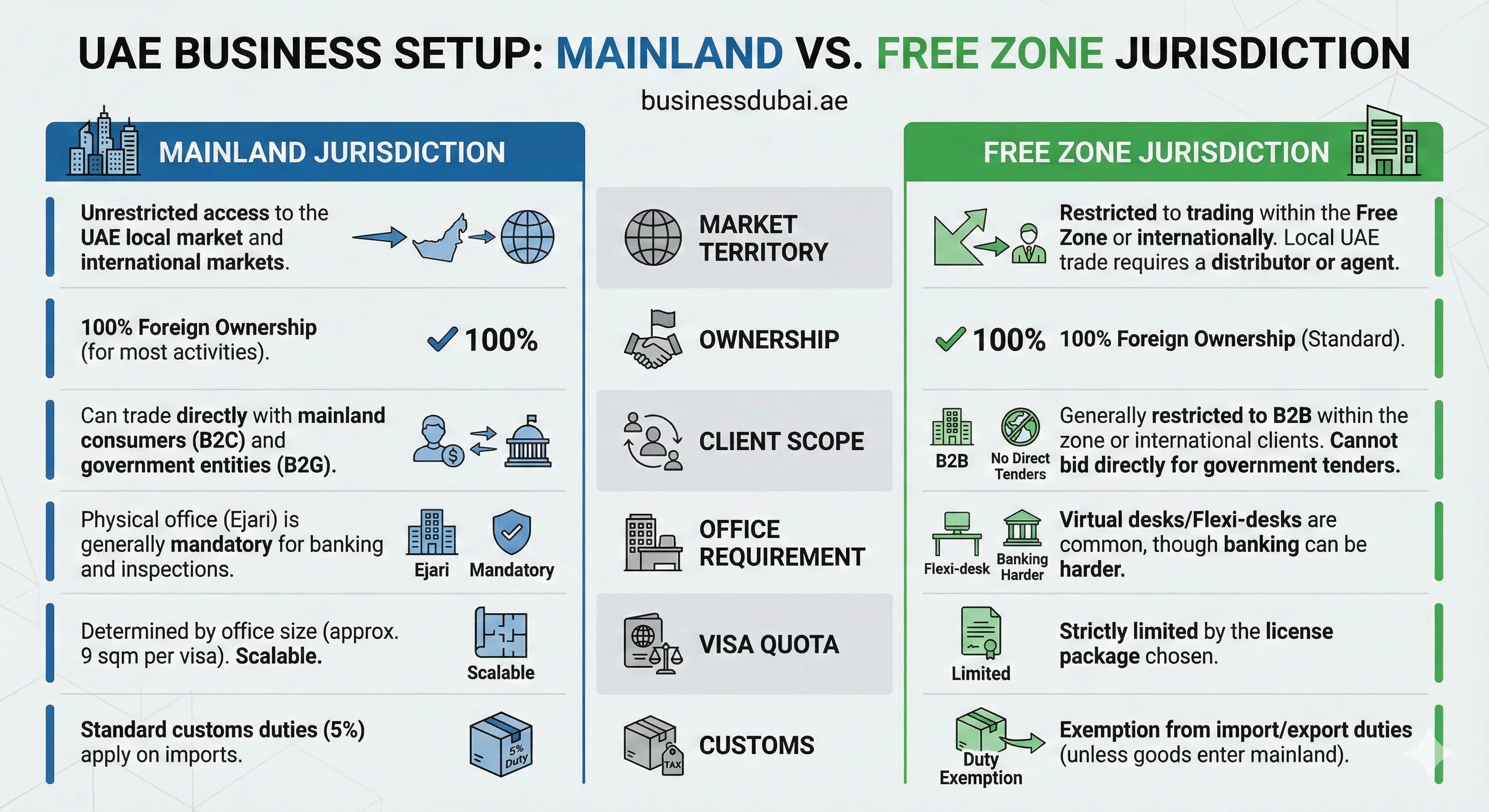
A mainland company is registered with the Department of Economy and Tourism (DET, formerly DED) and can trade anywhere in the UAE, not just within a specific zone. You can sell to local customers, bid on government contracts, open physical stores across any Emirate, and sponsor as many employee visas as your office space allows.
Since the 2021 law reform (Federal Decree-Law No. 32/2021), most mainland activities allow 100% foreign ownership. You no longer need a 51% UAE partner for the vast majority of businesses including trading, consulting, contracting, IT, e-commerce, restaurants, and more.
2. Types of Mainland Licenses
Your business activity determines which license you need. Picking the wrong one leads to delays, bank account rejections, and unnecessary regulatory headaches.
Your license type directly affects which bank will accept you, which external approvals you need, and how many visas you can sponsor. Get this right from day one.
3. Do You Still Need a Local Emirati Partner?
Short answer: almost certainly not.
Since June 2021, most mainland business activities allow 100% foreign ownership thanks to Federal Decree-Law No. 32/2021. The old "51% local / 49% expat" rule is history for the vast majority of entrepreneurs, whether you are in trading, consulting, IT, contracting, or retail.
When You Need a Local Service Agent (LSA)
If you are getting a Professional License (doctors, lawyers, engineers, accountants), you still own 100% of your company, but UAE law requires appointing a Local Service Agent. The LSA has zero ownership. They handle government liaison and administrative signatures only.
Optional Benefits of Having an Emirati Partner
Even though you do not have to have one, some people still choose to. Why?
If you do bring on a local partner, formalize everything in the MOA. The era of informal "side agreements" and "trust deeds" is over. UAE courts now treat the notarized MOA as the definitive proof of ownership.
Not sure if you need Mainland or Free Zone? We help you pick the right structure based on your actual business needs. No upselling, no confusion. Get a free consultation

4. Stage 1: Documents for Initial Approval
Initial Approval is the government's green light that says "yes, you can set up this business." Here is what DET needs from you at this stage.
4.1 Passport Copies of All Shareholders
Clear, colored scans of the front page, last page (with signature), and back cover of every shareholder's passport. If a company is a shareholder (not a person), you will need the company's registration documents instead.
Why it is needed: Identity verification and security screening against international watchlists.
Common mistake: Submitting a blurry phone photo or a cropped image that cuts off the passport number. This gets rejected instantly.
4.2 UAE Visa Copy and Emirates ID (If Already a UAE Resident)
If any shareholder already lives in the UAE, submit their current residence visa page and Emirates ID. If you are not a UAE resident yet and only want a business license initially, this is not mandatory, but providing it speeds things up.
4.3 Proposed Trade Name (Minimum 3 Options)
Submit at least 3 name options because rejections are common. Your trade name must follow DET naming rules:
Important: Trade name does not equal trademark. Registering a trade name with DET does NOT give you brand protection. If you want to protect your brand, file a separate trademark application with the Ministry of Economy.
4.4 Business Activity Code(s)
Every business activity in Dubai has a specific code from the DET official activity list. You need to pick the exact codes that match what your business will actually do, not vague descriptions.
Why this matters: Your activity code determines whether you need external approvals (from RTA, DHA, Municipality, etc.), whether 100% foreign ownership applies, what type of office space you need, and whether banks will accept your account application.
Common mistake: Choosing "General Trading" because it sounds broad. Banks are increasingly rejecting accounts with vague activity descriptions. Be specific: "Retail sale of electronics" is better than "General Trading."
4.5 Ownership Structure Details
DET needs to know who owns what percentage. If there are multiple shareholders, specify each person's share. You do not need the finalized Memorandum of Association yet (that comes later), but you do need to outline the ownership split and who will be the company's manager.
4.6 Contact Details for All Shareholders and Managers
Email address, mobile number, and physical address for each shareholder and manager. These are used for official government notifications, license renewals, and bank KYC verification.
4.7 No Objection Certificate (NOC), If Employed in UAE
If any shareholder currently holds an employment visa in the UAE sponsored by another company, some authorities require an NOC from the current employer. This confirms your employer has no objection to you starting a side business.
When it is required: Mostly for government or semi-government employees. Many private sector employers do not enforce this, but check your employment contract to be safe.
4.8 Bank Statement / Proof of Address (Home Country)
A recent bank statement (last 3 to 6 months) from your home country. This serves two purposes: it verifies you are an actual resident of your claimed country, and it provides early KYC documentation that you will need again when opening your corporate bank account.
Pro Tip: Start collecting your bank statements and source-of-funds documentation early. Banks are the biggest bottleneck in the entire setup process, not the license.
What Happens After Initial Approval?
Once DET issues your Initial Approval certificate, you can:
Think of Initial Approval as the green light to invest in office space and finalize your company structure.
Need help preparing your documents? We review your paperwork before submission to avoid rejections and delays. 500+ mainland setups completed with zero document-related failures. Talk to us today

Ready to set up this business in Dubai the right way? Our licensed business-setup advisors handle your trade licence, visas, and corporate bank account end to end — with transparent, fixed fees.
Get started free→5. Stage 2: Documents for Final License Issuance
With Initial Approval in hand, you move to the final stage. This is where you submit everything needed to get your actual trade license.
5.1 Initial Approval Certificate
The confirmation document issued by DET. You cannot proceed without it.
5.2 All Previously Submitted Documents
Everything from Stage 1 carries forward: passport copies, visa/Emirates ID copies, trade name reservation, NOC (if applicable). Keep these organized in one folder.
5.3 Office Lease Contract with Ejari Registration
A tenancy contract for your business premises, registered through the Ejari system (Dubai's mandatory rental registration platform). Your lease must match your licensed activity: a warehouse for logistics, an office for consulting, a shop for retail.
Critical: Without Ejari, you cannot get your trade license. Without a trade license, you cannot open a bank account. Ejari is the foundation of the entire process.
5.4 Notarized Memorandum of Association (MOA)
Signed by all shareholders (and the Local Service Agent if applicable), then notarized by a UAE Notary Public or via digital notarization using UAE Pass. The MOA outlines your business activities, ownership percentages, capital, and management structure.
For corporate shareholders: If a foreign company is a shareholder, their documents (Certificate of Incorporation, Board Resolution, etc.) must be notarized in the home country, legalized by the UAE Embassy, and attested by the UAE Ministry of Foreign Affairs.
5.5 Local Service Agent (LSA) Contract, If Applicable
Required mainly for Professional Licenses (doctors, lawyers, engineers, accountants). The LSA does not own any part of your company. You keep 100% ownership. They act as your government liaison for administrative matters.
5.6 External Authority Approvals, If Required
Some business activities need additional approvals beyond DET. DET will notify you during Initial Approval if your activity requires external clearance. The most common ones:
Pro Tip: Ask about required external approvals before you submit your initial application. Starting these approvals in parallel saves weeks.
5.7 Payment Voucher / License Fees
DET issues a payment voucher that summarizes all government fees: name reservation, initial approval, final license charges. Pay this to receive your trade license.
5.8 Proof of Identity for Managers and Signatories
Passport copy, visa, and Emirates ID for anyone who will have signing authority. Some authorities also ask for overseas proof of address or bank statements for anti-money laundering compliance.
6. Office Space and Ejari Requirements
Every mainland company in Dubai needs a physical address registered through the Ejari system. No Ejari means no license. No license means no bank account.
The 9 SQM Visa Rule
The Ministry of Human Resources (MOHRE) allocates visa quotas based on your office size. The standard rule is approximately 9 square meters per employment visa.
How Much Does Office Space Cost?
Over-investing in fancy office space before your business has revenue is one of the most common mistakes new entrepreneurs make. Start lean. You can always upgrade and move your Ejari later. It is a standard process.
Ejari Registration Cost
Approximately AED 220 (including VAT) if done online via the Dubai REST app. Slightly higher at a trustee center.
Mainland packages starting from AED 22,500 including trade license, one residence visa, and our complete service. No hidden fees. View mainland pricing
Not sure which licence or free zone fits your plan? Get a free, no-obligation consultation and a clear cost breakdown tailored to your business.
Get a free consultation→7. Who Can Start a Mainland Business in Dubai?
Virtually anyone with a valid passport. The UAE allows all nationalities to own mainland businesses. There are no nationality restrictions for typical activities.

8. Banking: The Part Nobody Warns You About
Getting your trade license is the easy part. Opening a corporate bank account is where most entrepreneurs get stuck. Banks in the UAE follow strict KYC (Know Your Customer) and AML (Anti-Money Laundering) rules, and requirements are getting tighter every year.
Documents Banks Typically Ask For
Banking Timelines
Top Reasons for Bank Account Rejection
Pro Tip: Build a basic company website and LinkedIn page BEFORE applying for a bank account. Banks check your digital footprint as part of their compliance process. A company with no online trace raises red flags.
We assist with bank account opening after license issuance. We know which banks accept which activities and help you prepare the right documentation from day one. Ask us about banking support
Want to skip the paperwork and approvals? Our team manages the whole setup for you, so you can focus on launching.
Talk to a setup expert→9. Pre-Application Checklist
Based on 500+ mainland setups we have processed, here are the things that cause the most delays when people skip them:
10. Post-Setup Compliance
Getting your license is step one. Staying compliant is what keeps your business alive. Here is what you need to manage after setup:
Already have your license and need help with renewals, VAT, or compliance? We support existing businesses too. Get in touch
Frequently Asked Questions
Can I start a mainland company on a tourist visa?
Yes. Dubai allows you to apply for Initial Approval and even complete licensing on a tourist or visit visa. You only need to switch to a residence visa if you want to live and work in the UAE long-term. About 30% of our clients start the process on tourist visas.
How much does mainland business setup cost in total?
Total cost ranges from AED 22,500+ depending on your activity, office space, and number of visas. Our mainland package starts at AED 22,500 including one residence visa, trade license, MOA notarization, and our service fee. This includes all government fees with no hidden charges.
How long does the entire process take?
License approval takes 5 to 10 working days for standard mainland applications. If you are adding a residence visa, add 7 to 14 days for Emirates ID and medical processing. Bank account opening adds another 1 to 4 weeks. Realistic total: 4 to 6 weeks for full setup including bank account, or 1 to 2 weeks for license only.
What is the difference between DED and DET?
Same authority, rebranded. The Department of Economic Development (DED) was renamed to Department of Economy and Tourism (DET) in 2021 when it merged with Dubai Tourism. Both names refer to the same licensing authority.
Do I need a physical office for an online business?
Yes, even fully online businesses need at least a registered office address with Ejari for a mainland license. The minimum is a desk in a business center or sustainability center. If you truly want to operate with no physical space, consider a Free Zone with flexi-desk options instead.
Can I have multiple business activities under one license?
Yes. Most mainland licenses allow you to list multiple activities. However, each additional activity may trigger different regulatory requirements or external approvals. We help clients pick activity combinations that maximize flexibility without creating unnecessary compliance burden.
Do I need a local partner for a restaurant or retail store?
No. Both restaurant and retail activities now allow 100% foreign ownership on the mainland. You will still need Municipality approvals for food businesses and a physical premises with Ejari, but no Emirati partner is required.
What documents do I need specifically for a bank account?
Trade license, MOA, passport copies of all shareholders, Emirates ID (if available), Ejari certificate, 6 to 12 months personal bank statements, business plan with projected transactions, and proof of source of funds. Having a company website and LinkedIn page also helps because banks check your digital presence.
Is the Golden Visa worth getting for business setup?
It is a strategic advantage. A Golden Visa signals to banks that you have passed government vetting, which can speed up account opening. It also decouples your residence from your company. If your business closes, your visa is not affected. Worth considering for investors making a long-term UAE commitment.
What happens if I miss my license renewal deadline?
Fines accumulate daily. Your bank account may be frozen. You cannot sponsor or renew employee visas. In serious cases, the license can be cancelled entirely. We send renewal reminders to all our clients 60 days before expiry.
Can a Free Zone company trade on the Mainland?
Partially. Under Resolution 11 of 2025, some Free Zone companies can get a "Permit to Operate on Mainland." But for businesses dealing in physical goods within the UAE, a full mainland license still gives you complete supply chain control without relying on third-party distributors.
Can I change my office location after getting my license?
Yes. Sign a new tenancy contract, register new Ejari, update your trade license address with DET, and notify your bank and immigration. There are amendment fees, but it is a routine process.
What if all my trade name options get rejected?
You will need to propose new names. DET usually tells you the reason for rejection (too similar to existing name, contains restricted words, etc.). This is common, which is why we recommend submitting 3 to 5 options.
Need Help With Your Mainland Setup?
We handle the entire documentation process from start to bank account opening. No hidden fees, no surprises. Just tell us your business idea and we will tell you exactly what documents you need, what it will cost, and how long it will take.
500+ mainland registrations completed since 2013. Transparent pricing. No hidden charges.