1. What is a Freezone Company and why do investors prefer it? Is setting up a freezone company in the UAE really a cost-effective option?
A free zone company is a business registered in one of the UAE’s specially created economic zones, built to make starting a company smooth and stress-free. These zones are a popular choice for startups, online businesses, consultants, traders, and international founders who want to enter the UAE market without unnecessary complexity.
Most investors choose free zones because they can own the company 100% themselves, without needing a local partner. The process is usually faster, the documentation is simpler, and visa options are flexible. In many cases, you don’t even need a physical office—shared desks or flexi-desk facilities are enough to stay fully compliant.
When it comes to cost, free zone setups are generally more affordable than mainland companies. License packages are available at lower starting prices (as low as 5,500 AED), yearly renewal costs are predictable (~80% of what you’ve paid in the first year), and day-to-day running expenses are easier to control. For businesses that operate online, work with international clients, or don’t need a storefront inside the UAE, a free zone company offers a practical mix of low cost, flexibility, and room to grow over time.
-
Is taxation different compared to Mainland?
Earlier, free zone companies were widely seen as completely tax-free. That was true for a long time. Things changed in 2023 with the introduction of 9% Corporate Tax in the UAE. Today, both mainland and free zone companies fall under the corporate tax framework if they earn income from the UAE mainland. That said, free zone companies still enjoy a major advantage. Income that qualifies as “Qualifying Income”—such as revenue from other free zone businesses or from clients outside the UAE—can still be taxed at 0%, as long as the company meets the required conditions. As for VAT, the rule is simple and the same for everyone. 5% VAT applies to both mainland and free zone companies when the activity is VAT-eligible. In short, free zones are no longer completely tax-free by default, but for the right type of business—especially those working internationally or within free zones—they can still offer meaningful tax efficiency when structured correctly. -
**Can Freezone companies operate anywhere in the UAE?
**No. This is the biggest restriction. A Freezone company is legally restricted to doing business within the Freezone itself or internationally. You cannot trade directly with mainland UAE clients (e.g., a shop in Dubai Mall) without a local distributor or a branch office.
2. What types of Freezones exist in the UAE?
There are over a dozen Freezones, often categorized by industry.
Which Freezones are best for eCommerce, trading, media, tech, logistics, industrial?
- eCommerce: Dubai CommerCity, EZDubai (Dubai South), Ajman Freezone.
- Media: Dubai Media City, twofour54 (Abu Dhabi), SHAMS (Sharjah - lower cost).
- Tech: Dubai Internet City, DIFC (FinTech), DTEC (Silicon Oasis).
- Logistics/Industrial: JAFZA (Jebel Ali), Dubai South, Hamriyah Free Zone.
- General Trading: DMCC, IFZA, RAKEZ.
- **Which Freezones offer the cheapest setup?
**Typically, the "Northern Emirates" Freezones are more budget-friendly. Sharjah Media City (SHAMS, from AED 6,885), RAKEZ (Ras Al Khaimah, from AED 6,010) and SPC Free Zone (from AED 5,765) are known for low-cost packages, while IFZA in Dubai starts from AED 12,900. The most cost effective is Ajman Freezone as they are running offers on their freezone for entrepreneurs. Get the best price from businessdubai.ae.
- **What benefits vary between each Freezone?
**Earlier, certain free zones had a clear edge because banks trusted them more, they offered higher visa allocations per desk, or they were known for specific industries. That difference used to matter a lot. But on the ground today, things are much more balanced. Most free zones are now widely accepted by banks, and opening a corporate bank account has become easier across the board. In practical terms, you’re no longer restricted to just a “premium” free zone—companies registered in almost any free zone can successfully open bank accounts, as long as the business profile and documents are in order.
3. What business activities are allowed in Freezones?
Free Zones allow a wide range of activities. Almost any activity: trading, consultancy, media, education, and light manufacturing. – from trading and consulting to industrial manufacturing and creative services. Each Free Zone publishes a license activity list. You can often include multiple activities on one license if they are related. For example, many zones allow several trade or service activities per license. However, mixing commercial/trading and professional/service under one license is usually not permitted – you’d need separate licenses for each category but currently Ajman Freezone does allow multiple activities from different categories. You can add approved activities later by applying for a license amendment (paying an extra fee)
- Which activities need external approvals?
Specialized activities need "NOCs" from other bodies. E.g., Education (KHDA), Healthcare (DHA/MOH), Engineering (Municipality). - **Can I combine service + trading + consultancy in one license?
**Yes, many Freezones (like RAKEZ, IFZA, AFZ) allow "General Trading" or mixing activities, but they usually charge extra per additional activity group. - **Can I add more activities later?
**Yes, usually for a fee (approx. from AED 500 per activity).
4. How much time does it take to register a Freezone company?
Generally, Free Zone company setup is fast. In straightforward cases with complete documentation, a Free Zone license can be issued in 3-7 days (and in some very fast zones, 1–3 business days). Key steps include:-
-
Name reservation & initial approval: Often completed within 1–2 business days if the Free Zone is quick and all documents are correct. Some zones and packages can fast-track this.
-
Final license issuance: Once the signed incorporation documents and lease proof are submitted, many Free Zones issue the trade license in 1–3 business days. Some zones (Meydan, IFZA, SHAMS, AFZ) boast 1–2 day turnaround, while larger zones (DMCC, DSO) may take up to a week.
-
Establishment Card (Immigration Card): After the license is issued, obtaining the Establishment Card takes another 4–7 days (this is needed for visas).
-
Visas: Sponsoring visas can add a few more days, depending on medical and Emirates ID processing (typically a week or so).
Q. What factors affect the registration timeline? When does the timeline increase?
Regulated activities requiring external approvals, incomplete or unclear documents, or high visa counts (which involve labor paperwork) can delay setup. For example, healthcare or education licenses often add weeks. Similarly, missing sponsor NOCs or address proofs will halt approval. Freelancer or e‑commerce packages (which usually have simpler requirements) can be slightly quicker, but still follow the same sequence. In summary, plan roughly 1–2 weeks for standard Free Zone company formation, allowing more time if approvals or corrections are needed.
**[Initial Approval]
**
4. What is Initial Approval in a Freezone?
It is the authority's "green light" confirming they have no objection to you starting a business. Initial Approval is the preliminary “go-ahead” from the Free Zone authority on your application. It indicates that your proposed company details (name, activity, shareholders, etc.) have passed the first review. This is mandatory before you can incorporate. The Free Zone checks your trade name (against naming rules), the appropriateness of your activity, and validates your submitted documents and shareholders’ credentials. It does not guarantee the final license – it simply means the authority is willing to proceed. In practice, Initial Approval triggers the next steps: drafting the Memorandum of Association (MoA), arranging the lease, and collecting final documents.
Q.What checks does the Freezone do?
They check your background (security) and ensure your chosen trade name isn't already taken or offensive.
Q.Can Initial Approval be rejected?
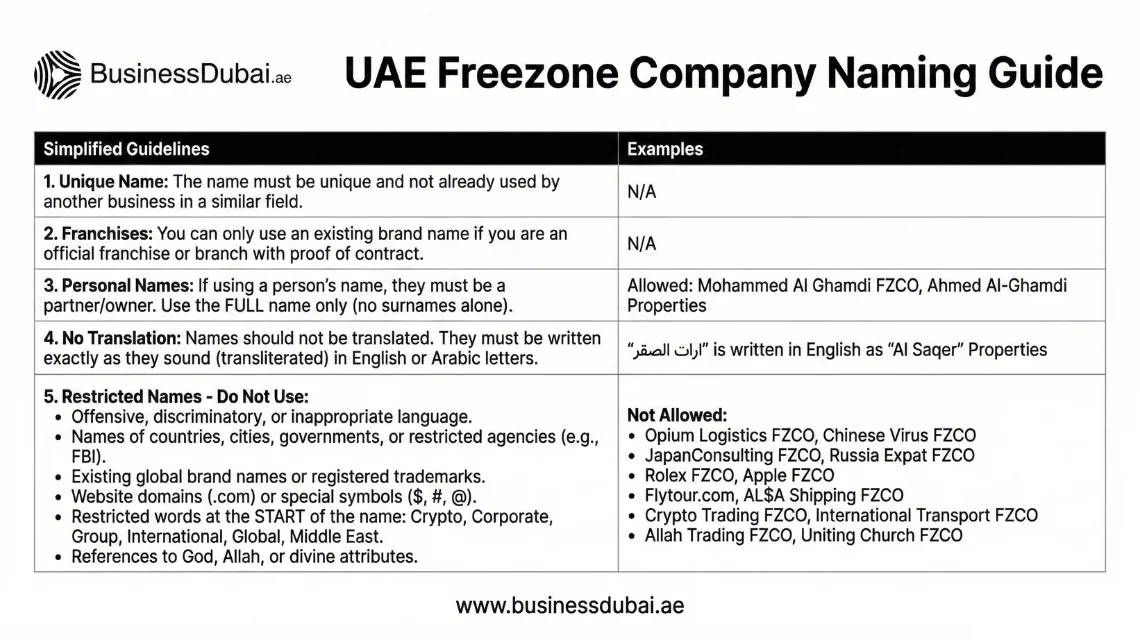
Initial Approval can be refused if you violate rules. Common reasons include: an illegal company name (e.g. using reserved words, religious names), an unapproved activity, missing paperwork, or lack of required NOCs (for example, if a resident’s sponsor has not permitted them to open a new business). If Initial Approval is denied, the Free Zone typically provides feedback so you can correct and reapply. Once granted, you may proceed to sign the incorporation documents and pay the license fees.
5. What documents are required for Initial Approval?
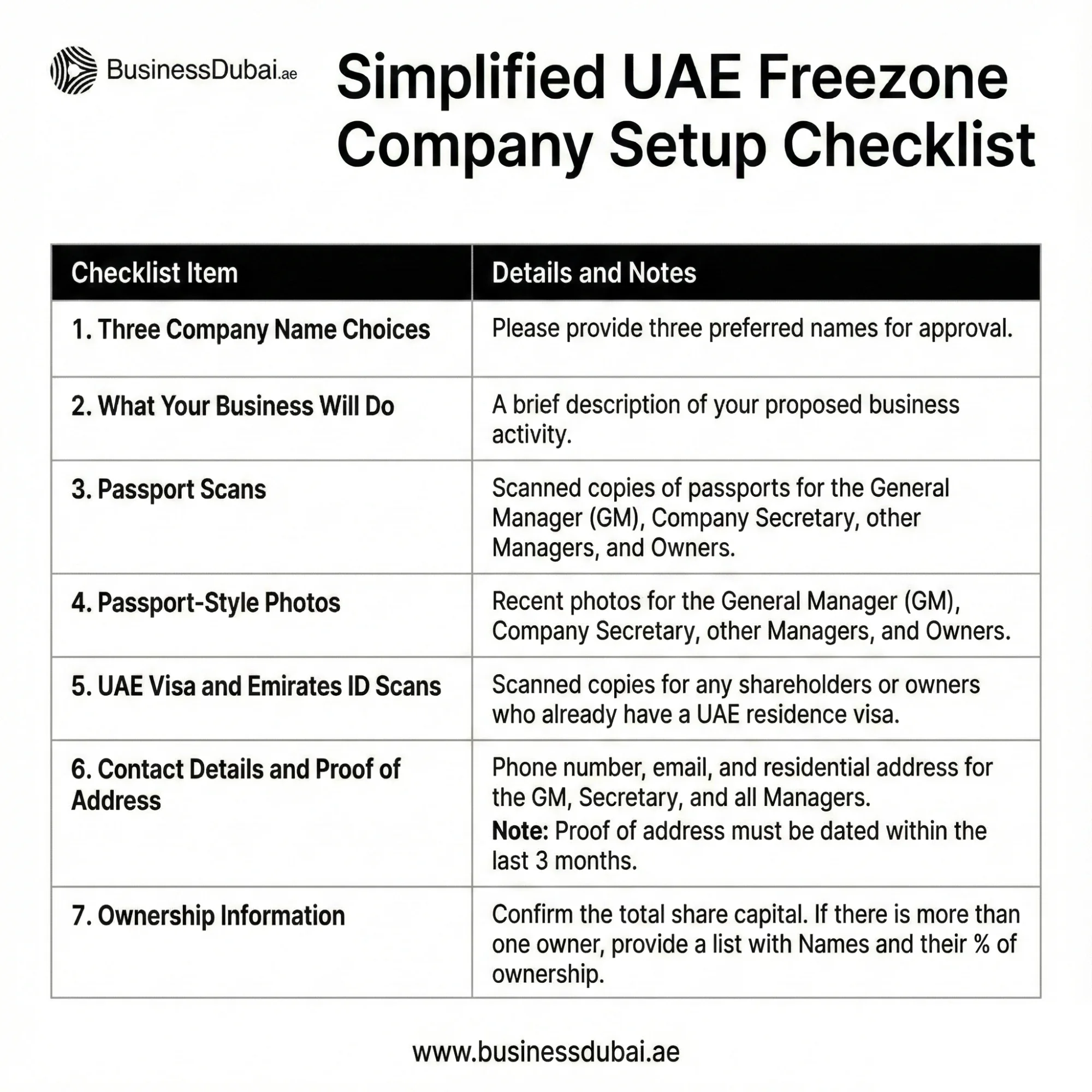
For Initial Approval most Free Zones require basic company and owner information. Typically you will submit:
-
Application form: the Free Zone’s initial approval form, plus your requested trade name(s). As per the UAE government.
-
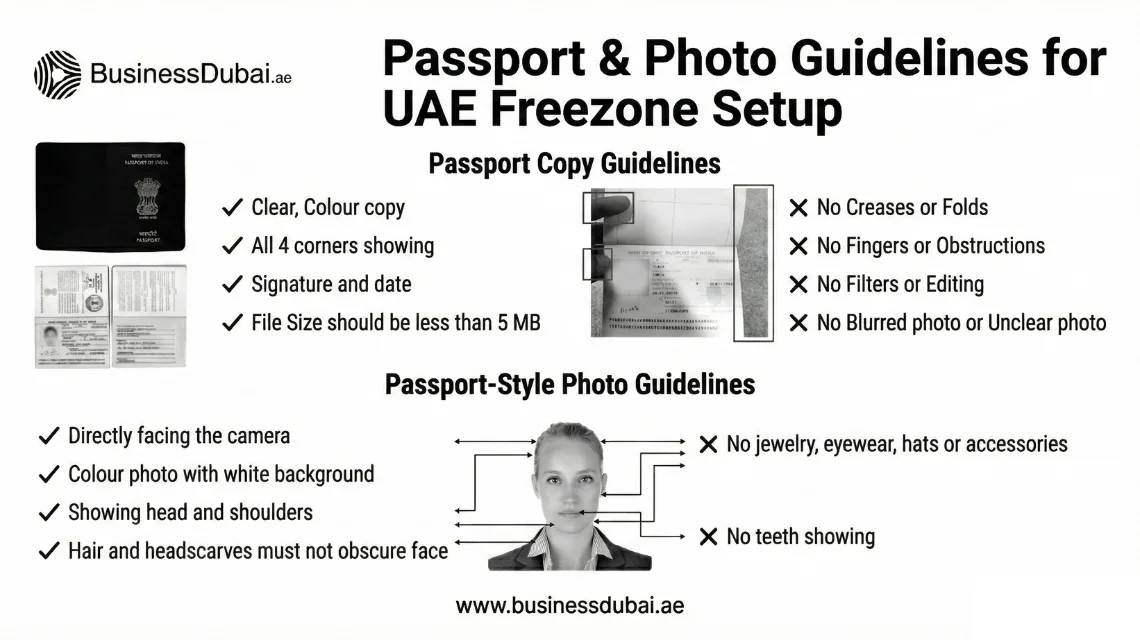
Passport copies: must be clear (usually color) and valid for 6+ months and copies of each shareholder’s passport. The corner should be visible from all the sides.
-
Passport-size photo: of each shareholder/manager with the plain background.
-
Copy of residence visa or entry stamp: Required if you are already inside the UAE. if you or any shareholder are already in the UAE on a visa (to prove legal presence). It is not required if you’re outside UAE.
-
Trade name: 3 options in order of preference. 3 names required if one gets rejected by any chance.
-
Contact details: addresses, phone numbers, etc.
-
Home Country Residency Proof: You need to give one document which proves your country residency. Documents can be any utility bill or bank statement.
-
Business Plan & Activities: Many zones want a brief plan or description of the intended activity. We as businessdubai.ae will help you to decide your freezone activities as per your business.
-
Sponsor NOC: If a UAE-resident (or citizen) is one of the shareholders, a No Objection Certificate from their current sponsor/employer is usually needed.
-
Professional certificates: If you’re applying for a professional license (engineering, medical, etc.), attested degrees or professional certificates and CVs may be required.
-
Existing license: If you already own another UAE company, a copy of that license may be requested.
-
Board Resolution/POA: If a corporate entity is a shareholder, a board resolution and Power of Attorney authorizing the investment may be needed.
1. Is a passport copy enough? Usually yes for investors abroad.
2. Is a business plan needed? Only for specific Freezones (like DMCC or JAFZA) or complex activities. Most cheaper Freezones (IFZA, SPC, AFZ) do not require one. But we’ll help you to draft the complete business plan for your business.
3. Do UAE residents need NOC? Only if they are employed by a government entity or a private company that strictly enforces non-compete clauses. Most Freezones do not ask for an NOC from your current employer anymore.
4. Are attested certificates required? Only for professional licenses (e.g., Engineer, Doctor, Teacher) to prove qualification. Not for trading.
6. How long does Initial Approval take?
Initial Approval is typically very quick. In straightforward cases, it often comes through within 1–2 business days once you submit complete documentation. Some Free Zones even promote one-day approvals for standard activities. There are fast-track services (sometimes for a premium) that can guarantee 24–48 hour turnaround. We’ve seen AFZ gives business license within 24 hours as per our experience.
Delays in Initial Approval usually arise from missing or inconsistent documents, or when an activity needs government vetting. For example, if your application requires an external NOC (say, from health or telecom authorities), the Free Zone must await that clearance, adding days or weeks. Another cause is name issues: if your requested name violates rules, you’ll have to choose a new one and reapply, delaying the process.
Typically, shareholders or managers do not need to be physically present in the UAE for Initial Approval. It is mainly a document review step. You can use a local consultant or the Free Zone’s e-portal to submit paperwork. After you receive the Initial Approval certificate (often electronically), you move on to the incorporation stage.
After Initial Approval
7. What is a Free Zone Trade Name Approval?
Before any license is issued, your proposed trade name (company name) must be approved. Free Zones apply naming rules similar to the mainland: the name can’t use protected terms (e.g. “Emirates,” “UAE,” “ALLAH”, “DUBAI”, royal family names) or anything offensive. Each zone has its own list of banned words and required suffixes (e.g. FZE, FZCO). The Free Zone will check your name during Initial Approval and may ask you to modify it if it conflicts with existing names or guidelines.
- Can the Free Zone reject a trade name? Yes, if it includes sensitive words (Allah, UAE, Police, Government) or is identical to an existing brand.
- Are name rules different from Mainland? Similar, but Freezones often require the suffix "FZ-LLC" or "FZE".
- Can I reserve a name without starting a company? Yes, for a fee, but it expires after a set period (usually 3-6 months).
8. Documents Required After Initial Approval?
Once Initial Approval is granted, you proceed to finalize the company registration. Typically you must submit:
-
Signed Memorandum and Articles of Association (MoA/AoA): This is the company’s constitution. It will be prepared by the Free Zone based on your details. All shareholders (or their authorized representatives) must sign it.
-
Proof of office: If you opted for a flexi-desk package, the Free Zone will provide a flexi-desk agreement. If you took a physical office, you submit the lease contract (and the Ejari-tenancy registration) to the zone. This demonstrates you have a valid address in the Free Zone.
-
Shareholder/Director documents: Final passport copies (with visa pages if resident) of all shareholders and managers, plus Emirates ID copies for UAE nationals/visa holders..
-
Bank deposit certificate: Some zones require proof that the share capital has been placed in a corporate bank account (often at license issuance, but sometimes upfront). If applicable, a bank deposit letter is needed.
-
Updated application forms: The free zone might provide a final corporate registration form or checklist to fill, and request any outstanding items (e.g. specimen signatures, list of directors).
-
Payment proof: Evidence of payment of all license, immigration card, and other fees (often handled by the setup agent or online portal).
In essence, you provide the final set of incorporation documents: the MoA/AoA, corporate filings, and office proof. For example, in DMCC (a Dubai Free Zone) you would send the completed application form, MoA/Articles, shareholders’ passport copies and proof of address. The Free Zone then reviews everything. Once satisfied and fees are paid, they issue the official trade license and company registration certificate.
Ready to set up this business in Dubai the right way? Our licensed business-setup advisors handle your trade licence, visas, and corporate bank account end to end — with transparent, fixed fees.
Get started free→9. What happens after Initial Approval is granted?
You pay the license fees and sign the MoA.After Initial Approval, the Free Zone issues you the MoA/AoA drafts. You need to sign these company documents (usually in the presence of a notary or through a power of attorney) and submit them back to the Free Zone. At this stage, the authority will have you finalize any remaining details – for instance, paying the license fee, formalizing your office space, and providing any missing proofs (such as director photos or bank deposit letters). We as businessdubai.ae will help you in all the things. We’ll send you digital documents for the signature before submitting to Freezone.
Once you submit the signed MoA/AoA and all outstanding requirements, the Free Zone will complete the incorporation. Shareholders or directors need to sign the MoA (or approve via POA) before license issuance. If a shareholder cannot be present, they can appoint an agent to sign on their behalf. After all signatures and documents are in place, the Free Zone issues the official trade license and company certificate. This typically happens within a few business days of final submission, provided everything is in order. At that point, your Free Zone company legally exists and you can begin operations (within the zone and approved activities).
Q. Do holders need to sign?
Yes, all shareholders must sign. Because it is mandatory for the verification and for the government authority to check.
10. Do I need an office space before the final license is issued?
- No. The Freezone provides a "Virtual" or "Flexi-desk" lease automatically as part of your package to satisfy the legal requirement.
- Is flexi-desk enough- For the license, yes. For some banks, it can be harder but banks like WIO and ADCB easily approve it as per our experience.
- Does office size affect visa quota- Yes. A Flexi-desk usually gives 3-4 visas. More than 4 visas then a physical office is required which gives 1 visa per 9 sq. meters. Please note most of the freezones can give upto 10 visas although some freezones do allow more than 10 visas but further documents are required.
Q. What is an Establishment Card and why is it needed?
The Establishment Card (also called Immigration Card or Company Card) is an official document issued by the Immigration Authority, linked to your Free Zone license. It is essentially a company’s immigration file. This card is mandatory before you can apply for any residence visas (investor, employee or family) under the company. Think of it as your business’s “key” to UAE immigration services.
After the trade license is issued, you apply for the Establishment Card through the Free Zone’s immigration section or Dubai GDRFA (for Dubai Free Zones). This involves paying the immigration fees and providing your company’s license and shareholder details. Once issued (usually 2–5 days), the Establishment Card proves to immigration that your company exists and is authorized to sponsor visas.
In short: you cannot sponsor or process any UAE residence visas until you have the Establishment Card for your Free Zone company. It’s the very next step after license issuance, and after that you can proceed to apply for the investor visa and employee visas under your new company.
What Exact Documents Are Required
13. What documents are required to register a freezone company?
To register your company (initial stage), you typically need:
-
Passport copy: Valid for at least 6 months, with UAE entry stamp if you’re already in the country.
-
Passport photo: A recent color photo of each shareholder (professional style).
-
Visa page/Emirates ID: If any shareholder is UAE-based, provide a copy of their residency visa page or Emirates ID.
-
Business plan: An outline of the business activity and markets (some Free Zones require this).
-
Trade name reservation form: Completed form or online application showing your company name(s).
-
Home Country Residency Proof: You need to give one document which proves your country residency. Documents can be any utility bill or bank statement.
-
Initial application form: Filled by the shareholder or agent (collects ownership details and intended activities).
-
NOC from sponsor: If a resident shareholder is sponsored (e.g. employment, family visa), a No Objection letter from their sponsor is needed.
-
Certified documents (for corporates): If a corporate entity is a shareholder, provide the corporate documents: Certificate of Incorporation, Board Resolution, and Memorandum (all notarized and UAE-attested), plus a Power of Attorney for the signatory.
-
Degree certificates: For professional licenses, include attested academic or professional qualifications and CVs.
-
Minimum share capital documents: If the Free Zone has a required share capital (e.g. DMCC requires AED 50,000), you may need a bank statement or deposit certificate to show the capital. On ground reality only few freezone companies ask deposit certificate only if you’re business little on the critical side.
In practice, originals or attested copies of any foreign documents will be needed later. However, for the initial application you usually give scanned copies. The key is: passports (with 6+ months validity) are essential, plus a filled application and any NOCs or sponsor approvals. The rest (MoA, share certificates, etc.) are prepared after initial approval.
14. Do Freezones require an Ejari/Tenancy contract?
Free Zones generally require proof of an office lease for visa purposes, but not all require you to register that lease as an Ejari. It depends on the office type:
-
Flexi Desk/Smart Desk: This is a shared/virtual office setup. No separate Ejari registration is needed – the Free Zone’s package includes the address. (Ejari and tenancy contracts are not required for flexi desk licenses.)
-
Physical Office: If you lease a dedicated office or warehouse, you must have a proper lease contract (and typically register it with Ejari, the Dubai tenancy system) for visa applications. Most Free Zones will ask for a copy of your Ejari or tenancy contract when you apply for visas. In other words, actual office leases do require Ejari registration.
-
Free Zone-provided space: Some Free Zones (like Ajman Free Zone, Shams) may offer bundled office or warehouse solutions. In those cases, the Free Zone issues an agreement on its own forms, and handles any registration internally.
In summary: if you are using the free flexi/virtual office included in your package, you don’t need a separate Ejari. But if you take a stand-alone office in Dubai/Abu Dhabi, Sharjah or Ajman, you will go through Ejari registration just like Mainland companies.
Q.Which Freezones include workspace automatically- Almost all (IFZA, AFZ, SHAMS, RAKEZ, Meydan) include a "lease agreement" in the package price.
Q.Which Freezones require separate tenancy- Only if you rent a physical warehouse or retail space (e.g., JAFZA, DAFZA).
Business Structure & Ownership
**
15. Can I do multiple activities under one license?
Yes, to an extent. Many Free Zones allow you to bundle related activities on one license. For example, you might include several trading or service activities if they fall within permitted categories. The rules vary by zone, but a common approach (like in RAKEZ) is: you can have up to five activities in the same category under a commercial license, or two activities under a service license. However Freezone like Ajman Nuventrues does allow up to 10 activities and it can be in different categories.
However, most Free Zones separate “commercial” (trading) and “professional” (services) licenses. You generally cannot mix these on the same license. For instance, RAKEZ explicitly requires commercial activities on a Commercial License and professional services on a Service License. If you need both types, you must hold two licenses or convert to a multi-activity license if offered.
Adding new activities: You can usually add new activities to your license even after your company is registered. Most free zones allow you to update your license during the year by applying for a change of activity and paying a small amendment fee. Once approved, they issue an updated license with the new activity added.
16. Can Freezone companies trade within UAE Mainland?
Traditionally, a Free Zone company cannot directly sell to customers in the UAE mainland. Free Zone companies are meant to do business only within the Free Zone or internationally. To reach mainland markets, you usually need a local distributor/agent or set up a mainland branch/licence. However, rules have evolved: Dubai just announced (Dec 2024) that eligible Free Zone companies can now obtain special permits to operate in Dubai’s mainland. This is a very recent change allowing a Dubai branch license for some Free Zone firms (for a fee).
- Do I need a distributor- Yes. You cannot issue an invoice directly to a mainland consumer for physical goods. You must sell to a local distributor (LLC) who then sells to the market.
- Do I need a Mainland branch- This is another option. You can open a "Branch of a Freezone Company" on the mainland to trade directly.
- Are there penalties- Yes, fines for trading onshore without a license are hefty (starting AED 50,000).
Q.What are the office requirements (flexi desk, visas)?
Every Free Zone license must be tied to an office type, which determines your visa quota. The basic options are:
-
Flexi Desk / Smart Desk: A shared desk in a common area. This is the cheapest option (often from AED 5,000/year). It provides you with an office address and minimal facilities. Visa eligibility is typically 1–3 visas per license. Ejari is not needed (the Free Zone handles the address).
-
Virtual Office: Similar to flexi-desk but may not include a physical desk. It gives you an official address and mail handling. Visa quota is usually very limited or none.
-
Dedicated Office: A private office suite or room leased to your company. Prices vary by zone and size. A small private office might give 3–6 visas, a larger one 6–12 visas, and a big multi-room office 12–20+ visas. Ejari is required and rent is higher.
-
Warehouse/Industrial Unit: For trading or manufacturing, you can rent a warehouse or factory unit. These allow the highest visa counts (often 20+ depending on size and Free Zone) and are built for physical storage/production.
-
Retail/Showroom: Some Free Zones (e.g. shopping malls) allow licensed shops. Visa benefits depend on the space size.
-
Office Space: A generic term for any physical office space (could be coworking or serviced office).
Each category of office comes with a different visa allowance. For example, the visa quotas can be roughly: Flexi Desk – 1–3 visas; Small Office – 3–6 visas; Large Office – 12–20 visas or more. (Actual numbers depend on the Free Zone’s policy.) If you need more visas later, you can usually upgrade your office and request an extra visa quota.
(Note: "Ejari" is the Dubai tenancy registration system. It’s not needed for flexi/virtual offices, but a physical office lease must be registered with Ejari for visa purposes.)
Q.What types of office spaces are available in Freezones?
Free Zones offer different office solutions to fit all budgets:
-
Flexi Desk / Smart Desk: A shared desk in a co-working area. You get a workspace when you need it. Ideal for startups or single-person firms.
-
Virtual Office: Just an official business address (for mail and registration). You work remotely or on-site elsewhere. Lowest cost, minimal visa quota.
-
Dedicated/Serviced Office: Your own enclosed office room or suite. More privacy and visas. Prices start higher (e.g. from AED 15/year and up).
-
Warehouse/Storage Unit: A large industrial space for inventory or production. Required for importers or manufacturers.
-
Showroom or Retail Outlet: In Free Zone malls or zones that include retail space. Useful if you want to directly sell to the public.
-
Labor Accommodation: Some Free Zones (especially RAK, UAQ) offer staff housing options on site.
Each Free Zone has its own offerings; some even have plug-and-play furniture options. The simplest “office” is the Flexi/Smart Desk, which is available in most Free Zones (Ajman, SHAMS, RAKEZ, AFZ, IFZA, etc.). Larger offices or warehouses are more expensive but come with correspondingly higher visa quotas.
Q.Can I change or upgrade my office space?
Yes. You can upgrade your license from a flexi desk to a private office or larger space by filing an amendment with the Free Zone. This usually involves: submitting the new lease agreement (or paying the difference if the Free Zone provided the space), and paying an amendment fee. Once approved, your license will reflect the new office.
Upgrading allows you to sponsor more visas. Free Zones often charge a small service fee or visa quota fee for each additional visa beyond your current limit. For example, in DMCC the fee is AED 500 per extra visa. The specific costs depend on the zone and your new office size, but generally you either pay per visa or a fixed fee for bigger offices.
Remember that your visa quota is tied to office size. When you move to a larger office, the Free Zone will recalculate how many visas you can hold (and you can then apply for those new visas). Also note: some zones require you to renew/upgrade the office lease before you can renew the license if it’s about to expire.
Q.What is the paid-up share capital requirement?
UAE law no longer enforces a minimum paid-up capital for LLCs in general. Free Zones often state a capital in the MoA for formality, but it is usually nominal. For example, most new RAKEZ or Ajman companies put AED 1 as capital. Some zones have higher usual amounts (e.g. DMCC traditionally used AED 50,000), but even this is usually authorized capital – you don’t necessarily have to deposit it immediately.
In practice, banks and regulators care more that your declared capital is reasonable for your business. When opening a corporate bank account, the bank will look at your actual funded capital (bank balance/investment), so you should have some funds in place. But for licensing itself, there is effectively no strict minimum. You should simply set your capital at a realistic level and be prepared to show the bank that you have some operational funds.
Q.What are the MoA and AoA and when do I sign them?
The Memorandum of Association (MoA) and Articles of Association (AoA) are the constitutional documents of your company. They outline the ownership structure, share capital, management rights, and other company rules. In the Free Zone setup, these usually come as one combined document (often just called the MoA).
You sign the MoA after receiving Initial Approval and finalizing the details (like shares and activities). The Free Zone will often provide a draft based on your application. All shareholders (or their legal agents) must sign the MoA in the presence of a notary or at the Free Zone office. If someone can’t sign in person, they can grant a notarized Power of Attorney to another person to sign on their behalf. Once signed, the MoA is submitted to the Free Zone along with other documents to complete incorporation.
As for digital signing: some Free Zones are starting to allow electronic signing or online notarization, but the norm has been ink signatures in front of an official. It depends on the Free Zone’s facilities; check if they support e-signature.
Changing clauses later: Generally, core MoA items (like shareholding percentages or capital) cannot be altered without an official amendment process. If you want to change shareholder stakes or add a partner after incorporation, you must apply for a license amendment (as covered in the question on changing shareholders). This will result in an updated MoA being filed with the new details.
Visa & Immigration
Not sure which licence or free zone fits your plan? Get a free, no-obligation consultation and a clear cost breakdown tailored to your business.
Get a free consultation→22. What visas can I obtain?
With a Free Zone company, you can sponsor:
-
Investor Visa: For each shareholder/partner (usually requires a minimum ownership, commonly 5%). This visa is tied to your ownership in the company and For shareholders. Valid for 2 or 3 years (some offer 10-year Golden Visa for high investments).
-
Employment Visas: For employees that your company hires. The number you can sponsor depends on your visa quota (which in turn depends on your office size). For example, a flexi-desk company can usually sponsor 1–3 visas, whereas a bigger office allows more (up to 20+ in large premises).
-
Dependent Visas: Once you hold an investor or employee visa, you can also sponsor your immediate family (spouse, children and parents) subject to income and housing requirements.
Generally, each shareholder can apply for one investor visa, and then you allocate the rest of your visa quota to employees. Note that the total number of visas (investor + employees) cannot exceed your quota. So if you have a 3-visa quota and two investor visas, you could sponsor one employee, or vice versa. Some Free Zones allow “conversion” between visa types (e.g. converting an unused employee slot to a partner visa).
24. When can I start applying for visas?
You must have your company license issued and your Establishment (Immigration) Card in hand before applying for any visas. In practice, visa applications begin after license issuance. The typical sequence is:
- Immediately after the license? You must wait for the Establishment Card (Company Immigration Card) to be issued first (takes 1-3 days after license).
- Does an investor need to be present? No for the application, but Yes for the Medical Test and Fingerprints (Biometrics) inside UAE.
25. Can I sponsor my family?
Yes, once you have an investor or employment visa through your Free Zone company, you can sponsor family members (spouse and children) for dependent visas. The requirements are:
-
Salary requirement: The UAE now mandates a minimum net salary of AED 3,000/month (raised from AED 4,000 recently)as per reddit.com discussion, though many companies sponsor on a higher salary. (Free Zones may have their own minimums, but AED 3,000 is the federal guideline.) Salary is not required if you’re on an investor visa although 3000 AED security deposit is required.
-
Housing requirement: You must have adequate housing (often proven by Ejari or title deed) to sponsor dependents. One-bedroom accommodation per child is the usual rule.
-
Documents: Marriage certificate and birth certificates are required (attested by the Ministry of Foreign Affairs and UAE Embassy where issued) to sponsor spouse and children. Passports of dependents, photos, and health records (vaccinations for children) are also needed.
-
Immigration forms: Completed family visa application forms and medical tests for those over age 18, plus Emirates ID registration.
Once these conditions are met, your company can apply for family residence permits on their behalf. Each family member will also need an Establishment Card fee payment.
What are "Lifetime Visas" in UAE? Clearing the doubts and Myths.
The term “lifetime visa” is a bit misleading. The UAE offers long-term Golden Visas (5- or 10-year residency permits) for eligible investors and talent, but these are not automatically tied to your Free Zone license. Some Free Zones like DMCC have partnered with immigration to facilitate Golden Visas for investors meeting criteria (large investment, property, or entrepreneurial projects). These Golden Visas are valid for 10 years and are renewable, and holders enjoy residency benefits beyond ordinary visas.
The cost for a Golden Visa is set by immigration (not cheap – usually thousands of dirhams in fees), and you must meet requirements (for example, a deposit of AED 2M in an investment fund, or a high property investment). If you obtain a Golden Visa through your business, it generally remains valid even if your company closes (since the visa is tied to the investment or qualifying criteria). However, always check the latest government rules, as these programs evolve.
In summary: Free Zones can assist eligible investors apply for Golden (long-term) visas, but there is no “lifetime” visa just for forming a Free Zone company. Lifetime residency is only for specific categories and usually requires separate investment or talent criteria.
When we say “lifetime visa,” we mean that your visa stays valid for as long as your business remains active and your license is renewed every year. You don’t need to pay any extra visa fees separately—the visa renewal is already included in your free zone package.
Banking & Finance
26. What documents do banks require from FreeZone companies?
Opening a corporate bank account will require a collection of corporate and personal documents. Typically banks ask for:
-
Corporate documents: Trade license, Certificate of Incorporation, Memorandum and Articles of Association (signed and notarized). If your company has a share capital, the initial share certificate or a bank deposit certificate may be needed.
-
Board resolution/POA: A board resolution authorizing the account opening and appointing signatories, or a Power of Attorney for the designated signatory, bearing the company stamp and notarization.
-
Shareholder details: A register of shareholders or updated ownership list, and a copy of the share transfer resolution if there was a change in ownership.
-
Proof of address: A utility bill or tenancy contract in the company’s name. Some banks want to see Ejari if you have a physical office. If you only have a flexi-desk, some banks may request a local address proof from the owner.
-
Personal KYC documents: Passport copy, UAE visa page, and Emirates ID (if you have one) for each shareholder and signatory. Bank statements and CVs of the signatories may also be requested.
-
Business profile: A brief company profile or business plan showing the nature of operations, along with copies of previous invoices or a contract demonstrating your business activity
-
Initial funds: Evidence of the source of initial deposit (personal bank statement) or a minimum deposit to activate the account. Banks usually require a certain minimum balance. There’s also another option where you can pay around AED 100 per month as bank charges and avoid maintaining the AED 50,000 minimum balance.
According to a specialist consultancy, the bank will also want proof of actual operations. For example, they may ask for 3–5 business invoices that match incoming funds. The overarching goal is to comply with Anti-Money Laundering rules: the bank needs to understand who owns the company, what business it does, and where its money comes from. It only requires when transitions are suspicious.
Q. What is a KYC Form?
A KYC (Know Your Customer) Form is a questionnaire and declaration required by banks to collect anti-money laundering information. It asks for details about the company’s owners, directors, business activities, funding sources, and expected transaction volumes. Filling out the KYC form truthfully is mandatory by law. It includes questions such as: Who is the ultimate beneficial owner (UBO)? What is the nature of the business? Where will funds come from? The bank uses it to assess risk and compliance. No bank will open an account without a KYC form and supporting documents. The form itself typically requires notarization by each signatory.
27. Can I open a UAE corporate bank account with a freezone license?
Yes, foreign entrepreneurs can open a corporate account using a Free Zone trade license. Having an investor visa is not strictly required by law for opening the account, but many banks strongly prefer it. A resident visa (usually a partner/investor visa) demonstrates a long-term presence and makes the bank more comfortable. However, it is possible to open an account pre-visa if you provide other strong documentation.
In addition to the license and incorporation documents, banks often want to see a business plan or projected financials for a new company. They want evidence that the account won’t just sit empty. Also, a utility bill (Ejari) is often asked to prove address. In practice, if you go to the bank with all standard documents (license, MoA, passports, Ejari, board resolution) and enough funds, you can usually get an account. Some international banks like Emirates NBD or ADCB have special SME desks that deal with Free Zone companies.
- Is an investor visa required- Highly recommended. Banks rarely open accounts for non-resident shareholders due to compliance risks.
- Do I need a business plan- YES,This is the #1 reason for rejection. Banks want to know exactly how you make money, who your suppliers are, and who your clients are.
- Do banks ask for utility bills- Yes, "Proof of Address" for the shareholder (from their home country or UAE) is mandatory.
Q.Why do some banks reject Free Zone companies?
Banks sometimes decline Free Zone companies for a few common reasons:
-
Incomplete KYC profile: If you fail to provide clear documents (like missing Ejari, no shareholder IDs, no proof of activities), the bank will reject. For example, if you only have a flexi-desk and no real proof of address, the bank may see your operations as too opaque.
-
High-risk business activity: Certain activities raise red flags (e.g. cryptocurrency trading, consultancy with little backing, e-commerce with no track record). If the bank’s risk department deems your sector too risky, they may refuse.
-
Lack of local presence: Banks prefer at least one director to have UAE residency. A Free Zone company with fully offshore managers may be seen as risky.
-
Insufficient funds: Banks usually want evidence of an initial capital injection. If your personal or company bank statements don’t show enough funds, they may not accept the account.
-
Poor credit references: Not having a bank reference letter from your home country or not having an existing relationship can make them cautious.
In short, anything that suggests uncertainty about who you are or what you do can cause rejection. Always ensure your application is complete and clear. Providing your minimum requirements (Ejari, KYC form, POA, etc.) is essential. Having a reasonable deposit ready also helps your case.
Q.How do I prove financial capability for a business visa?
When sponsoring an investor or employee visa, authorities often want to see that you (or the business) have sufficient funds. To prove this, you can submit:
-
Personal bank statements: Showing salary or savings that meet the required income threshold.
-
Corporate bank statements or deposit letters: If the company’s bank account has sufficient balance to support the visa (this is common for investor visas).
-
Letters from banks: Some companies provide an initial deposit letter from the bank confirming the business has a certain balance.
-
Contracts or invoices: Executed contracts, purchase orders, or sale invoices can indicate expected business income.
-
Business plan: In some cases, you can submit a detailed business plan with financial projections to immigration or for bank purposes, demonstrating how the company will be self-sustaining.
Banks specifically ask for personal statements: you’ll need to provide a bank statement (personal or company) showing your funds to justify the account opening. Similarly, for the visa, the Free Zone’s PRO might request an up-to-date bank statement of the owner or company. If you cannot immediately show funds, you may need a sponsor letter or invest more capital into the business to meet visa criteria.
Want to skip the paperwork and approvals? Our team manages the whole setup for you, so you can focus on launching.
Talk to a setup expert→Q.What happens if documents are missing or expired?
If key documents are missing or expired, you will face delays or rejection:
-
License issuance: The Free Zone will not issue the trade license until all required documents (signed MoA, lease, etc.) are complete. If, for example, a shareholder’s signature is missing on the MoA, they will hold off on issuance. If your lease (Ejari) has expired, you can’t renew your license until it’s renewed.
-
Bank account: Banks will not open (or may freeze) an account if your trade license has expired or if the visa of the signatory expires mid-process. Similarly, if your Flexi Desk period lapses, you lose your address proof for the account.
-
Visa processing: For visa renewals, if your company license expires first, it can complicate visa renewal – though often there’s a grace period (90 days for visa renewal in many zones). But it’s safer to renew the license first. Missing medical reports or Emirates ID renewals will delay visa issuance.
In general, keep all documents (passport, license, visa, lease) valid and updated. If something expires, address it promptly. Agencies often advise renewing the lease (Ejari) before it lapses to avoid impacting your license.
Renewal, Modifications & Compliance
**
29. What is the Freezone license renewal process?
Free Zone licenses are typically valid for 1 year and must be renewed annually. The renewal process usually involves: paying the renewal fee (which may include visa and office renewal if applicable), submitting updated tenancy contracts if your office has a new lease period, and providing any updated shareholder lists or contract extensions requested by the Free Zone. Most zones allow renewal online or via an agent.
If you miss the renewal deadline, expect penalties. For example, Dubai’s DSO (Dubai South) charges AED 1,000 per month late as per the discussion and case studies on reddit.com, and other zones have similar fees. After a certain period (often 1–3 months past expiry), the license may be suspended or even struck off, which would invalidate your visas. Usually, visas (and Emirates IDs) have a 90-day grace period after license expiration, but you’ll want to renew the license well before then to keep everything smooth. Always check your Free Zone’s specific late renewal fines and grace periods.
In practice, you should renew the office/lease first (especially if Ejari is expiring), then renew the license. Failure to renew in time could also invalidate the Establishment Card, so keep track of all expiry dates.
Q. What documents are needed to add activities?
To add (amend) activities on your license, you must file a modification request with the Free Zone. The typical requirements are:
-
Application form: The Free Zone’s amendment application.
-
Board/Shareholder Resolution: A signed resolution approving the new activity.
-
Revised MoA/AoA: The Memorandum of Association will need to be updated to include the added activity. You submit the amended MoA (often a simple addendum form in some zones).
-
Fee payment: Pay the change-of-activity fee (varies by zone; often modest, e.g. from AED 1,000).
-
Additional documents: If the new activity is regulated, you may need extra approvals (as in initial setup). Otherwise, it’s usually straightforward.
After submission, the Free Zone processes the amendment and issues an updated license showing the new activities. For example, RAKEZ notes you can apply for a “Change of Activity” to add services. This effectively updates your MoA and license. No full re-registration is needed – just an amendment to your existing company.
30. What documents are needed to change shareholders?
Changing shareholders (transferring shares) requires several documents to update the company’s ownership register. These generally include:
-
Share transfer agreement: A contract between the seller and buyer detailing the share sale (not always mandatory but recommended).
-
Resolutions: Two resolutions – one by the selling shareholder(s) approving the sale, and one by the company’s board accepting the new shareholder. These should be on company letterhead. Some Free Zones have specific resolution forms (e.g. JAFZA uses “10R” forms).
-
Share certificates: The original share certificate(s) (if issued) must be submitted and then re-issued. If a paid-up capital is involved, a new share certificate is prepared for the buyer.
-
Updated MoA: Submit an amended Memorandum of Association reflecting the new shareholder structure, signed by all parties.
-
New shareholder documents: For each incoming shareholder, provide passport copy, visa page (if any), and CV or business profile. For corporate shareholders, furnish attested Certificate of Incorporation and Board Resolution of the selling company
-
Fee payment: Pay the share transfer/amendment fee. (For example, JAFZA charges AED 2,000 per shareholder.)
After submission, the Free Zone will issue a new company registration reflecting the new ownership. For instance, JAFZA’s procedure requires the signed Transfer of Shares forms and an amended MoA. Each Free Zone has its own share transfer forms, so obtain those from the zone’s website or portal.
31.What compliance filings are required (UBO, AML, audit)?
UAE Free Zone companies are now subject to robust compliance requirements:
-
Ultimate Beneficial Owner (UBO) Declaration: By federal law, all companies must maintain and periodically update a register of their ultimate beneficial owners. Many Free Zones have online portals for filing UBO information with the regulators. You must declare any individual owning 10% or more of the company (or holding ultimate control)j. Keep this data current annually or whenever there is a change in ownership.
-
Anti-Money Laundering (AML/CFT) Reporting: As financial institutions, Free Zones follow AML regulations. Your company should keep proper accounting records and may need to file certain AML reports if requested. Banks will have already done KYC on you; as a company, you just need to ensure honest record-keeping. Some Free Zones may require you to certify AML compliance when renewing the license.
-
Financial Audit: Some Free Zones mandate an annual audit of accounts. For example, Jebel Ali (JAFZA) requires its companies to submit audited financial statements annually. Other Free Zones may not have a strict audit requirement unless you exceed a capital threshold. However, best practice is to keep proper bookkeeping and, if required by your zone or the Federal Competitiveness Department, have an audit at year-end.
-
Tax Filings: If your business crosses the VAT registration threshold or makes taxable supplies, you must register for VAT and file returns. Corporate Tax applies from 2023 and registration is required whether or not you end up paying anything. Economic Substance Notifications and Reports are no longer part of this list: Cabinet Decision No. 98 of 2024 cancelled the federal requirement for financial years ending after 31 December 2022, cancelled the fines issued for those years and refunded fines already paid. A lot of published checklists still include an annual ESR filing. They are out of date.
-
Visa Compliance: Keep track of your sponsored visas. You must renew visas and ID cards on time each 2 years, or face fines.
Failing to comply (not submitting an audit when required, not updating UBO, etc.) can lead to license fines, suspension, or even blacklisting. Always check your specific Free Zone’s compliance requirements, as some have automated systems (e.g., JAFZA’s requirement in regulations).
Final Advice
The paperwork can feel a bit confusing, which is why a business consultant like us helps make the free zone setup simple. With over 11 years of experience and real case studies of more than 1000+ companies registration, we handle the process smoothly and significantly improve approval chances by 96%. Our goal is to take the pressure off registrations so you can focus on running and growing your business.
Worth reading next: Dubai Mainland Licence: Every Document You'll Need — The Complete 2026 Checklist, >-, >-
Frequently Asked Questions
What documents are required to register a free zone company in Dubai?
For the initial stage you typically need a clear passport copy valid for at least six months, a recent passport-size colour photo of each shareholder, and basic contact details. If any shareholder is already in the UAE, a residence visa page or Emirates ID is required to prove legal presence. You also provide three trade name options, a brief description of your business activity, and a home country residency proof such as a utility bill or bank statement. Documents like the MoA and share certificates are prepared after initial approval.
Do I need a passport copy or a business plan for free zone setup?
For most investors applying from abroad, a passport copy is usually enough, along with a photo, trade name choices, and contact details. A business plan is only needed for specific free zones such as DMCC or JAFZA, or for complex activities. Most lower-cost free zones like IFZA, SPC, and AFZ do not require a business plan. The passport must be valid for at least six months, and you generally submit scanned copies for the initial application, with originals or attested copies needed later for any foreign documents.
How long does it take to register a free zone company in the UAE?
In straightforward cases with complete documentation, a free zone trade licence can be issued in roughly three to seven days, and some very fast zones complete it in one to three business days. Name reservation and initial approval often take one to two business days. After the licence, obtaining the Establishment Card adds another few days, and sponsoring visas takes additional time for medical and Emirates ID processing. Overall, plan for about one to two weeks for standard formation, allowing more time if external approvals or document corrections are needed.
Do UAE residents need a No Objection Certificate to open a free zone company?
A sponsor No Objection Certificate is generally required only if a UAE-resident shareholder is employed by a government entity or by a private company that strictly enforces non-compete clauses. Most free zones no longer ask for an NOC from your current employer. The NOC confirms that the resident's sponsor permits them to start a new business. Without a required NOC, initial approval can be refused, so it is important to confirm whether your specific employment situation calls for one before applying.
What documents are needed after initial approval is granted?
After initial approval, you finalise registration by submitting the signed Memorandum and Articles of Association, which the free zone prepares from your details and all shareholders must sign. You also provide proof of office, such as a flexi-desk agreement or a lease contract with Ejari registration for a physical office. Final passport copies with visa pages for residents and Emirates ID copies for UAE holders are required, plus any updated application forms and payment proof. Some zones also ask for a bank deposit certificate showing the share capital.
Is a flexi-desk enough to get a free zone licence and visas?
Yes, a flexi-desk or virtual office is sufficient to satisfy the legal address requirement for the licence, and the free zone usually provides this lease automatically as part of the package, so no separate Ejari is needed. A flexi-desk typically supports around three to four visas. If you need more than that, a physical office is required, generally allowing one visa per nine square metres. For banking, a flexi-desk can sometimes be harder, though the article notes banks like WIO and ADCB approve it based on its experience.