Understanding E-commerce Licensing in the UAE
1.How can I do an E-commerce business in UAE?
To start an e-commerce business in the UAE, the first step is getting a valid trade license with an e-commerce activity. This license can be issued either in the Mainland or in a Free Zone.
The process is straightforward. First, decide where you want to register your company – Mainland or Free Zone. Then choose a trade name and get it approved. After that, select the right business activity, such as “General Trading – E-commerce.” Once your activity is finalised, you prepare the required documents, submit them for approval, arrange a business address, and pay the license fees.
For Mainland companies, a physical office with a registered Ejari is mandatory. In Free Zones, a flexi-desk or shared workspace is usually enough and is often included in the setup package.
After approvals and payment, the authority issues your trade license, also known as the establishment card. Simply selling through online marketplaces is not enough. To legally sell in the UAE, your business must be officially registered and license
2. What is an E-commerce License in the UAE? Do you really need it to run your online store in the UAE?
An e-commerce license is a legal permit that lets you sell goods or services online within the UAE. Under Federal Decree-Law 14 of 2023, any person or company conducting online sales – even via social media – needs a valid license. Selling without a license is illegal (penalties can reach up to AED 500,000 and criminal charges). The license covers your stated activities: typically “online trading” or “e-commerce” activities that allow you to sell specific categories of products or services through websites, apps or social platforms. For example, Dubai’s e-trader license lets individuals (mostly UAE/GCC nationals) sell approved consumer goods on social media or simple websites.
A full e-commerce license, whether issued in the Mainland or a Free Zone, allows you to sell products or services online at a larger scale, as long as any required product approvals are in place.
In simple terms, yes, you need an e-commerce or trading license to sell online in the UAE. Even sales made through Instagram, Facebook, or other social media platforms are treated as commercial activities under UAE law. Selling without a license, even on social media, can lead to fines and penalties.
3. Mainland vs Freezone: Market Access and Costs
A full e-commerce license, issued either in the Mainland or a Free Zone, allows you to sell products or services online on a larger scale, provided all required product approvals are in place.
In simple terms, yes, you must have an e-commerce or trading license to legally sell online in the UAE. Selling through Instagram, Facebook, or any other social media platform is treated as a business activity under UAE law. Operating without a license, even on social media, can result in fines and legal action.
Costs: Free Zone company setups are usually more affordable and quicker to complete. Many Free Zones offer e-commerce license packages starting from around AED 4,900 to AED 10,000 per year, or around AED 10,900 with one visa included. For example, Ajman Free Zone and Sharjah Free Zones such as Shams and SPC offer business licenses in the range of AED 5,500 to AED 6,000 per year without visa.
Dubai Mainland or Abu Dhabi Mainland setups are more expensive in comparison. You should expect a first year budget of AED 20,000 or more. This includes the license cost of around AED 18,000, office rent which is usually above AED 15,000 or you can opt for virtual office space which will cost you around AED 3000/year, and local service agent fees where applicable. Mainland renewals also tend to be higher.
That said, Mainland companies have a strong advantage. They allow you to trade freely across the UAE without extra customs steps. For businesses focused on local UAE customers or planning to scale seriously, the higher cost of a Mainland company often makes sense and adds long term value.
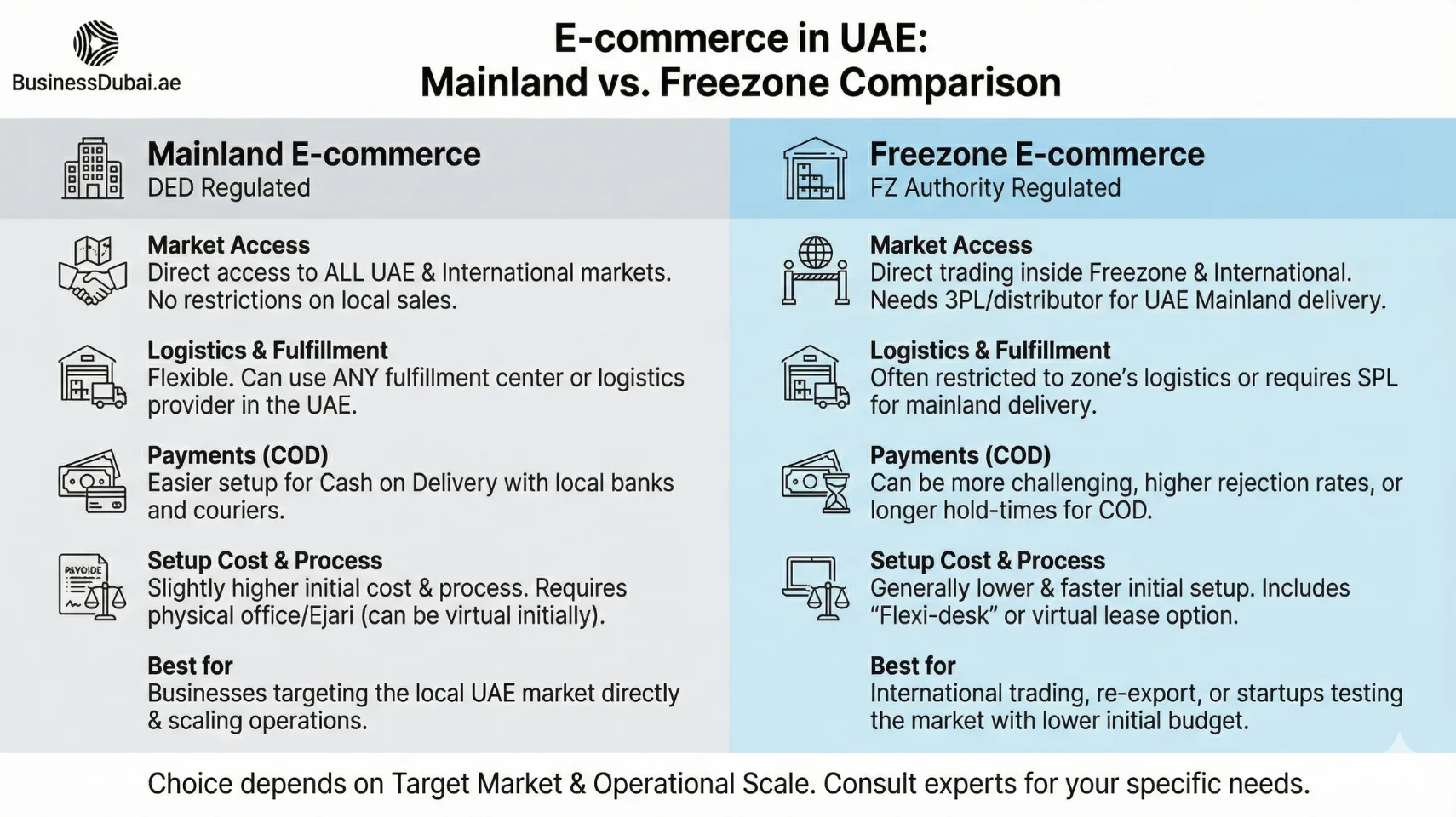
- Selling in UAE from Free Zone: A Free Zone company can ship to UAE customers (e.g. by using a courier to deliver). The goods will be treated as imports, so expect to pay ~5% customs duty (and 5% VAT) on the landed cost. Some free zones facilitate this process, but you may need an import license or bonded scheme if doing high volumes. You do not automatically need a mainland distributor, but many choose one for convenience. Mainland companies obviously need no extra steps.
- Cash on Delivery: Both Mainland and Free Zone e-commerce businesses can offer Cash on Delivery. This payment method is still very popular among UAE customers. Most major courier companies in the UAE support COD services and collect the payment from the customer at the time of delivery.
Couriers transfer the collected amount back to the merchant after delivery, usually after deducting delivery charges and any applicable VAT. You can enable COD regardless of whether your company is Mainland or Free Zone. However, courier fees are slightly higher for COD orders, and there is usually a delay of one to two weeks before the money reaches your bank account.
Understanding the Types of E-commerce Activities
In the UAE, different “e-commerce” licenses suit different models. Common categories include:
E-Trader License
This is a low cost Mainland license designed mainly for individuals. It is mostly used by UAE and GCC nationals who sell approved products through social media or small websites. The allowed activities are limited to specific product categories such as clothing, accessories, or basic electronics.
For expatriates who are not GCC nationals, this license is restricted to services only. Non GCC residents cannot sell physical products under an e-trader license and can only offer services such as consulting, design, or online coaching.
This license is best suited for small scale sellers who do not plan to hire staff, open offices, or scale quickly.
Standard E-commerce License
This is a full company license that can be issued in either the Mainland or a Free Zone. It allows wider online selling of products and services and is suitable for businesses planning to grow.
Under this license, you can usually add multiple business activities if the authority allows it. For example, you can combine online trading of electronics with professional services like digital marketing or IT support. Both physical products and digital services are allowed.
If your business involves regulated products such as cosmetics, food items, health supplements, or certain electronics, you must obtain additional approvals from the relevant UAE authorities before selling.
Online Marketplace or Portal License
This license is meant for businesses that operate a platform or marketplace connecting sellers with buyers. The company itself does not sell products but provides the technology and infrastructure for transactions.
Many Free Zones now offer portal or marketplace licenses under updated regulations. These are suitable for multi vendor platforms, service booking portals, or listing based websites. Even though you are not selling directly, you are still required to hold a valid license.
Dropshipping Model
Dropshipping businesses are also required to have a valid e-commerce license. Even though you do not keep inventory and suppliers ship products directly to customers, UAE law treats this as a normal online sale.
You must clearly declare dropshipping as your business activity and ensure your suppliers comply with UAE regulations, especially for restricted or controlled products.
Selling Products and Services Together
In most cases, you can sell both products and services under one license by adding multiple approved activities. For example, a digital agency can offer online advertising, IT consulting, and software sales under a single license if all activities are approved.
Social media selling is also covered under your license. Whether you sell through a website, Instagram, Facebook, or WhatsApp, your activity must match what is listed on your trade license.
Important Note
Many people assume marketplaces or social media selling do not require licensing. In the UAE, any form of online selling or paid service is considered a commercial activity. Having the right license from the start avoids fines, bank account issues, and payment gateway rejections later.
If you plan to scale, open a bank account smoothly, or work with payment providers, a standard e-commerce license is usually the safest long term option.
Cost & Budget Planning - In detailed Explanation
How much does it cost to open an E-commerce Company in UAE?
An e-commerce license in the UAE can range widely in cost, depending on jurisdiction. In free zones like Ajman, Fujairah or Ras Al Khaimah, basic e-commerce packages may start around AED 5,000–7,000. Mainland Dubai licensing can be higher (around AED 15,000–18,000 for a simple company in 2026). Free zone packages often bundle in a virtual office/flexi-desk and visas, whereas Mainland requires a physical office or virtual office(with Ejari lease).
- License and Setup Costs: Free Zones can be very affordable for e-commerce. Some low-cost e-commerce Free Zones (IFZA, Ajman, Shams) start around AED 12,400–18,100 per year (including visa). Mainland Dubai plan at least AED 24,000–28,000 for the first year. As one comparison shows, a Dubai Mainland trading company can cost AED 24K–28K for year one including 1 visa and virtual office space, while a Free Zone setup might be AED 12.4K–18kK depending on package including 1 visa and flexi-desk.
- Hidden costs include Ejari (tenancy) for Mainland, PRO/legal fees, visa stamping, medical tests (see below), and potential local service agent fees.
Q. What is included in the E-commerce License Cost?
License Fees & Inclusions: The basic license fee typically covers only the trade license itself. Office (Ejari) or flexi-desk fees are extra (though some Free Zones bundle a flexi-desk in their e-commerce package.For instance, Meydan Free Zone’s e-commerce package includes one free flexi-desk workspace. Mainland fees do not include office rent. Likewise, “establishment cards” or Dubai Chamber certificates are separate fees (not usually part of license fee). Renewal fees are often equal to the original license fee (sometimes slightly higher in rare cases) and are due annually.
Additional Costs: Budget for visa-related expenses and operations. Each partner visa roughly costs AED 3,500–5,000 (processing, medical, ID) plus a capital deposit (AED 3,000–5,000 refundable). Emirates ID is ~AED 370. If you hire workers, expect AED 4,000+ per visa. Other big expenses: setting up a website (could range from a few thousand AED to tens of thousands, or a monthly Shopify plan ~AED 100), marketing (PPC ads, social media), and logistics (courier fees and packaging). Also account for customs duty/VAT when importing goods. In sum, a small e-store should plan ~AED 5,000–10,000 per year just for mandatory administration (visa renewals, license renewal, PRO services) beyond the core setup fees.
Documentation & Approvals
What documents are required to start an E-commerce business?
Required Documents:
At registration, you typically need: passport copy of owner(s), UAE residency visa copy (if any), Emirates ID (for visa holders), passport-sized photos, and home country address proof like your recent bank statement or utility bill. Mainland DED will also ask for a signed NOC from your current employer if you are on a work visa. If setting up an LLC, you need the Memorandum of Association (MOA) and Ejari contract where businessdubai.ae will help you that. For a sole proprietor or freelancer (e-trader), usually passport, residency visa and Emirates ID suffice. In all cases, simply having a passport copy is not enough – the licensing authority needs proof of legal residence (visa/ID). For example, one guide notes: “International students need a UAE visa and NOC from their sponsor” to form a business, and a Free Zone e-commerce license usually requires Emirates ID and passport copies for all partners.
Q. How long does the registration process take?
Name reservation is very quick – typically 1 business day. After that, “initial approval” (pre-approval) can also be obtained in a day or two. The full license issuance then follows: for a Free Zone it might only take 3–5 business days, but for a Mainland DED license expect 10–20 working days (2–4 weeks) once all documents are submitted. Some packages advertise as fast as 1–2 weeks total, but allow up to 1–3 months in complex cases. Visa stamping (after the license is out) adds another 3–10 working days of processing. In summary: Mainland setup is usually 2–4 weeks end-to-end; a Free Zone can be 1–2 weeks.
Q.How do I choose the right trade name?
What names are not allowed?
The trade name must comply with UAE naming regulations. It cannot include terms like “Dubai”, “UAE”, “Emirates” (unless specially approved). It should not contain offensive or blasphemous words, nor the names of any foreign or local government authority. You can check our recent article on “What documents are required for Freezone company setup” or “What documents are required for Mainland Company setup”
Can I use brand names like “Dubai Shop”?
Avoid brand names or trademarks of other companies, and terms like “international” unless applicable. For example, using “Dubai Shop” as a name would likely be rejected due to the word “Dubai”. Also, generic names should not duplicate existing companies. The authority checks the name at application; if your initial name is rejected, you must choose another.
Do I need name approval again if I change later?
If you later decide to change your name, you must again get approval for the new name. In short, pick a unique, non-restricted name up front to avoid re-dos.
What is Initial Approval and why is it required?
Think of Initial Approval as the government saying,
“Yes, we’re okay with this business idea. You can move to the next step.”
It means your business name, activity, and ownership structure are accepted in principle.
What you can do after initial approval:
- Sign the MOA (Memorandum of Association)
- Take an office or flexi-desk lease (Ejari)
- Complete other setup formalities
What you cannot do yet:
- Start selling or operating
- Issue invoices
- Open a business bank account
Initial approval is not the final license. It’s just a green signal to continue the setup.
Only after you:
- Complete the office lease
- Sign MOA
- Pay final government fees
and receive the final trade license, you can legally start your business.
In short:
Initial approval = permission to prepare
Trade license = permission to operate
What Documents Required for Initial Approval
The Documents typically required for initial approval when setting up an e-commerce business in the United Arab of Emirates(UAE) This applies whether you are registering in a mainland jurisdiction or a free zone.
- Passport Copy – Identity proof for all shareholders/directors.
- Passport-Size Photo – For license application records.
- Home Country Address proof: Any latest bank statement or utility bill
- UAE Visa or Entry Stamp – Confirms your legal status in the UAE.
- Emirates ID (if resident) – Local identification document.
- Trade Name Reservation Certificate – Approval of your business name.
- Initial Approval Application Form – Main form submitted to the authority.
- Memorandum of Association (MOA) – Defines business structure (if company setup).
- Articles of Association (AOA) – Company rules and operations (if applicable).
- Tenancy Contract / Ejari – Proof of business address.
- No Objection Certificate (NOC) – Required if you are employed and on a UAE visa.
- UBO Declaration – Discloses the ultimate beneficial owner.
- Shareholder Address Proof – Recent utility bill or tenancy contract.
- Business Plan – Required in some free zones for activity approval.
When you work with a business consultant like us, we handle almost everything for you.
You only need to provide:
- Passport copy
- Passport-size photo
- Address proof (any utility bill)
- Your preferred company name (up to 3 names)
We take care of the rest, including:
- MOA drafting
- Business Plan
- UBO declaration
- NOC and other required documents
- Government submissions and approvals
Nothing is done without your knowledge. We take approvals and discuss each step with you before moving forward, so the process stays smooth and transparent.
What happens after receiving Initial Approval?
You sign the legal documents (MOA), pay the final government voucher, and get the License.
- Then: You apply for the Establishment Card (Immigration file) -> Then apply for Visas.
Once you have that initial go-ahead, you must submit the remaining documents to get the final license. This includes the signed Ejari tenancy (for Mainland) or office lease (if not flexi), the notarized MOA (for a company), and proof of any paid-up share capital (via a bank deposit receipt). You then pay the final license fees. Authorities will then issue the trade license/establishment card. According to one guide, once these are submitted and the fees paid, “the final trade license will be issued in 1–2 weeks”. At that point your company is fully registered. You can then apply for your visas. (Some free zones immediately issue investor visas alongside the license, others require separate visa applications.) In short: after initial approval, get your office lease and MOA done, pay the balance, and expect the license in roughly one to two weeks.
Once you get initial approval, you submit these to get your final trade license:
- Signed MOA
Confirms company ownership and shareholders. - LSA Agreement (only if required)
Needed for some mainland business structures. - Office Lease / Ejari
Proof of your official business address. - License Fee Payment Receipt
Shows government fees are paid. - Trade License Application Form
Final request to issue your license. - UBO Declaration
Declares the real owners of the company. - Specimen Signature Form
Official signatures of owners/managers. - Updated Passport & Emirates ID copies
For final identity verification. - External Approvals (if applicable)
Needed for activities like food, cosmetics, electronics, etc. - Establishment Card Application
Required to hire staff and apply for visas.
Once these are submitted and approved, your trade license is issued and you can legally start business.

Visa & Office Requirements
Do I need a visa to run an E-commerce business?
Yes, you generally need a UAE residence visa to hold a trade license. Many e-commerce entrepreneurs convert to an investor/partner visa under their new company. However, you can start on an existing employment visa if your employer provides a NOC. An investor visa is not mandatory from day one, but it simplifies doing business (you become your own sponsor). After license issuance you can apply for an investor visa by showing company documents and meeting requirements (e.g. salary/deposit criteria). Once you have a visa, you can sponsor others.
Q. Can I run the company while on my job visa? Is investor visa mandatory?
You can register a company while on a work visa only if your employer gives an NOC. This is required for most mainland licenses and many free zones. Without an NOC, your application will be rejected, so always get approval first.
To sponsor employees or family, you usually need a UAE Partner/Investor visa. This often requires showing minimum salary or capital (for example AED 10,000 salary or AED 40,000 deposit).
The number of visas you can issue depends on your office size:
- Mainland: about 1–2 visas per 10 sqm
- Free Zones: usually 1–3 visas, more with a bigger office
Each visa costs around AED 3,000–5,000.
Female business owners have the same rights and can sponsor employees and family just like male owners.
Q. Do I need an office or Ejari for E-commerce?
For a Mainland license, a company must have a registered office address or virtual office (Ejari). You cannot operate purely from a home without permission. Free Zones differ: many allow a “flexi-desk” (a shared office) or virtual setup, which they typically offer as part of the license package. For instance, Meydan Free Zone’s e-commerce plan includes a free coworking desk. Mainland e-commerce (trading) licenses explicitly require an Ejari tenancy contract as proof of office. Virtual offices per se are only allowed via specific schemes (like Dubai’s Instant License) – normally you need at least the flexi arrangement provided by Free Zones.
In short: Mainland = registered office Ejari mandatory (physical or virtual; Free Zone = usually flexi or virtual office is allowed (often included in fee).
Market Access & Selling Rules
Can a Freezone E-commerce company sell inside the UAE?
A Mainland company can sell and deliver anywhere in the UAE directly, with no extra approvals. A Free Zone company can also sell to UAE customers, but its goods are treated as imports, so 5% customs duty and 5% VAT apply. Usually, couriers handle customs clearance. A local distributor is not legally required, but working with a UAE company can make billing and returns easier. In reality, many free zone businesses still sell smoothly within the UAE by shipping through Dubai without setting up a mainland company.
Do I need to pay customs duty?
Customs Duty: All imported physical goods (non-GCC origin) incur 5% import duty in UAE. There is no duty on exports out of the UAE. So if you’re selling to customers outside the UAE, those sales are typically zero-rated (0% VAT and no UAE duty). For domestic sales by a free zone seller, expect that standard 5% duty plus 5% VAT when the customer receives the item. (Local-origin goods or GCC goods may be exempt or lower.)
Do I need approvals for specific products?
Product Approvals: Yes – many product categories require government approvals even for online sale. For example, cosmetics must be registered with Dubai Municipality (or MOHAP) before selling. You need a Free Sale Certificate and ingredients list for each item, and a local registration (Dubai E-Form system). Health supplements and nutraceuticals also need registration (treated like food/medicine by regulators). Food & beverages require a Food Trade License and health permit from the municipality. In short, anything in the food, cosmetics, pharma, or health category must meet the UAE’s health & safety approvals before you list it online. Without these, authorities can seize the products. Always verify with the relevant department (Municipality for food/cosmetics, MOHAP for medicines, etc.) for your item.
Can I sell internationally from the UAE?
Cross-Border Selling: You can definitely sell internationally from a UAE-based store. The UAE encourages exports: goods sent abroad are subject to no export duty and are zero-rated for VAT (i.e. you charge 0% VAT on exports, with paperwork). To do this, follow normal export procedures – commercial invoice, airway bill or bill of lading, Certificate of Origin (if needed). The importing country’s rules will apply on their end. For choosing a base, many point to the UAE’s Free Zones: e.g. IFZA, Ajman Free Zone and Shams (Sharjah) are often cited as low-cost e-commerce hubs, while DMCC, DAFZA or CommerCity (Dubai) offer world-class logistics connectivity. Free Zones simplify customs for export – as one accounting advisor notes, being in a UAE free zone “simplify[s] customs for cross-border trading” and can help avoid excess import fees.
Banking & Payments
How do I open a business bank account in the UAE?
Almost all UAE banks offer business accounts to licensed companies. Major banks like Emirates NBD, FAB (First Abu Dhabi Bank), ADCB, and Mashreq are popular with new entrepreneurs. Some even have special small-business or free-zone desks. But we’ll help you in your bank account opening. We also offer free bank account opening with WIO Digital Bank for low-risk businesses. For higher-risk businesses, the bank may ask for additional documents as part of their compliance checks.
Q. Minimum balance requirements? Best bank for new entrepreneurs?
UAE business bank accounts require either maintaining a minimum balance or paying a monthly low-balance fee. Minimum balance usually ranges from AED 25,000 to AED 500,000. If not maintained, most banks charge AED 200–300 per month. WIO Bank charges only AED 100 per month, which is one of the lowest in the market. Banks generally ask for your trade license, MOA/share certificate, and passport or ID of signatories. Both Mainland and Free Zone companies can open accounts, though some banks may require a UAE visa for one signatory. At BusinessDubai.ae, we assist you end-to-end with bank account opening, including documentation and coordination with banks like Emirates NBD, RAKBANK, and ADIB, to make the process smooth and hassle-free.
Q.How do I set up a payment gateway?
To accept online card payments in the UAE, you need a payment gateway like Stripe, PayPal, or PayTabs. The requirements are mostly the same: a valid UAE trade license, company documents (MOA or CR), passport and visa/Emirates ID of owners, and a UAE business bank account. Gateways also require a live, professional website with pages like About Us, Contact, and Terms & Conditions showing your company name. Just social media pages are usually not enough. Once approved, you can accept Visa, Mastercard (and sometimes Amex) from customers worldwide. Other popular UAE gateways include Telr, Checkout.com, and Amazon Payment Services. All major platforms like Shopify and WooCommerce support these gateways.
Q.Can I accept Cash On Delivery (COD)?
Yes, as mentioned earlier, COD is widely used. Courier partners in the UAE routinely support COD. For example, Fetchr explicitly offers COD and will remit the full collected amount to you. Aramex’s domestic service also allows COD pickup. Other couriers (Emirates Post, Ship&Co, Zajil) may offer similar services. Be aware: couriers charge a handling fee for COD (often a fixed AED fee or a small percentage). Settlement of COD proceeds can take 1–2 weeks after delivery, as the courier must reconcile payments. In any case, both Mainland and Free-Zone sellers routinely offer COD at checkout since customers expect it
Website, Branding & Operations
Do I need a website to get an E-commerce license?
Most licensing authorities expect you to at least have a plan for a website. In fact, some guidelines explicitly say a UAE country-domain is required for an e-commerce license. For example, a Free Zone guide notes that you must register a “.ae” domain name in order to legally sell online in the UAE. Practically, this means you’ll need to set up a website (or at least a landing page) showing your products or services. Using Instagram/WhatsApp alone is not enough to bypass licensing. Having a website also helps with licensing (some DED applications ask for it) and with payment gateway approval. On Shopify vs others: Shopify does work in the UAE (Shopify supports Middle Eastern currency and you can connect local gateways), and WooCommerce (WordPress) also works well. The key is that your e-store must display your UAE company name, license number, and contact details (to build customer trust). domain is strongly recommended.
Q.Which e-commerce platform is best for the UAE?
Many UAE e-merchants use Shopify because of its ease-of-use. A Basic Shopify plan costs about AED 100–120 per month; WooCommerce itself is free but you pay for hosting and setup (this can be lower or higher depending on your tech skills). Both platforms support all major UAE payment gateways. Note: Shopify’s own “Shopify Payments” (Stripe) is directly available in UAE, so you’ll integrate Stripe directly on Shopify. According to industry guides, Stripe (2.9%+AED 1.1 per tx) offers the lowest fees, but PayTabs and Telr are highly competitive in the UAE market. Regardless of platform, ensure your site is secure (SSL) and compliant.
How to handle logistics & delivery in UAE?
For deliveries inside the UAE, you can use courier companies like Aramex, Emirates Post, DHL, FedEx, and others like Fetchr, Shyft, or Zajel. They offer business accounts, cash-on-delivery, and special SME rates. Local delivery usually costs around AED 10–20 per kg, while same-day or express delivery costs more. As your business grows, you can negotiate better rates. For storage and packing, you can start small with basic storage, but as orders increase, using a fulfillment partner (3PL) can save time and effort. Fulfillment services usually charge per order plus shipping, and in the UAE this often ranges from AED 11–55 per order, depending on volume and complexity.
Taxes & Compliance
What is VAT? Do I need to register for VAT?
UAE VAT is 5%. You must register for VAT if your taxable turnover exceeds AED 375,000 per year. Once registered, charge 5% VAT on all sales to UAE customers (and show it separately on invoices). Sales to customers outside the UAE are zero-rated (no VAT), but you must document exports. File VAT returns quarterly (every three months) unless you have very high sales in which case monthly filing might apply. Keep thorough records of all sales and taxes, as the FTA can audit your store. Even if your turnover is below the threshold, you can register voluntarily.
What compliance rules do e-commerce stores must follow?
Return/Refund Policies: UAE law doesn’t universally mandate a fixed return period for e-commerce, but best practice is to have a clear written policy. Many UAE online retailers voluntarily offer 7–14 day return windows (as seen on sites like Noon and Amazon.ae) to remain competitive. Regardless, you must honor consumer protection laws: if a customer receives a defective or misdescribed item, you must refund or replace it. Display your return/refund policy prominently on your site (legal advisors often recommend posting it on your checkout page and on invoices).
Data Privacy: You are subject to the UAE’s Personal Data Protection Law (PDPL, 2021). This means if you collect any personal customer data (names, emails, phone numbers, payment info), you must obtain consent, safeguard it, and only use it for stated purposes. It’s good practice to publish a Privacy Policy on your site detailing how you handle data. For marketing emails or SMS, customers must opt in. In short: treat UAE customers’ data as if it’s highly protected (because it is) – secure it, and don’t share it with third parties without permission.
Advertising Guidelines: The UAE has strict advertising rules. All ads (online or offline) must be honest and not mislead customers. Avoid exaggerated claims or pricing tricks. Certain products (tobacco, gambling, adult content, unlicensed medicines) cannot be advertised at all. If you use social media influencers to promote your products, note that UAE now requires an "Advertiser Permit" for paid promotions on social media. Always comply with content regulations (no religious or political content, and ensure halal/ethical standards for food and cosmetics). In summary, stick to factual, respectful advertising, and obtain any influencer permits if applicable.
Product Sourcing & Inventory
Yes, dropshipping is legal in the UAE if you have a proper trade license. You don’t need to keep stock, but you are still responsible for delivery issues, returns, and customer complaints, so choose reliable suppliers. Many sellers use platforms like AliExpress or Spocket, and for local sourcing you can look at Tradeling. You can also import products from India or China; standard customs duty is 5% plus VAT, and some items like electronics, food, or cosmetics need extra approvals. To find UAE suppliers, places like Dragon Mart or trade shows such as GITEX and Gulfood work well. Always start with small test orders and avoid restricted items like drugs, weapons, counterfeit goods, or regulated products without licenses.
Growth, Marketing & Strategy
How to market an e-commerce store from instagram and google Ads in the UAE?
Promote your store online with targeted ads and social media. Instagram & Facebook Ads can be highly effective in the UAE. Expect to pay roughly AED 1.50–3.50 per click on Instagram, with CPM (thousand impressions) around AED 9–13. A small daily budget (AED 50–100) can already test the market. Google Ads/Shopping is also valuable: you can list products and pay per click (search CPC rates vary by keyword, typically a few AED). Consider running Google Shopping campaigns, which show product images with prices in search results.
Influencer marketing is big in the UAE. Collaborating with local influencers (Instagram, TikTok) can yield strong results, especially for lifestyle products. Costs vary: nano-influencers (1k–10k followers) may charge a few hundred AED per post, while top celebrities charge tens of thousands. A balanced strategy is to work with micro-influencers who have high engagement in your niche. Always use clear contracts and ensure any paid promotion is labeled #ad per UAE guidelines.
Don’t forget email marketing and SEO: many UAE shoppers still use Google and email promos. Collect emails at checkout to re-market to customers. Lastly, local partnerships help: listing on Amazon.ae or Noon.com can boost sales as you grow.
What are the most profitable niches in UAE E-commerce?
E-commerce in the UAE often sees strong demand (and profit margins) in categories like electronics, fashion/beauty, premium food items, and home goods. According to recent trend analyses, top products in 2025 include electronics (smartphones, gadgets), modest fashion and halal beauty, home appliances, gourmet food (dates, nuts, honey), baby products, car accessories, furniture, health/supplements, footwear, and perfumes. Many of these have healthy markups: for example, beauty cosmetics, perfumes, and baby care items typically allow 30–50% gross margins. High-end products (luxury watches, branded leather goods) can be even higher. Niche health supplements (if approved) can have very high margins but require regulatory compliance.
Niches that need special approval
Be cautious with trends that require approvals (cosmetics, food, electronics) or have high competition (e.g. basic clothing). Often the most profitable products are ones with strong local demand but limited local supply – for example, halal-certified beauty kits, specialty electronics for the home (like robotic vacuums), or custom car accessories. Use tools (Google Trends, Amazon best-sellers) to find what UAE shoppers want, and ensure you have legal clearance to sell those items.
How do I handle customer return/refund policies legally?
UAE law protects consumers: you must honor returns/exchanges for defective or mis-described items. Clearly state your return policy on your website. If a customer attempts fraud (e.g. returns a used or wrong item), refer to your terms. Keep evidence of order fulfillment (photos of package contents before shipping, tracking records). Many merchants require items to be unopened for a refund. In case of disputes (chargebacks), the burden is on you to prove the product was as described. Have clear policies and documentation to handle such cases. If a customer receives a wrong item, arrange a prompt exchange or refund; do not ignore legitimate complaints, as regulators can penalize non-compliance.
Watch out for fraud:
In rare cases customers may falsely claim an order never arrived or send back empty boxes. To protect yourself, use trackable shipping and photo-verify deliveries if possible (couriers in UAE often take a photo on delivery). If fraud happens, report it to the authorities – fraudulent claims can be prosecuted.
How to scale an e-commerce business in the UAE?
As your e-commerce business grows, plan to expand cautiously. When order volume justifies it, hire staff (customer service, marketing). Consider adding more visa-holders to your company (subject to your license type) to bring in talent. Expand your product range or add new verticals only after market testing. For instance, a fashion retailer might add accessories, or an electronics store might start selling smart home gadgets.
Reaching new channels is key: once your own site is stable, list products on Amazon.ae and Noon.com for additional UAE reach. These platforms have built-in logistics and customers. Also, look at neighboring markets (Saudi Arabia is huge) – you can use UAE as a base and ship to KSA or beyond. Finally, focus on branding: invest in high-quality packaging and reliable customer service. UAE consumers prize quality and trust, so building a strong brand (good website, responsive chat/email support) will help you charge premium prices and scale profitably.
Legal & After-Setup Questions
How to renew an E-commerce license? What is the renewal cost?
E-commerce licenses must be renewed every year, and the cost is usually similar to the first-year fee. Mainland Dubai renewals are often around AED 16,000+, while Free Zone renewals match the package price. Renew on time to avoid fines. For example, DMCC charges AED 0 if renewed within 30 days, AED 2,500 if 31–60 days late, and AED 5,000 if 61–90 days late. After 90 days, the license can be cancelled. During renewal, update any changed documents like Ejari or passport copies. Always mark your renewal date to avoid penalties.
Can I sponsor my family with an E-commerce license?
Yes, as an e-commerce business owner you can sponsor family visas, subject to general UAE rules.
Is salary proof needed?
Yes, some financial proof is required. To sponsor a spouse and children, the usual minimum is AED 4,000 salary (or AED 3,000 + accommodation). Since an investor visa doesn’t show a salary, you need to submit AED 3000/each-person deposit to government to sponsor them. Although it’s a refundable security deposit, you’ll get it back when your family leaves UAE permanently. If you meet the requirement, you can sponsor your wife, children, and parents. You’ll also need a tenancy contract (Ejari) for each dependent. Men and women have equal rights—female business owners can sponsor family the same way, with no gender restriction under UAE law.
What mistakes do new E-commerce founders make in UAE?
One big mistake is choosing the wrong license or jurisdiction. For example, many people buy a free-zone license without realizing it needs extra steps to sell inside the UAE. Always decide who you want to sell to first, then choose the license. Another common issue is a poor or incomplete website. If your site looks unprofessional or is missing basics like Contact details, Terms, or security, payment gateways may reject you and customers may not trust you. Lastly, incomplete or mismatched documents can delay everything. Missing passport copies, Ejari, NOC, or details on your website not matching your license can stop both company registration and payment gateway approval. Getting these basics right saves time, money, and stress later.
In summary, plan thoroughly. Choose the right license (Mainland vs Free Zone) for your market, set up a solid online presence, budget for all fees, and stay on top of legal requirements (VAT, consumer laws, renewals). That way your UAE e-commerce venture can launch smoothly and grow confidently.
The information shared in this article is based on our hands-on experience from real business registrations handled by BusinessDubai.ae, along with official guidelines and updates published by UAE government websites, licensing authorities, and Free Zones. We are a licensed professional service provider in the UAE and strive to keep all information accurate and up to date. However, laws, fees, and procedures may change without notice. This content is provided for general guidance only and should not be treated as legal or financial advice. For precise and case-specific advice, we recommend a direct consultation with our team or verification with the relevant UAE authorities.