Every guide to setting up a facility management company in Dubai treats the DET trade licence as the job. It is not even half of it. Depending on what you actually do, you may also need Dubai Civil Defence approval to touch a fire system, DEWA enrolment to touch a wire, a Dubai Municipality permit to spray for pests, Trakhees registration to work on the Palm, and RERA approval to charge an Owners' Association a single dirham. Five separate chains, not one.
And from January 2026 there is a sixth. Dubai Law No. 7 of 2025 created a mandatory unified Contractor Register covering mainland, free zones and DIFC, with penalties to AED 200,000 and a grace period that runs out in early 2027. Every competitor page we analysed was written before it, or ignored it.
This guide maps the whole chain, corrects the free-zone tax claim that every setup consultancy repeats, covers the VAT rule on service charges that none of them mention, and gives you the honest version of the economics. Since 2013, our team has set up contracting and services companies in Dubai, so the traps here come from real files.
The approval chain nobody draws
Here is the map. Which rows apply depends entirely on what you do in-house versus subcontract.
| Regulator | When it applies | What it controls |
|---|---|---|
| DET | Always (mainland) | Your trade licence and activities |
| Dubai Municipality | Contracting classification; pest control; pools | Contractor grading, Public Health permits, technician ID cards |
| Dubai Civil Defence (DCD) | Any fire system work | Only DCD-approved contractors may design, install, test or maintain fire systems |
| DEWA | Any electrical work | Contractor enrolment and classification; technicians examined to BS 7671 UAE-amended |
| Trakhees (PCFC) | Working in JAFZA, Palm Jumeirah, Nakheel communities, DWC | Its own parallel licensing and HSE regime, outside DET/DM entirely |
| RERA / DLD (Mollak) | Charging an Owners' Association for common-area work | Approval to bill service charges; 6-monthly reporting |
| SIRA | Only if you provide security guarding or CCTV monitoring | Company licence plus individual staff licences |
| DM Contractor Register (Law 7/2025) | From January 2026, broadly | Mandatory classification tier that caps what you can bid |
Common Mistake: Assuming one "facilities management" licence covers fire, electrical, pest control and OA work. It does not. Most established FM companies subcontract fire, lifts and electrical to separately-approved specialists precisely because obtaining those approvals from scratch is expensive and slow. That is a legitimate strategy, not a shortcut. Not sure which chains your scope triggers? Ask us→
Which activity do you need?
We have to be honest about a limitation here, because the alternative is inventing numbers.
DET's Invest in Dubai portal blocks automated checks, so we could not verify activity codes at source. What secondary sources report:
| Activity | Reported code | Confidence |
|---|---|---|
| Facilities Management Services | 8110.1 | Single unverified source. Treat as indicative |
| MEP maintenance (plumbing, sanitary, HVAC, ventilation) | 4322, with sub-codes 4322.92/.93/.97/.98 | Unverified |
| Pest control | 8129.92 | Reported; DM permit is separate from the trade licence |
| General building cleaning | ISIC 8121 | Reported |
| Other/specialised building cleaning (exterior, ducts) | ISIC 8129 | Reported |
| Lift and elevator maintenance | Not found | No source produced a code |
| Fire system maintenance | Not found | No source produced a code |
| Swimming pool maintenance | Not found | No source produced a code |
Real Talk: Three of the activities you most likely want have no publicly confirmable DET code, and the FM umbrella code itself rests on one unverified source. We are not going to invent numbers to make a tidier table. Confirm your exact codes on Invest in Dubai or with a licensing agent before you file. Any guide that lists a confident code for lift maintenance is guessing.
The common structure: license Facilities Management as your primary activity, add MEP maintenance, cleaning and pest control as secondary activities on the same licence, and subcontract fire, lifts and electrical to approved specialists.
Fire, electrical, pests and pools: who says yes
Dubai Civil Defence. Only DCD-approved contractors may design, install, test and maintain fire safety systems in Dubai, and a building needs a valid Annual Maintenance Contract from a DCD-approved firm before it gets its fire safety certificate [1]. Requirements include certified technicians and a delegate card on site, with six-monthly system maintenance and monthly functional tests. DCD grades approved companies; "Grade A" is repeatedly cited as the top tier, but we could not verify the criteria for Grade B or C, and DCD's own pages failed on direct fetch [1].
That AMC requirement is worth reading twice. It means every building in Dubai is a recurring, legally-mandated customer for a DCD-approved fire maintenance company. That is the most structurally protected niche in FM.
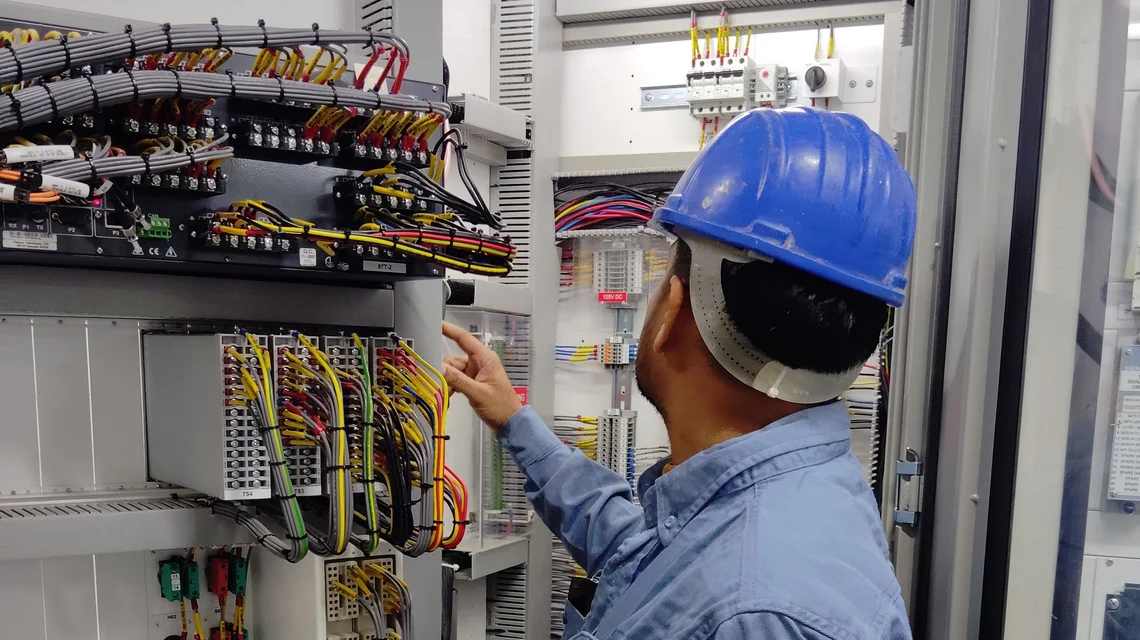
DEWA. Only DEWA-enrolled and classified contractors with technicians examined against BS 7671 (UAE-amended) may legally perform electrical installation, modification and testing [2]. A "Platinum" grade covering up to 5,000 KW plus substation work was referenced, but the full grade ladder and entry tiers could not be verified.
Dubai Municipality Public Health. Pest control needs a DM permit separate from the trade licence, with a competency exam (pass mark reported at 70%), staff ID cards, and periodic inspections [3]. Swimming pools carry hard technical standards: chlorine 1.0 to 3.0 ppm, pH 7.2 to 7.8, turbidity under 0.5 NTU, zero E. coli and coliform, weekly testing minimum, documented records [3].
Lifts. No separate "lift maintenance contractor licence" surfaced. What exists is equipment certification: lifts and escalators need biannual inspection by EIAC or ENAS-accredited bodies, and cranes, hoists and other lifting equipment need annual third-party certification [3].
Trakhees. If you work in JAFZA, Palm Jumeirah, Nakheel communities or Dubai World Central, Trakhees is the competent authority, with its own licensing and HSE regime entirely outside DET and DM, and Nakheel adds a community-level NOC on top [4]. Zero competitor pages mention this. Win a Palm contract without Trakhees registration and you cannot lawfully mobilise.
Owners' Associations: the RERA gate, and the claim that is overstated
This is where the real recurring money is, and where the rules bite.
Under Dubai Law No. 6 of 2019, you cannot legally charge fees for operating or maintaining the common areas of a jointly-owned property without RERA approval. You must submit 6-monthly reports to RERA, and breaches carry fines to AED 1 million, doubling to AED 2 million for a repeat within a year [5].
The staffing bar is the real gate, and it is credential-based, not paperwork [5]:
- A Director of Facility Management, an Owners Affairs Manager and a Finance Manager, each with 3+ years of relevant experience
- Dubai Police good-conduct certificates for those roles
- SIRA licensing for any on-site security staff
- Annual budgets submitted for RERA review and approval before you charge owners
- Approved escrow accounts
Pro Tip: One secondary source claims all FM companies must register with RERA. That is overstated. The primary law ties RERA approval specifically to charging fees for jointly-owned common-area management. Service a single building owner, an SME or a villa directly and you are outside that regime. This distinction is your entry strategy: direct contracts need no RERA gate; OA contracts do.
The 2026 change everyone missed: the Contractor Register
Dubai Law No. 7 of 2025 creates one mandatory unified Contractor Register run by Dubai Municipality and integrated with Invest in Dubai [6]. It matters because it is new, binding, and absent from every competitor page.
What it does [6]:
- Applies across mainland, free zones and DIFC (airport-linked projects excluded)
- Makes registration and classification mandatory for contracting activities
- New entrants start at the lowest tier, promoted only on proven financial stability, technical capacity, workforce holding Professional Competency Certificates, track record and compliance
- You may only operate within your assigned category and specialisation
- Penalties: AED 1,000 to 100,000 first violation, up to AED 200,000 for repeats within a year, escalating to suspension, classification downgrade, removal from the register, and trade licence revocation
Effective dates conflict across sources (8 January versus 15 January 2026), but all agree on roughly a one-year grace period to early 2027, with a possible extension [6].
Common Mistake: Assuming this is a construction rule that misses you. Sources describe scope as "all construction-related activities," and a Contracting Activities Regulation and Development Committee decides exactly which activities are captured. Whether pure FM and maintenance fall in scope is not documented publicly, and we could not confirm it. Given the penalties, confirm with Dubai Municipality directly rather than assuming either way.
There is also an older DM classification running alongside (Circular 133 of 2005), with tiers reported as G+1, G+4, G+12 and Unlimited based on financial, technical and workforce capacity [7]. Exact contract-value ceilings per grade could not be verified; the classification portal returned an empty table, and Dubai's own grade tables sit behind PDFs we could not open. Your grade, not just your licence, caps the size of tender you can bid. No competitor explains that.
Free zone or mainland? Mainland, effectively
Executive Council Resolution No. 11 of 2025 (effective 3 March 2025) gave free-zone companies three routes onto the mainland: a branch licence (around AED 10,000/year), a dual licence, or a temporary permit (around AED 5,000, up to 6 months) [8]. DIFC is excluded.
Apply that to FM. This is a physical business: technicians dispatched to buildings, vehicles, tools, spare parts. A pure free-zone FM company cannot lawfully send technicians onto mainland Dubai buildings without one of those instruments. Existing free-zone firms already doing mainland work had one year from 3 March 2025 to regularise [8].
DET was required to publish the list of which activities need a branch versus a temporary permit by 3 September 2025. We could not find that list, so whether FM qualifies for the cheaper temporary permit is an open question worth confirming.
Real Talk: For anything targeting OA or institutional work, mainland is effectively required, and one KPMG note confirms a free-zone company's mainland branch is taxed at the standard 9% anyway, losing 0% treatment for that branch [8]. Compare structures on our mainland company setup and free zone company setup pages.
Corporate tax: the free-zone 0% does not work here
Setup consultancies sell free-zone 0% hard. For FM it is not available, and it is not close.
Baseline: 9% above AED 375,000, 0% below [9].
Ministerial Decision No. 229 of 2025 sets a closed list of Qualifying Activities: manufacturing, processing, trading qualifying commodities, holding shares, ship operation, reinsurance, headquarter services, treasury and financing to related parties, fund management, wealth and investment management, aircraft leasing, distribution from a Designated Zone, logistics services, and ancillary activities [10]. Facility management, building maintenance and contracting services are not on it, and there is no services catch-all.
And de minimis cannot rescue you. It tolerates non-qualifying revenue up to the lower of 5% of revenue or AED 5 million [10]. That is built for a small non-qualifying slice. Your buildings are physically on the mainland, so essentially 100% of FM revenue is non-qualifying, not 5%.
There is a second disqualifier if you serve villas. MD 229 makes "any transactions with natural persons" an Excluded Activity, carving out only ships, fund management, wealth management and aircraft leasing [10]. Bill an individual villa owner and that revenue is excluded regardless.
And the consequence is long. Fail the conditions and you cease to be a Qualifying Free Zone Person for that period and the following four, with no Small Business Relief during the lockout [10].
Common Mistake: Choosing a free zone for a 0% rate your activity cannot reach. Choose it for ownership or licensing convenience if it suits, never for tax on FM revenue. Our UAE corporate tax filing guide has the wider regime.
What you can use: Small Business Relief (MD 73/2023). Revenue under AED 3 million, elect it, treated as having no taxable income. the relief now runs to tax periods ending on or before 31 December 2029[9].
VAT on service charges: the rule nobody mentions
Not one of the competitor pages we analysed covers this, and if you bill an Owners' Association it decides your invoicing.
FM services are standard-rated at 5%. And the residential question people get wrong: the VAT exemption attaches to the residential lease, not to services. Maintaining a residential building under a separate FM contract is 5%, regardless [11]. The only narrow exception is where the same landlord bundles a service charge into one composite invoice inside a single residential tenancy, which the FTA's Real Estate Guide treats as one composite exempt supply. That is a landlord-to-tenant case, not an FM company's fact pattern.
Now the centrepiece. FTA Public Clarification VATP022 addresses Dubai Owners' Associations after Dubai Law No. 6 of 2019 transferred their rights and obligations to Management Entities [12]. The FTA's conclusion, quoted:
"the Management Entity is not considered as an agent who is just managing the building on behalf of the owners [of the units]."
So the Management Entity is a principal, not an agent. The service charge it collects from unit owners is its own independent taxable supply at 5%, not a disbursement or pass-through [12]. It must register, issue valid tax invoices under Article 65(1) (AED 5,000 penalty per non-compliant document), account for output VAT, and can recover input VAT on its costs. Old OAs had to deregister, because the OA is no longer the supplier.
What that means for you, depending on structure [12]:
- You are the Management Entity (head contract with owners, collecting service charges): charge 5% on the full service charge as your own supply.
- You are a subcontractor to the ME (the common structure): your invoice to the ME is your own 5% supply, and the ME folds it into its own 5% charge to owners. Every link in the chain is a full taxable supply. There is no relief anywhere in it.
Pro Tip: VATP022 is expressly framed around Dubai's Law 6/2019. Other emirates have their own jointly-owned-property regimes, so do not assume it reads across.
Recharging subcontractors is not a pass-through
The related trap. You subcontract lift maintenance or pest control and recharge the client "at cost." Is that VAT-free? Almost certainly not.
Under Article 9, an agent acting in its own name is treated as making a direct supply to the customer [11]. And under VATP013, an expense recovery is an out-of-scope disbursement only if all of the following hold [11]:
- The client is the actual recipient of the service
- The client is legally responsible for paying the third party
- The third party's invoice is in the client's name, not yours
- You have the client's authorisation to pay on their behalf
- The item is genuinely additional to your own services
Common Mistake: Assuming "at cost = no VAT." If the lift contract is in your name, which is the near-universal reality because you engage and coordinate the specialists as part of your scope, condition 3 fails and it is a reimbursement: your own taxable supply at 5% on the full recharge, even with zero markup. Invoice it as such rather than netting it off as a disbursement line. See our VAT registration and compliance guide.
Thresholds: mandatory registration at AED 375,000, voluntary at AED 187,500, which newly formed FM companies commonly use to recover input VAT on mobilisation costs [11].
The labour model, and it is labour arbitrage
Let us not dress this up. FM is a people business built on wage differentials, and the numbers say so.
Salaries [13]: general maintenance technician averages AED 2,773 to 2,883 a month; a specialised AC/HVAC technician around AED 6,500. Entry-level cleaners sit lower, skilled MEP electricians higher.
Visa quota is a hard structural constraint. The mainland formula is 9 square metres of office per visa [14]. A 90 sqm office caps you at 10 visas. For a business planning dozens of technicians, your office size, not your pipeline, caps your headcount. See our UAE visa quotas guide.
Accommodation is mandatory at scale. Employers with 50+ workers earning AED 1,500/month or less must provide accommodation, register in MoHRE's Labour Accommodation System, and submit safety, layout and sanitation plans for approval, with minimum 3 sqm per worker in sleeping units, clean water, ventilation and lighting standards, daily cleaning and contracted licensed pest control [14]. Cost runs AED 500 to 1,000 per worker per month, up to 1,500 for premium camps, plus utilities at AED 250 to 450 and waste management [13].
Visas run AED 3,000 to 8,000 per worker for two years depending on MoHRE company category, plus health insurance at AED 650 to 2,500+ a year [13].
And WPS tightened in 2026, aimed squarely at you. Ministerial Resolution No. 340 of 2026, effective 1 June 2026, replaced the 2022 rules [15]:
- Wages due by the 1st of the following month
- Compliance threshold raised from 80% to 85% of wages transferred on time
- It explicitly names "cleaning services" and "security services" as targeted higher-risk sectors, alongside construction and transport
- Escalation: MoHRE notification day 2, work-permit freeze day 5, fines and category downgrade day 11, automatic labour dispute registration day 16 for employers with 25+ staff in named sectors, and asset attachment, travel bans and prosecution referral by day 21
Real Talk: You are a named-sector employer with a large low-wage payroll. WPS enforcement is not a background formality here; it is pointed at your business model. A cash-flow squeeze that delays payroll by three weeks now costs you your work permits.
Emiratisation applies too. Real estate and construction sit within the 14 targeted sectors; 20 to 49 employees means phased Emirati hires, and 50+ means 2% growth a year toward 10% by 2026, with AED 96,000 to 108,000 per missing position [13]. The minimum Emirati private-sector wage rises to AED 6,000/month from 1 January 2026. See our Emiratisation 2026 guide.
The honest economics
Zero competitor pages discuss margins. Here is why they might prefer not to.
The market is large. Estimates diverge widely, so treat the range, not a number: Mordor puts UAE FM at USD 21.28bn (2025) rising to USD 23.59bn (2026); MarkNtel says USD 18.29bn (2024) to USD 33.64bn by 2030; Astute Analytica projects only USD 12.33bn by 2033 [16]. No source gave a Dubai-only figure, so we will say Dubai holds the largest single-emirate share and decline to invent a number.
Pricing is by fixed annual fee per square foot or metre, a percentage management fee on the OA's Mollak-approved budget, or a fully comprehensive contract where you absorb repair risk [16]. One source cites Grade-A office hard FM at AED 160 to 220 per sqm per year in DIFC and Downtown, but that is single-source and unverified, so do not quote it to a client. Soft FM has no public rate card at all; contracts are negotiated, not listed.
Margins are thin, structurally. An FM operator's MD, quoted in trade press: "In Abu Dhabi, you can charge cost plus 15 to 20 per cent. But in Dubai you're looking at a margin of 5 per cent... who can run a company on 5 per cent?", attributing it to a market that went from 4 or 5 firms to around 95, and to Dubai law pushing OAs to select on lowest cost [16].
Quick Math: That quote is roughly 2010 to 2011 vintage, not current. We are citing it as historical colour on why Dubai margins are structurally thin, not as a 2026 figure. But the mechanism it describes persists: current trade commentary independently describes the market as "highly fragmented," where "most players provide the same services leading to a contested market space which implies pressure on margins and declining pay scales" [16]. Same cause, same effect, fifteen years on.
Labour as a share of revenue: no cited figure exists. Given the model, it is plausibly 50% to 70% for soft-FM-heavy contracts. That is an informed estimate, not a sourced fact, and we would rather say so than pretend.
Why FM companies fail [16]: saturation and declining pay scales; escalating Emiratisation penalties on a headcount-heavy model; managing without real cost and performance reporting; poor work-order systems causing service failures and churn; and price-sensitive SME clients who are themselves under-resourced.
Who you are competing with
The majors: Emrill, Farnek, Imdaad, EFS, Khidmah, Enova, Al Shirawi, Etisalat FM, Engie, Interserve [16]. Farnek alone has operated in Dubai since 1980 with 10,000+ staff, 3,000+ customers and 2,500+ properties. Imdaad is strong in public-sector tenders. The leaders increasingly compete on IoT dashboards and mobile workforce apps, which raises the floor: without CAFM tooling you are locked out of larger institutional tenders.
Can a small operator compete? Not head-on for large OA or institutional contracts, which need RERA staffing depth, classification grade, balance-sheet strength and a tech stack. What works [16]:
- Single-trade specialist packages sold to larger FM primes or direct to SME and villa clients. DCD-approved fire maintenance is the standout, because that AMC is legally mandatory for every building
- Boutique villa-community or small-building direct contracts below the OA threshold, which skips the RERA gate entirely
- Niche vertical FM: labour-camp FM, warehouse and logistics FM in Trakhees zones, where the majors have less density
On winning work, three channels are real: OA tenders via Mollak (needs the RERA credentials above), developer handover contracts as buildings exit their defects liability period, and direct building-owner and SME contracts. How you get on a developer's panel is not documented anywhere we could find; realistically it takes track record, classification grade and bonding capacity. Institutional tenders typically want 2 to 3 years of accounts before they take you seriously.
What does it cost?
Indicative. Official DET, DM and DCD fee schedules were not accessible for verification [17].
| Item | Indicative (AED) |
|---|---|
| DET trade licence (FM activity) | 10,000 – 25,000 (~18,000 typical) |
| Initial approval | 235 – 5,000 (sources disagree widely) |
| Trade name reservation | 600 – 1,500 |
| Licence issuance | ~600 first activity + 280/additional |
| Dubai Chamber membership | ~1,200 |
| MOA notarisation | 1,500 – 3,200 |
| DM market fee | 5% of annual office rent (capped ~20,000) |
| Office (mandatory; virtual not accepted) | varies; drives your visa quota |
| Warehouse for tools and spares | 40,000 – 80,000/year |
| Per-worker visa | 3,000 – 8,000 |
| Per-worker health insurance | 650 – 2,500+/yr |
| Labour accommodation | 500 – 1,000/worker/month |
| DCD company approval | Figures found describe project fire-drawing approvals, not company certification. Unverified |
| Vehicles, tools, PPE | Not quantified in any source |
Illustratively, a small FM startup lands around AED 30,000 to 50,000 on licence and approvals, AED 60,000 to 120,000 a year on office and warehouse, and AED 40,000 to 80,000 on 8 to 10 staff visas, before vehicles, tools and insurance. Every number is indicative.
What are the steps?
- Decide your in-house scope versus subcontract scope. This determines which of the five approval chains you enter, and it is the biggest cost decision you make.
- Choose mainland (or a free zone plus a mainland branch under Resolution 11/2025).
- Confirm activity codes on Invest in Dubai or with an agent. Do not trust published codes, including ours.
- Initial approval and trade name reservation.
- Secure office and warehouse, register Ejari. Office size sets your visa quota at 9 sqm per visa.
- MOA notarisation, Chamber membership, licence issuance. Days once documents are complete.
- Trigger the technical approvals that apply: DCD, DEWA, DM Public Health, Trakhees, RERA/Mollak. Weeks to months, and no licence timeline includes them.
- Register in the DM Contractor Register under Law 7/2025.
- MoHRE establishment card, visa quota, recruitment, Labour Accommodation System registration if you cross the 50-worker threshold.
- WPS-compliant payroll under the 1 June 2026 rules.
- Ongoing: approval renewals, biannual lift inspections, RERA 6-monthly OA reports, SIRA renewal.
The DET licence is fast. The approval chain is what takes the time. Our post-setup services team runs licensing, visas and banking in parallel.
What documents do you need?
- Passport and Emirates ID or visa copies for shareholders and managers, or a No Objection Certificate if resident
- Trade name reservation and initial approval
- Notarised Memorandum of Association and Ejari tenancy contract
- For RERA/OA work: experience certificates and Dubai Police good-conduct certificates for the Director of Facility Management, Owners Affairs Manager and Finance Manager
- For DCD, DEWA or DM approvals: technician certifications relevant to each
- MoHRE establishment card and labour accommodation plans if applicable
See our documents required for mainland business setup guide.
Real Client Stories
These are real examples from businesses we have helped set up. Names have been changed for privacy.
Sunil's Palm contract (Dubai mainland)
Sunil won a maintenance contract on Palm Jumeirah and assumed his DET licence covered it. Nakheel communities fall under Trakhees, a separate authority with its own licensing and HSE regime outside DET and Dubai Municipality entirely, plus a community NOC on top. He could not lawfully mobilise. We registered him with Trakhees and he kept the contract, six weeks late. His advice: "My licence said Dubai. The Palm apparently did not get the memo."
Priya's at-cost invoice (Dubai)
Priya subcontracted lift maintenance and recharged her client at cost with no VAT, reasoning that a pass-through is not a supply. Because the lift contract was in her company's name, it failed the disbursement test and was a reimbursement: her own supply at 5% on the full amount, zero markup notwithstanding. The FTA disagreed with her invoicing, not her pricing. Her tip: "At cost does not mean at zero VAT. Whose name is on the subcontractor's invoice is the whole question."
Tom's 10-visa ceiling (Dubai mainland)
Tom budgeted for 40 technicians and took a small office to save rent. Mainland visa quota runs at 9 square metres of office per visa, so his office capped him at 10. His pipeline was irrelevant. He moved to larger premises and lost a quarter before he could staff up. His takeaway: "I optimised the cheapest line on my budget and it capped the whole business."
Start your Dubai FM company the right way
FM in Dubai is a real market with genuinely recurring revenue, and it is unusually unforgiving of people who mistake the trade licence for the licence. Map which of the five approval chains your scope triggers before you file. Check whether the new Contractor Register captures you. Do not buy a free zone for a 0% rate FM cannot access. Get your service-charge VAT right if you touch an Owners' Association. Size your office to your headcount, not your rent budget. And go in knowing this is a thin-margin, labour-heavy business where the winnable ground is specialist and direct work, not head-on competition with Farnek.
Since 2013, BusinessDubai.ae has completed 700+ company registrations across the UAE, including contracting and facilities companies, with transparent itemised pricing and no hidden fees. We will scope your activities properly, map the approvals you actually need, size your premises to your visa plan, and sort your visas and bank account, with a clear all-in budget before you commit. Talk to a setup expert→ for a clear plan. If cleaning is your main line, see our cleaning company guide; if you are managing the asset rather than maintaining it, see property management.
Ready to set up your facility management company in Dubai the right way? Our licensed advisors handle the activities, approval chain, visas and bank account end to end, with transparent, fixed fees.
Get started free→Frequently Asked Questions
Is the trade licence all I need for an FM company?
No, and this is the biggest gap in the published advice. Depending on your scope you may also need Dubai Civil Defence approval for fire systems, DEWA enrolment for electrical work, a Dubai Municipality Public Health permit for pest control, Trakhees registration for JAFZA/Palm/Nakheel areas, and RERA approval to charge an Owners' Association. From January 2026 add the Dubai Municipality Contractor Register. That is up to six chains, not one.
What activity code do I need?
Honestly, we cannot tell you with confidence. DET's Invest in Dubai portal blocks automated checks. Secondary sources report 8110.1 for Facilities Management Services, but that rests on a single unverified source. MEP maintenance is reported as 4322 with sub-codes, pest control as 8129.92, cleaning as ISIC 8121 and 8129. No source produced a code for lift maintenance, fire system maintenance or pool maintenance. Confirm with Invest in Dubai or a licensing agent, and be suspicious of any guide that states these confidently.
Can one licence cover fire, electrical and pest control?
Not the technical approvals. The FM activity may bundle hard and soft FM on the trade licence, but fire work requires a DCD-approved company, electrical work requires DEWA enrolment and classification, and pest control requires a DM permit with a competency exam and staff ID cards. Most established FM companies subcontract fire, lifts and electrical to separately-approved specialists rather than obtaining every approval from scratch.
What does Dubai Civil Defence require for fire work?
Only DCD-approved contractors may design, install, test or maintain fire safety systems in Dubai, and a building needs a valid Annual Maintenance Contract from a DCD-approved firm before it gets its fire safety certificate. Expect certified technicians, a delegate card on site, six-monthly maintenance and monthly functional tests. DCD grades companies and "Grade A" is cited as the top tier, but we could not verify the Grade B or C criteria.
Why is fire maintenance the best niche for a small operator?
Because the Annual Maintenance Contract is legally mandatory for every building's fire safety certificate. That makes every building in Dubai a recurring, compelled customer for a DCD-approved firm. It is the most structurally protected demand in FM, and it is a single-trade package a small operator can realistically deliver or sell to larger FM primes.
Do I need DEWA approval?
For any electrical installation, modification or testing, yes. DEWA runs a contractor enrolment and classification system, and only enrolled, classified contractors with technicians examined against BS 7671 (UAE-amended) may legally do the work. A "Platinum" grade covering up to 5,000 KW plus substations was referenced, but we could not verify the full grade ladder or entry tiers.
What does pest control require?
A Dubai Municipality Public Health permit separate from your trade licence, a competency exam with a reported 70% pass mark, DM-issued staff ID cards carried by technicians, and periodic inspections. The DET trade licence alone does not let you spray.
Do I need a licence to maintain lifts?
No separate lift maintenance contractor licence surfaced in our research. What exists is equipment certification: lifts and escalators require biannual inspection by EIAC or ENAS-accredited bodies, and cranes, hoists and other lifting equipment require annual third-party certification. We also could not find a DET activity code for lift maintenance.
What is Trakhees and does it apply to me?
Trakhees, part of the Ports, Customs and Free Zone Corporation, is the competent licensing and HSE authority for JAFZA, Palm Jumeirah, Nakheel communities and Dubai World Central, entirely outside DET and Dubai Municipality. Nakheel adds a community-level NOC on top. If you work in those areas you must be Trakhees-registered. Zero competitor pages mention this, and it will stop you mobilising on a contract you have already won.
Do I need RERA approval?
Only if you charge fees for operating or maintaining the common areas of a jointly-owned property, per Dubai Law No. 6 of 2019. Then you need RERA approval, 6-monthly reports, and a credentialed team: a Director of Facility Management, Owners Affairs Manager and Finance Manager each with 3+ years' experience plus Dubai Police good-conduct certificates, and SIRA licensing for on-site security. Fines reach AED 1 million, doubling to AED 2 million for repeats.
Is it true all FM companies must register with RERA?
No, that claim is overstated. It comes from a secondary source. The primary law ties RERA approval specifically to charging fees for jointly-owned common-area management. Servicing a single building owner, an SME or a villa directly sits outside that regime entirely, which is exactly why direct contracts are the realistic entry point for a new operator.
What is the new Contractor Register?
Dubai Law No. 7 of 2025 creates one mandatory unified Contractor Register run by Dubai Municipality and integrated with Invest in Dubai, covering mainland, free zones and DIFC. New entrants start at the lowest tier and are promoted on financial stability, technical capacity, certified workforce, track record and compliance, and may only operate within their assigned category. Penalties run AED 1,000 to 100,000 for a first violation and up to AED 200,000 for repeats, escalating to trade licence revocation.
When does the Contractor Register bite, and does it cover FM?
Sources conflict on the effective date (8 versus 15 January 2026) but agree on roughly a one-year grace period to early 2027. Whether pure FM and maintenance activities fall within scope is not publicly documented: sources describe it as covering "all construction-related activities," and a dedicated committee decides exactly which activities are captured. Given the penalty range, confirm with Dubai Municipality directly rather than assuming.
How does contractor grading limit me?
Your grade, not just your licence, caps the size of contract you can bid. The older Dubai Municipality classification under Circular 133 of 2005 reports tiers of G+1, G+4, G+12 and Unlimited based on financial, technical and workforce capacity. We could not verify the exact contract-value ceilings per grade: the classification portal returned an empty table and the underlying tables sit behind PDFs we could not open. No competitor page explains this constraint at all.
Can I run an FM company from a free zone?
Not realistically for mainland work. FM means dispatching technicians to physical buildings, and a pure free-zone company cannot lawfully do that on the mainland. Executive Council Resolution No. 11 of 2025 provides three routes: a branch licence (around AED 10,000/year), a dual licence, or a temporary permit (around AED 5,000, up to 6 months). DET was to publish which activities need which by September 2025, but we could not find that list.
Does free zone give me 0% corporate tax on FM revenue?
No. Facility management and building maintenance are not on Ministerial Decision No. 229 of 2025's closed list of Qualifying Activities, and there is no services catch-all. De minimis does not rescue it either: it tolerates non-qualifying revenue up to the lower of 5% of revenue or AED 5 million, but your buildings are on the mainland so essentially all your revenue is non-qualifying. If you also bill individual villa owners, transactions with natural persons are separately an Excluded Activity.
What happens if I lose Qualifying Free Zone Person status?
You cease to be a QFZP for that tax period and the following four, so a single breach costs you five years, with the entire taxable income at 9% above AED 375,000 and no Small Business Relief available during the lockout. This is why chasing a 0% rate your activity cannot reach is worse than simply not chasing it.
Is there any tax relief for a small FM company?
Yes. Small Business Relief under Ministerial Decision No. 73 of 2023, as amended by Ministerial Decision 131 of 2026: revenue under AED 3 million, elect it in your return, and you are treated as having no taxable income. It is not available to Qualifying Free Zone Persons, which an FM company cannot be anyway. Note for tax periods ending on or before 31 December 2029.
Is maintaining a residential building exempt from VAT?
No, and this catches people. The exemption attaches to the residential lease, not to services. An FM contract to maintain a residential building is a separate supply of services at 5%. The only narrow exception is where the same landlord bundles a service charge into one composite invoice inside a single residential tenancy, which is a landlord-to-tenant scenario, not an FM company's.
How does VAT work on Owners' Association service charges?
This is the rule no competitor mentions. FTA Public Clarification VATP022, following Dubai Law No. 6 of 2019, holds that the Management Entity is a principal and "not considered as an agent who is just managing the building on behalf of the owners." So the service charge is the Management Entity's own independent taxable supply at 5%, not a disbursement or pass-through. It must register, issue valid tax invoices, account for output VAT and can recover input VAT on its costs.
What if I am a subcontractor to the Management Entity rather than the ME itself?
Your invoice to the ME is your own 5% taxable supply, and the ME folds that cost into its own 5% service charge to owners. Every link in the chain is a full taxable supply, with no exemption or relief anywhere in it. Be precise about which role you occupy, because it changes which invoice is the VATP022 supply.
Does VATP022 apply outside Dubai?
It is expressly framed around Dubai's Law No. 6 of 2019. Other emirates have their own jointly-owned-property legislation, and while the general VAT principle should extend by analogy, do not assume it reads across if you take OA-funded contracts elsewhere.
If I recharge a subcontractor at cost, is it VAT-free?
Almost certainly not. Under VATP013 a disbursement requires all five conditions to hold, including that the third party's invoice is in the client's name rather than yours. If the lift or pest control contract is in your name, which is the near-universal reality, it fails and becomes a reimbursement: your own taxable supply at 5% on the full recharge, even at zero markup. Invoice it as such rather than showing it as a non-VAT disbursement.
How many visas can I get?
Mainland quota runs at roughly 9 square metres of office per visa, so a 90 sqm office caps you at 10 visas. For a labour-heavy FM business this is a real structural constraint, and it means your office size, not your pipeline, caps your headcount. Size premises to your staffing plan.
Do I have to provide labour accommodation?
If you employ 50 or more workers earning AED 1,500 a month or less, yes. You must register in MoHRE's Labour Accommodation System and submit safety, layout and sanitation plans for approval, with a minimum 3 sqm per worker in sleeping units, uninterrupted clean water, ventilation and lighting standards, daily cleaning and contracted licensed pest control. Budget AED 500 to 1,000 per worker per month, more for premium camps.
What changed with WPS in 2026?
Ministerial Resolution No. 340 of 2026, effective 1 June 2026, requires wages by the 1st of the following month and raises the compliance threshold from 80% to 85% of wages transferred on time. Critically, it explicitly names cleaning and security services as targeted higher-risk sectors. Enforcement escalates from MoHRE notification on day 2 to a work-permit freeze on day 5, fines and category downgrade on day 11, automatic labour dispute registration on day 16 for employers with 25+ staff in named sectors, and asset attachment, travel bans and prosecution referral by day 21.
Does Emiratisation apply to FM?
Yes. Real estate and construction sit within the 14 targeted sectors. Companies with 20 to 49 employees face phased Emirati hiring; 50+ employees must grow Emirati headcount 2% a year toward 10% by 2026, with AED 96,000 to 108,000 per missing position, rising annually. The minimum Emirati private-sector wage rises to AED 6,000 a month from 1 January 2026. On a headcount-heavy, thin-margin model this is a material and escalating cost.
How big is the Dubai FM market?
Estimates diverge enough that you should take the range rather than a number. Mordor puts UAE FM at USD 21.28bn in 2025 and USD 23.59bn in 2026; MarkNtel at USD 18.29bn in 2024 growing to USD 33.64bn by 2030; Astute Analytica projects only USD 12.33bn by 2033. No source we found gives a Dubai-only figure, so the honest statement is that Dubai holds the largest single-emirate share.
How do FM companies price contracts?
Three ways: a fixed annual fee per square foot or metre, a percentage management fee on the OA's Mollak-approved annual budget, or a fully comprehensive contract where you absorb repair and replacement risk for a flat fee. One source cites Grade-A office hard FM at AED 160 to 220 per sqm per year in DIFC and Downtown, but that is single-source and unverified. Soft FM has no public rate card; it is negotiated per contract.
What margin can I make?
Thin, and structurally so. A widely-quoted FM operator's line is that Abu Dhabi supports cost plus 15 to 20 per cent while "in Dubai you're looking at a margin of 5 per cent," blamed on a market that went from a handful of firms to around 95 and on OA procurement selecting for lowest cost. That quote is roughly 2010 to 2011 vintage, so treat it as historical colour on why margins are thin rather than a 2026 figure. Current commentary independently describes the same fragmentation and margin pressure.
What share of revenue is labour?
No sourced figure exists for Dubai FM specifically. Given the model is delivering service labour (cleaners, MEP technicians, security, pest control), it is plausibly 50% to 70% for soft-FM-heavy contracts. That is an informed estimate rather than a cited fact, and anyone quoting you a precise UAE number is guessing.
Can a small operator compete with Emrill or Farnek?
Not head-on for large OA or institutional contracts, which require RERA staffing depth, classification grade, balance-sheet strength and increasingly a CAFM/IoT tech stack. Farnek alone has 10,000+ staff and 2,500+ properties. What works is single-trade specialist packages (DCD-approved fire maintenance especially) sold to FM primes or direct clients, boutique villa-community and small-building contracts below the OA threshold, and niche verticals like labour-camp FM or warehouse FM in Trakhees zones.
How do I win contracts?
Three real channels: OA tenders via Mollak, which need the RERA credentials; developer handover contracts as buildings exit their defects liability period; and direct building-owner and SME contracts, which are the lowest-barrier entry since they skip the RERA gate. How you get onto a developer's panel is not documented anywhere we could find, but realistically it takes track record, an appropriate classification grade and bonding capacity, and institutional tenders typically want 2 to 3 years of accounts.
Why do FM companies fail here?
Fragmentation and saturation driving declining pay scales and margins; escalating Emiratisation penalties on a headcount-heavy model; operating without real cost and performance reporting, so decisions get made by guesswork; poor work-order and communication systems causing service failures and churn; and a client base of price-sensitive, under-resourced SMEs.
References
[1] Dubai Civil Defence. Requirement that only DCD-approved contractors may design, install, test and maintain fire safety systems in Dubai, and that a valid Annual Maintenance Contract from a DCD-approved firm is required before a building receives its fire safety certificate; certified technicians and on-site delegate card requirements; six-monthly system maintenance and monthly functional tests; DCD company grading with "Grade A" cited as the top tier by multiple approved contractors. Grade B and C criteria could not be verified and no official breakdown was found. DCD's own company-approval and licensing pages returned connection errors on direct fetch, so these findings rest on secondary sources and the DCD approved-company directory rather than primary DCD text. dcd.gov.ae and companies.dcd.gov.ae
[2] Dubai Electricity and Water Authority. DEWA contractor and consultant enrolment/classification system, under which only DEWA-enrolled and classified contractors with technicians examined against BS 7671 (UAE-amended) may legally perform electrical installation, modification and testing in Dubai. A "Platinum" grade covering up to 5,000 KW plus substation work was referenced, but the full grade ladder and entry-tier scope limits could not be verified; DEWA's classification pages returned no readable content on direct fetch. dewa.gov.ae and crm.dewa.gov.ae
[3] Dubai Municipality. Consultants and Contractors Licensing Standards, including Circular No. 133 of 2005 covering activity classification, staff accreditation and NOCs, with contracting categories that include Refrigeration and Air Conditioning Works Contracting, Installation and Repair of Safety and Fire-Fighting Equipment, and Building Maintenance as a distinct classification. DM Public Health and Safety Department separately regulates pest control (competency exam reported at 70% pass mark, staff ID cards, periodic inspections) and swimming pools (chlorine 1.0 to 3.0 ppm, pH 7.2 to 7.8, turbidity below 0.5 NTU, zero E. coli and coliform, weekly testing minimum, documented records). Lift, escalator and lifting-equipment certification runs through EIAC/ENAS-accredited third parties: biannual inspection for lifts and escalators, annual certification for cranes, hoists and other lifting equipment (DM Technical Guidelines DM-HSD-GU48-ECLA2). No separate lift maintenance contractor licence was found. dm.gov.ae
[4] Trakhees / Ports, Customs and Free Zone Corporation. Trakhees as the competent planning, HSE and licensing authority for JAFZA, Palm Jumeirah, Nakheel communities and Dubai World Central, operating its own licensing and technical-guideline regime outside DET and Dubai Municipality, with Nakheel maintaining an additional community-level NOC layer. FM and contracting companies operating in those zones must be Trakhees-registered. trakhees.ae
[5] Government of Dubai. Law No. 6 of 2019 Concerning Ownership of Jointly Owned Real Property in the Emirate of Dubai: RERA approval required before charging fees for operating or maintaining common areas of a jointly-owned property; 6-monthly reporting to RERA; fines up to AED 1,000,000, doubled to AED 2,000,000 for repeat violations within a year. Staffing requirements for administrative supervision of jointly owned property management include a Director of Facility Management, Owners Affairs Manager and Finance Manager each with 3+ years' relevant experience plus Dubai Police good-conduct certificates, SIRA licensing for on-site security, approved escrow accounts, and annual budgets submitted for RERA review before charging owners. The secondary-source claim that all facility management companies must register with RERA is overstated: the primary law ties the requirement specifically to charging fees for jointly-owned common-area management. dlp.dubai.gov.ae, dubailand.gov.ae and mollak.dubailand.gov.ae
[6] Government of Dubai. Dubai Law No. 7 of 2025 establishing a mandatory unified Contractor Register managed by Dubai Municipality and integrated with the Invest in Dubai platform, applying across mainland, free zones and DIFC (excluding airport-linked projects); mandatory registration and classification for contracting activities; new entrants starting at the lowest tier with promotion based on financial stability, technical capacity, workforce holding Professional Competency Certificates, track record and compliance; operation restricted to the assigned category and technical specialisation. Penalties of AED 1,000 to 100,000 for a first violation and up to AED 200,000 for repeat violations within a year, extending to construction suspension, classification downgrade, registry removal, trade licence suspension or revocation and technical-staff deregistration. Sources conflict on the effective date (8 versus 15 January 2026) but agree on an approximately one-year grace period to early 2027 with a possible one-time extension. Whether pure facility management and maintenance activities fall within scope is not publicly documented; sources describe scope as "all construction-related activities," with a Contracting Activities Regulation and Development Committee determining which activities are captured. Confirm scope with Dubai Municipality directly.
[7] Dubai Municipality contractor classification under the Circular 133 of 2005 framework, with tiers reported as G+1, G+4, G+12 and Unlimited for engineering contracting companies based on financial, technical and workforce capacity, and separate classification documents for Contracting Activity Classifications, Building and Steel Work, and Demolition and Wrecking. Exact capital and experience thresholds and precise contract-value ceilings per grade could not be verified: the classification portal returned an empty results table and the underlying grade tables sit behind PDF documents that could not be opened. Note that the Abu Dhabi DMT classification portal is a different emirate's regulator and should not be conflated with Dubai's. dm.gov.ae
[8] Government of Dubai. Executive Council Resolution No. 11 of 2025, Regulating the Conduct of Free Zone Establishments' Activities within the Emirate of Dubai (effective 3 March 2025), permitting free zone companies other than DIFC to access mainland Dubai via a branch or subsidiary licence (reported around AED 10,000 per year, 1-year validity), a dual licence, or a temporary permit (reported around AED 5,000, valid up to 6 months); existing free-zone firms already doing mainland work had one year from 3 March 2025 to regularise, with a possible one-time extension; none of these instruments authorise work in other emirates. DET was required to publish the definitive list of eligible economic activities specifying branch-licence versus temporary-permit routes by 3 September 2025; that list's content regarding FM and maintenance contracting was not located. A KPMG note confirms a free-zone company's mainland branch is taxed at the standard 9% corporate tax rate, losing 0% qualifying-income treatment for that branch. dlp.dubai.gov.ae
[9] Federal Tax Authority and Ministry of Finance. UAE Corporate Tax (Federal Decree-Law No. 47 of 2022): 0% up to AED 375,000 of taxable income and 9% above. Small Business Relief (Ministerial Decision No. 73 of 2023, as amended by Ministerial Decision 131 of 2026): AED 3,000,000 revenue threshold in the current and all prior relevant tax periods, must be elected in the Corporate Tax return, available only for tax periods ending on or before 31 December 2029, and not available to Qualifying Free Zone Persons or members of multinational groups; electing forfeits net interest expense deductions and carry-forwards for that period. Corporate Tax registration is generally required within 3 months of incorporation for entities established on or after 1 March 2024 (AED 10,000 late-registration penalty), with returns due 9 months after the end of the tax period. tax.gov.ae and mof.gov.ae
[10] Ministry of Finance. Ministerial Decision No. 229 of 2025 regarding Qualifying Activities and Excluded Activities (effective retroactively from 1 June 2023, replacing MD 265/2023): the closed list of Qualifying Activities, which does not include facility management, building maintenance or general contracting services and contains no general services category; the Excluded Activities, including "any transactions with natural persons" other than carve-outs for ship operation, fund management, wealth and investment management and aircraft financing and leasing; the de minimis threshold of the lower of 5% of total revenue or AED 5,000,000; and the consequence of failing the conditions, under which a Free Zone Person ceases to be a Qualifying Free Zone Person for the relevant tax period and the subsequent four tax periods, with Small Business Relief unavailable during the lockout. mof.gov.ae
[11] Federal Tax Authority. Facility management and building maintenance as standard-rated (5%) supplies of services under Federal Decree-Law No. 8 of 2017; the residential-property VAT exemption attaching to the lease rather than to separately contracted maintenance services, with the narrow exception of a same-landlord composite service charge inside a single residential tenancy per the FTA Real Estate VAT Guide (VATGRE1, April 2021); Article 9 on supply via agent, under which an agent acting in its own name is treated as making a direct supply; Public Clarification VATP013 on disbursements versus reimbursements and its five cumulative conditions (client is the actual recipient; client is legally responsible for payment; the third party's invoice is issued in the client's name; the supplier is authorised to pay on the client's behalf; the item is additional to the supplier's own services), failing any of which makes the recovery a reimbursement and the supplier's own taxable supply at 5% on the full amount even at zero markup. VAT registration thresholds: mandatory at AED 375,000, voluntary at AED 187,500 (trailing 12 months or expected next 30 days). tax.gov.ae
[12] Federal Tax Authority. Public Clarification VATP022, Dubai Owners' Associations and Management Entities (November 2020), issued following Dubai Law No. 6 of 2019 (effective 3 November 2019) which transferred the rights and obligations of Owners' Associations to Management Entities. The clarification establishes that "the Management Entity is not considered as an agent who is just managing the building on behalf of the owners [of the units]", so the Management Entity is a principal and the management/service charge collected from unit owners is the Management Entity's own independent taxable supply subject to 5% VAT, not a disbursement or pass-through of the OA's costs. Management Entities must register once over the threshold, issue valid tax invoices under Article 65(1) of the VAT Decree-Law (AED 5,000 penalty per non-compliant document), account for output VAT, and may recover input VAT on costs incurred to deliver the service under Article 54(1)(a); pre-existing Owners' Associations were required to deregister. VATP022 is expressly framed around Dubai's Law No. 6 of 2019 and other emirates have their own jointly-owned-property legislation, so its geographic scope should not be assumed to read across. The FTA's primary PDF could not be retrieved directly (the tax.gov.ae link 404'd and direct site fetch was blocked); this finding is corroborated across multiple independent professional-services summaries including a direct quoted extract, and should be cross-checked against the live FTA document. tax.gov.ae
[13] Dubai FM labour costs and Emiratisation. Maintenance technician average salary approximately AED 2,773 to 2,883 per month and AC/HVAC technician approximately AED 6,500 per month (Indeed/Glassdoor aggregators, moderate confidence, averages across a wide band). Labour accommodation approximately AED 500 to 1,000 per worker per month, up to AED 1,500 for premium camps, plus utilities of AED 250 to 450 per month and waste management of AED 300 to 500 per month for larger camps. Work visas approximately AED 3,000 to 8,000 per worker for two years depending on MoHRE company category, plus mandatory health insurance of AED 650 to 2,500+ per year. Emiratisation: real estate and construction fall within the 14 targeted private-sector sectors; companies with 20 to 49 employees face phased Emirati hiring and those with 50+ must raise Emirati headcount 2% per year toward a 10% threshold by 2026, with penalties of AED 96,000 to 108,000 per missing position rising annually; the minimum Emirati private-sector wage for work-permit purposes rises to AED 6,000 per month from 1 January 2026.
[14] UAE Government and MoHRE. Mainland visa quota calculated at approximately 9 square metres of office space per visa on the Establishment Card (consistent across multiple sources). Labour accommodation: establishments employing 50 or more workers earning AED 1,500 per month or less must provide employer accommodation, register in MoHRE's Labour Accommodation System, and submit safety plans, layout and sanitation details for approval, with a minimum 3 square metres of space per worker in sleeping units, uninterrupted clean water, ventilation and lighting standards, daily cleaning and contracted licensed pest control. u.ae and mohre.gov.ae
[15] UAE Ministry of Human Resources and Emiratisation. Ministerial Resolution No. 340 of 2026, effective 1 June 2026, repealing the prior 2022 Wage Protection System resolution: wages for a given Gregorian month must be transferred via WPS by the 1st of the following month; the compliance threshold rises from 80% to 85% of total wages transferred on time; cleaning services and security services are explicitly named as targeted higher-risk sectors alongside construction, transport and storage, and recruitment agencies. Enforcement escalates from MoHRE notification on day 2, to work-permit freeze on day 5, to fines and reclassification to a lower compliance category on day 11, to automatic labour dispute registration and work-permit suspension on day 16 for employers with 25 or more employees in the named sectors, to precautionary asset attachment, travel bans and Public Prosecution referral by day 21. mohre.gov.ae
[16] UAE facility management market, economics and competition. Market sizing estimates diverge: Mordor Intelligence at USD 21.28bn (2025) rising to USD 23.59bn (2026) and USD 43.45bn by 2031 at 12.99% CAGR; MarkNtel Advisors at USD 18.29bn (2024) to USD 33.64bn by 2030 at ~10.69% CAGR; Astute Analytica (February 2026) at USD 12.33bn by 2033. An older ResearchAndMarkets figure of USD 14.33bn is a 2022-vintage forecast and is stale. No source provided a Dubai-only breakout figure; Dubai is sourced as holding the largest single-emirate share. Pricing structures (fixed annual fee per square foot or metre, percentage management fee on the Mollak-approved OA budget, or fully comprehensive contract absorbing repair risk) are confirmed across multiple sources; a Grade-A office hard FM benchmark of AED 160 to 220 per square metre per annum in DIFC/Downtown is single-source and unverified and should not be quoted as authoritative; no reliable public soft-FM rate-card data exists. The "5 per cent margin" quotation from a Musanadah FM managing director (contrasting Abu Dhabi's cost-plus 15 to 20 per cent, and attributing compression to market growth from 4 or 5 firms to approximately 95 and to Dubai Law No. 27 of 2007 pushing OAs toward lowest-cost selection) is from a MEED article of approximately 2010 to 2011 vintage and is historical colour on why Dubai margins are structurally thin, not a current 2026 statistic; more recent trade commentary independently describes the market as highly fragmented with "most players provide the same services leading to a contested market space which implies pressure on margins and declining pay scales." Labour as a percentage of revenue is not sourced anywhere and the 50% to 70% figure given is an informed estimate only. Major players: Emrill Services, Farnek Services (Dubai operations since 1980, 10,000+ workforce, 3,000+ customers, 2,500+ properties), Imdaad (strong in public-sector tenders), EFS Facilities Management, Khidmah, Enova, Al Shirawi Facilities Management, Etisalat Facilities Management, Engie and Interserve. Failure causes (fragmentation and declining pay scales, Emiratisation cost pressure, managing without cost and performance reporting, poor work-order systems causing churn, price-sensitive under-resourced SME clients) are drawn from trade and consultancy sources. How to get onto a developer's panel was not documented in any source found.
[17] Indicative setup costs. DET trade licence AED 10,000 to 25,000 (approximately AED 18,000 typical for FM/pest-control-style licences); initial approval AED 235 to 5,000 (sources disagree widely); trade name reservation AED 600 to 1,500; licence issuance approximately AED 600 for the first activity plus AED 280 per additional activity; Dubai Chamber membership approximately AED 1,200; MOA notarisation AED 1,500 to 3,200; Dubai Municipality market fee of 5% of annual office rent capped at approximately AED 20,000; warehouse for tools and spares AED 40,000 to 80,000 per year; office mandatory with virtual office reported as not accepted for this activity. DCD-approval cost figures found in research (ranging AED 3,000 to 100,000+) describe project and building fire-drawing approvals rather than the cost of certifying a maintenance company itself, and are not verified for that purpose. Vehicles, tools and PPE costs were not quantified in any source. Official DET, Dubai Municipality and DCD fee schedules were not accessible for direct verification, so all figures are aggregated from consultancy sources and should be confirmed with a licensing agent.
[18] BusinessDubai.ae. Internal data from UAE contracting and facilities company registrations since 2013, including activity scoping, the DCD, DEWA, Dubai Municipality, Trakhees and RERA approval chains, visa quota planning, VAT and corporate tax positions, banking and client case studies. businessdubai.ae