


Dubai's training rules were written for classrooms, but their wording reaches screens. Executive Council Resolution No. 50 of 2015 applies to anyone who conducts a training activity in the emirate, free zones and the DIFC included, and a repeat offence within a year doubles the fine, up to AED 100,000 [2]. From January 2027, the federal Child Digital Safety Law is fully enforceable, and it requires explicit, documented parental consent before a platform uses the data of a child under 13 [3].
There is no single edtech company license Dubai issues under that name. What you need depends on what your platform sells: software to schools and companies, courses to learners, or both. The UAE's edtech market reached US$1.2 billion in 2024, according to the Dubai Startup Guide 2025 [1], and the deciding question is whether your company delivers training or supplies the tools for it.
Since 2013, BusinessDubai.ae has set up companies on the Dubai mainland and across the UAE's free zones. This guide covers activity codes by platform model, KHDA, federal education rules, children's data, VAT, corporate tax, free zone or mainland, and an itemised cost. It is general information, not legal or tax advice: confirm your position with KHDA, your licensing authority and a tax adviser.
What licence does an edtech company need in Dubai?
An edtech company in Dubai licenses by what it sells. Software and LMS firms use codes such as DET 6201011 with no education approval flagged; a platform that itself sells courses to people in Dubai falls under KHDA's Resolution 50 of 2015. From January 2027, under-13s need parental consent, and courses carry 5% VAT.
Four questions decide an edtech company's paperwork, and each is answered by a different body [2][3][4][5].
| Question | Who decides | When it reaches your platform |
|---|---|---|
| Which activity code goes on the licence | Dubai Department of Economy and Tourism (DET) or the free zone authority | Always |
| Whether you need a KHDA permit | Knowledge and Human Development Authority (KHDA), under Resolution 50 of 2015 | When your company offers training courses to people in Dubai |
| How you handle children's data | Federal Decree-Law No. 26 of 2025 on Child Digital Safety, plus the PDPL | When children use the platform; parental consent for under-13s |
| How you charge VAT and pay corporate tax | Federal Tax Authority and Ministry of Finance | VAT from AED 375,000 of taxable supplies; corporate tax above AED 375,000 of profit |
Most edtech founders sit in the first row only. Trouble starts when a platform quietly moves into the second: an LMS vendor that sells paid teacher workshops, or a marketplace that starts selling its own courses.
Which activity code fits your edtech platform?
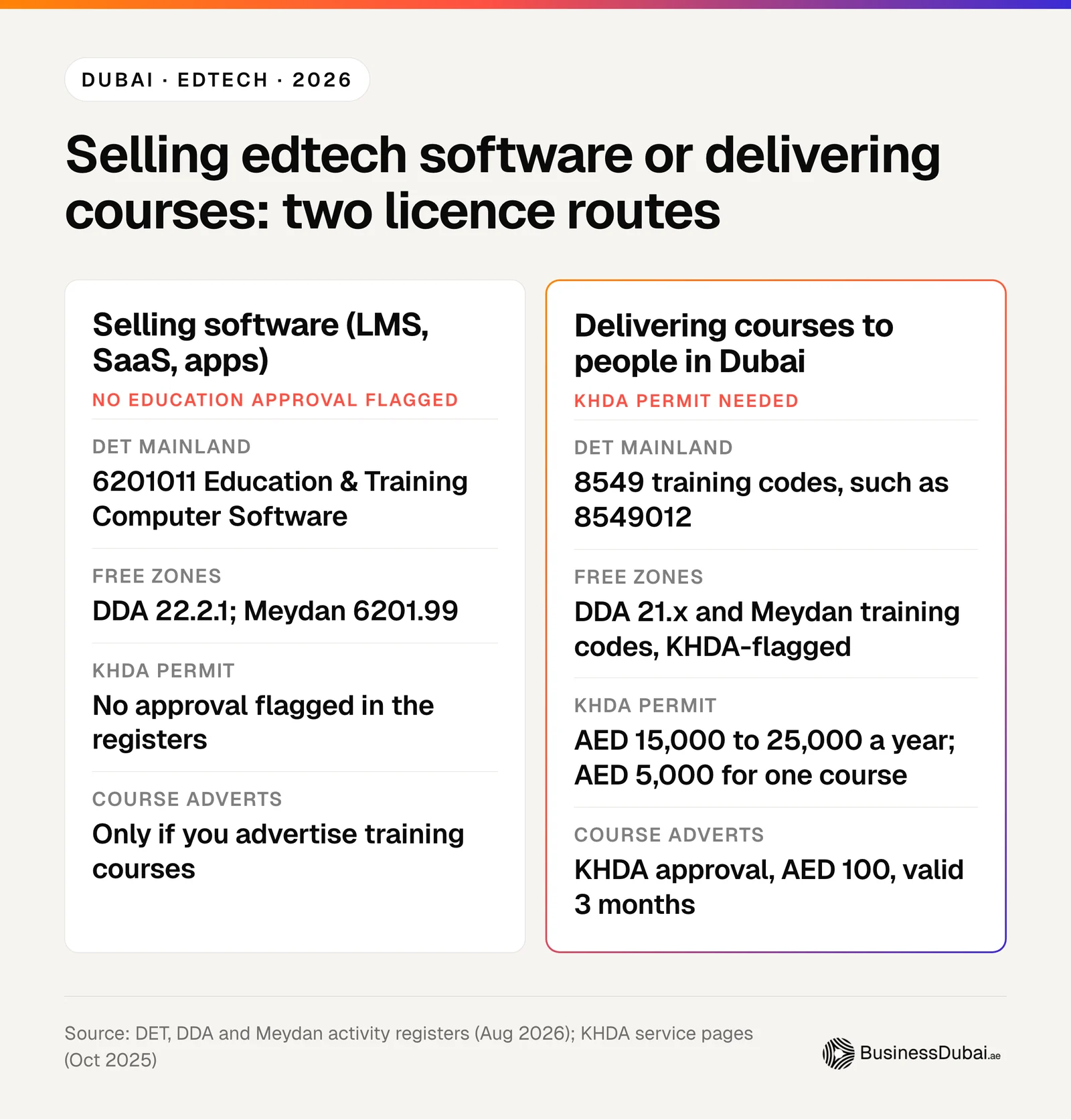
The activity code for a Dubai edtech company follows the platform model. LMS and school software sits on DET 6201011 Education & Training Computer Software, edtech research on 7220007, and a general app on 6201001. Courses delivered to learners use DET 8549 training codes such as 8549012 Computer Training, and that is where KHDA comes in.
DET's register describes 6201011 as software analysis and design for organisations involved in education and training, with no approval flagged; it fits an LMS, a school management system or an assessment engine [4]. DMCC and IFZA list the same code, and Meydan Free Zone lists it as 6201.99 [5]. DET 7220007 Educational Technologies Research & Development covers research on learning technologies, but its description bars field surveys and questionnaires until the competent authority approves them [4]. A consumer app can use the general software code 6201001 [4].
Dubai Development Authority (DDA), which licenses Dubai Internet City and Dubai Knowledge Park, lists 22.2.1 Education Technology Implementation Services, "Organisations enhancing the delivery of learning capabilities and the administration of schools and other educational organizations through technological learning solutions", and 21.13.2 eLearning Advisor, both with no approval flagged [5]. DDA's 21.x training categories carry a KHDA flag, as do Meydan's training and education support codes [5].
Once your company teaches people itself, the code changes to a delivery code: DET 8549012 Computer Training, 8549013 Professional & Management Development Training, 8549016 Supplementary Education, or 8550006 Education Support Services [4]. That is where KHDA comes in, because Resolution 50 of 2015 follows the training wherever the company is licensed [2].
The table maps common edtech models to the code that fits and the KHDA question each raises [4][5].
| Platform model | Typical code | Approval flagged in the register | The KHDA question |
|---|---|---|---|
| LMS or school management software sold to schools | DET 6201011; DDA 22.2.1; Meydan 6201.99 | None | Only arises if you also train people |
| Edtech research and product development | DET 7220007; Meydan 7220.97 | None at licensing; surveys need prior approval | Not a training activity |
| Consumer learning app | 6201011 or 6201001 | None | Depends on whether the app sells courses to people in Dubai |
| Course marketplace hosting other providers | No Dubai code named for it | Confirm with the licensing authority | Open question; ask KHDA in writing |
| Platform selling its own courses to Dubai learners | DET 8549 codes such as 8549012 or 8549013 | KHDA, in the free zone registers | Yes, on the wording of Resolution 50 |
| Tutoring or school-subject support | 8549016 Supplementary Education | KHDA | Yes |
| eLearning consultancy | DDA 21.13.2 eLearning Advisor | None | Not a training activity |
No Dubai register we checked names an activity for a platform that hosts other people's courses for a commission. The candidates are a software activity with commission income or an online selling activity, and the licensing authority should confirm which it accepts before you apply.
The two sides of the line are clearer side by side: only one of them brings KHDA's permit and advert approval with it [4][5][6][7][8].
Codes named for specific platform types, such as online learning platforms, LMS or virtual classrooms, sit outside Dubai. RAKEZ lists 8542013 Online Learning Platforms, 6201030 Learning Management Systems (LMS), 8542014 Virtual Classroom Solutions, 8542012 Education Technology (EdTech) Development and 5820008 E-Learning Content Creation, none flagged for approval [5]. Abu Dhabi and ADGM list 8549020 Remote learning, an internet-delivered training institute, and SPC Free Zone in Sharjah flags its 7220.97 for the Sharjah Private Education Authority [5].
Common Mistake: Choosing a training code for a software business, or the reverse. A school-software company that takes 8549013 because it sees itself as an education business has picked an activity the free zone registers flag for KHDA, inviting a permit question its product never raised. The reverse is worse: a platform selling its own paid courses to Dubai learners on 6201011 is offering training without the activity on its licence or a KHDA Authorisation [2][4]. Our management consultancy vs training activity guide covers the same trap for consultants.
If your product is software first, our software development company guide covers owning the code and how SaaS income is treated.
When does KHDA apply to an edtech platform?
KHDA applies to an edtech platform when the company itself offers training to people in Dubai. Executive Council Resolution No. 50 of 2015 requires KHDA Authorisation plus a trade licence before any Person offers Training Activities in the emirate, free zones and the DIFC included. A training institute permit costs AED 15,000 to 25,000 a year.
What Resolution 50 of 2015 says
The resolution, issued on 19 November 2015, sets its scope in Article 2(a): "This Resolution will apply to any Person who conducts a Training Activity in the Emirate, including Special Development Zones and free zones such as the Dubai International Financial Centre." [2] Article 4(a) sets the duty: "No Person may offer Training Activities to others in the Emirate without first obtaining the relevant Authorisation from the KHDA and a Licence from the relevant Licensing Authority." [2] A Training Programme is "A training course or a series of training courses offered to Trainees in order to increase their knowledge and develop their skills in any educational or professional field." [2] Nothing in that definition mentions a classroom or a mode of delivery.
Two exclusions in Article 2(b) matter to edtech. The resolution does not apply to "entities authorised by a Government Entity, pursuant to the legislation in force in the Emirate, to conduct a Training Activity", or to "private entities that provide Training Programmes by themselves to their employees in order to increase their knowledge and develop their skills" [2]. On our reading, a company training its own staff on your platform falls within that exclusion; your platform training another company's staff does not.
The software-versus-delivery test (our reading)
KHDA has published no rule for online platforms, and its permit pages, in archived copies last updated in October 2025, never mention online delivery [6][7]. Answering a Gulf News reader about online cooking classes in January 2021, KHDA said: "All training courses in Dubai have to be licensed by KHDA and obtain the necessary approvals from respective licensing authorities." [9] Al Tamimi & Company wrote in May 2021 that training institutions "are and were allowed to offer short-term training courses entirely through distance learning; provided that they have obtained the requisite approvals from the relevant regulators", with approvals decided case by case [10].
Our reading, not a KHDA rule: a company that only licenses software, or hosts courses that other providers deliver, does not obviously "offer Training Activities to others". A platform that itself sells courses to people in Dubai is, on the wording of Article 4(a).
| Your platform | Position on our reading of Resolution 50 |
|---|---|
| Licenses an LMS to a school that teaches its own pupils | Not obviously offering training; the school is the educator |
| Hosts other providers' courses for a commission | Unclear; ask KHDA, and check each provider holds its own permit |
| Sells its own courses, live or recorded, to people in Dubai | Within Article 4(a); plan for a KHDA permit |
| Runs paid workshops for teachers on its own software | A training course offered to others; needs a permit |
| Is used by a company to train its own employees | That company is excluded by Article 2(b)(3) |
| Sells only to learners outside the UAE | Outside "in the Emirate" on a plain reading; confirm in writing |
The Dubai Startup Guide 2025 calls the KHDA permit mandatory for institutions offering training "within the Dubai mainland" [1], but Resolution 50 names free zones and the DIFC [2]. A free zone licence is not a way around KHDA.
KHDA permits and what they cost
The fees below come from KHDA's service pages, read through archived copies dated 15 and 23 October 2025 because the live pages block automated reading; re-check them on KHDA's site before you budget [6][7][8].
| KHDA service | Fee (AED) | Processing time | Notes |
|---|---|---|---|
| Educational Services Permit, training institute, 1 to 2 activities | 15,000 | 8 working days | Valid one year; renew at least 30 days before expiry |
| Educational Services Permit, 3 to 4 activities | 18,000 | 8 working days | As above |
| Educational Services Permit, 5 to 6 activities | 20,000 | 8 working days | As above |
| Educational Services Permit, more than seven activities | 25,000 | 8 working days | As above |
| Permit to deliver a training course, non-training institutes | 5,000 | 6 working days | One course only |
| Approval of a training institute's advertisement | 100 | 2 working days | Valid 3 months |
The one-course route is blunt: "A permit issued to entities that are not training institutes will be valid for delivering only one training course." [6] Its form asks for a "Proposed venue and schedule for the training course." [6] That was written for a room, so an online provider should describe its delivery platform in place of a venue.
Adverts and penalties
Course adverts need their own approval, at AED 100 each, valid for three months [8]. KHDA told Gulf News that "Any advertisement, social media post or email circular advertising training courses also has to be approved by KHDA" [9]. On penalties, Resolution 50 doubles a fine for a repeat within one year, and "A doubled fine must not exceed one hundred thousand Dirhams (AED 100,000.00)." [2] Its Schedule 3, as published in 2015, lists AED 50,000 for delivering a training activity without an Authorisation; check for later changes [2].
Real Talk: Nobody can tell you with certainty whether a pure software platform or a course marketplace needs a KHDA permit, because KHDA has not published a rule for platforms. So ask KHDA. Describe what the platform does, who teaches, who the learners are and where, and ask for its position in writing. If the answer is yes, the cheapest entry point is AED 5,000 for one course [6]. If it is no, keep the reply on file, because a bank, an investor or a school's procurement team may ask the same question.
Common Mistake: Repeating the claim, made on some setup sites, that KHDA has a new online-education mandate starting in 2027. The versions we found cite placeholder resolution numbers and no KHDA or Dubai legislation source. The real January 2027 date for edtech is the Child Digital Safety Law's compliance deadline [3], and KHDA's actual rule, Resolution 50 of 2015, already applies today [2].
For the full KHDA institute process and the academic zones, see our training institute setup guide; one-to-one teaching is covered in our online tutoring business guide.
Do federal education rules apply to an edtech platform?
Federal education rules reach an edtech platform mainly when it awards qualifications or works inside an accredited programme. The federal ministry licenses higher-education institutions, and the Commission for Academic Accreditation's September 2022 manual governs their online and blended programmes. No federal rule licenses a platform that sells non-accredited courses.
The u.ae portal states that the "Ministry of Education is responsible for licensing higher educational institutes in all emirates", subject to approval by the competent authority in each emirate, KHDA in Dubai [11]. The ministry's 2019 standards cover all higher-education institutions, free zone universities included, and set standards for e-learning [12]. The CAA's Procedural Manual for Online and Blended Learning guides those institutions when they apply for Substantive Change or Initial Accreditation of online or blended programmes [13]. It is written for universities, not platforms: a platform hosting a university's accredited programme is a supplier, and the accreditation burden stays with the institution.
| What you offer | Who regulates it | Where the platform stands |
|---|---|---|
| Short, non-accredited courses to adults in Dubai | KHDA, under Resolution 50 of 2015 | Needs a KHDA permit if it delivers them |
| Degrees or accredited programmes, including online | Federal higher-education ministry and the CAA | Only through a licensed institution |
| Private school education | KHDA in Dubai, under Federal Decree-Law No. 18 of 2020 on Private Education [11] | Platforms sell to schools; they are not schools |
| Software sold to schools or universities | No education regulator licenses the software | Trade licence, plus the buyer's procurement and data terms |
A certificate from a short course is a training certificate, not a qualification. Calling it "accredited" when no accrediting body has reviewed it is the kind of claim KHDA's advert review exists to catch.
What does the Child Digital Safety Law mean for an edtech app?
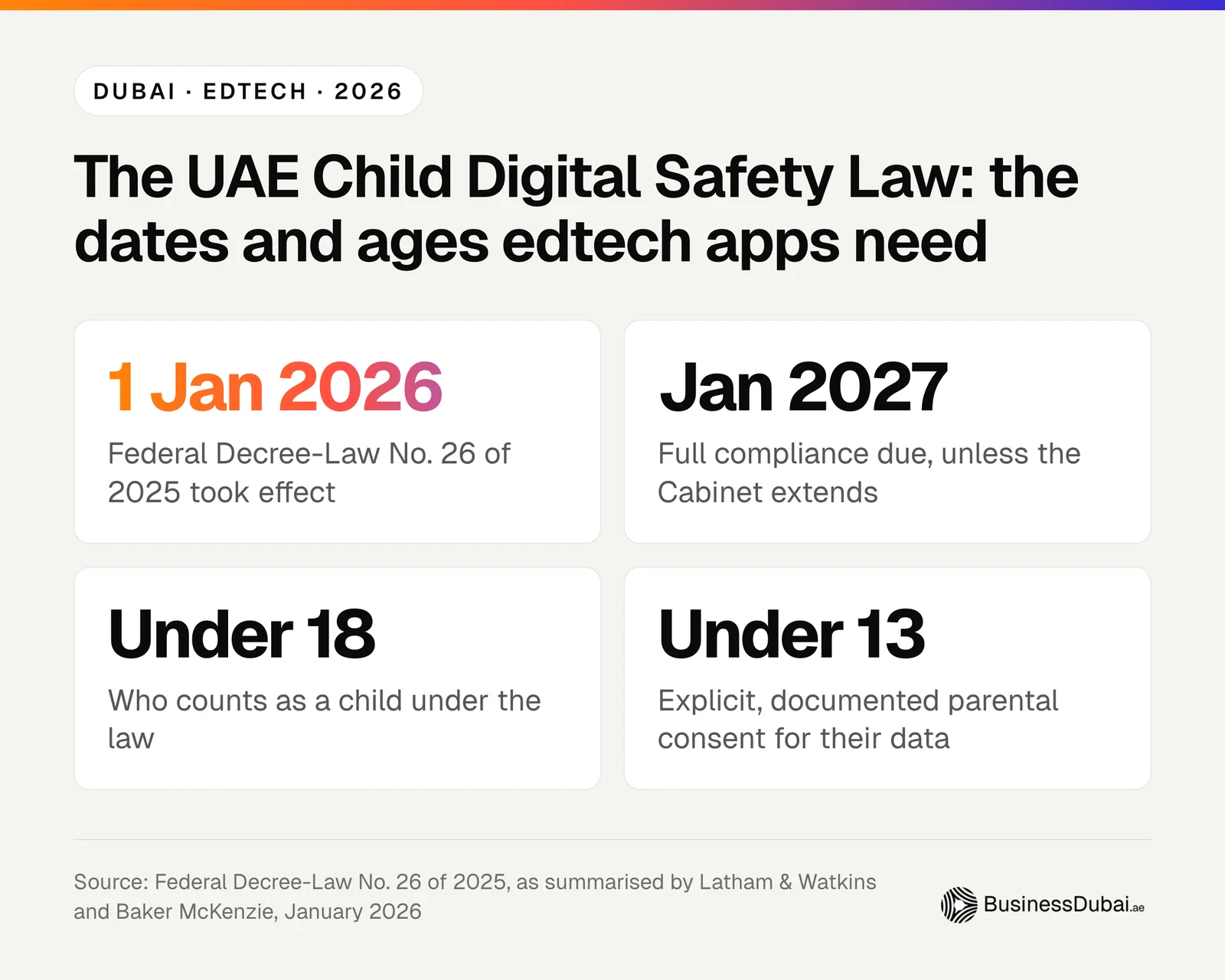
The Child Digital Safety Law, Federal Decree-Law No. 26 of 2025, applies to websites and apps that operate in or target the UAE, even from abroad. It took effect on 1 January 2026 with full compliance due in January 2027, defines a child as under 18, and bars using under-13 data without explicit, documented parental consent.
Who the law covers
Latham & Watkins summarised the timing on 9 January 2026: the law "took effect on January 1, 2026, and covered entities have up to one year from that date to comply, unless the Cabinet extends the deadline." [3] It applies to platforms that operate in or target users in the UAE "regardless of any legal presence in the country", and covered platforms include websites, smart applications and e-commerce platforms [3]. A child is anyone under 18 [3]. A learning app built in London or Bengaluru and marketed to UAE families is in scope without a UAE company.
The under-13 rule and the education exemption
In Latham & Watkins' words: "Platforms cannot collect, process, publish, or share personal data of children under 13 without explicit, documented parental consent, a simple and always-available way to withdraw consent, and clear privacy policy disclosures to the child and caregiver." [3] There must be no commercial use, targeted ads or tracking beyond the authorised purpose, and the Cabinet will set consent verification methods [3].
Baker McKenzie places one sentence directly after that rule: "Platforms used for educational or health purposes are exempt from this prohibition where Cabinet approval is obtained." [14] Law firms read the reach of "this prohibition" differently: the whole under-13 rule, or only the ban on targeted advertising and profiling. We found no published Cabinet approval mechanism, so plan to meet the consent rule in full.
Much of the detail still waits on the Cabinet: a risk classification of platforms, the age verification each class needs, and penalties that may include blocking or closure [14]. Baker McKenzie says the law becomes "fully enforceable in January 2027" [14]. The four numbers below decide what an edtech app has to build [3][14].
What the PDPL adds
The general data law, Federal Decree-Law No. 45 of 2021 (PDPL), has no child rule of its own. Bird & Bird: "There is no specific provision regulating the processing of a minor’s data or parental consent." [15] It adds that "consent should be obtained from the parent/legal guardian in order to be relied on in the local courts." [15] Morgan Lewis reported in June 2026 that the PDPL's implementing regulations "have still not been issued" [16]. Free zones with their own data law, such as the DIFC and ADGM, are reported to sit outside the PDPL.
Pro Tip: Build consent and age checks before January 2027, not after the Cabinet's classification arrives. Have a parent create any account for a user under 13, record the consent with a timestamp, give the parent a one-tap way to withdraw it, write a privacy notice a child and a parent can both read, and switch off ad tracking on child accounts [3]. The law already names each of these, so the work is not wasted whatever the Cabinet decides.
Common Mistake: Paying for UAE-only data hosting because a setup site said the PDPL requires it. We found no UAE data-localisation rule for edtech in the PDPL or in the law firm analyses we read [15][16]. A school customer may ask for local hosting in its contract, which is a commercial term. Meanwhile the rule that does exist, parental consent for under-13s, goes unbuilt.
Should an edtech company set up on the mainland or in a free zone?
An edtech company can set up on the Dubai mainland from AED 18,200 without a visa or AED 26,900 with one, or in Meydan Free Zone or Dubai South from AED 12,500 licence-only or AED 21,850 with one visa, on BusinessDubai.ae's 2026 package prices. KHDA's Resolution 50 applies equally in both.
The choice turns on who pays you. If your buyers are Dubai schools, companies and government entities, check how they buy first; if they are learners and institutions worldwide, a free zone company usually does the job for less. Our free zone company setup and mainland company setup pages itemise each route, including the renewal the headline price leaves out.
The comparison uses BusinessDubai.ae's standard 2026 packages [27].
| Factor | Dubai free zone | Dubai mainland (DET) |
|---|---|---|
| Licence, no visa | Meydan or Dubai South AED 12,500; IFZA AED 12,900 | AED 18,200 |
| Licence with one visa | Meydan or Dubai South AED 21,850; IFZA AED 22,200 | AED 26,900 |
| Year-two renewal | Roughly 80% of year one | About AED 15,000 |
| Foreign ownership | 100% | 100% for most activities |
| Selling to Dubai schools and companies | Depends on the buyer's procurement rules | Direct |
| KHDA if you deliver training | Yes, Resolution 50 names free zones | Yes |
| Corporate tax on course and software income | Mostly non-qualifying, so ordinary rates | 0% to AED 375,000, 9% above |
Each zone lists edtech under slightly different names, and only some carry a BusinessDubai.ae package price; non-Dubai zones are labelled [5][27].
| Zone | Edtech codes | Package (AED): licence only / 1 visa / 2 visas |
|---|---|---|
| Meydan Free Zone | 6201.99; 7220.97 | 12,500 / 21,850 / 28,400 |
| Dubai South | Check the zone's list | 12,500 / 21,850 / 28,400 |
| IFZA | 6201011; 7220007 | 12,900 / 22,200 (partner prices; IFZA publishes none) |
| DMCC | 6201011; 7220007 | Quoted on request |
| DDA (Dubai Internet City, Dubai Knowledge Park) | 22.2.1; 21.13.2 | Quoted on request |
| DIFC | Education & Training Computer Software; Educational Technologies R&D | Quoted on request |
| RAKEZ (non-Dubai) | 8542013, 6201030, 8542014, 8542012, 5820008 | 6,010 / 12,810 / 18,810 |
| SPC Free Zone, Sharjah (non-Dubai) | 7220.97, flagged for the Sharjah Private Education Authority | 5,765 / 15,055 / 19,505 |
| Ajman Free Zone (non-Dubai) | Check the zone's list | 5,555 / 13,931 / 17,971 |
Our Meydan Free Zone setup guide and IFZA free zone guide cover the two cheapest Dubai routes, while our Dubai Internet City setup guide and DIFC Innovation Licence guide cover the tech-cluster options. A Sharjah base changes which regulator asks the education question rather than removing it, and our business setup in Sharjah page shows what its packages include. On the wording of Resolution 50, a licence from another emirate does not take a platform that trains people in Dubai outside its scope; ask KHDA if that is your model.
Schools and government entities set their own procurement rules. Some contract with free zone companies for software; others ask for a mainland licence or a vendor on an approved list. Ask a target buyer before you choose the base, because a mainland licence costs little next to losing a tender on eligibility.
Real Talk: IFZA and Meydan Free Zone now require a shareholder applying for an investor visa to show capital of at least AED 75,000 in a bank account, in the UAE or the home country [27]. A founder relocating on the investor visa should have that balance in place before applying.
How is VAT charged on online courses and edtech subscriptions?
Online courses and edtech subscriptions sold in the UAE carry VAT at the standard 5% rate. Zero-rating is reserved for a Qualifying Educational Institution delivering a curriculum a competent government entity recognises. Registration is mandatory above AED 375,000 of taxable supplies a year and voluntary from AED 187,500, under Federal Tax Authority rules.
The Federal Tax Authority (FTA) published its first education VAT guide, VATGED1, in June 2026 [17]. Zero-rating needs a recognised Qualifying Educational Institution delivering a recognised curriculum, and in Deloitte's summary, "Failure to meet either condition means the supply is subject to VAT at the standard rate of 5%." [17] A commercial edtech platform fails the first condition.
BSA Law's summary says pre-recorded courses with automatic assessments may be electronic services with their own place-of-supply rules, while "interactive teaching and live forums generally do not." [18] BSA adds: "Non-resident providers supplying UAE students via automated platforms may have UAE VAT registration obligations." [18]
| What you sell | VAT position |
|---|---|
| Live online classes with a tutor | Education rules; place of supply where performed; 5% for a commercial platform |
| Pre-recorded course with automatic assessments | May be an electronic service, taxed where used and enjoyed |
| LMS or SaaS subscription to a UAE school | Standard-rated at 5% |
| Course delivered in the UAE to a non-resident | 5%; "If the place of supply is the UAE, export zero-rating is unavailable even for non-resident recipients" [18] |
| Services to customers outside the UAE | Possibly zero-rated as an export, if the conditions are met |
Registration is mandatory once taxable supplies exceed AED 375,000 in 12 months and voluntary from AED 187,500 [19]. Our VAT registration and compliance guide covers filing, and the digital economy VAT guide covers export zero-rating of services sold abroad.
Quick Math: An edtech platform selling AED 600,000 a year of courses to UAE learners is past the AED 375,000 mandatory threshold [19]. If its prices are VAT-exclusive, 5% adds AED 30,000 of output VAT, collected from learners and paid to the FTA. If the prices were set VAT-inclusive by mistake, the VAT is carved out of the same AED 600,000 instead: 5/105 of it, about AED 28,571, comes out of the margin.
Can an edtech company pay 0% corporate tax in a free zone?
Most edtech income does not get 0% corporate tax in a UAE free zone. Ministerial Decision No. 229 of 2025 lists no Qualifying Activity for software, e-learning or platforms and excludes transactions with natural persons. The one route for software income is qualifying intellectual property, meaning copyrighted software, measured by a nexus calculation.
A Qualifying Free Zone Person pays 0% only on qualifying income, and MD 229's closed list of Qualifying Activities, from manufacturing to fund management and logistics, has nothing for software, courses or subscriptions [20]. It also excludes "Any transactions with natural persons, except transactions in relation to the Qualifying Activities specified under paragraphs (e), (g), (h) and (k) of Clause (1) of this Article." [20] Those paragraphs cover ships, fund management, wealth management and aircraft leasing, so fees from individual learners are excluded income.
The one 0% hook is intellectual property. Cabinet Decision No. 100 of 2023 defines Qualifying Intellectual Property as "Patents, Copyrighted Software and any right functionally equivalent to a Patent that is both legally protected and subject to a similar approval and registration process to a Patent" [21]. Income from it qualifies only up to a nexus amount based on your own research and development spending, and the rest is taxable [20][21].
| Income stream | In a free zone | Result |
|---|---|---|
| Course fees from individual learners | Excluded: transactions with natural persons | Non-qualifying |
| SaaS or LMS subscriptions to schools and companies | Not a Qualifying Activity | Non-qualifying, unless part qualifies as IP income |
| Income from copyrighted software you developed | Qualifying IP, up to the nexus amount | 0% on the qualifying part |
Non-qualifying revenue is allowed only up to the lower of 5% of total revenue or AED 5,000,000 [20]. A free zone course platform selling to individuals fails that test and becomes an ordinary taxable person: 0% up to AED 375,000 of taxable income and 9% above [22]. A company that fails is taxed at ordinary rates from the start of that period and cannot be a Qualifying Free Zone Person for the following four [20][22]. Small Business Relief, for revenue at or under AED 3,000,000 in periods ending on or before 31 December 2029, is open to ordinary taxable persons but not to a Qualifying Free Zone Person [23]. Our Small Business Relief guide and Qualifying Free Zone Person guide cover both tests.
Quick Math: A mainland edtech company with AED 900,000 of taxable profit pays 0% on the first AED 375,000 and 9% on the remaining AED 525,000 [22]. That is AED 47,250, an effective rate of about 5.25%. A free zone company earning the same profit from course fees lands in the same place, because its income is non-qualifying.
Common Mistake: Choosing a free zone for 0% tax on a course or subscription business. The package may still be right on price and visas, but the tax saving usually does not exist for edtech income [20]. Choose on cost, activity fit and how your buyers contract, and treat any 0% on software as a qualifying IP question with its own advice and records.
To have the corporate tax position modelled before you pick a zone, model your position→
How big is the UAE edtech market, and who supports founders?
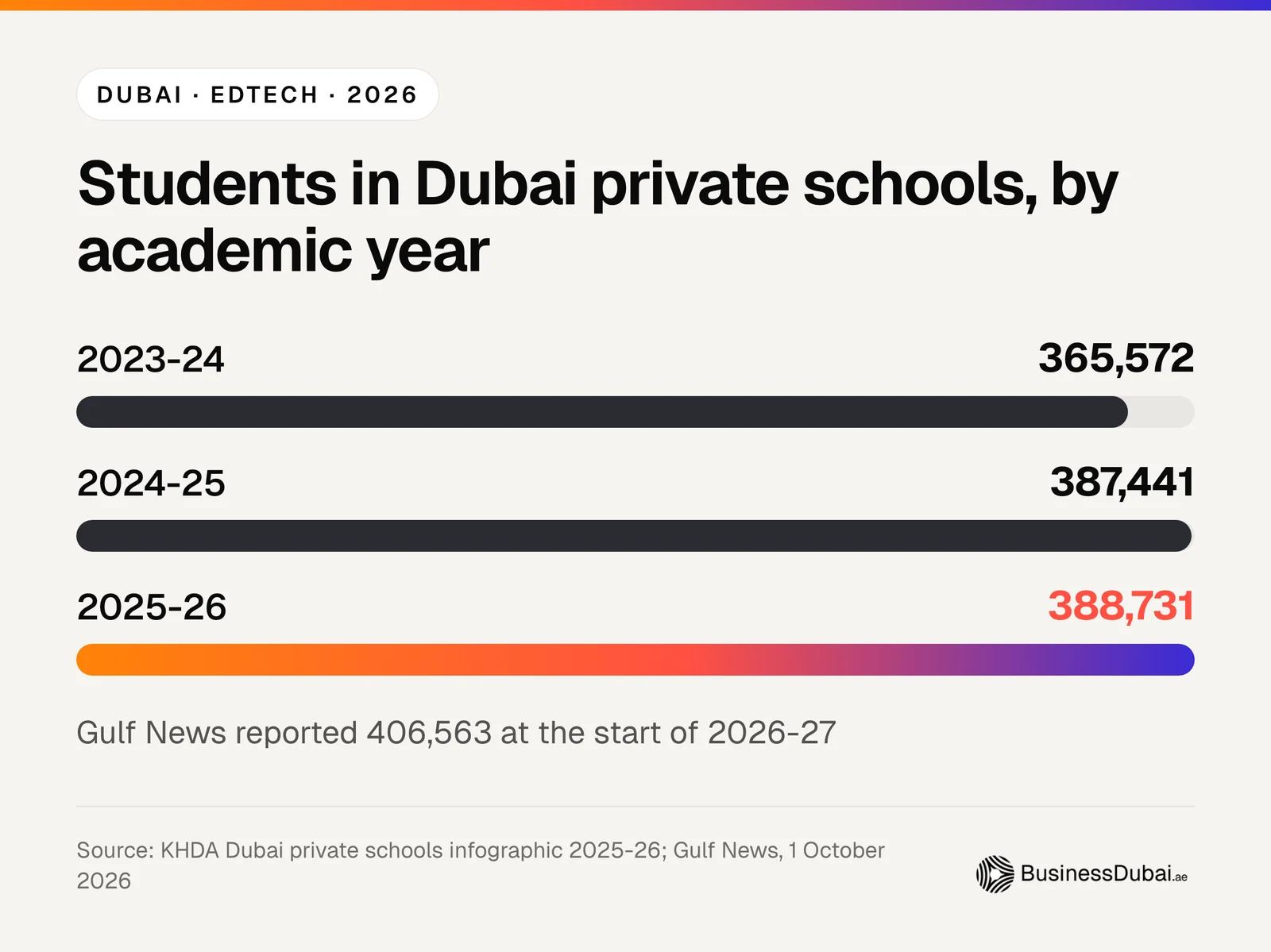
The UAE edtech market reached US$1.2 billion in 2024 and is projected to reach US$3.31 billion by 2033, according to the Dubai Startup Guide 2025. KHDA counted 388,731 students in Dubai private schools in 2025-26, and Gulf News reported 406,563 at the start of 2026-27.
The Edtech section of the Dubai Startup Guide 2025 states: "UAE’s Edtech market size reached US $1.2 billion in 2024 and is projected to reach US $3.31 billion by 2033, rising at a CAGR of 11.88%." [1] The guide, launched on 11 October 2025, covers 12 digital-economy sectors, Edtech among them [26]. The same section notes that the Ministry of Education planned AI as a subject in public schools from kindergarten to Grade 12 from 2025-2026, at 20 hours a year [1].
Schools are the clearest local market. KHDA's figures show Dubai private school enrolment rising from 365,572 in 2023-24 to 387,441 in 2024-25 and 388,731 in 2025-26 [24]. Gulf News reported on 1 October 2026 that 406,563 students were enrolled at the start of 2026-27 [25]; that is a start-of-year count, not a like-for-like annual figure. The trend is set out below [24][25].
For support, the guide lists the "CoFounder+ Programme" with the sectors "EdTech, HealthTech, HRTech, PropTech, RetailTech", and in5's programmes as "in5 Tech; in5 Media; in5 Design; in5 Science" [1]. Our UAE business incubators guide compares the incubator routes.
Dubai is the wrong base for some edtech founders. If your learners and buyers are all outside the Gulf and you do not need UAE residency, a UAE company adds cost and compliance without adding customers.
What does it cost to set up an edtech company in Dubai?
An edtech company in Dubai costs AED 12,500 licence-only or AED 21,850 with one visa at Meydan Free Zone, or AED 18,200 without a visa and AED 26,900 with one on the mainland, on BusinessDubai.ae's 2026 prices. A platform that delivers training adds a KHDA permit of AED 5,000 to 25,000.
The packages cover company formation; the KHDA, advert and child-data lines depend on your model and are priced by KHDA or advisers [6][7][8][27].
| Cost item | Amount (AED) | Notes |
|---|---|---|
| Meydan Free Zone or Dubai South package | 12,500 / 21,850 / 28,400 | Licence only, one visa, two visas |
| IFZA package | 12,900 or 22,200 | Licence only or one visa; partner prices |
| Dubai mainland (DET) package | 18,200 or 26,900 | No visa or one visa |
| DMCC, DDA or DIFC | Quoted on request | No BusinessDubai.ae published package |
| RAKEZ (non-Dubai) | 6,010 / 12,810 / 18,810 | Licence only, one visa, two visas |
| SPC Free Zone, Sharjah (non-Dubai) | 5,765 / 15,055 / 19,505 | Licence only, one visa, two visas |
| Ajman Free Zone (non-Dubai) | 5,555 / 13,931 / 17,971 | Licence only, one visa, two visas |
| KHDA training institute permit | 15,000 to 25,000 a year | Only if you deliver training |
| KHDA permit for one course | 5,000 | Non-training institutes; one course only |
| KHDA advert approval | 100 each | Valid 3 months |
| Child-data compliance (privacy notice, consent flow, age checks) | Adviser quote | Scope depends on the Cabinet's classification |
| Investor visa capital at IFZA or Meydan | 75,000 shown in a bank account | A balance to evidence, not a fee |
| Year two, free zone renewal | Roughly 80% of year one | Ask for the standard renewal price |
| Year two, mainland renewal | About 15,000 | BusinessDubai.ae mainland package |
For a pure software company the bill ends near the package price; for a platform that teaches, the KHDA permit can match the licence every year. Year two brings licence and visa renewals, the corporate tax return and VAT filings within months of each other, and our post-setup services team runs that calendar so a renewal does not land in a product launch.
Pro Tip: If your first training product is a single workshop, test it on KHDA's permit for non-training institutes. At AED 5,000 it costs a third of the smallest institute permit at AED 15,000, though it covers one course only [6][7]. Move to the institute permit once you run a programme, and add the training activity to your licence at the same time.
For a quote that prices the licence, the visas and the KHDA position for your model, get an itemised setup quote→
What are the steps to launch an edtech company in Dubai?
Launching an edtech company in Dubai takes seven steps: define what the platform sells, pick the activity codes, choose mainland or free zone, license the company, ask KHDA in writing if you deliver training, build child-data consent before January 2027, then register for VAT and corporate tax. KHDA's institute permit takes 8 working days.
- Write down what the platform sells and to whom, including whether any users are children.
- Pick the activity codes: a software code such as 6201011 or 22.2.1, and a training code such as 8549013 only if your company teaches [4][5].
- Choose mainland or a free zone on how your buyers contract, not on a 0% tax promise [20].
- License the company: trade name, Initial Approval, then the licence; a training institute adds KHDA's Initial Approval, valid six months [7].
- Ask KHDA in writing if you are near the line. The one-course permit takes 6 working days and the institute permit 8, once documents are complete [6][7].
- Build consent and age checks for under-13s before the January 2027 compliance date [3][14].
- Register for tax: corporate tax on time, as late registration carries an AED 10,000 penalty, and VAT once taxable supplies pass AED 375,000 [19][22].
Which setup fits your edtech business?
The right edtech setup depends on who pays you and for what. A school-software vendor, a course marketplace, an own-course platform for adults, a kids' learning app, a corporate training platform and a founder relocating from abroad each need a different code, base and first task, from a KHDA question to parental consent.
The table maps six profiles to codes, base and the point most likely to cause trouble [2][3][4][5].
| Profile | Codes | Likely base | Watch first |
|---|---|---|---|
| School SaaS or LMS vendor | DET 6201011; DDA 22.2.1; Meydan 6201.99 | Free zone, or mainland if buyers ask | Paid teacher training brings KHDA in |
| Course marketplace | Software code; confirm the marketplace activity with the licensing authority | Either | Ask KHDA in writing; check each provider's permit |
| Own-course platform for adults | DET 8549 codes such as 8549013, plus a software code | Either; KHDA applies in both | KHDA permit, advert approvals, 5% VAT |
| Kids' learning app | 6201011 or 6201001; 8549016 if it teaches school subjects | Either | Under-13 parental consent before January 2027 |
| Corporate training platform | 6201011; 8549013 if you deliver the training | Either | Training another company's staff is training "to others" |
| Founder relocating from abroad | Code by model, often software first | Free zone with one visa | AED 75,000 capital for an IFZA or Meydan investor visa |
If your profile sits between two rows, ask whether your company teaches the learner or someone else does: teaching puts you in KHDA's territory; supplying the tools is selling software.
Real Client Stories
These are composite examples built from the situations edtech founders most often face in Dubai. Names and details are illustrative, and the only figures used are published government fees and BusinessDubai.ae's package prices.
The school-software founder whose workshops needed KHDA (IFZA)
A UK founder whose platform tracks pupil progress for British-curriculum schools set up in IFZA on 6201011 Education & Training Computer Software, at a partner package price of AED 22,200 with one visa. The code carries no education approval in the register, and selling the software to Dubai schools raised no KHDA question. Then two schools asked for paid half-day workshops to train their teachers on the platform. That was a training course offered to others in Dubai, which the software licence did not cover. He applied for KHDA's AED 5,000 permit for non-training institutes, covering one course, and asked KHDA in writing how a recurring programme would be treated. Lesson: the licence follows the software; KHDA follows the teaching.
The course marketplace that became a course provider (Dubai mainland)
An Indian founder launched a marketplace where independent instructors sold recorded courses, licensed on the Dubai mainland at BusinessDubai.ae's package price of AED 26,900 with one visa under a software activity. In year two the platform produced its own data-science course and sold it to learners in Dubai. That changed its position: Resolution 50 of 2015 applies to any person offering training courses to others in the emirate, and the platform was now the provider, not the host. It added a training activity to its licence, applied for KHDA's training institute permit at AED 15,000 for one or two activities, and budgeted AED 100 for each advert approval. Lesson: hosting courses and teaching them are different businesses.
The kids' learning app that rebuilt sign-up before the deadline (Meydan Free Zone)
A phonics and maths app for children aged five to nine set up in Meydan Free Zone on 6201.99 at BusinessDubai.ae's package price of AED 21,850 with one visa. Its first build asked children for a nickname and a parent's email, nothing more. Reviewing the Child Digital Safety Law, which took effect on 1 January 2026 with full compliance due in January 2027, the founders saw it requires explicit, documented parental consent before using an under-13's data, plus a simple way to withdraw it. They rebuilt sign-up so a parent creates the account, records consent and can revoke it, and switched off ad tracking on child accounts. Lesson: consent is a product feature; build it before the deadline.
Start your edtech company in Dubai the right way
For an edtech company, the licence is the quick part. Three decisions matter more. Whether your company teaches or supplies the tools decides the code and whether KHDA applies, and near that line KHDA's written view beats any setup agent's opinion. Whether children use your product decides how much of the Child Digital Safety Law you build before January 2027. And for most course and subscription income, the honest corporate tax answer is ordinary rates, not 0%.
BusinessDubai.ae has set up companies across the UAE since 2013, with itemised pricing and no hidden fees. We will price a free zone company setup against a mainland company setup on what differs for an edtech business: the code for your model, how your buyers contract and whether a KHDA permit belongs in the budget. Our post-setup services team then handles renewals, visas and the tax calendar.
Frequently Asked Questions
Which activity code should an LMS company use in Dubai?
An LMS company in Dubai usually uses DET 6201011 Education & Training Computer Software, which DMCC and IFZA also list, or Meydan Free Zone's 6201.99. Dubai Development Authority lists 22.2.1 Education Technology Implementation Services. None is flagged for an education approval in the registers as of 2026.
Do I need KHDA approval to sell online courses in Dubai?
If your company sells its own courses to people in Dubai, plan for KHDA approval, live or recorded. Resolution 50 of 2015 requires KHDA Authorisation before anyone offers training to others in the emirate, and KHDA has published no separate online rule, so confirm your model in writing.
Do I need KHDA approval if I only sell software to schools?
A company that only sells software to schools is not obviously offering training under Resolution 50 of 2015, and the software codes carry no education approval in the registers. KHDA has published no rule for platforms, so ask KHDA for its position in writing. Paid teacher training on your software needs a permit.
Does KHDA regulate free zone edtech companies?
Yes, where they deliver training in Dubai. Resolution 50 of 2015 applies to anyone conducting a training activity in the emirate, including free zones such as the DIFC. A free zone licence changes who issues the trade licence, not whether KHDA's permit is needed.
How much does a KHDA permit cost for a training provider?
A KHDA Educational Services Permit for a training institute costs AED 15,000 for one or two activities, AED 18,000 for three or four, AED 20,000 for five or six and AED 25,000 for more than seven, valid one year. These are KHDA's fees as last updated in October 2025.
Can I run one online course without becoming a training institute?
Yes. KHDA issues a permit to entities that are not training institutes for one training course, at AED 5,000 with 6 working days' processing. It covers only that course, and the form asks for a venue and schedule, so describe the online delivery.
Do I need KHDA approval for social media ads for my courses?
Yes, for training course adverts in Dubai. KHDA told Gulf News in 2021 that any advertisement, social media post or email circular advertising training courses has to be approved. Its advert approval costs AED 100, takes 2 working days and is valid for three months.
What are the penalties for running courses in Dubai without KHDA approval?
Resolution 50 of 2015 lists AED 50,000 in its published Schedule 3 for delivering a training activity without an Authorisation. A repeat within one year doubles the fine, capped at AED 100,000, and KHDA's Director General can suspend an institute's activity for up to six months.
Is there a KHDA online education mandate starting in 2027?
We found no KHDA or Dubai legislation source for a new online-education mandate in 2027; the versions online cite placeholder law numbers. The real January 2027 date for edtech is the Child Digital Safety Law's compliance deadline.
What licence does a course marketplace need in Dubai?
No Dubai register we checked names an activity for a course marketplace. The likely routes are a software activity with commission income or an online selling activity, and the licensing authority should confirm which it accepts. Whether KHDA applies depends on whether the platform itself offers the courses.
Do I need Ministry of Education approval for an edtech app?
An edtech app selling non-accredited learning products does not need federal education approval as a platform. The federal ministry licenses higher-education institutions and the CAA governs their online programmes, so federal approval matters only if you award qualifications or deliver an accredited programme with an institution.
Are certificates from my online courses recognised as qualifications?
No. A certificate from a short online course is a training certificate, not an academic qualification. Avoid marketing a course as "accredited" unless a recognised body has actually accredited it.
Does the UAE Child Digital Safety Law apply to my learning app?
Very likely, if children in the UAE use it. Federal Decree-Law No. 26 of 2025 covers websites and smart applications that operate in or target users in the UAE, regardless of legal presence, and defines a child as anyone under 18. Detailed duties depend on a Cabinet risk classification not yet published.
When does the Child Digital Safety Law have to be complied with?
The law took effect on 1 January 2026, and covered platforms have one year to comply, so full compliance is due in January 2027 unless the Cabinet extends the deadline.
Do I need parental consent to collect children's data in the UAE?
Yes for children under 13. The Child Digital Safety Law bars collecting or processing their personal data without explicit, documented parental consent, a simple way to withdraw it and clear privacy disclosures. The PDPL has no child-specific rule, but law firms advise parental consent anyway.
Are educational platforms exempt from the Child Digital Safety Law?
Not automatically. Baker McKenzie reports that educational or health platforms are exempt from "this prohibition" where Cabinet approval is obtained, and law firms read its reach differently. We found no published approval mechanism, so plan to meet the parental consent rule in full.
Does the PDPL require student data to be stored in the UAE?
We found no UAE data-localisation rule for edtech in the PDPL or in the law firm analyses we read, and the PDPL's implementing regulations had still not been issued as of June 2026. A school customer may require local hosting by contract, which is a commercial term.
Is VAT charged on online courses in the UAE?
Yes. Online courses sold in the UAE are standard-rated at 5% unless a Qualifying Educational Institution delivers them under a recognised curriculum. A commercial edtech platform does not meet that test, so its courses and subscriptions carry 5% VAT once it is registered.
Do I charge UAE VAT to students outside the UAE?
It depends on the course. Pre-recorded courses with automatic assessments may be electronic services, taxed where used and enjoyed, so sales abroad may fall outside UAE VAT. Live teaching performed in the UAE has a UAE place of supply, and export zero-rating is then unavailable.
Does a foreign edtech platform selling to UAE students need to register for VAT?
It may. BSA Law's summary of the FTA's June 2026 education guide says non-resident providers supplying UAE students through automated platforms may have UAE VAT registration obligations, so take advice before UAE sales grow.
Can a free zone edtech company pay 0% corporate tax?
Usually not on its main income. Ministerial Decision No. 229 of 2025 lists no Qualifying Activity for software or e-learning and excludes transactions with individuals. Income from qualifying intellectual property, such as copyrighted software, can reach 0% up to a nexus-calculated amount.
Does Small Business Relief apply to an edtech startup?
A resident edtech company with revenue at or under AED 3,000,000 can elect Small Business Relief for tax periods ending on or before 31 December 2029, under Ministerial Decision No. 73 of 2023 as amended by Ministerial Decision No. 131 of 2026. It is not available to a Qualifying Free Zone Person.
Can a foreigner own 100% of an edtech company in Dubai?
Yes. Free zone companies are 100% foreign-owned, and most mainland activities, including software, allow 100% foreign ownership.
Which free zones have specific edtech activity codes?
RAKEZ in Ras Al Khaimah lists explicitly named codes such as 8542013 Online Learning Platforms, 6201030 Learning Management Systems (LMS) and 8542014 Virtual Classroom Solutions. Dubai zones use broader names, such as 6201011 at DMCC and IFZA, 6201.99 at Meydan and 22.2.1 at DDA.
Is there an edtech accelerator in Dubai?
The Dubai Startup Guide 2025 lists the CoFounder+ Programme with EdTech among its sectors, and in5's programmes, including in5 Tech.
How long does KHDA take to issue a training permit?
KHDA lists 8 working days for a training institute's Educational Services Permit and 6 working days for a one-course permit, counted from receipt of all documents. The institute route also needs a trade name reservation and Initial Approval first.
References
[1] Dubai Chamber of Digital Economy. Dubai Startup Guide 2025, Edtech section: the UAE edtech market size statement (US$1.2 billion in 2024, US$3.31 billion projected by 2033, CAGR 11.88%), the Ministry of Education AI subject note, the edtech compliance list including the KHDA Educational Service Permit and KHDA advertising review, and the programme list including the CoFounder+ Programme and in5. dubaichamberdigital.com
[2] Government of Dubai. Executive Council Resolution No. 50 of 2015 Regulating Training Institutes in the Emirate of Dubai, issued 19 November 2015: Article 1 definitions (Training Activity, Training Programme), Article 2 scope and exclusions, Article 4(a) Authorisation duty, Article 16 penalties and Schedule 3 fines. dlp.dubai.gov.ae
[3] Latham & Watkins. UAE's Child Digital Safety Law: What Every Digital Platform and ISP Should Know, 9 January 2026: commencement on 1 January 2026, the one-year compliance period, extraterritorial scope, covered platforms, the under-18 definition and the under-13 parental consent rule. lw.com
[4] Dubai Department of Economy and Tourism (DET). Business activity register: 6201011 Education & Training Computer Software, 7220007 Educational Technologies Research & Development, 6201001, 8549012, 8549013, 8549016 and 8550006, with descriptions and approval flags from the Invest Dubai register generated 22 August 2026. app.invest.dubai.ae
[5] Free zone and emirate activity registers for DDA (TECOM), DIFC, Meydan Free Zone, DMCC, IFZA, RAKEZ, SPC Free Zone, Abu Dhabi and ADGM, as compiled in BusinessDubai.ae's activity registers on 22 August 2026: edtech, software and training codes with each authority's approval flags, including Meydan's 6201.99 and 7220.97. meydanfz.ae and meydanfz.ae
[6] Knowledge and Human Development Authority (KHDA). Authorisation to deliver a training course for Non-Training Institutes: fee AED 5,000, 6 working days, required documents and the one-course condition, page last updated 15 October 2025 (read via archived copy). web.khda.gov.ae
[7] Knowledge and Human Development Authority (KHDA). Issuing an Educational Services Permit for a Training Institute: fees of AED 15,000 to 25,000 by number of activities, 8 working days, one-year validity, Initial Approval valid six months, page last updated 23 October 2025 (read via archived copy). web.khda.gov.ae
[8] Knowledge and Human Development Authority (KHDA). Approving Training Institute's Advertisement: fee AED 100, 2 working days, approval valid 3 months, page last updated 15 October 2025 (read via archived copy). web.khda.gov.ae
[9] Gulf News. Dubai: can my wife offer online cooking classes without a permit?, 7 January 2021: KHDA's statement on licensing training courses and approving adverts, social media posts and email circulars. gulfnews.com
[10] Al Tamimi & Company. Operating as an education provider in the UAE, May 2021: distance delivery of short-term training courses with approvals decided case by case, and advertising approvals. tamimi.com
[11] UAE Government portal (u.ae). Licensing private educational institutes: the ministry's role in licensing higher-education institutes, KHDA's approval in Dubai, KHDA's licensing of private schools and Federal Decree-Law No. 18 of 2020 on Private Education. u.ae
[12] UAE Ministry of Education. New accreditation standards for higher education institutions, 4 February 2019: standards for licensing and accreditation of all higher-education institutions, including free zone universities, and standards for e-learning. moe.gov.ae
[13] Commission for Academic Accreditation, Ministry of Education. Procedural Manual For Online and Blended Learning, September 2022: guidance for higher-education institutions applying for Substantive Change or Initial Accreditation of online or blended programmes. caa.ae
[14] Baker McKenzie. UAE issues new Child Digital Safety Law, 8 January 2026: the one-year grace period and full enforceability in January 2027, the risk classification system, age verification, the under-13 data rule and the educational and health platform exemption subject to Cabinet approval, and penalties. bakermckenzie.com
[15] Bird & Bird. Children in the Digital World, United Arab Emirates: no PDPL provision on minors' data or parental consent, consent from a parent or guardian for reliance in local courts, and no specific parental consent verification requirements. childreninthedigitalworld.twobirds.com
[16] Morgan Lewis. UAE Establishes Federal Authority for Artificial Intelligence and Data, June 2026: PDPL implementing regulations still not issued and enforcement elusive. morganlewis.com
[17] Deloitte Middle East. FTA issues first VAT Guide for the UAE Education Sector, July 2026: VATGED1 published June 2026, the two zero-rating conditions and standard rating on failure, and distance learning without human interaction as an electronic service. deloitte.com
[18] BSA Law. Summary of the FTA's education VAT guide VATGED1, 30 June 2026: non-binding status, place of supply where performed, no export zero-rating where the place of supply is the UAE, pre-recorded courses as possible electronic services, and non-resident registration obligations. bsalaw.com
[19] Federal Tax Authority. VAT registration: mandatory registration above AED 375,000 of taxable supplies and voluntary registration from AED 187,500. tax.gov.ae
[20] Ministry of Finance. Ministerial Decision No. 229 of 2025 regarding Qualifying Activities and Excluded Activities, dated 28 August 2025: Article 2(1) Qualifying Activities, Article 2(2)(a) transactions with natural persons, Article 3 de minimis, Article 4 qualifying intellectual property income and Article 5 conditions and loss of status. mof.gov.ae
[21] Cabinet Decision No. 100 of 2023 on Determining Qualifying Income for the Qualifying Free Zone Person: the definition of Qualifying Intellectual Property and Article 7 on income from intellectual property. mof.gov.ae
[22] Federal Tax Authority. Corporate tax under Federal Decree-Law No. 47 of 2022: 0% up to AED 375,000 of taxable income and 9% above, the Qualifying Free Zone Person regime and loss of status, and the AED 10,000 late registration penalty. tax.gov.ae
[23] Ministry of Finance. Ministerial Decision No. 73 of 2023 on Small Business Relief, as amended by Ministerial Decision No. 131 of 2026: the AED 3,000,000 revenue threshold and tax periods ending on or before 31 December 2029. mof.gov.ae
[24] Knowledge and Human Development Authority (KHDA). Dubai Private Schools infographic 2025-26: enrolment of 365,572 (2023-24), 387,441 (2024-25) and 388,731 (2025-26), and 0.33% growth in the latest year. web.khda.gov.ae
[25] Gulf News. KHDA: Dubai schools to add 18,000 affordable seats as student numbers climb to 406,563, 1 October 2026: start-of-year 2026-27 enrolment compared with about 388,731 in June 2026. gulfnews.com
[26] Dubai Media Office. Dubai Startup Guide launch, 11 October 2025: the guide's 12 digital-economy sectors, including Edtech, and its coverage of accelerators, incubators, sandboxes and free zones. mediaoffice.ae
[27] BusinessDubai.ae. Internal data: 2026 standard package prices for the Dubai mainland, Meydan Free Zone, Dubai South, IFZA, RAKEZ, SPC Free Zone and Ajman Free Zone, renewal estimates, the IFZA and Meydan investor visa capital requirement, and activity registers compiled since 2013. businessdubai.ae