

A garment factory in the UAE is two businesses wearing one licence. The first is a company like any other. The second is an industrial facility that the Ministry of Industry and Advanced Technology (MoIAT) will only recognise once it has "Total of no fewer than 10 employees." and "Total capital of no less than AED 250,000." [1]. That federal licence is what lets you import fabric, trims and sewing machines without customs duty, and it is the line most garment setup guides never mention.
Get the structure wrong and the costs arrive later. A tailoring-shop licence cannot become a factory licence, a desk package in a business hub cannot host a production line, and a free zone factory that sells straight to shoppers can lose its 0% corporate tax for five tax periods. This guide is general information, not legal or tax advice; confirm your own position with the authority or a licensed adviser before you sign a lease or order machines.
Since 2013, BusinessDubai.ae has set up mainland and free zone companies across the UAE, including industrial and trading setups. This guide covers the Dubai activity codes that make a garment factory a factory, where to locate one, the MoIAT Industrial Production Licence, the per-shipment customs exemption on fabric and machines, worker housing and Emiratisation, the textile labelling scheme, export origin and the India CEPA, corporate tax and VAT, and an itemised cost table.
What does it take to open a garment factory in the UAE?
A UAE garment factory needs an Industrial activity (a DET 1410xxx code or a free zone equivalent), a local industrial licence, then MoIAT's Industrial Production Licence, which needs 10 employees and AED 250,000 capital. That licence unlocks duty-free fabric and machines per registered HS code. Workers on AED 1,500 or less must be housed once you employ 50.
For export, UAE-made garments can qualify for the India-UAE CEPA if production changes the tariff heading and adds 40% value [2].
The layers stack in a fixed order: the activity code, then industrial premises, then the local industrial licence issued by the Dubai Department of Economy and Tourism (DET) or the free zone, then MoIAT [1]. Input registration, labels, origin and tax come after. The generic factory approval chain (Dubai Municipality, Civil Defence, utilities and industrial land) is covered in our manufacturing company setup guide, so this article stays on what is specific to garments.
Factory, tailoring workshop, brand or trader: which business are you actually starting?
A UAE garment business is one of four things: a factory with an Industrial licence, a tailoring shop or workshop on a Professional licence, a brand that outsources production, or a trading company that imports finished clothing. Only the factory can hold MoIAT's Industrial Production Licence, so only the factory can claim the duty exemption on fabric and machines.
The difference is not size or ambition. It is the licence type DET attaches to the activity code. Garment manufacturing codes sit in the DET group "Manufacturing of garments and rugs" with licence type "Industrial", while the tailoring codes sit in "Gents tailoring and design" or "Ladies tailoring and design" with licence type "Professional" [3]. The table below maps each model to its licence and to what it can and cannot do.
| Business model | Licence type and example codes | Can it hold a MoIAT licence? | Typical buyers |
|---|---|---|---|
| Garment factory (cut, sew, finish, pack) | Industrial: 1410101 to 1410117, 1311007 | Yes, once it has 10 employees and AED 250,000 capital | Brands, retailers, uniform buyers, exporters |
| Tailoring shop | Professional: 1410904 Men Tailoring, 1410907 Ladies Wears Tailoring and Embroidery | No | Walk-in customers, made to measure |
| Tailoring workshop | Professional: 1410919 and 1410920 tailoring and embroidery workshops | No | Small runs, uniforms in modest volumes |
| Brand outsourcing production | Commercial or trading activity, design and marketing | No; the contract factory holds it | Retailers, online shoppers |
| Garment trading company | Commercial: clothing and textile trading codes | No | Wholesalers and retailers |
The workshop row is the one that catches people. DET describes 1410920 as "shops comprising numerous sewing machines and tailors for sewing men and boy apparel" [3]. Numerous machines and tailors still make a shop on a Professional licence, not a factory. The tailoring shop codes even cap the side trade: 1410904 firms "are allowed to sell the activity-related materials, such as, textiles, and garments accessories in non-commercial quantities" [3].
Common Mistake: Opening a tailoring licence for what is really a production line. A founder who plans to run 20 or 30 machines on bulk orders takes 1410920 because it is quicker and the shop rent is lower. The licence type is Professional, so MoIAT's Industrial Production Licence, which requires an "Industrial license from a local licensing department." [1], is out of reach, and every roll of fabric pays duty. Fixing it later means a new Industrial activity, industrial premises and a fresh approval chain.
If your plan is a brand rather than a factory, our guide on how to start a clothing and fashion business in Dubai covers the brand, retail and online side. If you will import finished garments or fabric to resell, the textile trading company guide covers the trading codes, the 5% import duty, the GCC label standard and the anti-dumping position, none of which this article repeats.
Which activity codes does a garment factory need in Dubai?
A Dubai mainland garment factory needs one or more 1410xxx manufacturing codes, each carrying licence type Industrial in DET's register, such as 1410102 Men's Outerwear Manufacturing or 1410113 Uniforms Manufacturing. Add 1311007 if you dye fabric or yarn, and 3290012 if you make buttons, badges or emblems. Free zones use their own lists.
The codes below come from the Dubai Department of Economy and Tourism business activity list as recorded in a public copy of the register, with DET records last updated in October 2023 [3]. Pick the codes that match what leaves your loading bay, because MoIAT issues its licence on top of the local licence and its activity.
| DET code | Activity name | Licence type | What the register says it covers |
|---|---|---|---|
| 1410101 | Men's Underwear Manufacturing | Industrial | Men's undergarments of woven, knitted or crocheted fabric |
| 1410102 | Men's Outerwear Manufacturing | Industrial | Shirts, nightwear, beach wear, trousers, shorts, ready-made suits, ties |
| 1410104 | Children Wears Manufacturing | Industrial | Swaddling clothes, nightwear, party clothes, shirts and trousers |
| 1410105 | Children's underwear Manufacturing | Industrial | Children's undergarments |
| 1410106 | Women Outerwear Manufacturing | Industrial | No description beyond the activity name |
| 1410107 | Ladies' underwear manufacturing | Industrial | Women's undergarments, woven, knitted or crocheted |
| 1410110 | Arabic Gown Manufacturing | Industrial | Gowns, as described below |
| 1410111 | Protective Garments & Vest Manufacturing | Industrial | Protective vests, coats, gloves and trousers |
| 1410112 | Sports Wears Manufacturing | Industrial | Sportswear |
| 1410113 | Uniforms Manufacturing | Industrial | School clothing and staff work wear |
| 1410114 | Jackets & Overcoats Manufacturing | Industrial | Fashion and winter jackets and overcoats |
| 1410115 to 1410117 | Gloves; Socks; Caps & Headwear Manufacturing | Industrial | Gloves, socks, ghoutras, caps, veils and textile hats |
| 1311007 | Yarn, Textiles Dyeing & Processing | Industrial | Dyeing, plus cutting and sewing ready-made garments |
| 3290012 | Tailoring & Embroidery Requisites Manufacturing | Industrial | Buttons, threads, badges and emblems |
A few entries need a closer read. The register describes 1410110 Arabic Gown Manufacturing as "manufacturing the wear over men gowns from knitted and crocheted fabrics" [3], which is narrower than most founders assume. 1410113 Uniforms Manufacturing covers "unified formal clothing worn by members of an organization such as school clothing" [3], which is the natural home for a factory supplying schools, hotels and hospitals. 1410117 covers "ladies' head and face covers such as various types of veils" [3], and 1311007 is broader than its name, because the register says "it includes preparing, cutting, tailoring and sewing to manufacture ready-made garments" [3].
Abayas and the empty entry
No separate abaya manufacturing code appears in the register. The closest fit by name is 1410106 Women Outerwear Manufacturing, but its register entry carries no description beyond repeating its own name [3]. Before you apply, put your product list in writing to DET and ask it to confirm which code covers abayas, kaftans and jalabiyas. A written answer costs nothing and saves an amendment later.
Free zone codes are not DET codes
Free zones publish their own activity lists, often numbered on the international ISIC pattern. Meydan Free Zone, for example, lists "1410.00 - Manufacture of wearing apparel, except fur apparel" [4]. That is a free zone activity reference, not a DET code, and quoting it to DET or to a mainland bank causes confusion.
Pro Tip: List every product you will make for the first two years before you choose codes, then add the codes in one application. A uniform factory that also plans sportswear and caps needs 1410113, 1410112 and 1410117 from the start. Adding an activity later means a licence amendment, and MoIAT re-inspects a licensed factory on renewal "Only in case of location or activity change." [5].
Where should you locate a garment factory in the UAE?
A UAE garment factory belongs where you can lease industrial premises and hold an industrial activity: the northern emirates' free zones such as Ajman Free Zone, SPC Free Zone, Hamriyah, SAIF Zone and RAKEZ, Abu Dhabi's KEZAD, or Dubai mainland industrial areas. BusinessDubai.ae packages start at AED 5,555, but factory space is quoted separately.
Start with one honest point about every price in this section. BusinessDubai.ae packages are company formation only. A garment factory needs industrial premises, meaning a factory unit or land, plus an industrial activity, and the zone must confirm and quote both separately. A desk package does not make a factory. The table shows BusinessDubai.ae's current standard package prices next to what you still need from the zone [21].
| Location | BusinessDubai.ae package (licence only / 1 visa / 2 visas) | Industrial premises | Notes |
|---|---|---|---|
| Ajman Free Zone | AED 5,555 / 13,931 / 17,971 | Zone quote | Lowest one-visa entry point in this table |
| RAKEZ | AED 6,010 / 12,810 / 18,810 | Zone quote | Ras Al Khaimah; confirm the garment activity and unit |
| SPC Free Zone (Sharjah) | AED 5,765 / 15,055 / 19,505 | Zone quote | Confirm the zone can licence production on its premises |
| Meydan Free Zone or Dubai South | AED 12,500 / 21,850 / 28,400 | Not a factory location in this package | Suits a brand or private-label company, not a production line |
| Hamriyah Free Zone (Sharjah) | No BusinessDubai.ae package | Zone quote | Industrial zone; price direct with the zone |
| SAIF Zone (Sharjah) | No BusinessDubai.ae package | Zone quote | Price direct with the zone |
| KEZAD (Abu Dhabi) | No BusinessDubai.ae package | Zone quote | Industrial land and units; price direct |
| Dubai Industrial City | No BusinessDubai.ae package | Zone quote | Price direct with the zone |
| Dubai mainland industrial areas | AED 18,200 without a visa / AED 26,900 with one visa | Lease an industrial unit separately | DET Industrial licence; direct access to UAE buyers |
For the Sharjah options, our business setup in Sharjah page explains how the emirate's zones compare, and the zone guides for Hamriyah Free Zone and SAIF Zone cover their industrial offer. If Ajman's lower entry price suits a first unit, our business setup in Ajman page shows what the package buys. For Abu Dhabi industrial land, see the KEZAD free zone guide, and for a zone-by-zone ranking of factory locations, see our best free zones for manufacturing guide.
Free zone or mainland for a garment factory?
The choice comes down to who buys. An exporting free zone factory keeps the 0% corporate tax route open; a mainland factory sells directly to UAE schools, hotels and government buyers.
| Factor | Free zone garment factory | Dubai mainland garment factory |
|---|---|---|
| Formation package (1 visa, BusinessDubai.ae) | From AED 12,810 (RAKEZ) to AED 15,055 (SPC) in the northern zones | AED 26,900 |
| Factory premises | Zone unit or land, zone quote | Industrial area lease, landlord quote |
| Selling to UAE buyers | Goods leaving the zone clear customs into the local market; confirm the treatment with the zone | Direct |
| Corporate tax | 0% possible on qualifying income as a Qualifying Free Zone Person | 0% to AED 375,000, 9% above |
| MoIAT Industrial Production Licence | Needed for the input exemption; confirm the zone's licence is accepted as the local industrial licence | Needed for the input exemption |
| Year-two renewal | Zone renewal, quote from the zone | About AED 15,000 for the BusinessDubai.ae mainland package |
Our free zone company setup and mainland company setup pages itemise each route, including the renewal that the headline price leaves out.
Real Talk: The cheapest licence is rarely the cheapest factory. A difference of a few thousand dirhams between packages disappears next to rent on an industrial unit, power for 30 machines and housing for your workers. Ask each zone for three written quotes before you choose: the industrial licence with your garment activity, the unit you would actually use, and the year-two renewal. Then compare totals, not package headlines.
What does the MoIAT Industrial Production Licence require and cost?
MoIAT's Industrial Production Licence requires a local industrial licence, a memorandum of association, at least 10 employees and at least AED 250,000 in capital. The application fee is AED 0 and the inspection fee AED 100. MoIAT's FAQ gives the time as "Within 15 business days". Renewal costs AED 500, plus AED 100 inspection if needed.
MoIAT is explicit about why a garment factory wants this licence. Its service page says: "This permit enables you to apply for exemptions from customs duties on the import of machinery, equipment, spare parts, and other materials directly involved in the manufacturing process." [1]. Without it, the exemption services are closed to you.
The FAQ lists the memorandum of association alongside the three thresholds, and the service card adds the partnership or incorporation contract and the owner's or manager's identity documents [1].
| MoIAT service, 2026 | Fee | Time | Notes |
|---|---|---|---|
| Issue Industrial Production License | AED 0 application, AED 100 inspection | FAQ: "Within 15 business days"; service card: 5 working days | Inspector visits the facility before issue [1] |
| Renew Industrial Production License | AED 500 application, AED 100 inspection if needed | 3 working days | Re-inspection "Only in case of location or activity change." [5] |
| Late renewal fine | AED 100 per month | Capped | "AED 100 per month up to a maximum of AED 1,000" [5] |
| Industrial Registry | Not published on the page read | Annual | Under Federal Decree-Law No. 25 of 2022 [6] |
After you apply, MoIAT reviews the file, you pay the inspection fee, an inspector visits, and the licence issues once the report is approved [1]. The service card shows 5 working days, while the FAQ says "Within 15 business days" [1]. Plan on the longer figure.
The licence also has an annual companion. MoIAT describes the Industrial Registry as "a digital platform allowing customers and companies to register their information annually", in line with Federal Decree-Law No. 25 of 2022 [6]. Put it in the compliance calendar next to the licence renewal.
Pro Tip: Book the MoIAT inspection only once the factory is running. The inspector visits after you pay the AED 100 fee [1], and the report decides the licence. Have the machines installed, the 10 employees on visas and the production flow visible, from cutting tables to packing. A half-fitted unit invites a second visit, and every week without the licence is a week of fabric imports paying full duty.
How does the customs exemption on fabric, trims and machines work?
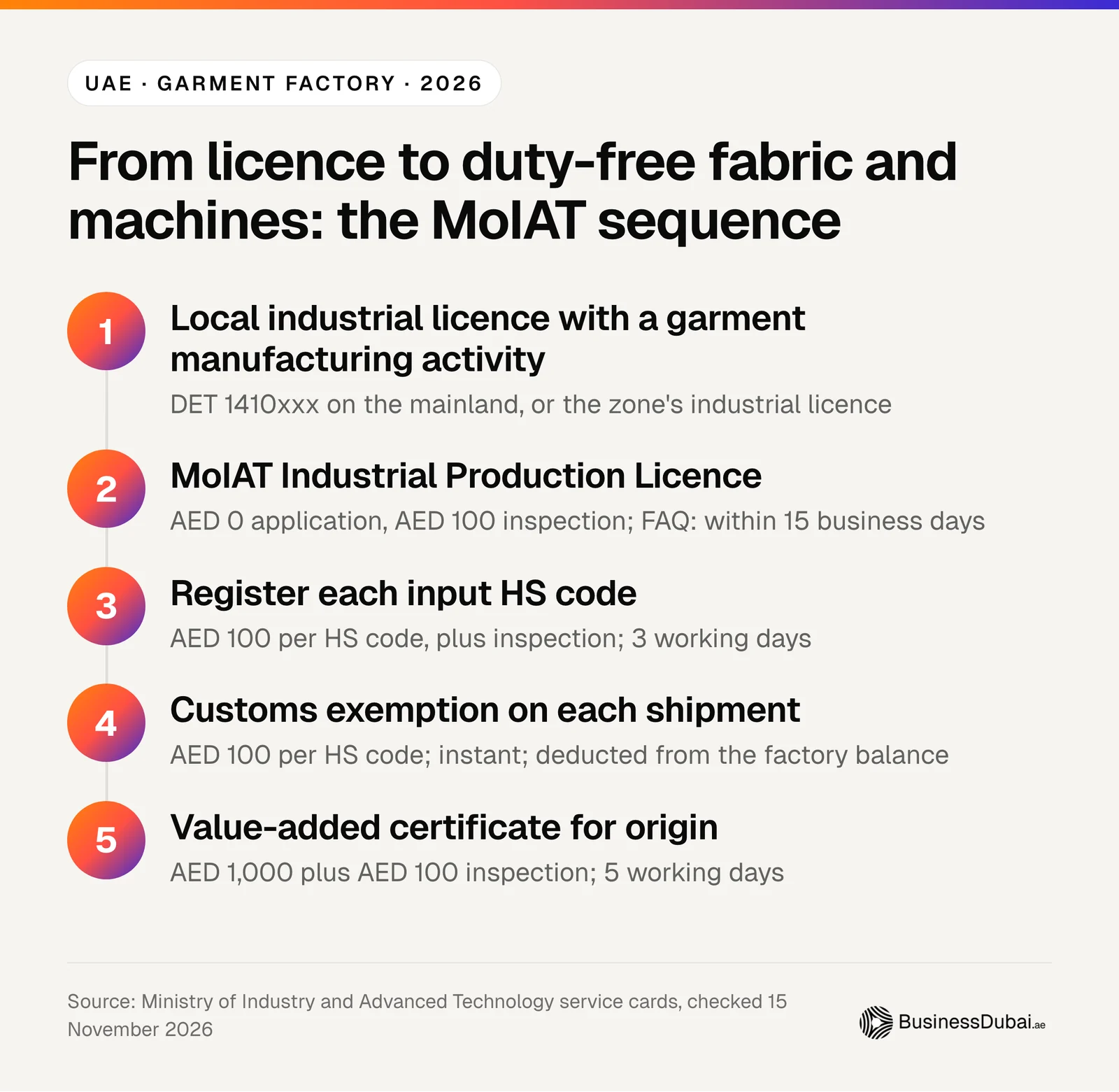
A UAE garment factory claims customs exemption in two MoIAT steps. First, register each input by HS code at AED 100 per code, taking 3 working days. Then request the exemption for each shipment at AED 100 per HS code, issued instantly, and the quantity is deducted from the factory's registered balance. The Industrial Production Licence is a precondition.
For a cut-and-sew factory, that means fabric, thread, trims, packaging and machines. MoIAT's registration service covers "raw materials, machinery, equipment, semi-finished or finished goods, and packaging materials, provided the industrial facility holds a valid industrial production license" [7].
The four MoIAT services in the sequence below are where the published fees and times come from.
Step 1: register each input HS code
MoIAT's registration fee is "100 dirhams for each HS code." plus an AED 100 inspection fee where the materials are inspected, with a service time of "3 Working Days" [7]. The application needs certified invoices that show the HS code of each material, the bill of lading, a list of materials and the certificate of origin [7]. Once approved, the registered quantity is added to the factory's balance [7]. Think of that balance as a duty-free allowance for each input, which every exempt shipment then draws down.
Step 2: request the exemption on each shipment
The exemption request costs "100 dirhams for each HS code" and the service time is "Instant service" [8]. You download the application form or payment receipt, attach it to the customs declaration and "mention the application number that begins with DX" [8]. A customs officer checks it, and MoIAT's page states: "If approved, the quantity will be deducted from the factory’s balance." [8]. The requirements add legalised or attested invoices and a packing list [8]. MoIAT's FAQ is blunt on the precondition: asked "Can I obtain the service without an Industrial Production License?", the answer is "No" [8].
Step 3: the fast track when orders grow
A factory that needs more than it registered does not always start again. MoIAT's fast-track service grants an instant exemption if the requested increase "does not exceed 30% of the previously registered quantity" [9]. The published fees are AED 50 as a quantity-increase fee per HS code, AED 50 per HS code for the exemption, and AED 150 for document certification if the documents are not already certified [9].
For a factory still fitting out, MoIAT's exemption page accepts an "initial approval certificate for machines" in place of the full licence for machinery [8], so ask MoIAT whether your stage of setup qualifies before your sewing lines ship.
Quick Math: Fabric entering the UAE local market pays customs duty of 5% of its CIF value [10]. An AED 400,000 fabric shipment would pay AED 20,000 without the exemption. With it, the cost is MoIAT's AED 100 per HS code: three fabric codes on that shipment cost AED 300 to exempt [8]. On price-sensitive export orders, that AED 19,700 difference per shipment matters.
Common Mistake: Shipping before the HS codes are registered, or with unattested invoices. The exemption draws on a registered balance, so a container that lands before its fabric code is registered has nothing to deduct from, and the attested invoice is a listed requirement on both MoIAT services [7][8]. Register the codes for your first season's fabrics, threads and trims while the factory is being fitted out, not when the first container is already at port.
Free zone factories and the exemption
Goods held inside a free zone are generally outside the local market until they enter it, so a free zone factory exporting all of its output may need the MoIAT exemption less than a mainland factory. MoIAT's pages do not say how they apply to each free zone, so confirm with the zone and with the customs authority at your port before you build the exemption into your costing. Our guide to Dubai Customs registration for import and export covers the customs code you need in any case.
What labour, housing and Emiratisation rules apply to a garment factory?
A UAE garment factory with "50 or more workers earning a wage of AED 1,500 or less per month must provide accommodation" under Ministerial Resolution No. 44 of 2022, registered in MoHRE's Labour Accommodation System. Bedrooms must give each person at least 3 square metres and hold 8 to 10 persons at most. Emiratisation targets apply from 50 employees.
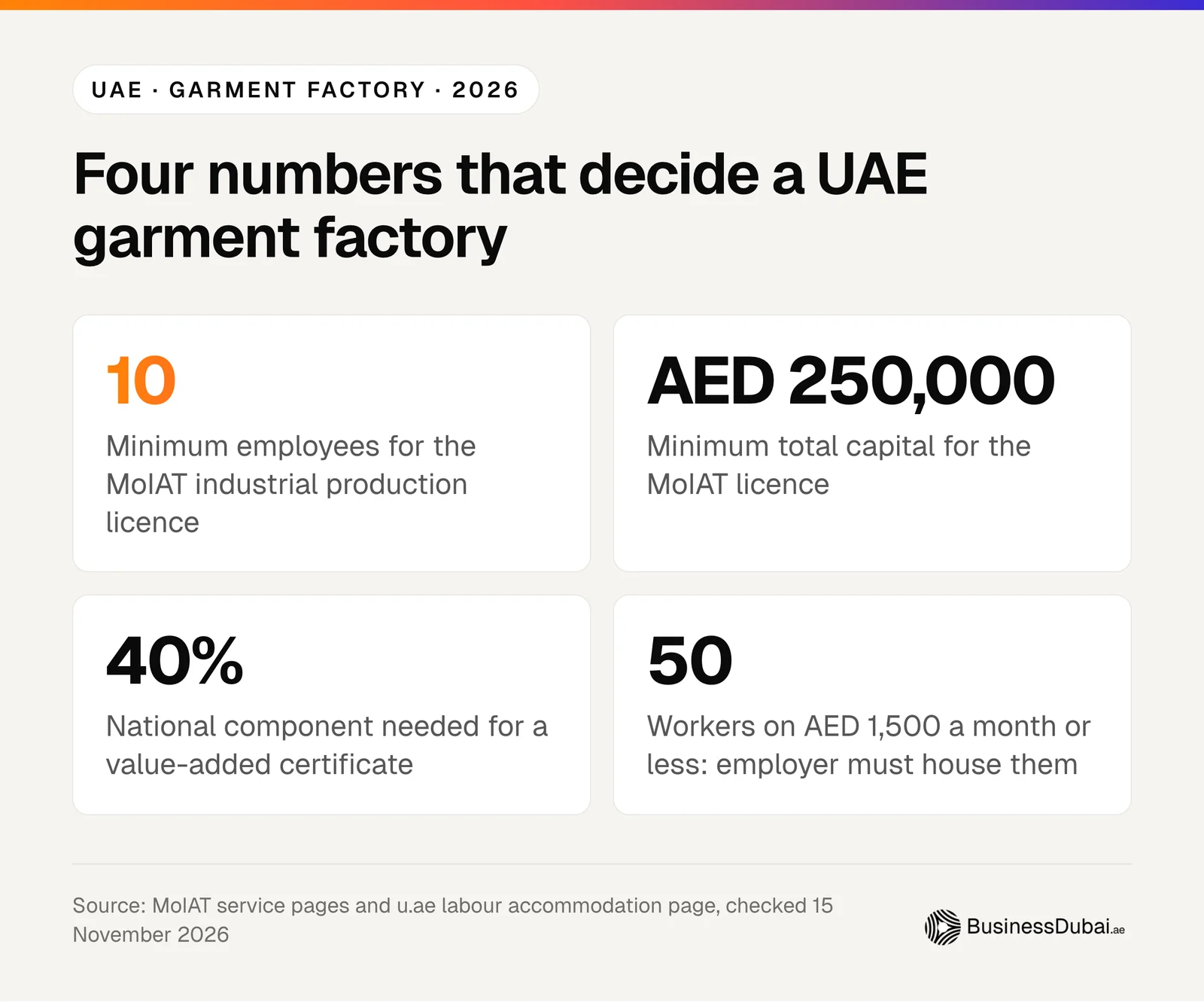
Garment production is labour-intensive, so the labour rules shape the business plan more than they do for most setups. Three thresholds matter, and two of them are set out in the graphic below next to the MoIAT numbers.
Worker accommodation
The UAE government portal states that, under Ministerial Resolution No. 44 of 2022, establishments employing "50 or more workers earning a wage of AED 1,500 or less per month must provide accommodation" for those workers, and must register in the "Labour Accommodation System" of the Ministry of Human Resources and Emiratisation (MoHRE) [11]. The standards on the same page are specific [11]:
- "The area allocated for each person should not be less than 3 square metres."
- The maximum for one bedroom "ranges from 8 to 10 persons".
- "Bedroom ceiling height should not be less than 7 feet."
- "The accommodation must be located at least 5 km away from family housing areas."
A newer instrument has followed. Law firm Morgan Lewis reported on 20 October 2026 that MoHRE issued "Ministerial Resolution No. 122 of 2026 Regarding the Update of Labour Accommodation Requirements" [12]. According to that report, it keeps the 50-worker and AED 1,500 thresholds, adds requirements including "free internet access throughout the accommodation" and "at least one supervisor for every 200 workers", and lets local authorities extend the regime by "reducing the 50-worker threshold, increasing the AED 1,500 wage threshold, or both" [12]. The official text was not available to us, so confirm the effective date and your emirate's thresholds with MoHRE.
Real Talk: Price housing before you price machines. A garment factory planning 60 machine operators on modest wages is squarely inside the accommodation rule [11], and the bed space, transport and supervision are a fixed monthly cost from the day the 50th worker joins. Get written quotes from licensed accommodation providers in your emirate, and check each one is registered in MoHRE's system, because the registration duty sits on you as the employer.
Emiratisation
Gulf News reported on 22 June 2026 that private companies with 50 or more employees must raise the number of Emiratis in skilled positions by 1% in each half of the year, 2% a year in total [13]. Non-compliant companies pay "Dh10,000 per month, or Dh120,000 annually, for each Emirati position not filled", according to the same report [13]. Whether a free zone factory falls inside the targets is not settled in the sources we read, so confirm your position with MoHRE. Our Emiratisation 2026 guide covers the targets and the Nafis platform in detail.
What labelling and conformity rules apply to garments made in the UAE?
Garments made in the UAE fall under Cabinet Resolution No. 54 of 2019, the UAE Scheme for the Control of Textile Products, which covers products "offered, manufactured, distributed, imported into the State", including "New ready-to-wear clothing products." The maker counts as a supplier, must register products in ECAS, and labels need the ECAS mark, components and a batch code.
The Resolution was issued on 4 August 2019 and took effect on 16 August 2019 [14]. Its scope covers textile products that are "offered, manufactured, distributed, imported into the State", and the first category it names is "New ready-to-wear clothing products." [14]. It defines a supplier as "Manufacturer, importer, carrier, collector, agent" and others in the chain [14], so a factory carries the duties directly, not only the importer of finished goods.
What the scheme asks of a garment maker
The supplier must comply "at any stage of the Supply Chain" [14]. Under Article 3, the product must meet the Resolution's annexes on combustion resistance for babies' and children's textiles, harmful materials and heavy metals, "the care label and the components label", and environmental requirements [14].
Conformity is verified by checking that the supplier "has registered the product with ESMA in the Emirates Conformity Assessment Scheme (ECAS)" and by an acceptable conformity assessment body [14]. For a certificate of conformity, the supplier must also put in place "systems for controlling the product during the various stages of production" [14]. A product holding the Emirates Quality Mark is deemed to meet the standard [14]. The Resolution's text dates from 2019 and names the Emirates Authority for Standardization and Metrology (ESMA), so confirm today's registration channel with MoIAT before you apply.
What goes on the label
Article 5 sets the label content [14]. The label "must include the Emirates Conformity Mark (ECAS) in addition to the components of the product and the chemical components of the product", must carry information about the appropriate storage environment, and textile products "must have a code for the production batch, through which the product can be traced during its circulation in the market" [14]. Nothing on the product may carry "Any information that cannot be verified and proven." [14]. Annex 1 lists the standards the label must meet. We did not read the annex, so take the detailed label format from your conformity body, and for the GCC identification label standard on imported textiles, see the textile trading company guide.
Pro Tip: Build the batch code into your cutting tickets from the first order. Article 5 requires a production batch code that traces the garment in the market [14], and the cheapest way to meet it is to print the cutting batch on the care label at the sewing stage. Adding codes after packing means unpacking cartons, and a 100% cotton or organic claim you cannot prove with fabric test reports breaks the rule against unverifiable information.
Who is outside the scheme, and the sanctions
The Resolution excludes "Textile products crafted by self-employed tailors." and products made by people working in their residences [14]. A tailoring shop may sit outside it; a factory does not. For violations of the supplier and conformity articles, the authority may coordinate "to cancel the commercial license of the Supplier responsible for the violation", cancel the certificate of conformity and charge the cost of remedying the damage [14]. Customs ports may "prohibit its import or entry and offering in the local markets, except after obtaining the Certificate of Conformity" [14].
Can UAE-made garments be exported as UAE origin, including under the India CEPA?
UAE-made garments can carry UAE origin once MoIAT issues a Value-Added Certificate, which requires "The national component must represent at least 40% of the total production cost." The certificate costs AED 1,000 plus AED 100 inspection and takes 5 working days. India's CEPA rule for apparel in Chapters 61 and 62 is "CTH + VA 40%".
The MoIAT Value-Added Certificate
MoIAT issues the certificate under the Arab Rules of Origin, calculating the national component from the factory's financial data [15]. The threshold is stated plainly: "The national component must represent at least 40% of the total production cost." [15]. The payoff, in MoIAT's words: "Obtaining this certificate enables the facility to register in the Ministry of Economy’s Certificate of Origin system" [15]. MoIAT's own consultation on the industrial licence put it the same way: "the licensed company can request a value-added certificate, which qualifies it for a Certificate of Origin from the Ministry of Economy" [16].
| Item | Value-Added Certificate, 2026 |
|---|---|
| Fees | AED 1,000 plus AED 100 inspection [15] |
| Service time | 5 working days [15] |
| Threshold | National component at least 40% of total production cost [15] |
| Documents | Previous year's financial budget certified by an accredited audit firm; raw material invoices [15] |
| Precondition | Industrial Production License: "Yes, it is mandatory" [15] |
The documents row has a timing consequence. The application needs "The factory's financial budget for the previous year, certified by an accredited audit firm." [15]. A factory in its first trading year has no audited prior year, so plan first-year export prices without assuming a UAE-origin preference, and ask MoIAT whether any interim route applies to you.
The India-UAE CEPA rule for garments
India's customs rules for the India-UAE Comprehensive Economic Partnership Agreement list the product-specific rule for each chapter. For garments they read: "Chapter 61 Articles of apparel and clothing accessories, knitted or crocheted CTH + VA 40%" and "Chapter 62 Articles of apparel and clothing accessories, not knitted or crocheted CTH + VA 40%" [2].
Two terms decide whether your garments qualify. "CTH" means "change to this heading from any other heading" [2]. In plain terms, the materials you import must sit under a different tariff heading from the finished product. Fabric is classified in Chapters 52 to 60 of the Harmonized System, for example Chapter 60 "Knitted or crocheted fabrics" [2], and a garment cut and sewn from it lands in Chapter 61 or 62. That change of heading is what a real cut-and-sew operation produces. "VA" is value addition, and "The percentages are on an FOB basis." [2]. Where the ex-works price is the basis, "the value addition shall be 5 percentage points lower", so 40% FOB becomes 35% ex-works [2].
Real Talk: Cut-and-sew clears the heading test easily; it is the 40% that fails. A factory that imports pre-cut kits, sews them and packs them adds little value, and the same factory buying expensive imported fabric for a low-priced garment may struggle to reach 40%. Run the numbers on your actual costing sheet before you quote an Indian buyer a CEPA price. India's rules also require the producer's cost break-up and a description of the manufacturing process [2].
We found no UAE-EU trade agreement in force, so plan on garments shipped to Europe paying the EU's ordinary duty rates, and check the position before you price European orders.
How is a garment factory taxed in the UAE?
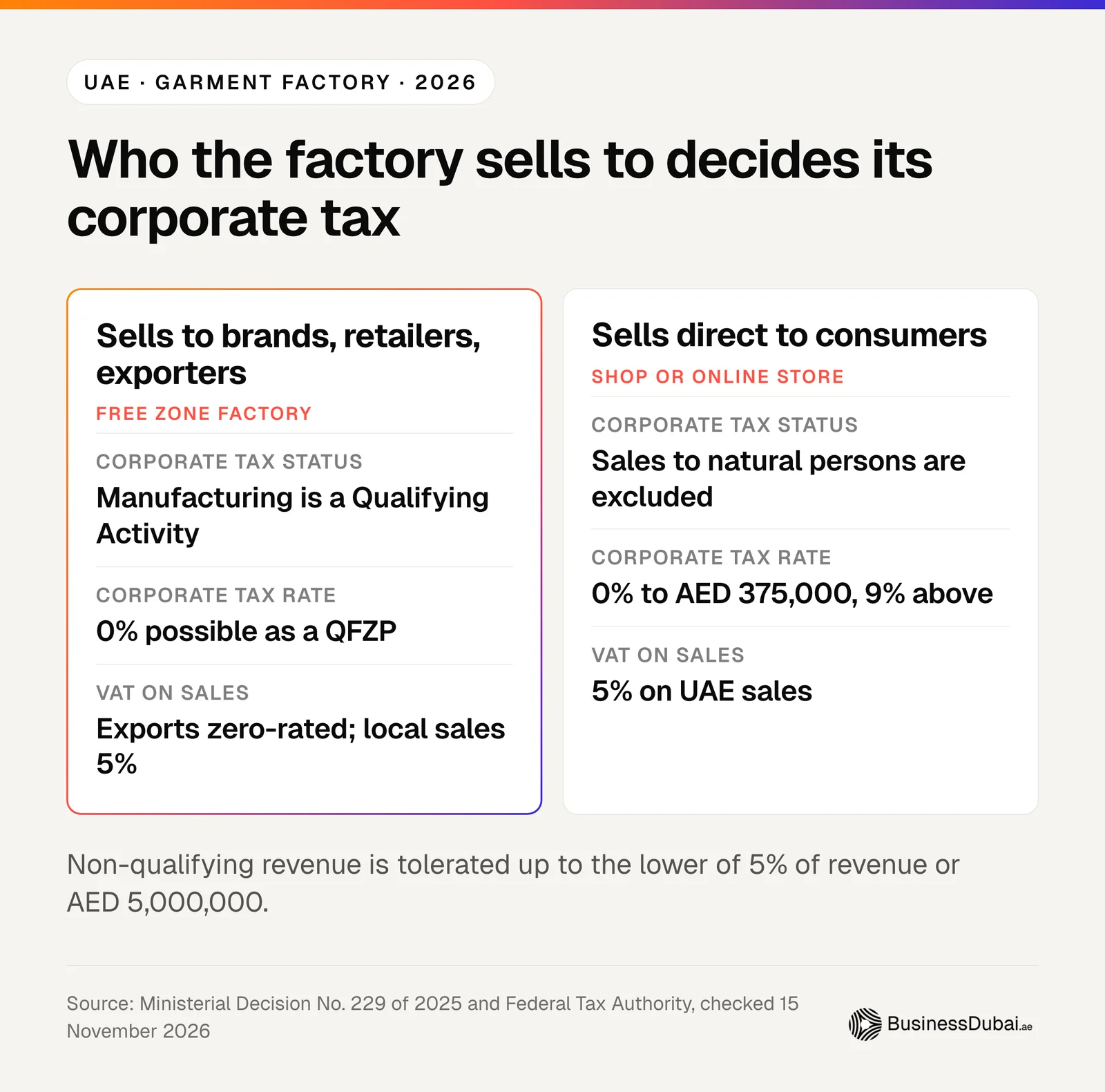
Garment manufacturing is a Qualifying Activity under Ministerial Decision No. 229 of 2025, so a free zone factory selling to brands, retailers and exporters can pay 0% corporate tax. Sales to individual consumers are excluded. A mainland factory pays 0% to AED 375,000 and 9% above. Exports are zero-rated for VAT; local sales carry 5%.
Ministerial Decision No. 229 of 2025 lists "Manufacturing of goods or materials" as a Qualifying Activity and defines it: "Manufacturing of goods or materials includes the production, improvement or assembly of products and materials from raw materials or components." [17]. Cutting fabric and sewing it into garments fits that wording. The Decision also lists as an Excluded Activity "Any transactions with natural persons", with exceptions for certain other qualifying activities that do not include manufacturing [17].
That one line splits garment factories into two groups.
The de minimis limit and what happens if you breach it
A Qualifying Free Zone Person can carry some non-qualifying revenue. The limit is met where that revenue "does not exceed 5% (five percent) of the total Revenue of the Qualifying Free Zone Person in that Tax Period or AED 5,000,000 (five million dirhams), whichever is lower" [17]. Go past it and the company will "cease to be a Qualifying Free Zone Person from the beginning of the relevant Tax Period and for the subsequent (4) four Tax Periods" [17]. It then pays the ordinary rates, 0% on the first AED 375,000 and 9% above, from the start of that period [18]. QFZP status also needs audited financial statements and adequate substance in the zone, which a real factory usually has. Our Qualifying Free Zone Person guide sets out every condition.
| Garment factory profile | Corporate tax | VAT on sales |
|---|---|---|
| Free zone factory selling to brands, retailers and importers abroad | 0% possible on qualifying income as a QFZP [17] | Exports outside the GCC zero-rated; UAE sales 5% [19] |
| Free zone factory with a small factory-outlet shop | Stays a QFZP if consumer sales stay within the lower of 5% or AED 5,000,000 [17] | 5% on UAE retail sales |
| Free zone factory selling heavily online to consumers | Fails the de minimis test; ordinary rates 0% to AED 375,000, 9% above, and loses QFZP for four more periods [17][18] | 5% on UAE sales |
| Mainland factory | 0% to AED 375,000, 9% above [18] | 5% locally, exports zero-rated [19] |
| Small factory with revenue at or under AED 3,000,000 | Small Business Relief available for tax periods ending on or before 31 December 2029, but not for a QFZP [20][18] | As above |
Quick Math: A mainland garment factory with AED 1,200,000 of taxable profit pays nothing on the first AED 375,000 and 9% on the remaining AED 825,000 [18]. Nine per cent of AED 825,000 is AED 74,250. The same profit in a free zone factory that sells only to brands and exporters, and meets every QFZP condition, can be taxed at 0% [17]. That AED 74,250 a year is the value of keeping consumer sales out of the free zone company.
Common Mistake: Opening a factory-outlet shop or a direct-to-consumer web store inside the free zone factory company. The Decision excludes "Any transactions with natural persons" from qualifying income, so every sale to an individual counts against you [17]. Small volumes sit within the de minimis limit; a successful online store does not. If you want both, run retail through a separate company, usually on the mainland, and sell to it at arm's length.
For small factories in their early years, our Small Business Relief guide explains the AED 3,000,000 threshold, and the VAT registration and compliance guide covers export zero-rating and the evidence the Federal Tax Authority expects. To see which route fits your sales mix, model your tax position with an adviser→
What does a garment factory cost to set up in the UAE?
A UAE garment factory's formation cost runs from AED 13,931 for an Ajman Free Zone package with one visa to AED 26,900 for a Dubai mainland package with one visa, at BusinessDubai.ae standard prices. MoIAT fees are small, from AED 100. The large costs are the factory unit, machines and housing, which zones and suppliers quote separately.
Government fees below come from MoIAT's service pages, checked on 15 November 2026, and package prices from BusinessDubai.ae's standard pricing [21]. The "quote" rows are not estimated, because rents, machines and housing vary too much to give an honest single figure.
| Cost item | Amount (AED) | Notes |
|---|---|---|
| Company formation, Ajman Free Zone, 1 visa | 13,931 | BusinessDubai.ae package; licence only 5,555, two visas 17,971 [21] |
| Company formation, RAKEZ, 1 visa | 12,810 | Licence only 6,010, two visas 18,810 [21] |
| Company formation, SPC Free Zone, 1 visa | 15,055 | Licence only 5,765, two visas 19,505 [21] |
| Company formation, Dubai mainland | 18,200 without a visa, 26,900 with one visa | DET licence; industrial activity and premises approvals extra [21] |
| Hamriyah, SAIF Zone, KEZAD, Dubai Industrial City | Zone quote | No BusinessDubai.ae package for these zones |
| Industrial premises (factory unit or land) | Zone or landlord quote | Required for any production line; a desk package does not qualify |
| MoIAT Industrial Production Licence | 100 | AED 0 application, AED 100 inspection [1] |
| Input registration, per HS code | 100 each, plus 100 inspection if inspected | Ten fabric, thread and trim codes cost AED 1,000 to register [7] |
| Exemption request, per shipment | 100 per HS code | Instant [8] |
| Value-Added Certificate | 1,100 | AED 1,000 plus AED 100 inspection, from the second year [15] |
| Sewing, cutting and finishing machines | Supplier quote | Duty-exempt once registered with MoIAT |
| Worker accommodation | Licensed provider quote | Mandatory at 50 workers on AED 1,500 or less a month [11] |
| Conformity registration and testing | Conformity body quote | Under Cabinet Resolution No. 54 of 2019 [14] |
| Year two: mainland package renewal | About 15,000 | BusinessDubai.ae mainland package renewal [21] |
| Year two: MoIAT licence renewal | 500, plus 100 inspection if needed | Late fine AED 100 per month, up to AED 1,000 [5] |
| Capital requirement for MoIAT | 250,000 | A capital requirement on the company, not a fee [1] |
Read the table from the bottom up. The capital requirement and the premises decide whether the factory exists; the government fees, at a few hundred dirhams, barely register. A founder who budgets AED 15,000 to "set up a garment factory" has priced the company, not the factory.
Real Talk: If you cannot yet show 10 employees and AED 250,000 in capital, do not set up a factory company and wait. Start as a brand that outsources production to a licensed UAE factory, learn your volumes, and build the factory when the orders justify it. A brand company in a business hub costs from AED 12,500 at BusinessDubai.ae prices [21], and it carries no unit lease, no housing and no MoIAT inspection.
For an itemised quote that sets the package next to the zone's industrial premises quote, get a free setup quote→
In what order should you set up a garment factory?
A UAE garment factory is set up in a fixed order: choose the activity code, secure industrial premises, obtain the local industrial licence, hire at least 10 employees, then apply for MoIAT's Industrial Production Licence, which takes "Within 15 business days" by MoIAT's FAQ. Input registration, conformity and the value-added certificate follow.
Most delays come from doing the right things in the wrong order. The sequence below follows the dependencies in MoIAT's service pages.
- Confirm the activity codes with DET or the zone, in writing for any product the register does not describe clearly, such as abayas [3].
- Secure the premises. The zone or landlord quotes the unit; the industrial licence depends on it.
- Obtain the local industrial licence with the garment manufacturing activity.
- Hire the first 10 employees and process their visas. MoIAT's licence requires them [1].
- Install the machines. If they arrive before the full licence, ask MoIAT about the initial approval certificate for machines [8].
- Apply for the Industrial Production Licence. AED 0 application, AED 100 inspection, "Within 15 business days" per the FAQ [1].
- Register each input HS code, 3 working days and AED 100 per code [7].
- Register products in ECAS and set up labels with batch codes [14].
- Request the exemption on each shipment, instantly, at AED 100 per HS code [8].
- Apply for the Value-Added Certificate once you have a year of audited accounts [15].
- Set the calendar: MoIAT renewal, the annual Industrial Registry entry [6], licence and visa renewals, corporate tax and VAT returns.
Year two is when this calendar becomes someone's job. Our post-setup services team runs renewals, visas and filings so they do not land in peak production season.
Which setup fits your garment business?
The right UAE garment setup depends on what you make and who buys it. An export cut-and-sew factory suits a northern emirates free zone with the MoIAT licence; a uniform maker for UAE schools and hotels suits the mainland; a private-label brand needs no factory at all. Match the profile below before you sign a lease.
| Profile | Licence and codes | Location | MoIAT licence | Tax angle |
|---|---|---|---|---|
| Export cut-and-sew factory | Industrial: 1410102, 1410106, 1410112 as relevant | Ajman Free Zone, RAKEZ, SPC, Hamriyah or SAIF, with a factory unit | Yes, for duty-free fabric and machines | QFZP 0% possible on B2B and export sales |
| Uniform manufacturer for UAE schools and hotels | Industrial: 1410113 Uniforms Manufacturing | Dubai mainland industrial area | Yes | Ordinary rates; Small Business Relief while revenue is AED 3,000,000 or less |
| Abaya workshop scaling up | Move from a Professional tailoring code to an Industrial code, confirmed with DET | Mainland or northern zone with a unit | Yes, once at 10 employees and AED 250,000 capital | Keep the retail boutique in a separate company if the factory is a QFZP |
| Private-label brand outsourcing production | Commercial or design and trading activity | Meydan Free Zone or Dubai South, from AED 12,500 | No; the contract factory holds it | Brand sales to consumers are not qualifying income |
| Knitwear unit importing yarn | Industrial garment codes, plus 1311007 if dyeing | Free zone or mainland with a unit | Yes; register yarn and machine HS codes | Garments from imported fabric change heading for CEPA; yarn spun into fabric in-house adds further value |
Real Client Stories
These are composite examples built from the situations garment factory founders most often face in the UAE. Names and details are illustrative, and the only figures used are published government fees and BusinessDubai.ae's package prices.
The export factory that planned on CEPA in year one (Ajman Free Zone)
A founder set up a cut-and-sew unit in Ajman Free Zone on the AED 13,931 one-visa package, leased a factory unit on the zone's separate quote, and planned his first-season prices for an Indian buyer on the CEPA preference. When he applied to MoIAT for the Value-Added Certificate, at AED 1,000 plus AED 100 inspection, he learned the application needs the previous year's audited accounts. In year one he had none. He shipped the first season at the buyer's standard duty and repriced. The lesson: in year one, quote export prices without any origin preference, and apply for the certificate after the first audit.
The tailoring workshop that won a uniform contract (Dubai mainland)
A tailoring workshop owner held the Professional code 1410920 and won a large hotel uniform order. She wanted duty-free fabric and assumed her licence would do. MoIAT requires an industrial licence from the local licensing department, so her workshop code did not qualify. She added the Industrial activity 1410113 Uniforms Manufacturing, moved to an industrial unit, reached 10 employees and showed AED 250,000 in capital before the AED 100 MoIAT inspection. The lesson: a tailoring workshop, however busy, is a Professional licence, and the factory route has to be built rather than switched on.
The free zone factory with a web store (northern emirates free zone)
A knitwear maker in a northern emirates free zone sold mostly to boutiques and importers, which kept his income qualifying. Then he launched a web store selling sweaters to shoppers from the same company. By the third quarter, consumer sales were heading past 5% of revenue, the lower of the two de minimis limits for his size. Breaching it would cost QFZP status for that year and the next four. He moved the store into a separate mainland company on the AED 18,200 package. The lesson: keep consumer sales out of the free zone factory company from the start.
Start your garment factory the right way
For a garment factory, the trade licence is the easy part. The decisions that matter are whether your activity is Industrial rather than Professional, whether you can show 10 employees and AED 250,000 in capital for MoIAT, and whether you keep consumer sales out of a free zone factory company. Get those three right and the customs exemption, the origin certificate and the 0% tax route follow; get one wrong and each costs more to fix than to set up.
BusinessDubai.ae has set up companies across the UAE since 2013, with itemised pricing and no hidden fees. We will price a free zone company setup in Ajman, Sharjah or Ras Al Khaimah against a mainland company setup in Dubai on what actually differs for a factory: premises, buyers, housing and tax. Our post-setup services team then handles visas, renewals and filings while you run production. Talk to a setup expert→
Frequently Asked Questions
Do I need an industrial licence to make clothes in the UAE?
Yes, if you are running a factory. In Dubai, garment manufacturing codes such as 1410102 Men's Outerwear Manufacturing carry licence type Industrial in DET's register. A tailoring shop works on a Professional licence, but it cannot hold MoIAT's Industrial Production Licence or claim duty exemption on its fabric.
What is the DET activity code for a garment factory in Dubai?
DET's garment factory codes are the 1410xxx series, including 1410101 Men's Underwear, 1410102 Men's Outerwear, 1410106 Women Outerwear, 1410112 Sports Wears and 1410113 Uniforms Manufacturing, all licence type Industrial. Code 1311007 adds dyeing, and 3290012 covers buttons, badges and emblems. DET's records were last updated in October 2023.
Which activity code covers abaya manufacturing?
No separate abaya manufacturing code appears in DET's register. The closest by name is 1410106 Women Outerwear Manufacturing, but the register gives it no description beyond its name. Ask DET in writing which code covers abayas before you apply.
Can a tailoring workshop get the MoIAT industrial licence?
No. MoIAT requires an "Industrial license from a local licensing department", and DET's tailoring workshop codes 1410919 and 1410920 are Professional licences. A workshop that wants the licence must add an Industrial garment manufacturing activity, move into industrial premises and meet the 10-employee and AED 250,000 capital thresholds.
What are the MoIAT Industrial Production Licence requirements?
MoIAT's licence requires a local industrial licence, the company's memorandum of association, at least 10 employees and at least AED 250,000 in total capital. The application fee is AED 0 and the inspection fee AED 100, as of November 2026. An inspector visits the factory before the licence is issued.
How long does the MoIAT industrial licence take?
MoIAT's FAQ says "Within 15 business days", while its service card shows 5 working days. Plan on 15 business days from application, and book the inspection only once the factory is fitted out and staffed.
How much does it cost to renew the MoIAT industrial licence?
Renewal costs AED 500, plus AED 100 for inspection if one is needed, with a service time of 3 working days. Late renewal is fined "AED 100 per month up to a maximum of AED 1,000". Re-inspection applies only if the factory changes location or activity.
Can a garment factory import fabric duty-free in the UAE?
Yes, once it holds MoIAT's Industrial Production Licence. The factory registers each fabric HS code with MoIAT at AED 100 per code, then requests the exemption on each shipment at AED 100 per HS code. The approved quantity is deducted from the factory's registered balance.
Can I import sewing machines without customs duty?
Yes. MoIAT's licence covers exemption applications for machinery, equipment, spare parts and materials used in manufacturing. The machines are registered and exempted by HS code like fabric, and MoIAT's exemption page also accepts an "initial approval certificate for machines" in place of the full licence for machinery.
How much customs duty does a garment factory save?
Fabric entering the UAE local market pays 5% of its CIF value, so an AED 400,000 shipment would pay AED 20,000 without the exemption. With MoIAT's exemption, the cost is AED 100 per HS code on the shipment. Confirm the treatment in your zone with the customs authority.
What is the MoIAT fast-track customs exemption?
The fast-track service grants an instant exemption when the requested increase "does not exceed 30% of the previously registered quantity" of an input. Fees are AED 50 for the quantity increase and AED 50 per HS code for the exemption, plus AED 150 if documents need certification.
When must a garment factory provide worker accommodation?
Under Ministerial Resolution No. 44 of 2022, an establishment with 50 or more workers earning AED 1,500 or less a month must provide accommodation and register it in MoHRE's Labour Accommodation System. Morgan Lewis reports that Resolution No. 122 of 2026 keeps those thresholds and lets emirates tighten them.
What are the labour accommodation standards in the UAE?
The UAE government portal sets at least 3 square metres per person, 8 to 10 persons per bedroom at most, a ceiling of at least 7 feet, and a location at least 5 km from family housing. Resolution No. 122 of 2026 adds requirements such as free internet and one supervisor per 200 workers, as reported by Morgan Lewis.
Do Emiratisation targets apply to a garment factory?
Emiratisation targets apply to private companies with 50 or more employees, which must add 2% Emiratis in skilled roles each year. Gulf News reported a contribution of Dh10,000 per month for each unfilled position from July 2026. Whether a free zone factory is covered is not settled in public sources; confirm with MoHRE.
What labels do garments made in the UAE need?
Under Cabinet Resolution No. 54 of 2019, labels must carry the Emirates Conformity Mark (ECAS), the product's components and chemical components, storage information and a production batch code. Claims that cannot be verified are banned. Annex 1 lists the label standards; confirm the format with your conformity body.
Does the UAE textile control scheme apply to manufacturers?
Yes. Cabinet Resolution No. 54 of 2019 applies to textile products "offered, manufactured, distributed, imported into the State", and its definition of supplier starts with "Manufacturer". New ready-to-wear clothing is named first in its scope. Self-employed tailors and home-based makers are excluded.
How do UAE-made garments get a certificate of origin?
The factory applies to MoIAT for a Value-Added Certificate under the Arab Rules of Origin, showing a national component of at least 40% of total production cost. The certificate costs AED 1,000 plus AED 100 inspection, takes 5 working days and lets the factory register in the Ministry of Economy's certificate of origin system.
Can a new garment factory get a value-added certificate in its first year?
Usually not straight away. MoIAT's application requires the factory's financial budget for the previous year, certified by an accredited audit firm. A factory in its first trading year should price exports without an origin preference and apply once its first audited year is complete.
Are UAE-made garments duty-free into India under CEPA?
They can be, if they meet India's product-specific rule for Chapters 61 and 62, "CTH + VA 40%". That means the imported materials change tariff heading, as fabric does when it becomes a garment, and the value added reaches 40% on an FOB basis or 35% on an ex-works basis.
Is there a UAE-EU trade agreement for garments?
We found no UAE-EU trade agreement in force as of November 2026, so plan on UAE-made garments entering the European Union at its ordinary duty rates. Check the position again before signing long-term European supply contracts.
Is a free zone garment factory eligible for 0% corporate tax?
Yes, potentially. Ministerial Decision No. 229 of 2025 lists manufacturing as a Qualifying Activity, so a free zone factory selling to brands, retailers and exporters can pay 0% on qualifying income as a Qualifying Free Zone Person. It must also meet the substance, audit and de minimis conditions.
What if my free zone garment factory sells directly to consumers?
Sales to individuals are an Excluded Activity under Ministerial Decision No. 229 of 2025. If non-qualifying revenue exceeds the lower of 5% of revenue or AED 5,000,000, the company loses QFZP status for that period and the next four, paying 0% to AED 375,000 and 9% above.
What corporate tax does a mainland garment factory pay?
A mainland garment factory pays 0% on taxable profit up to AED 375,000 and 9% above it. On AED 1,200,000 of profit, the tax is 9% of AED 825,000, or AED 74,250. Small Business Relief applies to revenue of AED 3,000,000 or less for periods ending by 31 December 2029.
Do garment exports get VAT zero-rating?
Yes. Garments exported outside the GCC are zero-rated for VAT when the export evidence is kept, while sales within the UAE carry the standard 5%. A factory must register for VAT once taxable supplies pass AED 375,000.
How much does it cost to start a garment factory in the UAE?
Company formation runs from AED 13,931 in Ajman Free Zone with one visa to AED 26,900 on the Dubai mainland with one visa, at BusinessDubai.ae standard prices. MoIAT fees start at AED 100. Factory premises, machines and worker housing are quoted separately and are the largest costs.
Can I run garment production from a business centre or flexi-desk?
No. A garment factory needs industrial premises, a factory unit or land, approved for production by the zone or municipality. A desk package in a business hub such as Meydan Free Zone or Dubai South suits a brand that outsources production, not a production line.
References
[1] Ministry of Industry and Advanced Technology (MoIAT). Issue Industrial Production License service card and FAQ: requirements (memorandum of association, at least 10 employees, at least AED 250,000 capital, local industrial licence), AED 0 application and AED 100 inspection fees, 5 working days service time and "Within 15 business days" FAQ answer, and the customs exemption benefit; checked 15 November 2026. moiat.gov.ae
[2] Government of India. Customs Tariff (Determination of Origin of Goods under the Comprehensive Economic Partnership Agreement between India and the United Arab Emirates) Rules, 2022, Annexures: product-specific rules for Chapters 60, 61 and 62, the definitions of CTH and VA, and the FOB and ex-works bases. India's import rules for UAE-origin goods; read from a mirror of the Gazette PDF. taxguru.in
[3] Dubai Department of Economy and Tourism (DET). Business activity list as recorded in a public copy of the register: garment manufacturing codes 1410101 to 1410117, 1311007 and 3290012 (licence type Industrial) and tailoring codes 1410904, 1410907, 1410919 and 1410920 (licence type Professional), with official descriptions; DET records last updated 24 and 25 October 2023. visaindubai.ae
[4] Meydan Free Zone. Wearing apparel manufacturing activity page: activity "1410.00 - Manufacture of wearing apparel, except fur apparel", a free zone activity reference rather than a DET code; checked 15 November 2026. meydanfz.ae
[5] Ministry of Industry and Advanced Technology (MoIAT). Renew Industrial Production License: AED 500 application, AED 100 inspection if needed, 3 working days, re-inspection only on location or activity change, and the late renewal fine of AED 100 per month up to AED 1,000; checked 15 November 2026. moiat.gov.ae
[6] Ministry of Industry and Advanced Technology (MoIAT). Industrial Registry: annual registration of industrial company information under Federal Decree-Law No. 25 of 2022; checked 15 November 2026. moiat.gov.ae
[7] Ministry of Industry and Advanced Technology (MoIAT). Request Registration of Industrial Input for Customs Duty Exemption: items covered, AED 100 per HS code plus AED 100 inspection, 3 working days, required documents and the factory balance; checked 15 November 2026. moiat.gov.ae
[8] Ministry of Industry and Advanced Technology (MoIAT). Request Customs Duty Exemption for Industrial Inputs: AED 100 per HS code, instant service, DX application number, deduction from the factory balance, required documents, the initial approval certificate for machines and the licence precondition; checked 15 November 2026. moiat.gov.ae
[9] Ministry of Industry and Advanced Technology (MoIAT). Fast Track Customs Exemption Request: instant exemption where the increase does not exceed 30% of the previously registered quantity, AED 50 quantity-increase fee, AED 50 exemption fee per HS code and AED 150 document certification; checked 15 November 2026. moiat.gov.ae
[10] Dubai Customs. Dubai Customs Service Guide, version 9 (2025): customs duty of "5% of the value CIF (Cost Freight Insurance) value except for alcohol and cigarettes/tobacco". dubaicustoms.gov.ae (PDF)
[11] UAE Government portal (u.ae). Labour accommodation: Ministerial Resolution No. 44 of 2022, the duty to house 50 or more workers earning AED 1,500 or less a month, registration in MoHRE's Labour Accommodation System, and room, ceiling and location standards; checked 15 November 2026. u.ae
[12] Morgan Lewis, Shifting Sands of Labor Law. "UAE Introduces Updated Labour Accommodation Requirements", 20 October 2026: Ministerial Resolution No. 122 of 2026, thresholds, new facility requirements and local authority powers. A law firm's summary, not the Resolution's text. morganlewis.com
[13] Gulf News. "MoHRE warns UAE firms ahead of Emiratisation deadline", 22 June 2026: targets for companies with 50 or more employees and the Dh10,000 per month contribution per unfilled position from 1 July 2026. gulfnews.com
[14] UAE Cabinet. Cabinet Resolution No. (54) of 2019 Regarding the UAE Scheme for the Control of Textile Products, issued 4 August 2019, effective 16 August 2019: scope, supplier definition and duties, conformity assessment, label requirements, market monitoring and sanctions. Read from a copy of the UAE Legislation portal page, as the portal blocked direct access; Annexes 1 and 2 not read. uaelegislation.gov.ae and copy read
[15] Ministry of Industry and Advanced Technology (MoIAT). Issue Value-Added Certificate: Arab Rules of Origin, the 40% national component threshold, registration in the Ministry of Economy's certificate of origin system, AED 1,000 plus AED 100 inspection, 5 working days, prior-year audited budget and the licence precondition; checked 15 November 2026. moiat.gov.ae
[16] Ministry of Industry and Advanced Technology (MoIAT). Industrial Production License public consultation (11 August to 11 November 2023): the value-added certificate as the route to a Ministry of Economy certificate of origin and the Made in the Emirates mark. moiat.gov.ae
[17] UAE Ministry of Finance. Ministerial Decision No. 229 of 2025 Regarding Qualifying Activities and Excluded Activities: manufacturing as a Qualifying Activity and its definition, transactions with natural persons as an Excluded Activity, the de minimis test and loss of status. mof.gov.ae
[18] UAE Ministry of Finance. Corporate tax under Federal Decree-Law No. 47 of 2022: rates of 0% up to AED 375,000 and 9% above, and the conditions for Qualifying Free Zone Persons. mof.gov.ae
[19] Federal Tax Authority. VAT under Federal Decree-Law No. 8 of 2017: the 5% standard rate, the AED 375,000 mandatory registration threshold and zero-rating of exports outside the GCC. tax.gov.ae
[20] UAE Ministry of Finance. Ministerial Decision No. 73 of 2023 on Small Business Relief, as amended by Ministerial Decision No. 131 of 2026 issued 29 July 2026: the AED 3,000,000 revenue threshold and tax periods ending on or before 31 December 2029. mof.gov.ae
[21] BusinessDubai.ae. Internal pricing data: 2026 standard package prices for Dubai mainland, Ajman Free Zone, RAKEZ, SPC Free Zone, Meydan Free Zone and Dubai South by visa count, and the mainland renewal figure, as of November 2026. businessdubai.ae