
Running payments for other people in the UAE without a Central Bank licence is a criminal offence: Federal Decree-Law No. 6 of 2025 punishes it with imprisonment and a fine of up to AED 500 million [1]. A PSP licence in the UAE is the permission that keeps a payment business on the right side of that line, and the Central Bank of the UAE (CBUAE) issues it in four categories with initial capital from AED 100,000 to AED 3 million [2].
The stakes are practical. Pick the wrong category and you either lock up capital you did not need or build a product your licence does not cover. Let customers keep balances on a payment account and you have drifted into stored value, a separate regime that starts at AED 15 million of paid-up capital [3]. Assume a free zone trade licence covers payments and you are running an unlicensed financial activity.
Since 2013, BusinessDubai.ae has formed companies across the UAE mainland and free zones, and for a payment business that company is the base layer the CBUAE licence sits on. This guide covers which licence your model needs, the four categories and their capital, stored value, who needs no licence, the application and the 60-working-day clock, penalties under the 2025 law, the DIFC and ADGM routes, VAT and corporate tax, and the full cost. Every rule here was read from the published texts on 8 November 2026. It is general information, not legal, regulatory or tax advice.
Which PSP licence does your payment business need?
A UAE payment business needs a CBUAE licence under the Retail Payment Services and Card Schemes Regulation if it issues payment accounts or instruments, acquires merchants, aggregates payments, transfers funds or runs open banking services. Stored value needs a separate SVF licence, remittance-only firms fall under exchange rules, and a merchant using a licensed gateway needs none.
The regulation is CBUAE Circular No. 15 of 2021, listed on the CBUAE Rulebook as "C 15/2021 Effective from 6/6/2021" [2]. Its introduction says retail payment services "comprise nine categories", from payment account issuance to payment account information [2]. Article 2 says: "No Person shall provide or engage in the Promotion within the State of any of the Retail Payment Services set out in Annex I without obtaining a prior License from the Central Bank unless this Person is an exempted Person" [2]. Marketing a payment service to UAE residents is caught as well as providing it.
The fastest way to place your business is to ask what it does with money. The table maps common models to the regime that applies.
| Business model | What it does with money | Licence or regime |
|---|---|---|
| Merchant acquirer | Contracts with merchants to accept and process payments and settles funds to them | RPSCS Category I, II or III (Merchant Acquiring) [2] |
| Payment aggregator or checkout platform | Receives customer payments, pools them and pays merchants later | RPSCS Category I, II or III (Payment Aggregation) [2] |
| Card issuer, payout account or domestic transfer app | Issues instruments or accounts, or moves money inside the UAE, holding funds only in transit | RPSCS Category I, II or III |
| Cross-border transfer with payment accounts | Moves money in or out of the UAE through accounts | RPSCS Category I or II |
| Open banking app | Initiates payments or shows account data, never holds funds | RPSCS Category IV |
| E-wallet that keeps balances for later spending | Stores value for the customer | Stored Value Facilities licence [3] |
| Remittance without payment accounts, or currency exchange | Receives funds from a payer with no account created | Exchange Business Regulation (C 7/2025) [4] |
| Payment token issuer or custodian | Issues or holds fiat-referenced payment tokens | Payment Token Services Regulation (C 2/2024) [5] |
| DIFC or ADGM money services firm | Payment services inside a financial free zone | DFSA or FSRA licence; CBUAE licence for onshore customers |
| Merchant selling its own goods through a licensed gateway | Receives its own sale proceeds | No payment licence |
| Software or terminal vendor that never touches money | Technical service only | Excluded from the RPSCS Regulation |
Most models land in Categories I to III, and the choice between them is about geography and tokens, not the service list.
Common Mistake: Running a marketplace that collects buyers' payments into its own bank account and pays sellers weekly, with no licence. The regulation defines Payment Aggregation as a service where providers "receive payments from Retail Payment Service Users, pool and transfer them on to the Merchants after a time period" [2]. Article 62 of the 2025 law adds "platforms, decentralized applications (dApps), protocols, or technological infrastructure that facilitate, intermediate, or enable the provision of financial services, such as payments" to CBUAE's reach [1]. Either route the money through a licensed provider so the marketplace never holds it, or apply.
What are the four CBUAE PSP licence categories and what does each cover?
The Retail Payment Services and Card Schemes Regulation sorts payment firms into four licence categories in Article 3. Category III covers accounts, instruments, acquiring, aggregation and domestic transfers; Category II adds cross-border transfers; Category I adds payment token services; Category IV covers only payment initiation and account information, the open banking services that never hold funds.
Article 3 lists, for each category, the services that trigger it [2]. The table below is built only from those lists.
| Retail payment service (Article 3) | Category I | Category II | Category III | Category IV |
|---|---|---|---|---|
| Payment Account Issuance Services | Yes | Yes | Yes | No |
| Payment Instrument Issuance Services | Yes | Yes | Yes | No |
| Merchant Acquiring Services | Yes | Yes | Yes | No |
| Payment Aggregation Services | Yes | Yes | Yes | No |
| Domestic Fund Transfer Services | Yes | Yes | Yes | No |
| Cross-border Fund Transfer Services | Yes | Yes | No | No |
| Payment Token Services | Yes | No | No | No |
| Payment Initiation Services | No | No | No | Yes |
| Payment Account Information Services | No | No | No | Yes |
Read the table as a ladder. Category III is the domestic payments licence, cross-border fund transfer moves a firm up to Category II, and payment tokens move it to Category I. Category IV sits apart as the no-funds licence: payment initiation "does not involve the holding and maintenance of Payer's funds at any time", and the account information service "does not involve the holding of Retail Payment Service User's funds at any time" [2]. The moment you hold money, even briefly, you are in Categories I to III.
Payment tokens now have their own rulebook
The Payment Token Services Regulation (C 2/2024), listed on the Rulebook as "Effective from 31/8/2024", now governs payment tokens, with "Initial and ongoing capital of fifteen (15) million Dirhams" for a licensed issuer [5]. The RPSCS text still lists Payment Token Services under Category I, and whether CBUAE still issues new Category I licences for tokens is something we could not confirm. Ask at the pre-application meeting. For crypto activity, our Dubai crypto licence guide covers the VARA route.
Real Talk: Some guides describe Category I as a crypto exchange licence and Category IV as a licence for invoice platforms. Neither matches Article 3 [2]. Category I is Category II plus payment tokens, and Category IV is payment initiation and account information only. If an adviser's description does not match the article, ask which text they are reading.
Banks and finance companies
Banks "shall be deemed licensed to provide Retail Payment Services" but need a No Objection Letter for some services, and finance companies are exempt only "for the service of issuance of credit cards" [2]. If your plan is a full digital bank, our UAE digital banking licence guide covers that route.
How much capital does a UAE PSP licence need?
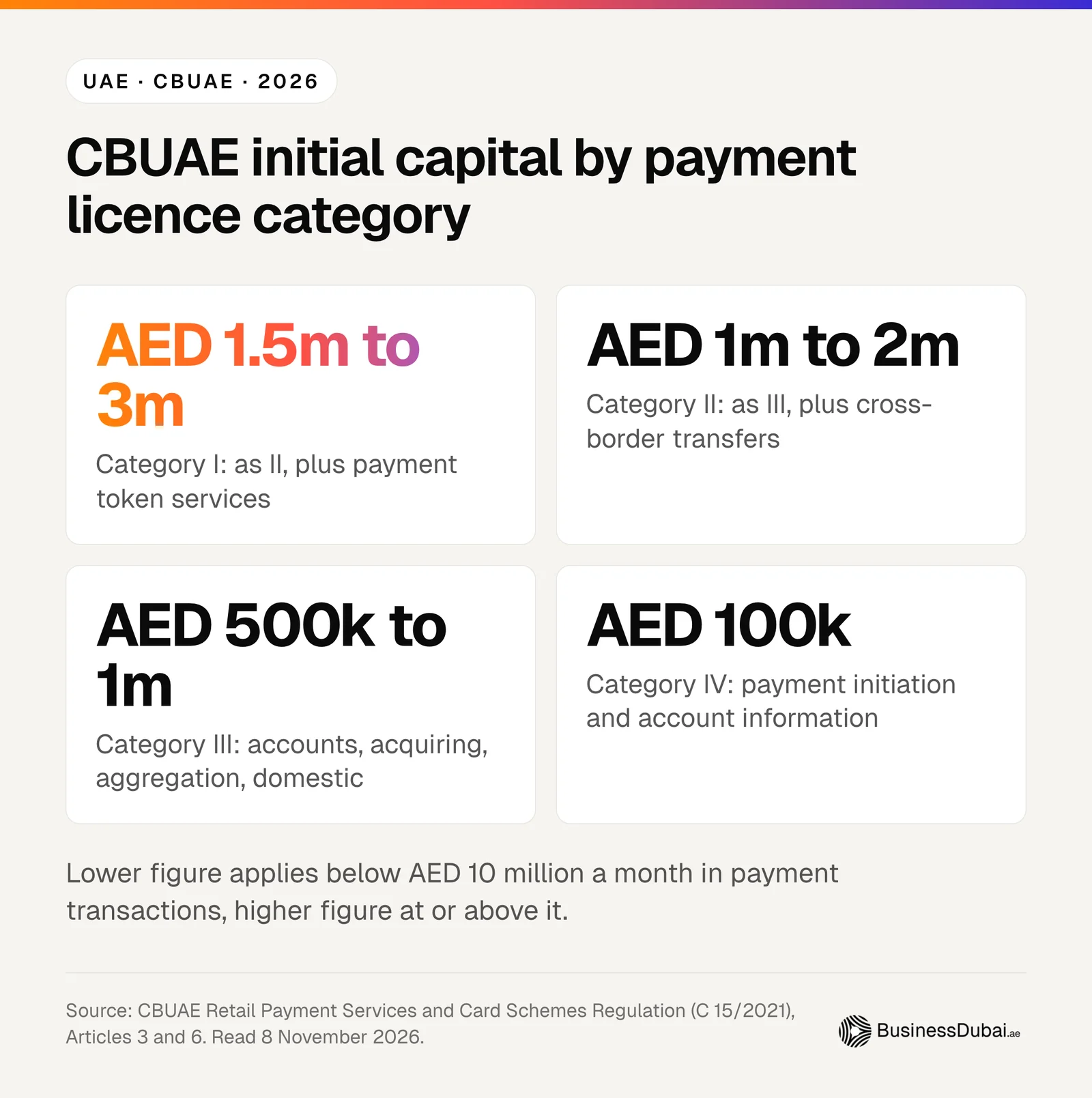
Initial capital for a CBUAE payment licence under Article 6 runs from AED 100,000 for Category IV to AED 3 million for Category I. Categories I to III each have two levels, set by whether monthly payment transactions average AED 10 million or more, measured over three months or, before trading, from the business plan.
For Category I, Article 6 requires "initial capital of at least three (3) million Dirhams where the monthly average value of Payment Transactions amounts to ten (10) million Dirhams or above" or "initial capital of at least one and a half (1.5) million Dirhams" below it [2]. Category III drops to "five hundred thousand (500,000) Dirhams" under AED 10 million a month, and Category IV needs "one hundred thousand (100,000) Dirhams regardless of the monthly average value of Payment Transactions" [2].
| Licence category | Monthly average below AED 10 million | Monthly average AED 10 million or above | Extra condition at application |
|---|---|---|---|
| Category I | AED 1,500,000 | AED 3,000,000 | List of payment tokens to be issued, with a legal opinion on each [2] |
| Category II | AED 1,000,000 | AED 2,000,000 | None beyond Article 4 |
| Category III | AED 500,000 | AED 1,000,000 | None beyond Article 4 |
| Category IV | AED 100,000 | AED 100,000 | Professional indemnity insurance held at application [2] |
The monthly average uses "the moving average of the preceding (3) months or, where such data does not exist at the time of being granted a License by the Central Bank, on the basis of the business plan and financial projections provided" [2]. A new applicant is judged on its own forecast.
The four capital floors side by side, as set by Article 6 of the regulation [2]:
The capital has to stay there
Article 7 requires a licensed firm to "hold and maintain at all times aggregate capital funds that do not fall below the initial capital requirements laid down in Article (6)", and CBUAE may set a higher figure [2]. After three consecutive months above AED 10 million, the firm must "report this fact to the Central Bank and become automatically subject to the higher aggregate capital funds requirements" [2]. Capital funds are paid-up capital, reserves (excluding revaluation reserves) and retained earnings, less "Accumulated losses" and "Goodwill", and the applicant must explain the "source(s) of funds" [2].
Quick Math: An aggregator forecasting AED 8 million a month of payments, all inside the UAE, applies for Category III and needs AED 500,000 of initial capital. Once its three-month average crosses AED 10 million, the floor becomes AED 1,000,000. If the same aggregator also settles funds across borders, it needs Category II instead: AED 1,000,000 at AED 8 million a month, rising to AED 2,000,000 at AED 10 million. Adding cross-border on day one doubles the starting capital.
Real Talk: The capital floor is a floor, not a budget. Because accumulated losses are deducted from capital funds, a Category III firm that starts with exactly AED 500,000 and loses AED 200,000 in its first year is AED 200,000 below its requirement. Most payment businesses lose money while they build volume. Plan to inject the capital plus your expected losses, or plan to top up before the gap opens.
When does a payment business need a stored value facility (SVF) licence instead?
A payment business needs a CBUAE stored value facility licence when customers load money that stays on the facility for later spending, as in a true e-wallet. The SVF Regulation requires paid-up capital of at least AED 15 million, capital funds of at least 5% of the float, and a bank guarantee for the full paid-up capital.
The RPSCS text draws the line. A payment account "is only used for holding fund/cash in transit and not allowed to store and maintain fund/cash", and "At no time shall Payment Service Providers hold funds of Retail Payment Service Users unless these are funds in transit" [2]. A balance the customer leaves on your app to spend next week is stored value, and the Stored Value Facilities Regulation (C 6/2020) says "Issuing and operating SVF in the State requires a prior License from the Central Bank" [3].
| SVF requirement | Exact rule | Source |
|---|---|---|
| Who can apply | "a company incorporated in the State, including free zones but excluding Financial Free Zones" | SVF Regulation [3] |
| Paid-up capital | "paid-up capital of at least 15 million Dirham (15,000,000 AED)" | Article 7 [3] |
| Ongoing capital | "Aggregate Capital Funds must be at least 5% of the total Float received from the Customers" | Article 7 [3] |
| Bank guarantee | "An unconditional irrevocable bank guarantee for the full paid up capital amount in favor of the Central Bank paid upon first demand shall also be submitted to the Central Bank with the application of the License" | Article 7 [3] |
| Float protection | Float held "in segregated accounts with licensed banks or a foreign bank" recognised by CBUAE | SVF Regulation [3] |
| Management | "The chief executive and the alternate chief executive should be individuals who are ordinarily resident in the State" | SVF Regulation [3] |
An SVF applicant ties up AED 15 million and a bank guarantee for the same amount, which is why the SVF licences in the press belong to firms such as Revolut, Wise and Ant International, each paired with a Category II RPSCS licence [9][10][11].
The SVF exemptions
A "Single-purpose Stored Value Facility" needs no licence, and "A Closed Loop Payment Scheme is a typical Single-purpose Stored Value Facility" [3]. On application, CBUAE may also exempt cash reward, digital product, bonus point and limited-group schemes, and small facilities where "the aggregate amount of the Float of the facilities does not exceed half a million Dirham (500,000 AED) or its equivalent and the aggregate number of Customers is not more than 100", after a trial in CBUAE's FinTech Office sandbox [3]. Exemptions are granted, not assumed.
Common Mistake: Applying for Category III because AED 500,000 is affordable, then designing a wallet where customers top up and spend over weeks. That product is stored value, and stored value needs AED 15 million of paid-up capital plus a matching bank guarantee [3]. Decide early whether balances will rest on your platform. If they will not, design settlement so funds leave within a short window; if they will, budget for the SVF route or partner with a licensed SVF issuer.
Who does not need a PSP licence in the UAE?
A business does not need a CBUAE payment licence if it never takes possession of customers' money. The RPSCS Regulation excludes technical service providers, data processing, IT security, authentication, communication networks and terminal suppliers, plus intra-group and settlement-system payments. A merchant selling its own goods through a licensed gateway is not a payment provider either.
The exclusions sit at the front of the regulation under the heading "This Regulation shall not apply to the following" [2]. The technical exclusions apply to "Any service other than Payment Initiation and Payment Account Information Service", and they are the ones that matter most to software companies.
| Exclusion in the RPSCS Regulation | Exact text | What it means in practice |
|---|---|---|
| Technical service providers | "services, provided by any technical service provider that supports the provision of any payment service, but does not at any time enter into possession of any money under that payment service" | A gateway software vendor, checkout plug-in or orchestration layer that never holds funds |
| Data services | "the service of processing or storing data" | Hosting, processing and storage vendors |
| Security | "any information technology security, trust or privacy protection service" | Fraud tools, tokenisation vendors, security providers |
| Authentication | "any data or entity authentication service" | KYC and identity verification vendors |
| Networks | "the service of providing a communication network" | Telecom and connectivity |
| Hardware | "the service of providing and maintaining any terminal or device used for any payment service" | Point-of-sale terminal suppliers |
| Group payments | "Payment Transactions and related services between a parent undertaking and its subsidiary or between subsidiaries of the same parent undertaking" | Intra-group treasury without an outside intermediary |
Other items on the list, such as "Payment Transactions involving Remittances" and stored value, send you to a different CBUAE regime rather than to no regime [2].
The merchant is not the payment provider
A shop or online store that sells its own goods and takes card payments through a licensed acquirer or gateway is a customer of a payment provider, not a provider: the money it receives is its own sale proceeds. Our guide to payment gateways for e-commerce in Dubai covers which providers approve new companies. For the wider launch, see our guide to starting an online store in the UAE.
The 2025 law widened the edge of the perimeter
Article 62 of Federal Decree-Law No. 6 of 2025 covers anyone "facilitating, whether directly or indirectly, any Licensed Financial Activity" [1], and Hadef & Partners reads it as reaching platforms that enable financial services "even if they do not interact directly with clients" [6]. The RPSCS exclusions remain in force, but a technology business close to the money should get written comfort rather than rely on its own reading.
Pro Tip: Use one test before anything else: does your company, at any moment, have legal possession of money that belongs to someone else? Map every flow, including refunds, chargebacks and failed payouts. If any single flow lands in your bank account, even for a day, treat the business as a payment provider until a lawyer or CBUAE says otherwise.
What does CBUAE expect on local presence, ownership and governance?
CBUAE expects a licensed payment firm to be run from the UAE. The RPSCS Regulation requires the chief executive and alternates to be ordinarily resident, other management to be based in the State unless CBUAE allows otherwise, prior approval for any controller with 20%, and risk, compliance and internal audit functions in place.
The residency rule sits inside the definition of Management: "The chief executive officer and his or her alternate(s) shall be a natural person who are ordinarily residing in the State whereas the remaining members of Management shall be based in the State unless the Central Bank allows otherwise" [2]. A Controller is a person with "an interest in at least 20% of the shares" or who can "control at least 20% of the votes", and "A Person shall not become a Controller in a Payment Service Provider without obtaining a prior approval from the Central Bank" [2].
| Governance item | What the RPSCS Regulation requires | Where |
|---|---|---|
| Control functions | "a risk management function, an internal audit function and a compliance function" | Article 10 [2] |
| Annual audit | An auditor to audit annually the financial statements and "the systems and controls of the Retail Payment Services provided" | Article 10 [2] |
| Outsourcing | Material outsourcing "shall be subject to the prior approval of the Central Bank", with an annual report | Article 16 [2] |
| Safeguarding, settled within 24 hours | Funds "shall not be commingled at any time" with others' funds, or insulated against other creditors | Article 14 [2] |
| Safeguarding, settled after 24 hours | "open a separate escrow account with a Bank", or cover funds by insurance or a bank guarantee from an unrelated insurer or bank | Article 14 [2] |
Which company vehicle can hold the licence?
The RPSCS Regulation defines an Applicant as "a juridical Person duly incorporated in the State in accordance with Federal Law No. 2 of 2015 on Commercial Companies" [2], and the 2025 law says "Other Financial Institutions may take the form of joint-stock companies or limited liability companies" [1]. The SVF rules accept a company incorporated "including free zones but excluding Financial Free Zones" [3]; the RPSCS text is silent on free zones, so confirm the vehicle before you incorporate. On ownership, the law leaves the "conditions and controls for shareholding" of non-bank institutions to the CBUAE Board, and its 60% national rule is written for banks [1]. We found no published Board decision for payment firms.
The table compares the three vehicles for a payment business.
| Factor | Dubai mainland LLC | Non-financial free zone company | DIFC or ADGM entity |
|---|---|---|---|
| Can hold a CBUAE RPSCS licence | Fits the Applicant definition | Regulation silent; confirm with CBUAE | Not for onshore SVF or tokens; separate regulator |
| Can hold a CBUAE SVF licence | Yes, if incorporated in the State | Yes, expressly allowed [3] | Excluded as an applicant [3] |
| Customer market | Whole UAE once licensed | Whole UAE once CBUAE-licensed | The financial free zone; onshore needs CBUAE |
| BusinessDubai.ae package | From AED 18,200 without a visa, AED 26,900 with one visa [21] | Quoted per zone | No package; BusinessDubai.ae does not form DIFC or ADGM entities |
A mainland company fits the Applicant definition without argument. Our mainland company setup page sets out the Dubai mainland package, and our free zone company setup page shows the zone options if CBUAE confirms a free zone vehicle works for your category. CBUAE is a federal regulator, so the company does not have to sit in Dubai; founders who prefer another emirate can compare business setup in Sharjah for a mainland base there.
Common Mistake: Planning to run the UAE entity with a chief executive who lives in London or Singapore and visits monthly. The regulation requires the chief executive and alternates to be "ordinarily residing in the State" [2]. That means UAE residence visas for at least two senior people before the licence.
How does the CBUAE licensing process work, step by step?
The CBUAE licensing process for a payment firm runs in four stages: an encouraged pre-application meeting with the Licensing Division, a formal application with capital and documents in place, an in-principle approval while the firm builds out, and the final licence with entry on the register. Published press cases took nine to fourteen months from in-principle approval.
Article 5 is two sentences long. "The licensing of Applicants shall be subject to the procedure envisaged in the Central Bank's Licensing Guidelines", and "The Management of an Applicant is encouraged to meet with the Central Bank's Licensing Division before submitting a formal Application" [2]. Article 4 then sets what must be true "at the time of submitting an Application": the applicant must "fulfil the Legal Form", "meet the respective initial capital requirements per License Category", and "provide the necessary documents and information specified in the Central Bank application form as provided by the Licensing Division" [2].
| Stage | What happens | Rule or evidence |
|---|---|---|
| 1. Company and bank account | Incorporate the operating company and open its corporate account | Applicant must be a juridical person incorporated in the State [2] |
| 2. Pre-application meeting | Management meets the CBUAE Licensing Division | Article 5 [2] |
| 3. Formal application | Application form, documents, source of funds, category-specific items | Articles 4 and 6 [2] |
| 4. Completeness and review | The 60-working-day clock runs only once all conditions are met | Article 64 of Federal Decree-Law No. 6 of 2025 [1] |
| 5. In-principle approval | Build-out: hiring, systems, safeguarding accounts, capital | Pattern reported for Revolut and Ant International [8][10] |
| 6. Final licence | Licence issued | Press reports [9][10] |
| 7. Register entry | Trading starts only after entry on the CBUAE register | Article 68 of the 2025 law [1] |
The law says "A Licensed Financial Institution shall not commence any Licensed Financial Activity except after its name was entered to the register" [1], so a licence letter alone is not the start date. For Category IV, the indemnity insurance amount "shall be decided upon by the Central Bank" [2].
What CBUAE charges
The 2025 law lets CBUAE "impose fees and charges for providing any service, including but not limited to, issuing licenses and authorizations" by a published Board decision [1]. Fees are set by CBUAE, and we found no published fee schedule in the sources we could read. Ask the Licensing Division at the pre-application meeting, and treat any figure quoted online without a CBUAE source as unverified.
For the bank account in stage one, our guide to opening a corporate bank account in Dubai covers what banks ask for, and a payment business should expect more questions than most.
How long does a CBUAE payment licence take, and when does the 60-day clock start?
Federal Decree-Law No. 6 of 2025 gives CBUAE sixty working days to decide a licence application, but the clock starts only once every condition and requirement is met, and silence counts as rejection. Real cases run longer end to end: Revolut took about nine months from in-principle approval to licence, and Ant International about fourteen.
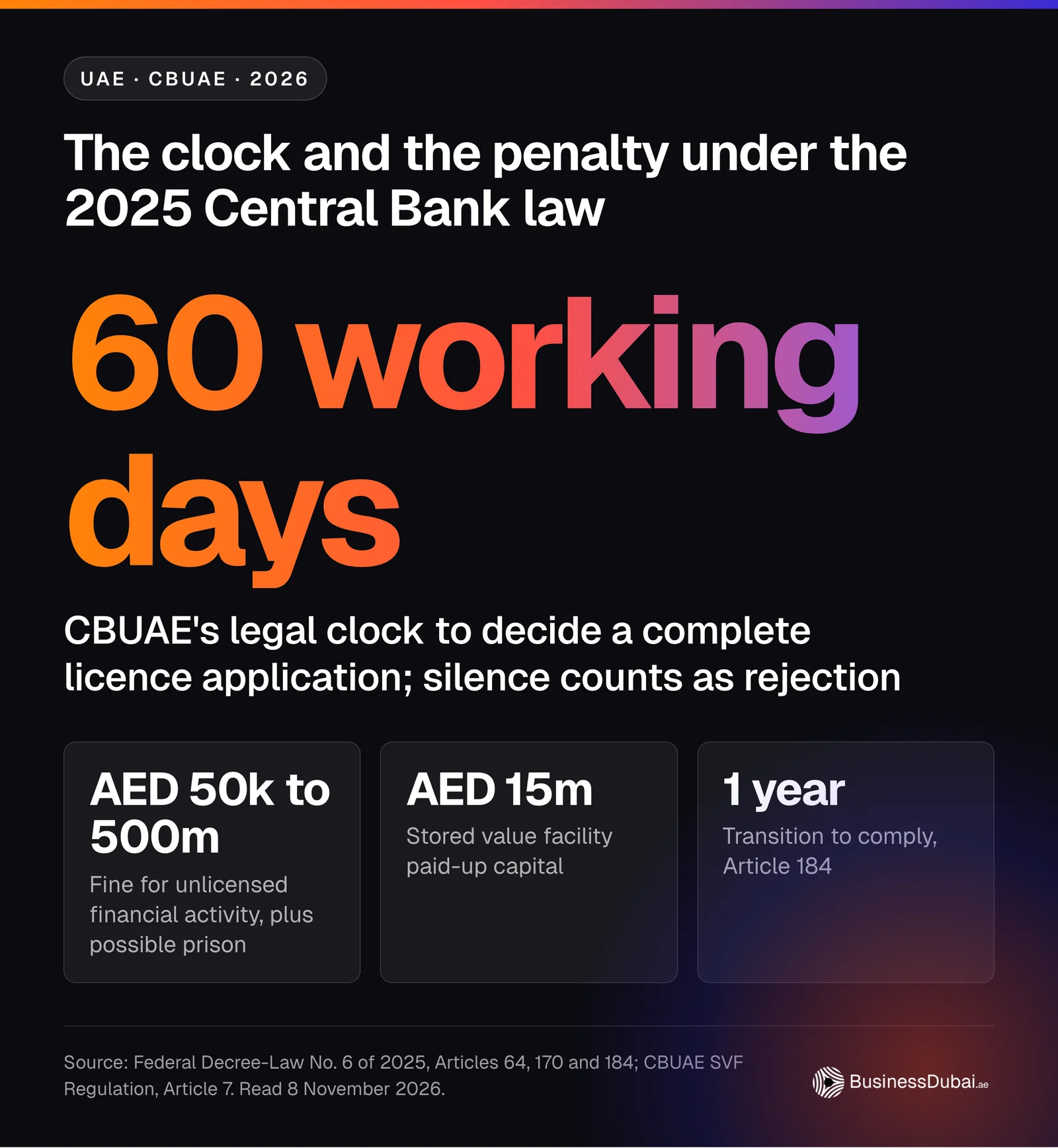
Article 64(1) is the clock: "Deciding on licensing application or extension thereof shall be within a period not exceeding sixty (60) working days from date of meeting all conditions and requirements for licensing. The expiry of the period without a response shall constitute an implicit rejection of the request" [1]. The clock starts when the file is complete, and a lapse is a refusal. Article 64(3) also lets CBUAE reject an application "based on the capacity of the financial sector in the State and the needs of the local market", with no appeal to the Grievances and Appeals Committee [1]. A business plan that explains what the UAE market lacks is not decoration.
CBUAE publishes no end-to-end timeline. The cases below come from dated trade press and company statements.
| Firm | Licences | In-principle approval | Final licence | Source |
|---|---|---|---|---|
| Revolut | SVF and RPSCS Category II | Reported 9 September 2025 | June 2026, "a nine-month regulatory cycle since the in-principle approval" | Gulf News; The Paypers, 17 June 2026 [8][9] |
| Ant International | RPSCS Category II and SVF | August 2025 | Reported 15 October 2026 | Fintech News Hong Kong [10] |
| Wise | SVF and Retail Payment Services Category 2 | Not stated | "final approval" announced 14 October 2025 | Wise newsroom [11] |
| MBME Pay | Category 3, merchant acquiring and payment aggregation | Not stated | Announced 10 April 2026 | Gulf Today [12] |
These are large applicants, and the published gap runs from in-principle approval, not from the first meeting. By our count, Ant International's licences were reported about fourteen months after its August 2025 in-principle approval [10].
Pro Tip: The 60-working-day clock runs from a complete file, so completeness is the lever you control. Hold the capital, the source-of-funds evidence, the resident chief executive and alternate, the control function heads, the safeguarding bank arrangement and, for Category IV, the indemnity insurance before you file. Each item you add later restarts the wait for "all conditions and requirements" [1].
What are the penalties for running payments without a licence under the 2025 law?
Under Federal Decree-Law No. 6 of 2025, carrying on a licensed financial activity such as retail payments or stored value without a licence is punishable by imprisonment and a fine of AED 50,000 to AED 500 million, or either. The law also brings promotion, platforms and technology that facilitate payments inside CBUAE's licensing perimeter.
Article 170 reads: "Any Person who engages in any of the Licensed Financial Activities referred to in item (1) of Article (61) of this decree-law without a license or authorization shall be punished by imprisonment and a fine of not less than fifty thousand (50,000) Dirhams and not exceeding five hundred million (500,000,000) Dirhams, or by either of these two punishments" [1].
| Provision of Federal Decree-Law No. 6 of 2025 | What it says | Article |
|---|---|---|
| Payments in scope | "Providing stored values services, retail payments and digital money services" | 61 [1] |
| Criminal penalty | Imprisonment and a fine of AED 50,000 to AED 500 million, or either | 170 [1] |
| Old rules stay | Existing regulations "shall remain in force, until such regulations, decisions and circulars are issued in replacement thereof" | 183 [1] |
| Transition | One year to "reconcile their respective positions"; "The Board of Directors may extend this period" | 184 [1] |
Article 185 repeals the old Central Bank law, Federal Decree-Law No. 14 of 2018 [1]. Hadef & Partners reports that the law was issued on 8 September 2025 "with affected entities granted a one-year transition period until 16 September 2026" [6]; Addleshaw Goddard put the cut-off at "the 15th of September of 2026, unless otherwise amended by CBUAE" [7]. We found no notice that the Board extended the period, but could not confirm either way. Because of Article 183, the 2021 RPSCS and 2020 SVF regulations still govern, even though both cite the repealed 2018 law [1].
The three numbers that frame the risk, from the law and the SVF Regulation [1][3]:
Real Talk: The transition year has run out on the dates the law firms give. If your business was operating under an informal arrangement, a partner's licence or an assumption that a free zone trade licence was enough, plan as if the grace period is over and get a written position now. The penalty runs to imprisonment, and promotion alone is regulated under both the 2021 regulation and the 2025 law [1][2].
Remittance and exchange houses are a separate regime
A Remittance is "the receipt of funds from a Payer without any Payment Accounts being created in the name of the Payer or the Payee", and the RPSCS Regulation excludes it [2]. Those businesses fall under the Exchange Business Regulation (C 7/2025), whose Category IV covers "Remittances via digital channels acceptable to the Central Bank" [4]. A limited liability company "must inject a minimum Paid-up Capital of AED twenty five (25) million", and "This requirement applies to all Category IV License applications" [4]. Non-UAE ownership "must not exceed forty percent (40%)" for most legal forms, although for Category IV CBUAE may permit "full (100%) ownership by non-UAE Nationals" [4].
Can you get a payment licence in DIFC or ADGM instead?
A payment firm can be licensed in DIFC by the DFSA or in ADGM by the FSRA for Providing Money Services, with DFSA base capital of US$200,000 for payment accounts and US$500,000 for stored value. Those licences cover the financial free zone, though; serving retail customers onshore in the UAE still needs a CBUAE licence.
The SVF Regulation states: "Financial institutions regulated by Financial Free Zone Authorities may conduct SVF business in the State after obtaining a License from the Central Bank" [3], and Addleshaw Goddard reads the 2025 law as excluding "financial freezones such as the Dubai International Financial Centre and the Abu Dhabi Global Market" [7]. A DFSA or FSRA licence serves the DIFC or ADGM perimeter; it is not a passport to onshore UAE consumers.
DIFC: the DFSA categories
A DIFC firm is in Category 3D if it is licensed to "Provide Money Services and it: (i) provides or operates a Payment Account; (ii) executes a Payment Transaction on a Payment Account provided or operated by another Person; or (iii) issues a Payment Instrument" [13]. Stored value issuers are Category 3C and money-transmission-only firms Category 4, where "If an Authorised Firm is authorised to Operate a Crowdfunding Platform, Provide Money Transmission or Operate an Alternative Trading System its Base Capital Requirement is $140,000" [13]. The capital requirement is "the highest of" the base figure, an expenditure-based minimum and a volume figure: "3% of the average daily outstanding Stored Value", or a transaction-based figure starting at "4% of the first $5 million of payment volume" [13]. DFSA annual fees add "$1,000 for the first $1,000,000 of expenditure and $1 for each additional $1,000 of expenditure" to the base amounts [14].
ADGM: the FSRA rules
An ADGM money services firm holds capital "as the highest of" its base requirement and a variable requirement, such as "2.5% of the first $10 million of monthly payment volume" for a Payment Account Provider [15]. The base table gives US$250,000 for Category 3C and US$50,000 for Category 4, but the text we read does not confirm which category a money services firm falls into, so we state no ADGM base figure for payments [15].
| Item | DIFC (DFSA) | ADGM (FSRA) |
|---|---|---|
| Activity | Providing Money Services | Providing Money Services |
| Payment accounts or instruments | Category 3D, base capital US$200,000 [13] | Variable: 2.5% of the first US$10 million of monthly volume, then lower bands [15] |
| Stored value | Category 3C, base capital US$500,000; plus 3% of average outstanding stored value [13] | 2.5% of average daily outstanding stored value [15] |
| Money transmission only | Category 4, base capital US$140,000 [13] | Money Remitter: 1.25% of the first US$10 million of monthly volume [15] |
| Application fee | US$25,000 (stored value), US$15,000 (payments), US$10,000 (transmission only) [14] | US$15,000 (exchange or remittance), US$25,000 (payment services) [16] |
| Annual fee | Same base amounts, plus an expenditure element [14] | US$15,000 or US$25,000 [16] |
| Onshore UAE retail customers | Needs a CBUAE licence | Needs a CBUAE licence |
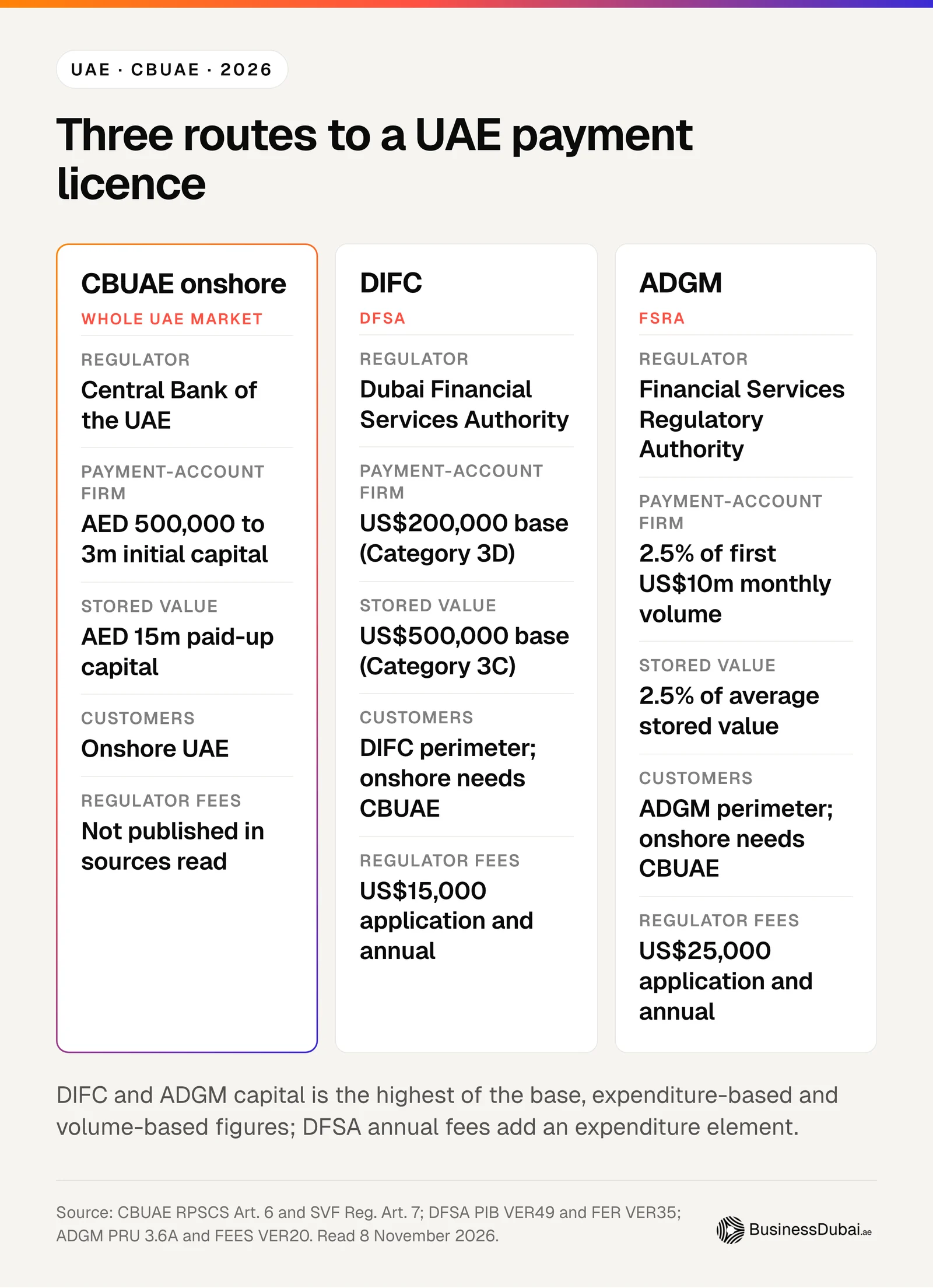
The three routes side by side, using only the figures in the rulebooks above [2][3][13][14][15][16]:
BusinessDubai.ae has no DIFC or ADGM package. For background, see our ADGM company setup guide, our DIFC business setup guide and our Dubai fintech licence guide. If you want an onshore Abu Dhabi base near the capital's financial institutions rather than inside ADGM, our business setup in Abu Dhabi page covers the mainland company.
Common Mistake: Choosing DIFC or ADGM because the base capital looks lower, then discovering the target customers are onshore UAE consumers. The financial free zone licence does not cover them, and the firm then needs a CBUAE licence as well, with its own capital and its own application [3]. Decide where your customers are before you decide where to incorporate.
How are PSPs taxed in the UAE: VAT and corporate tax?
A UAE payment service provider charges 5% VAT on explicit per-transaction fees, because the VAT Executive Regulation exempts financial services only where there is no explicit fee or commission. For corporate tax, payment services are not a Qualifying Activity under Ministerial Decision 229 of 2025, so expect ordinary rates: 0% to AED 375,000, 9% above.
VAT on payment fees
Article 42 of the VAT Executive Regulation exempts financial services "where they are not conducted in return for an explicit fee, discount, commission, and rebate or similar", and says they "shall be subject to tax where the consideration payable in respect of a supply of Services is an explicit fee, commission, discount, and rebate or similar" [17]. A merchant discount rate or per-transaction fee is an explicit fee, so in our reading it is standard-rated at 5%, while a margin-only exchange spread is exempt. And "Where Article 31 of this Decision applies in respect of a supply of financial services, this supply should be treated as zero-rated" [17], which covers qualifying exports. Our guide to VAT registration and compliance in the UAE covers the AED 375,000 mandatory and AED 187,500 voluntary registration thresholds.
Corporate tax
Ministerial Decision No. 229 of 2025 lists Qualifying Activities from "a. Manufacturing of goods or materials" to "m. Logistics services", and payment services are not among them [18]. Its Excluded Activities include "b. Banking activities", which "means the regulated financial activities specified under Federal Decree-Law No. 14 of 2018 referred to above and any law that amends or replaces it" [18]; the 2025 replacement law lists retail payments and stored value [1]. In our reading, a free zone or DIFC or ADGM payment firm is taxed at ordinary rates, 0% up to AED 375,000 and 9% above [19]. Confirm with a tax adviser. Small Business Relief covers revenue at or under AED 3,000,000 for periods ending on or before 31 December 2029 (Ministerial Decision No. 131 of 2026) [19].
| Tax question | Answer for a payment business | Source |
|---|---|---|
| VAT on explicit per-transaction fees | Standard-rated at 5% | VAT Executive Regulation, Article 42(4) [17] |
| VAT on margin-only currency exchange | Exempt | Article 42(3)(a) [17] |
| VAT on fees to qualifying overseas customers | Zero-rated where Article 31 applies | Article 42(7) [17] |
| Qualifying Activity for 0% free zone rate | No; payments are not listed | Ministerial Decision No. 229 of 2025 [18] |
| Corporate tax rate, ordinary | 0% up to AED 375,000, 9% above | Federal Decree-Law No. 47 of 2022 [19] |
| DIFC or ADGM payment firm | Ordinary rates, in our reading; confirm | MD 229 of 2025 [18] |
| Small Business Relief | Revenue at or under AED 3,000,000, periods ending by 31 December 2029 | Ministerial Decision No. 131 of 2026 [19] |
Quick Math: A Category III acquirer earning AED 2,000,000 a year in explicit fees from UAE merchants charges AED 100,000 of VAT on top, paid over to the Federal Tax Authority. If its taxable profit is AED 600,000, corporate tax is 9% of the AED 225,000 above the AED 375,000 band, or AED 20,250. With revenue at or under AED 3,000,000, the firm may instead elect Small Business Relief for periods ending by 31 December 2029 [19].
Our guides to Small Business Relief to 2029 and UAE corporate tax filing cover the elections and deadlines.
What does AML compliance look like for a UAE PSP?
AML compliance for a UAE PSP means meeting Federal Decree-Law No. 10 of 2025, which came into force on 14 October 2025, running risk-based customer due diligence and reporting suspicious transactions through goAML to the Financial Intelligence Unit. The RPSCS Regulation adds enterprise risk assessments, customer risk profiling and a ban on anonymous accounts.
Article 12 of the RPSCS Regulation requires payment firms to "comply with the relevant UAE AML Laws and Regulations" and to "report any suspicious transactions to the Financial Intelligence Department at the Central Bank" [2]. It also requires firms to "conduct enterprise-level and business relationship-specific risk assessments" and prohibits any relationship "under an anonymous or fictitious name or by pseudonym or number" [2].
The AML law itself changed in 2025. Legal 500 commentary dated 19 November 2025 says Federal Decree-Law No. 10 of 2025 came into force on 14 October 2025 and "repeals and replaces Federal Decree‑Law No. 20 of 2018", and that suspicious activity "must be reported via the digital goAML system to the FIU without tipping off the subject" [20]. The RPSCS text still cites the old 2018 AML law, so read it alongside the new one. In practice, that means goAML registration, an enterprise risk assessment written before launch, and the compliance function Article 10 requires [2].
What does a PSP licence cost in the UAE all in?
A PSP licence in the UAE costs the company formation plus regulatory capital plus compliance spend. BusinessDubai.ae forms the Dubai mainland company from AED 18,200 in year one without a visa or AED 26,900 with one visa; capital then runs AED 100,000 to AED 3 million by category, or AED 15 million for stored value.
The CBUAE licence is the regulated layer on top of an ordinary UAE company. BusinessDubai.ae forms that company and coordinates post-setup items such as visas and renewals; it does not prepare the CBUAE application or give regulatory advice. Its packages are company formation only and exclude CBUAE licensing, capital, safeguarding, audits and compliance staff.
| Cost item | Amount (AED) | Notes |
|---|---|---|
| Dubai mainland company, year one, no visa | 18,200 | BusinessDubai.ae standard package; company formation only [21] |
| Dubai mainland company, year one, one visa | 26,900 | Standard package with one residence visa [21] |
| Company renewal, year two | About 15,000 | Licence renewal, before visas [21] |
| Initial capital, Category IV | 100,000 | Held as capital funds, not a fee [2] |
| Initial capital, Category III | 500,000 to 1,000,000 | Higher figure at AED 10 million a month [2] |
| Initial capital, Category II | 1,000,000 to 2,000,000 | Higher figure at AED 10 million a month [2] |
| Initial capital, Category I | 1,500,000 to 3,000,000 | Higher figure at AED 10 million a month [2] |
| SVF paid-up capital | 15,000,000 | Plus a bank guarantee for the full amount and 5% of float [3] |
| Professional indemnity insurance, Category IV | Quote | Amount decided by CBUAE [2] |
| CBUAE application and annual fees | Set by CBUAE | Not published in the sources we read [1] |
| Resident chief executive, alternate and control function heads | Quote | Salaries and visas; required before licence [2] |
| Annual audit of accounts and of payment systems and controls | Quote | Article 10 requires both [2] |
| Safeguarding escrow, insurance or bank guarantee | Quote | Depends on settlement speed [2] |
| Regulatory counsel and application preparation | Quote | Not part of any BusinessDubai.ae package |
The formation line is the smallest number in the table. A realistic budget starts from the capital and the team, then adds the company.
Real Talk: If your model fits a licensed partner, working under their licence can beat applying yourself in year one. A sub-merchant structure with a licensed aggregator costs a share of fees but no AED 500,000 of capital, no resident control team and no application wait. Apply for your own licence when the partner's margin costs more than the capital and staff.
For a company formation quote alongside a list of the regulatory items to price with your counsel, get a free consultation→
Once the company exists, licence renewal, visa renewals, corporate tax registration and VAT fall due. Our post-setup services team runs those company-side items so the compliance team can focus on CBUAE.
Real Client Stories
These are composite examples built from the situations payment founders most often face when they apply for a UAE licence. Names and details are illustrative, and the only figures used are published regulatory requirements and BusinessDubai.ae's package prices.
The marketplace that was already a payment business
A founder building a Dubai services marketplace formed a mainland company on the AED 26,900 one-visa package and planned to collect buyers' card payments into the company account, then pay providers every Friday. Before launch, the founder compared that flow with the regulation's definition of Payment Aggregation, which describes receiving payments, pooling them and passing them on "after a time period". It matched. The options were a Category III licence with AED 500,000 of capital, or a licensed aggregator that splits payments directly to providers. The founder chose the aggregator and kept the marketplace out of the money flow.
Lesson: test your money flow against the definitions before you build the payout logic.
The wallet that wanted to keep balances
Two founders planned a family spending app and budgeted for Category III at AED 500,000, because the product issued payment accounts and cards inside the UAE. Their design let parents top up balances that children spent over several weeks. On reading Article 14 and the definition of a payment account, they saw that accounts may hold funds only in transit. Resting balances are stored value, which needs AED 15 million of paid-up capital, a bank guarantee for the same amount and capital funds of at least 5% of the float. They redesigned around instant card-funded payments and kept the Category III plan.
Lesson: decide whether money rests on your platform before you pick a licence category.
The open banking team that needed a resident chief executive
A European team building an account-aggregation and payment-initiation app identified Category IV as the fit: no funds held, AED 100,000 of initial capital. Two requirements reshaped the plan. Professional indemnity insurance had to be in place at the time of application, in an amount CBUAE decides, so the insurer conversation came first. And the chief executive and an alternate had to be ordinarily resident in the UAE, so the team formed a Dubai mainland company on the AED 26,900 package with one visa and added a second visa for the alternate.
Lesson: the small capital figure is not the whole Category IV entry ticket.
Your next steps
The decision that matters most is what your company does with money. If it never holds funds, you may need no payment licence or only Category IV. If it holds funds in transit, you need Category I, II or III, and geography sets the capital. If it holds balances, you need an SVF licence at AED 15 million.
| Your model | Route | Capital floor | First step |
|---|---|---|---|
| Merchant selling its own goods online | No payment licence; licensed gateway | None | Trade licence and gateway account |
| Software or terminal vendor that never holds money | Technical-service exclusion | None | Map every flow and get written comfort |
| Open banking app (initiation or account information) | CBUAE Category IV | AED 100,000 plus indemnity insurance | Insurer quote and resident chief executive |
| Domestic acquirer or aggregator | CBUAE Category III | AED 500,000 to 1,000,000 | Volume forecast and pre-application meeting |
| Acquirer, aggregator or transfers with cross-border flows | CBUAE Category II | AED 1,000,000 to 2,000,000 | Volume forecast and pre-application meeting |
| Payment tokens | Payment Token Services Regulation | From AED 15 million for issuers | Ask CBUAE which regime applies |
| E-wallet holding balances | CBUAE SVF licence | AED 15 million plus matching bank guarantee | Funding plan and bank guarantee |
| Digital remittance without accounts | Exchange Business Category IV | AED 25 million for an LLC | Ownership and capital plan |
| DIFC or ADGM clients only | DFSA or FSRA money services | From US$140,000 base in DIFC | Financial free zone counsel |
BusinessDubai.ae forms the company that sits under the licence, with itemised pricing and no hidden fees. We will price a mainland company setup against a free zone company setup on the points that matter to a payment applicant: the vehicle CBUAE accepts for your category, the visas for your resident chief executive and alternate, and the year-two renewal. Our post-setup services team then keeps the company side current while your compliance team handles CBUAE.
Ready to form the operating company for your payment business? Talk to a setup expert→
Frequently Asked Questions
What is a PSP licence in the UAE?
A PSP licence in the UAE is a Central Bank of the UAE licence to provide retail payment services under the Retail Payment Services and Card Schemes Regulation (Circular 15 of 2021). It comes in four categories, I to IV, covering accounts, instruments, acquiring, aggregation, transfers and open banking.
What is the minimum capital for a payment service provider in the UAE?
The minimum is AED 100,000, for a CBUAE Category IV licence. Category III needs AED 500,000, Category II AED 1 million and Category I AED 1.5 million below AED 10 million a month in payments, and double those figures at or above it.
How much capital does a stored value facility need in the UAE?
A stored value facility needs paid-up capital of at least AED 15 million under the CBUAE SVF Regulation, as of 2026. Capital funds must also reach 5% of the float, and the applicant gives CBUAE a bank guarantee for the full paid-up capital.
Do I need a CBUAE licence to process payments in the UAE?
Yes, if your business provides or promotes any of the nine retail payment services, such as acquiring, aggregation or fund transfers. A business that never takes possession of customers' money, such as a gateway software vendor, falls within the technical-service exclusion.
Does an online store using Stripe or another gateway need a payment licence?
No. A merchant receiving its own sale proceeds through a licensed gateway or acquirer is a customer of a payment provider, not a provider. It needs a trade licence for its activity and a merchant account.
Is a marketplace that pays sellers a payment service provider?
It can be. A marketplace that collects buyers' money into its own account and pays sellers later matches the RPSCS definition of Payment Aggregation. The safe options are a CBUAE licence or a licensed aggregator that pays sellers directly.
Which licence category does a merchant acquirer need?
A merchant acquirer needs CBUAE Category III for domestic transfers only, Category II if it also moves funds across borders, and Category I only if it adds payment token services, under Article 3 of the RPSCS Regulation.
Which licence does an open banking app need in the UAE?
An app that only initiates payments from accounts held elsewhere or shows consolidated account information needs CBUAE Category IV. Initial capital is AED 100,000, plus professional indemnity insurance, in an amount CBUAE decides, held at application.
What is the difference between an SVF licence and an RPSCS licence?
An SVF licence lets a firm hold customer balances for later spending and needs AED 15 million of paid-up capital. An RPSCS licence covers funds held only in transit, with capital from AED 100,000 to AED 3 million. Revolut, Wise and Ant International hold both.
Can a free zone company get a CBUAE payment licence?
The SVF and payment token regulations expressly accept non-financial free zone companies. The RPSCS Regulation refers to the Commercial Companies Law and does not mention free zones, so confirm the vehicle with CBUAE's Licensing Division before incorporating.
Can a foreigner own 100% of a UAE payment company?
Federal Decree-Law No. 6 of 2025 leaves ownership conditions for non-bank institutions to CBUAE Board decisions, and its 60% national rule applies to banks. We found no published decision limiting payment firms. Exchange houses generally cap non-UAE ownership at 40%.
Do I need to live in the UAE to run a licensed payment company?
The chief executive and alternates must be ordinarily resident in the UAE, and other managers based there unless CBUAE allows otherwise. Shareholders need not relocate, but anyone with 20% or more needs CBUAE approval as a controller.
How long does it take to get a CBUAE payment licence?
CBUAE must decide within 60 working days once all licensing conditions are met. Real cases took longer: Revolut moved from in-principle approval in September 2025 to licences in June 2026, and Ant International from August 2025 to October 2026.
What happens if CBUAE does not respond within 60 working days?
Silence counts as refusal. Article 64 of Federal Decree-Law No. 6 of 2025 says the expiry of the period without a response "shall constitute an implicit rejection of the request", and the period starts only once the file is complete.
What does CBUAE charge for a payment licence application?
CBUAE sets its fees by Board decision under Article 182 of Federal Decree-Law No. 6 of 2025. We found no published fee schedule in the sources we could read in November 2026, so ask the Licensing Division before applying.
What is the penalty for operating without a payment licence in the UAE?
Imprisonment and a fine of AED 50,000 to AED 500 million, or either, under Article 170 of Federal Decree-Law No. 6 of 2025. It applies to retail payments, stored value and other licensed financial activities carried on without a licence.
What was the 16 September 2026 deadline?
It was the end of the one-year transition under Article 184 of Federal Decree-Law No. 6 of 2025, as reported by Hadef & Partners; Addleshaw Goddard gave 15 September 2026. The Board may extend it, but we found no extension notice.
Is remittance covered by the PSP licence?
No. Remittance without payment accounts is licensed under CBUAE's Exchange Business Regulation (C 7/2025). Its Category IV covers digital remittance, and a limited liability company must inject at least AED 25 million of paid-up capital before the final licence.
Can I use a DIFC or ADGM licence to serve UAE customers onshore?
Not on its own. A DFSA or FSRA licence covers the financial free zone, and the SVF Regulation says free zone firms may conduct SVF business in the State only after obtaining a CBUAE licence.
What is the DFSA capital for a payment firm in DIFC?
Under DFSA PIB version 49, a payment account or payment instrument firm is Category 3D with base capital of US$200,000, a stored value issuer is Category 3C at US$500,000, and a money-transmission-only firm is Category 4 at US$140,000.
Is VAT charged on payment processing fees in the UAE?
Yes, in our reading. The VAT Executive Regulation taxes financial services where the consideration is an explicit fee or commission, so a merchant discount rate or per-transaction fee is standard-rated at 5% unless export zero-rating applies.
Do payment companies pay UAE corporate tax at 0% in a free zone?
No, in our reading. Payment services are not a Qualifying Activity under Ministerial Decision 229 of 2025, so expect ordinary rates of 0% up to AED 375,000 and 9% above. Confirm with a tax adviser.
Can a small payment company use Small Business Relief?
Yes, if revenue is at or under AED 3,000,000, for tax periods ending on or before 31 December 2029 under Ministerial Decision No. 131 of 2026. The relief must be elected on the return.
How do payment firms report suspicious transactions in the UAE?
Through the goAML system to the Financial Intelligence Unit. Federal Decree-Law No. 10 of 2025, in force from 14 October 2025, governs AML obligations, and the RPSCS Regulation requires suspicious transaction reporting.
Does BusinessDubai.ae apply for the CBUAE licence for me?
No. BusinessDubai.ae forms the operating company, from AED 18,200 on the Dubai mainland without a visa or AED 26,900 with one visa, and coordinates post-setup items. The CBUAE application sits with the applicant and its regulatory counsel.
References
[1] Central Bank of the UAE Rulebook. Federal Decree-Law No. 6 of 2025 Regarding the Central Bank, Regulation of Financial Institutions and Activities, and Insurance Business, Articles 60 to 64, 68, 69, 71, 170 and 182 to 185. Used for the licensing prohibition, perimeter, 60-working-day clock, refusal power, penalty, fees power and transition. CBUAE Rulebook, DFL 6/2025
[2] Central Bank of the UAE Rulebook. Retail Payment Services and Card Schemes Regulation (Circular C 15/2021), Exclusions, Definitions, Articles 2 to 10, 12, 14 and 16, and Annex I. Used for the nine services, the four categories, initial capital, governance, safeguarding and AML. CBUAE Rulebook, RPSCS Regulation
[3] Central Bank of the UAE Rulebook. Stored Value Facilities (SVF) Regulation (Circular C 6/2020). Used for the licence requirement, exemptions, AED 15 million paid-up capital, 5% of float, bank guarantee, float safeguarding, management residency and the financial free zone scope. CBUAE Rulebook, SVF Regulation
[4] Central Bank of the UAE Rulebook. Exchange Business Regulation (Circular C 7/2025), Articles 3, 6, 7 and 8. Used for exchange house categories, ownership limits and paid-up capital. CBUAE Rulebook, Exchange Business Regulation
[5] Central Bank of the UAE Rulebook. Payment Token Services Regulation (Circular C 2/2024), Articles 2, 13 and 39. Used for payment token capital, the financial free zone exclusion and the carve-out from the RPSCS Regulation. CBUAE Rulebook, Payment Token Services Regulation
[6] Hadef & Partners. UAE Introduces New Central Bank Law 2025: Key Changes for Licensed Institutions, 15 January 2026. Used for the issue date, the transition end date of 16 September 2026, the reading of Article 62 and maximum administrative fines. hadefpartners.com
[7] Addleshaw Goddard. CBUAE New 2025 Law: What You Need to Know, 29 October 2025. Used for the exclusion of DIFC and ADGM and the stated 15 September 2026 cut-off. addleshawgoddard.com
[8] Gulf News. Revolut receives in-principle approval for UAE payment licences from Central Bank, 9 September 2025. gulfnews.com
[9] The Paypers. Revolut gains UAE fintech licences from central bank, 17 June 2026. Used for the June 2026 licences and the nine-month cycle. thepaypers.com
[10] Fintech News Hong Kong. UAE Central Bank Grants Ant International Two Payment Licences, 15 October 2026. Used for the Category II and SVF licences and the August 2025 in-principle approval. fintechnews.hk
[11] Wise Newsroom. Wise secures Central Bank final approval for Stored Value Facilities and Retail Payment Services licenses in the UAE, 14 October 2025. newsroom.wise.com
[12] Gulf Today. CBUAE grants MBME Pay payment service provider licence, 10 April 2026. Used for the Category 3 merchant acquiring and aggregation licence. gulftoday.ae
[13] Dubai Financial Services Authority. Prudential: Investment, Insurance Intermediation and Banking Module (PIB/VER49/04-25), Rules 1.3.5, 1.3.5A, 1.3.6, 3.5.2, 3.6.2, 3.8A and 3.8B. Used for Categories 3C, 3D and 4, base capital and volume-based capital. DFSA PIB VER49
[14] Dubai Financial Services Authority. Fees Module (FER/VER35/04-26), application and annual fee tables. Used for money services fees. DFSA FER VER35
[15] ADGM Financial Services Regulatory Authority. Prudential Rules, PRU Part 3, Rules 3.3.2 and 3.6A. Used for base capital and money services variable capital. ADGM PRU Part 3
[16] ADGM Financial Services Regulatory Authority. Fees Rulebook (FEES VER20.010126), Rules 3.9.1 to 3.9.4. Used for money services application and annual supervision fees. ADGM FEES VER20
[17] Federal Tax Authority. Executive Regulation of Federal Decree-Law No. 8 of 2017 on VAT (Cabinet Decision No. 52 of 2017 and its amendments, unofficial translation), Article 42 on financial services. FTA VAT Executive Regulation
[18] UAE Ministry of Finance. Ministerial Decision No. 229 of 2025 Regarding Qualifying Activities and Excluded Activities, Article 2 and the definition of Banking activities. MD 229 of 2025
[19] UAE Ministry of Finance. Federal Decree-Law No. 47 of 2022 corporate tax rates (0% up to AED 375,000, 9% above) and Ministerial Decision No. 131 of 2026 amending Ministerial Decision No. 73 of 2023 on Small Business Relief, extending it to tax periods ending on or before 31 December 2029. MoF financial legislation
[20] Legal 500 (Dolce Vita Advisors). Federal Decree By Law No. (10) Of 2025 Regarding Anti-Money Laundering, 19 November 2025. Used for the in-force date, goAML reporting and record keeping. legal500.com
[21] BusinessDubai.ae. Internal data: standard 2026 Dubai mainland company formation package prices (AED 18,200 without a visa, AED 26,900 with one visa, about AED 15,000 on renewal), from company registrations since 2013. businessdubai.ae