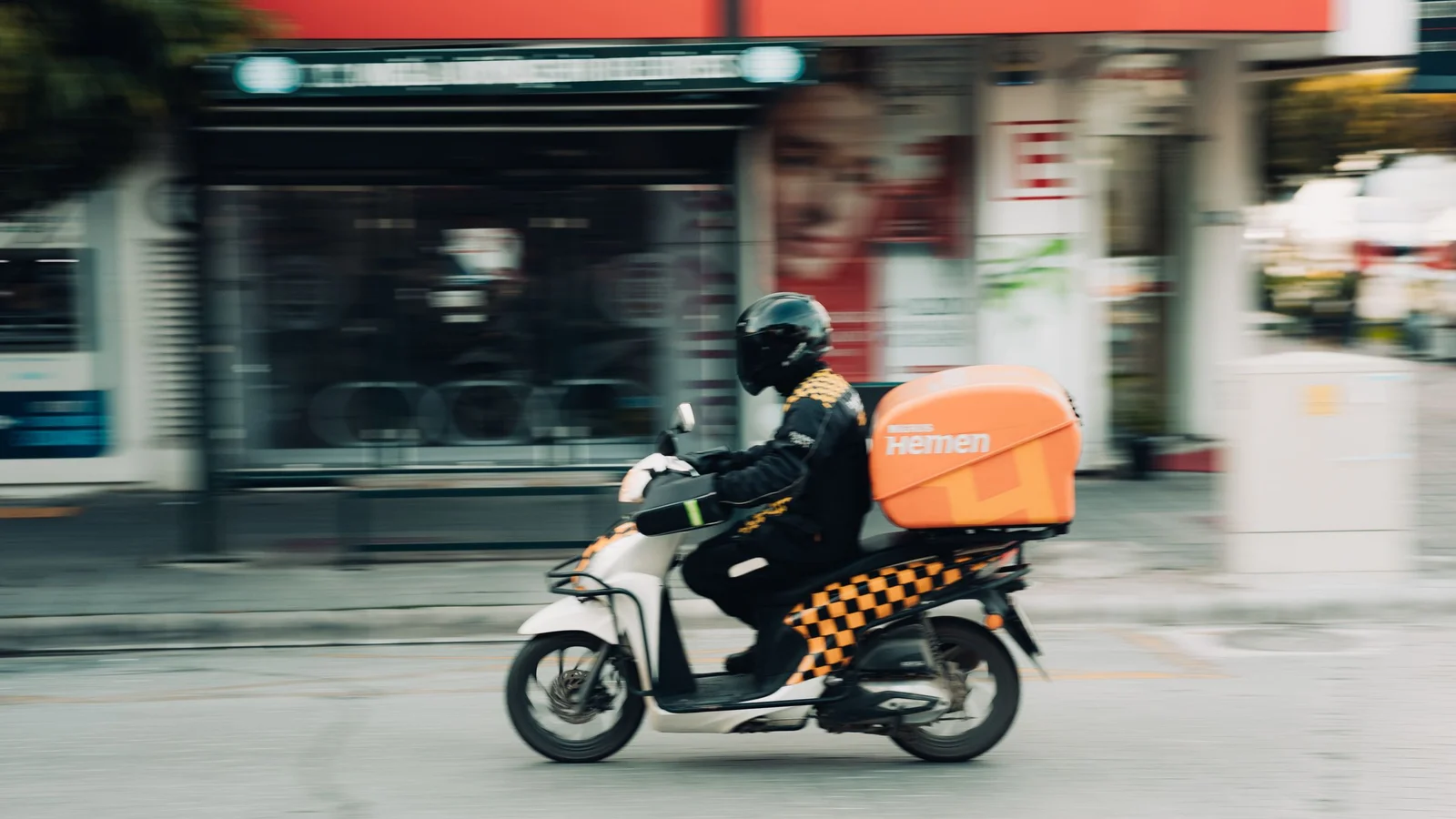
Here is the framing almost every guide gets wrong. If you plan to supply riders and bikes to Amazon, Noon, Talabat or Careem, you are not starting a delivery brand. You are starting a business-to-business fleet company whose customer is a platform. You will never own the consumer, set the price they pay, or control order flow. You sell capacity, measured in compliant riders on the road per hour.
That changes what decides whether you can operate. The DET trade licence is the easy part. The real gate is the Roads and Transport Authority, which controls rider certification, the occupational permit each rider carries, the age and specification of every bike, which lanes those bikes may use, and increasingly what the fleet is doing minute by minute [1][2][3]. Underneath sits the question founders get wrong most often: whether riders are employees or contractors. In this model they are normally employed and visa-sponsored by your fleet company, even though your company is an independent contractor to the platform [1][5].
This guide covers the licence, the RTA layer, the rider employment reality, the 2025 and 2026 rule changes, how each platform contracts with fleets, what it costs, and the unit economics nobody publishes. Since 2013, our team has set up transport, logistics and staffing-heavy companies across the UAE, so the traps here come from real files. This is a guide, not legal or tax advice on your specific licence. For the consumer-facing route instead, see our delivery business setup and food delivery platform licence guides.
What is the fleet-partner model, and how does it differ from a delivery brand?
A fleet partner owns bikes, employs riders, sponsors their visas, keeps them compliant with RTA, and rents that capacity to a platform under a commercial contract. A delivery brand sells delivery to consumers or restaurants and owns pricing, marketing and the app. Same bikes on the road, completely different business.
The distinction runs through every decision. A fleet partner spends almost nothing on marketing and everything on recruitment, visas, bike uptime and retention, and growth is capped by how fast you can legally put certified riders on the road, not by demand.
| Platform fleet partner | Consumer delivery brand | |
|---|---|---|
| Who is the customer | Amazon, Noon, Talabat, Careem | Consumers or merchants |
| Who owns pricing and order flow | The platform | You |
| Dominant cost | Rider salary, visas, bikes | Technology, marketing, merchant sales |
| Main constraint | Certified riders and RTA compliance | Demand and acquisition cost |
| Main risk | Concentration in one or two contracts | Running out of cash before density |
| Technology build | Minimal, you use the platform's app | Heavy, dispatch, tracking, payments |
Real Talk: This model is attractive because demand risk is largely someone else's problem, and dangerous for exactly the same reason. You inherit a customer whose volume, per-drop rate and contract length you do not control, and whose alternative is another fleet willing to run the same riders for less. Capitalise and manage it as a services business with a capacity constraint, not as a startup.
How big is the market you would actually be serving?
Large and still growing, but measure it by platform volume rather than headline e-commerce value. UAE e-commerce sits at roughly USD 12.28 to 12.30 billion across 2025 and 2026, forecast to about USD 21.0 to 21.2 billion by 2030 or 2031 at roughly 11.3 to 11.5% annual growth. A separate estimate puts it at AED 32.3 billion in 2024 rising to AED 50.6 billion by 2029.
Quick commerce consumes riders fastest, forecast to reach about USD 1.86 billion in the UAE by 2029 with Talabat, Noon and Careem named as leaders. Talabat reported 28% GMV growth in constant currency for 2025 and has signalled over USD 100 million of investment in 2026 across subscriptions and grocery, which converts directly into rider-hours somebody must supply.
On fleet size the public numbers disagree, so use the range. RTA data points to roughly 92,000 registered commercial motorbikes in Dubai and about 124,000 across the UAE, while independent press estimates put around 15,000 delivery riders active on a given day in Dubai. Those measure different things, registered vehicles versus riders working. If you are weighing this against selling goods yourself, our how to start an ecommerce business and Amazon FBA business guides cover the merchant side.
What licence do you need, and why is RTA the real gate?
A mainland DET commercial licence carrying a courier or delivery activity, plus RTA approval to operate delivery services. The licence gets you a company. RTA approval, rider certification and occupational permits are what let that company put a bike on a Dubai road. Founders who budget only for the licence discover this in week three.
Because the operating entity must be mainland, start there: our mainland company setup page covers the DET route this model requires, including the 100% foreign ownership position now available on most mainland activities. On the activity code, third-party guides widely cite 5320.03. We could not confirm that on a DET-owned page, so treat it as unverified and check the exact wording on the live Invest in Dubai activity search. The wording matters because the RTA approvals are keyed to it.
The RTA layer sits in its Technical Manual for Managing Delivery Services Through Electronic Platforms, published 11 July 2021 under Executive Council Resolution No. 47 of 2017 and Administrative Resolution No. 793 of 2020 [1]. It rests on four pillars: safety stipulations for delivery companies, mandatory rider training at accredited driving institutes, field awareness campaigns, and regulation of the platforms and applications managing delivery [1].
| Layer | Who issues it | What it authorises |
|---|---|---|
| Trade licence with delivery or courier activity | DET | The company exists and may contract |
| Delivery services approval | RTA | Delivery operations on Dubai roads [1] |
| Rider qualification certificate | RTA-accredited driving institute | An individual may ride commercially [2] |
| Occupational permit per rider | RTA | That rider, bike, box, area and tariff [1] |
| Vehicle registration and plates | RTA | The specific bike is lawful for delivery |
| Work permit and residence visa per rider | MOHRE and GDRFA | The rider may lawfully work and live here [1] |
Common Mistake: Treating this as a licence purchase with an approval attached. It is six stacked permissions, four of which attach to individual people and individual bikes rather than to the company. A licence with no certified riders and no occupational permits cannot deliver a single order, and no platform signs a fleet contract with an operator who cannot show the rider-level paperwork.
What is the rider qualification certificate, and who issues it?
A mandatory RTA-backed training certificate every delivery motorcyclist must hold in addition to a valid driving licence before your company allows them to ride. RTA runs the programme through accredited driving institutes, and companies that put uncertified riders on the road expose themselves to legal action [2].
RTA lists nine accredited institutes, including Al Ahli Driving Center, Belhasa Driving Center, Bin Yaber Driving Institute, Dubai Driving Center, Emirates Driving Institute, Emirates Transport Driving Institute, Excellence Driving and Galadari Motor Driving Centre [2]. The training covers safe riding and the specific hazards of commercial delivery work, which is the point: RTA treats delivery riders as a distinct road-safety category, not ordinary motorcyclists who happen to be working.
The practical consequence is that your hiring pipeline has a training queue inside it. A rider recruited today is not a rider you can deploy today. Between the certificate, the occupational permit, the work permit and the residence visa, the lead time from offer to first delivery runs into weeks, and every resignation puts you back at the start of that queue. This is the most under-modelled constraint in the business.

What is the occupational permit, and what does it cover?
An RTA permit issued per rider that ties the person to the operating detail of the job. It records the vehicle and motorcycle type, the delivery box size, the tariff and the delivery area, and is issued against medical and police clearance for that individual [1]. It is a working licence for the role, not a generic ID card.
Read those fields carefully, because they constrain deployment. Swapping a rider onto a different class of bike or a different box is a permit matter, not a neutral operational decision. We could not confirm the permit fee on an RTA-owned page, and we will not quote one; several third-party guides publish figures that trace to no primary source. Budget it as a real recurring per-rider cost and confirm the current fee with RTA.
Pro Tip: Build rider onboarding as a checklist with owners and dates: recruitment, entry permit, medical, Emirates ID, work permit, residence visa, qualification certificate, occupational permit, bike assignment, insurance endorsement, box and uniform. Fleets that run this informally lose people in the gaps and pay salaries to riders who are not yet legally deployable. Talk to a setup expert→ if you want the sequence mapped against your target headcount.
What are the vehicle rules, and what changes in 2026?
Tighter than most founders expect, and the age rule quietly rewrites your capital plan. A delivery motorcycle must be no more than four years old from the date of manufacture, with a possible fifth year only after passing a new optional inspection introduced on 14 February 2026. Engine capacity must sit between 100cc and 200cc, or 3,000 to 6,000W for electric bikes, and a speed limiter must be fitted.
The visible change is the plates. New gold "code-9" front plates for commercial delivery bikes began rolling out from the end of December 2025 at licence renewal, which makes a non-compliant bike identifiable to enforcement at a glance.
| Rule | Requirement | Note |
|---|---|---|
| Vehicle age | Maximum 4 years from manufacture | Fifth year only via the optional inspection introduced 14 February 2026 |
| Engine, petrol | 100cc to 200cc | Sets the class of bike you can buy |
| Motor, electric | 3,000W to 6,000W | Electric fleets are explicitly contemplated |
| Speed limiter | Mandatory | Fitted to the bike, not a rider setting |
| Front plate | Gold "code-9" commercial delivery plate | Rolling out from end December 2025 at renewal |
| Rider age | 21 to 55 | Narrows the recruitment pool at both ends |
| Delivery box | Size recorded on the occupational permit | Changing box class is a permit matter [1] |
Two honest caveats. No RTA source we could find imposes a cap or quota on delivery-bike permits, so ignore any guide asserting one. And on ownership, no RTA source bars a rider-owned vehicle, but serious operators own or lease bikes to riders because that is the only way to control age compliance, specification, maintenance and uptime. Treat "bikes must be company-owned" as unverified as an absolute rule, and company-owned or leased as the operating norm.
Quick Math: The four-year age rule makes your fleet a depreciating asset with a hard expiry, not a one-time purchase. A new bike is compliant for four years, or five via the 2026 inspection route. Across 20 bikes that means replacing roughly a quarter of the fleet every year on a rolling basis, forever. Model bikes as an annual replacement line, not a year-one capital line.
Where can delivery bikes ride, and how closely is RTA watching?
More narrowly than before, and increasingly in real time. From 1 November 2025, RTA and Dubai Police barred delivery motorcycles from the two leftmost lanes on roads with five or more lanes and from the leftmost lane on roads with three to four lanes, with a 100km/h cap on delivery bikes [3].
That is a routing and scheduling change, not a paperwork one. Keeping bikes out of the fast lanes lengthens journey times on arterial roads. If your commercial model assumed a drop rate built on unrestricted lane use, rebuild it, and make sure any rate you negotiate reflects the real achievable cycle time.
Monitoring is heading the same way. RTA is rolling out AI cameras, telematics and GPS geofencing across the delivery fleet, with pilots concluding in the first quarter of 2026 and full rollout targeted by end 2026. Enforcement is already substantial: RTA and Dubai Police ran over 11,000 rider inspections in 2024, issued more than 1,200 fines, and seized 44 non-compliant bikes and 33 unlicensed e-bikes [8]. When cameras and telematics watch lane use, speed and hours continuously, compliance stops being an annual renewal task and becomes an operations function with a named owner.
Must riders be employees, or can they be contractors?
This is the most consequential question in the model, and the answer is layered. In the standard Dubai fleet structure, the rider is employed and visa-sponsored by your fleet company, while your fleet company is an independent contractor to the platform. Two different relationships, and confusing them is where founders get into trouble.
Start with RTA. Its technical manual requires riders to be registered and holding work permits as part of the delivery licensing process, and a valid delivery licence allows the company to sponsor residence visas for owners, employees and delivery riders [1]. That is an employment architecture. It assumes a company standing behind each rider, holding the permit, the visa and the responsibility, which is exactly why platforms onboard riders through fleet companies rather than signing individuals off the street.
The platform contracts describe something different at their own layer. Careem's Captain Technology Terms characterise the platform-to-Captain relationship as independent contractors, cap Careem's liability at USD 1,000, and push accident and cargo-loss risk toward the Captain and the fleet [5]. Both things are true at once: the platform contracts at arm's length, and the fleet supplies RTA-approved visa sponsorship to the people doing the work.
The alternatives are narrower than the internet suggests. MOHRE operates a genuine freelance permit as one of thirteen work-permit categories, which suits individual self-employment rather than running a fleet. Separately, Dubai Future Foundation and Amazon announced a gig economy programme under Sandbox Dubai on 27 August 2025, piloting on-foot, task-based delivery under a lighter model [6]. That is a sandbox for on-foot work and does not give a motorbike fleet a route around employment and sponsorship.
| Structure | Who sponsors the rider | Where it fits |
|---|---|---|
| Fleet company employs riders | Your company, work permit plus residence visa [1] | The standard motorbike fleet model |
| Platform contracts the fleet | Nobody, it is a B2B services contract [5] | How your revenue contract is written |
| Platform contracts an individual Captain | Terms say independent contractor [5] | Still typically needs a fleet-provided visa |
| MOHRE freelance permit | The individual holds their own permit | Individual self-employment, not a fleet |
| Sandbox Dubai on-foot gig pilot | Pilot-specific | On-foot and task-based, not a bike fleet [6] |
Common Mistake: Assuming "gig economy" means engaging 30 riders as freelancers with no visa sponsorship and no employment obligations. In the motorbike fleet model that is not how Dubai works. RTA's framework expects registered riders with work permits behind a licensed company [1], and platforms deliberately push sponsorship, insurance and liability onto the fleet partner [5]. A financial model with no visa, no work permit and no wage protection line is not a model of this business.
What does the midday break do to summer capacity?
It removes your peak-heat hours and caps what you can ask riders to do inside the window, every year. The UAE midday break runs 15 June to 15 September, banning outdoor work between 12:30 and 15:00. In that window riders cannot be compelled to work, on-foot delivery is banned, and platforms must cap assigned orders at three per rider with total delivery time no more than 60 minutes [4].
| Element | Rule | Fleet consequence |
|---|---|---|
| Period | 15 June to 15 September | A quarter of the year has restricted capacity |
| Daily window | 12:30 to 15:00, outdoor work banned | Shift patterns must be built around it |
| Rider choice | Cannot be compelled to work [4] | Voluntary cover only, and genuinely voluntary |
| On-foot delivery | Banned in the window [4] | Relevant to on-foot task models |
| Order cap in window | 3 orders per rider, 60 minutes total [4] | Utilisation falls even where work continues |
| Penalty | AED 5,000 per worker, up to AED 50,000 [4] | Plus file suspension and classification downgrade |
Penalties run to AED 5,000 per worker, rising to as much as AED 50,000 for multi-worker breaches, with file suspension, classification downgrade and prosecution in injury cases [4]. For a company whose only asset is its ability to keep supplying compliant riders, a suspended file is existential, not a fine. Plan the summer into the contract rather than around it, and build the split shift and cooling provision into your cost base from day one.
How does each platform actually contract with fleets?
Differently, and less publicly than you would like. All four major platforms rely on third-party fleets to varying degrees, but none publishes fleet contract rates, minimum fleet sizes or commercial terms for the UAE.
Amazon runs a Delivery Service Partner programme. An Amazon.jobs listing for a Logistics Delivery Partner Manager in the UAE indicates Amazon works with roughly 25 to 30 DSP owners across the country, spanning first-time entrepreneurs and established carriers. Amazon's global DSP materials, which describe the US programme, cite USD 10,000 of capital, USD 30,000 of liquid assets and a five-vehicle minimum; whether any of that applies in the UAE is unverified, so treat them as US-programme figures only. Amazon also runs Amazon Flex for individual own-vehicle delivery, and the Sandbox Dubai on-foot pilot [6].
Talabat onboards riders through fleet partners rather than individuals. Published rider requirements include a smartphone, a motorbike registered in the emirate of operation and no more than five years old, a valid visa, licence and Mulkiya each with at least a month of validity, a minimum age of 21, and medical insurance. Riders work for third-party logistics companies, not for Talabat. Noon runs Noon Send, its own last-mile fleet serving marketplace, direct-to-consumer and enterprise shippers, plus a Food partner programme, and publishes no minimum fleet size or contracting terms. Careem contracts independent fleet companies that supply and manage Captains [5], and also runs an electric motorbike subscription fleet offered to Captains.
| Platform | How fleets engage | What is publicly known | What is not |
|---|---|---|---|
| Amazon | DSP programme, plus Flex for individuals | Roughly 25 to 30 DSP owners in the UAE | Whether US capital and vehicle minimums apply |
| Talabat | Onboards riders via fleet partners only | Bike under 5 years, rider 21+, visa, licence, Mulkiya, insurance | Fleet rates and volume commitments |
| Noon | Noon Send in-house fleet plus Food partners | Serves marketplace, D2C and enterprise shippers | Minimum fleet size, contracting terms |
| Careem | Contracts independent fleets supplying Captains | Independent contractor terms, USD 1,000 liability cap [5] | Per-drop or per-hour fleet rates |
Real Talk: On commercial terms, the honest position is that there is no current, platform-published per-drop or per-hour rate for fleet contracts in the UAE. The circulated figure of roughly AED 7.5 per order plus about AED 1 per five kilometres is a 2022 Talabat rider-facing number that has since increased and was never a fleet-contract rate. Rates are negotiated bilaterally and treated as confidential. Build from your own cost floor upward rather than anchoring on a number from a blog.
What does it cost to launch a delivery fleet in Dubai?
More than the licence, and dominated by people rather than paper. No credible source publishes an itemised total for a 10 to 20 rider fleet, so what follows is a build-up of line items with confidence marked on each. Treat every figure as a 2026 estimate to verify, not a quote.
| Line item | Indicative (AED) | Confidence |
|---|---|---|
| DET delivery or courier licence, per year | 6,500 to 20,000, by structure | Secondary estimate |
| RTA food delivery permit, per year | About 1,000 | Third-party, unverified on an RTA page |
| RTA occupational permit, per rider | No figure available | Not confirmed on an RTA-owned page |
| Rider qualification certificate, per rider | No published figure | Confirm with the accredited institute [2] |
| Employment visa, per rider, 2 years | 3,500 to 7,000 | Secondary estimate |
| Work permit, per rider | 250 to 3,450 | Varies by category |
| Entry permit, per rider | 500 to 1,150 | Secondary estimate |
| Health insurance, per rider, per year | 600 to 1,500 | Mandatory |
| Visa stamping, per rider | 500 to 700 | Secondary estimate |
| Motorcycle full motor cover, per bike, per year | From about 1,299 | Delivery use prices above private use |
| Motorcycle third-party liability, per bike, per year | From about 425 | Minimum cover only |
| Bike purchase, box, uniform, fuel, Salik, maintenance | Not publicly priced | Quote from suppliers directly |
Notice how many rows carry no reliable public figure. That is the honest state of the information, and it is why guides quoting a single all-in number should not be trusted. The one broad benchmark in circulation suggests six to twelve months of combined operating cost in the AED 300,000 to 800,000 range for a small operator, which is a third-party estimate rather than an RTA or DET figure and is useful only as an order of magnitude. Here is a transparent build for a 15-rider fleet in year one, clearly labelled our estimate.
| Category | Basis | Year-one estimate (AED) |
|---|---|---|
| DET licence and company setup | Mid-range mainland structure | 15,000 to 25,000 |
| RTA permits, company level | Delivery permit plus approvals | 1,000 plus unquoted RTA fees |
| Rider onboarding, 15 riders | Visa, work permit, entry permit, stamping | 70,000 to 180,000 |
| Rider health insurance, 15 riders | 600 to 1,500 each | 9,000 to 22,500 |
| Training and occupational permits | No published per-rider figure | Confirm before committing |
| Motorcycles, 15 units | Not publicly priced, buy or lease | Obtain supplier quotes |
| Motor insurance, 15 bikes | From about 1,299 each, full cover | From about 19,500 |
| Rider wages, 15 riders | Your largest single line | Model on your own offer letters |
| Depot, office, uniforms, boxes, tooling | Location dependent | Quote locally |
| Working capital buffer | Platform terms lag your payroll | 3 to 6 months of payroll |
Quick Math: The line that decides solvency is on no licence schedule. You pay riders monthly under the Wages Protection System from their first day, while the platform pays you on its own cycle after work is delivered and reconciled. That gap widens as you add riders, so growth consumes cash rather than generating it early on. A fleet scaling from 15 to 40 riders in a quarter has tripled its payroll obligation before one extra invoice clears.
How is a fleet company taxed, and does the free-zone 0% route work?
Standard mainland treatment, and the free-zone 0% pitch does not survive contact with this model. On corporate tax you pay 0% on taxable income up to AED 375,000 and 9% above. Small Business Relief covers revenue at or below AED 3 million, but only for tax periods ending on or before 31 December 2029, and it is not available to Qualifying Free Zone Persons or multinational group members.
Now the free-zone question, worked through rather than dismissed, because the honest answer is more interesting than a flat no. Ministerial Decision No. 229 of 2025 does list logistics services as a Qualifying Activity, and Article 2(3)(m) defines it generously: storing and transporting goods on behalf of another person without taking title, including cargo handling, freight forwarding, order and inventory management and customs brokerage [7]. A fleet moving parcels it never owns, for a platform that does own them, reads like a fit on paper.
Be careful with one clause that gets misquoted a lot. Article 2(3) does contain a 51% revenue concentration test, but it sits inside the definition of Trading of Qualifying Commodities, not logistics: a commodities trader cannot claim that category if distribution, warehousing, logistics or inventory-management functions make up 51% or more of its revenue [7]. It is a guardrail against a warehousing business badging itself a commodity trader. It does not restrict the logistics services activity, and any guide telling you logistics is capped at 51% has misread the decision.
What actually decides it is structural. Operating delivery on Dubai public roads requires a mainland DET licence plus RTA approval, and a free-zone entity cannot itself run road delivery [1]. So, plainly: the free-zone 0% logistics route is not realistic for a last-mile delivery fleet, because the activity forces mainland licensing, which sits outside the free-zone corporate tax regime entirely. Our free zone company setup page explains what a free-zone licence does and does not authorise, which is worth reading precisely so you can rule it out with confidence.
One narrow exception is worth knowing. If your group also runs genuine warehousing, fulfilment or freight that never touches Dubai road delivery, that arm may have a legitimate free-zone conversation, which is a different question from the fleet. Our logistics company setup and freight forwarding vs customs broker guides cover where the qualifying-activity analysis genuinely applies, and the free zone company setup page compares the zones for that side of a group. The road fleet stays on the mainland, which our mainland company setup page covers.
Pro Tip: If someone sells you a free-zone licence for a Dubai delivery fleet on the promise of 0% corporate tax, ask one question: which entity holds the RTA delivery approval and sponsors the riders? There is no good answer, because the answer is a mainland company. Structure for the regulator first and the tax rate second. Talk to a setup expert→ if you want that checked before you commit.
How does VAT work on a platform fleet contract?
Simply, and at the standard rate. You supply delivery services to a UAE-registered business customer, so your invoices to the platform are business-to-business and standard-rated at 5%. Registration is mandatory once taxable supplies pass AED 375,000, which a fleet of any real size clears quickly.
The zero rate founders sometimes reach for does not apply. International transport of goods is zero-rated, but a last-mile fleet moving parcels and food between points inside the UAE is doing purely domestic transport, which carries 5%. Get the invoice coding right from the first month, because reconstructing a year of platform settlement reports against your own delivery counts is genuinely painful work.
What ongoing compliance does a fleet company carry?
A heavier annual cycle than most small businesses, because obligations attach to people and vehicles as well as the entity. The company renews its licence, tenancy, RTA approvals and establishment card. Every rider carries a work permit, residence visa, medical insurance, qualification certificate and occupational permit, each with its own expiry. Every bike carries registration, insurance and an age limit.
Payroll must run through the Wages Protection System, which is not optional and is among the first things a labour inspection checks. On liability, know where risk actually sits. Platforms typically provide bundled rider accident insurance, with Deliveroo's UAE cover cited at AED 175,000 for accidental death or permanent disablement, AED 200 a day for temporary disablement to a maximum of 30 days, and AED 30,000 of medical cover. Careem's terms, by contrast, push cargo loss and damage onto the Captain and fleet, with Careem's own liability capped at USD 1,000 [5]. Read the insurance schedule of every platform contract, because the gaps become your gaps.
This rolling, date-driven work is what sinks owner-operators trying to run dispatch at the same time, and it is what our post-setup services team handles day to day. Build the compliance calendar at 10 riders rather than retrofitting expiry tracking across a live fleet at 30. Renewals, visa cycles, corporate tax filings and VAT returns are all predictable, which is exactly why our post-setup services team can run them on a fixed cycle while you concentrate on utilisation.
What are the honest unit economics, and why does churn decide the business?
The mechanism is simple and the inputs are private. Revenue is drops per rider per day multiplied by the rate per drop. Cost is rider wage, bike, insurance, fuel, permits and overhead per rider per day. The margin between them is thin by design, because the platform sets the rate and other fleets are bidding. Utilisation and retention are the only two levers you genuinely control.
We will be straight about what cannot be sourced. There is no credibly published current per-drop platform rate or drops-per-hour benchmark for the UAE fleet-partner model. The 2022 Talabat figure in circulation is dated, rider-facing and not a fleet contract rate. Model the mechanism with your own negotiated rate and your own measured drop rate, and distrust any spreadsheet built on a public number.
| Lever | What moves it | Why it matters |
|---|---|---|
| Drops per rider per hour | Zone density, routing, lane rules [3], shift timing | Multiplies revenue on a fixed cost base |
| Rate per drop | Negotiation, contract length, service level | Set by the platform, not by you |
| Rider wage and benefits | Market rate, retention strategy | Your largest single cost line |
| Bike cost per day | Buy or lease, four-year age rule, maintenance | A rolling replacement obligation |
| Idle and non-deployable time | Onboarding queue, permit lapses, sickness | Salary paid against zero drops |
| Rider churn | Pay, treatment, conditions, competing fleets | Rebuilds the onboarding queue continuously |
Churn is the dominant operational problem, and it is not a soft issue. Every departure takes a work permit, visa, qualification certificate, occupational permit and weeks of lead time with it, and the replacement restarts the queue. General UAE SME data puts turnover cost at 50 to 200% of annual salary once visa fees and lost productivity are counted, and the existence of a whole outsourcing industry built around rider recruitment, visa turnover and retention for platform fleets tells you how real it is.
Based on our experience, the operators who make money are unglamorous about it. They pick two or three dense zones and refuse work outside them, treat retention as the primary KPI rather than headcount, and measure non-deployable days as carefully as drops. Operators chasing headcount to win a bigger platform allocation usually find they have scaled their churn faster than their revenue.
How do you manage concentration risk?
By refusing to be a single-platform fleet longer than you have to. If one platform is 100% of revenue, it sets your rate, your volume, your service levels and your termination date, and nothing in your contract changes that. Diversification here is a risk control, not a growth strategy.
Real operators already do this: one Dubai fleet firm serves Noon, Talabat, Keeta and Noon Minutes simultaneously, which smooths volume across different demand peaks and removes any single client's ability to dictate terms. Grocery, food and parcel peaks fall at different hours, so a mixed book also improves rider utilisation across the day. The uncomfortable part is that you usually have to win the second contract while you are still small enough that nobody wants to give it to you. Fleets that wait until they are large and profitable on one contract find that contract is exactly what makes them un-diversifiable, because riders, bikes and shifts are all configured around one client.
Can you open a corporate bank account for a delivery fleet company?
Yes. This is an activity UAE banks understand, but expect standard onboarding rather than anything instant or remote: full know-your-customer checks on shareholders, activity and expected turnover, with the licence, tenancy and RTA approvals in hand and usually an in-person meeting.
Two things speed it up: a signed or advanced platform contract, because a named institutional customer answers the bank's main question about where money comes from, and a clear explanation of your payroll pattern, since a fleet pays many small salaries monthly through the Wages Protection System. Open the account early. Your first payroll falls due before your first platform settlement lands, and a fleet that cannot pay riders on time loses them immediately.
Real Client Stories
The licence that could not put a bike on the road. A founder arrived with a mainland delivery licence issued, a signed intent from a platform and eight riders recruited, and could not deploy any of them. None held a rider qualification certificate and no occupational permits had been applied for. He had budgeted for the licence and the bikes and nothing for the rider-level approvals or the weeks they take. The licence was never the constraint.
The fleet that lost its only contract. An operator built to 40 riders on a single platform agreement, reinvested every dirham into more bikes, and had the rate revised at renewal. With no second client and no cash buffer there was no negotiating position, and the fleet shrank within a quarter. The operators who survive this win a second platform while they are still small.
The free-zone structure that had to be unwound. A client incorporated in a free zone on the promise of 0% corporate tax on logistics activity, then found the entity could not hold the RTA delivery approval or sponsor riders for road operations, and that the revenue concentration rule would have excluded it anyway [7]. We set up the mainland operating company and kept the free-zone entity for a genuinely separate warehousing arm.
Set up your Dubai delivery fleet the right way
This model rewards operators who understand they are selling compliant capacity, not delivery. Get the mainland licence and activity wording right, plan RTA certification and occupational permits as a hiring pipeline rather than a formality, buy bikes that will still be compliant in three years, build the summer break into your shift patterns, employ and sponsor riders properly, and win a second platform before you need one.
Since 2013, BusinessDubai.ae has completed 700+ company registrations across the UAE, including transport, logistics and staffing-heavy operations. We will confirm the right DET activity wording, structure the mainland company, map the RTA approvals and rider onboarding sequence against your target headcount, set up visas, payroll and Wages Protection System properly, and get the corporate tax and VAT positions correct, all with clear itemised pricing. Talk to a setup expert→ for a plan built around the fleet size and platforms you are targeting.
Planning a delivery fleet for Amazon, Noon, Talabat or Careem? Our licensed advisors scope the mainland licence, the RTA approvals, rider visas and the tax position end to end, with transparent fixed fees.
Get started free→Frequently Asked Questions
What is a delivery partner or fleet operator in Dubai?
A company that owns or leases delivery bikes, employs and sponsors riders, keeps them compliant with RTA, and supplies that capacity to a platform such as Amazon, Noon, Talabat or Careem under a commercial contract. Its customer is the platform, not the consumer.
How is a fleet partner different from starting a delivery brand?
A delivery brand sells to consumers or merchants and controls pricing, marketing and the app. A fleet partner sells rider capacity to a platform and controls neither pricing nor order flow, so it is labour and vehicle heavy with almost no marketing spend.
What licence do I need to run a delivery fleet in Dubai?
A mainland DET commercial licence carrying a courier or delivery activity, plus RTA approval to operate delivery services on Dubai roads [1]. Third-party guides cite activity code 5320.03, but that could not be confirmed on a DET-owned page, so treat it as unverified.
Why is RTA the real gate rather than the trade licence?
Because RTA controls everything that lets a bike work: delivery services approval, rider certification, the occupational permit per rider, vehicle age and specification, lane restrictions and monitoring [1][2][3]. A licence without those approvals cannot deliver a single order.
What is the RTA rider qualification certificate?
A mandatory training certificate every delivery motorcyclist must hold in addition to a driving licence before your company allows them to ride. RTA delivers it through nine accredited driving institutes, and companies putting uncertified riders on the road risk legal action [2].
Which institutes issue the delivery rider certificate?
RTA lists nine accredited institutes, including Al Ahli Driving Center, Belhasa Driving Center, Bin Yaber Driving Institute, Dubai Driving Center, Emirates Driving Institute, Emirates Transport Driving Institute, Excellence Driving and Galadari Motor Driving Centre [2]. Confirm the current list with RTA before booking training.
What is the RTA occupational permit for delivery riders?
A per-rider permit covering vehicle and motorcycle type, delivery box size, tariff and delivery area, issued against medical and police clearance [1]. It ties a specific person to specific operating conditions, so changing bike class or box size is a permit matter.
How much does the RTA occupational permit cost?
We could not confirm a fee on an RTA-owned page and will not quote one. Several third-party guides publish figures that do not trace to a primary source. Treat it as a real recurring per-rider cost and confirm the current fee directly with RTA.
How old can a delivery motorcycle be in Dubai?
No more than four years from the date of manufacture, with a fifth year possible only after passing the optional inspection introduced on 14 February 2026. That makes fleet replacement a rolling annual obligation rather than a single capital purchase.
What engine size is allowed for a delivery bike?
Between 100cc and 200cc for petrol motorcycles, or 3,000 to 6,000W for electric bikes, with a speed limiter fitted. The specification narrows which machines you can buy, so check compliance before committing to a supplier or a lease.
What are the gold code-9 delivery plates?
New gold front plates for commercial delivery motorcycles, rolling out from the end of December 2025 as bikes come up for licence renewal. They make a delivery bike identifiable to enforcement immediately, which raises the practical cost of running an out-of-spec fleet.
Is there a cap on the number of delivery bike permits in Dubai?
No confirmed cap or quota appears in any RTA source we could find, so be sceptical of guides that assert one. The binding constraints are rider certification, occupational permits, vehicle specification and your own capital, not a permit ceiling.
Do the bikes have to be owned by the company?
No RTA source we found bars a rider-owned vehicle, so treat the absolute rule as unverified. In practice, real fleet operators own or lease bikes to riders because that is the only way to control age compliance, specification, maintenance and uptime.
What age can delivery riders be in Dubai?
Between 21 and 55. That narrows the recruitment pool at both ends and interacts with visa processing, licence conversion timelines and the experience level actually available in the market at the wage you plan to offer.
Which lanes can delivery motorbikes use in Dubai?
Since 1 November 2025, delivery motorcycles are barred from the two leftmost lanes on roads with five or more lanes and from the leftmost lane on roads with three to four lanes, with a 100km/h cap [3]. That lengthens cycle times on arterial routes.
Is RTA monitoring delivery fleets with cameras and GPS?
Yes. RTA is rolling out AI cameras, telematics and GPS geofencing across the delivery fleet, with pilots concluding in the first quarter of 2026 and full rollout targeted by the end of 2026. Enforcement is already active and substantial [8].
How much enforcement activity is there against delivery riders?
RTA and Dubai Police conducted over 11,000 rider inspections in 2024, issued more than 1,200 fines, and seized 44 non-compliant bikes and 33 unlicensed e-bikes [8]. Compliance is checked on the road, not only at renewal time.
Must delivery riders be employees, or can they be freelancers?
In the standard Dubai fleet model they are employed and visa-sponsored by the fleet company. RTA's framework requires riders to be registered and hold work permits, and a valid delivery licence lets the company sponsor residence visas for owners, employees and riders [1].
If riders are employed, why do platforms call them independent contractors?
Because two relationships operate at once. Careem's Captain Technology Terms describe the platform-to-Captain relationship as independent contractors [5], while the fleet company remains the entity that sponsors visas and employs riders. Your company is the contractor; your riders are your employees.
Can I use the MOHRE freelance permit for my delivery riders?
It is a genuine permit, one of thirteen work-permit categories, but it suits individual self-employment rather than running a fleet. It does not give a motorbike fleet operator a route around employing and sponsoring the riders it deploys under its RTA approvals [1].
What is the Sandbox Dubai gig delivery pilot?
Dubai Future Foundation and Amazon announced a gig economy programme under Sandbox Dubai on 27 August 2025, piloting on-foot, task-based delivery under a lighter regulatory model [6]. It is a sandbox pilot for on-foot work, not an alternative structure for a motorbike fleet.
What is the midday break rule for delivery riders?
From 15 June to 15 September, outdoor work is banned between 12:30 and 15:00. Riders cannot be compelled to work in that window, on-foot delivery is banned, and platforms must cap assigned orders at three per rider with total delivery time no more than 60 minutes [4].
What are the penalties for breaching the midday break?
AED 5,000 per worker, rising to as much as AED 50,000 for multi-worker breaches, plus file suspension, company classification downgrade and prosecution where injury results [4]. For a fleet company, a suspended file is far more damaging than the fine.
How do Amazon, Talabat, Noon and Careem contract with fleets?
Amazon runs a Delivery Service Partner programme, working with roughly 25 to 30 DSP owners in the UAE. Talabat onboards riders only through fleet partners. Noon runs Noon Send in house plus a Food partner programme. Careem contracts independent fleet companies supplying Captains [5].
Do Amazon's DSP minimums apply in the UAE?
Unverified. The widely quoted USD 10,000 capital, USD 30,000 liquid assets and five-vehicle minimum come from Amazon's US programme materials. Whether equivalent thresholds apply to UAE DSPs is not published, so treat those as US-programme figures only.
What rate do platforms pay fleet companies per delivery?
There is no current platform-published per-drop or per-hour rate for fleet contracts in the UAE; rates are negotiated bilaterally and treated as confidential. The circulated figure of roughly AED 7.5 per order plus about AED 1 per five kilometres is a dated 2022 Talabat rider-facing number.
What does it cost to start a delivery fleet in Dubai?
The DET licence runs about AED 6,500 to 20,000 a year by structure, with rider visas at AED 3,500 to 7,000 each for two years plus work permits, entry permits, insurance and stamping, and motor cover from about AED 1,299 per bike. Bikes, boxes, fuel and maintenance are not publicly priced.
Can I run a delivery fleet from a free zone and pay 0% corporate tax?
Realistically no, though not for the reason usually given. Logistics services genuinely is a Qualifying Activity under Ministerial Decision No. 229 of 2025, and the 51% revenue concentration test that gets quoted here actually sits inside Trading of Qualifying Commodities, not logistics [7]. What rules it out is licensing: road delivery requires a mainland DET licence plus RTA approval, which a free-zone entity cannot hold [1].
Is VAT charged on delivery services supplied to a platform?
Yes, at the standard 5% rate. You supply services to a UAE business customer, so it is standard-rated business-to-business income, with registration mandatory once taxable supplies pass AED 375,000. The zero rate for international transport does not apply to domestic last-mile work.
Why is rider churn the biggest risk in a delivery fleet business?
Because every departure takes a work permit, visa, qualification certificate, occupational permit and weeks of onboarding lead time with it. General UAE SME turnover costs run 50 to 200% of annual salary including visa fees, and an outsourcing industry exists purely to manage fleet recruitment and retention.
References
[1] Roads and Transport Authority, Dubai. Technical Manual for Managing Delivery Services Through Electronic Platforms, published 11 July 2021 under Executive Council Resolution No. 47 of 2017 and Administrative Resolution No. 793 of 2020. Sets out the four pillars of safety stipulations for delivery companies, mandatory rider training at accredited institutes, field awareness campaigns and regulation of delivery platforms and applications, together with rider registration, work permits and the occupational permit covering vehicle and motorcycle type, delivery box size, tariff and delivery area with medical and police clearance. RTA delivery services technical manual
[2] Roads and Transport Authority, Dubai. Programme for certifying delivery motorbike riders: every delivery motorcyclist must hold a driving licence and a qualification certificate from one of nine RTA-accredited driving institutes before a company may allow them to ride, with non-compliant companies exposed to legal action. RTA rider certification programme
[3] Gulf Business. Delivery riders barred from fast lanes in Dubai from 1 November 2025: RTA and Dubai Police restrict delivery motorcycles from the two leftmost lanes on roads of five or more lanes and the leftmost lane on three to four lane roads, with a 100km/h speed cap. Gulf Business lane restrictions
[4] Khaleej Times. UAE midday break rules for delivery riders: outdoor work banned 12:30 to 15:00 from 15 June to 15 September, riders cannot be compelled to work in the window, on-foot delivery banned, platforms required to cap assigned orders at three per rider with total delivery time no more than 60 minutes, and penalties of AED 5,000 per worker up to AED 50,000 for multi-worker breaches with file suspension and classification downgrade. Khaleej Times midday break rules
[5] Careem. Captain Technology Terms: describes the platform-to-Captain relationship as independent contractors, caps Careem's liability at USD 1,000, and allocates accident and cargo loss and damage risk toward the Captain and the fleet side. Careem Captain technology terms
[6] Zawya. Dubai Future Foundation and Amazon launch a gig economy programme under Sandbox Dubai, announced 27 August 2025, piloting on-foot, task-based delivery as a distinct and lighter regulatory model. Sandbox Dubai gig economy programme
[7] UAE Ministry of Finance. Ministerial Decision No. 229 of 2025 on Qualifying Activities and Excluded Activities: Article 2(1)(m) lists logistics services as a Qualifying Activity, defined at Article 2(3)(m) as storing and transporting goods on behalf of another person without taking title. The 51% revenue concentration test appears at Article 2(3)(c), within the definition of Trading of Qualifying Commodities, and does not apply to logistics services. MOF Ministerial Decision No. 229 of 2025
[8] The National. More than 1,200 delivery riders in Dubai fined for violating safety rules: RTA and Dubai Police conducted over 11,000 rider inspections in 2024, issuing more than 1,200 fines and seizing 44 non-compliant bikes and 33 unlicensed e-bikes. The National enforcement report