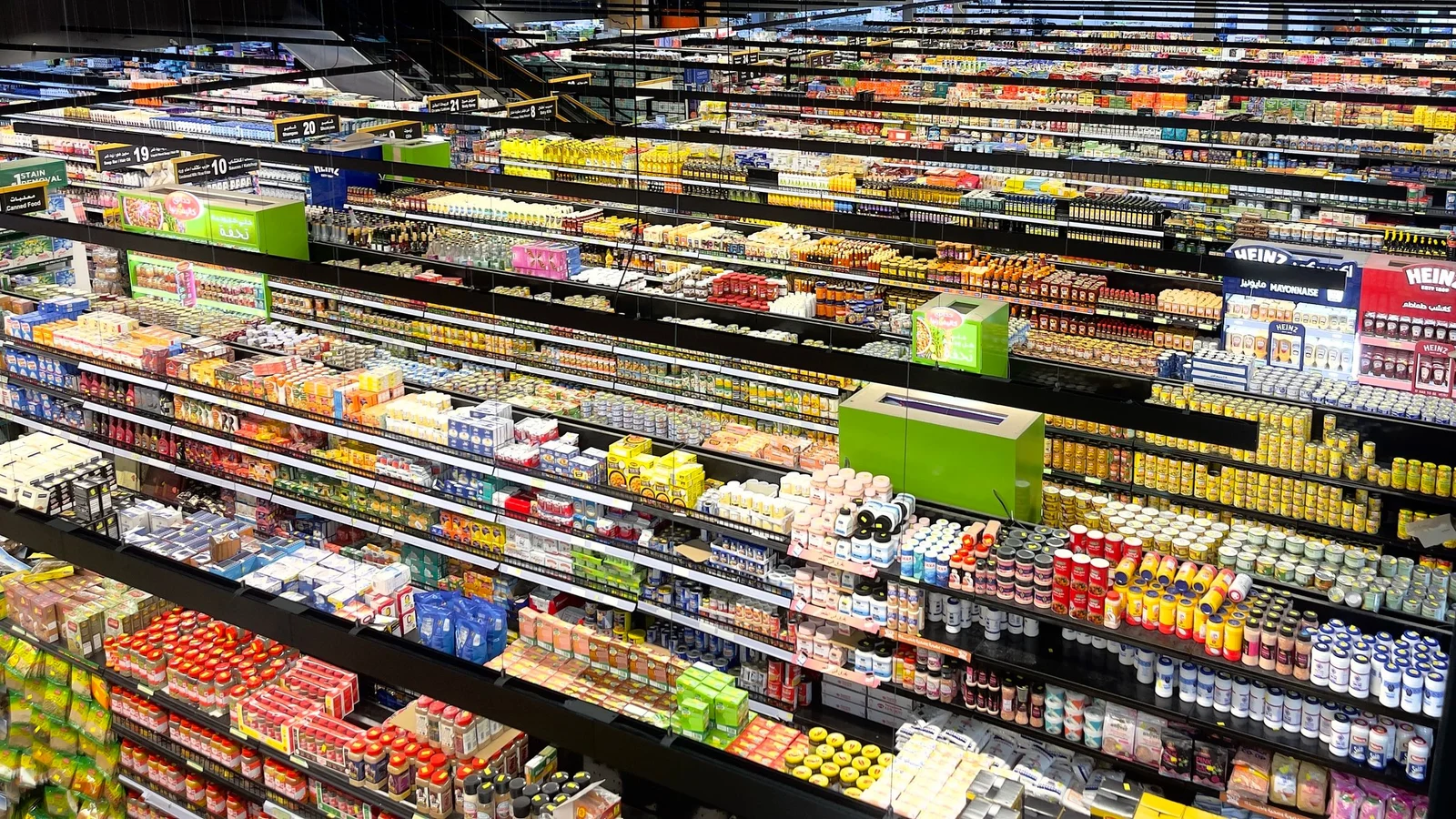
Search for what a Dubai grocery earns and you will be told 10% to 30% profit. Look at what grocery retail actually makes anywhere in the world and the net margin benchmark is roughly 1% to 3% [10]. Those two numbers cannot both be right. The consultancy figures are describing gross margin, or nothing at all, and the gap between them is the reason independent groceries here open loudly and close quietly.
This guide is built on Dubai Municipality's own Food Code rather than on other people's blog posts, which means we can tell you things nobody else prints: the exact floor area you need before you are even allowed to apply to sell pork, the temperatures your chillers must hold, why your layout has to be approved before you fit out, and the excise rule that can tax you for over-ordering ahead of a price rise. Then the honest economics. Since 2013, our team has set up food retail and trading businesses in Dubai, so the traps here come from real files.
One sourcing note up front. Much of the regulatory detail below comes from Dubai Municipality's Food Code 2.0, dated 12 July 2023 [1]. Dubai Municipality's website blocks automated access, so we retrieved the document through a mirror used by a DM-approved training provider. It carries a draft watermark. We are confident it reflects operative practice, and we are telling you its status rather than presenting it as settled gazetted text. Verify anything critical with DM directly.
What licence do you need, and can it be a free zone?
Mainland, and the format you pick changes the requirements.
A shop selling to walk-in customers needs a DET mainland licence. A free zone company cannot run a retail storefront serving the public on the mainland without a mainland branch or a licensed mainland distributor. There is no clever structure around this, and unlike a catering company or a service business, a grocery is inherently a physical mainland retail operation.
Dubai separates retail food formats by activity, and the reported codes are:
| Format | Reported code | Notes |
|---|---|---|
| Supermarket | 4711002 | Packaged and fresh food including meat, fish and poultry |
| Grocery store | 4711003 | Smaller "consumer stores" format |
| Hypermarket | Not confirmed | Larger combined format |
Common Mistake: Picking the wrong classification at the DET stage. The activity you choose determines the minimum food area Dubai Municipality expects, so a mismatch between your activity code and your actual unit gets caught at DM clearance, after you have signed a lease. One widely repeated figure puts the supermarket minimum at 2,000 square feet. We could not verify that number, or the activity codes above, against a DM or DET primary document, because the relevant files are not accessible to automated retrieval. Treat them as reported and confirm with your PRO before committing to a unit.
A baqala, the neighbourhood corner grocery, is not a separate legal category. It is the grocery activity in a small unit. Compare structures on our mainland company setup page and see business licence types for the wider picture.
Why must your layout be approved before you fit out?
Because the Food Code says so explicitly for your business type, and because getting it wrong is the most expensive mistake available to you.
Every food establishment needs both a DET trade licence and a Dubai Municipality Food Safety permit before it opens [1]. Section 2.2 of the Food Code requires floor plans to be submitted and approved before construction, fit-out or renovation, showing food handling, storage, cleaning and sanitary areas, ventilation, equipment positions and all entries and exits. Section 2.2(f) names supermarkets and department stores among the business types that must obtain layout pre-approval [1].
So this is not a general contractor's best practice. It is written into the code for your format specifically.
The Code also sets siting expectations: a distance of around 30 metres from contamination sources such as waste facilities is recommended rather than absolute, and streets and lanes within 10 metres must be kept clean [1].
Pro Tip: Make your lease conditional on layout approval. Reported timelines put DM plan review at one to two weeks and inspection plus documentation review at another one to two, so roughly four to six weeks end to end if everything is right first time. That is a short wait against the cost of rebuilding drainage or ventilation in a unit you are already paying rent on.
What are the cold chain rules?
Specific, numeric, and enforced by inspection. These come straight from the Food Code [1].
| Requirement | Rule |
|---|---|
| Chilled and high-risk perishable food | At or below 5°C |
| Hot held food | At or above 60°C |
| Frozen food | At or below -18°C |
| Dry storage | Below 25°C, humidity 60-65% |
| Danger zone | 5°C to 60°C |
Beyond the headline temperatures, the operational rules that catch retailers:
- Time out of temperature. High-risk hot food may sit outside its range for a maximum of 2 hours; high-risk cold food for a maximum of 4 hours including preparation, after which it must be discarded.
- Cooling after cooking. From 60°C to 20°C within 2 hours, then 20°C to 5°C within a further 4 hours.
- Thawing. Under refrigeration in air at or below 10°C, or under cold running water below 21°C with the core at or below 5°C. Thawed ready-to-eat food stays at or below 5°C and must be used within 48 hours.
- Moving chilled stock. Surface temperature must not exceed 10°C and the transfer must take no more than 15 minutes.
- Loading display chillers. Staff must respect the manufacturer's capacity and airflow limits, which is exactly what gets ignored on a busy restock.
- Separation. Raw and ready-to-eat food must be physically separated in storage and display. Where they share a unit, ready-to-eat goes above raw so nothing drips down onto it. Colour-coded boards and utensils are required.
- Chiller and freezer thermometers must be calibrated at least annually.
Common Mistake: Over-filling a display chiller above its load line during a delivery. It blocks airflow, the unit cannot hold 5°C through the cabinet, and an inspector measuring product temperature rather than the display's own readout will find it. The cheapest fix in this business is training staff on how to stock a fridge.
Can you sell pork in a Dubai supermarket?
Yes, under a specific annual permit, and there is a hard floor area requirement that we have not seen published anywhere else.
The Food Code devotes section 8.9 to handling non-halal foods, and the requirements are demanding [1]:
- An annual Dubai Municipality "Non-Halal Food" permit is required.
- The supermarket or department store must have a total floor area of at least 5,000 square feet to qualify for the permit at all.
- Pork must be sold from a physically enclosed area with a door, labelled "Non-Halal Foods Only" in Arabic and English.
- A butchery trading pork must be separate, with its own equipment.
- Non-halal chilled, frozen and dry storage, transport and display equipment must be separately labelled and never shared with halal stock, with separate colour-coded boards, knives and utensils.
- A designated staff member and a separate cash counter are required for non-halal sales.
- Bulk non-halal warehousing carries its own rules, including an exclusively leased warehouse of at least 5,000 square feet with at least 10% allocated to non-halal stock, privately owned with an NOC.
Real Talk: That 5,000 square foot threshold quietly decides your business model. If you are opening a neighbourhood grocery of a few hundred square feet, the pork section is not a decision you get to make, it is closed to you by size. It also explains why pork aisles appear in large stores in expat-heavy areas and nowhere else. Do not promise a customer base something your floor area cannot legally support.
Can you sell alcohol?
Effectively not under your grocery licence.
Retail alcohol in Dubai runs through two licensed operators, MMI and African + Eastern, which typically trade as separately walled-off concessions in or beside a mainstream supermarket. Chains like Carrefour, Lulu and Spinneys do not sell alcohol under their own grocery licence. This is a distinct specialised retail liquor track, not an activity you can add to a supermarket permit.
Since a change in 2023, customers buying alcohol need only present identification, an Emirates ID for residents or a passport for tourists, and the personal liquor licence is free. That changed the customer experience, not the retailer licensing route.
What about tobacco?
Also separate, and for a precise reason: the Food Code's own definition of food excludes tobacco [1]. Section 1.6 states the definition does not include alcohol, cosmetics, tobacco or substances used only as drugs.
So tobacco retail sits entirely outside your food establishment permit. It requires its own Dubai Municipality permit under the technical guidelines for tobacco and smoking supplies establishments, plus the corresponding DET activity and third-party approval before licence issuance. Minimum purchase age is 21 and there are heavy restrictions on display and advertising.
Do you have to register every product you sell?
No, and this is a genuine relief that competitor guides tend to blur.
Food product registration through FIRS, Dubai Municipality's food import and re-export system, is the obligation of the importer of record, not of every retailer down the chain [1]. If you buy from an already licensed UAE wholesaler or distributor whose products are registered, you do not separately register each SKU.
What you must do instead is source correctly. Food Code section 3.2.2.1 requires establishments to obtain food from sources approved by the Food Safety Department and to ensure all their suppliers are registered on the municipality's platform [1]. Your compliance duty is supplier diligence, not product registration.
Note also that Montaji is the registration route for cosmetics and health supplements, not food. If your store carries a health and beauty aisle, that stock sits on a different registration track. Our food trading company guide covers the importer side if you plan to import directly rather than buy locally.
What food safety obligations does the store carry?
Registration, a certified person in charge, and health cards for handlers.
The platform. Dubai Municipality has replaced FoodWatch Connect with a mobile-first platform branded DMChecked, with existing businesses migrated across. The legacy portal still resolves, so check which system is live when you register rather than trusting any article's name for it.
Person in charge. The Food Code requires at least one full-time, on-site certified PIC, with an active PIC during every shift where high-risk food is prepared [1]. Certification comes in two tiers, standard and advanced, and requires DM-approved training, a valid Emirates ID and prior basic food safety training. If your PIC leaves you have 30 days to name a replacement, who must be certified within 45 days. Refresher training is required every two years.
Health cards. Every food handler needs a valid occupational health card, reported at AED 300 to 600 a year and renewed annually. That figure is consultancy-sourced rather than taken from a DHA schedule.
On inspection grades, the sources disagree. Secondary guidance describes an A, B, C and F letter grading system with a Gold Card for sustained A grades. The Food Code itself refers in passing to a D grade in a clause about certification validity [1], which does not fit that model. We are flagging the inconsistency rather than picking one, because we could not confirm the full scale.
Does a bakery or hot food counter change anything?
Yes, materially. Adding cooking to a shop that otherwise sells packaged and fresh goods moves you into a higher-risk category.
There is a distinct activity for sandwich and hot food counter operations, reported as 5629.97, and its description specifically excludes the manufacture and retail of packaged sandwiches through supermarkets. In practice a genuine in-store hot food, deli or bakery counter triggers the fuller preparation regime in the Food Code: cooking temperatures, hot holding, ready-to-eat controls and the PIC coverage that goes with them, none of which a purely packaged and chilled grocery needs to the same degree.
Also worth knowing for pricing: hot and prepared takeaway food is standard-rated for VAT just like everything else in the store, so a deli counter creates no VAT complication, only a food safety one.
Do you need a separate licence to sell through delivery apps?
No. Your existing permit already covers it, which is one of the clearer answers in this guide.
The Food Code's scope explicitly extends to digital platforms that promote or sell food, and to the storage, logistics and delivery facilities supporting online sale, and separately lists food delivery and transportation providers as regulated [1]. Selling groceries through Talabat, InstaShop, Careem or Noon Minutes is covered by the food establishment permit you already hold.
What you do need is a vehicle permit. Any vehicle delivering food in Dubai, including bikes, requires an annual food transportation permit from a DM-authorised, accredited testing centre, with working temperature monitoring calibrated annually and food kept separate from non-food [1]. If your primary channel becomes online rather than walk-in, DET reportedly expects the retail-via-internet activity, 4791, added to your licence.
On dark stores, we could not find any DM or DET category specific to quick-commerce micro-warehouses. Reading the Food Code's definition of a food establishment, which covers places where food is stored including warehousing facilities [1], a dark store would fall under the same permit, layout approval, PIC and cold chain regime as any other food storage facility. That is our inference from the Code's scope, not a confirmed ruling, so treat it as such.
Is food zero-rated for VAT in the UAE?
No. Groceries are standard-rated at 5%, and the reason so many guides get this wrong is genuinely interesting.
Article 45 of Federal Decree-Law No. 8 of 2017 is an exhaustive list of zero-rated supplies [3]. It covers exports, international transport, certain transport means, the first supply of new residential buildings, charity buildings, crude oil and natural gas, investment precious metals, and specific government-owned or funded healthcare and education. There is no basic foodstuffs category. Bread, rice and staples all carry 5%.
Why the myth persists. In 2015, ahead of VAT implementation, the Ministry of Finance publicly floated zero-rating around 94 to 100 essential food items, and the expectation stuck. By the 2017 legislation food had been dropped entirely. Asked directly whether food would be zero-rated, the FTA's then Director-General answered plainly that it is not on the list of zero-rated items [4]. A decade later, content written from the 2015 promise rather than the 2018 law is still circulating.
The GCC point competitors get backwards. Many guides claim the UAE zero-rates basic foodstuffs, citing Article 31 of the GCC Unified VAT Agreement. That article permits member states to zero-rate an agreed list of basic food commodities. It is an option, not a mandate. Bahrain took it and publishes a zero-rated basic food list [5]. The UAE did not. So this is a UAE policy choice, not a GCC default, and quoting the GCC framework as though it applies here is simply wrong.
Registration is mandatory above AED 375,000 of taxable supplies, voluntary from AED 187,500. See our VAT registration and compliance guide.
The excise trap: can a supermarket owe excise tax?
Normally no, but there is a specific way a grocery gets caught, and it is not covered anywhere else we looked.
Excise tax is paid upstream by importers, producers and warehouse keepers, so a store buying already-taxed soft drinks, energy drinks or tobacco from a licensed distributor has the tax baked into its cost and no filing obligation. There is no turnover threshold for excise, because liability follows activity rather than size.
The stockpiler rule is where a grocer gets caught. A business becomes a taxable stockpiler if it holds excise goods for business purposes in an excess quantity on which excise has not been accounted for. Excess is assessed against your own normal pattern, calculated as the lower of your average monthly stock over the prior twelve months or twice your average monthly sales [11]. Anything above that normal level at the effective date of a rate change can be taxed.
Real Talk: The classic way to trigger this is the obvious commercial instinct. A rate rise is announced, so you buy a container of soft drinks at the old price to sell later at the new one. That over-ordering is exactly what the stockpiler rule is built to catch, and the 1 January 2026 change made it live. Talk to a tax adviser before you bulk-buy ahead of an excise change, not after.
The 2026 sweetened drinks change. From 1 January 2026 the flat 50% on carbonated drinks was replaced by a tiered volumetric model based on sugar per 100ml [2]:
| Sugar content | Excise rate |
|---|---|
| Under 5g per 100ml | AED 0 per litre |
| 5g to under 8g per 100ml | AED 0.97 per litre |
| 8g or more per 100ml | AED 1.09 per litre |
Energy drinks remain in their own, higher category. Pure juice with no additives, dairy and infant and medical nutrition are outside the sweetened drink category. Each product needs a conformity certificate for sugar content based on accredited lab testing, and secondary guidance indicates products without one are treated at the highest tier until proven otherwise, which we would verify with your supplier rather than assume.
For the shelf this means low sugar and diet lines got relatively cheaper against the old flat rate, while high sugar lines did not. Our excise tax and F&B guide covers the wider regime.
What corporate tax will you pay?
9% above AED 375,000 of taxable income, with no free zone escape.
The free zone question is largely moot because a retail grocery has to be mainland anyway, but it is worth stating why the structure would not help even if you tried it. Ministerial Decision 229 of 2025 makes an Excluded Activity of "Any transactions with natural persons", with narrow carve-outs for ships, fund management, wealth and investment management, and aircraft [6]. A shop selling to walk-in shoppers is transactions with natural persons in its purest form.
Small Business Relief is the practical lever for a single store. Revenue under AED 3 million lets you elect to be treated as having no taxable income, but Ministerial Decision 73 of 2023, as amended by Ministerial Decision 131 of 2026, limits it to tax periods ending on or before 31 December 2029 [7], making 2026 the final year under current rules. Registration for corporate tax remains mandatory regardless of whether relief zeroes your bill. See our corporate tax filing guide.
On audited financial statements, Ministerial Decision 84 of 2025 sets the threshold at AED 50 million of revenue for a standalone taxable person, with all tax groups caught regardless of size [12]. A typical single-store grocery is well below that and does not need an audit, which is worth knowing because general advice often implies otherwise.
What about staffing, visas and Emiratisation?
Your unit size caps your visas, and retail is a targeted Emiratisation sector.
Mainland visa quota follows leased area, commonly cited at roughly one visa per 9 square metres, recorded on your establishment card. Every food handler needs the occupational health card described above, and you need your certified PIC coverage across shifts.
Emiratisation matters here more than in most sectors. Wholesale and retail trade is one of the fourteen designated sectors. Companies with 20 to 49 employees have had to hire one Emirati and then a second under the phased targets already in force, with reported penalties around AED 9,000 a month per unfilled role. Larger stores crossing 50 employees face percentage targets on skilled roles. From 1 January 2026 the minimum salary for Emirati staff in the private sector is AED 6,000 a month. A mid-size supermarket with cashiers, stockers and supervisors crosses these thresholds quickly, so budget it into your staffing model rather than discovering it. See our Emiratisation guide and hiring guide.
One piece of good news: the WPS changes under Ministerial Resolution 340 of 2026 raise the compliance threshold to 85% and name construction, transport, security, cleaning and recruitment as higher-risk sectors for accelerated enforcement. Retail is not among them, though you still must comply with the general rules.
What are the honest economics?
Thin. This is the section that should decide whether you do this at all.
Net margin in grocery retail runs about 1% to 3% globally, with 2% to 3% considered good and above 3% exceptional, usually on the back of strong private label and tight shrinkage control [10]. Specialty organic formats can reach around 5%.
Set that against the UAE business-setup content quoting 10% to 30% profit, or 8% to 15% net after year two. Those figures almost certainly describe gross margin, or are simply marketing from firms that earn a fee when you incorporate. We could not find a single audited UAE-specific grocery net margin figure, and we are not going to manufacture one. Plan on low single digit net margin and treat anything better as a win.
Quick Math: At 2% net margin, a store turning over AED 4 million a year makes about AED 80,000 of net profit. One bad fresh produce wastage run, one month of a competitor's price war, or one delivery-app commission deal signed on the wrong terms can wipe out a meaningful slice of that. This is a volume and discipline business, not a high-margin one. Get a realistic setup budget→
Data gaps we will not paper over. We found no UAE-specific published figures for supermarket shrinkage, rent as a percentage of revenue, staff cost percentage, or sales per square metre. For scale of the wastage problem generally, US benchmarks put fresh produce shrink around 12% for fruit and 11.6% for vegetables with enormous variation by item, but that is a different market and we cite it only as an order of magnitude, not as a Dubai figure.
Startup capital, from consultancy sources that vary by two to three times for the same category, runs roughly AED 65,000 to 150,000 for a small baqala, AED 120,000 to 175,000 for a medium grocery, and AED 180,000 to 350,000 or more for a full supermarket, with breakeven commonly quoted at 12 to 24 months.
Is delivery worth it for a small grocer?
Do the arithmetic before you sign, because it can consume your entire margin.
Two models operate. Aggregators such as InstaShop route orders to your existing store, reportedly at a 5% to 15% markup or commission depending on the store. Dark store operators such as Talabat Mart, Noon Minutes and Careem Quik hold their own inventory in micro-fulfilment hubs and typically carry a price premium for speed.
Now put those commission rates next to a 1% to 3% net margin. A 5% to 15% commission is several times your entire net margin, which means routing sales through an aggregator at those rates either requires higher online pricing or destroys the profitability of every order. We want to be clear that this is reasoned analysis rather than a cited study, because no source we found quantifies it for small Dubai grocers specifically. But the arithmetic is not subtle.
Pro Tip: If you go on an app, price your online catalogue separately from your shelf price rather than mirroring it. Every large chain does this. Matching your in-store price on a platform that takes 5% to 15% is a decision to lose money on your fastest-growing channel.
Is there room for a new independent supermarket?
Only with a genuine differentiator, and the evidence is against a generic entrant.
Oliver Wyman's assessment of the UAE grocery market describes it as already crowded and maturing, with less runway than Saudi Arabia, and argues that retailers need to pick a clear position: offer or premium specialist, value or discount specialist, or a balanced multi-specialist [8]. In that market, 53% of UAE shoppers rank value as their top purchase driver, 56% shop both online and in store, and 66% buy private label regularly [8]. Those numbers describe big chains competing hard on price with private label economics a small independent cannot match.
The incumbents are entrenched: Carrefour with over 100 UAE stores, Lulu around 111, Nesto around 100, Spinneys around 72 in the premium lane, Union Coop, Choithrams around 40, plus discounters like Viva and value players like West Zone and Al Maya. We could not find credible published market share percentages by chain or for independents as a group, so we are not going to quote any.
On market size, the most repeated figure is around USD 40 billion for UAE grocery retail with a 6.5% five-year growth rate, but that traces to a 2023 baseline and we could not find a cleanly sourced 2025 or 2026 grocery-specific figure [9]. Hypermarkets and supermarkets take roughly 85% of grocery spend, with online around 15% and growing fastest.
On niches, the largest expat communities are already well served: Indian grocery by Al Adil, Malabar and Talal among others, Filipino by several established chains. Thinner coverage appears in West and Central African and Latin American products, and we found a forum thread asking specifically where to buy Latino groceries, which is a demand signal. We are labelling these as informed hypotheses rather than verified white space, because no source confirms them as underserved.
What does it cost to set up?
Estimates from business-setup consultancies, not official fee schedules, and they vary widely.
| Item | Indicative AED |
|---|---|
| DET trade licence | 12,000-25,000 |
| Small baqala or grocery, all in | 65,000-150,000 |
| Medium grocery, all in | 120,000-175,000 |
| Full supermarket, all in | 180,000-350,000+ |
| Refrigeration and equipment | 20,000-75,000 |
| Occupational health card, per handler per year | 300-600 |
Current licence pricing sits on our mainland company setup page, and our setup cost breakdown covers the wider budget.
What are the steps?
- Pick the right activity, supermarket or grocery, matched to the unit size you can realistically take.
- Reserve the trade name and get initial approval through DET.
- Find the unit and register Ejari, but make the lease conditional on layout approval.
- Submit floor plans to Dubai Municipality and get layout approval before any fit-out.
- Fit out, then pass DM food safety inspection and Civil Defence clearance.
- Get the trade licence issued and register on DMChecked.
- Certify your PIC and get occupational health cards for every food handler.
- Apply for the non-halal permit separately if you have 5,000 square feet and want a pork section.
- Register for VAT if over the threshold, and take excise advice before any bulk purchase of taxed goods.
- Permit your delivery vehicles before you start any delivery service.
What documents do you need?
- Passport and Emirates ID of shareholders and manager
- Trade name reservation and DET initial approval
- Ejari and unit floor plans for DM layout approval
- Memorandum of Association
- Dubai Municipality food establishment permit and inspection clearance
- Civil Defence clearance
- PIC certification and food handler occupational health cards
- Supplier documentation showing sources are DM-approved and platform-registered
- Non-halal permit, if applicable
- Vehicle permits for any delivery vehicles
- VAT registration certificate where applicable
Real Client Stories
The store that fitted out first. A client took a unit in a residential building and started fit-out immediately to hit a Ramadan opening. Dubai Municipality rejected the layout because the receiving area ran through the retail floor and the chilled and dry storage were configured in a way that put raw stock above ready-to-eat. He rebuilt, missed Ramadan entirely, and paid rent for months on a shop that could not open. The Food Code names supermarkets specifically as needing layout pre-approval. It was avoidable in the first week.
The pork section that was never possible. A founder planning a store aimed at Western expats built his entire positioning around a non-halal section, and had signed a lease on a unit of roughly 2,800 square feet before he spoke to us. The permit requires a total floor area of at least 5,000 square feet. His concept could not be licensed in that unit at any price. We reworked the range around chilled and international lines that were permitted, but the lease was already signed on the wrong assumption.
The grocer whose delivery channel lost money on every order. A neighbourhood store joined an aggregator and mirrored its shelf prices online, delighted at the order volume in month one. On a net margin in the low single digits and a commission in the high single digits, every delivered basket lost money, and the busier the channel got the worse it became. We repriced the online catalogue as a separate list. His comment: "I thought I was scaling. I was subsidising."
Open your Dubai supermarket with the numbers in front of you
Since 2013, BusinessDubai.ae has completed 700+ company registrations across the UAE, including food retail and trading businesses. We will match your activity code to the unit you can actually take, get your floor plans through Dubai Municipality before you spend money on fit-out, tell you honestly whether your floor area supports the range you have in mind, handle your Civil Defence clearance, PIC certification and vehicle permits, and set up your VAT and excise position so a bulk purchase does not create a tax bill you did not expect, with clear itemised pricing. Talk to a setup expert→ for a plan and a realistic budget. If you are importing rather than buying locally, our food trading company guide covers that route, and post-setup services covers what comes after the licence.
Frequently Asked Questions
Can I open a supermarket in Dubai with a free zone licence?
No. A shop serving walk-in customers needs a DET mainland licence. A free zone company would need a mainland branch or a licensed mainland distributor, which defeats the purpose for a retail store. Grocery retail is inherently a mainland business.
What is the difference between a grocery and a supermarket licence?
They are different DET activities with different Dubai Municipality requirements, reportedly 4711003 for grocery and 4711002 for supermarket, with the supermarket format covering packaged and fresh food including meat, fish and poultry. One widely repeated figure puts the supermarket minimum food area at 2,000 square feet, but we could not verify either the codes or that area against a DM or DET primary document, so confirm before signing a lease.
Do I need Dubai Municipality approval as well as a trade licence?
Yes. Every food establishment needs both a DET trade licence and a Dubai Municipality Food Safety permit before operating [1]. They are separate approvals on separate tracks, and the DM permit is a hard gate, not a formality.
Do I really have to get my layout approved before fit-out?
Yes, and supermarkets are named specifically. Food Code section 2.2 requires floor plans to be approved before construction, fit-out or renovation, and section 2.2(f) lists supermarkets and department stores among the businesses that must obtain layout pre-approval [1]. Building first risks having to rip out ventilation or drainage and restart the inspection cycle.
What temperatures must a grocery hold?
Chilled and high-risk perishable food at or below 5°C, frozen at or below -18°C, hot held food at or above 60°C, and dry storage below 25°C with humidity of 60% to 65% [1]. The danger zone is 5°C to 60°C, and high-risk cold food may only spend 4 hours outside its range including preparation before it must be discarded.
Can a supermarket in Dubai sell pork?
Only with an annual Dubai Municipality non-halal food permit, and only if the store has a total floor area of at least 5,000 square feet [1]. The pork section must be physically enclosed with a door and labelled "Non-Halal Foods Only" in Arabic and English, with separate equipment, separate storage and transport, a designated staff member and a separate cash counter.
Can I sell alcohol in my grocery store?
Effectively no. Retail alcohol runs through two licensed operators, MMI and African + Eastern, usually as walled-off concessions rather than as part of a supermarket's own licence. It is a separate specialised retail liquor track you cannot simply add to a grocery permit.
Do I need a separate permit for tobacco?
Yes. The Food Code's definition of food explicitly excludes tobacco [1], so it falls outside your food establishment permit entirely and needs its own Dubai Municipality permit and DET activity, with a minimum purchase age of 21 and restrictions on display and advertising.
Do I have to register every product I sell with Dubai Municipality?
No. Product registration through FIRS is the importer of record's obligation, not every retailer's [1]. Your duty is to source from Food Safety Department approved suppliers who are registered on the municipality platform. Note that Montaji covers cosmetics and health supplements rather than food, so a health and beauty aisle sits on a different track.
What is DMChecked and do I need to register?
DMChecked is Dubai Municipality's replacement for the FoodWatch Connect platform, with existing businesses migrated across. Registration is required for food businesses. The legacy portal still resolves, so confirm which system is live at the time you register.
How many Persons in Charge does a supermarket need?
At least one full-time, on-site certified PIC, with an active PIC during every shift involving high-risk food preparation [1]. If your PIC leaves you have 30 days to name a replacement, who must be certified within 45 days, and refresher training is required every two years. We found no formula tying PIC headcount to floor area.
Does adding a bakery or hot food counter change my requirements?
Yes. Preparing and hot-holding food moves you into a higher-risk regime with cooking temperatures, hot holding rules and fuller PIC coverage, and there is a distinct reported activity, 5629.97, for sandwich and hot food counter operations that excludes packaged sandwich retail through supermarkets.
Do I need a separate licence to sell on Talabat or InstaShop?
No. The Food Code's scope already covers digital platforms selling food and the logistics supporting online sale [1], so your existing food establishment permit applies. You do need an annual food transportation permit for every delivery vehicle, including bikes, with calibrated temperature monitoring.
Are dark stores licensed differently?
We could not find any DM or DET category specific to dark stores or quick-commerce hubs. Reading the Food Code's definition of a food establishment, which includes food storage and warehousing facilities [1], the same permit, layout approval, PIC and cold chain rules would apply. That is our inference from the Code rather than a confirmed ruling.
Is food zero-rated for VAT in the UAE?
No. Article 45 of Federal Decree-Law No. 8 of 2017 is an exhaustive zero-rating list with no basic foodstuffs category, so groceries carry 5% [3]. The confusion comes from a 2015 Ministry of Finance proposal to zero-rate essential food that was dropped from the final law, and the FTA confirmed food is not on the zero-rated list [4].
Doesn't the GCC agreement require zero-rating basic food?
No. Article 31 of the GCC Unified VAT Agreement permits member states to zero-rate an agreed list of basic food commodities. It is optional. Bahrain adopted it and publishes a zero-rated food list [5]; the UAE did not. Guides citing the GCC framework as though it zero-rates food in the UAE are wrong.
Does a supermarket pay excise tax on soft drinks?
Normally no, because excise is paid upstream by importers, producers and warehouse keepers and is already in your cost when you buy from a licensed distributor. But you can become liable as a stockpiler if you hold excise goods in excess of your normal pattern with tax unaccounted for, measured as the lower of your average monthly stock over twelve months or twice average monthly sales [11].
What are the 2026 excise rates on sweetened drinks?
From 1 January 2026 a tiered volumetric model applies based on sugar per 100ml: AED 0 per litre under 5g, AED 0.97 per litre from 5g to under 8g, and AED 1.09 per litre at 8g or above [2]. Energy drinks stay in their own higher category, and pure juice, dairy and infant or medical nutrition sit outside the sweetened drink category.
Should I stock up before an excise rate rise?
Take advice first. Buying heavily ahead of an announced rate change is precisely the behaviour the stockpiler rule targets, and excess stock above your normal holding pattern can be taxed at the new rate anyway [11]. The commercial instinct and the tax rule point in opposite directions here.
What corporate tax does a grocery pay?
9% on taxable income above AED 375,000. Free zone 0% is unavailable because retail sales to shoppers are transactions with natural persons, an Excluded Activity under Ministerial Decision 229 of 2025 [6], and a retail store has to be mainland regardless. Small Business Relief under AED 3 million of revenue is available for tax periods ending on or before 31 December 2029 [7].
Do I need audited financial statements?
Only above AED 50 million of revenue for a standalone taxable person, or if you are part of a tax group, under Ministerial Decision 84 of 2025 [12]. A typical single store is below that threshold, though you still must keep proper accounting records and register for corporate tax.
Does Emiratisation apply to a supermarket?
Yes. Wholesale and retail trade is one of the fourteen designated sectors. Companies with 20 to 49 employees must hire Emirati staff under the phased targets already in force, with reported penalties around AED 9,000 per month per unfilled role, and larger stores face percentage targets on skilled roles. From 1 January 2026 the minimum salary for Emirati private sector staff is AED 6,000 a month.
What profit margin does a supermarket make in Dubai?
Grocery retail net margin runs roughly 1% to 3% globally, with above 3% exceptional [10]. UAE business-setup content quoting 10% to 30% is describing gross margin or is unsubstantiated marketing. We could not find any audited UAE-specific net margin figure, so plan on low single digits.
Is selling through delivery apps profitable for a small grocer?
Only if you price for it. Aggregator commissions reported at 5% to 15% are several times a typical grocery net margin of 1% to 3%, so mirroring your shelf price online means losing money on each delivered basket. Price your online catalogue separately, as the large chains do. This is reasoned analysis rather than a cited study, since no source quantifies it for small Dubai grocers.
How much does it cost to open a grocery in Dubai?
Consultancy estimates, which vary by two to three times for the same category, put a small baqala or grocery at roughly AED 65,000 to 150,000 all in, a medium grocery at AED 120,000 to 175,000, and a full supermarket at AED 180,000 to 350,000 or more, with the trade licence alone at AED 12,000 to 25,000. These are not official fee schedules.
How long does it take to open?
Reported timelines put Dubai Municipality plan review at one to two weeks and inspection plus documentation review at another one to two, so roughly four to six weeks from application to permit if everything is correct first time. That excludes finding and fitting out the unit, which usually adds months.
Is the Dubai grocery market too crowded for a new entrant?
For an undifferentiated store, very likely. Oliver Wyman describes the UAE grocery market as already crowded and maturing, with 53% of shoppers ranking value first and 66% buying private label regularly [8], which is a market where entrenched chains compete on price economics a small independent cannot match. A defensible niche beats a general store competing with Carrefour and Lulu on price.
References
[1] Dubai Municipality, Food Code 2.0, dated 12 July 2023, sections 1.4, 1.6, 2.2, 2.3, 3.1.1, 3.2.2.1, 3.4, 6, 7.1 and 8.9. Retrieved via a mirror used by a DM-approved training provider; the document carries a draft watermark. assets-eu-01.kc-usercontent.com
[2] UAE Federal Tax Authority, calculating excise tax according to the tiered volumetric model, effective 1 January 2026. tax.gov.ae
[3] Federal Decree-Law No. 8 of 2017 on Value Added Tax, Article 45. tax.gov.ae
[4] Gulf News, reporting the FTA Director-General confirming food is not on the zero-rated list. gulfnews.com
[5] Bahrain National Bureau for Revenue, zero-rated basic food items list, showing Bahrain adopted the optional GCC basic food zero-rating. nbr.gov.bh
[6] Ministerial Decision No. 229 of 2025 on Qualifying Activities and Excluded Activities, Article 2. mof.gov.ae
[7] Ministerial Decision No. 73 of 2023, as amended by Ministerial Decision 131 of 2026 on Small Business Relief, Article 2. mof.gov.ae
[8] Oliver Wyman, Boosting Grocery Retail Success In Saudi Arabia And The UAE, November 2024. oliverwyman.com
[9] Khaleej Times, UAE grocery retail market growth and structure. khaleejtimes.com
[10] Grocery store net profit margin benchmarks, global. pos.toasttab.com
[11] Stockpiler definition and excess stock calculation under UAE excise tax. claemirates.com
[12] Ministerial Decision No. 84 of 2025 on Audited Financial Statements. mof.gov.ae
Last Updated: July 2026