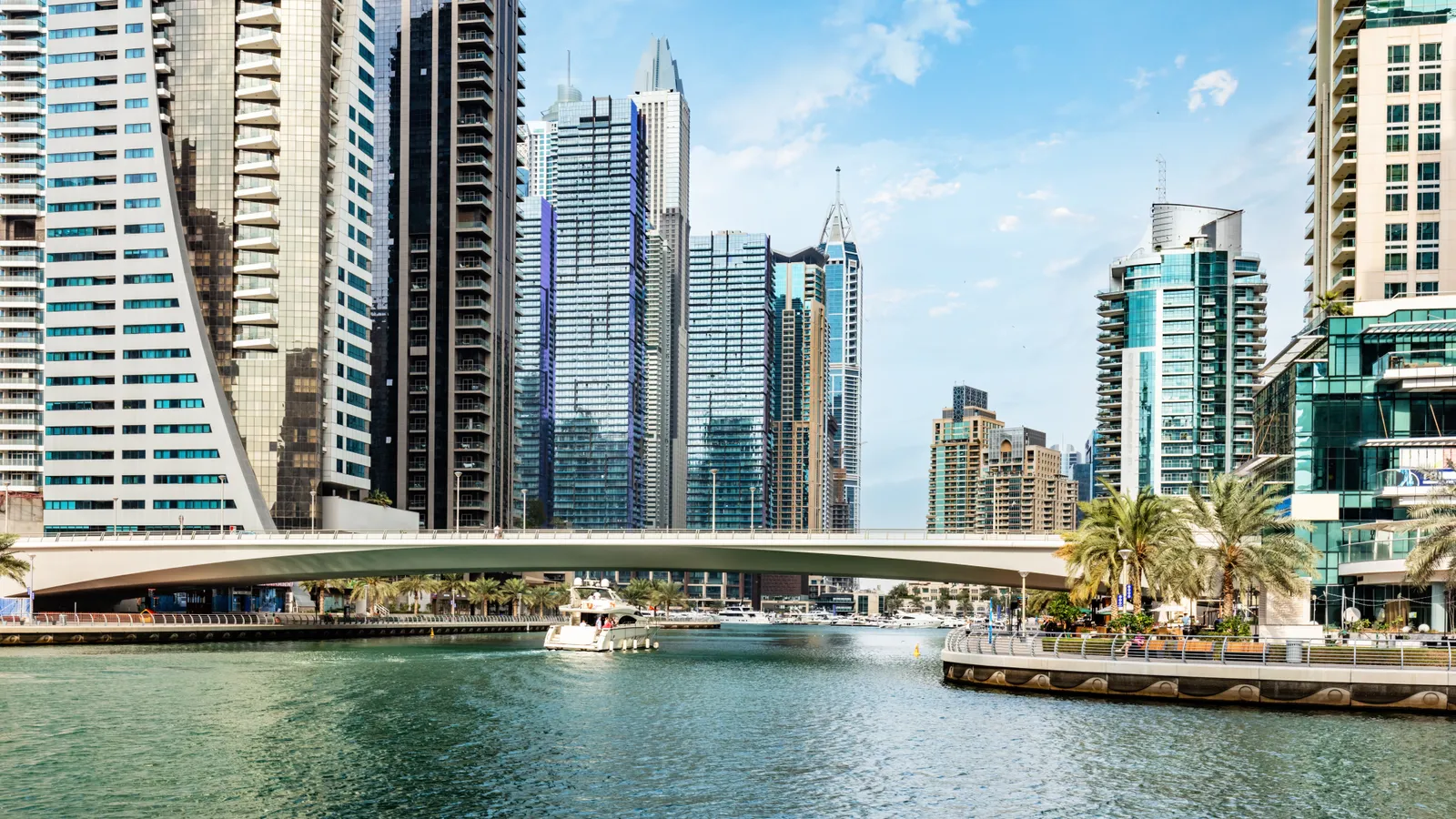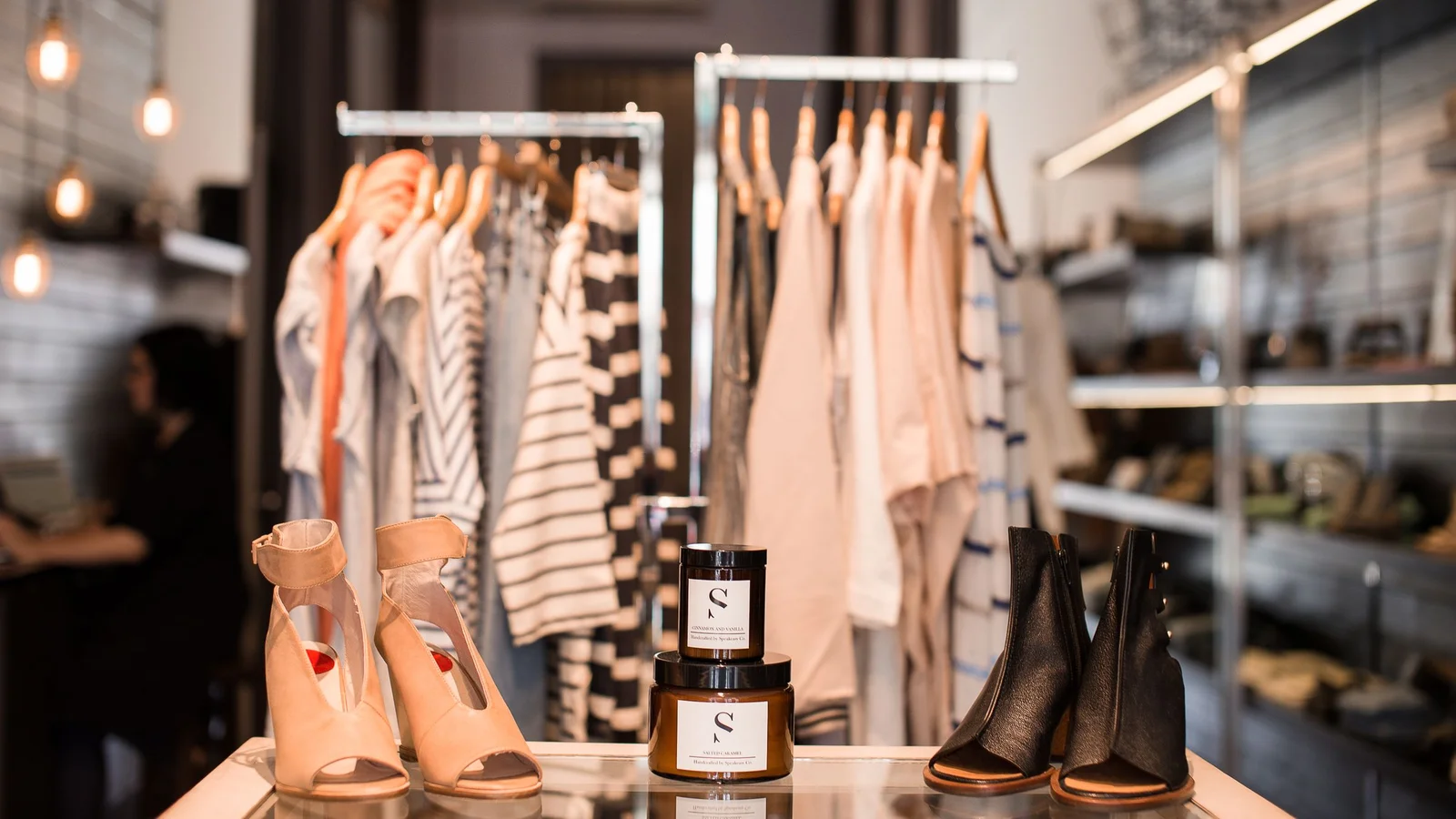
This is not a choice between an old channel and a new one. It is a choice between two cost structures, and the licence question most founders open with is the least interesting part of it. A shop buys you captive footfall with a large fixed cost base you sign for years in advance. An online store buys you a small fixed cost base and a paid customer acquisition bill that arrives with every order and never stops.
That distinction decides everything downstream. Rent is contractually fixed, so every extra dirham of sales dilutes it. Acquisition cost, gateway fees, returns and last-mile delivery scale with volume, so they never dilute at all. A shop that doubles its sales halves its rent ratio. An online store that doubles its orders doubles its acquisition spend. Founders who understand that pick correctly; founders who compare licence fees pick the cheaper mistake.
This guide weights toward the physical shop, because the online side is already covered in depth elsewhere on this site and because the retail route is where the money actually gets lost. It covers licences, the E-Trader restriction almost every article gets wrong, the March 2025 rule that changed what a free-zone company may do on the mainland, premises approvals, real costs on both sides, the metrics that decide each model, and tax. Since 2013, our team has set up trading, retail and e-commerce companies across Dubai, so the traps here come from real files. This is a guide, not legal or tax advice on your specific business.
Which licence does each model actually need?
A physical shop needs a DET commercial licence with a retail trading activity and a real leased premises behind it. An online store can sit on a mainland commercial licence, a free-zone e-commerce licence, or the low-cost E-Trader route, and those three are not interchangeable. The premises requirement, not the licence fee, is what separates them.
For a shop, the licence layer is straightforward. Dubai's Department of Economy and Tourism holds a register of more than 3,000 named business activities, and up to 10 compatible activities can sit on a single licence, so a homeware shop that also sells gifts and accessories usually does not need three licences. A General Trading licence is a subtype of the commercial licence covering import, export, wholesale and retail of largely unrelated goods, and it is the right pick when your range does not fall neatly under one activity family. Because a walk-in shop must sit on a DET licence tied to a Dubai address, start with the route on our mainland company setup page before you shortlist units.
One honesty note most competing pages skip: we could not confirm the specific numeric activity code for general retail trade on a DET-owned page, because dubaidet.gov.ae blocks automated access, and we will not invent one. Confirm your exact activity and code on the Invest in Dubai activity search before you budget, since the activity drives approvals and, in some categories, external clearances. The one code we can state with confidence is the "Online Seller" commercial activity, code 6312009, used under the E-Trader licence.
| Question | Physical retail shop | Mainland e-commerce | Free-zone e-commerce | E-Trader |
|---|---|---|---|---|
| Licence type | DET commercial licence | DET commercial licence | Free-zone e-commerce or trading licence | DET E-Trader |
| Premises | Commercial shop unit plus Ejari | Office or warehouse plus Ejari | Flexi-desk or virtual office typically accepted | None required |
| Sell to walk-in public on the mainland | Yes | Not from an office | Only via a mainland branch licence | No |
| Sponsors visas | Yes | Yes | Yes | No |
| Company or partnership allowed | Yes | Yes | Yes | No, sole proprietorship only |
| Fire and building approvals | Yes, Civil Defence and Municipality | Limited, premises-dependent | Zone-administered | Not applicable |
That table is the whole comparison in miniature. Everything expensive about the shop route sits in the premises column, and everything expensive about the online route sits outside the licence entirely.
Who can actually use an E-Trader licence?
Far fewer people than the marketing suggests, and the limits are specific rather than vague. E-Trader is a sole proprietorship only, with no companies and no partnerships permitted. It requires an Emirates ID and a Dubai residential address with a Makani number, needs no office, and does not sponsor visas. It is a starting point, not a structure.
The eligibility limit is what trips people up. UAE and GCC nationals are the primary eligible group for the full range of commercial activities under E-Trader. Expatriate residents are restricted to service and professional activities and generally cannot sell physical goods on it. That rule is missing from almost every cheap-licence listicle, and it is why founders arrive at us holding an E-Trader licence and a container of stock they are not authorised to sell.
There is one real carve-out. DET opened the "Online Seller" commercial activity, code 6312009, under E-Trader to all nationalities, so an expatriate resident can legitimately hold an E-Trader licence for online selling under that activity. What it will not do is give you a visa, let you take a partner, or let you open a unit with a door.
Common Mistake: Treating E-Trader as a cheap version of a trading licence. It is a different legal form with a different scope. Founders who build inventory, hire a packer and take a storage unit on one usually discover the mismatch when a bank, a marketplace or a payment gateway asks for documents the licence cannot produce. If your plan involves other people, pick a company from day one. Our Dubai online store licence guide compares the online options in full.
Can a free-zone company open a shop on the mainland now?
Yes, and this is the single most out-of-date claim on the internet about this topic. Historically a free-zone establishment could not open a walk-in shop in a Dubai mall or on a mainland high street, full stop. Dubai Executive Council Resolution No. 11 of 2025, issued on 3 March 2025, changed that by creating a route for free-zone establishments to apply to DET for a licence to operate physically on the mainland [1][2].
The mechanism is a branch licence issued by DET. A free-zone establishment applies for permission to conduct its activity outside its zone, on the mainland. The licence is valid for one year and renewable, and carries an annual DET fee of AED 10,000 [1][2]. It does not apply to financial institutions regulated within DIFC [1][2]. This converts a hard prohibition into an administrative process with its own approvals, fee and premises requirements.
Read the change accurately, because the overcorrection is as wrong as the outdated version. This is not automatic and it is not a loophole that turns a flexi-desk into a shop. You still apply, you still get approved or refused, and the mainland unit you occupy still needs the same tenancy, Ejari, Municipality and Civil Defence approvals as any other shop. What has gone away is the categorical answer: a route now exists, so you do not have to dissolve and re-form. Compare both structures on our free zone company setup page before you commit.
Real Talk: Most articles on "can a free zone company do retail in Dubai" still repeat the pre-March-2025 absolute rule as current fact. If an adviser tells you flatly that it is impossible, they have not read Resolution No. 11 of 2025 [1], which is a fair proxy for how current the rest of their advice is.
What premises and approvals does a physical retail shop need?
A genuine commercial tenancy, Ejari registration, Dubai Municipality building and fit-out permits, and Dubai Civil Defence sign-off before you occupy or alter the unit. The premises track runs in parallel with the licence track from day one, and it is the longer of the two in almost every file we have handled.
You sign a commercial tenancy and register it through Ejari, which makes the lease usable for licensing. Fit-out, signage and any structural or mechanical, electrical and plumbing work go to Dubai Municipality Building Control and Permits. Fire and life safety goes to Dubai Civil Defence, covering the fire alarm, suppression, emergency lighting and exit signage, with a drawing review then a physical inspection before you occupy or alter the premises. In a mall, the landlord will also require its own NOC and design approval, on a timeline you do not control.
The online side is lighter but not weightless. A mainland e-commerce licence still needs a genuine tenancy and Ejari, office or warehouse, so the "no premises needed for online" line is only half right. Free-zone e-commerce can typically run on a flexi-desk or virtual office with storage arranged separately, which is the real cost advantage of the zone route. E-Trader needs no office at all.
Category approvals apply regardless of channel, which is where founders assume online is exempt. Food, cosmetics and electronics carry their own clearances whether the customer takes the product off a shelf or a courier hands it over. We are deliberately not listing per-category requirements, because we could not obtain a current primary list and a wrong list is worse than none.
Pro Tip: Make the Civil Defence and Municipality approvals a payment milestone in your fit-out contract, not something your contractor promises to handle afterwards. The expensive failure is the one we see constantly in food and beverage: approved drawings and built unit drift apart, and the gap is found at inspection, when the rent is already running.
What does a retail shop actually cost to open in Dubai?
Considerably more than the licence, and rent plus fit-out are the whole story. A small shop realistically lands at AED 60,000 to 150,000 all in, while a full grocery-scale investment including stock and fit-out runs AED 260,000 to 550,000. Opening inside Dubai Mall specifically is cited from AED 180,000 in the first year. The spread is real, not a hedge.
| Setup item | Typical cost (AED) |
|---|---|
| DET commercial licence | 10,000 to 20,000 |
| Ejari registration | ~178 to 220 |
| Security deposit on the lease | ~5% of annual rent |
| Fit-out, basic finish | 350 to 550 per sqft |
| Fit-out, mid-range | 600 to 900 per sqft |
| Fit-out, luxury | 1,800+ per sqft |
| Civil Defence and Municipality signage fees | Not publicly sourced, confirm directly |
| Small shop, all-in first year | 60,000 to 150,000 |
| Grocery-scale, including stock and fit-out | 260,000 to 550,000 |
We could not source published figures for Civil Defence and Municipality signage fees, so we are not quoting any. Anyone giving you a precise number without naming the schedule is guessing.
Rent is the line that decides the business, and Dubai's spread between mall tiers and community units is enormous.
| Location tier | Rent (AED per sqft per year) | Notes |
|---|---|---|
| Dubai Mall kiosk | 1,000 to 3,000 | Small footprint, high throughput format |
| Dubai Mall mid-size shop | 2,000 to 4,000 | The typical in-line unit |
| Dubai Mall flagship | 4,000 to 5,000 | Brand-asset economics as much as P&L |
| Community and high street | ~50 to 100+ | Derived approximation, see caveat |
The community figure needs a caveat we will not bury. JBR-type units of roughly 800 to 4,000 sqft commonly run about AED 200,000 to 400,000 a year in total, implying roughly AED 50 to 100+ per sqft. That per-square-foot number is our arithmetic from total rents, not a published rate card. The direction is not in doubt: a prime mall unit costs twenty to fifty times per square foot what a community unit costs, and Dubai's Fashion Avenue ranks as the eleventh most expensive retail location globally [3].
Quick Math: A 1,000 sqft mid-tier Dubai Mall unit at AED 3,000 per sqft is AED 3,000,000 a year in rent alone, before fit-out, stock or a single salary. At a healthy 8% rent-to-revenue ratio, that unit must turn over roughly AED 37.5m a year, about AED 103,000 every day, to be a normally profitable shop. If that does not match your product and basket size, the site is wrong however good the footfall looks on a Saturday. Get an itemised retail budget for your unit→
What does an e-commerce setup actually cost?
Much less to start and much more to run. Setup vendors cite e-commerce licences from AED 5,750 to 8,050, which is indicative vendor pricing rather than a DET primary schedule, and the free-zone flexi-desk removes the rent line almost entirely. The recurring costs then arrive per transaction, forever.
| Item | Typical cost |
|---|---|
| E-commerce licence (vendor-quoted, indicative) | AED 5,750 to 8,050 |
| Free-zone flexi-desk or virtual office | Included in most packages |
| Payment gateway setup | From AED 5,000 |
| Gateway monthly fee | AED 200 to 1,500 |
| Gateway transaction fee | 1.5% to 3.9% plus AED 0.50 to 1.50 per transaction |
| VAT on all gateway fees | 5% on top |
| Shopify platform fee, third-party gateway | 2% Basic, 1% Standard, 0.5% Advanced |
| Noon marketplace commission | 4% to 27% by category, no monthly seller fee |
| Amazon.ae referral fee | Typically 4.5% to 15% [8] |
Two details there are routinely missed. First, every one of those gateway fees carries 5% VAT, so effective processing cost is higher than the quoted percentage. Second, if you run Shopify with a third-party gateway, which you must in the UAE, Shopify charges its own platform fee on top of the gateway's cut, and that fee falls as you move up plans, so on a thin-margin category the Basic plan's 2% is a real reason to upgrade early. Marketplace commissions also vary by category far more than sellers expect [8].
Our Amazon FBA business guide covers fulfilment, our payment gateways for ecommerce guide compares processors, and our Dubai CommerCity guide covers the purpose-built zone. For the full launch sequence, start with how to start an ecommerce business.
Both cost ranges above are genuinely wide, and that is a finding rather than a hedge. Category, location tier and scale move the base cost by a factor of three to five in either model. A kiosk and a flagship are not the same business, and neither are a digital-product store and a fashion brand carrying returns.
What is the metric that actually decides a retail shop?
Occupancy cost, meaning rent as a percentage of gross sales. Not footfall, not margin per item, not store design. If the rent ratio is wrong, no amount of merchandising fixes it, because the number is fixed in a contract you signed before you knew your actual sales.
The benchmark most operators work to sits at 5% to 12% of gross sales, with 6% to 8% commonly cited as healthy. Grocery and discount run as low as 2.5%, trading volume against thin margins, and apparel tolerates 12% and above on far higher gross margin. One caveat: this is a global commercial real estate benchmark, not a Dubai-specific study, because we could not find a credible Dubai-specific one. Use it as a sanity check, not a local standard.
| Format | Typical rent to revenue | Why |
|---|---|---|
| Grocery and discount | ~2.5% | Very high volume, very thin gross margin |
| General retail, healthy range | 6% to 8% | The commonly cited comfortable band |
| Broad retail benchmark | 5% to 12% | The range most formats fall inside |
| Apparel and fashion | 12%+ | High gross margin absorbs higher rent |
Why the ratio is existential rather than cosmetic becomes obvious next to gross margin by category. These are global benchmarks rather than UAE-specific figures, and they are close enough to be useful.
| Category | Typical gross margin | Net margin after everything |
|---|---|---|
| Fashion and apparel | 45% to 60% | 2% to 10% across retail generally |
| General merchandise | 35% to 45% | 2% to 10% |
| Grocery | 25% to 30% | 2% to 10%, usually the low end |
| Electronics | 15% to 40% | 2% to 10%, category-dependent |
Read the two tables together. Retail net margins typically land at only 2% to 10% after occupancy, labour and logistics. If your net margin is 6% and your rent ratio drifts from 8% to 14%, the extra six points do not dent your profit, they erase it. That is why the lease deserves far more scrutiny than the licence application ever gets. Dubai mall leases are multi-year with fixed base rent, and prime centres sometimes add turnover rent on top. The base does not flex downward if footfall disappoints, your category softens, or the anchor tenant beside you leaves. You carry the whole risk of the revenue assumption you made at signing.
Why are Dubai retail rents rising, and what does that mean for a new entrant?
Because the space is close to full and demand is still queuing. Dubai's major mall operators reported roughly 97% to 98% occupancy in Q3 2025, with waitlists for anchor space, and prime retail rents up about 9% year on year, placing Dubai among the top five cities globally for retail rent growth [3][4]. Dubai Mall alone drew more than 111 million visitors in 2024, with 2025 expected higher [3].
That is a landlord's market, and it has a direct consequence for you. A new entrant has almost no bargaining power. When a mall is at 98% occupancy with a waitlist, your ability to push for a rent-free fit-out period, a turnover-only structure, a break clause or a capped uplift is close to zero, because the operator has another tenant who will sign without asking. The lease you are offered is broadly the lease you take. Retail contributes 25.3% of Dubai's GDP, the largest sectoral contribution, so this is not a declining sector you are bravely entering [3]. It is a crowded, well-performing one where landlords capture much of the upside through rent.
Based on our experience, founders model the revenue side of a mall unit optimistically and the rent side literally. The rent is the only number in the model that is contractually certain. Build the forecast so the business survives at 60% of your expected revenue.
What does e-commerce actually cost per order?
This is where the real numbers live, and almost no comparison page publishes them. The licence saving you made at setup is spent, repeatedly, on acquiring and delivering each order. UAE customer acquisition cost runs around AED 257, roughly USD 70, which is in line with global averages of USD 68 to 84. That is the price of one customer, before you have shipped anything.
| Per-order cost driver | Typical figure | Why it matters |
|---|---|---|
| Customer acquisition cost | ~AED 257 (roughly USD 70) | Paid on every new customer, never dilutes with scale |
| Overall UAE return rate | ~17% | Reverse logistics plus refurbishment or write-off |
| Apparel return rate | ~26% | Roughly one order in four comes back |
| COD share of transactions | 25% to 40% (estimated) | Drives the failure rate below |
| COD return to origin | ~20% | Against roughly 6% for prepaid orders |
| Cost per RTO order | AED 25 to 50 (estimated) | Dual-direction handling on a sale that never happened |
| Delivery, dense urban Dubai | 3% to 5% of basket value | The good case |
| Delivery, remote or northern emirates | 15% to 25% of basket value | The case that quietly kills margin |
Cash on delivery is the most underreported cost in UAE e-commerce. A COD-heavy store is not simply a store with slower cash flow, it is a store paying to ship a fifth of its COD orders twice for nothing, on revenue it never collected. Delivery geography compounds it, and sellers advertising flat-rate free national delivery are cross-subsidising their most expensive customers with their cheapest, which on a thin-margin category is a structural loss rather than a marketing expense.
Quick Math: A store doing 1,000 orders a month at an AED 200 basket, with 35% COD, has 350 COD orders, of which roughly 70 come back at 20% RTO. At AED 35 per failed order that is about AED 2,450 a month burned on orders that never converted, plus AED 14,000 of revenue evaporated, before the 17% return rate on the orders that did land. None of that appears on a licence quotation.

Is e-commerce in Dubai really growing as fast as people say?
Not as fast as the funding headlines imply. UAE e-commerce penetration sits at only 15% to 20% of total retail and is essentially flat into 2026. For comparison, China runs at about 47% and both the UK and South Korea sit near 30%. Order growth in 2025 was around 7% year on year, which is healthy but nowhere near the narrative.
Market sizing is where the sources fall apart, and we would rather show the disagreement than pick the flattering number. A 2022 Dubai Chamber report projected USD 9.2bn by 2026 and 12.6% of retail, now an ageing forecast. Recent estimates cluster between USD 7.5bn and USD 12.3bn for 2025 and 2026, and one government-linked forecast puts the market at AED 32.3bn in 2024 growing to AED 50.6bn by 2029. Use that AED range or the penetration figure and ignore the rest.
Some numbers should simply be refused. Figures of USD 125bn and USD 270bn circulate from market-research mills and are implausible against a UAE GDP of roughly USD 545bn, since they would put e-commerce alone at a quarter to a half of the entire economy. If a pitch deck quotes those, the rest of it is not worth reading.
Real Talk: The conclusion is not that online is a bad idea. It is that 80% to 85% of UAE retail spending still happens in physical stores, and that share is not collapsing. Anyone telling you to skip physical retail because online is taking over is describing a different country. Equally, anyone telling you a shop is safe because malls are full is ignoring what full malls do to rent.
How are the two models taxed, and why does the free-zone 0% fail either way?
Identically on corporate tax and VAT, and the free-zone 0% that founders chase does not rescue either model when the customer is a consumer. Both a shop and an online store pay 0% corporate tax on taxable income up to AED 375,000 and 9% above. Small Business Relief allows a business with revenue at or below AED 3,000,000 to elect to be treated as having no taxable income, and it is legislated only for tax periods ending on or before 31 December 2029 [7]. It must be elected, not assumed.
The free-zone question is where the advice is worst. Under Ministerial Decision No. 229 of 2025, published on 28 August 2025, replacing Ministerial Decision 265 of 2023 and applying retroactively to 1 June 2023, distribution is a Qualifying Activity only when conducted in or from a Designated Zone, where the goods enter the UAE through that zone and are supplied to a customer who resells, processes or alters them [5][6]. Separately, transactions with natural persons are an Excluded Activity [5][6].
Put those together and the answer is clean. A B2C retailer or online seller fails on both counts: the customer does not resell or process the goods, and the customer is a natural person. The 0% is unavailable whether you run a shop or a website. Only a genuine B2B wholesale model, routed through a Designated Zone to a customer who resells or processes, has a real path to it. One honesty note: we could not confirm the exact article numbering from the primary PDF, so treat this as the position confirmed by multiple advisory readings [5][6] and check it against your own facts.
Common Mistake: Choosing a free zone for an online consumer store specifically to get the 0% rate. The zone may still be right for cost, ownership and flexi-desk premises, and our free zone company setup page covers those real advantages. But selling to consumers is structurally outside the qualifying regime, so pick the zone for operational reasons and budget for 9% above AED 375,000.
Is VAT different for an online store and a shop?
No, and this is one of the few genuinely simple answers here. VAT is 5% and channel-neutral. The same product carries the same VAT whether a customer takes it off a shelf in Mirdif or has it couriered to Al Ain. Registration is mandatory once taxable supplies pass AED 375,000, with voluntary registration from AED 187,500, which is worth taking early on the retail side because a shop incurs heavy input VAT on fit-out, fixtures and stock before it earns anything.
The practical difference is not the rate, it is the record-keeping. A shop's VAT sits mostly in a POS system with one supply point. An online store's sits across a website, one or two marketplaces, a payment gateway and a courier's COD remittance file, which is where reconciliation errors start. That load is ongoing rather than one-off, and it is the kind of recurring work our post-setup services team handles.
Which should you actually pick?
Match the model to your product's margin and your capital, not to your preference. The rule of thumb that survives contact with real files: if your gross margin cannot absorb both rent and staffing, go online; if your product needs to be touched, tried or taken away immediately, go physical; if it needs both, open online first and let the data pick your site.
| Product and capital position | Better fit | Reasoning |
|---|---|---|
| Fashion and apparel, capital above AED 500k | Physical, or hybrid | 45% to 60% gross margin absorbs rent; 26% online return rate is brutal |
| Fashion and apparel, capital under AED 150k | Online first | Rent would consume the margin before the brand exists |
| Electronics and accessories | Online | 15% to 40% margin, low return rate, price-comparison behaviour favours online |
| Grocery and convenience | Physical, community location | ~2.5% rent ratio needs cheap space and immediate purchase behaviour |
| Beauty and cosmetics | Hybrid, online-led | High margin, but sampling drives conversion; kiosk plus online works |
| Furniture and homeware | Physical showroom, online catalogue | High basket value, delivery cost tolerable, touch matters |
| Digital or made-to-order products | Online only | No stock, no returns logistics, no reason to pay rent |
| Testing an unproven concept, any category | Online or kiosk | Both are reversible; a multi-year mall lease is not |
The hybrid answer is not a cop-out, it is usually the right sequence. An online store generates the demand data that tells you where your customers actually are, which is what you need before signing a lease you cannot exit. Founders who open a shop first buy a location on instinct; founders who open online first buy it on evidence. If you are leaning toward the shop, plan the DET structure on our mainland company setup page, and if grocery is your category, our supermarket business setup guide covers that format.
Pro Tip: If you cannot decide, run the rent-to-revenue test in reverse. Take the annual rent of the unit you like, divide by 0.08, and ask honestly whether you can turn over that number. If the answer is no, you have your answer before spending anything. Talk to a setup expert→
What are the ongoing costs and compliance for each model?
Both carry annual renewals and tax filings; the shop adds a physical inspection layer that repeats. The DET licence and Ejari renew annually in both mainland cases, a free-zone licence and flexi-desk renew on the zone's cycle, and a shop adds signage permits, Civil Defence renewals tied to the premises and landlord obligations outside the government stack entirely.
On tax, both register for corporate tax and file annually, and both register for VAT once taxable supplies pass AED 375,000. Both maintain Ultimate Beneficial Owner records, renew staff visas and Emirates IDs, and run payroll under the Wages Protection System where staff are sponsored. A free-zone establishment operating a mainland branch under Resolution No. 11 of 2025 carries the additional AED 10,000 annual DET fee and an annual branch renewal [1][2]. The load is heavier than founders expect online, because the filings are identical while transaction volume is higher and spread across more systems. These recurring renewals and reconciliations are what our post-setup services team runs for clients, and they belong in year-one budgets as a permanent line.
Can you open a corporate bank account for either model?
Yes for both, but expect standard UAE onboarding rather than an instant or fully remote account, and expect the online business to face more questions. Banks run full know-your-customer checks on shareholders, activity and expected turnover, and an in-person meeting is normal.
A shop is, counter-intuitively, often the easier file: it has a lease, a visible address, a card terminal and a legible revenue story. An online business with a flexi-desk, cross-border suppliers, marketplace settlements and COD remittances is a more complicated picture, and banks price that in with slower approvals. Apply early, bring a modelled P&L and a clear explanation of how money physically arrives from your gateway, marketplace or courier, and expect to maintain a minimum balance. The account must be live before your first sale settles.
Real Client Stories
The mall unit that needed AED 100,000 a day. A client fell for a mid-tier mall unit at roughly AED 3,000 per sqft and built a model showing profitability from month four. When we ran rent against a realistic 8% occupancy cost, the unit needed turnover of about AED 103,000 a day for a category whose average basket was AED 240. He would have needed over 400 transactions daily in a 1,000 sqft space. He took a community high-street unit at a fraction of the rent and opened profitably in year one.
The E-Trader licence that could not sell stock. An expatriate founder bought an E-Trader licence advertised as the cheapest way to sell products in Dubai, then imported a first order of homeware. Expatriate residents on E-Trader are restricted to service and professional activities, and the one carve-out that would have helped, the Online Seller activity 6312009, was not on his licence. We re-licensed him properly. Check the activity on the licence, not the sales page.
The free-zone brand told a shop was impossible. A free-zone consumer brand was advised by two agencies that a mainland retail unit was categorically off the table, and had begun planning an expensive re-formation. Executive Council Resolution No. 11 of 2025 had already created a DET branch licence route at AED 10,000 a year [1][2]. She kept her free-zone company and applied for the branch. The advice was not wrong when it was written; it was wrong when it was given.
Set up your Dubai shop or online store the right way
The founders who do well here are the ones who choose a cost structure deliberately. A shop with rent inside 6% to 8% of achievable revenue is a strong business in a sector contributing a quarter of Dubai's GDP. An online store with acquisition cost, returns and COD priced honestly into the basket is a strong business too. What fails is a shop signed on optimistic footfall and an online store priced as if orders arrive for free.
Since 2013, BusinessDubai.ae has completed 700+ company registrations across the UAE, including retail, trading and e-commerce companies. We will confirm the right DET activity for what you actually intend to sell, structure the entity as mainland, free zone or a free-zone company with a mainland branch under the 2025 resolution, run the Ejari, Municipality and Civil Defence track for a physical unit, and set the corporate tax and VAT position correctly for a B2C model. Talk to a setup expert→ for a plan built around your category, your capital and your numbers.
Frequently Asked Questions
Should I open a retail shop or an e-commerce business in Dubai?
It depends on your gross margin and your capital, not your preference. A shop buys captive footfall with a fixed cost base fixed for years. Online buys a low fixed base with permanent paid acquisition. High-margin, touch-and-try categories favour a shop; price-comparison and digital categories favour online.
What licence does a physical retail shop in Dubai need?
A DET commercial licence carrying the correct retail trading activity, supported by a genuine commercial tenancy and Ejari registration. DET's register holds more than 3,000 named activities and up to 10 compatible activities can sit on one licence, so a mixed product range does not usually need multiple licences.
What is the activity code for retail trade in Dubai?
We could not confirm the specific numeric code for general retail trade on a DET-owned page, because dubaidet.gov.ae blocks automated access, so we will not quote one. Confirm your exact activity and code on the Invest in Dubai activity search before budgeting.
Can an expat sell physical goods on an E-Trader licence?
Generally no. Expatriate residents on E-Trader are restricted to service and professional activities, while UAE and GCC nationals are the primary eligible group for the full range of commercial activities. The one carve-out is the Online Seller activity, code 6312009, which DET opened to all nationalities.
What is the Online Seller activity code 6312009?
It is the DET commercial activity for online selling that sits under the E-Trader licence and is open to all nationalities, including expatriate residents. It is the single confirmed activity code in this area and the only route that lets an expat sell products on an E-Trader licence.
Can a free zone company open a shop in a Dubai mall now?
Yes, through a route created in 2025. Dubai Executive Council Resolution No. 11 of 2025, issued on 3 March 2025, lets free-zone establishments apply to DET for a branch licence to operate physically on the mainland outside their zone [1][2]. It is an application, not an automatic right.
How much does the free-zone mainland branch licence cost?
The branch licence carries an annual DET fee of AED 10,000, is valid for one year and is renewable [1][2]. It does not apply to financial institutions regulated within DIFC. The mainland premises you occupy still needs its own tenancy, Ejari and safety approvals.
Do I need Ejari for an e-commerce business in Dubai?
For a mainland trading licence, yes: you need a genuine tenancy, office or warehouse, registered through Ejari. Free-zone e-commerce can typically use a flexi-desk or virtual office with storage arranged separately. An E-Trader licence needs no office at all.
Do I need Civil Defence approval for a retail shop in Dubai?
Yes. Dubai Civil Defence covers fire and life safety including the fire alarm, suppression, emergency lighting and exit signage, with a drawing review followed by a physical inspection before you occupy or alter the premises. Dubai Municipality Building Control handles fit-out, signage and structural or MEP work.
How much does it cost to open a retail shop in Dubai?
A small shop realistically runs AED 60,000 to 150,000 all in, and a grocery-scale investment including stock and fit-out runs AED 260,000 to 550,000. Opening inside Dubai Mall specifically is cited from AED 180,000 in the first year. The DET commercial licence itself is AED 10,000 to 20,000.
How much is retail rent in Dubai Mall?
Roughly AED 1,000 to 5,000 per sqft per year depending on format: kiosks around AED 1,000 to 3,000, mid-size shops AED 2,000 to 4,000 and flagship units AED 4,000 to 5,000. Dubai's Fashion Avenue ranks as the eleventh most expensive retail location globally [3].
What is retail rent per square foot on a Dubai high street?
Dramatically lower than the malls. JBR-type units of roughly 800 to 4,000 sqft commonly run about AED 200,000 to 400,000 a year in total, implying roughly AED 50 to 100+ per sqft. That per-square-foot figure is derived from total rents, not a published rate card, so treat it as an approximation.
How much does shop fit-out cost in Dubai?
Basic finish runs AED 350 to 550 per sqft, mid-range AED 600 to 900 per sqft, and luxury AED 1,800 and above. Add a security deposit of around 5% of annual rent and Ejari registration of about AED 178 to 220. Civil Defence and Municipality signage fees are not publicly sourced.
How much does an e-commerce licence cost in Dubai?
Setup vendors cite AED 5,750 to 8,050, which is indicative vendor pricing rather than a DET primary schedule. The bigger costs sit elsewhere: payment gateway setup from AED 5,000, monthly gateway fees of AED 200 to 1,500, and transaction fees of 1.5% to 3.9% plus AED 0.50 to 1.50, all carrying 5% VAT.
What is a healthy rent-to-revenue ratio for a retail shop?
The global retail benchmark is 5% to 12% of gross sales, with 6% to 8% commonly cited as healthy. Grocery and discount formats run as low as 2.5%, and apparel tolerates 12% and above. This is a global commercial real estate benchmark rather than a Dubai-specific study.
What gross margin should I expect in retail?
As global benchmarks: fashion and apparel 45% to 60%, general merchandise 35% to 45%, grocery 25% to 30%, electronics 15% to 40%. Net margins across retail typically land at only 2% to 10% after occupancy, labour and logistics, which is why the rent ratio is existential.
What percentage of retail businesses fail in Dubai?
No reliable public figure exists, and that is worth saying plainly. A widely circulated claim that 40% close within five years traces to a low-quality aggregator with no primary source, so we do not use it. Treat any precise Dubai retail failure statistic you are quoted with suspicion.
Why are Dubai retail rents going up?
Because supply is close to full. Major mall operators reported roughly 97% to 98% occupancy in Q3 2025 with waitlists for anchor space, and prime retail rents rose about 9% year on year, putting Dubai among the top five cities globally for retail rent growth [3][4].
Can I negotiate a mall lease as a new retailer in Dubai?
Very little. At 97% to 98% occupancy with waitlists, the operator has another tenant who will sign without asking for a rent-free period, a turnover-only structure or a break clause [4]. Assume the lease you are offered is broadly the lease you take, and price your risk accordingly.
What is customer acquisition cost for e-commerce in the UAE?
Around AED 257, roughly USD 70, which is in line with global averages of USD 68 to 84. Unlike rent, acquisition cost does not dilute as you scale: it is paid again on every new customer, which is the defining economic feature of the online model.
What is the return rate for e-commerce in the UAE?
Roughly 17% overall and about 26% for apparel, so in fashion around one order in four comes back. Returns carry reverse logistics cost plus refurbishment or write-off, and they must be built into pricing from launch rather than discovered in month six.
What is return to origin and why does cash on delivery make it worse?
Return to origin is an order that fails at the doorstep and comes back unsold. COD is an estimated 25% to 40% of UAE e-commerce transactions and returns to origin at about 20%, against roughly 6% for prepaid, with each failed order costing an estimated AED 25 to 50 in dual-direction handling.
How much does delivery cost per order in the UAE?
It depends heavily on the address. Delivery can run 3% to 5% of basket value in dense urban Dubai and 15% to 25% to remote or northern-emirate addresses. Flat-rate national free delivery therefore cross-subsidises your most expensive customers with your cheapest.
How big is the UAE e-commerce market?
Sources diverge badly, and we would rather show the disagreement. Recent estimates cluster between USD 7.5bn and USD 12.3bn for 2025 and 2026, with one government-linked forecast of AED 32.3bn in 2024 growing to AED 50.6bn by 2029. Figures of USD 125bn or USD 270bn are implausible against UAE GDP of roughly USD 545bn.
Is e-commerce taking over retail in the UAE?
Not yet, and not quickly. UAE e-commerce penetration is only 15% to 20% of total retail and essentially flat into 2026, against about 47% in China and around 30% in the UK and South Korea. Order growth in 2025 was roughly 7% year on year.
Do I pay corporate tax on a retail shop or an online store?
Both pay the same: 0% on taxable income up to AED 375,000 and 9% above. Small Business Relief lets a business with revenue at or below AED 3,000,000 elect to be treated as having no taxable income, and it is legislated only for tax periods ending on or before 31 December 2029 [7].
Can a free zone e-commerce business get the 0% corporate tax rate?
Not for a B2C model. Under Ministerial Decision No. 229 of 2025, distribution is a Qualifying Activity only in or from a Designated Zone where goods enter through that zone and go to a customer who resells, processes or alters them, and transactions with natural persons are an Excluded Activity [5][6].
Is VAT different for online sales and shop sales in Dubai?
No. VAT is 5% and channel-neutral, applying identically whether the customer buys in a shop or online. Registration is mandatory once taxable supplies pass AED 375,000, with voluntary registration from AED 187,500, often worth taking early on the retail side to recover input VAT on fit-out.
What commission do Noon and Amazon.ae charge?
Noon runs roughly 4% to 27% by category, with electronics at the low end and fashion and beauty at the top, and charges no monthly seller fee. Amazon.ae referral fees typically fall between 4.5% and 15% depending on category [8].
Can I open a corporate bank account for a retail shop in Dubai?
Yes, with a local bank once the licence and tenancy are in place, subject to full know-your-customer checks and usually an in-person meeting. A shop is often the easier file because it has a lease, an address and a legible revenue story; online businesses with marketplace and COD flows face more questions.
References
[1] Dubai Legislation portal, Executive Council Resolution No. (11) of 2025 regulating the conduct of free zone establishments' activities, issued 3 March 2025: the mainland branch licence route, one-year renewable validity and the AED 10,000 annual DET fee. Executive Council Resolution No. 11 of 2025
[2] KPMG, UAE free zone taxpayers allowed to operate on mainland Dubai: analysis of the branch licence, its fee, renewal and the DIFC-regulated financial institution exclusion. KPMG on free zone operations on mainland Dubai
[3] Cushman and Wakefield Core, Dubai annual retail market update 2025/2026: prime retail rent growth, mall occupancy, footfall and the retail sector's contribution to Dubai GDP. Dubai annual retail market update 2025/2026
[4] Cavendish Maxwell, Dubai retail and warehouse market performance Q3 2025: mall occupancy of roughly 97% to 98%, waitlists for anchor space and prime rent growth of about 9% year on year. Dubai retail and warehouse market performance Q3 2025
[5] UAE Ministry of Finance, Ministerial Decision No. 229 of 2025 regarding Qualifying Activities and Excluded Activities: distribution from a Designated Zone as a Qualifying Activity and transactions with natural persons as an Excluded Activity. Ministerial Decision No. 229 of 2025
[6] PwC Middle East, new Ministerial Decisions No. 229 and No. 230 of 2025 on the Qualifying Free Zone Person regime: publication date, replacement of Ministerial Decision 265 of 2023 and retroactive application to 1 June 2023. PwC on Ministerial Decisions 229 and 230
[7] UAE Ministry of Finance, decision on Small Business Relief for corporate tax purposes: the AED 3,000,000 revenue threshold and the election available for tax periods ending on or before 31 December 2029. Ministry of Finance on Small Business Relief
[8] Amazon UAE, selling partner pricing and fees: referral fee ranges by product category for sellers on amazon.ae. Amazon UAE seller pricing