Almost every guide to starting a facade or high-rise cleaning business in Dubai buries it inside a generic "cleaning company licence" article and misses the one thing that actually gates the business. The real gatekeeper is not the trade licence. It is Dubai Municipality's rope-access technical guideline, GU35, which since October 2019 means only an IRATA-audited company may run rope-access operations in Dubai, with technicians holding EIAC-accredited certification [1]. If you plan to clean the outside of a tower, that guideline, not the licence, is your barrier to entry.
Two widespread myths are worth killing up front. First, guides tell you that you need an RTA work-at-height permit. The RTA does not issue one. It issues a road-occupation permit only when a cradle base or access vehicle actually sits on a public road [4]. Second, they cite SIRA or OSHAD. SIRA regulates security guards, not cleaning, and OSHAD governs Abu Dhabi, not Dubai [5]. A guide repeating those has not understood the sector.
This guide covers the DM rope-access guideline and the IRATA and EIAC requirements, the myth-busting on permits, the per-job approvals, the safety and insurance stack, and honest recurring-contract economics. Since 2013, our team has set up services and regulated companies across the UAE, so the traps here come from real files. This is a guide, not legal or safety advice on your specific operation.
Why is the trade licence not the real gate?
Because working at height on a tower is heavily safety-regulated, and the control sits in a Dubai Municipality guideline, not the licence. A DET trade licence with a building or facade-cleaning activity lets you incorporate the company. It does not, on its own, let you send technicians over the edge of a high-rise.
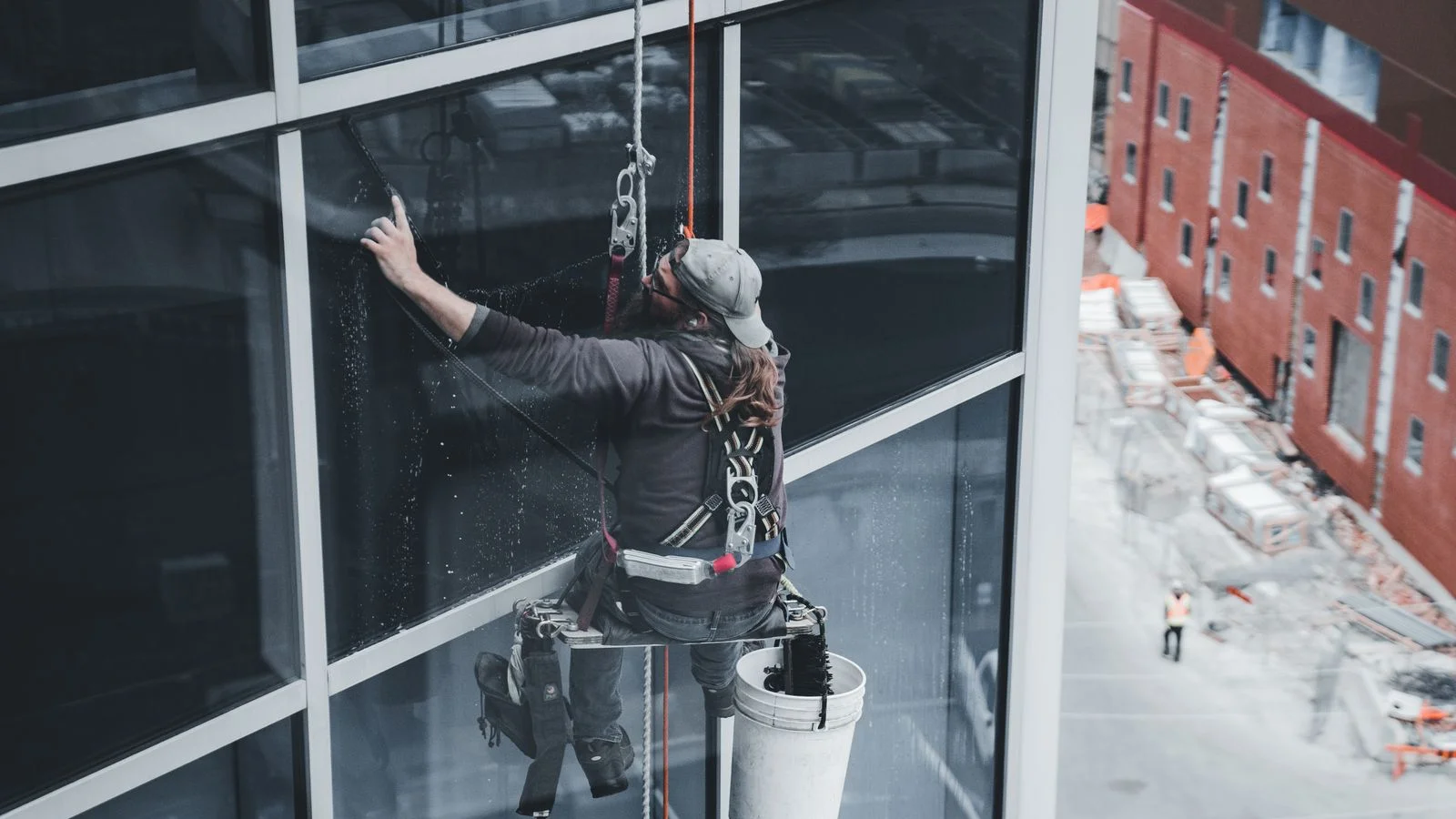
The operative instrument is Dubai Municipality's Health and Safety Department technical guideline GU35, on the use of rope access systems. It was revised in October 2019 so that [1]:
- Only an IRATA-audited company may run rope-access operations in Dubai.
- Technicians must hold EIAC-accredited third-party certification, IRATA being the named example.
- The supervisor must be an EIAC-accredited Level 3, competent in rescue.
- Ropes must be attached to at least two independently anchored systems, the two-rope rule.
So the barrier to entry is the safety accreditation, not the paperwork. A company with a cleaning licence but no IRATA audit and no EIAC-accredited technicians cannot lawfully or credibly work on facades.
Common Mistake: Treating a facade-cleaning business as an ordinary cleaning company. The trade licence is the easy part. Without the IRATA audit and EIAC-accredited technicians that GU35 requires, you cannot get on a building, pass a client's safety check, or win a tender. Budget for the accreditation, not just the licence.
Is IRATA legally required, or just nice to have?
Both answers you will read are wrong, and the truth sits in between. IRATA is not a UAE government body. It is a UK-based industry trade association and the global standard for rope access [2]. So it is inaccurate to say federal law mandates IRATA. But it is equally wrong to call it optional, because Dubai Municipality's GU35 requires the company to be IRATA-audited and technicians to hold EIAC-accredited certification [1]. In Dubai, IRATA is a de-facto legal prerequisite through the municipal guideline, and a hard client and tender requirement on top.
The IRATA structure you build around [2]:
- Level 1 technicians work under supervision. Level 2 add rigging and rescue. Level 3 is the supervisor who takes full responsibility for site safety, holds current first aid, and must be present on every site.
- At company level, IRATA operator membership requires a Technical Authority who has held Level 3, a rope-access manager, and independent audits at joining, at twelve months, then every three years.
And the certification must be EIAC-accredited. EIAC, the Emirates International Accreditation Centre, is the UAE accreditation authority, and DM requires third-party certification from an EIAC-accredited body [3]. A foreign IRATA card obtained through an unaccredited route can be challenged, so route your training and assessment through EIAC-accredited centres.
Pro Tip: Build the firm around a qualified Level 3 supervisor and EIAC-accredited technicians from day one, because that team, not the licence, is what gets you onto buildings and through the IRATA audit. This is a certified-labour business, and the scarcity of Level 3 supervisors is the real constraint on how fast you can grow. Get your facade-cleaning setup scoped around the accreditation→
Do you need an RTA permit, and who actually regulates this?
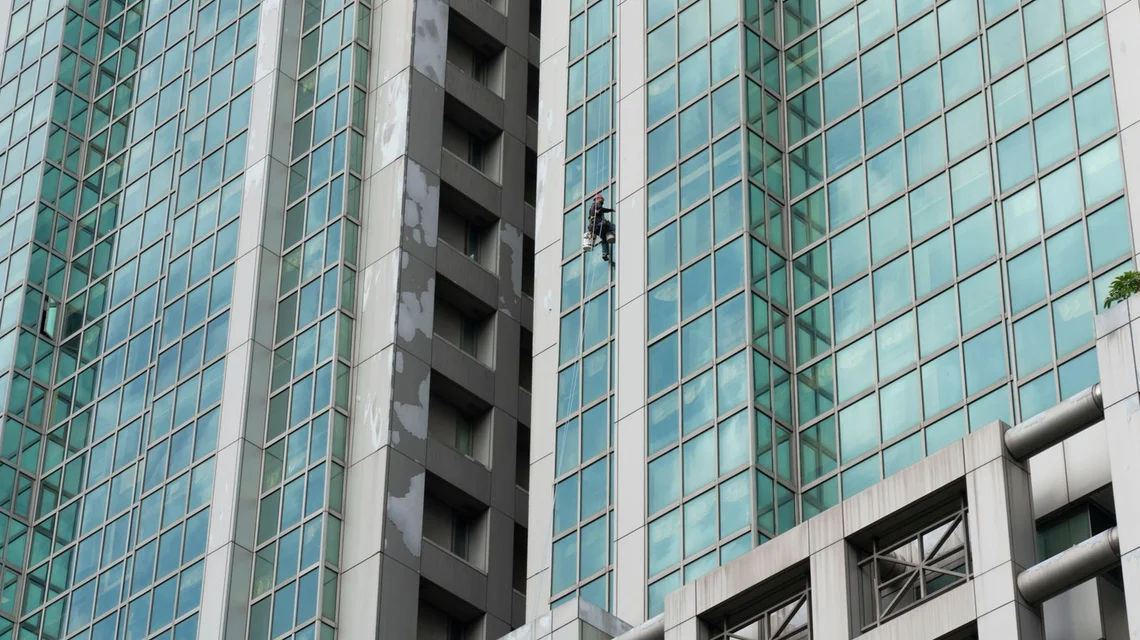
No RTA work-at-height permit exists, and the regulation is a stack, not a single agency. This is where the copy-paste guides go wrong. The RTA does not issue a work-at-height permit. It issues a right-of-way or lane-closure permit only when a cradle base, a building-maintenance-unit outrigger or an access vehicle physically occupies a public road or footpath [4]. Rope access off a rooftop needs no RTA permit.
The actual regulation is a layered stack, with no single "Dubai OSH authority" [5]:
- Federal: the Labour Law and MOHRE occupational-safety rules impose an employer duty to provide a safe environment, work-at-height training, PPE and rescue.
- Emirate: Dubai Municipality's public-health and safety mandate, delivered through the HSD technical guidelines like GU35 for rope access and GU67 for MEWPs, the mobile access platforms used where ropes are not the right method.
- Special zones: if the building is in a Trakhees-regulated area such as the Palm or JAFZA, the permit-to-work runs through Trakhees-EHS, not the city system.
And to be clear: SIRA does not regulate cleaning, it regulates security, and OSHAD is the Abu Dhabi framework, not Dubai's. Any guide listing those for a Dubai facade-cleaning firm is wrong.
What approvals do you need per job?
A permit-to-work and a building access NOC, issued through the building, not a city-wide licence. Each high-rise job runs on its own approvals:
- A building-management NOC or access permit from the tower's owners' association or facilities manager, covering roof access and anchor use.
- A permit-to-work for working at height, issued through the client or FM's health-and-safety system, or through Trakhees-EHS if the building sits in a Trakhees zone.
- An RTA road-occupation permit only if your access equipment occupies a road.
- Civil Defence coordination for larger works involving fire-system isolation or roof plant, not a routine per-clean permit.
So the licence and accreditation get you into business, and per-building permits get you onto each tower. Build the permit-to-work discipline into your operation, because a building manager who lets an uncertified contractor work can share the liability if something goes wrong.
What about staff, equipment and insurance?
Certified people, inspected equipment, and high-risk insurance, because this is not general cleaning. The requirements that set a facade firm apart:
- Staff. IRATA Level 1 and 2 technicians with at least one Level 3 supervisor on every site, all EIAC-accredited, plus fitness-to-work-at-height medicals and a documented rescue plan, because you cannot rely on public emergency services for a rope rescue [1][5].
- Equipment inspection. Rope-access gear, anchors and access equipment need third-party inspection, commonly on a six-monthly cycle by an approved inspector, with re-inspection after severe weather. This is the LOLER-style discipline the sector runs on [6].
- Insurance, and it is a high-risk class. Building managers and government clients typically require public liability of at least AED 1 million before granting site access, and workmen's compensation is mandatory. Premiums are materially higher than for office or villa cleaning because of the work-at-height risk [6].
This certified-labour, inspected-equipment, high-insurance profile is exactly why facade cleaning is a distinct, defensible business rather than a corner of general cleaning.
Can you use a free zone, and can a foreigner own it?
You can own 100%, but on-site facade cleaning is a mainland activity. Cleaning the outside of a tower is a physical service performed at a client's building on the mainland, so it needs a mainland DET licence. A free-zone licence does not authorise operating at mainland client sites [6]. Because facade cleaning is a Dubai Municipality permitted service carried out at client buildings spread across the whole city, from Business Bay to JLT to Downtown, the mainland licence is the default and effectively the only workable structure for the operating company, and our mainland company setup page walks through the exact DET route a facade contractor needs, including the activity wording and the external Municipality approval.
Where a free zone does earn a place is a separate trading arm rather than the operating company. If you intend to import and resell rope-access hardware, suspended cradles, water-fed pole systems, descenders, harnesses or cleaning chemicals to other contractors, that is a trading business with no on-site mainland work in it, and our free zone company setup page covers that route and the warehouse and customs-code side of it. Many established facade firms end up running exactly this pairing: a mainland operating licence for the ropes and a free-zone trading licence for the equipment and consumables.
On ownership, 100% foreign ownership is available on the mainland under Federal Decree-Law No. 32 of 2021, with no local service agent needed, since cleaning is not a strategic-impact activity [7]. So the honest structure is a mainland company, fully foreign-owned, built around the IRATA audit and EIAC-accredited team. Founders often arrive at facade cleaning from an adjacent trade, and the licence choice is the same in each case: our cleaning company guide covers the general interior and villa cleaning route, our facility management guide covers the wider building-services contract that facade cleaning usually sits inside, and where a job crosses into structural repair, glazing replacement or cladding work, our construction company guide covers the contracting approvals that then apply.
How is a facade cleaning company taxed?
At standard rates, and the free-zone 0% pitch does not apply. Cleaning and facade services are standard-rated at 5% VAT, charged once you cross the AED 375,000 registration threshold, with no exemption. Our VAT registration and compliance guide covers the mechanics.
For corporate tax, the standard regime is 0% on the first AED 375,000 of profit and 9% above, with Small Business Relief while revenue stays at or below AED 3 million, for periods up to the end of December 2029. The free-zone 0% rate does not apply here: cleaning and facade services are not a Qualifying Activity under Ministerial Decision No. 229 of 2025, and serving mainland client buildings is mainland-facing income anyway, so a free-zone cleaning company is taxed at 9%, not 0% [8]. Our corporate tax filing guide covers the conditions.
What does it cost, and is it worth it?
The licence is modest; the accreditation, equipment and insurance are the real numbers. Here is a realistic 2026 picture in AED.
| Item | Typical range (AED) |
|---|---|
| Mainland DET trade licence and cleaning activity | 12,000 to 18,000 |
| Dubai Municipality health and safety approval | Confirm current fee with DM |
| Public liability insurance (min AED 1m cover) | 3,500 to 6,000/yr |
| IRATA certification, per technician per level | ~6,600 to 8,100 |
| Rope-access equipment, per technician | ~4,000 to 8,000 |
| Office and Ejari, and visas | Standard rates |
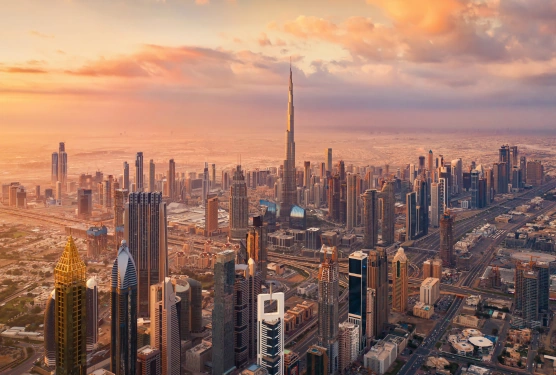
A small firm can be set up for roughly AED 28,000 to 55,000 in the first year on the licence side, with the IRATA certification, equipment and insurance the real investment. The demand case is structural and strong: Dubai is a self-refreshing forest of glass towers that legally cannot be cleaned from the inside, a typical high-rise needs three to four facade cleans a year, and the large majority of commercial buildings outsource the work in a big and growing facilities-management market [8]. The prize is recurring annual contracts, which are the profit engine over one-off jobs, and rope access wins on cost against scaffolding and cranes. The winners compete on certified safety, a Level 3-led team and reliability, not on being the cheapest.
Is a facade cleaning company a profitable business in Dubai?
It can be genuinely profitable, because the revenue repeats. Dubai has one of the densest high-rise skylines in the world, every one of those towers has to be cleaned from the outside, and the cleaning cycle is set by dust and weather rather than by the client's mood. The money sits in annual contracts, not in one-off jobs.
Four things drive the demand, and they all keep running. Dubai's tower stock is enormous and still growing, with new buildings handing over continuously across Business Bay, JLT, Dubai Marina, Downtown and the newer districts, so the addressable building count rises every year. The climate does the rest: constant dust, sand and post-shamal residue mean a typical high-rise needs around three to four facade cleans a year, so a single signed building is not one invoice but three or four [8]. Building maintenance is not optional either, since owners associations and facilities-management companies are responsible for keeping the building envelope maintained and generally award recurring annual contracts rather than buying cleans one at a time. And the large majority of commercial buildings outsource this work rather than employing rope technicians directly [8].
Now the honest counterweight, because this is not a soft business. You are carrying real safety liability every single day a technician goes over an edge, and one serious incident ends the company's reputation and its access to buildings. Insurance is priced as a high-risk class, so the AED 1 million public liability cover clients demand costs materially more than an office-cleaning policy [6]. Trained rope-access technicians are scarce and expensive, particularly the IRATA Level 3 supervisor who has to be present on every site, and losing one supervisor can idle a whole crew. And at the lower end of the market there is real price competition from firms that cut corners on certification, which drags quoted rates down even though your certified cost base does not move.
| Business model | Safety and permit burden | Capital intensity | Margin profile | Recurring revenue |
|---|---|---|---|---|
| Facade and high-rise cleaning | Very high (GU35, IRATA audit, per-building permit-to-work) | Moderate (certified staff, rope gear, insurance) | Higher rate per job, squeezed by certified-labour and insurance cost | High, three to four cleans per building per year |
| General cleaning | Low (standard labour and PPE duties) | Low (staff, consumables, vans) | Thin, heavy price competition | Moderate, monthly and per-visit contracts |
| Facility management | Moderate to high (multi-trade approvals, subcontractor oversight) | High (multi-trade staff, systems, spares) | Blended across trades, upside from bundling | Very high, multi-year building contracts |
Real Talk: The certification stack that makes this business slow to start is exactly what protects your pricing once you are in. A firm with a plain cleaning licence and no IRATA audit cannot bid the towers at all, so the wall you have to climb is also the wall your competitors sit behind. That is why the operators who last treat the accreditation as an asset, not a cost.
There is a second revenue line worth knowing about. Facade contractors buy ropes, descenders, harnesses, suspended cradles, water-fed poles and cleaning chemicals continuously, and that supply side is a trading business rather than a service one, so it can sit in a separate entity. A free zone company setup suits an equipment and cleaning-materials trading arm cleanly, because no on-site mainland work is involved and the licence, warehousing and customs code all line up with importing and reselling.
Quick Math: Take a modest portfolio of 10 mid-rise towers on annual contracts, each cleaned three times a year. That is 30 scheduled jobs a year from a client list you only have to win once, before any one-off work, post-construction cleans or signage and glass restoration add-ons. The reason operators chase owners association and FM relationships so hard is that one contract signature books a year of crew utilisation, not a single day of it.
What documents and steps does it take to start a facade cleaning company?
More paperwork than an ordinary cleaning firm, because Dubai Municipality gates the work-at-height side and the people and the equipment are certified individually, not just the company. Expect the licence in weeks and the accreditation and crew build-out to take considerably longer, and plan the order accordingly.
A realistic document checklist looks like this.
- Shareholder documents: passport copies and photographs of each shareholder, plus the manager's details and signature specimen.
- Trade name and initial approval: a reserved DET trade name and DET initial approval for the building and facade-cleaning activity.
- Memorandum of Association: the MOA setting out the structure and shareholding.
- Tenancy: a registered Ejari for the office, plus a plan for equipment storage and, once you are hiring crews, compliant labour accommodation.
- Dubai Municipality approval: the Municipality cleaning and facade permit and health-and-safety sign-off that sits on top of the DET licence.
- Height-work and rope-access certification: EIAC-accredited third-party certification for every technician, IRATA being the named example, with Level 1 and Level 2 technicians and at least one Level 3 supervisor [1][2].
- Safety officer: a designated safety officer or competent person owning the method statements, permits and rescue plan.
- Equipment certification: third-party certification and inspection records for ropes, harnesses, anchors, descenders and any suspended cradles or access equipment, commonly on a six-monthly cycle [6].
- Insurance: public liability of at least AED 1 million and mandatory workmen's compensation, both usually checked before a building lets you on the roof [6].
- Method statements and risk assessments: a written method statement, job-specific risk assessment and rescue plan per building, which is what the client's permit-to-work system actually reviews.
The order matters more than the list, because the licence is fast and the certified team is not. Here is a realistic staged timeline.
| Step | Typical timeline |
|---|---|
| DET trade name, initial approval and mainland licence | 1 to 3 weeks |
| Dubai Municipality cleaning and facade permit and HSD compliance | 2 to 4 weeks, alongside the licence |
| Technician recruitment, EIAC-accredited certification and visas | 6 to 12 weeks, gated by Level 3 availability |
| Equipment purchase, third-party certification and insurance binding | 2 to 4 weeks, can run in parallel |
| First building NOC, permit-to-work and first contract | Once certified and insured, typically month 3 to 4 |
Common Mistake: Hiring technicians last. Founders order the licence, buy the ropes, then start looking for a Level 3 supervisor and discover the market for them is thin and slow. Start the supervisor search on day one, because that single hire, not the licence, sets your go-live date. Talk to a setup expert→ to map the documents, certification and timeline around your firm.
What are the ongoing costs and compliance for a facade cleaning company?
Setup is one payment, but a facade firm carries a heavier recurring stack than almost any other cleaning business, and underbudgeting it is the usual reason young firms lose their building access. Nearly every item here is annual and non-negotiable.
The DET licence and Ejari renew annually, and the Dubai Municipality cleaning and facade permit carries its own renewal cycle alongside them. Equipment third-party inspection runs on a roughly six-monthly cycle by an approved inspector, with re-inspection after severe weather, and any item that fails inspection is scrapped rather than repaired, so budget for gear replacement as a running line rather than a one-off purchase [6]. Technician recertification is its own calendar: IRATA certification is time-limited and revalidated periodically, and at company level the operator audit runs at joining, at twelve months, then every three years, so there is always an audit or a revalidation somewhere in the year [1][2]. Insurance premiums renew annually and are priced on your headcount, your claims history and the work-at-height class, which means a clean safety record is worth real money at renewal [6].
On the people side, labour visas, medicals and Wages Protection System payroll scale directly with crew size, and rope technicians are a higher-cost hire than general cleaners, so payroll is the largest single running cost. On tax, the company files corporate tax annually and files VAT once registered, charging the standard 5% on facade-cleaning services [8]. Then there is the federal filing that catches founders off guard: the Ultimate Beneficial Owner register, which has to be kept current regardless of company size. Economic Substance notifications used to sit beside it and were cancelled for financial years ending after 31 December 2022. These renewals, filings, permit cycles and register updates are exactly the kind of ongoing work our post-setup services handle, so the crews stay on the ropes while the compliance calendar stays clean.
Based on our experience, the firms that get into trouble are not the ones that fail an inspection, they are the ones that let a certification lapse quietly and then cannot produce a valid card when a building manager asks at the gate. Track every technician card, every equipment certificate and every permit expiry in one calendar from month one.
Can you open a corporate bank account for a facade cleaning company?
Yes, with a local bank once the mainland licence and ideally the Municipality permit are in place, but expect standard UAE onboarding rather than an instant account. UAE banks do not open fully-remote corporate accounts, and a physical, labour-based contracting business is squarely in the category where in-person know-your-customer checks on the shareholders and the manager are required.
Practically, the bank wants to see that this is a working trading account rather than a shell. That means the trade licence, the MOA, the Ejari and shareholder passports and residency status in hand, plus a clear description of the activity and expected turnover. What genuinely strengthens the file for a facade firm is evidence of real work: signed maintenance contracts or annual facade-cleaning agreements with owners associations or FM companies, a quoted pipeline, and the insurance certificates that show the operation is properly covered. A firm that walks in with two signed annual contracts onboards far more smoothly than one with a licence and a plan.
Expect a maintained minimum balance, expect the account to take a few weeks rather than a few days, and start the process as soon as the licence is issued, because crew salaries under the Wages Protection System cannot run until the account is live.
Real Client Stories
The cleaner who could not get on the building. A founder set up a cleaning company and won a tower contract, then was turned away at the building's safety check because the firm was not IRATA-audited and his technicians had no EIAC-accredited certification. We built the accreditation and the audit. The licence had never been enough to get a rope over the edge.
The RTA permit that did not exist. A client spent time trying to obtain an "RTA work-at-height permit" his research insisted he needed. There is no such permit. The RTA only handles road occupation for access vehicles, and the work-at-height control runs through Dubai Municipality's guidelines and the building's permit-to-work. Chasing the wrong permit had cost him time.
The free-zone plan that could not operate. A client set up a free-zone cleaning licence expecting to service Dubai towers. On-site facade cleaning at mainland buildings needs a mainland licence, which a free-zone entity does not provide, and it earned no 0% tax benefit either. He moved to a mainland structure. The address decided whether he could do the work.
Set up your Dubai facade cleaning company the right way
Facade cleaning rewards operators who build around the IRATA audit and a certified team, and it frustrates those who treat it as ordinary cleaning. Since 2013, BusinessDubai.ae has completed 700+ company registrations across the UAE, including services and regulated companies. We will help you get the correct mainland licence and activity, plan the Dubai Municipality health-and-safety compliance and the IRATA and EIAC accreditation, line up the Level 3-led team and the equipment-inspection regime, arrange the high-risk insurance clients demand, and get the VAT and corporate tax treatment right, all with clear itemised pricing. Talk to a setup expert→ for a plan built around your operation. Our facility management setup guide covers the neighbouring FM business, and post-setup services covers ongoing renewals and compliance.
Frequently Asked Questions
Do you need a special licence for high-rise window cleaning in Dubai?
Yes, in practice. Beyond a mainland cleaning licence, Dubai Municipality's rope-access guideline GU35 requires the company to be IRATA-audited and technicians to hold EIAC-accredited certification before working at height on facades. The accreditation, not the licence, is the real gate [1].
Is rope access legal in Dubai, and who regulates it?
Yes, and it is the standard method for facade work. It is regulated through Dubai Municipality's Health and Safety Department technical guideline GU35, which requires an IRATA-audited company, EIAC-accredited technicians and a Level 3 supervisor, plus the building's permit-to-work per job [1].
Is IRATA certification required in the UAE?
IRATA is a UK industry standard, not a UAE government body, but Dubai Municipality's GU35 makes it a de-facto requirement: the company must be IRATA-audited and technicians must hold EIAC-accredited certification. It is also a hard client and tender requirement [1][2].
What is EIAC accreditation?
EIAC, the Emirates International Accreditation Centre, is the UAE accreditation authority. Dubai Municipality requires rope-access technicians to hold third-party certification from an EIAC-accredited body, so route your IRATA training and assessment through EIAC-accredited centres [3].
Do I need an RTA work-at-height permit?
No. The RTA does not issue work-at-height permits. It issues a right-of-way or lane-closure permit only when a cradle base or access vehicle occupies a public road. Work-at-height control comes from Dubai Municipality and the building's permit-to-work [4].
Does SIRA or OSHAD apply to a facade cleaning company?
No. SIRA regulates security services like guarding and CCTV, not cleaning. OSHAD is the Abu Dhabi occupational-safety framework, not Dubai's. Any guide listing them for a Dubai facade-cleaning firm is mistaken [5].
How much does it cost to start a rope access cleaning company in Dubai?
The licence side runs roughly AED 28,000 to 55,000 in the first year. The real investment is IRATA certification at around AED 6,600 to 8,100 per technician per level, rope-access equipment, and high-risk public liability insurance of at least AED 1 million cover.
How many technicians do I need?
At least a team with an IRATA Level 3 supervisor, who must be on every site, plus Level 1 and 2 technicians. The scarcity of Level 3 supervisors is the main constraint on how many jobs you can run at once [1][2].
Can a facade cleaning company be set up in a free zone?
Not for the on-site work. Cleaning mainland client buildings is a mainland activity needing a DET licence; a free-zone licence does not authorise operating at mainland sites, and it earns no 0% tax benefit for this work [6][8].
What insurance does a rope access company need?
Mandatory workmen's compensation, and public liability that building managers and government clients typically require at a minimum of AED 1 million per incident. Premiums are higher than general cleaning because of the work-at-height risk class [6].
What are Dubai's working-at-height rules?
A stack: federal labour and MOHRE occupational-safety duties, Dubai Municipality's HSD technical guidelines such as GU35 for rope access and GU67 for MEWPs, and Trakhees-EHS permits in special zones. There is no single "Dubai OSH" agency [5].
Do rope access anchor points and equipment need inspection?
Yes. Rope-access gear, anchors and access equipment need third-party inspection, commonly on a six-monthly cycle by an approved inspector, with re-inspection after severe weather. This is a core compliance and safety requirement [6].
What is the two-rope rule?
Under GU35, a rope-access system must be attached to at least two independently anchored systems, each of sufficient strength, so that a failure of one does not cause a fall. It is a fundamental rope-access safety principle [1].
How is a facade cleaning company taxed?
Services are standard-rated at 5% VAT, and corporate tax is 0% up to AED 375,000 of profit and 9% above. The free-zone 0% rate does not apply, because cleaning is not a Qualifying Activity [8].
Can a foreigner own 100% of a facade cleaning company?
Yes, on the mainland under Federal Decree-Law No. 32 of 2021, with no local service agent needed, since cleaning is not a strategic-impact activity [7].
How often do Dubai high-rise buildings need facade cleaning?
A typical high-rise needs around three to four facade cleans a year in Dubai's dusty climate, and the large majority of commercial buildings outsource the work, which is what makes recurring annual contracts the profit engine of the business [8].
What is the difference between rope access and cradle or BMU cleaning?
Rope access uses ropes and anchors and is usually the most cost-effective. Cradles and building-maintenance units are suspended platforms governed by their own standards, and MEWPs are mobile access platforms under Dubai Municipality's GU67. Each has its own approvals [6].
What activity covers facade cleaning in Dubai?
It sits under building and cleaning services activities on the DET list, with facade and high-rise cleaning treated as a scoped activity requiring the Dubai Municipality rope-access and work-at-height compliance on top. Confirm the exact activity wording with DET [6].
How do I win facade cleaning contracts in Dubai?
Through IRATA-audited credibility, a Level 3-led safety record, proper insurance and reliability, then building relationships with facilities-management companies, owners' associations and building owners who award the recurring annual contracts that drive the business [8].
Is a facade cleaning business profitable in Dubai?
It can be. Recurring annual contracts across a self-refreshing forest of glass towers give a deep, repeating pipeline, and rope access wins on cost against scaffolding and cranes. Margins depend on certified-labour cost, insurance and equipment recertification [8].
What is GU35?
It is Dubai Municipality's Health and Safety Department technical guideline for the use of rope access systems. Revised in October 2019, it requires an IRATA-audited company, EIAC-accredited technicians, a Level 3 supervisor and the two-rope rule. It is the operative control for facade rope work in Dubai [1].
What is the difference between IRATA Level 1, 2 and 3?
Level 1 technicians perform rope-access tasks under supervision. Level 2 adds rigging and rescue capability. Level 3 is the supervisor who takes full responsibility for site safety, holds current first aid and must be present on every site. Building a crew means at least one Level 3 per active site [2].
When should you use a boom lift instead of rope access?
Use a boom lift or MEWP for low-rise and mid-rise work with clear ground access and no rope anchor points, a suspended cradle or BMU where the building already has permanent equipment installed, and rope access for tall towers, awkward geometry and cost efficiency. MEWPs fall under Dubai Municipality's GU67 rather than GU35, and if the machine occupies a public road you add an RTA road-occupation permit [4][6].
Do I need a Dubai Municipality permit for every building I clean?
The Municipality gates the activity through the licence and the GU35 compliance regime rather than issuing a fresh permit per clean. What changes per building is the client-side approval: an owners association or facilities-manager access NOC covering roof and anchor use, and a permit-to-work issued through the client's health-and-safety system, or through Trakhees-EHS in special zones such as the Palm or JAFZA [1][5].
Why is insurance more expensive for a facade cleaning company?
Because work at height is rated as a high-risk class. Building managers and government clients typically require public liability of at least AED 1 million before granting site access, workmen's compensation is mandatory, and clients often ask to see current certificates before each contract. Premiums are priced on crew headcount, method and claims history, so a clean safety record directly lowers your renewal cost [6].
How do you win owners association and FM contracts for facade cleaning?
By being credible on safety before you are competitive on price. Owners associations and facilities-management companies award the recurring annual contracts, and their first filter is the IRATA audit, the Level 3-led team, current insurance certificates and equipment inspection records. Relationships with FM companies matter more than advertising, because one FM company can control access to a portfolio of towers [8].
Can facade cleaning crews work through the Dubai summer?
Yes, but with a hard restriction. The MOHRE midday break rule stops outdoor work during the hottest hours in the peak summer months, so facade crews shift to early-morning and late-afternoon windows. Add wind limits, since rope access stops in high wind regardless of the clock, and summer productivity per technician drops. Plan schedules and pricing around a shorter working day from June to September.
Is cleaning a stone or aluminium facade different from cleaning glass?
Yes, and quoting them the same way is how firms damage buildings. Glass and curtain walling take purified or de-ionised water and soft applicators to avoid streaking and scratching. Natural stone, cladding and painted aluminium need pH-appropriate chemicals, controlled pressure and often a test patch first, because the wrong product can etch stone or strip a coating. Survey the facade materials before pricing the job.
How is facade cleaning priced in Dubai?
Usually per square metre of facade area or per drop, adjusted for building height, facade material, access difficulty, anchor availability and how much of the work has to happen outside normal hours. One-off cleans price higher per visit than annual contracts, which trade a lower unit rate for guaranteed repeat volume across three to four cleans a year, and that guaranteed volume is what makes the annual contract the better commercial deal [8].
References
[1] Dubai Municipality Health and Safety Department Technical Guidelines for the Usage of Rope Access Systems (DM-HSD_GU35_URAS2), revised October 2019: only an IRATA-audited company may run rope-access operations, technicians must hold EIAC-accredited certification, a Level 3 supervisor is required, and the two-rope rule applies. Dubai Municipality GU35
[2] IRATA International, the UK-based industry standard for rope access (not a UAE government body), including the Level 1, 2 and 3 technician structure and operator-company membership with independent audits. IRATA International
[3] Emirates International Accreditation Centre (EIAC), the UAE accreditation authority whose accredited bodies provide the third-party certification Dubai Municipality requires. EIAC
[4] The RTA issues a right-of-way or road-occupation permit only when access equipment occupies a public road, not a work-at-height permit. RTA right-of-way guidance
[5] The Dubai work-at-height regulatory stack: federal Labour Law and MOHRE occupational-safety rules, Dubai Municipality HSD technical guidelines, and Trakhees-EHS in special zones; SIRA regulates security not cleaning, and OSHAD is the Abu Dhabi framework. UAE work-at-height regulations overview
[6] DET building and cleaning services licensing, alternative access methods (suspended cradles and BMUs under EN 1808, MEWPs under Dubai Municipality GU67), third-party equipment inspection, and the high-risk insurance profile (public liability of at least AED 1 million and workmen's compensation). Dubai Municipality HSD guidelines catalogue
[7] Federal Decree-Law No. 32 of 2021 on Commercial Companies, allowing 100% foreign ownership of cleaning services on the mainland with no local service agent. Invest in Dubai
[8] Ministerial Decision No. 229 of 2025 on Qualifying Activities (cleaning and facade services are not Qualifying Activities, so 9% applies), standard 5% VAT on cleaning services, and UAE facilities-management market size and recurring facade-cleaning demand. Ministry of Finance and Mordor Intelligence UAE facility management