

A paper packaging factory in the UAE sits on the right side of the single-use ban for almost everything it makes, and on the wrong side for the one product most people assume is the green alternative. Since 1 January 2026, federal Ministerial Resolution No. 380 of 2022 has prohibited the import, production or circulation of single-use shopping bags whatever they are made of [1], and Dubai banned importing and trading single-use paper bags thinner than 57 micrometres from 1 June 2024 [2]. Corrugated boxes, folding cartons and labels are not named in either list.
Demand is real: UAE e-commerce reached AED 42.2 billion in 2025, according to an EZDubai Logistics Hub report reported by Zawya [3], and those orders leave warehouses in boxes. The Ministry of Industry and Advanced Technology (MoIAT) licenses factories with a "Total of no fewer than 10 employees." and a "Total capital of no less than AED 250,000." [4], and that licence opens customs exemption on kraft paper, board and inks. This guide is general information, not legal or tax advice; confirm your position with the authority or a licensed adviser before you sign a lease.
Since 2013, BusinessDubai.ae has set up mainland and free zone companies across the UAE, including industrial setups. This guide covers activity codes, the ban on paper bags and the open question on cups, location, environmental clearance, printing, duty-free paper, food contact, waste paper, origin, tax and cost.
What does it take to open a packaging factory in the UAE?
A UAE packaging factory needs an Industrial paper-products code, such as 1702002 for corrugated boxes or 1702004 for paper bags, environmental clearance (Category C for converting, now issued by DECCA in Dubai) and MoIAT's Industrial Production Licence (10 employees, AED 250,000 capital) to import kraft paper and board duty-free. Single-use paper carrier bags are banned locally; boxes are not.
The layers stack in a fixed order: the product code from the Dubai Department of Economy and Tourism (DET) list or the free zone's own list [5], industrial premises, the local industrial licence, environmental clearance, and only then MoIAT's federal licence [4]. Paper packaging adds four rule books to that chain: the single-use ban, the food-contact guideline, the media law question for anything you print, and the customs rules on waste paper.
The generic approval chain is in our manufacturing company setup guide, and the plastic side of the ban is in our plastic factory guide. If you only buy finished cartons and resell them, that is a trading company, not a factory.
What can a paper packaging factory make and sell in the UAE in 2026?
A UAE paper packaging factory can make corrugated cartons, folding cartons, labels, cores and most food boxes with no single-use prohibition named in federal law. Single-use paper carrier bags are the exception: Dubai banned trading them below 57 micrometres from 1 June 2024, and federal Resolution 380 of 2022 bans producing them for the UAE market from 1 January 2026.
The table reads federal Resolution 380 of 2022 [1], Dubai's Executive Council Resolution No. 124 of 2023 [2] and Dubai Municipality's awareness guide [6] together. "Not named" means the text is silent, which is not a written permission.
| Product | Federal (Resolution 380 of 2022) | Dubai (Resolution 124 of 2023) | Export |
|---|---|---|---|
| Corrugated cartons, folding cartons, gift boxes | Not named | Not named in any item list | Allowed |
| Single-use paper carrier bags | Production and circulation prohibited from 1 January 2026 | Import and trading prohibited from 1 June 2024 below 57 micrometres | Allowed with a clear export label |
| Paper bags thicker than 57 micrometres | No thickness figure in the text | Outside the definition; the guide exempts "Bags thicker than 57 micrometres." | Allowed |
| Bread bags and produce, meat and fish wrapping bags | The ban is headed shopping bags; not named | The guide exempts "Bread bags." and wrapping bags | Allowed |
| Bags for online orders | Not addressed | "No, the ban does not include bags used for products packaged online." | Allowed |
| Paper cups | An example of a non-plastic product in scope; not prohibited | Open question; plastic lids for paper cups are banned | Ask in writing |
| Paper plates, bowls and straws | Only plastic ones named | Open question | Ask in writing |
| Food delivery boxes | Not named | Open question: the definition lists "food delivery packaging" as an example | Ask in writing |
| Labels, paper cores and tubes | Not named | Not named | Allowed |
The four dates and carve-outs below are the ones to keep in mind when you choose a product line.
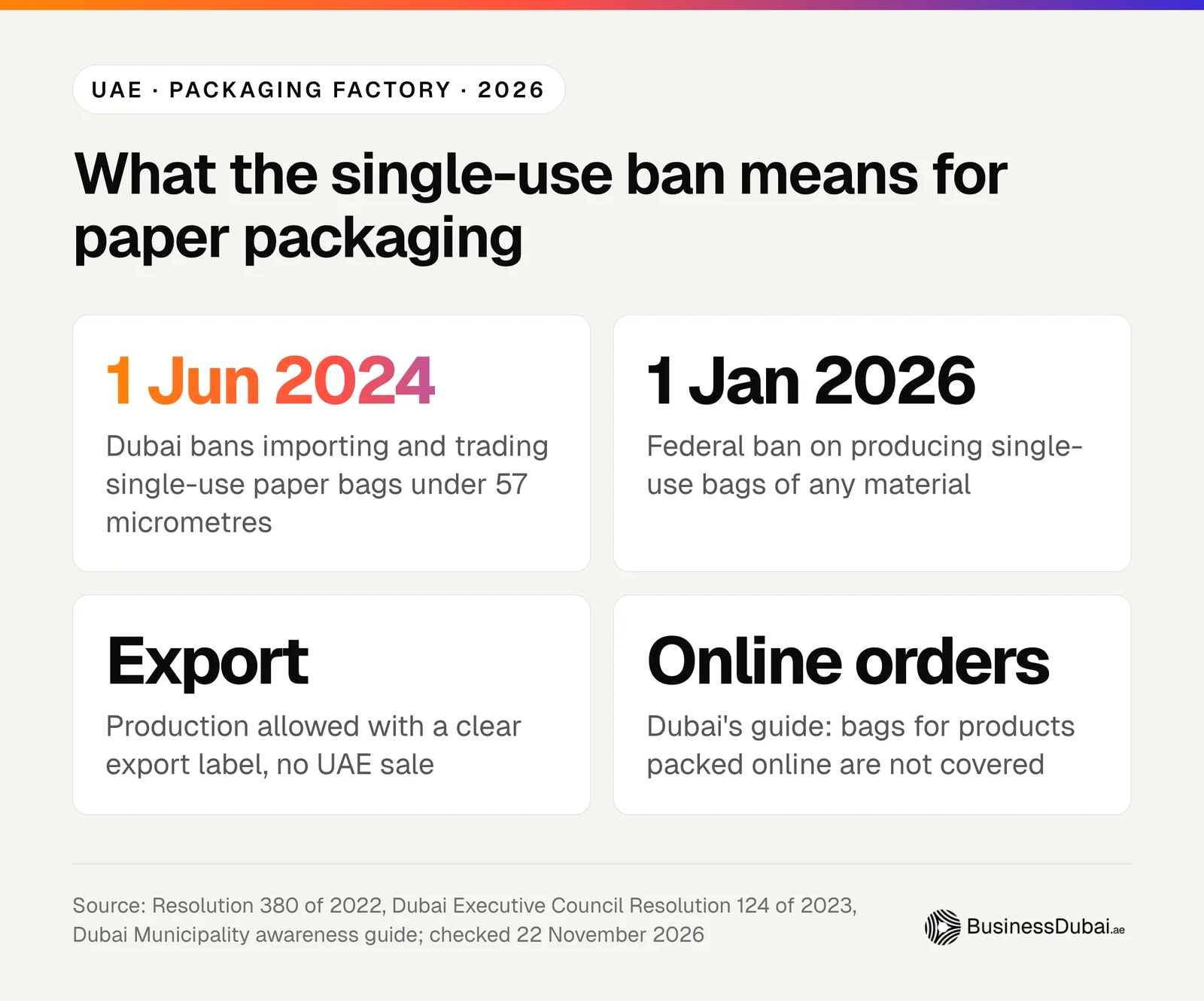
Federal production ban, Dubai trading ban
Resolution 380 of 2022, issued by the Ministry of Climate Change and Environment on 21 November 2022, prohibits import, production and circulation, applies in all free zones, and bans single-use plastic bags from 1 January 2024 and single-use bags of any material from 1 January 2026 [1]. Its 2026 consumer-product list is plastic only: beverage cups and lids, cutlery, plates, straws, stirrers and Styrofoam food boxes [1]. So the federal text reaches a paper bag factory directly, because it bans production, not only sale.
Dubai's resolution states that "the import and Trading of Single-use Products are prohibited", with "Non-plastic Single-use Products, including Single-use Bags: effective from 1 June 2024" [2]. It defines a single-use bag as "A biodegradable or other plastic bag, a paper bag, or a bag made of plant fibre whose thickness is less than fifty-seven (57) micrometres and which is used to carry and transport Commodities." [2]. The federal text sets no thickness [1], so outside Dubai, ask the emirate's authority which threshold it applies. Dubai Municipality's guide lists "Paper bags." among the banned types and says "The policy only covers single-use bags for carrying goods." [6], which is why bread bags and online mailers sit outside it and the shop-till carrier bag does not.
Fines and the export carve-out
Dubai's fine is "a fine of two hundred dirhams (AED 200.00)", doubled for a repeat within one year, and "A doubled fine must not exceed two thousand dirhams (AED 2,000.00)." [2]. Both texts exempt single-use shopping bags made for export: federally with a clear export label and no circulation in UAE markets [1], and in Dubai the products "must be clearly marked for export or re-export outside the UAE." [2]. A DECCA policy adviser told a Dubai Chamber webinar in February 2026, as reported by Wastes Recycling Magazine, that "Products manufactured for export are exempt." [7], a reported statement rather than law.
Common Mistake: Buying a paper carrier-bag line to supply UAE supermarkets in 2026. Paper feels like the safe swap for plastic, but the federal text prohibits producing single-use shopping bags of any material for the UAE market from 1 January 2026 [1], and Dubai has banned trading paper carrier bags under 57 micrometres since 1 June 2024 [2]. The line can run for export under a clear label, or switch to bread, produce and online-order bags. Price those markets before the machine.
Recycled content
Federally, single-use products made from materials recycled in the UAE are exempt as set out in a Ministry guide [1] we could not obtain. The DECCA adviser's reported Dubai position was that recycled content, "regardless of percentage", "is currently exempt, provided businesses can substantiate claims through invoices or" technical data sheets [7]. The word "currently" matters; get a written answer first.
Which activity codes does a packaging factory need in Dubai?
A Dubai packaging factory needs an Industrial DET activity for each product: 1702002 Corrugated Carton Boxes & Containers Manufacturing, 1702003 Paper Boxes & Containers Manufacturing, 1702004 Paper Bags Manufacturing, 1709019 Packaging Materials Manufacturing or 1709017 Self Adhesive Labels Manufacturing. Trading codes such as 4773964 are Commercial and do not license production.
The codes below are from DET's business activity list as recorded in a public copy of the register, Industrial unless marked [5], with the environmental category each carries in Dubai Municipality's April 2024 guidance [8].
| Code | Activity (DET register) | What the register says it covers | Environmental category |
|---|---|---|---|
| 1702002 | Corrugated Carton Boxes & Containers Manufacturing | Boxes "made of corrugated or non-corrugated carton" | C |
| 1702003 | Paper Boxes & Containers Manufacturing | "manufacture and printing of boxes" and packing bags | C |
| 1702004 | Paper Bags Manufacturing | "one layer or multiple layers bags for packaging and wrapping materials" | C |
| 1702006 | Core Paper Manufacturing | Paper tubes and cores | C |
| 1709001 | Disposable Paper Products Manufacturing | "disposable paper bowls, plates, dishes and straws"; no cups | C |
| 1709017 | Self Adhesive Labels Manufacturing | Labels, including "recutting, printing and preparation" | C |
| 1709019 | Packaging Materials Manufacturing | Packing materials "such as ordinary paper packs and packages" | C |
| 1811017 | Integrated Printing Press | Magazines, books, newspapers, commercial publications | B |
| 1701002 | Paper & Paperboard Manufacturing | A paper mill | A |
| 4773964 | Packing & Packaging Materials Trading | Commercial: reselling only | Not industrial |
| 4669101 | Waste Paper Trading | Commercial: "collecting and reselling recyclable paper waste" | Not industrial |
The code is a product decision: 1702002 for a corrugator plant, 1702003 for a folding-carton converter, 1702004 for a bag maker, plus 1709017 for labels. The 2220xxx group is plastics: 2220001 is "Disposable Plastic Cutlery Manufacturing." [5], the wrong family for paper. The register copy we read was last updated on 24 October 2023, so confirm current codes with DET. Free zones run their own lists and numbering.
Printing is already inside the box code
The register's description of 1702003 covers "manufacture and printing of boxes" [5], and 1709017 covers label printing. A converter printing its own boxes may not need the Integrated Printing Press code, whose description is written around publications [5]. Confirm in writing with DET or the zone, because 1811017 sits in a higher environmental category [8].
Common Mistake: Taking a commercial licence for boxes. A trading activity such as 4773964 Packing & Packaging Materials Trading lets you resell packaging, not run a corrugator [5], and packing-services activities are not manufacturing either. MoIAT's licence needs an "Industrial license from a local licensing department." [4], so a factory on a trading licence cannot reach the duty exemption. Fixing it later means an amendment, a premises approval and a fresh environmental application.
Can a UAE factory make paper cups, plates and straws in 2026?
A UAE factory making paper cups, plates or straws faces an open question, not a written ban. Federal Resolution 380 of 2022 names only plastic cups, plates and straws in its prohibitions. Dubai's Resolution 124 of 2023 bans trading non-plastic single-use products from 1 June 2024, but no Dubai Municipality or DECCA list we read names paper cups or plates.
The federal position
Resolution 380 of 2022 lists paper cups, wooden sticks and aluminium containers as examples of non-plastic single-use products within its scope, then prohibits only plastic consumer products from 2026 [1]. For paper cups, plates and straws that is silence, not permission.
The Dubai position
Dubai's text is wider. It defines a non-plastic single-use product as "Any product made from materials other than Plastic Materials, and designed for single-time use and subsequent disposal or recycling." [2]. Read literally, a paper cup or plate fits that wording, and the non-plastic phase has applied since 1 June 2024 [2]. Yet Dubai Municipality's guide and poster name bags and plastic items only [6], and the DECCA adviser's list of 2026 items named "lids for paper cups" [7], meaning the plastic lid, not the cup.
The lining question
Most paper cups are lined. Dubai defines single-use plastic products as "products manufactured partially or entirely from Plastic Materials" designed for one-time use, and its 1 January 2026 phase includes "single-use plastic beverage cups and lids" [2]. Whether a polyethylene-lined paper cup counts as paper or as partly plastic is not answered in anything we read. A PLA lining sits under the adviser's remark that biodegradable and PLA products are "temporarily exempt" [7], which is not law.
Real Talk: Do not buy a cup or plate machine on a reading of the text, ours included. Write to DECCA with the exact product, lining and lid, and ask whether it can be traded in Dubai; ask DET which code licenses a paper-cup line, since 1709001 names bowls, plates, dishes and straws but not cups [5]. The export exemptions are written for bags and plastic consumer products [1][2], so ask about export too, and keep the replies in your file.
Where should you locate a packaging factory in the UAE?
A UAE packaging factory belongs where you can lease industrial premises and hold an industrial paper-products activity: free zones such as Ajman Free Zone, RAKEZ, SPC Free Zone, Hamriyah, SAIF Zone, KEZAD and JAFZA, or Dubai mainland industrial areas. BusinessDubai.ae packages start at AED 5,555 licence-only; the factory unit is always quoted separately.
BusinessDubai.ae packages are company formation only. A packaging factory needs industrial premises and an industrial activity that the zone or DET approves and quotes separately; confirm the zone lists your paper activity before you sign. BusinessDubai.ae has no JAFZA, Hamriyah, SAIF Zone, KEZAD or Dubai Industrial City package [28].
| Location | BusinessDubai.ae package (licence only / 1 visa / 2 visas) | Industrial premises | Notes |
|---|---|---|---|
| Ajman Free Zone | AED 5,555 / 13,931 / 17,971 | Zone quote | Confirm the activity and unit |
| RAKEZ | AED 6,010 / 12,810 / 18,810 | Zone quote | Ras Al Khaimah |
| SPC Free Zone (Sharjah) | AED 5,765 / 15,055 / 19,505 | Zone quote | Confirm production is licensable |
| Meydan Free Zone or Dubai South | AED 12,500 / 21,850 / 28,400 | Not a factory location | A packaging brand or trading company can use them; a factory cannot |
| Hamriyah Free Zone or SAIF Zone (Sharjah) | No BusinessDubai.ae package | Zone quote | Price direct |
| KEZAD (Abu Dhabi) | No BusinessDubai.ae package | Zone quote | Price direct |
| JAFZA or Dubai Industrial City (Dubai) | No BusinessDubai.ae package | Zone quote | Price direct |
| Dubai mainland industrial areas | AED 18,200 without a visa / AED 26,900 with one visa | Landlord quote | Direct access to UAE buyers |
Sharjah has three of these zones, and our business setup in Sharjah page compares them. If Ajman's entry price suits a first unit, our business setup in Ajman page shows what it buys. Zone detail is in the Ajman Free Zone, RAKEZ and KEZAD guides and our ranking of the best free zones for manufacturing.
Free zone or mainland for a packaging factory?
A free zone does not take a paper bag line outside the ban: both resolutions apply in free zones [1][2]. The real differences are buyers, premises and tax.
| Factor | Free zone packaging factory | Dubai mainland packaging factory |
|---|---|---|
| Formation package (1 visa, BusinessDubai.ae) | From AED 12,810 (RAKEZ) to AED 15,055 (SPC) in the northern zones | AED 26,900 |
| Factory premises | Zone unit or land, zone quote | Industrial area lease, landlord quote |
| Selling cartons to UAE brands and fulfilment centres | Through customs into the local market; confirm with the zone | Direct |
| Environmental approval | The zone's own regime | DECCA environmental permit |
| Corporate tax | 0% possible on qualifying income as a Qualifying Free Zone Person | 0% to AED 375,000, 9% above |
| Year-two renewal | Zone renewal, quote from the zone | About AED 15,000 for the BusinessDubai.ae mainland package |
Our free zone company setup and mainland company setup pages itemise each route, including the renewal that the headline price leaves out.
Real Talk: Boxes are bulky and cheap per unit, so the cheapest licence is rarely the cheapest factory. Freight to buyers, dry storage for kraft reels and the size of the unit outweigh the AED 2,245 between the RAKEZ and SPC one-visa packages [28]. Get each zone's written quote for the licence, unit and year-two renewal.
Which environmental approvals does a packaging factory need in Dubai?
A Dubai carton, box, bag or label converter needs Environmental Clearance before production starts. Dubai Municipality's April 2024 guidance lists codes 1702002, 1702003, 1702004, 1702006, 1709001, 1709017 and 1709019 as Category C, reviewed in 3 working days. An integrated printing press is Category B and a paper mill Category A. DECCA now issues industrial permits.
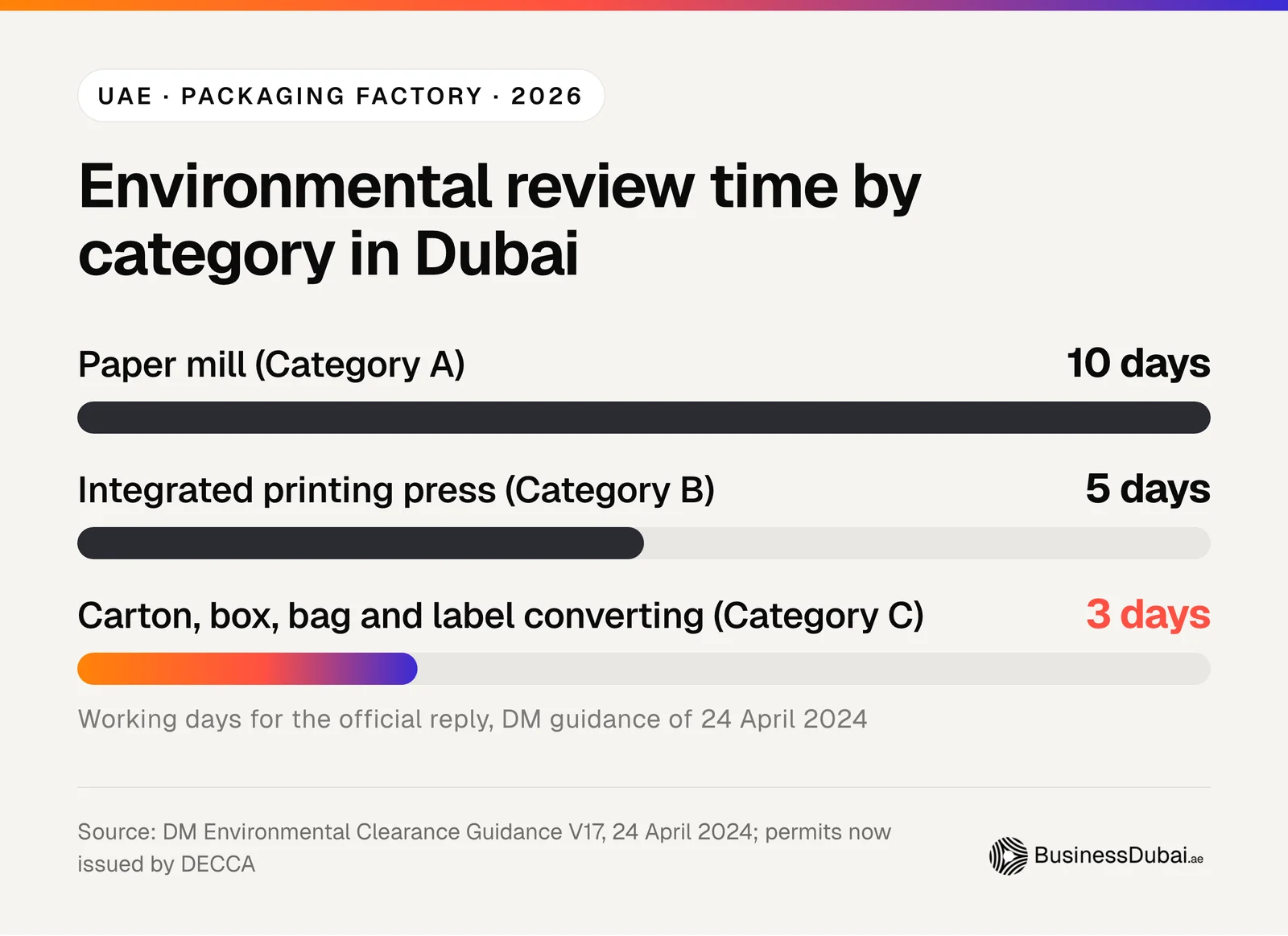
Dubai Municipality's Environmental Clearance guidance of 24 April 2024 states that "Environmental Clearance should be obtained before starting the industrial activities" [8]. Converting codes sit in its "List of Light Industrial Activities (Category C)", which needs an EIA checklist, and the review timeframe "is 3 working days" [8]. Category B needs an EIA Summary Report, where the timeframe "is 5 working days"; Category A needs a full EIA report, where it "is 10 working days" [8]. Only a licence based on an administrative office is excused [8].
The three review times are set out below by the kind of plant.
The move to DECCA
On 20 August 2026, Dubai Municipality announced that seven services had moved to the Dubai Environment and Climate Change Authority (DECCA), including "environmental permits for industrial projects" [9]. Whether DECCA kept the 2024 categories, fees and review times was not confirmed, so check the portal and requirements with DECCA. Free zones such as JAFZA run their own regimes; confirm with your zone.
Pro Tip: List every code you will use in the first environmental application, including any printing step. Converting is Category C, but an Integrated Printing Press and ink manufacturing are Category B [8], so a plant that adds a press later may need a different study. Ask DECCA at the start which document a mixed application needs, and design the layout once.
Inks, solvents and fire load
Dubai Municipality's solvents guideline (DM-HSD-GU43-SUOS2, version 4.0, issued 9 May 2024) applies to "all commercial and industrial establishments, public or government institutions, where industrial organic solvents are used", and its purpose clause names "paints and lacquers, adhesives, degreasing, dry cleaning, printing etc." [10]. Solvent-based flexo or gravure inks and solvent laminating adhesives bring its storage rules, such as "Smoking must be prohibited in and around storage areas." [10]. On water-based inks, check the data sheets before assuming it does not apply.
Civil Defence approval is required for industrial premises. Reels of kraft paper, board stock and finished cartons are a significant fire load, so raise storage heights, separation and sprinklers with your fire consultant before you sign the layout.
Do you need a media licence to print on boxes and labels in the UAE?
No UAE text we read says printing on packaging needs a media permit, and none exempts it. Federal Decree-Law No. 55 of 2023 regulates media content, and the government portal says "a media activity means the production, circulation, printing or publishing of media content." DET's code 1702003 already includes printing of boxes. Confirm in writing before ordering a press.
The UAE government portal gives that definition for Federal Decree-Law No. 55 of 2023, whose executive regulation is Cabinet Resolution No. 68 of 2024 [11]. Printing is in the definition, and so is "media content". Whether a brand name and a barcode on a carton are media content is the question no text we read answers. DET's register puts box printing inside 1702003 and label printing inside 1709017 [5], both Industrial activities. The part of the press market that clearly touches media rules is publications: the Integrated Printing Press code is described around magazines, books, newspapers and commercial publications [5].
Real Talk: This is the cheapest question in the file to ask and the most expensive to get wrong. Before you order a flexo or offset press, write to DET (or your free zone) and to the UAE Media Council describing exactly what you will print, especially if the press will also take catalogue or magazine jobs, and ask whether any licence or permit is needed beyond your industrial licence. Keep the written answer.
For the economics of print equipment, see our printing business guide; for the food's own label content, our UAE food labelling requirements guide.
What does the MoIAT Industrial Production Licence require and cost?
MoIAT's Industrial Production Licence requires a local industrial licence, at least 10 employees and at least AED 250,000 in capital. The application fee is AED 0 and the inspection fee AED 100, and MoIAT's FAQ gives the time as "Within 15 business days". Renewal costs AED 500, plus AED 100 inspection if needed.
MoIAT states why a packaging factory wants it: "This permit enables you to apply for exemptions from customs duties on the import of machinery, equipment, spare parts, and other materials directly involved in the manufacturing process." [4]. It requires a memorandum of association, the staff and capital thresholds and an "Industrial license from a local licensing department." [4]. The fees are the same for paper as for any factory.
| MoIAT service, 2026 | Fee | Time | Notes |
|---|---|---|---|
| Issue Industrial Production License | AED 0 application, AED 100 inspection | FAQ: "Within 15 business days" | An inspector visits the facility before issue [4] |
| Renew Industrial Production License | AED 500 application, AED 100 inspection if needed | 3 working days | Re-inspection "Only in case of location or activity change." [12] |
| Late renewal fine | AED 100 per month | Capped | "AED 100 per month up to a maximum of AED 1,000" [12] |
Pro Tip: Book the MoIAT inspection only when the line is running. The inspector visits after the AED 100 fee is paid [4], and the report decides the licence, so have the machines installed, the 10 employees on visas and paper in the store. Because a change of activity can bring a new inspection [12], plan any later bag or label line now rather than bolting it on.
How do you import kraft paper, board and inks without customs duty?
A UAE packaging factory with MoIAT's Industrial Production Licence registers each input by HS code at AED 100 per code, a service listed as "3 Working Days", then requests exemption on each shipment, an "Instant service". Kraft liner, fluting medium, board, inks and adhesives are the obvious inputs to register, subject to MoIAT approval.
MoIAT's registration service covers "raw materials, machinery, equipment, semi-finished or finished goods, and packaging materials, provided the industrial facility holds a valid industrial production license" [13]. The pages do not name kraft paper; liner, fluting, boxboard, inks, adhesives, dies and machines are the inputs to put forward, and MoIAT decides what it approves.
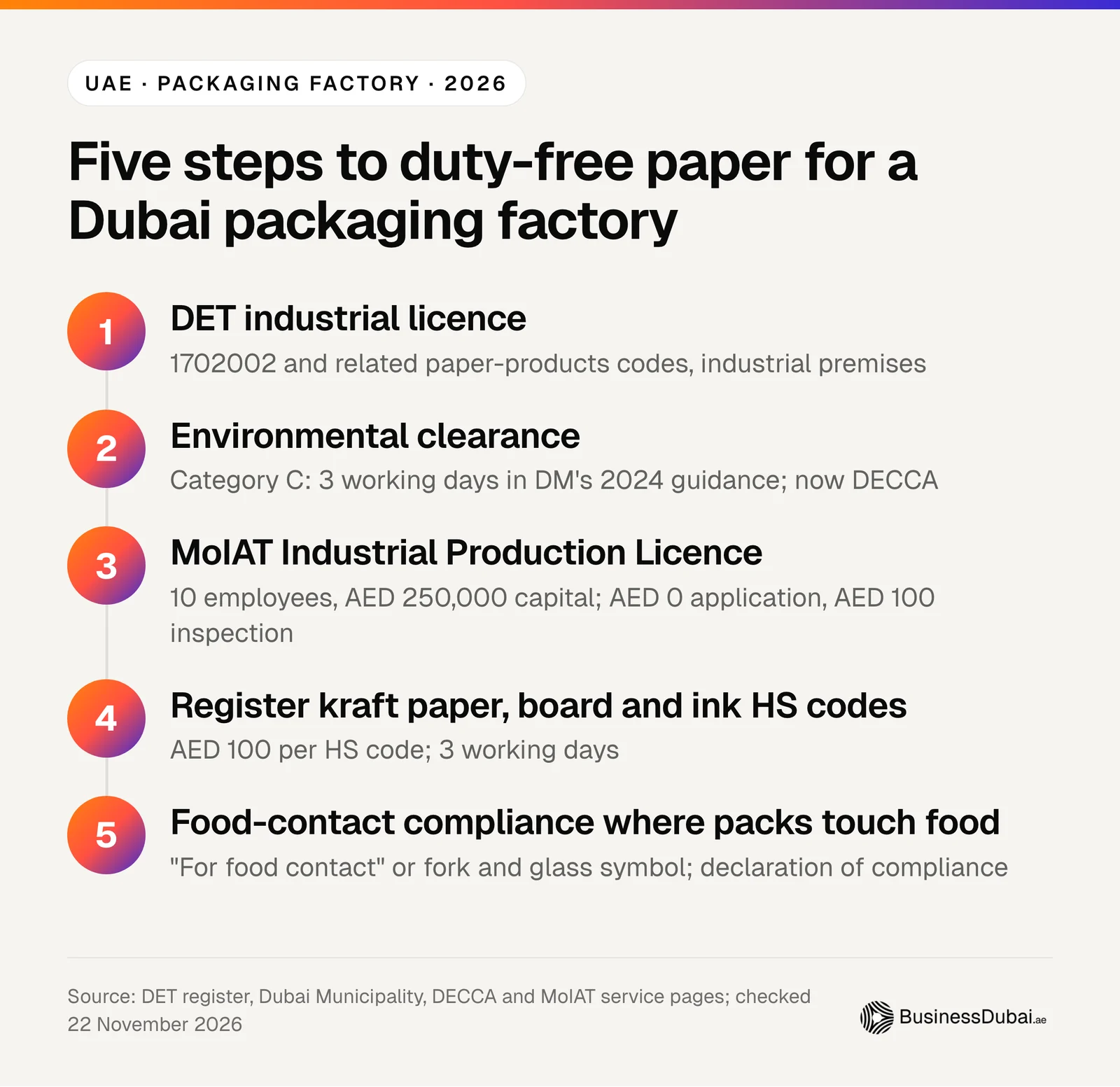
The five approvals that lead to duty-free paper are set out below.
Register, then draw down
Registration costs "100 dirhams for each HS code" with a service time of "3 Working Days" [13], and the approved quantity becomes a duty-free balance. Each shipment's exemption request costs AED 100 per HS code: "If approved, the quantity will be deducted from the factory’s balance." [14]. When orders grow, the fast track grants an instant exemption where the increase "does not exceed 30% of the previously registered quantity", for a quantity-increase fee of AED 50 [15].
Quick Math: Goods entering the UAE local market pay customs duty of "5% of the value CIF (Cost Freight Insurance) value except for alcohol and cigarettes/tobacco" [16]. An AED 400,000 kraft liner shipment entering the local market would pay AED 20,000 without the exemption. With it, the cost is MoIAT's AED 100 per registered HS code on the shipment [14], so liner and fluting under two codes cost AED 200 to exempt.
Common Mistake: Registering the paper and forgetting everything else. A corrugated plant also imports inks, corrugating adhesive, stitching wire and spare parts, and a container that lands before its HS code is registered has no balance to deduct from [13][14]. Draw up the full first-year input list during fit-out and register it in one pass.
A free zone plant exporting all its output may need the exemption less, since goods held in a zone are generally outside the local market; confirm with the zone and your port's customs authority. Our guide to Dubai Customs registration for import and export covers the customs code you need either way.
What food-contact rules apply to paper packaging made in Dubai?
Paper food packaging made in Dubai falls under Dubai Municipality's Technical Guidelines for Food Contact Materials (DM-HSD-GU132-FCM2, issued 24 July 2024), whose scope includes paper and board and printing inks. Packs need "for food contact" or the fork and glass symbol, traceability and, before retail, a declaration of compliance. The guideline sets no paper-specific limits.
The guideline's scope list includes "Paper and board", "Printing inks", "Adhesives", "Varnishes and coatings" and "Waxes" [17]. Out of scope are "Secondary packaging materials that do not come into contact with food directly." [17]. A shipping carton around sealed food tins is secondary packaging; a pizza box, a bakery box or a cup touches the food and is in scope.
What the guideline requires, and what it does not say
Materials must be food grade and "in compliance with the relevant GSO standards", made under "good manufacturing practice (or any food safety system or quality management that is acceptable to Dubai Municipality)" [17]. Articles not yet in contact with food carry the words "for food contact" or the fork and glass symbol, with the maker's name and contact details [17]. Operators need systems "to allow identification of the businesses from which and to which materials or articles" are supplied, and before retail the information can travel in a "declaration of compliance" [17].
The guideline contains no paper-specific migration limits, no rule on recycled fibre and no approved-ink list, and names no single GSO standard as a paper standard. MoIAT's regulated-product list we read names no paper packaging product, so do not assume a MoIAT conformity certificate is required for a paper box, or that it is not: ask.
Pro Tip: Start the food-contact file with your suppliers. Ask the board mill, ink and coating suppliers for food-contact declarations on each grade, and keep batch records linking each reel and ink lot to each customer order. The guideline's traceability and declaration rules [17] then become paperwork, not a recall.
What happens to your trim and waste paper, and where does recycled board come from?
A UAE packaging factory's trim and waste paper is a saleable product. Dubai Customs Notice No. 3 of 2024 replaced earlier temporary export bans with an export fee of AED 140 per ton on paper scrap under HS 470710 and 47079090. On the supply side, Star Paper Mill opened an AED 200 million recycled containerboard plant in KEZAD in 2026.
Dubai Customs suspended waste paper exports in 2022 and 2023, then Customs Notice No. 3 of 2024 levied export fees on industrial waste, including AED 140 per ton on paper scrap, stating "This Notice shall come into force as of 29/01/2024" [18]. The temporary export ban in Customs Notice No. 13 of 2026 covers iron, copper and aluminium scrap, not paper [19]. Confirm with Dubai Customs that the AED 140 fee still applies before you cost an export sale.
TradeArabia reported on 8 May 2026 that MoIAT's Minister inaugurated Star Paper Mill's AED 200 million KEZAD plant at Make it in the Emirates 2026, with an "annual production capacity of 135,000 tonnes of recycled containerboard", and that "The plant will recycle up to 80% of waste paper sourced domestically." [20]. For a converter, that means local board and a local buyer for trim, not a price or a promise.
Collecting other companies' waste paper is a different business, licensed under the Commercial code 4669101 Waste Paper Trading [5]; our waste management and recycling guide covers it.
Can UAE-made boxes claim UAE origin or CEPA preference?
UAE-made boxes and cartons can carry UAE origin once MoIAT issues a Value-Added Certificate, which needs a national component of at least 40% of total production cost, costs AED 1,000 plus AED 100 inspection and takes 5 working days. India's CEPA rule for Chapter 48 paper articles is a change of subheading plus 40% value addition.
MoIAT states: "The national component must represent at least 40% of the total production cost." [21]. The documents include "The factory's financial budget for the previous year, certified by an accredited audit firm." and raw material invoices [21], so a first-year factory has no audited prior year to show. Price first-year exports without an origin preference.
The India-UAE CEPA rules for paper and print
India's rules of origin for the India-UAE Comprehensive Economic Partnership Agreement give Chapter 48, "Paper and paperboard; articles of paper pulp, of paper or of paperboard.", the rule "CTSH + VA 40%", and Chapter 49 printed matter the same rule [22]. CTSH means a "change to this subheading from any other subheading", and "The percentages are on an FOB basis." [22]; on an ex-works basis "the value addition shall be 5 percentage points lower" [22]. Converting imported kraft paper into boxes usually changes subheading, but check your HS codes with a customs adviser.
Real Talk: The subheading test is usually the easy one; the 40% is hard. Paper can be the largest cost in a plain carton, so a converter of imported liner into low-priced boxes may miss 40%, while printed, die-cut packs carry more value added. UAE-made recycled containerboard [20] may change the arithmetic, so ask MoIAT how domestic board counts before you build an export price on it.
What labour and Emiratisation rules apply to a packaging factory?
A UAE packaging factory with "50 or more workers earning a wage of AED 1,500 or less per month must provide accommodation for their workers" under Ministerial Resolution No. 44 of 2022 and register in MoHRE's Labour Accommodation System. MoIAT's licence needs at least 10 employees. Confirm Emiratisation targets for your headcount with MoHRE.
The UAE government portal sets out the rule and the registration with the Ministry of Human Resources and Emiratisation (MoHRE) [23]. A corrugator running shifts can reach 50 operators quickly, and housing then becomes a fixed monthly cost. Our Emiratisation 2026 guide covers the targets.
How is a packaging factory taxed in the UAE?
Packaging manufacturing is a Qualifying Activity under Ministerial Decision No. 229 of 2025, so a free zone carton plant selling to manufacturers, food companies, e-commerce fulfilment and exporters can pay 0% corporate tax. Sales to individual consumers are excluded. A mainland factory pays 0% to AED 375,000 and 9% above. Exports are zero-rated for VAT; local sales carry 5%.
Ministerial Decision No. 229 of 2025 defines the Qualifying Activity: "Manufacturing of goods or materials includes the production, improvement or assembly of products and materials from raw materials or components." [24]. Turning reels of liner into printed boxes fits that wording. The Decision excludes "Any transactions with natural persons", with exceptions that do not include manufacturing [24].
Non-qualifying revenue is tolerated where it "does not exceed 5% (five percent) of the total Revenue of the Qualifying Free Zone Person in that Tax Period or AED 5,000,000 (five million dirhams), whichever is lower" [24]. Beyond it, the company will "cease to be a Qualifying Free Zone Person from the beginning of the relevant Tax Period and for the subsequent (4) four Tax Periods" [24], and pays the ordinary rates, 0% on the first AED 375,000 and 9% above, from the start of that period [25]. Our Qualifying Free Zone Person guide sets out every condition.
| Packaging factory profile | Corporate tax | VAT on sales |
|---|---|---|
| Free zone carton plant selling to manufacturers, food companies, fulfilment centres and exporters | 0% possible on qualifying income as a QFZP [24] | Exports outside the GCC zero-rated; UAE sales 5% [26] |
| Free zone plant also selling gift boxes online to individuals | Sales to individuals count against the de minimis limit; above it, ordinary rates and loss of QFZP for four more periods [24][25] | 5% on UAE sales |
| Mainland packaging factory | 0% to AED 375,000, 9% above [25] | 5% locally, exports zero-rated [26] |
| Small factory with revenue at or under AED 3,000,000 | Small Business Relief for tax periods ending on or before 31 December 2029, but not for a QFZP [27][25] | As above |
Quick Math: A mainland packaging factory with AED 1,200,000 of taxable profit pays nothing on the first AED 375,000 and 9% on the remaining AED 825,000 [25], which is AED 74,250. A free zone carton plant selling only to businesses and exporters, meeting every QFZP condition, can pay 0% on the same profit [24].
Common Mistake: Running a consumer web store for moving boxes or gift packaging from the free zone factory company. Every carton sold to an individual counts against the lower of 5% of revenue or AED 5,000,000 [24]. Run retail through a separate mainland company buying at arm's length; our e-commerce business guide covers that licence.
Our Small Business Relief guide explains the AED 3,000,000 threshold, and the VAT registration and compliance guide covers export zero-rating evidence. To see which route fits your sales mix, model your tax position with an adviser→
What does a packaging factory cost to set up in the UAE?
A UAE packaging factory's formation cost runs from AED 12,810 for a RAKEZ package with one visa to AED 26,900 for a Dubai mainland package with one visa, at BusinessDubai.ae standard prices. MoIAT fees start at AED 100. The large costs, the factory unit, the machines and the environmental work, are quoted separately.
Package prices are BusinessDubai.ae's standard pricing as of November 2026 [28]; rows marked "quote" are not estimated, because any figure there would be invented.
| Cost item | Amount (AED) | Notes |
|---|---|---|
| Company formation, Ajman Free Zone, 1 visa | 13,931 | Licence only 5,555, two visas 17,971 [28] |
| Company formation, RAKEZ, 1 visa | 12,810 | Licence only 6,010, two visas 18,810 [28] |
| Company formation, SPC Free Zone, 1 visa | 15,055 | Licence only 5,765, two visas 19,505 [28] |
| Company formation, Dubai mainland | 18,200 without a visa, 26,900 with one visa | Premises and approvals extra [28] |
| Industrial premises (factory unit or land) | Zone or landlord quote | A desk package does not qualify |
| Environmental checklist or study | Consultant quote | Category C for converting; fee and portal to confirm with DECCA [9] |
| MoIAT Industrial Production Licence | 100 | AED 0 application, AED 100 inspection [4] |
| Input registration, per HS code | 100 each, plus 100 inspection | Five codes cost AED 500 [13] |
| Value-Added Certificate | 1,100 | AED 1,000 plus AED 100 inspection, after the first audited year [21] |
| Corrugator, printer-slotter, die-cutter, folder-gluer or bag machine | Supplier quote | Duty-exempt once registered with MoIAT |
| Worker accommodation | Licensed provider quote | Mandatory at 50 workers on AED 1,500 or less a month [23] |
| Year two: mainland package renewal | About 15,000 | BusinessDubai.ae mainland package renewal [28] |
| Year two: MoIAT licence renewal | 500, plus 100 inspection if needed | Late fine up to AED 1,000 [12] |
| Capital requirement for MoIAT | 250,000 | Capital, not a fee [4] |
The capital, the premises and the machines decide whether the factory exists; government fees barely register. A founder budgeting AED 15,000 has priced the company, not the factory.
For an itemised quote that sets the package next to the zone's industrial premises quote, get a free setup quote→
In what order should you set up a packaging factory?
A UAE packaging factory is set up in a fixed order: check every product against the single-use rules, confirm the activity codes, secure industrial premises, obtain the industrial licence and environmental clearance, settle the printing question, hire at least 10 employees, then apply for MoIAT's Industrial Production Licence, which takes "Within 15 business days" by MoIAT's FAQ.
- Check each product against Resolution 380 of 2022 and, for Dubai, Resolution 124 of 2023 [1][2].
- Get written positions from DECCA on any cup, plate or food delivery box, and from DET or the zone on each code [5].
- Secure industrial premises in a zone or area that lists your paper activity.
- Obtain the local industrial licence with every product code.
- Apply for environmental clearance, Category C for converting, now with DECCA in Dubai [8][9].
- Settle the printing question in writing [11], and plan Civil Defence approval.
- Hire the first 10 employees [4].
- Install the machines, then apply for the Industrial Production Licence [4].
- Register each input HS code, 3 working days and AED 100 per code [13].
- Set up food-contact compliance for any pack that touches food [17].
- Request the exemption on each shipment at AED 100 per HS code [14], and diarise renewals, tax returns and the Value-Added Certificate [12][21].
Year two is when this calendar becomes someone's job. Our post-setup services team runs renewals, visas and filings so they do not land in your peak season.
Which setup fits your packaging business?
The right UAE packaging setup depends on what you make and who buys it. A corrugated box plant suits a northern free zone or the mainland with the MoIAT licence; a carton and label printer must settle the printing question; a paper bag maker must pivot to export or exempt bags. Match your profile below.
| Profile | Licence and codes | Location | Ban position | Tax angle |
|---|---|---|---|---|
| Corrugated box plant for e-commerce and FMCG | 1702002, plus 1709017 for labels | Northern free zone, KEZAD or Dubai mainland | Boxes not named | QFZP 0% possible on B2B sales |
| Folding carton and label printer | 1702003 and 1709017; 1811017 only for publications | Free zone or mainland | Not named; settle printing in writing | QFZP possible without consumer sales |
| Paper bag maker pivoting | 1702004 | Free zone with a factory unit | Carrier bags export-only; bread, produce and online-order bags outside Dubai's ban | QFZP possible |
| Food box and cup converter | 1709001 or 1709019 as DET confirms, plus 1702003 | Mainland, close to food buyers | Cups, plates and delivery boxes open in Dubai; plastic lids banned | Ordinary rates on local sales |
| Recycled board trader moving into converting | Commercial 4669101 or 4773964 now; add 1702002 | KEZAD or a northern free zone | Not named | Trading income tested separately from manufacturing |
Real Client Stories
These are composite examples built from the situations packaging factory founders most often face in the UAE. Names and details are illustrative, and the only figures used are published government fees and BusinessDubai.ae's package prices.
The paper bag line that had to change customers (Ajman Free Zone)
A founder set up a paper bag line in Ajman Free Zone on the AED 13,931 one-visa package, with the factory unit on the zone's separate quote. His plan was carrier bags for supermarkets switching away from plastic. From 1 January 2026, federal law prohibited producing single-use shopping bags of any material for the UAE market, and Dubai had already banned trading them below 57 micrometres. He kept the machine and changed the order book: bread bags for bakeries, mailer bags for online sellers, and export cartons of carrier bags with a clear export label on every pack. The lesson: paper is not automatically outside the ban.
The box plant that registered the paper and forgot the ink (Dubai mainland)
A corrugated box plant on the Dubai mainland, formed on the AED 26,900 one-visa package, held its MoIAT licence and registered kraft liner and fluting at AED 100 per HS code before its first shipment. Its first ink and adhesive consignment had not been registered, so it paid customs duty at 5% of CIF value while registration, listed at 3 working days, went through. When e-commerce orders rose, the plant used the fast-track service for an increase within 30% of its registered quantity, at AED 50. The lesson: register every input on the first-year list, not just the paper.
The cup line that waited for an answer (SPC Free Zone)
A converter in SPC Free Zone, set up on the AED 15,055 one-visa package, planned a paper cup line for Dubai cafés, with plastic lids from an outside supplier. Plastic lids for paper cups were among the items banned in Dubai from 1 January 2026, and nothing published said whether a lined paper cup was a paper or a partly plastic product. The founder wrote to DECCA with the cup, lining and lid specifications, and asked the zone which activity covered cups, before ordering the cup former. Meanwhile the folding-carton line ran printed confectionery cartons, outer packs that never touch the food. The lesson: get the written position before the machine.
Start your packaging factory the right way
For a paper packaging factory, the licence is the easy part. What decides the business is which products the single-use rules let you sell locally, whether the MoIAT licence is in place before the first kraft reels land, whether printing is settled in writing, and whether a free zone plant keeps consumer sales outside the company.
BusinessDubai.ae has set up companies across the UAE since 2013, with itemised pricing and no hidden fees. We will price a free zone company setup in Ajman, Sharjah or Ras Al Khaimah against a mainland company setup in Dubai on what actually differs for a factory: premises, buyers, the product list and tax. Our post-setup services team then handles visas, renewals and filings while you run production. Talk to a setup expert→
If your packaging is plastic film, trays or containers rather than paper, see our plastic factory guide; for a sewn-products factory under the same MoIAT sequence, the garment factory guide.
Frequently Asked Questions
Are paper bags banned in the UAE in 2026?
Single-use paper carrier bags are. Federal Resolution No. 380 of 2022 prohibits producing or circulating single-use shopping bags of any material from 1 January 2026, and Dubai has banned trading paper bags under 57 micrometres since 1 June 2024. Bread bags and export-labelled bags are treated differently.
Can I manufacture paper carrier bags in the UAE for export?
Yes. Resolution 380 of 2022 exempts single-use shopping bags prepared for export or re-export, provided they carry a clear label showing the purpose of production is export and are not circulated in UAE markets. Dubai's resolution has the same marking rule.
What thickness makes a paper bag single-use in Dubai?
Dubai's Executive Council Resolution No. 124 of 2023 defines a single-use bag as a plastic, paper or plant-fibre bag whose thickness is less than 57 micrometres and which is used to carry goods. The federal Resolution 380 of 2022 sets no thickness figure, so outside Dubai, ask the emirate's authority.
Are bags used for online orders covered by Dubai's ban?
No, according to Dubai Municipality's awareness guide, which says the ban does not include bags used for products packaged online. The same guide exempts bread bags and produce wrapping bags in Dubai.
Are paper cups banned in Dubai?
No published Dubai list names paper cups, but the answer is not settled. Dubai's Resolution 124 of 2023 bans trading non-plastic single-use products from 1 June 2024 and defines them broadly, and plastic lids for paper cups are banned. Get DECCA's written position on your exact cup, lining and lid before investing.
Are paper plates and paper straws banned in the UAE?
The federal Resolution 380 of 2022 names only plastic plates and straws in its prohibitions. In Dubai, the broad non-plastic single-use category could reach paper plates and straws, but no Dubai Municipality or DECCA list we read names them. Ask DECCA in writing before you buy a line.
Does the single-use ban affect corrugated boxes and cartons?
Neither the federal Resolution 380 of 2022 nor Dubai Municipality's published lists name corrugated boxes, shipping cartons or folding cartons, and both resolutions apply in free zones. Food delivery boxes in Dubai are worth a written check with DECCA.
What is the DET activity code for carton box and paper bag manufacturing?
DET code 1702002 Corrugated Carton Boxes & Containers Manufacturing covers corrugated and non-corrugated carton boxes, 1702003 Paper Boxes & Containers Manufacturing covers paper boxes including their printing, and 1702004 Paper Bags Manufacturing covers bags. All are Industrial activities in the register.
Which activity code covers paper cup manufacturing?
No DET code we read names paper cups. Code 1709001 Disposable Paper Products Manufacturing covers paper bowls, plates, dishes and straws, and 1709019 Packaging Materials Manufacturing covers ordinary paper packs. Ask DET in writing which code licenses your cup line.
Can I make boxes under a trading or packaging services licence?
No. Trading codes such as 4773964 Packing & Packaging Materials Trading are Commercial and cover reselling, not production. A factory needs an Industrial code, and MoIAT's Industrial Production Licence requires an industrial licence from the local licensing department.
Do I need a separate licence or Media Council permit to print my own boxes?
Nothing we read requires one, and nothing exempts it. DET's code 1702003 already includes printing of boxes, and Federal Decree-Law No. 55 of 2023 regulates printing of media content. Before ordering a press, ask DET or your zone and the UAE Media Council in writing, especially if the press will also print publications.
Which environmental category is a carton or paper bag factory in Dubai?
Category C, light industrial. Dubai Municipality's April 2024 guidance lists the carton, box, bag, core, plate, label and packaging-materials codes as Category C, reviewed in 3 working days. An integrated printing press is Category B and a paper mill Category A.
Who issues environmental permits for factories in Dubai now?
The Dubai Environment and Climate Change Authority (DECCA). Dubai Municipality announced on 20 August 2026 that environmental permits for industrial projects had moved to DECCA. Confirm the current portal, fees and review times with DECCA.
Do solvent-based printing inks bring extra rules in Dubai?
Yes. Dubai Municipality's guideline on industrial organic solvents, version 4.0 of 9 May 2024, applies where industrial organic solvents are used and names printing among the uses. It sets storage rules such as cool, ventilated storage away from ignition sources and no smoking.
Do I need Civil Defence approval for a packaging factory?
Yes. Civil Defence approval is required for industrial premises in the UAE, and reels of paper and finished cartons are a significant fire load to raise with your fire consultant early.
What are the MoIAT Industrial Production Licence requirements?
MoIAT requires a memorandum of association, at least 10 employees, total capital of at least AED 250,000 and a local industrial licence. The application fee is AED 0 and the inspection fee AED 100, as of 2026, and MoIAT's FAQ gives the time as within 15 business days.
Can a packaging factory import kraft paper duty-free in the UAE?
Yes, once it holds MoIAT's Industrial Production Licence and registers each input. Registration costs AED 100 per HS code and takes 3 working days, then each shipment is exempted instantly at AED 100 per HS code. MoIAT decides which inputs it approves.
How much duty does the MoIAT exemption save on kraft liner?
Dubai Customs charges 5% of CIF value on goods entering the local market, so an AED 400,000 kraft liner shipment would pay AED 20,000 in duty. With the MoIAT exemption, the cost is AED 100 per registered HS code on the shipment.
Do paper food boxes and cups need approval in Dubai?
They must meet Dubai Municipality's Technical Guidelines for Food Contact Materials, issued 24 July 2024, which cover paper and board and printing inks: food-grade materials, the words "for food contact" or the fork and glass symbol, traceability and a declaration of compliance before retail.
Does a shipping carton for packed food need to meet food-contact rules?
Not if it never touches the food. Dubai Municipality's food-contact guideline excludes secondary packaging materials that do not come into contact with food directly, so an outer carton around sealed tins or wrapped products is out of its scope. A pizza box or bakery box is in scope.
Can I export waste paper from Dubai?
Yes, subject to an export fee. Dubai Customs Notice No. 3 of 2024 set an export fee of AED 140 per ton on paper scrap from 29 January 2024, after temporary bans in 2022 and 2023. The 2026 scrap export ban covers iron, copper and aluminium, not paper. Confirm the fee still applies.
Do UAE-made cartons qualify for lower duty into India under CEPA?
They can. The India-UAE CEPA rule for Chapter 48 paper and paperboard articles is a change of tariff subheading plus 40% value addition on an FOB basis, or 5 points lower on an ex-works basis. The 40% value addition is usually the harder test for a converter of imported paper.
Is a free zone packaging factory eligible for 0% corporate tax?
Yes, if it meets the QFZP conditions. Manufacturing is a Qualifying Activity under Ministerial Decision No. 229 of 2025, so sales to businesses and exporters can be taxed at 0%. Sales to individuals are excluded and must stay within the lower of 5% of revenue or AED 5,000,000.
What corporate tax does a mainland packaging factory pay?
A mainland packaging factory pays 0% on taxable profit up to AED 375,000 and 9% above. On AED 1,200,000 of profit, that is AED 74,250. Small Business Relief is available for revenue at or under AED 3,000,000 for tax periods ending on or before 31 December 2029.
How much does it cost to set up a packaging factory in the UAE?
Company formation at BusinessDubai.ae standard prices runs from AED 12,810 for a RAKEZ package with one visa to AED 26,900 for a Dubai mainland package with one visa. Premises, machines and the environmental work are quoted separately, and MoIAT requires AED 250,000 in capital.
Does a packaging factory need to house its workers?
Yes, once it has 50 or more workers earning AED 1,500 or less a month. Ministerial Resolution No. 44 of 2022 requires those establishments to provide accommodation and register in MoHRE's Labour Accommodation System.
References
[1] UAE Ministry of Climate Change and Environment. Ministerial Resolution No. 380 of 2022 Regarding Regulating the Use of Single-use Products, 21 November 2022 (official Arabic text): definitions and scope including all free zones, the examples of non-plastic single-use products including paper cups, Article 4 prohibition of import, production or circulation with the 2024 and 2026 lists, and Article 5 exemptions for export-labelled products and materials recycled in the State. Read from the Arabic text; quoted in English only as paraphrase. faolex.fao.org (PDF)
[2] Government of Dubai. Executive Council Resolution No. (124) of 2023 Regulating the Use of Single-use Products in the Emirate of Dubai, issued 30 December 2023: definitions of Single-use Product, Single-use Bag, Single-use Plastic Products, Single-use Non-plastic Products and Trading, scope including free zones, the phased prohibition of import and trading, export exemptions and marking, and fines. dlp.dubai.gov.ae
[3] Zawya. "EZDubai Logistics Hub: UAE e-commerce market size reaches AED 42.2bln in 2025", press release reporting an EZDubai Logistics Hub report: UAE e-commerce of AED 42.2 billion in 2025. A market report, not official statistics. zawya.com
[4] Ministry of Industry and Advanced Technology (MoIAT). Issue Industrial Production License service card and FAQ: memorandum of association, at least 10 employees, at least AED 250,000 capital, local industrial licence, AED 0 application and AED 100 inspection fees, the "Within 15 business days" FAQ answer and the customs exemption benefit; checked 22 November 2026. moiat.gov.ae
[5] Dubai Department of Economy and Tourism (DET). Business activity list as recorded in a public copy of the register: paper and packaging codes 1702002, 1702003, 1702004, 1702006, 1709001, 1709017, 1709019, 1811017 and 1701002 (Industrial), trading codes 4773964 and 4669101 (Commercial) and plastics code 2220001, with official descriptions; DET records last updated 24 October 2023. visaindubai.ae
[6] Dubai Municipality. The Awareness Guide for Regulating the Use of Single-Use Products in the Emirate of Dubai: banned bag types including paper bags, exempt bags including bread bags, trash bin liners and bags thicker than 57 micrometres, online-order bags and the scope of the bag policy. dmpmedia.dm.gov.ae (PDF)
[7] Wastes Recycling Magazine. "Businesses urged to comply with 2026 single-use plastic rules", 17 February 2026: statements of a DECCA policy strategy adviser at a Dubai Chamber webinar on the 2026 items including lids for paper cups, export, recycled content and biodegradable and PLA products. A trade press report of an official's remarks, not legal text. wasterecyclingmag.com
[8] Dubai Municipality. Guidance on the Environmental Clearance (EC) Requirements for Development, Infrastructure and Industrial Projects in the Emirate of Dubai, version 17, 24 April 2024: Categories A, B and C, review timeframes of 10, 5 and 3 working days, the administrative office exception, and the annex lists placing paper converting codes in Category C, printing and ink codes in Category B and paper manufacturing in Category A. dmpmedia.dm.gov.ae (PDF)
[9] Dubai Municipality. Announcement of 20 August 2026 restructuring 20 services: seven services transferred to the Dubai Environment and Climate Change Authority, including environmental permits for industrial projects. dm.gov.ae
[10] Dubai Municipality, Health and Safety Department. Technical Guidelines for Safe Use of Industrial Organic Solvents, DM-HSD-GU43-SUOS2, version 4.0, issued 9 May 2024: scope, the purpose clause naming printing and adhesives, and storage rules. dmpmedia.dm.gov.ae (PDF)
[11] UAE Government portal (u.ae). Media regulation: Federal Decree-Law No. 55 of 2023 on media regulation and the definition of a media activity as the production, circulation, printing or publishing of media content; checked 22 November 2026. u.ae
[12] Ministry of Industry and Advanced Technology (MoIAT). Renew Industrial Production License: AED 500 application, AED 100 inspection if needed, 3 working days, re-inspection only on location or activity change, and the late renewal fine; checked 22 November 2026. moiat.gov.ae
[13] Ministry of Industry and Advanced Technology (MoIAT). Request Registration of Industrial Input for Customs Duty Exemption: items covered including raw materials and packaging materials, AED 100 per HS code plus AED 100 inspection and 3 working days; checked 22 November 2026. moiat.gov.ae
[14] Ministry of Industry and Advanced Technology (MoIAT). Request Customs Duty Exemption for Industrial Inputs: AED 100 per HS code, instant service and deduction from the factory balance; checked 22 November 2026. moiat.gov.ae
[15] Ministry of Industry and Advanced Technology (MoIAT). Fast Track Customs Exemption Request: instant exemption where the increase does not exceed 30% of the registered quantity, and the AED 50 quantity-increase fee; checked 22 November 2026. moiat.gov.ae
[16] Dubai Customs. Dubai Customs Service Guide, version 9 (2025): customs duty of 5% of CIF value. dubaicustoms.gov.ae (PDF)
[17] Dubai Municipality, Health and Safety Department. Technical Guidelines for Food Contact Materials, DM-HSD-GU132-FCM2, version 1.0, issued 24 July 2024: scope including paper and board, printing inks, adhesives, varnishes and coatings and waxes, the exclusion of secondary packaging, food-grade materials, good manufacturing practice, labelling, traceability and the declaration of compliance. dmpmedia.dm.gov.ae (PDF)
[18] Dubai Customs. Customs Notice No. (03/2024) Enforcing Industrial Waste Management Policy, issued 13 February 2024, in force from 29 January 2024: export fee of AED 140 per ton on paper scrap under HS 470710 and 47079090. It followed the temporary export suspensions of iron scrap and waste paper in Customs Notices No. 07/2022 and No. 05/2023. dubaicustoms.gov.ae (PDF)
[19] Dubai Customs. Customs Notice No. 13 of 2026: temporary prohibition on exporting waste and scrap of iron, copper and aluminium. dubaicustoms.gov.ae (PDF)
[20] TradeArabia. "$54.4m recycled containerboard plant opens in KEZAD", 8 May 2026: Star Paper Mill's AED 200 million plant inaugurated at Make it in the Emirates 2026, its 135,000 tonne annual capacity and the domestic waste paper statement. A press report of a company statement. tradearabia.com
[21] Ministry of Industry and Advanced Technology (MoIAT). Issue Value-Added Certificate: the 40% national component threshold, AED 1,000 plus AED 100 inspection, 5 working days and the prior-year audited budget; checked 22 November 2026. moiat.gov.ae
[22] Government of India. Customs Tariff (Determination of Origin of Goods under the Comprehensive Economic Partnership Agreement between India and the United Arab Emirates) Rules, 2022, Annexures: the Chapter 48 and Chapter 49 product-specific rules, the definitions of CTSH and VA, and the FOB and ex-works bases. Read from a mirror of the Gazette PDF. taxguru.in
[23] UAE Government portal (u.ae). Labour accommodation: Ministerial Resolution No. 44 of 2022 and the duty to house 50 or more workers earning AED 1,500 or less a month, with registration in MoHRE's Labour Accommodation System; checked 22 November 2026. u.ae
[24] UAE Ministry of Finance. Ministerial Decision No. 229 of 2025 Regarding Qualifying Activities and Excluded Activities: manufacturing as a Qualifying Activity and its definition, transactions with natural persons as an Excluded Activity, the de minimis test and loss of status. mof.gov.ae
[25] UAE Ministry of Finance. Corporate tax under Federal Decree-Law No. 47 of 2022: rates of 0% up to AED 375,000 and 9% above, and the conditions for Qualifying Free Zone Persons. mof.gov.ae
[26] Federal Tax Authority. VAT under Federal Decree-Law No. 8 of 2017: the 5% standard rate and zero-rating of exports outside the GCC. tax.gov.ae
[27] UAE Ministry of Finance. Ministerial Decision No. 73 of 2023 on Small Business Relief, as amended by Ministerial Decision No. 131 of 2026: the AED 3,000,000 revenue threshold and tax periods ending on or before 31 December 2029. mof.gov.ae
[28] BusinessDubai.ae. Internal pricing data: 2026 standard package prices for Dubai mainland, Ajman Free Zone, RAKEZ, SPC Free Zone, Meydan Free Zone and Dubai South by visa count, and the mainland renewal figure, as of November 2026. businessdubai.ae