

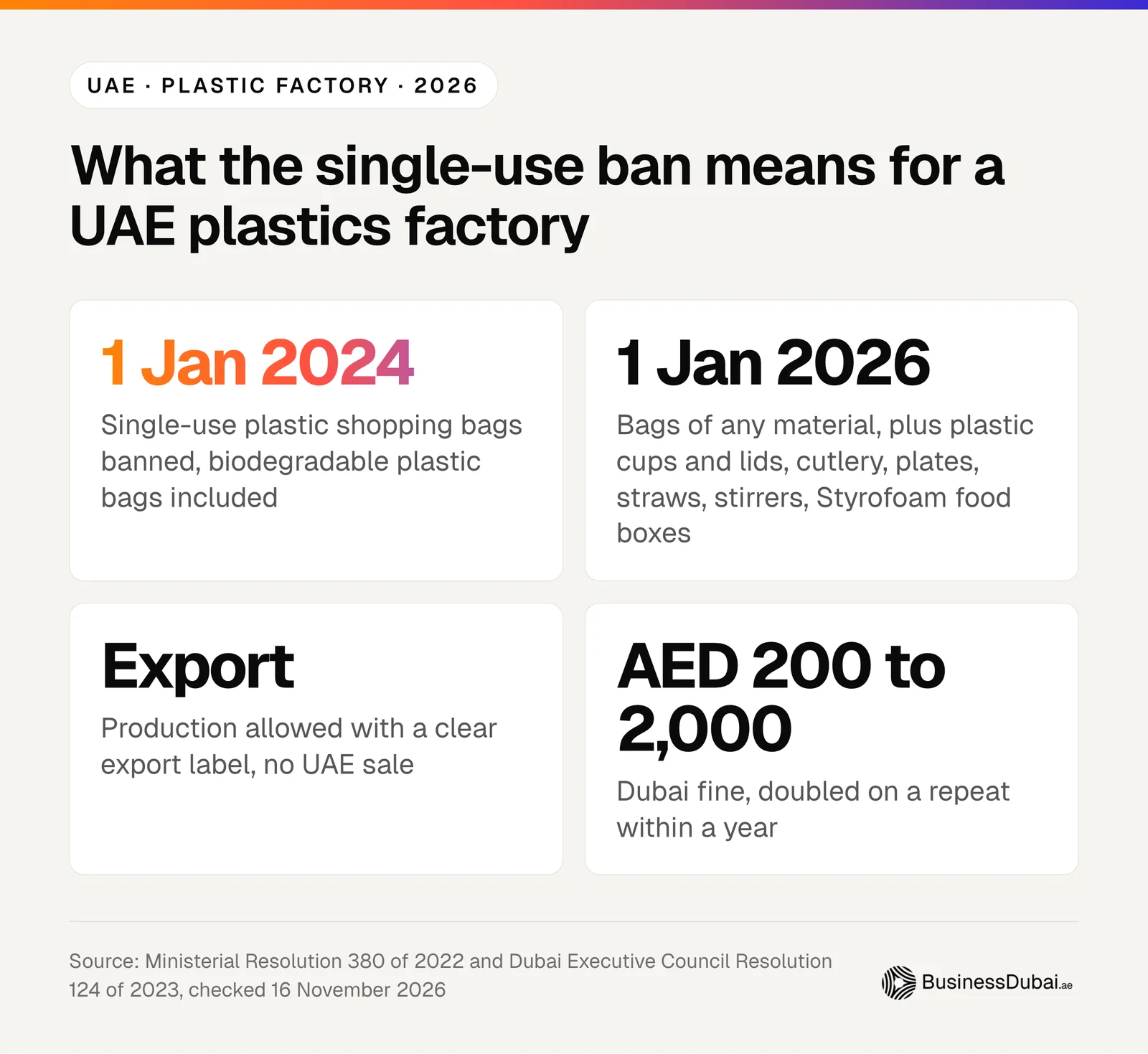
A plastics factory in the UAE is the one manufacturing setup where federal law has already written part of your product list. Since 1 January 2026, Ministerial Resolution No. 380 of 2022 has prohibited the import, production or circulation of single-use plastic beverage cups and lids, cutlery, plates, straws, stirrers and Styrofoam food boxes, on top of the single-use plastic shopping bags banned from 1 January 2024 [1]. A cutlery line bought for the local market in 2026 is a line that can only run for export.
The rest of the setup is an industrial file with a valuable prize at the end. The Ministry of Industry and Advanced Technology (MoIAT) licenses factories with a "Total of no fewer than 10 employees." and a "Total capital of no less than AED 250,000." [2], and that licence is what opens customs exemption on resin, masterbatch and moulds. This guide is general information, not legal or tax advice; confirm your own position with the authority or a licensed adviser before you sign a lease or order a line.
Since 2013, BusinessDubai.ae has set up mainland and free zone companies across the UAE, including industrial and trading setups. This guide covers activity codes, what the ban still allows, export labels, recycled and biodegradable claims, location, environmental clearance, the MoIAT licence and duty-free inputs, food-contact rules, CEPA origin, tax and an itemised cost table.
What does it take to open a plastics factory in the UAE?
A UAE plastics factory needs a DET 2220xxx code, a local industrial licence, environmental clearance and MoIAT's Industrial Production Licence (10 employees, AED 250,000 capital) to import resin and moulds duty-free. Since 1 January 2026, federal law bars producing single-use bags, cups and lids, cutlery, plates, straws, stirrers and Styrofoam food boxes for the UAE market; export-labelled production is exempt.
The layers stack in order: the product code from the Dubai Department of Economy and Tourism (DET) list or the zone's own list [3], industrial premises, the local industrial licence, environmental clearance, and only then MoIAT's federal licence [2]. What makes plastics different is the product list. Resolution No. 380 of 2022 applies across the State, including all free zones, and its regulated establishments include industrial establishments that produce single-use products [1], so every product is checked against it first.
The generic factory approval chain is covered in our manufacturing company setup guide. If you only want to import and sell resin or finished plastic goods, that is a trading company, and our polymer trading company guide covers its codes, granule storage and what the ban means for a trader.
What can a UAE plastics factory still make after the single-use ban?
Most of a UAE plastics factory's catalogue sits outside the single-use ban. Pipes, fittings, sheets, building products, buckets and reusable utensils are not named in it, and garbage bags, medicine bags and thin roll bags for food are expressly exempt. Resolution 380 of 2022 bans single-use shopping bags, beverage cups and lids, cutlery, plates, straws, stirrers and Styrofoam food boxes.
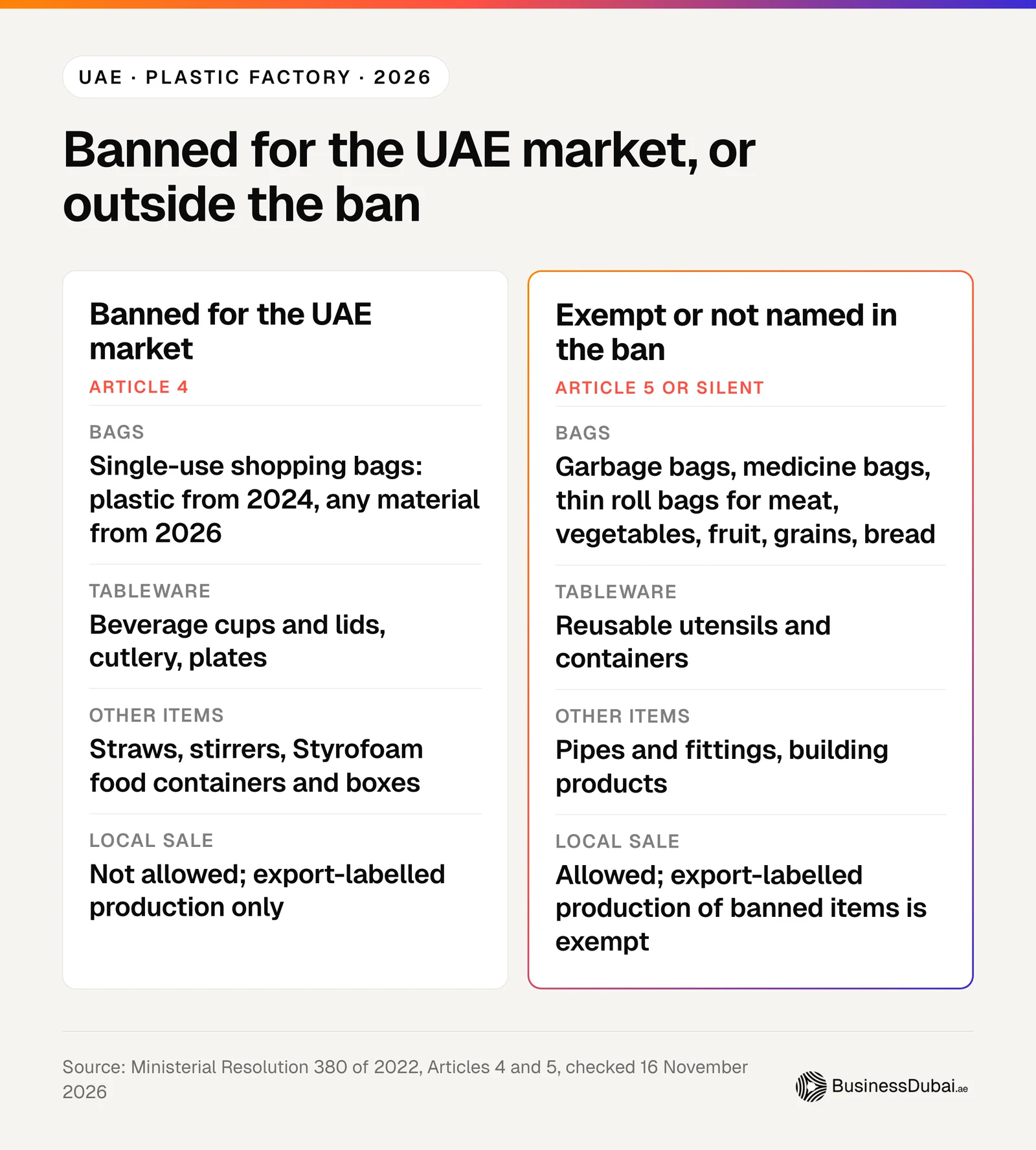
Article 4 of the resolution sets out what is prohibited and from when; Article 5 sets out what is exempt [1]. The table reads both together, from the official Arabic text.
| Product | Federal position (Resolution 380 of 2022) | From |
|---|---|---|
| Single-use plastic shopping bags, including biodegradable plastic bags | Import, production and circulation prohibited (Art. 4) | 1 January 2024 |
| Single-use shopping bags of any material | Prohibited (Art. 4) | 1 January 2026 |
| Single-use plastic beverage cups and their lids | Prohibited (Art. 4) | 1 January 2026 |
| Cutlery: spoons, forks, knives and chopsticks | Prohibited (Art. 4) | 1 January 2026 |
| Plates, straws and stirrers | Prohibited (Art. 4) | 1 January 2026 |
| Styrofoam food containers and boxes | Prohibited (Art. 4) | 1 January 2026 |
| Thin roll bags for meat, vegetables, fruit, grains and bread | Exempt (Art. 5) | Not banned |
| Garbage bags and medicine bags | Exempt (Art. 5) | Not banned |
| Large shopping bags for fashion, electronics and toys | Exempt as set out in a Ministry guide (Art. 5) | Not banned |
| Bags and single-use products made from materials recycled in the UAE | Exempt as set out in a Ministry guide (Art. 5) | Not banned |
| Pipes, sheets, building products, buckets, reusable utensils, resin | Not named in the ban | Not banned |
Every banned item can still be made for export or re-export under a clear export label (Art. 5). Two exemptions depend on a Ministry guide we could not obtain, so their exact conditions are not set out here. Article 5 also lets the competent authority exempt other products with the Ministry [1].
The four numbers below are the ones to keep in mind when you plan a product line.
What "not named in the ban" means
This guide says "not named in the ban" rather than "allowed" where the text is silent. Bottle caps, industrial bottles, woven cement sacks and greenhouse film do not appear in Article 4 [1], but food-contact, conformity and environmental rules still apply. A "reusable" cup that is in practice thrown away after one use is a risk to raise with the authority, not a loophole.
Common Mistake: Buying a cutlery, cup or carrier-bag line in 2026 to supply the UAE market. Since 1 January 2026 the federal text prohibits producing these single-use items unless the output is labelled for export and kept out of UAE markets [1]. A line bought on a local catering contract becomes an export-only line on the day it arrives. Price the export market, or the exempt product, before you price the machine.
Which activity codes does a plastic factory need in Dubai?
A Dubai plastics factory needs an Industrial activity from the Department of Economy and Tourism (DET) list, usually a 2220xxx product code such as 2220003 Plastic Pipes & Fitting Manufacturing or 2220025 Plastic Bottles & Containers Manufacturing. There is no separate code for injection moulding, extrusion or blow moulding: the code names the product, and the product decides the ban.
The codes below are from DET's business activity list as recorded in a public copy of the register, all with the Industrial licence type [3]. The register describes 2220008 as covering "plastic bags, for shopping, garbage, packing" and 2220025 as "bottles, barrels and containers used for various industrial purposes and for packing foodstuff" [3]. The last column maps each code against Articles 4 and 5 of Resolution 380 of 2022 [1].
| Code | Activity (DET register) | Single-use ban position |
|---|---|---|
| 2220001 | Disposable Plastic Cutlery Manufacturing. | Inside the 2026 ban; export-labelled or recycled routes only |
| 2220002 | Plastic Utensils Manufacturing | Not named; food-contact rules apply |
| 2220003 | Plastic Pipes & Fitting Manufacturing | Outside the ban |
| 2220006 | Plastic Sheets Manufacturing | Not named in the ban |
| 2220008 | Plastic Bags Manufacturing | Partly: shopping bags banned; garbage, thin roll, medicine bags exempt; woven sacks not named |
| 2220015 | Plastic Films Manufacturing | Not named; bags follow the bag rules |
| 2220024 | Plastic Buckets & Pots Manufacturing | Not named in the ban |
| 2220025 | Plastic Bottles & Containers Manufacturing | Partly: Styrofoam food containers banned; bottles not named |
| 2220033 | Plastic Building Products Manufacturing | Outside the ban |
| 2220035 | Plastic Caps & Lids Manufacturing | Partly: beverage cup lids banned; bottle caps not named |
| 2220156 | Plastic Masterbatch & Compounds Manufacturing | Raw material, not named in the ban |
| 2013001 | Crude Plastic Manufacturing | Resin, not named in the ban |
| 3240001 | Plastic Toys Manufacturing | Not named in the ban |
| 1709019 | Packaging Materials Manufacturing | Partly: biodegradable shopping bags are banned |
The code choice is a product decision. A factory moulding bottles and caps needs 2220025 and 2220035 and can sell both locally; one thermoforming lids for takeaway cups needs the same 2220035 and can only sell those lids abroad.
The split between banned and exempt products is easier to see side by side.
No code for injection moulding or extrusion
The DET register does not license processes, so there is no "injection moulding licence" [3]. List every product family you will make, pick one code for each, and ask DET or the zone to confirm in writing any product the register does not describe clearly.
Free zone codes are not DET codes
Each free zone runs its own activity list and numbering. The zone must confirm that the activity matches your products, is industrial and can be practised on the premises you lease, before you pay for the licence.
Does the single-use ban stop production, or only sales?
The federal ban reaches production. Resolution 380 of 2022, Article 4, prohibits the import, production or circulation of the listed single-use products across the UAE, including all free zones. Dubai's Executive Council Resolution No. 124 of 2023 prohibits only import and trading, but a Dubai factory is still bound by the federal rule on production.
What the federal text says
Resolution 380 of 2022 was issued by the Ministry of Climate Change and Environment on 21 November 2022, and the Arabic verb list in Article 4 includes production [1]. English summaries by the UNEP LEAP database and Duke University's Nicholas Institute describe Article 4 as covering importing, distributing or using the products [6][7]. The Arabic text is the legal text. The resolution sets no fines of its own; it leaves enforcement to local authorities and requires existing establishments to bring themselves into line [1].
What Dubai's resolution adds
Dubai's Executive Council Resolution No. 124 of 2023 states that "the import and Trading of Single-use Products are prohibited" on a phased timetable, "including in Special Development Zones and free zones, such as the Dubai International Financial Centre." [4]. Its list is broader and earlier in places.
| Product | Federal, Resolution 380 of 2022 | Dubai, Executive Council Resolution 124 of 2023 |
|---|---|---|
| Plastic bags | Prohibited from 1 January 2024 | Import and trading prohibited from 1 January 2024 |
| Non-plastic single-use products, including bags | Bags of any material from 1 January 2026 | From 1 June 2024 |
| Stirrers, straws, Styrofoam cups and food containers | From 1 January 2026 | From 1 January 2025 |
| Single-use table covers and plastic cotton buds | Not named | From 1 January 2025 |
| Plates, tableware, beverage cups and lids | From 1 January 2026 | From 1 January 2026 |
| Single-use plastic food containers (not only Styrofoam) | Not named; only Styrofoam containers are | From 1 January 2026 |
The food-container row is the one factory owners miss. Dubai adds "single-use plastic food containers" from 1 January 2026 [4], so thin takeaway containers in any plastic cannot be traded in Dubai, though the federal list names only Styrofoam.
How thin is a single-use bag?
Dubai defines a Single-use Bag as "A biodegradable or other plastic bag, a paper bag, or a bag made of plant fibre whose thickness is less than fifty-seven (57) micrometres and which is used to carry and transport Commodities." [4]. Press reports of the federal 2026 phase cite under 50 microns, but the federal resolution sets no thickness figure [1]. Outside Dubai, ask the emirate's authority what it applies.
Fines and enforcement
Dubai's fine for breaching its Article 5 is "a fine of two hundred dirhams (AED 200.00)", doubled for a repeat within one year, and "A doubled fine must not exceed two thousand dirhams (AED 2,000.00)." [4]. Dubai defines Trading to include "selling or displaying, with the intention of sale or distribution free of charge" [4], so a factory that sells banned items into the Dubai market is trading them. Dubai Municipality enforced the 2025 phase fully from 1 June 2025 after a soft start [8]. A DECCA policy adviser told a Dubai Chamber session in February 2026, as reported by Wastes Recycling Magazine, that "Existing stock of banned items is not exempt from enforcement." [5], a reported statement rather than law.
Real Talk: The fine is small and that is not the point. The federal text puts production itself on the prohibited list [1], and your industrial licence, MoIAT licence and environmental clearance all sit with authorities that can ask what you make. A factory producing banned items for the local market puts every licence in its file in front of a regulator. Build the business on products you can name to an inspector.
Can a UAE factory make banned items for export, and what must the label say?
A UAE factory can make banned single-use bags and plastic consumer products for export or re-export. Resolution 380 of 2022, Article 5, requires a clear label showing the purpose of production is export, and the goods may not be circulated in UAE markets. Dubai's resolution says they "must be clearly marked for export or re-export outside the UAE."
The export carve-out is written into both texts. Federally, Article 5 exempts bags and single-use plastic consumer products prepared for export or re-export, on two conditions: the export label and no circulation in UAE markets [1]. Dubai's Article 6 exempts the same groups, bans trading them in UAE markets and adds: "These products must be clearly marked for export or re-export outside the UAE." [4]. The DECCA adviser's reported summary: "Products manufactured for export are exempt." [5].
What the texts do not tell you
Neither text sets the wording, language or position of the export mark, or whether it goes on each item or the carton, or what records to keep. Put those questions to the authority in your emirate before your first export run.
Pro Tip: Treat the export route as something you prove, not something you claim. Mark product and carton for export from the first run, keep export stock separate from local stock, and keep the buyer's order, export declaration and bill of lading for each shipment. If export-labelled cutlery turns up in a UAE shop, your shipping file is the answer.
Do recycled-content, biodegradable, PLA or oxo-degradable products escape the ban?
Only recycled content has a written federal exemption. Resolution 380 of 2022 exempts single-use bags and products made from materials recycled in the UAE, under conditions set in a Ministry guide we could not obtain. The same text bans biodegradable plastic bags from 2024. A DECCA official said in February 2026 that biodegradable and PLA products are temporarily exempt.
Recycled content
Article 5 exempts bags and single-use products made from materials recycled in the State, as set out in a Ministry guide [1] that we could not obtain. The DECCA adviser's reported position in Dubai is wider. According to Wastes Recycling Magazine, any product containing recycled content, "regardless of percentage", "is currently exempt, provided businesses can substantiate claims through invoices or" manufacturer technical data sheets, and "Inspectors will not rely solely on labels or stickers." [5]. "Currently" signals a position that can change, and the federal wording refers to materials recycled in the UAE, so ask before you build a product on imported recycled resin.
Biodegradable and PLA
The federal text is not ambiguous on bags. The 2024 phase bans single-use plastic shopping bags including biodegradable plastic bags, and the 2026 phase bans single-use shopping bags whatever they are made of [1]. The DECCA adviser was reported as saying: "Biodegradable and PLA products are temporarily exempt pending further national standardization guidance from the Ministry of Industry and Advanced Technology." [5]. That is a reported statement, made against a federal text that names biodegradable bags in its ban. DET code 1709019 describes bags "designed to disintegrate and biodegrade in weeks" [3], but a code is not an exemption.
Oxo-degradable additives
The status of oxo-degradable plastics is unclear. The DECCA adviser was reported as saying: "Oxo-biodegradable plastics are not recommended and are restricted in certain applications." [5]. Dubai Municipality's 2024 environmental guidance still lists a 2013 Ministerial Decree on registering degradable plastic products [11], but we found no current text on how it applies. Get written confirmation from MoIAT before using an oxo additive.
Where should you locate a plastics factory in the UAE?
A UAE plastics factory belongs where you can lease industrial premises and hold an industrial activity: free zones such as Ajman Free Zone, RAKEZ, SPC Free Zone, Hamriyah, SAIF Zone, KEZAD and JAFZA, or Dubai mainland industrial areas. BusinessDubai.ae packages start at AED 5,555 licence-only, but the factory unit is always quoted separately.
BusinessDubai.ae packages are company formation only. A plastics factory needs industrial premises and an industrial activity that the zone or DET must approve and quote separately; a desk package does not make a factory. BusinessDubai.ae has no JAFZA, Hamriyah, SAIF Zone, KEZAD or Dubai Industrial City package [28].
| Location | BusinessDubai.ae package (licence only / 1 visa / 2 visas) | Industrial premises | Notes |
|---|---|---|---|
| Ajman Free Zone | AED 5,555 / 13,931 / 17,971 | Zone quote | Confirm activity and unit |
| RAKEZ | AED 6,010 / 12,810 / 18,810 | Zone quote | Ras Al Khaimah |
| SPC Free Zone (Sharjah) | AED 5,765 / 15,055 / 19,505 | Zone quote | Confirm production is licensable |
| Meydan Free Zone or Dubai South | AED 12,500 / 21,850 / 28,400 | Not a factory location | Brand or trading company only |
| Hamriyah Free Zone (Sharjah) | No BusinessDubai.ae package | Zone quote | Price direct |
| SAIF Zone (Sharjah) | No BusinessDubai.ae package | Zone quote | Price direct |
| KEZAD (Abu Dhabi) | No BusinessDubai.ae package | Zone quote | Price direct |
| JAFZA (Dubai) | No BusinessDubai.ae package | Zone quote | Price direct |
| Dubai Industrial City | No BusinessDubai.ae package | Zone quote | Price direct |
| Dubai mainland industrial areas | AED 18,200 without a visa / AED 26,900 with one visa | Industrial unit lease | Direct access to UAE buyers |
Our business setup in Sharjah page compares that emirate's zones, with guides to Hamriyah Free Zone and SAIF Zone. If Ajman's entry price suits a first unit, our business setup in Ajman page shows what it buys. See also the KEZAD free zone guide, the JAFZA free zone guide and our ranking of the best free zones for manufacturing.
Feedstock close to home
Borouge said in May 2026 that its Borouge 4 project "will boost the company's production capacity by 1.4 million tonnes to make Ruwais the world's largest single-site polyolefin complex" [9]. The release puts Operation 300bn's target at AED 300 billion of industrial GDP by 2031, up from AED 133 billion [9]. KEZAD has published a case study of a Ravago recycled-PET plant in the zone, which by its own account can process up to one billion bottles a year [10].
Free zone or mainland for a plastics factory?
A free zone does not take you outside the single-use ban: both resolutions apply in free zones [1][4].
| Factor | Free zone plastics factory | Dubai mainland plastics factory |
|---|---|---|
| Formation package (1 visa, BusinessDubai.ae) | From AED 12,810 (RAKEZ) to AED 15,055 (SPC) in the northern zones | AED 26,900 |
| Factory premises | Zone unit or land, zone quote | Industrial area lease, landlord quote |
| Single-use ban | Applies in all free zones | Applies |
| Selling to UAE buyers | Through customs into the local market; confirm with the zone | Direct |
| Environmental approval | The zone's own regime; confirm with the zone | DECCA environmental permit |
| Corporate tax | 0% possible on qualifying income as a Qualifying Free Zone Person | 0% to AED 375,000, 9% above |
| Year-two renewal | Zone renewal, quote from the zone | About AED 15,000 for the BusinessDubai.ae mainland package |
Our free zone company setup and mainland company setup pages itemise each route, including the renewal that the headline price leaves out.
Real Talk: The cheapest licence is rarely the cheapest factory. A few thousand dirhams between packages disappears next to industrial rent, power for extruders and the environmental study. Ask each zone for written quotes on the licence, the unit and the year-two renewal, and compare totals.
Which environmental approvals does a plastics factory need in Dubai?
A Dubai plastics factory needs Environmental Clearance before production starts. Dubai Municipality's April 2024 guidance lists most plastic converting codes as Category B, needing an Environmental Impact Assessment Summary Report reviewed in 5 working days. Since 20 August 2026, environmental permits for industrial projects are issued by the Dubai Environment and Climate Change Authority (DECCA).
Dubai Municipality's Environmental Clearance guidance of 24 April 2024 states that "Environmental Clearance should be obtained before starting the industrial activities" [11]. Category A needs a full Environmental Impact Assessment, Category B a summary report and Category C a checklist; for Category B the review timeframe "is 5 working days" [11]. Its annex places the plastics codes as follows.
| Activity and code | Category in DM's 2024 guidance | Study required |
|---|---|---|
| Plastic converting: 2220001, 2220002, 2220003, 2220006, 2220008, 2220015, 2220024, 2220025, 2220033, 2220035 | B (medium) | EIA Summary Report; 5 working days review |
| Crude Plastic Manufacturing, 2013001 | B (medium) | EIA Summary Report |
| Recycled Plastic Materials Manufacturing, 3830907 | B (medium) | EIA Summary Report |
| Synthetic Resins Manufacturing, 2029005 | A (major) | Full EIA report; 10 working days review |
| Plastic Toys Manufacturing, 3240001 | C (light) | EIA checklist |
| Packing and packaging materials, 1709019 | C (light) | EIA checklist |
| Plastic Masterbatch & Compounds Manufacturing, 2220156 | Not found in the 2024 list | Confirm with DECCA |
Only a licence based on an administrative office is excused clearance, and where activities fall in different categories, the one with the greater impact governs the assessment [11].
The move to DECCA
On 20 August 2026, Dubai Municipality announced that seven services had moved to DECCA, including "environmental permits for industrial projects" [12]. Whether DECCA kept the 2024 categories, fees and timeframes was not confirmed, so check the portal and requirements with DECCA. Free zones such as JAFZA run their own regimes; confirm with your zone.
Pro Tip: Commission the environmental study when you choose the unit, not when the machines arrive. The Category B report covers raw materials, process flow, emissions and waste, which you can only answer once the layout is fixed [11]. Scope it to every product code, because adding a code later can mean redoing the study.
Production waste
Dubai's Administrative Resolution No. 34 of 2026 requires "A Waste Producer must maintain a register, whether in electronic or paper format", and it names "industrial Establishments" among the producers covered [13]. Those producers must transport waste "daily to the Disposal Sites approved by the DM", either through a licensed carrier or their own authorised vehicle [13]. For selling scrap to recyclers, our waste management and recycling guide covers recycling licences and the extended producer responsibility pilot.
Civil Defence
Civil Defence approval is required for industrial premises. Stored resin and finished plastic goods are a significant fire load, so raise storage heights, sprinklers and separation with your fit-out consultant before you sign the layout.
What does the MoIAT Industrial Production Licence require and cost?
MoIAT's Industrial Production Licence requires a local industrial licence, a memorandum of association, at least 10 employees and at least AED 250,000 in capital. The application fee is AED 0 and the inspection fee AED 100, and MoIAT's FAQ gives the time as "Within 15 business days". Renewal costs AED 500, plus AED 100 inspection if needed.
MoIAT is explicit about why a plastics factory wants this licence: "This permit enables you to apply for exemptions from customs duties on the import of machinery, equipment, spare parts, and other materials directly involved in the manufacturing process." [2]. It also requires an "Industrial license from a local licensing department." [2].
| MoIAT service, 2026 | Fee | Time | Notes |
|---|---|---|---|
| Issue Industrial Production License | AED 0 application, AED 100 inspection | FAQ: "Within 15 business days" | An inspector visits the facility before issue [2] |
| Renew Industrial Production License | AED 500 application, AED 100 inspection if needed | 3 working days | Re-inspection "Only in case of location or activity change." [14] |
| Late renewal fine | AED 100 per month | Capped | "AED 100 per month up to a maximum of AED 1,000" [14] |
Because re-inspection follows a change of activity [14], adding a product code later can bring a new inspection.
Pro Tip: Book the MoIAT inspection only once the line is running. The inspector visits after you pay the AED 100 fee [2], and the report decides the licence. Have the machines installed, the 10 employees on visas and resin in the store. A half-fitted unit invites a second visit, and every week without the licence is a week of resin paying full duty.
How do you import resin, masterbatch and moulds without customs duty?
A UAE plastics factory with MoIAT's Industrial Production Licence registers each input by HS code at AED 100 per code, a service listed as "3 Working Days", then requests exemption for each shipment, an "Instant service" at AED 100 per HS code. Resin, masterbatch and moulds are the obvious inputs to register, subject to MoIAT approval.
MoIAT's registration service covers "raw materials, machinery, equipment, semi-finished or finished goods, and packaging materials, provided the industrial facility holds a valid industrial production license" [15]. The pages do not name resin; resin grades, masterbatch, moulds, dies and machines are the obvious candidates, and MoIAT decides what it approves.
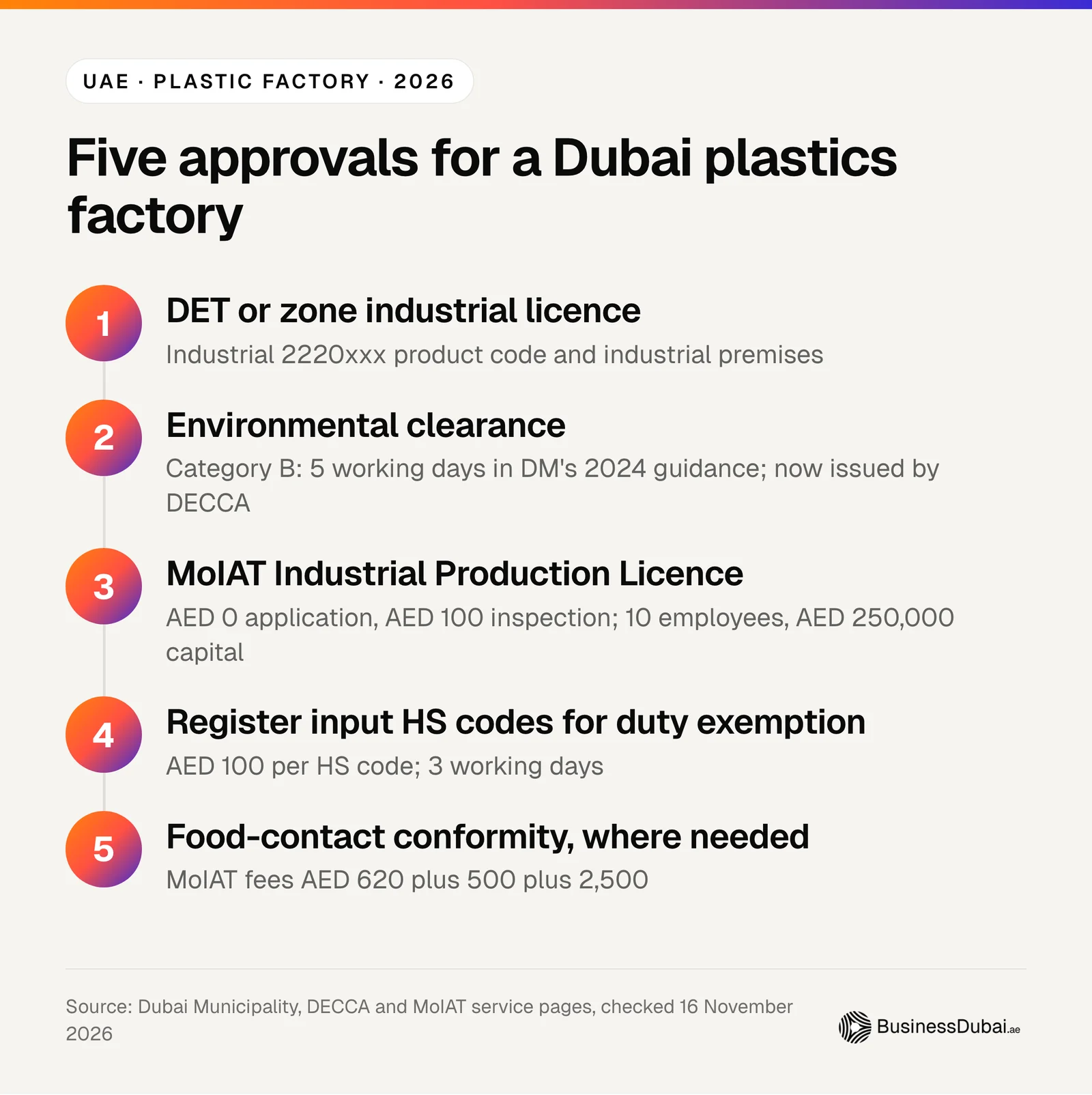
The full approval sequence, with the published fees and times, is set out below.
Step 1: register each input HS code
MoIAT's registration fee is "100 dirhams for each HS code." plus an AED 100 inspection fee, with a service time of "3 Working Days" [15]. The approved quantity becomes a duty-free balance per input that each exempt shipment draws down.
Step 2: request the exemption on each shipment
The exemption request costs "100 dirhams for each HS code" and the service time is "Instant service" [16]. A customs officer checks the declaration, and MoIAT's page states: "If approved, the quantity will be deducted from the factory’s balance." [16]. The listed requirements include the Industrial Production License and legalised or attested invoices [16].
Step 3: the fast track when orders grow
MoIAT's fast-track service grants an instant exemption if the requested increase "does not exceed 30% of the previously registered quantity" [17]. The published fees are AED 50 as a quantity-increase fee for a registered input and AED 50 per application for the exemption [17].
Quick Math: Goods entering the UAE local market pay customs duty of "5% of the value CIF (Cost Freight Insurance) value except for alcohol and cigarettes/tobacco" [18]. An AED 500,000 resin shipment would pay AED 25,000 without the exemption. With it, the cost is MoIAT's AED 100 per registered HS code on the shipment [16]: two resin grades under two codes cost AED 200 to exempt. Over a year of monthly shipments, that is the difference between AED 300,000 in duty and AED 2,400 in fees.
Common Mistake: Shipping resin before its HS code is registered, or with unattested invoices. A container that lands before its code is registered has no balance to deduct from, and attested invoices are a listed requirement [15][16]. Register your first year's resin, masterbatch and moulds during fit-out.
Free zone factories and the exemption
A free zone factory exporting all its output may need the exemption less, since goods in a zone are generally outside the local market. Confirm the position with the zone and your port's customs authority. Our guide to Dubai Customs registration for import and export covers the customs code you need in any case.
What rules apply to food-contact plastics made in the UAE?
Food-contact plastics made in Dubai fall under Dubai Municipality's Technical Guidelines for Food Contact Materials (DM-HSD-GU132-FCM2, issued 24 July 2024), which require food-grade materials meeting the relevant GSO standards, the words "for food contact" or the fork and glass symbol, and traceability. MoIAT's conformity certificate fees are AED 620, 500 and 2,500.
The guideline covers plastics [19]. Its general rule: "All materials used in fabrication, forming, or treatment of packages shall be of the food grade materials and in compliance with the relevant GSO standards." [19]. Check the plastics GSO standard number against the current guideline.
What goes on the product
Food-contact materials not yet in contact with food when placed on the market "shall be accompanied by the words "for food contact" or the fork and glass symbol" [19]. The guideline also says "Manufacturers must print the type of plastic material on the packaging preferably on the bottom of the package (either name or abbreviation)." [19], and it places that line under good practice. On traceability, business operators need systems "to allow identification of the businesses from which and to which materials or articles" are supplied [19]. For a converter, that means batch records linking resin lots to product lots and customers.
MoIAT conformity certificates
MoIAT's published fees for regulated products are "620 dirhams" for a request to register products in the UAE Conformity Assessment System, "500 dirhams" for the technical review of documents for each certificate, and "AED 2500" for issuing the certificate [20]. Whether your plastic product is on the regulated list was not confirmed, so check with MoIAT. Dubai Municipality's Montaji registration fees were not found; ask Dubai Municipality.
Pro Tip: Get the resin supplier's food-contact declaration before you choose the grade, not after the first order. Food-grade status and traceability [19] both start with the resin maker's paperwork. For the food's own labels, our UAE food labelling requirements guide covers what the food itself must carry.
Can UAE-made plastic products be exported as UAE origin, including under the India CEPA?
UAE-made plastic products can carry UAE origin once MoIAT issues a Value-Added Certificate, which needs a national component of at least 40% of total production cost, costs AED 1,000 plus AED 100 inspection and takes 5 working days. India's CEPA rule for Chapter 39 plastics is a change of tariff subheading plus 40% value addition.
MoIAT states: "The national component must represent at least 40% of the total production cost." [21]. The certificate opens the Ministry of Economy's certificate of origin system [21].
| Item | Value-Added Certificate, 2026 |
|---|---|
| Fees | AED 1,000 plus AED 100 inspection [21] |
| Service time | 5 working days [21] |
| Threshold | National component at least 40% of total production cost [21] |
| Documents | "The factory's financial budget for the previous year, certified by an accredited audit firm." and raw material invoices [21] |
A first-year factory has no audited prior year, so price first-year exports without an origin preference.
The India-UAE CEPA rule for plastics
India's rules of origin for the India-UAE Comprehensive Economic Partnership Agreement give Chapter 39, "Plastics and articles thereof.", the annex prints the rule as "CTSH + VA 40% VA" [22]. Read it as a change of tariff subheading plus 40% value addition; the trailing "VA" appears to be a printing duplicate.
CTSH means a "change to this subheading from any other subheading" [22]. Chapter 39 puts plastics in primary forms, such as granules, in headings 3901 to 3914, and semi-finished and finished articles in the headings after them, up to 3926. Moulding granules into pipes, containers or caps changes subheading. VA is value addition, and "The percentages are on an FOB basis." [22]. Where the ex-works price is the basis, "the value addition shall be 5 percentage points lower" [22].
Real Talk: Moulding clears the subheading test easily; it is the 40% that is hard. Resin can be the largest cost in a plastic product, so a converter of imported resin into low-priced articles may miss 40%. Run the test on your costing sheet before quoting a CEPA price, and ask MoIAT how UAE-made resin from Ruwais counts.
What labour and Emiratisation rules apply to a plastics factory?
A UAE plastics factory with "50 or more workers earning a wage of AED 1,500 or less per month must provide accommodation for their workers" under Ministerial Resolution No. 44 of 2022 and register in MoHRE's Labour Accommodation System. MoIAT's licence needs at least 10 employees. Confirm Emiratisation targets for your headcount with MoHRE.
The UAE government portal sets out the rule and the registration in the Ministry of Human Resources and Emiratisation's (MoHRE) system [23]. A converter running three shifts can reach 50 operators quickly, and housing then becomes a fixed monthly cost; check any provider is registered with MoHRE. Emiratisation targets depend on headcount, so confirm yours with MoHRE. Our Emiratisation 2026 guide covers the targets and the Nafis platform.
How is a plastics factory taxed in the UAE?
Plastics manufacturing is a Qualifying Activity under Ministerial Decision No. 229 of 2025, so a free zone converter selling to brands, distributors, F&B chains and exporters can pay 0% corporate tax. Sales to individual consumers are excluded. A mainland factory pays 0% to AED 375,000 and 9% above. Exports are zero-rated for VAT; local sales carry 5%.
Ministerial Decision No. 229 of 2025 defines the Qualifying Activity: "Manufacturing of goods or materials includes the production, improvement or assembly of products and materials from raw materials or components." [24]. Turning resin into pipes or film fits that wording. It excludes "Any transactions with natural persons", with exceptions that do not include manufacturing [24].
Non-qualifying revenue is tolerated where it "does not exceed 5% (five percent) of the total Revenue of the Qualifying Free Zone Person in that Tax Period or AED 5,000,000 (five million dirhams), whichever is lower" [24]. Go past it and the company will "cease to be a Qualifying Free Zone Person from the beginning of the relevant Tax Period and for the subsequent (4) four Tax Periods" [24]. It then pays the ordinary rates, 0% on the first AED 375,000 and 9% above, from the start of that period [25]. Our Qualifying Free Zone Person guide sets out every condition.
| Plastics factory profile | Corporate tax | VAT on sales |
|---|---|---|
| Free zone converter selling to brands, distributors, F&B chains and exporters | 0% possible on qualifying income as a QFZP [24] | Exports outside the GCC zero-rated; UAE sales 5% [26] |
| Free zone factory selling heavily online to consumers | Fails the de minimis test; ordinary rates 0% to AED 375,000, 9% above, and loses QFZP for four more periods [24][25] | 5% on UAE sales |
| Mainland factory | 0% to AED 375,000, 9% above [25] | 5% locally, exports zero-rated [26] |
| Small factory with revenue at or under AED 3,000,000 | Small Business Relief for tax periods ending on or before 31 December 2029, but not for a QFZP [27][25] | As above |
Quick Math: A mainland plastics factory with AED 1,200,000 of taxable profit pays nothing on the first AED 375,000 and 9% on the remaining AED 825,000 [25]. Nine per cent of AED 825,000 is AED 74,250. A free zone converter selling only to businesses and exporters, meeting every QFZP condition, can pay 0% on the same profit [24].
Common Mistake: Selling household containers or storage boxes straight to shoppers through a web store run by the free zone factory company. The Decision excludes "Any transactions with natural persons" from qualifying income [24], so every sale to an individual counts against the de minimis limit. If you want both, run retail through a separate mainland company at arm's length.
Our Small Business Relief guide explains the AED 3,000,000 threshold, and the VAT registration and compliance guide covers export zero-rating evidence. To see which route fits your sales mix, model your tax position with an adviser→
What does a plastics factory cost to set up in the UAE?
A UAE plastics factory's formation cost runs from AED 12,810 for a RAKEZ package with one visa to AED 26,900 for a Dubai mainland package with one visa, at BusinessDubai.ae standard prices. MoIAT fees are small, from AED 100. The large costs are the factory unit, machines, moulds and the environmental study, which zones, suppliers and consultants quote separately.
Package prices are BusinessDubai.ae's standard pricing as of November 2026 [28]; "quote" rows are not estimated.
| Cost item | Amount (AED) | Notes |
|---|---|---|
| Company formation, Ajman Free Zone, 1 visa | 13,931 | Licence only 5,555, two visas 17,971 [28] |
| Company formation, RAKEZ, 1 visa | 12,810 | Licence only 6,010, two visas 18,810 [28] |
| Company formation, SPC Free Zone, 1 visa | 15,055 | Licence only 5,765, two visas 19,505 [28] |
| Company formation, Dubai mainland | 18,200 without a visa, 26,900 with one visa | Premises and approvals extra [28] |
| Industrial premises (factory unit or land) | Zone or landlord quote | A desk package does not qualify |
| Environmental study (EIA Summary Report for Category B) | Consultant quote | Permit fee and portal to confirm with DECCA [12] |
| MoIAT Industrial Production Licence | 100 | AED 0 application, AED 100 inspection [2] |
| Input registration, per HS code | 100 each, plus 100 inspection | Five codes cost AED 500 [15] |
| Food-contact conformity certificate, where regulated | 620 registration, 500 review, 2,500 issuance | Check whether your product is regulated [20] |
| Value-Added Certificate | 1,100 | AED 1,000 plus AED 100 inspection, after the first audited year [21] |
| Extruders, moulding machines, moulds and dies | Supplier quote | Duty-exempt once registered with MoIAT |
| Worker accommodation | Licensed provider quote | Mandatory at 50 workers on AED 1,500 or less a month [23] |
| Year two: mainland package renewal | About 15,000 | BusinessDubai.ae mainland package renewal [28] |
| Year two: MoIAT licence renewal | 500, plus 100 inspection if needed | Late fine up to AED 1,000 [14] |
| Capital requirement for MoIAT | 250,000 | Capital, not a fee [2] |
The capital, premises and machines decide whether the factory exists; government fees barely register. A founder budgeting AED 15,000 has priced the company, not the factory.
For an itemised quote that sets the package next to the zone's industrial premises quote, get a free setup quote→
In what order should you set up a plastics factory?
A UAE plastics factory is set up in a fixed order: check every product against the single-use ban, choose the activity codes, secure industrial premises, obtain the local industrial licence and environmental clearance, hire at least 10 employees, then apply for MoIAT's Industrial Production Licence, which takes "Within 15 business days" by MoIAT's FAQ. Input registration follows.
Most delays come from the right steps in the wrong order.
- Check the product list against Resolution 380 of 2022. Mark each banned, exempt or not named [1].
- Confirm the activity codes in writing with DET or the zone [3].
- Secure the premises.
- Obtain the local industrial licence with the plastics manufacturing activities.
- Commission the environmental study and apply for clearance. Now issued by DECCA [11][12].
- Plan Civil Defence approval with your fit-out consultant.
- Hire the first 10 employees [2].
- Install the machines and moulds, then apply for the Industrial Production Licence: AED 0 application, AED 100 inspection [2].
- Register each input HS code, 3 working days and AED 100 per code [15].
- Set up food-contact compliance where you make food packaging: labels, traceability, certificates [19][20].
- Request the exemption on each shipment, instantly, at AED 100 per HS code [16].
- Set the calendar: renewals, the waste register, tax returns and the Value-Added Certificate [13][21].
Year two is when this calendar becomes someone's job. Our post-setup services team runs renewals, visas and filings so they do not land in a peak production month.
Which setup fits your plastics business?
The right UAE plastics setup depends on what you make and who buys it. A pipe extruder for construction suits a northern free zone or the mainland with the MoIAT licence; a food-container maker must check Dubai's 2026 list first; a carrier-bag maker has to pivot to export or exempt bags. Match your profile below before you sign a lease.
| Profile | Licence and codes | Location | Ban position | Tax angle |
|---|---|---|---|---|
| Pipe and fittings extruder for construction | Industrial: 2220003, plus 2220033 for building products | Northern free zone, KEZAD or mainland | Outside the ban | QFZP 0% possible on B2B sales |
| Food-container thermoformer supplying caterers | Industrial: 2220025, 2220035 | Mainland, close to UAE buyers | Styrofoam boxes, cup lids, plates banned; Dubai also bans single-use plastic food containers | Ordinary rates |
| Carrier-bag maker pivoting | Industrial: 2220008, 2220015 | Free zone with a factory unit | Shopping bags export-only; garbage, medicine, thin roll bags exempt | QFZP possible |
| Masterbatch compounder | Industrial: 2220156 | Free zone or mainland with a unit | Not named in the ban | Qualifying income in a free zone |
| Recycled-PET flake and sheet producer | Industrial: 3830907 and 2220006, confirmed with DET or the zone | KEZAD, a northern free zone or Dubai | Sheet not named; recycled route depends on the Ministry guide | QFZP possible |
Real Client Stories
These are composite examples built from the situations plastics factory founders most often face in the UAE. Names and details are illustrative, and the only figures used are published government fees and BusinessDubai.ae's package prices.
The carrier-bag line that had to find a new market (Ajman Free Zone)
A founder ran a carrier-bag line in Ajman Free Zone, formed on the AED 13,931 one-visa package with a factory unit on the zone's separate quote. His UAE retail buyers stopped ordering single-use bags of any material from 1 January 2026. Rather than sell the extruder, he split production. Garbage bags and thin roll bags for fruit and vegetables, both exempt, went to local supermarkets, and shopping bags went to export buyers with an export label on every carton and the stock kept apart. The lesson: read Article 5 before you read the machine catalogue.
The thermoformer who read only the federal list (Dubai mainland)
A Dubai mainland converter, set up on the AED 26,900 one-visa package, planned to swap its Styrofoam takeaway boxes for thin plastic containers once the federal ban took effect. The federal list names only Styrofoam food containers. Dubai's resolution, though, bans trading single-use plastic food containers from 1 January 2026, so its Dubai caterers could not buy them. The company moved to heavier reusable containers, registered its products in the UAE Conformity Assessment System for AED 620 and budgeted AED 500 and 2,500 per certificate. The lesson: a Dubai factory must check both lists.
The pipe extruder that shipped resin too early (RAKEZ)
A founder set up a pipe and fittings extruder in RAKEZ on the AED 12,810 one-visa package, a product line outside the single-use ban. His first resin shipment landed before he had applied to register its HS code with MoIAT, so it paid customs duty at 5% of CIF value. Registration cost AED 100 per code and took 3 working days, and every later shipment was exempted instantly at AED 100 per HS code. The missed exemption on one container cost more than every MoIAT fee he paid that year. The lesson: register inputs while the factory is being fitted out.
Start your plastics factory the right way
For a plastics factory, the licence is the easy part. What matters is which products the single-use ban still lets you sell in the UAE, whether your environmental clearance and MoIAT licence are in place before the first resin container lands, and whether a free zone factory keeps consumer sales outside the company.
BusinessDubai.ae has set up companies across the UAE since 2013, with itemised pricing and no hidden fees. We will price a free zone company setup in Ajman, Sharjah or Ras Al Khaimah against a mainland company setup in Dubai on what actually differs for a factory: premises, buyers, the product list and tax. Our post-setup services team then handles visas, renewals and filings while you run production. Talk to a setup expert→
If you are making garments rather than plastics, the same MoIAT sequence is set out in our garment factory guide.
Frequently Asked Questions
Is it legal to manufacture single-use plastic products in the UAE in 2026?
Only for export or where an exemption applies. Federal Resolution No. 380 of 2022 prohibits producing single-use plastic shopping bags from 2024, and single-use bags of any material, plastic cups and lids, cutlery, plates, straws, stirrers and Styrofoam food boxes from 1 January 2026. Export production with a clear export label is exempt.
Can I open a plastic bag factory in the UAE after the ban?
Yes, if you make exempt bags or sell banned ones abroad. Garbage bags, medicine bags and thin roll bags for meat, vegetables, fruit, grains and bread are exempt under Article 5 of Resolution 380 of 2022. Single-use shopping bags can be made only for export, with a clear export label.
Can I manufacture plastic cutlery in the UAE for export?
Yes. Resolution 380 of 2022 exempts single-use plastic consumer products prepared for export or re-export, provided they carry a clear label showing the purpose of production is export and are not circulated in UAE markets.
What label do export-only single-use products need in the UAE?
The federal text requires a clear label showing that the purpose of production is export or re-export, and Dubai's resolution says the products "must be clearly marked for export or re-export outside the UAE." Neither text sets the wording, language or position of the mark, so confirm the format with the authority in your emirate before your first export run.
Does the single-use plastic ban apply in UAE free zones?
Yes. Article 3 of Resolution 380 of 2022 applies it across the State, including all free zones. Dubai's Resolution No. 124 of 2023 also covers Dubai's free zones.
What thickness counts as a single-use bag in Dubai?
Dubai's Executive Council Resolution No. 124 of 2023 defines a single-use bag as a plastic, paper or plant-fibre bag whose thickness is less than 57 micrometres and which is used to carry goods. Press reports of the federal 2026 phase cite under 50 microns, but the federal Resolution 380 of 2022 sets no thickness figure.
What is the fine for selling banned single-use plastics in Dubai?
Dubai fines a breach of its single-use ban AED 200, doubled for a repeat within one year, with a doubled fine capped at AED 2,000, under Executive Council Resolution No. 124 of 2023. The federal Resolution 380 of 2022 sets no fines of its own and leaves enforcement to local authorities.
Are biodegradable or PLA products exempt from the UAE plastic ban?
Not under the federal text for bags. Resolution 380 of 2022 bans single-use plastic shopping bags including biodegradable ones from 2024, and single-use bags of any material from 2026. A DECCA official said in February 2026 that biodegradable and PLA products are temporarily exempt pending MoIAT standardisation guidance, which is a reported statement rather than law.
Are oxo-biodegradable plastics allowed in the UAE?
The status is unclear. A DECCA official was reported in February 2026 as saying oxo-biodegradable plastics are not recommended and are restricted in certain applications. Get written confirmation from MoIAT before using an oxo additive.
Is recycled plastic exempt from the UAE single-use ban?
Partly. Resolution 380 of 2022 exempts bags and single-use products made from materials recycled in the UAE, under conditions in a Ministry guide. A DECCA official said in February 2026 that products with recycled content, regardless of percentage, are currently exempt in Dubai if the claim is backed by invoices or technical data sheets.
What is the DET activity code for a plastic factory in Dubai?
Dubai plastics factories use Industrial codes from DET's 2220xxx group, chosen by product: for example 2220003 Plastic Pipes & Fitting Manufacturing, 2220008 Plastic Bags Manufacturing, 2220025 Plastic Bottles & Containers Manufacturing and 2220156 Plastic Masterbatch & Compounds Manufacturing.
Is there an activity code for injection moulding in Dubai?
No. DET's activity list licenses products, not processes, so there is no separate code for injection moulding, extrusion, blow moulding or thermoforming. Choose the 2220xxx code for each product.
Can I run a plastics factory from a desk or flexi-office licence?
No. A plastics factory needs industrial premises and an industrial activity approved by DET or the free zone, and MoIAT inspects the facility before issuing its Industrial Production Licence.
Who issues the environmental permit for a factory in Dubai now?
The Dubai Environment and Climate Change Authority (DECCA). Dubai Municipality announced on 20 August 2026 that environmental permits for industrial projects had moved to DECCA. Confirm the current portal and fees with DECCA.
Which environmental category is a plastics factory in Dubai?
Most plastic converting codes, including 2220001 to 2220035, are Category B in Dubai Municipality's April 2024 Environmental Clearance guidance. Category B needs an Environmental Impact Assessment Summary Report with a 5 working day review. Synthetic resins manufacturing is Category A and plastic toys Category C.
Do I need Civil Defence approval for a plastics factory?
Yes. Civil Defence approval is required for industrial premises in the UAE, and stored resin and finished plastic goods are a significant fire load. Raise storage with your fit-out consultant early.
What are the MoIAT Industrial Production Licence requirements?
MoIAT requires a memorandum of association, at least 10 employees, total capital of at least AED 250,000 and an industrial licence from the local licensing department. The application fee is AED 0 and the inspection fee AED 100, as of 2026.
How long does the MoIAT industrial licence take?
MoIAT's FAQ says the Industrial Production Licence is issued "Within 15 business days". An inspector visits the facility before issue.
Can a plastics factory import resin duty-free in the UAE?
Yes, once it holds MoIAT's Industrial Production Licence and registers each input. Registration costs AED 100 per HS code and takes 3 working days, then each shipment is exempted instantly at AED 100 per HS code. MoIAT decides which inputs it approves.
How much customs duty does the MoIAT exemption save on resin?
Dubai Customs charges 5% of CIF value on goods entering the local market, so an AED 500,000 resin shipment would pay AED 25,000 in duty. With the MoIAT exemption, the cost is AED 100 per registered HS code on the shipment.
Do plastic food containers need approval in Dubai?
Food-contact plastics made in Dubai must meet Dubai Municipality's Technical Guidelines for Food Contact Materials, issued 24 July 2024: food-grade materials, the words "for food contact" or the fork and glass symbol, and traceability. Regulated products also need a MoIAT conformity certificate, with fees of AED 620, 500 and 2,500.
Do UAE-made plastics qualify for lower duty into India under CEPA?
They can. The India-UAE CEPA rule for Chapter 39 plastics is a change of tariff subheading plus 40% value addition on an FOB basis, printed in India's annex as "CTSH + VA 40% VA". The 40% value addition is usually the harder test.
Is a free zone plastics factory eligible for 0% corporate tax?
Yes, if it meets the QFZP conditions. Manufacturing is a Qualifying Activity under Ministerial Decision No. 229 of 2025, so sales to businesses and exporters can be taxed at 0%. Sales to individual consumers are excluded and must stay within the lower of 5% of revenue or AED 5,000,000.
What corporate tax does a mainland plastics factory pay?
A mainland plastics factory pays 0% on taxable profit up to AED 375,000 and 9% above. On AED 1,200,000 of profit, that is AED 74,250. Small Business Relief is available for revenue at or under AED 3,000,000 for tax periods ending on or before 31 December 2029.
How much does it cost to set up a plastics factory in the UAE?
Company formation at BusinessDubai.ae standard prices runs from AED 12,810 for a RAKEZ package with one visa to AED 26,900 for a Dubai mainland package with one visa. Premises, machines, moulds and the environmental study are quoted separately, and MoIAT requires AED 250,000 in capital.
Does a plastics factory need to house its workers?
Yes, once it has 50 or more workers earning AED 1,500 or less a month. Ministerial Resolution No. 44 of 2022 requires those establishments to provide accommodation and register in MoHRE's Labour Accommodation System.
References
[1] UAE Ministry of Climate Change and Environment. Ministerial Resolution No. 380 of 2022 Regarding Regulating the Use of Single-use Products, 21 November 2022 (official Arabic text): Article 1 definition of establishment, Article 3 scope including all free zones, Article 4 prohibition of import, production or circulation with the 2024 and 2026 lists, Article 5 exemptions including export-labelled products and materials recycled in the State, and Articles 8 and 9 on enforcement and existing establishments. Read from the Arabic page images. faolex.fao.org (PDF)
[2] Ministry of Industry and Advanced Technology (MoIAT). Issue Industrial Production License service card and FAQ: memorandum of association, at least 10 employees, at least AED 250,000 capital, local industrial licence, AED 0 application and AED 100 inspection fees, "Within 15 business days" FAQ answer and the customs exemption benefit; checked 16 November 2026. moiat.gov.ae
[3] Dubai Department of Economy and Tourism (DET). Business activity list as recorded in a public copy of the register: plastics codes 2220001 to 2220156, 2013001, 3240001 and 1709019, licence type Industrial, with official descriptions; DET records last updated 24 October 2023. visaindubai.ae
[4] Government of Dubai. Executive Council Resolution No. (124) of 2023 Regulating the Use of Single-use Products in the Emirate of Dubai, issued 30 December 2023: definitions including Single-use Bag and Trading, scope including free zones, the phased prohibition of import and trading, export exemptions and marking, and fines. dlp.dubai.gov.ae
[5] Wastes Recycling Magazine. "Businesses urged to comply with 2026 single-use plastic rules", 17 February 2026: statements of a DECCA policy strategy adviser at a Dubai Chamber session on export, recycled content, biodegradable and PLA products, oxo-biodegradable plastics and existing stock. A trade press report of an official's remarks, not legal text. wasterecyclingmag.com
[6] UNEP Law and Environment Assistance Platform (LEAP). English abstract of Ministerial Resolution No. 380 of 2022. leap.unep.org
[7] Duke University, Nicholas Institute. Plastics policies database entry for Ministerial Resolution No. 380 of 2022. nicholasinstitute.duke.edu
[8] Dubai Municipality. Single-use products page: soft implementation of the 2025 phase from 1 January to 31 May 2025 and full implementation from 1 June 2025. dm.gov.ae
[9] Borouge. Borouge 4 mega project release, 6 May 2026: 1.4 million tonnes of added capacity at Ruwais and Operation 300bn's target of AED 300 billion industrial GDP by 2031. A company release. borouge.com
[10] KEZAD Group. Ravago recycled-PET plant case study, 25 September 2024. The zone's own account. kezadgroup.com
[11] Dubai Municipality. Guidance on the Environmental Clearance (EC) Requirements for Development, Infrastructure and Industrial Projects in the Emirate of Dubai, 24 April 2024: Categories A, B and C, the Category B summary report and 5 working day review, the administrative office exception, and the annex lists of industrial activities by code. dmpmedia.dm.gov.ae (PDF)
[12] Dubai Municipality. Announcement of 20 August 2026 restructuring 20 services: seven services transferred to the Dubai Environment and Climate Change Authority, including environmental permits for industrial projects. dm.gov.ae
[13] Government of Dubai. Administrative Resolution No. (34) of 2026 Regulating Waste Management: the waste producer register, industrial establishments as producers and daily transport to approved disposal sites. dlp.dubai.gov.ae
[14] Ministry of Industry and Advanced Technology (MoIAT). Renew Industrial Production License: AED 500 application, AED 100 inspection if needed, 3 working days, re-inspection only on location or activity change, and the late renewal fine; checked 16 November 2026. moiat.gov.ae
[15] Ministry of Industry and Advanced Technology (MoIAT). Request Registration of Industrial Input for Customs Duty Exemption: items covered, AED 100 per HS code plus AED 100 inspection and 3 working days; checked 16 November 2026. moiat.gov.ae
[16] Ministry of Industry and Advanced Technology (MoIAT). Request Customs Duty Exemption for Industrial Inputs: AED 100 per HS code, instant service, deduction from the factory balance and required documents; checked 16 November 2026. moiat.gov.ae
[17] Ministry of Industry and Advanced Technology (MoIAT). Fast Track Customs Exemption Request: instant exemption where the increase does not exceed 30% of the registered quantity, and AED 50 fees; checked 16 November 2026. moiat.gov.ae
[18] Dubai Customs. Dubai Customs Service Guide, version 9 (2025): customs duty of 5% of CIF value. dubaicustoms.gov.ae (PDF)
[19] Dubai Municipality, Health and Safety Department. Technical Guidelines for Food Contact Materials, DM-HSD-GU132-FCM2, version 1.0, issued 24 July 2024: scope including plastics, food-grade materials, labelling, plastic type marking as good practice and traceability. dmpmedia.dm.gov.ae (PDF)
[20] Ministry of Industry and Advanced Technology (MoIAT). Issue Conformity Certificates for Regulated Products: AED 620 product registration, AED 500 technical review per certificate and AED 2,500 issuance; checked 16 November 2026. moiat.gov.ae
[21] Ministry of Industry and Advanced Technology (MoIAT). Issue Value-Added Certificate: the 40% national component threshold, registration in the Ministry of Economy's certificate of origin system, AED 1,000 plus AED 100 inspection, 5 working days and the prior-year audited budget; checked 16 November 2026. moiat.gov.ae
[22] Government of India. Customs Tariff (Determination of Origin of Goods under the Comprehensive Economic Partnership Agreement between India and the United Arab Emirates) Rules, 2022, Annexures: the Chapter 39 product-specific rule, the definitions of CTSH and VA, and the FOB and ex-works bases. Read from a mirror of the Gazette PDF. taxguru.in
[23] UAE Government portal (u.ae). Labour accommodation: Ministerial Resolution No. 44 of 2022 and the duty to house 50 or more workers earning AED 1,500 or less a month, with registration in MoHRE's Labour Accommodation System; checked 16 November 2026. u.ae
[24] UAE Ministry of Finance. Ministerial Decision No. 229 of 2025 Regarding Qualifying Activities and Excluded Activities: manufacturing as a Qualifying Activity and its definition, transactions with natural persons as an Excluded Activity, the de minimis test and loss of status. mof.gov.ae
[25] UAE Ministry of Finance. Corporate tax under Federal Decree-Law No. 47 of 2022: rates of 0% up to AED 375,000 and 9% above, and the conditions for Qualifying Free Zone Persons. mof.gov.ae
[26] Federal Tax Authority. VAT under Federal Decree-Law No. 8 of 2017: the 5% standard rate and zero-rating of exports outside the GCC. tax.gov.ae
[27] UAE Ministry of Finance. Ministerial Decision No. 73 of 2023 on Small Business Relief, as amended by Ministerial Decision No. 131 of 2026: the AED 3,000,000 revenue threshold and tax periods ending on or before 31 December 2029. mof.gov.ae
[28] BusinessDubai.ae. Internal pricing data: 2026 standard package prices for Dubai mainland, Ajman Free Zone, RAKEZ, SPC Free Zone, Meydan Free Zone and Dubai South by visa count, and the mainland renewal figure, as of November 2026. businessdubai.ae