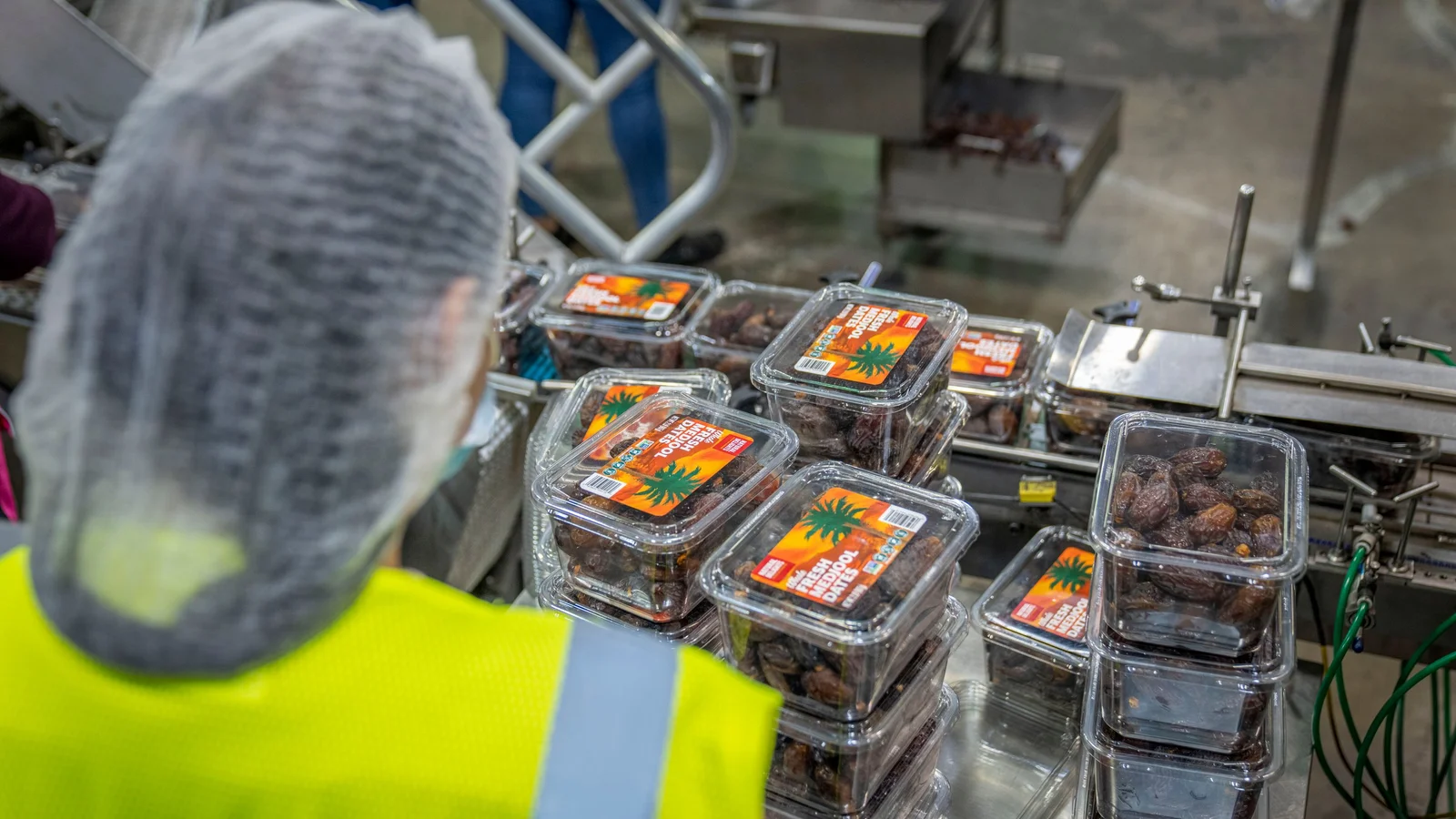


In the UAE, a food label is a legal document before it is a marketing one. The federal government's own summary is blunt: "using incorrect labels will attract a fine ranging from AED 10,000 to 100,000" [1], and the fine doubles on a repeat offence [2]. In Dubai the rule bites earlier, because Dubai Municipality says food establishments "should not import, sell, consign or deliver any pre-packed food item" unless the label carries everything its Food Control Department requires [3].
That makes food labelling requirements in the UAE a pre-shipment problem, not a port problem. A label that fails is reprinted at the factory, relabelled under permit, re-exported or written off, and each of those costs more than getting the artwork right first time.
Since 2013, BusinessDubai.ae has set up food trading and import companies on the Dubai mainland and in the free zones, and the label is where first shipments most often stall. This guide covers every mandatory label element, the Arabic and sticker rules, date formats, FIRS registration and label assessment before shipment, the port, rejection reasons with a fix for each, relabelling permits, federal penalties, tax and the company an importer needs. It is general information, not legal advice: confirm your product with Dubai Municipality before you print.
What are the food labelling requirements in the UAE in 2026?
Food labelling requirements in the UAE come from four layers: Federal Law No. 10 of 2015 on Food Safety, mandatory UAE food standards led by UAE.S 9:2019 for prepackaged food, the Dubai Municipality Food Code, and FIRS label approval in Dubai. Arabic is mandatory, dates must be printed by the producer, and Dubai wants labels approved before import.
Most importers meet these rules as one checklist, but they come from different places. The table separates them.
| Layer | Instrument | What it does for a label |
|---|---|---|
| Federal law | Federal Law No. 10 of 2015 on Food Safety | Bans trading food that breaches technical regulations, which include labelling; fines of AED 10,000 to 100,000 [2] |
| Mandatory standards | Cabinet Resolution No. 4 of 2020 on making the food sector standards mandatory [4] | Turns UAE food standards into binding rules |
| Labelling standard | UAE.S 9:2019, the edition Dubai Municipality cites [5] | Mandatory label content, language and dates |
| Dubai rules | Dubai Municipality Food Code (2013 edition), sections 7 and 8 [3] | FIRS registration, label approval before import, Arabic, untampered dates |
| National registration | Ministerial Decree No. 239 of 2018 (ZAD) [1] | Food registered federally before it is handled in UAE markets |
Which edition of GSO 9 applies?
The Gulf standard GSO 9 "Labeling of Prepackaged Food Stuffs" exists in a 2013 edition [6] and a newer GSO 9:2022 (Edition 4), whose amendment GSO 9:2022/Amd1:2025 was approved on 22 April 2025 and is listed as the current edition [7]. Dubai Municipality's label assessment guide, though, says mandatory information "should follow the UAE standard of labeling prepackaged food stuffs (UAE.S 9:2019)" [5].
So Dubai checks against UAE.S 9:2019, and a newer GSO edition exists that the UAE may adopt. The UAE standard is sold, not published, so the clause references here come from the GSO 9/2013 text we could read, flagged as such. Where later wording might differ (font size, the allergen list, sticker wording) we say so rather than guess. Buy UAE.S 9 from the Ministry of Industry and Advanced Technology (MoIAT) before you finalise artwork for a large range.
Based on our experience: Factories outside the GCC usually design labels to their home-market rules. Three UAE rules catch them most often: Arabic as the mandatory language, both a production date and an expiry date, and the ban on dates that appear only on a sticker [6][8]. Check those three on the first proof, before anything else.
What must appear on a food label sold in Dubai?
A food label sold in Dubai must show, in Arabic: the product name, net content in metric units, ingredients in descending order with additives, allergens, storage conditions, country of origin, the manufacturer or packer's name and address, nutrition information, production and expiry dates, a batch code and the brand where there is one.
Dubai Municipality lists the basic information "on any label" as trade name and description, net content, storage condition, ingredients in descending order, country of origin, allergy warning, manufacturer or packer, nutrition information, and brand name, which is mandatory for UAE products [5]. GSO 9 and USDA's 2025 country report add the date, batch and animal-source items [6][8].
| Label element | The rule (GSO 9 clauses are from the 2013 text) |
|---|---|
| Name of the food | Prominent, in the same field of vision as the net contents (GSO 9 7.1.4) |
| Brand name | Declared if there is one; mandatory for UAE-made products [5] |
| Net contents | Metric; volume for liquids, weight for solids, plus drained weight for food in liquid (5.4) |
| Ingredients | Descending order of weight, under a heading containing "ingredient" (5.2.1 to 5.2.3) |
| Additives | Name or E number with the functional class (5.2.4); Dubai's system takes E numbers [5] |
| Allergens | Thirteen groups, from gluten cereals to sesame and lupin (5.2.5) |
| Animal source | Stated where the food or a component contains animal content [8] |
| Nutrition | Required; the standard is UAE.S 2233 [5] |
| Production and expiry dates | Both, printed by the producer on the pack or original label (5.7) |
| Storage and use | Where the date depends on storage; instructions where needed (5.7.5, 5.7.6) |
| Country of origin | Required [5] |
| Manufacturer or packer | Name and address; importer name optional (5.5.1, 5.5.2) |
| Batch or lot | Permanently marked, in code or in clear (8.3) |
| Barcode | Unique, entered exactly as printed [5][8] |
| Language | Arabic; any other language identical to the Arabic (7.2.1) |
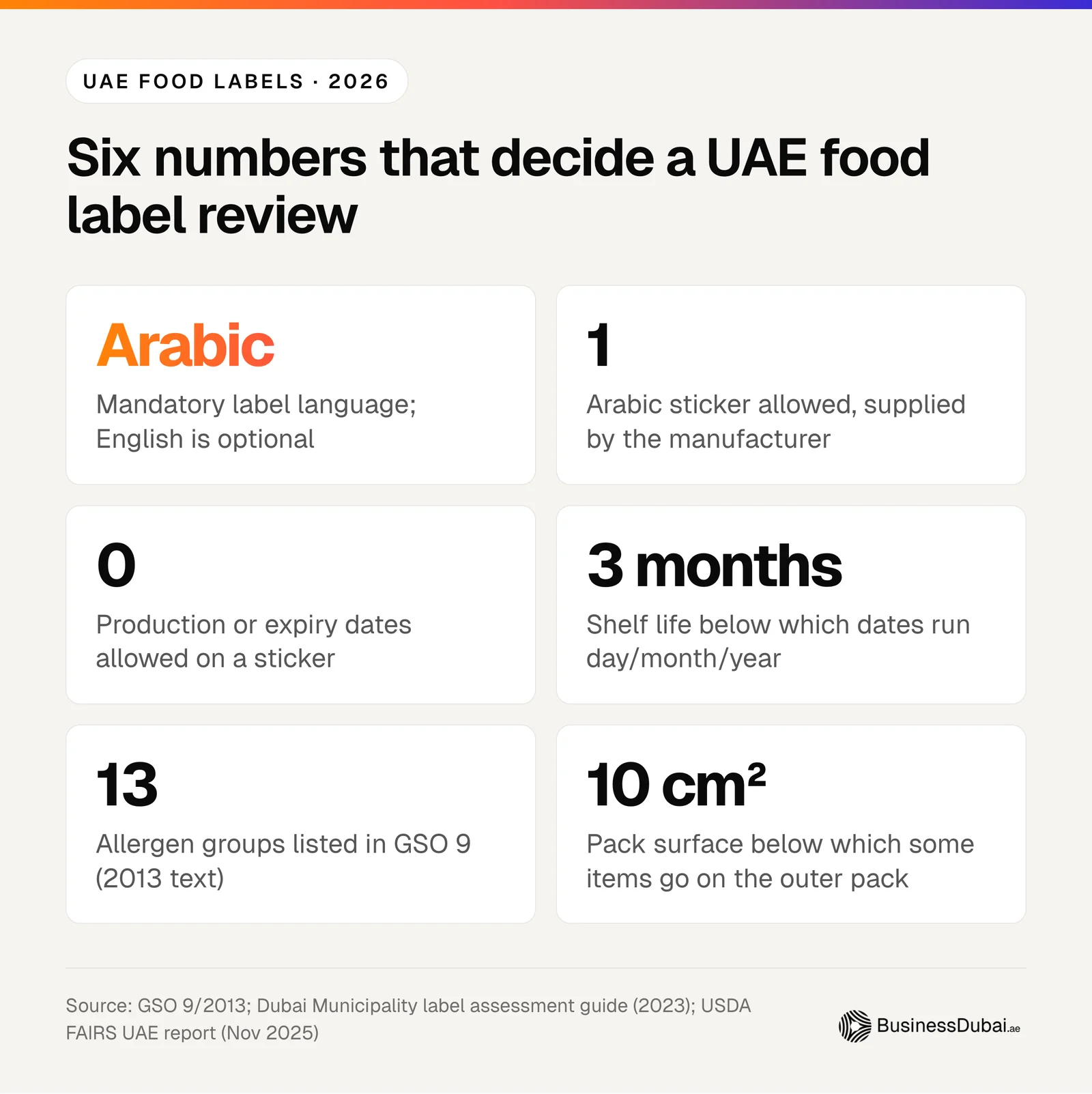
The six numbers that decide most label reviews are in the graphic below. Each comes from the rules above.
Ingredients, additives and allergens
The ingredients list causes the most re-work because it has to match the product, not just the standard. In Dubai's system every ingredient is entered separately, with additives chosen by E number [5]. The 2013 allergen list covers cereals containing gluten, crustacea, eggs, fish, peanuts and soybeans, walnuts, milk (lactose included), sulphite at 10 ppm or more, celery, mustard, sesame, clams and lupin, each with their products [6]. Baby food adds one rule: "Artificial sweeteners or nutritive are not allowed in all baby foods" [6].
The importer's own name is optional in the 2013 text, which says the distributor, importer, exporter or vendor "may be written" [6]; most importers add it because retailers want a local contact. Packs whose largest surface is under 10 cm² may move some details to the outer container [6].
Halal statements on the label
A halal claim brings paperwork. Dubai's Food Code requires halal certificates for processed meat products and for foods containing meat, poultry or ingredients of animal origin such as gelatin, seafood excepted [3], and USDA says printing "halal" requires compliance with UAE.S GSO 2055-2:2015 [8]. Our sister guide to halal certification in the UAE covers who may certify and why foreign certificates fail at the port.
Is Arabic mandatory on food labels in Dubai, and is English required?
Arabic is mandatory on food labels in Dubai, and English is optional. Dubai Municipality states that "The mandatory language is Arabic and English is optional", and GSO 9 requires any other language used to be identical to the Arabic. Non-halal products are the main exception: their ingredients must appear in both Arabic and English.
The Food Code asks for a label carrying "the required information in Arabic" [3], and GSO 9 adds that "All the information provided in another language shall be identical with those written in Arabic" [5][6]. That second rule catches people: an English panel updated for a new recipe beside an Arabic panel translated from older artwork is a mismatch, and a mismatch is a rejection.
The exceptions are narrow. Non-halal products sold under permit must list ingredients "in Arabic and English" and state that they are non-halal [3]. Health supplements, which are not food, allow "clear English and/or Arabic" [9]. Institutional-use packs may enter without Arabic but cannot be sold in retail stores unless accompanied by an Arabic label [8]. Several ranking pages call bilingual labels mandatory for all food; they are not, though most importers print both because retailers expect English.
Common Mistake: Translating the English artwork once and then updating only the English panel when the recipe changes. Six months later the Arabic lists the old ingredients and the two panels no longer match, which GSO 9 7.2.1 does not allow [6]. Treat the Arabic panel as the master copy, update it first, and resubmit the label for assessment whenever an ingredient changes.
Can you use an Arabic sticker on imported food, and when must it be applied?
An Arabic sticker is allowed on imported food if it is a single sticker supplied by the manufacturer, covers no required information, says nothing different from the original label and cannot be peeled off in normal handling. It may never carry the production or expiry date. USDA says stickering must happen before export, not on entry.
GSO 9 sets those five conditions for a sticker beside the original label, starting with a single sticker "provided by the manufacture only" [6]. USDA's 2025 report adds: "Stickering on imported items must be a single sticker performed prior to export and cannot be completed upon entry", and every sticker must be approved and included in the label assessment [8].
Dubai Municipality, though, issues a "Temporary Permit for Changes Related to Food Label/Packages" for goods in a licensed Dubai warehouse [10], and the DET register includes a Professional activity, 8292101 Labeling Services, for firms "engaged in relabeling in Arabic and English" imported goods [11]. The sources do not agree:
| Question | GSO 9 (2013 text) | USDA FAIRS (Nov 2025) | Dubai Municipality permits guide (2020) |
|---|---|---|---|
| Sticker allowed? | Yes, one, from the manufacturer | Yes, single and pre-approved | Label or package changes under permit |
| When applied? | Not stated | Before export, not on entry | In a licensed Dubai warehouse, per consignment |
| Dates on it? | No | No; dates only on a sticker are rejected | Not stated; the date rules still apply |
| Approval needed? | Must meet the standard | Included in label assessment | FIRS registration, approved label assessment, manufacturer NOC where applicable |
The safe course is the one every source allows: apply the Arabic sticker at the factory, get it into the label assessment, and keep the Dubai permit as a recovery route. USDA's report is an export guide for American shippers rather than a Dubai regulation, but nothing in Dubai Municipality's documents accepts a post-arrival sticker without a permit.
Real Talk: If your plan is to ship English-only stock and sticker it in a Dubai warehouse, you are planning to use an exception. The permit needs an approved label assessment first [10], so you still design and approve the Arabic sticker before the goods move. At that point the factory could have applied it for the price of a print run.
What date format do UAE food labels need?
UAE food labels need both a production date and an expiry date, printed by the producer on the pack, never on a sticker. Products with a shelf life under three months use day-month-year. Longer shelf lives may use month-year, and a month-year expiry means the last day of that month.
GSO 9 says dates must be "printed or stamped by irremovable ink directly on all packages or on their original label by the producer only", and "Adding stickers for production and expiry dates is not permissible" [6]. Only one production date and one expiry date may appear on a pack, behind a phrase such as "expiration date" or "best before" [6].
| Shelf life | Format | Example |
|---|---|---|
| Under three months | Day/month/year (GSO 9 5.7.1.1) [6] | PROD 02/11/2026, EXP 30/11/2026 |
| Exactly three months | Day/month/year, which satisfies both sources; USDA applies it to "three months or less" [8] | PROD 02/11/2026, EXP 01/02/2027 |
| Over three months | Month/year, shelf life to the end of the month (5.7.1.2); USDA also accepts day/month/year [8] | EXP 02/2027 means 28 February 2027 |
| Exempt from an expiry date | Production or harvest date only (5.7.4) | Fresh produce, honey, solid sugars, loose tea, dry cereals |
The 2013 exemption list also covers bakery goods eaten within 24 hours, vinegar in glass, non-fortified salt, chewing gum, dry legumes, dried vegetables and herbs, and glucose [6]. How long a product may be dated is set by two UAE standards: UAE.S 150-1 for mandatory expiration dates, which Dubai Municipality says "are mandatory and cannot be changed", and UAE.S 150-2 for voluntary ones [5]. A product in 150-1 cannot simply be given a longer life for the UAE.
Common Mistake: Reading a month-year expiry as the first day of the month. USDA's report states that "the last day of the listed month is considered the expiration date" [8]. A factory that prints EXP 03/2027 meaning 1 March has given the product an extra month, and a date that does not match the registered shelf life is a label problem. Agree the convention with the factory in writing.
Which portal registers food in Dubai: FIRS, ZAD, ZADI or Montaji?
Packaged food imported into Dubai is registered and label-assessed in Dubai Municipality's Food Import and Re-export System (FIRS), also reached through Dubai's integrated ZADI platform. ZAD is the federal registration system for all seven emirates. Montaji is Dubai Municipality's consumer-product system for cosmetics, detergents and health supplements, not food.
The Food Code is direct: "All imported or re-exported food items should be individually registered in the FIRS System" [3]. USDA describes ZAD as a federal system for products "destined for any of the seven emirates" and says that outside Dubai label assessment comes from each municipality's food control department [8]. Montaji covers cosmetics, fragrances, detergents, biocides, health supplements, food contact materials and children's toys [12].
| System | Run by | Use it for |
|---|---|---|
| FIRS | Dubai Municipality Food Safety Department | Food item registration, label assessment, import and re-export requests [3] |
| ZADI | Dubai integrated platform | Import requests, registration, label assessment and customs services together [8] |
| ZAD | Federal, Ministerial Decree No. 239 of 2018 | National registration before food is handled in UAE markets [1] |
| Montaji | Dubai Municipality consumer products | Supplements, cosmetics, detergents; not ordinary food [12] |
| EDE marketing authorisation | Emirates Drug Establishment | Federal authorisation of dietary supplements and herbal products [13] |
Competitor pages that send food importers to Montaji send the application to the wrong department. If your range includes supplements as well as food, you need both: Dubai Municipality says no health supplement may be imported or sold in Dubai "unless it has been registered in Montaji system" [9], and the Emirates Drug Establishment charges AED 100 plus AED 5,000, takes 45 working days and grants five years [13]. Our supplement manufacturing guide covers that route.
How does FIRS product registration and label assessment work before shipment?
FIRS product registration and label assessment happen online before the goods ship. Dubai Municipality lists food item registration at 1 working day and registration with label assessment at 5 working days. You upload the artwork and a pack photo, type every detail exactly as printed, add the HS code, and wait for approval before requesting import.
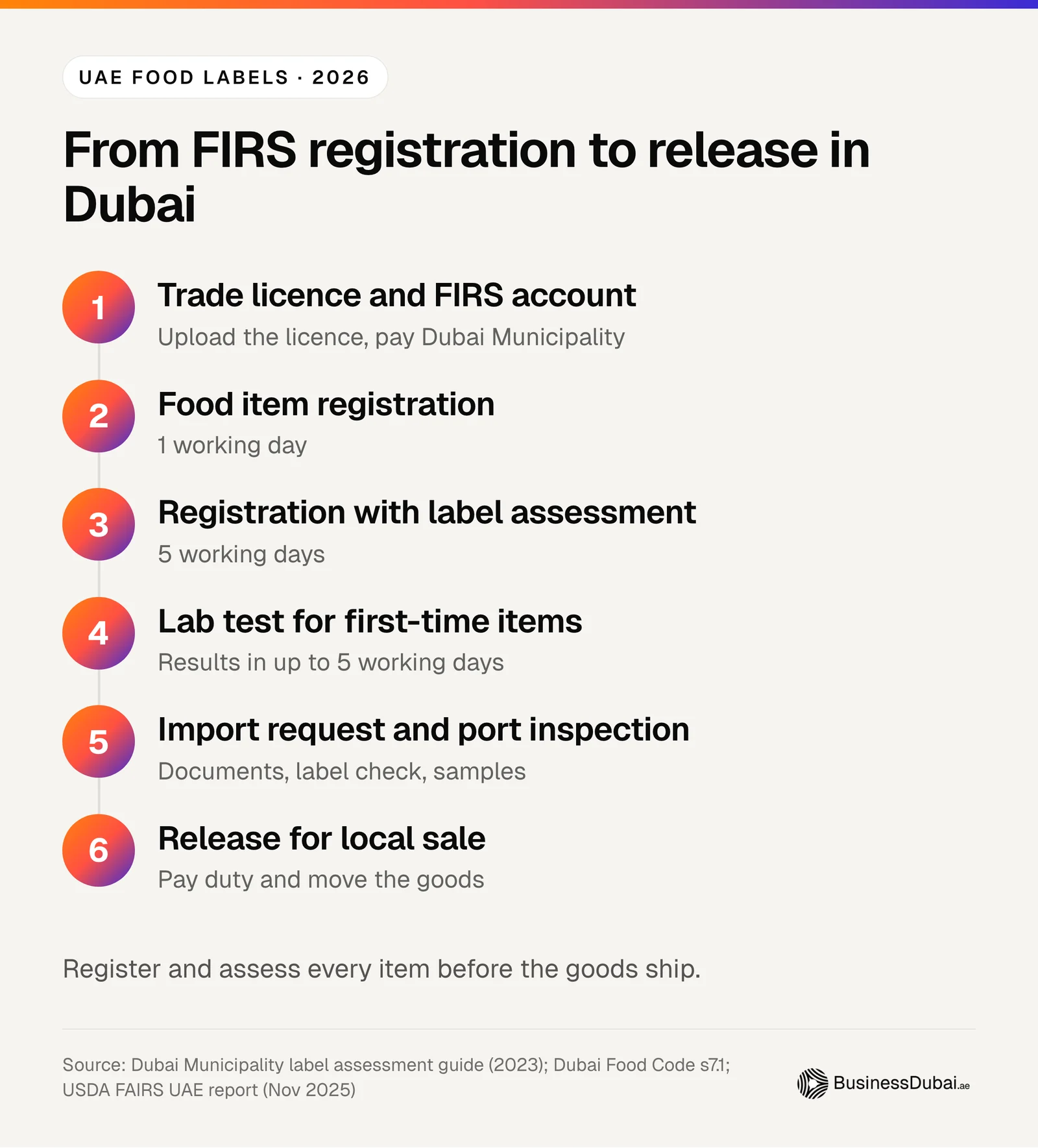
The Food Code requires registration in Dubai Municipality's e-Government system and FIRS before importing, and says the establishment "should ensure that labelling on the food item is approved using FIRS" [3]. The service is called "Apply to Register and Assess a Food Item" [14]. The sequence from licence to release, with the published times, is below.
What you upload and type
There are four options: label assessment only, item registration only, both together, and edit registration; any non-compliance is written as a remark on the assessment certificate [5]. For a new product choose both. You need high-resolution artwork, a photo of the actual pack, the barcode, the HS code (mandatory) and every ingredient entered separately [5]. The guide warns that "Unclear image and incomplete information will always be reason of rejection" [5]. If a request still shows as new after 5 working days, contact the section.
First-time items are lab tested
USDA reports that items registering for the first time in Dubai "will undergo laboratory testing through Dubai Municipality", based on risk and import frequency, and that an ingredient or additive detected but not on the label means the item "will be rejected" [8]. Results can take up to five working days depending on the test [8].
Does every SKU need a label assessment?
Dubai Municipality's guide lists items that do not need one (bulk seeds, pulses, nuts, grains, oils and honey; fresh produce; food additives; pork products; unprocessed meat; manufacturing inputs) and items that do (products with claims, UAE-made products, relabelled items, special nutritional food) [5]. The Food Code and USDA describe label approval as a step before import for food generally [3][8]. Treat it as required for every packaged retail SKU unless Dubai Municipality confirms an exemption in writing.
Pro Tip: Book the assessment against final artwork, not a render. Dubai Municipality compares what you type with the label image and the pack photo [5]. A factory that changes the barcode or net weight between proof and print run has created a different item. Freeze artwork, register, then print.
The customs code runs alongside FIRS: see our guide to Dubai Customs registration for import and export, or use a licensed customs clearance company for declarations.
When does a label change need a new registration or a reassessment?
A food label change needs a new Dubai registration when the country of origin, net weight, brand, barcode or trade name changes, and a reassessment when an ingredient, colour or flavour is added. A change of colours or fonts needs neither. Each pack size is a separate item, so a 100 g and a 200 g pack are registered separately.
Dubai Municipality sets the three tiers, and USDA adds the pack-size and barcode rules [5][8].
| Change | What Dubai requires |
|---|---|
| Colours, font or non-basic design | Nothing new |
| New ingredient, colour or flavour | Reassessment, no new registration |
| Country of origin, net weight, brand, barcode or trade name | New registration |
| A second pack size | A separate item |
| Barcode reused for a different description | Not allowed |
For a range, that is arithmetic. A spread in 200 g and 400 g jars, in two flavours, is four items with four assessments. Moving production to a factory in another country makes every one a new registration, because the origin changes.
Quick Math: A snack importer launching 3 flavours in 2 pack sizes has 6 items. If the factory later trims the net weight of all six by 5 grams, that is 6 new registrations, not one amendment [5]. At the published 5 working days, the paperwork is quick; the risk is stock arriving with a weight that matches no registered item.
What does a compliant UAE label look like on a jar of date spread?
A compliant UAE label on a 350 g jar of date spread shows the Arabic name and net weight together on the front, an Arabic ingredients list in descending order with the emulsifier's source, a sesame allergen line, nutrition per 100 g, producer-printed production and month-year expiry dates, a batch code, storage advice and the manufacturer's address.
The product is imaginary: a 350 g glass jar of date spread with tahini, made in Jordan, with a 12-month shelf life, imported into Dubai for supermarkets.
| Element | What the jar shows | Why |
|---|---|---|
| Name and net weight | "Date spread with tahini" in Arabic and English, 350 g, on the front | Same field of vision; metric weight for a solid [6] |
| Ingredients | "Ingredients: dates, sesame paste, sunflower oil, emulsifier (E471, of vegetable origin)" | Descending order; additive code with class [6] |
| Animal source | "of vegetable origin" after E471 | E471 can come from animal or plant fat, so the source is stated [8] |
| Allergens | "Contains sesame" | Sesame is on the GSO list [6] |
| Nutrition | Energy (kcal), protein, carbohydrates, fat and dietary fibre per 100 g | UAE.S 2233 [5][8] |
| Dates | "PROD 03/2026, EXP 02/2027", inkjet on the lid | Over three months, so month-year; expiry is 28 February 2027 [6] |
| Storage | "Store in a cool, dry place. Refrigerate after opening." | Storage and after-opening instructions [3] |
| Origin and maker | "Product of Jordan", manufacturer's name and address | Both required [5] |
| Importer | Dubai importer's name | Optional in the 2013 text [6] |
| Batch and barcode | Lot code beside the dates; one EAN unique to the 350 g jar | Permanent lot mark; unique barcode [6][8] |
| Language | All mandatory text in Arabic; English identical | Arabic mandatory [6] |
Two lines decide whether this jar clears. The first is E471: if the factory used an animal-fat emulsifier, the label must say so, and the Food Code then requires a halal certificate for a food containing an ingredient of animal origin [3]. The plant-origin version needs none. The second is the date: the lid carries the only dates, so any Arabic sticker carries none.
Pro Tip: Ask the factory for a specification sheet listing the source of every additive and carrier before the artwork is drawn. Dubai Municipality's lab tests what is in the jar, and an undeclared additive is a rejection [8]. Emulsifiers, flavour carriers and colours are where undeclared ingredients usually hide.
What happens to a food shipment at the Dubai port?
A food shipment arriving in Dubai is checked at the port by Dubai Municipality's food control inspectors, who verify documents against FIRS, inspect labels and take samples where needed. Compliant goods are released for local sale. Minor non-compliance usually brings a warning; non-compliant food can be relabelled under permit, re-exported, destroyed or referred for penalties.
The Food Code says "All imported food products and food contact materials are inspected by the Food Control Department at the port of entry" [3]. The volume is large: the municipality's Food Trade Control Section reported averages of about 12,600 sea, 12,000 air and 6,000 land consignments a month, in a presentation built on 2020 statistics [15]. Its document list is a health certificate from an authorised government entity, a halal certificate for meat and poultry products, a packing list, and where relevant a pork-free diet certificate for farmed fish, an organic certificate if organic is claimed and a GMO-free certificate if that is claimed [15].
| Outcome | When it happens | Source |
|---|---|---|
| Released for local sale | Documents, label and any test match FIRS; duty is paid | [8] |
| Warning | Minor non-compliance; a letter confirming the mistake will be avoided | [8] |
| Relabelling under permit | Goods in a licensed Dubai warehouse, item registered and label approved | [10] |
| Re-export | Non-compliant but no health risk; to a non-GCC third country | [8][14] |
| Destruction | Unfit food, under Dubai Municipality supervision | [15] |
| Referral | Frequent or major breaches, such as pork labelling or tampering with dates | [8] |
FIRS notifies the importer of a detention or rejection, and the importer "can use the same portal to appeal this decision" [8]. An appeal will not change the date on a pack, so most label rejections end in relabelling, re-export or reprinting.
Based on our experience: The cost of a held container is rarely the fine. It is the days the stock waits while the importer works out whether relabelling is possible, plus moving it to a licensed warehouse for the permit. For chilled and frozen goods, shelf life burns the whole time; our cold storage warehouse guide covers the premises side.
Why do Dubai food labels get rejected, and how do you fix each reason?
Dubai food labels are most expensively rejected for dates printed only on a sticker or covered by one, ingredients the lab finds but the label omits, and pork labelling breaches. Cheaper rejections are Arabic that differs from the English, unproven claims, changes never re-registered, reused barcodes, blurred images and details typed differently from the label.
The ranking orders the reasons by how hard they are to fix once the goods have shipped, which decides the cost.
| Rank | Rejection reason | The fix |
|---|---|---|
| 1 | Dates only on a sticker, or a sticker over the original date [6][3] | Cannot be fixed in Dubai; reprint at origin. Inkjet dates on the pack |
| 2 | Ingredient or additive found by the lab but not on the label [8] | Reformulate or relabel with the full list and reassess; get the full specification first |
| 3 | Pork content not stated, or pork imagery on non-pork food [8] | Reprint; pork products also need special permits |
| 4 | Arabic missing, or not identical to the English [5][6] | Pre-export sticker approved in the assessment, or relabel under permit |
| 5 | Organic, nutrition or health claim without proof [15][5] | Supply the certificate, or remove the claim and reassess |
| 6 | Weight, barcode, brand or name changed without re-registration [5] | Register the new item before shipping |
| 7 | Barcode reused for a different product [8] | A new barcode for every variant and pack size |
| 8 | Blurred artwork, or details typed differently from the label [5] | Full-resolution artwork, every field typed exactly as printed |
Reasons 6 to 8 reject the application, so they cost days, not stock, if caught before shipping. Reasons 1 to 3 surface at the port or in the lab and cost the consignment.
Common Mistake: Covering the original date with an Arabic sticker because the factory used a format the importer disliked. The Food Code says date marks must not be "removed, erased, altered, obscured, superimposed or in any way tampered with" [3], and USDA lists tampering with dates among the major infringements referred to the national food safety committees [8]. A sticker over a date turns a format question into a tampering case.
Can you relabel food after it arrives in Dubai?
Food can be relabelled after arrival in Dubai only under Dubai Municipality's "Temporary Permit for Changes Related to Food Label/Packages". The importer needs a FoodWatch registration and a licensed Dubai warehouse, the item registered in FIRS with an approved label assessment, and a manufacturer NOC where applicable. The fee is AED 200 per application, up to 5 items.
These terms come from Dubai Municipality's food permits guide, a document dated 2020 [10], so re-check the fee and the five-item cap on FoodWatch before relying on them. The guide says the permit is issued in 1 working day, per consignment, and lists three common rejection reasons: the item is not in the system, its status is already "Normal Release", or the location is not in Dubai or not on FoodWatch [10]. That second reason matters: the permit is for goods not yet released, not for stock already on shelves.
The labour can be done by your warehouse team or by a firm licensed for DET 8292101 Labeling Services, which the register describes as relabelling imported goods after "submitting such labels to the concerned authorities prior to re-sticking" [11].
Quick Math: A first container with 12 English-only SKUs needs 3 permit applications at 5 items each, which is AED 600 in permit fees on the 2020 schedule [10]. That is the small number. Labour, the sticker print run, transport to a licensed warehouse and the storage days sit on top, and none of them is a published figure. Get a per-unit quote from your warehouse before the goods ship.
What are the penalties for incorrect food labels in the UAE?
Incorrect food labels in the UAE are punished under Article 14 of Federal Law No. 10 of 2015. Trading food that breaches technical regulations, which include labelling, carries a fine of AED 10,000 to 100,000, as does a false description meant to deceive. Penalties double on repetition, and unlicensed pork or alcohol food carries AED 50,000 to 500,000.
The law defines technical regulations to include labelling, so a non-compliant label is caught by Article 14(5) even when nobody meant to deceive [2].
| Offence | Penalty | Article |
|---|---|---|
| Trading food that violates the technical regulations | Fine of AED 10,000 to 100,000 | 14(5) |
| False description of food to deceive the consumer | Fine of AED 10,000 to 100,000 | 14(3) |
| Trading, without licence, food containing pork or alcohol | At least one month in prison and AED 50,000 to 500,000, or either | 14(2) |
| Disposing of food retained under the law | Three months to two years and AED 100,000 to 300,000, or either | 14(4) |
| Adulterated, harmful or rotten food | At least three months and AED 100,000 to 2,000,000, or either | 14(1) |
| Repetition | Penalty doubled in all cases | 14(8) |
Article 17 adds a warning, closure for up to three months, and permanent closure with licence withdrawal if the violation is not removed [2]. Offences under clauses 2, 5 and 7 can be settled before referral for no more than AED 100,000 per offence [2]. The headline numbers are summarised below.
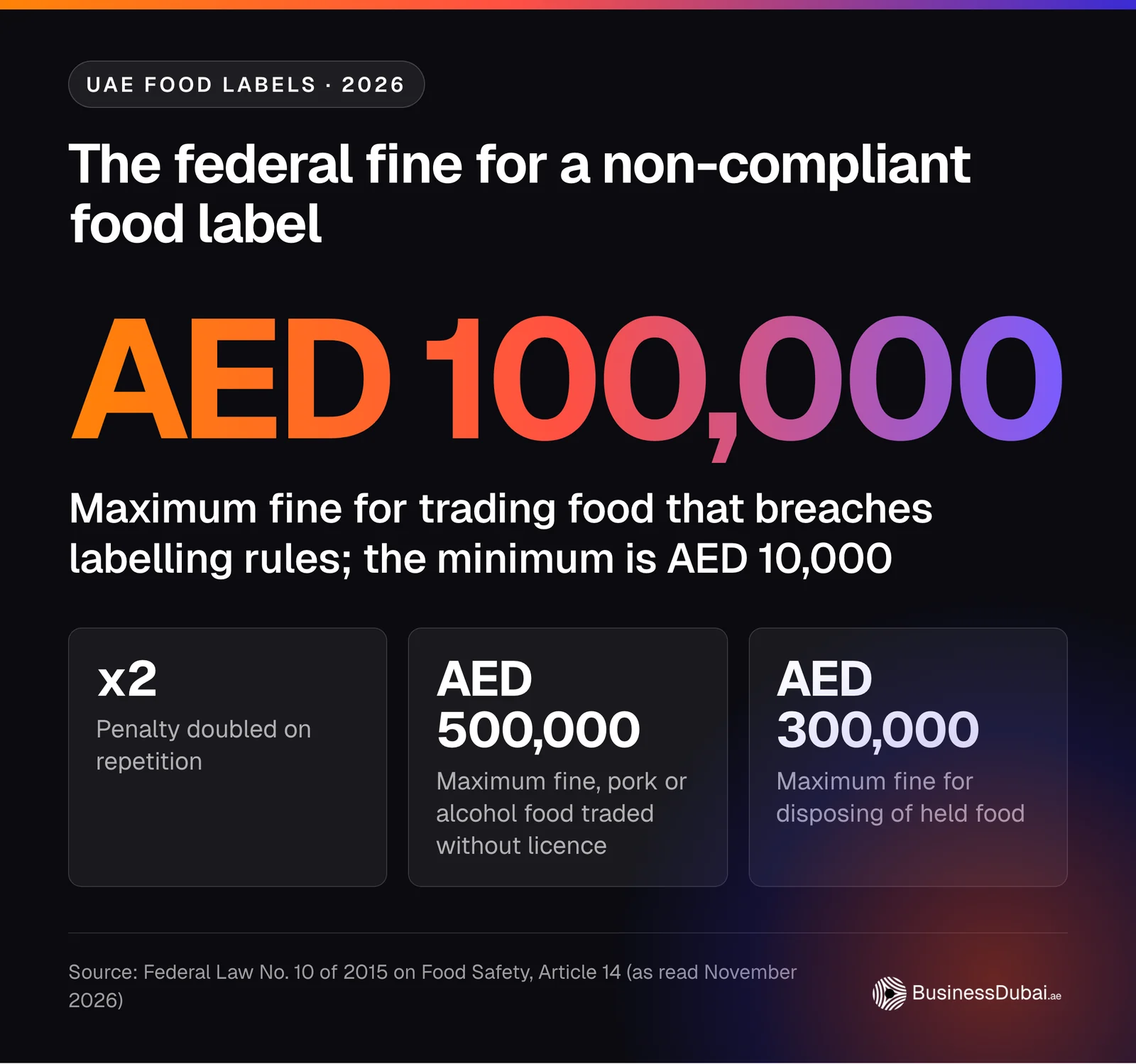
The disposal clause is the one importers overlook. Moving or selling stock Dubai Municipality has held before it is released carries AED 100,000 to 300,000 on its own [2]. A held consignment stays put until the authority says otherwise.
Is front-of-pack nutrition labelling, such as Nutri-Mark, mandatory in Dubai?
Front-of-pack nutrition labelling is not mandatory in Dubai as of November 2026. The UAE traffic-light standard UAE.S 5034:2018 was changed from mandatory to voluntary in December 2021, Abu Dhabi's Nutri-Mark A to E grade is voluntary, and a federal Nutri-Mark regulation was notified to the WTO in October 2025 only as a draft.
| Scheme | Status we found |
|---|---|
| UAE.S 5034:2018 traffic-light labelling | Changed "from mandatory to voluntary" in December 2021 [16] |
| Federal Nutri-Mark front-of-pack regulation | Draft notified as G/TBT/N/ARE/679 on 28 October 2025, comments to 27 December 2025; adoption not confirmed [17] |
| Abu Dhabi Nutri-Mark (A to E) | Voluntary, no date yet for mandatory use (January 2026) [18] |
| Nutri-Mark nationally | "not yet been made mandatory in the country" (June 2026) [19] |
| Dubai label grading | Khaleej Times reported in September 2026 that Dubai will get traffic light-style indicators; we could not read the detail [20] |
The draft federal rule exempts, among others, single-ingredient foods such as rice, tea, coffee and sugar, packs under 25 cm², bottled water, infant and baby foods and dietary supplements [17]. We found no mandatory sugar or sodium warning symbol in any Dubai or federal source we read. The back-of-pack nutrition panel is required; the front-of-pack grade is not, yet. A mandatory grade would mean new artwork for every SKU, so watch the federal draft.
Foods with extra labelling rules
Organic claims need an organic logo and a government certificate under UAE.S GSO 2374:2014 [8]. Nutrition and health claims follow UAE.S GSO 2333:2019 and are not allowed on foods for infants and young children except where Codex or national law permits [8]. Pork products need special permits and labels that "must clearly state the product contains pork" [8]. Energy drinks, juices, dairy and bottled water sit under the federal conformity scheme USDA describes; confirm the current scope with MoIAT [8].
Should a food importer set up on the Dubai mainland or in a free zone?
A food importer selling packaged goods to Dubai supermarkets usually needs a Dubai mainland trading licence, from AED 26,900 with one visa through BusinessDubai.ae, or a free zone company importing through a Designated Zone and selling to resellers. Either way, the licence holder registers in FIRS and holds the label approvals.
FIRS access needs an online application with the trade licence uploaded and a payment to Dubai Municipality [8], so the licence comes first. Our food trading company setup guide covers the setup in full; here is what changes for labels.
| Factor | Dubai free zone (Meydan Free Zone, Dubai South, IFZA) | Dubai mainland (DET) |
|---|---|---|
| Licence only, year one | AED 12,500 (Meydan, Dubai South); AED 12,900 (IFZA, partner price) | AED 18,200 |
| One visa / two visas | AED 21,850 / 28,400 (Meydan, Dubai South); AED 22,200 / 25,400 (IFZA) | AED 26,900 / 30,900 |
| Renewal | Ask the zone for its standard price | About AED 15,000 |
| Selling to Dubai supermarkets | Through a mainland distributor | Direct |
| FIRS label approval and relabelling permits | Required for goods entering Dubai; permit needs a licensed Dubai warehouse | Same |
Package figures are BusinessDubai.ae's 2026 standard prices for company formation only, with no warehouse or stock [25]. Who buys from you decides the route. For an importer selling to Dubai retailers, our mainland company setup page itemises the DET route and its renewal. For an importer holding stock for re-export or selling only to distributors, our free zone company setup page compares the zones on the visa basis that matters, and our JAFZA free zone guide covers the port-side Designated Zone.
Dubai against the other UAE bases
Corporate tax is federal, so the rate does not change by emirate. The price, the label route and access to Dubai shops do.
| Base | Corporate tax | BD package, one visa (AED) | Food label route | Sells directly to Dubai retail |
|---|---|---|---|---|
| Dubai mainland | 0% to AED 375,000, 9% above | 26,900 | Dubai Municipality FIRS | Yes |
| Meydan Free Zone or Dubai South | Ordinary rates for most trading | 21,850 | FIRS for goods entering Dubai | No |
| JAFZA | 0% possible on qualifying distribution | No BD package | FIRS for goods entering Dubai | No |
| Ajman | Ordinary rates for most trading | 11,600 | Ajman's own municipal food control [8] | No |
If the business never needs a Dubai address, Ajman is BusinessDubai.ae's cheapest complete package at AED 11,600 with one visa, and our business setup in Ajman page shows what that buys. It is a non-Dubai licence, so goods for Dubai shelves still go through Dubai Municipality.
Activity codes for packaged food importers
The DET register has no single "food importer" activity; it splits trading by food type, all Commercial [11][25]. The common ones are 4721032 Canned & Preserved Food Trading (sealed packaged food), 4721037 Snack Food Trading, 4721014 Confectionery & Chocolate Trading, 4721002 Dairy Products Trading, 4721017 Baby Food Trading, 4722001 Soft Drinks & Carbonated Water Trading and 4721016 Food Supplements Trading, where the Montaji and EDE rules apply. 8292101 Labeling Services is a separate Professional activity. Supermarket operators should read our supermarket business setup guide, and producers printing labels in Dubai our food processing factory guide, because UAE-made products always need label assessment [5].
What does it cost to get food labels compliant and an import company running?
A Dubai food import company costs from AED 18,200 in year one without a visa and AED 26,900 with one visa on the mainland through BusinessDubai.ae, or from AED 12,500 at Meydan Free Zone or Dubai South. Dubai Municipality publishes no FIRS label assessment fee on the pages we reviewed; artwork, translation and lab tests are quotes.
Setup figures are BusinessDubai.ae's 2026 package prices [25]; government fees appear only where we found them published.
| Cost item | Amount (AED) | Notes |
|---|---|---|
| Dubai mainland package | 18,200 / 26,900 / 30,900 | No visa / one visa / two visas; year one |
| Meydan Free Zone or Dubai South package | 12,500 / 21,850 / 28,400 | Licence only / one visa / two visas |
| IFZA package | 12,900 / 22,200 / 25,400 | Partner price; licence only / one visa / two visas |
| Ajman package (non-Dubai alternative) | 4,888 / 11,600 / 17,000 | Licence only / one visa / two visas |
| FIRS registration and label assessment | Not published on the pages we reviewed | Confirm in the portal before you budget |
| Laboratory test, first-time items | Not published on the pages we reviewed | Depends on the tests requested |
| Relabelling permit | 200 per application, up to 5 items | 2020 schedule; re-check on FoodWatch [10] |
| Supplement authorisation (EDE), if relevant | 100 plus 5,000 | 45 working days, five-year validity [13] |
| Arabic translation, artwork and stickers | Quote | Per SKU; stickers must be in the label assessment |
| Warehouse and cold storage | Quote | Not in any package |
| Year two, mainland renewal | About 15,000 | Licence only; visas and warehouse separate |
| Year two, free zone renewal | Ask the zone | Request the standard, not the launch, price |
The label lines are quotes because no official schedule we read gives them, and a competitor's average would mislead you. They are driven by the number of items (every pack size and flavour counts), whether the factory prints Arabic or you sticker, and how many items need first-time lab tests.
For an itemised plan covering the licence, the FIRS account and a label check on your first range, get a free consultation→
How is imported packaged food taxed: customs duty, VAT and corporate tax?
Imported packaged food entering the Dubai mainland pays 5% customs duty on CIF value on most non-GCC lines, then 5% import VAT. Corporate tax is 0% on taxable income up to AED 375,000 and 9% above. A free zone distributor reaches 0% only on qualifying sales to resellers, never on sales to individuals.
Dubai Customs charges 5% of CIF value on imports, except alcohol and tobacco [21], and USDA notes that most non-GCC food is either exempt or 5% [8], so check your HS code in the tariff before pricing. VAT applies at "a standard rate of 5%" on any supply or import [22], with no general zero rate for food. USDA reports excise of 50% on sweetened and carbonated drinks and 100% on energy drinks [8]. Corporate tax is 9% on income above AED 375,000 [23]. Our import from China to Dubai guide walks through landed cost from one large source market.
Ministerial Decision No. 229 of 2025 treats distribution from a Designated Zone as a Qualifying Activity only where goods enter through the zone and go to "A customer who resells, processes or alters such goods", and lists "Any transactions with natural persons" as an Excluded Activity [24]. A JAFZA importer selling cartons to supermarkets can qualify; selling the same cartons online to households cannot, on those sales.
Quick Math: A container with a CIF value of AED 200,000 on a 5% line pays AED 10,000 in duty. Import VAT is 5% of CIF plus duty, so 5% of AED 210,000, which is AED 10,500, generally recoverable if you are VAT-registered; the duty is a cost. A container rejected for its labels has still paid freight, and if it is re-exported it never earns the sale that recovers either.
What has to be renewed and kept current every year?
A Dubai food importer renews its trade licence every year (about AED 15,000 on a BusinessDubai.ae mainland package), keeps FIRS item records current, re-registers or reassesses items whenever a label changes, renews visas, files VAT returns once registered and files an annual corporate tax return.
The label side is never finished. Dubai Municipality warns that "The requirements of food label will be changed in case of any update on standards" [5], so a new UAE.S 9 edition or a mandatory front-of-pack rule would mean reassessment across the range. Every new flavour, pack size or factory adds an item, and every relabelling permit is per consignment [10].
Licence renewal, item updates, visas and tax filings tend to land in the same few months. Our post-setup services team keeps that calendar for food traders, so a renewal does not land in the week a new range is due at the port.
Real Client Stories
These are composite examples built from situations food importers commonly face in Dubai. Names and details are illustrative, and the only figures used are published government fees and BusinessDubai.ae's package prices.
The olive oil importer who stickered the date
Karim imported olive oil from Tunisia on a Dubai mainland licence, from the AED 26,900 package with one visa. The factory printed a month-year expiry in a corner the buyer disliked, so his warehouse team added a neat Arabic sticker that repeated the date and partly covered the original. At the port it was treated as a sticker over a date mark. The bottles could not be relabelled into compliance, and the batch went back for reprinting at origin. He now has dates inkjet-printed on every bottle and approves the sticker artwork in the label assessment. "I thought I was making the label clearer. The inspector saw a covered date."
The snack brand with six items, not one
Mei Ling set up at Meydan Free Zone, from AED 21,850 with one visa, to supply Dubai supermarkets through a mainland distributor. She launched three flavours of rice crackers in two pack sizes and expected one registration. Dubai Municipality treats each pack size as a separate item, so she had six registrations and six label assessments, and a later 5-gram weight change meant six new registrations. Each assessment took about the published 5 working days, so the delay was small, but only because she caught the weight change before printing. "Every barcode is its own product. I keep a sheet now with all six."
The date spread that nearly needed a halal certificate
Omar planned to import a Jordanian date spread through a Dubai mainland company, from AED 18,200 without a visa. The ingredients list showed E471 with no source. When he asked, the factory confirmed the emulsifier came from animal fat, which meant the label had to state its origin and, under the Food Code, the product would need a halal certificate. He asked the factory to switch to a plant-origin E471, updated the Arabic panel first, and registered the item with the new specification. The first container cleared. "One line on the ingredients list nearly added a certificate to every shipment."
Start your food import business the right way
For a packaged food importer, the label decides the shipment more than the licence does. Three things matter: designing to UAE rules from the first artwork (Arabic as the master language, producer-printed production and expiry dates, a full additive specification), registering and assessing every item in FIRS before anything is printed or shipped, and treating the relabelling permit as a recovery route, not a plan.
BusinessDubai.ae has completed 700+ company registrations across the UAE, including food trading and import companies, with itemised pricing and no hidden fees. We will price a mainland company setup for selling to Dubai retailers against a free zone company setup for import and distribution, and our post-setup services team keeps your licence, visas, VAT and corporate tax filings current once your range is on shelf.
Tell us what you import, from where and who buys it, and we will build an all-in plan around your first container. Talk to a setup expert→
Frequently Asked Questions
What are the food labeling requirements in the UAE for imported products?
Imported packaged food in the UAE must carry, in Arabic, the product name, net content, ingredients with additives, allergens, nutrition information, storage conditions, country of origin, the manufacturer's name and address, a batch code and both production and expiry dates. Dubai Municipality checks these against UAE.S 9:2019.
Is Arabic labelling mandatory for food sold in Dubai?
Yes. Dubai Municipality states that Arabic is the mandatory language on food labels and English is optional. Any other language on the pack must be identical to the Arabic under GSO 9.
Is an English-only food label ever acceptable in the UAE?
Only for institutional-use products, according to USDA's 2025 report on UAE import rules. Those packs may enter without Arabic but cannot be sold in retail stores unless accompanied by an Arabic label.
Can I add an Arabic sticker after the goods arrive in Dubai?
Not as a routine plan. USDA says stickering must be done before export. Dubai Municipality does issue a temporary permit for label changes in a licensed Dubai warehouse, at AED 200 per application for up to 5 items on its 2020 schedule, but only after FIRS registration and an approved label assessment.
Can an Arabic sticker show the expiry date?
No. GSO 9 does not permit stickers for production and expiry dates, and dates printed only on a sticker are not accepted. Dates must be printed, stamped or embossed by the producer on the pack or original label.
What date format is required on food labels in the UAE?
Food with a shelf life under three months uses day/month/year; longer shelf lives may use month/year. Both a production date and an expiry date are required, with only one of each on the pack.
Does a month/year expiry date mean the first or the last day of the month?
The last day. USDA's 2025 report states that with month/year, the last day of the listed month is the expiration date, and GSO 9 calculates shelf life to the end of the recorded month.
Which foods do not need an expiry date in the UAE?
Under the GSO 9 (2013 text), foods such as fresh fruit and vegetables, non-fortified salt, solid sugars, chewing gum, honey, dry legumes, loose tea and dry cereals need only a production or harvest date.
Do I need label approval before shipping food to Dubai?
Yes. Dubai Municipality's Food Code says that before importing any food item, the establishment should ensure its labelling is approved using FIRS. Register and assess the item before the goods leave the factory.
How long does FIRS label assessment take in Dubai?
Dubai Municipality publishes 1 working day for food item registration and 5 working days for registration with label assessment. First-time items may also need a lab test, with results in up to five working days according to USDA.
How much does food label assessment cost in Dubai?
Dubai Municipality does not publish a FIRS label assessment fee on the pages we reviewed, so confirm the amount in the portal before you budget. Competitor figures vary widely and are not official.
Is Montaji used to register food products in Dubai?
No. Montaji is Dubai Municipality's system for consumer products such as cosmetics, detergents and health supplements. Packaged food is registered and label-assessed in FIRS, also reachable through ZADI.
What is the difference between FIRS, ZAD and ZADI?
FIRS is Dubai Municipality's food import and re-export system for registration and label assessment. ZAD is the federal food registration system for all seven emirates under Ministerial Decree No. 239 of 2018. ZADI is Dubai's integrated platform combining import requests, registration, label assessment and customs services.
Does every pack size need its own registration?
Yes. USDA's 2025 report states that a 100 g and a 200 g pack of the same food are different items and must be registered separately, each with its own unique barcode.
Do I need to re-register a food item if I change the label?
It depends on the change. Dubai Municipality requires a new registration for a change of origin, net weight, brand, barcode or trade name, a reassessment for a new ingredient, colour or flavour, and nothing new for colours or fonts.
Is the Nutri-Mark or traffic light label mandatory in Dubai?
Not as of November 2026. UAE.S 5034:2018 was made voluntary in December 2021, Abu Dhabi's Nutri-Mark is voluntary, and a federal Nutri-Mark draft notified to the WTO in October 2025 had no confirmed adoption date in the sources we read.
Which allergens must be declared on UAE food labels?
The GSO 9 (2013 text) lists gluten cereals, crustacea, eggs, fish, peanuts and soybeans, walnuts, milk including lactose, sulphite at 10 ppm or more, celery, mustard, sesame, clams and lupin, with their products. Check the current UAE.S 9 for changes.
What happens if a food shipment arrives in Dubai with non-compliant labels?
For minor non-compliance a warning is normally issued, according to USDA. Safe but non-compliant food may be re-exported to a non-GCC country or relabelled under a Dubai Municipality permit, and major breaches such as date tampering are referred for fines or bans.
Can I appeal a rejected food shipment in Dubai?
Yes. USDA says FIRS notifies the importer of a detention or rejection and that the importer can appeal through the same portal. An appeal does not fix a non-compliant label.
What is the fine for incorrect food labels in the UAE?
Federal Law No. 10 of 2015 sets a fine of AED 10,000 to 100,000 for trading food that breaches technical regulations, which include labelling, and the same for a false description meant to deceive. The penalty doubles on repetition.
Do I need a halal certificate for every food product?
No. Dubai's Food Code requires halal certificates for processed meat products and foods with meat, poultry or animal-origin ingredients such as gelatin, seafood excepted. A printed halal claim must still comply with UAE.S GSO 2055-2:2015, according to USDA.
Who is responsible for a compliant label, the factory or the importer?
The importer. Dubai Municipality's guide says it is the consignee's responsibility to read and follow UAE standards. The factory prints the label, but the Dubai licence holder registers it and answers for it at the port.
Do I need a trade licence before registering a food product in Dubai?
Yes. FIRS access requires an online application with the trade licence uploaded and a payment to Dubai Municipality. A Dubai mainland package through BusinessDubai.ae starts from AED 18,200 without a visa.
Does a Dubai label approval cover Abu Dhabi and Sharjah?
Not automatically. USDA says that outside Dubai, label assessment comes from each municipality's food control department, while ZAD is the federal registration system for all seven emirates.
Do health supplements follow the same labelling rules as food?
No. Supplements in Dubai are registered in Montaji, and Dubai Municipality's guideline allows clear English and/or Arabic. The Emirates Drug Establishment charges AED 100 plus AED 5,000 for a federal marketing authorisation taking 45 working days.
References
[1] UAE Government portal (u.ae). Food safety and health tips: fine of AED 10,000 to 100,000 for incorrect labels and Ministerial Decree No. 239 of 2018 on ZAD registration. Updated 8 September 2026. u.ae
[2] Federal Law No. 10 of 2015 on Food Safety (English, hosted by the Ministry of Climate Change and Environment): definition of technical regulation, Article 14 penalties and Article 17 administrative measures and settlement. moccae.gov.ae
[3] Dubai Municipality. Food Code (2013 edition, English): section 7.1 FIRS registration and label approval, 7.3 port inspection and certificates, 8.1 food labelling and 8.7 non-halal food. dmpmedia.dm.gov.ae
[4] UAE Cabinet. Cabinet Resolution No. 4 of 2020 on making mandatory the standard specifications for the food sector (Arabic, hosted by Dubai Municipality); title only relied on. dmpmedia.dm.gov.ae
[5] Dubai Municipality. How to apply for Food Label Assessment on the IRS system (December 2023): UAE.S 9:2019, basic label information, Arabic mandatory and English optional, processing times, service options, rejection causes and re-registration rules. dm.gov.ae
[6] GCC Standardization Organization. GSO 9/2013 Labeling of Prepackaged Food Stuffs (English text): ingredients, allergens, net contents, date marking, exemptions, language and sticker clauses. servicio.mapama.gob.es
[7] GSO standards store. GSO 9:2022/Amd1:2025, Edition 4, approved 22 April 2025, listed as current edition. dgsm.gso.org.sa
[8] USDA Foreign Agricultural Service, Dubai. Food and Agricultural Import Regulations and Standards Country Report, United Arab Emirates, TC2025-0008 (21 November 2025): label assessment, stickers, date formats, pack sizes, barcodes, lab testing, FIRS, ZAD and ZADI, port outcomes, special categories and excise. agriexchange.apeda.gov.in
[9] Dubai Municipality. Technical Guidelines for Health Supplements, DM-HSD-GU29-TGHS2, Version 2.0 (4 May 2024): Montaji registration and supplement label language. dmpmedia.dm.gov.ae
[10] Dubai Municipality. Food / Food Related Permits and Approvals Services (document dated July 2020): item 7, Temporary Permit for Changes Related to Food Label/Packages, prerequisites, rejection reasons, fee and validity. dmpmedia.dm.gov.ae
[11] Dubai Department of Economy and Tourism. Business activity register as recorded in a public copy: 8292101 Labeling Services and the foodstuff trading activity codes (checked against a July 2026 register export). visaindubai.ae
[12] Dubai Municipality. Guidelines for Consumer Products Import and Re-export, Version 2.0 (2 May 2025): Montaji scope of regulated consumer products. dmpmedia.dm.gov.ae
[13] Emirates Drug Establishment. Issuance of Marketing Authorization for a Healthcare Product: scope, AED 100 application fee, AED 5,000 registration fee, 45 working days and five-year validity, as read 11 November 2026. ede.gov.ae
[14] Dubai Municipality. Food Safety Department services list: register and assess a food item, release for local market, transfer between emirates and re-export release. dm.gov.ae
[15] Dubai Municipality Food Safety Department, Food Trade Control Section. Presentation on import requirements (statistics to 2020, hosted by Spices Board India): consignment volumes, customer journey, required documents and services. indianspices.com
[16] Food Business Middle East and Africa. "UAE amends nutritional labelling requirements from mandatory to voluntary", 14 December 2021: UAE.S 5034:2018. foodbusinessmea.com
[17] Slovak Office of Standards, Metrology and Testing. Weekly compilation of WTO TBT notifications, week 44 of 2025: G/TBT/N/ARE/679, UAE Nutri-Mark front-of-pack draft, comment deadline and exemptions. normoff.gov.sk
[18] The National. Abu Dhabi food labelling system encouraging producers to offer healthier options, 30 January 2026: voluntary Nutri-Mark grades. thenationalnews.com
[19] FoodNavigator-Asia. "UAE's Nutri-Mark nutrition labelling system goes digital", 23 June 2026: status not yet mandatory. foodnavigator-asia.com
[20] Khaleej Times. "Dubai to get traffic light-style indicators on food product labels", 2 September 2026 (headline only; article body not read). khaleejtimes.com
[21] Dubai Customs. Dubai Customs Services Guide 2025: customs duty of 5% of CIF value except alcohol and tobacco. dubaicustoms.gov.ae
[22] Federal Tax Authority. Federal Decree-Law No. 8 of 2017 on Value Added Tax (unofficial English translation), Article 3: standard rate of 5% on supplies and imports. tax.gov.ae
[23] UAE Government portal (u.ae). Corporate tax: 9% on income above AED 375,000 under Federal Decree-Law No. 47 of 2022. u.ae
[24] UAE Ministry of Finance. Ministerial Decision No. 229 of 2025 regarding Qualifying Activities and Excluded Activities: distribution from a Designated Zone and transactions with natural persons. mof.gov.ae
[25] BusinessDubai.ae. Internal data from food trading and import company registrations since 2013, including 2026 standard package prices for the Dubai mainland, Dubai free zones and Ajman, and DET activity selection for food importers. businessdubai.ae