

Dubai ended 2025 with 154,264 hotel rooms across 827 establishments and welcomed 19.59 million international overnight visitors [1]. Every one of those rooms is furnished, and every refurbishment cycle is a purchase order. That is why so many joiners, upholsterers and cabinet makers want to open a furniture factory in Dubai. Most of them start on the wrong licence.
The Dubai Department of Economy and Tourism (DET) register has a Professional activity called Carpentry, and its description limits it to small workshops [2]. A furniture factory sits on Industrial codes instead, needs an environmental clearance before production starts, and only qualifies for federal duty-free timber, boards and machines once it holds the Ministry of Industry and Advanced Technology (MoIAT) Industrial Production Licence, which asks for at least 10 employees and AED 250,000 of capital [3]. Pick the carpentry code, and you can make a villa's wardrobes. You cannot easily bid for a hotel package, and you pay full duty on every board you import.
Since 2013, BusinessDubai.ae has set up companies across the mainland and the free zones, and this guide is written from the authorities' own documents. It covers activity codes, the carpentry workshop versus factory decision, environmental clearance and spray booth rules, Civil Defence, timber and CITES imports, the MoIAT licence and customs exemption, product rules, hotel and government supply, export origin, tax and cost. It is general information, not legal or tax advice: confirm your own case with the authority or a qualified adviser.
What does it take to open a furniture factory in Dubai?
A Dubai furniture factory needs an Industrial activity code (3100xxx for furniture, or 1622001 for wooden doors and windows), not the Professional carpentry code 1622007, which is limited to small workshops. It needs environmental clearance (Category B, now issued by DECCA) and Civil Defence approval before production, then MoIAT's Industrial Production Licence to import inputs duty-free.
Those are four gates, run by four bodies, in a fixed order. The local licence defines what you may make; the environmental clearance whether you may make it on that plot; Civil Defence whether the building is safe for the process. MoIAT then decides whether you are a factory in the federal sense, which is what unlocks the customs exemption on raw materials, machinery and equipment [4].
Each gate reads the one before it. The environmental clearance application asks for your licence and lists your activity codes against a published category list [5]. MoIAT's licence asks for "Industrial license from a local licensing department." [3]. A carpentry code at the start therefore carries through to every later approval.
| Gate | Who decides | What it needs from you | Published time |
|---|---|---|---|
| Activity and licence | DET (mainland) or the free zone authority | An Industrial furniture code and premises that suit it | Varies by authority |
| Environmental clearance | Dubai Environment and Climate Change Authority (DECCA), formerly Dubai Municipality | EIA Summary Report for Category B activities | 5 working days for Category B [5] |
| Fire and life safety | Civil Defence | Drawings, then inspection of the built premises | Not published as a single figure |
| Industrial Production Licence | MoIAT | 10 employees, AED 250,000 capital, local industrial licence | "Within 15 business days" per the MoIAT FAQ [3] |
| Customs exemption | MoIAT, then Dubai Customs | Registered HS codes for each input | 3 working days to register, instant per shipment [4][6] |
Carpentry workshop, factory, upholsterer or turnkey supplier: which business are you starting?
A Dubai furniture business is one of four things: a carpentry workshop on Professional code 1622007, a factory on Industrial 3100xxx codes, an upholsterer on Professional 9524003, or a turnkey supplier on Commercial 4610011. Only the factory sits in environmental Category B and can realistically meet MoIAT's 10-employee, AED 250,000 test for duty-free inputs.
The table maps each model to its DET code, licence type, environmental clearance category and MoIAT position [2][5][3].
| Model | DET code and licence type | Environmental clearance | MoIAT licence and duty-free inputs |
|---|---|---|---|
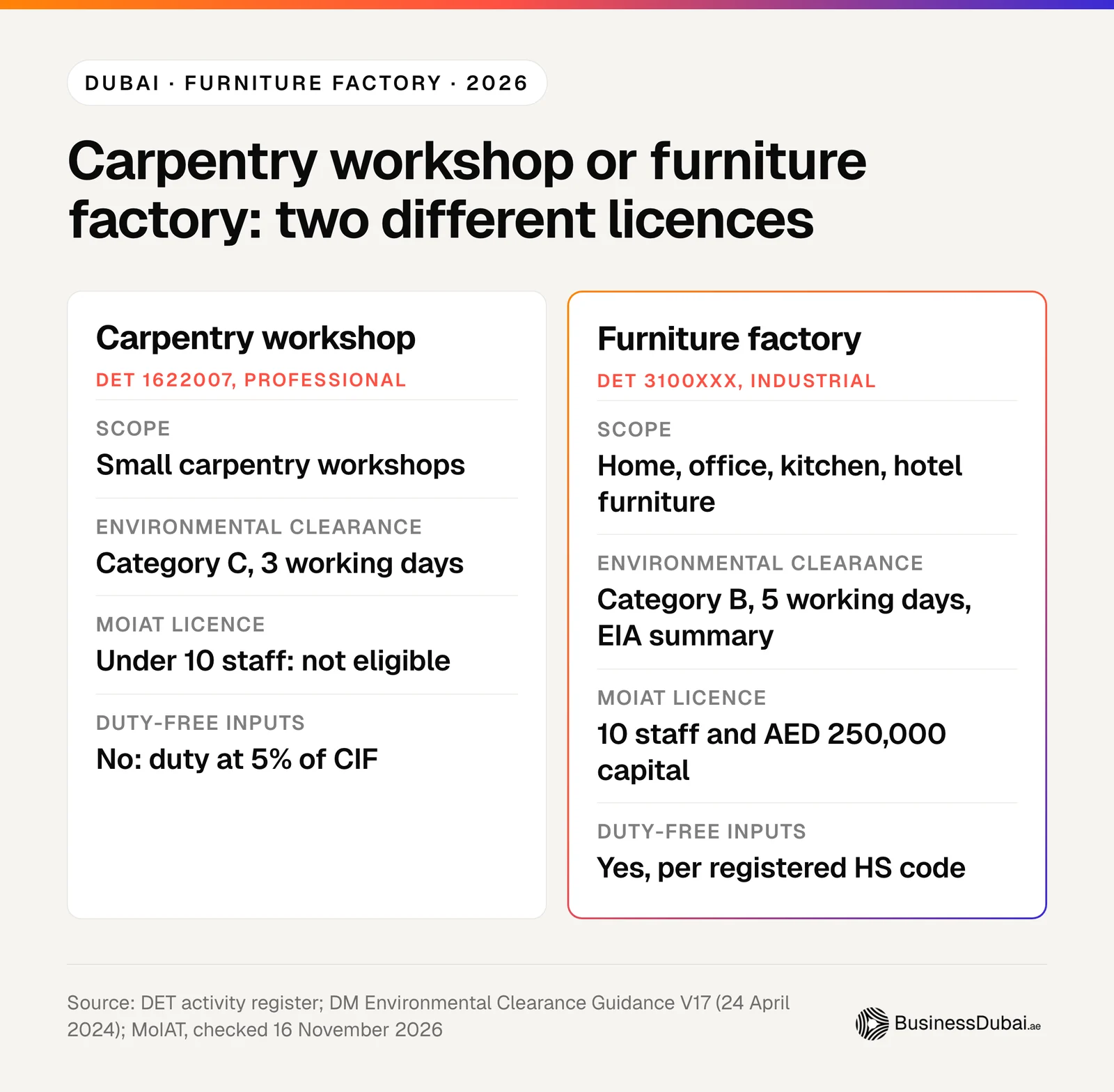
| Carpentry workshop | 1622007 Carpentry, Professional | Category C (light), 3 working days | Not eligible below 10 employees and AED 250,000 capital |
| Furniture factory | 3100001, 3100002, 3100004, 3100007, 3100008 and others, Industrial | Category B (medium), 5 working days, EIA Summary Report | Eligible once it meets the 10 staff and AED 250,000 test |
| Doors, windows and decor joinery | 1622001 or 1622005, Industrial | Category B | Eligible on the same test |
| Upholsterer or refurbisher | 9524003 or 9524004, Professional | Confirm with DECCA | Not a manufacturing route in practice |
| Turnkey FF&E supplier | 4610011 Turnkey Projects Contracting, Commercial | Not an industrial activity | No: a trading and contracting code |
Read the carpentry row carefully. The public copy of the DET register at visaindubai.ae describes 1622007 as "Includes small carpentry workshops whose activities are limited to making household and personal items as well as producing simple wooden products." [2]. The DET register pulled from Invest Dubai in August 2026 words the same code differently but keeps the phrase "small carpentry workshops" [29]. Either wording describes a workshop, not a plant with a panel saw line, CNC router, edge bander and spray booth.
The two routes most founders weigh are compared below.
Common Mistake: Opening on 1622007 Carpentry and then bidding for a hotel package. The workshop code is Professional and limited to "small carpentry workshops", its environmental category is C, and a team below 10 employees cannot hold MoIAT's Industrial Production Licence [2][3]. When the contractor's pre-qualification asks for an industrial licence, you are amending the licence, re-filing the environmental clearance under Category B and paying 5% of CIF on boards in the meantime [7].
Real Talk: The carpentry code is not a mistake for everyone. A bespoke joiner with five craftsmen fitting wardrobes and kitchens in villas may never need the MoIAT licence, and Category C clearance at 3 working days is lighter [5]. Choose it deliberately, and price imported boards with the 5% duty included, because no exemption is available to you.
Which DET activity codes does a furniture factory need?
A Dubai furniture factory uses DET Industrial codes from the 3100xxx group for furniture and mattresses, 1622001 for wooden doors and windows, 1622005 for wooden decor and 1610001 for plywood. Carpentry 1622007, sawmilling 1610008, upholstery 9524003 and repair 9524004 are Professional. Turnkey supply to hotels is Commercial code 4610011.
The full list below comes from DET's business activity list as recorded in a public copy of the register [2]. Names follow the DET register; the mirror spells a few differently (it calls 3100002 "Kitchen Furniture Manufacturing"), but the codes agree [29].
| Code | Activity | Licence type | What it covers |
|---|---|---|---|
| 3100001 | Home Furniture Manufacturing | Industrial | Beds, sofas, tables, cupboards, chairs, and hotel or restaurant furniture |
| 3100002 | Kitchen Cabinets & Fixtures Manufacturing | Industrial | Cabinets and fixtures of wood with metal fittings for kitchens |
| 3100004 | Schools, Hospitals & Parks Furniture Manufacturing | Industrial | Seats, desks, beds, shelves and cupboards for schools, labs, hospitals, parks |
| 3100007 | Office Furniture Manufacturing | Industrial | Reception, desking, seating, screens, storage, boardrooms |
| 3100008 | Shop Fixtures Manufacturing | Industrial | Retail fixtures |
| 3100009 | Sponge Mattresses Manufacturing | Industrial | Mattresses with sponge or foam |
| 3100010 | Spring Mattresses Manufacturing | Industrial | Mattresses fitted with spring wire coils |
| 2930109 | Transport Furniture Manufacturing | Industrial | Seats and furniture fixed in aircraft, vehicles, yachts and ships |
| 1622001 | Wooden Doors & Windows Manufacturing | Industrial | Doors, windows and frames, including blast-resistant styles |
| 1622005 | Wooden Decor Products Manufacturing | Industrial | Partitions, stair and balcony rails and other decor woodwork |
| 1610001 | Plywood Manufacturing | Industrial | Plywood, particle board and MDF |
| 1610006 | Wood Drying & Processing | Industrial | Air or kiln drying of timber |
| 1622007 | Carpentry (Carpenter shop) | Professional | Small carpentry workshops |
| 1610008 | Sawmilling & Planning of Wood | Professional | Sawmilling and cutting of wood into boards |
| 9524003 | Furniture Upholstery | Professional | Padding, springs, webbing, fabric and leather covers |
| 9524004 | Furniture Repair & Refurbishing | Professional | Repair, polishing, painting, varnishing, re-upholstery |
| 4610011 | Turnkey Projects Contracting | Commercial | Supplying facilities such as hotels with furniture and fixtures |
Most factories carry two or three of these, for example 3100001 with 1622001 for doors and 1622005 for wall panelling. Each extra Industrial code goes onto the same environmental clearance, so list them before you file.
There is no joinery, millwork or veneer code
No code named joinery, millwork or veneer appears in either copy of the Dubai register we checked [29]. If a proposal shows a joinery code, ask for the DET code number and check it on the DET activity list before you pay.
Turnkey supply is a separate commercial code
DET's 4610011 Turnkey Projects Contracting describes firms "supplying private and governmental facilities like educational, military and health units, hotels" with furniture and fixtures, and says these firms "are permitted to directly import their materials, but not re-export or trade them" [2]. A factory that wants to contract as the FF&E package supplier, not only as the maker, may need 4610011 added to its licence. Confirm that with DET against the contract you are bidding for.
Free zone codes are not DET codes
Free zones keep their own activity lists and codes. JAFZA, Ajman Free Zone and RAKEZ list furniture manufacturing; IFZA and Meydan do not; SPC lists only repair, assembly and upholstery; DAFZ lists finishing and panels only [29]. Meydan's own assembly page says manufacturing and retail of new furniture "are not permitted under this activity" [8].
Where should you locate a furniture factory in Dubai or the northern emirates?
A furniture factory belongs in industrial premises: a Dubai mainland industrial unit, or a free zone that lists furniture manufacturing (JAFZA, Ajman Free Zone or RAKEZ). BusinessDubai.ae packages start at AED 18,200 on the Dubai mainland without a visa, AED 5,555 in Ajman Free Zone and AED 6,010 at RAKEZ, before premises.
Location decides whether the activity is on the zone's list, whether the plot allows a wood plant, and whether you can sell to Dubai buyers directly. The table compares the realistic options [29].
| Location | Furniture manufacturing on the list? | BusinessDubai.ae package | Premises |
|---|---|---|---|
| Dubai mainland industrial area | Yes, DET Industrial codes | AED 18,200 without a visa, AED 26,900 with one visa | Industrial unit, landlord quote |
| Al Quoz (Dubai mainland) | DET codes apply, but check the plot's land use first | As Dubai mainland | Plot-specific; see below |
| JAFZA | Yes, the zone's own furniture codes | No BusinessDubai.ae package | Zone quote |
| Dubai Industrial City | Confirm the activity with the zone | No BusinessDubai.ae package | Zone quote |
| Ajman Free Zone | Yes | AED 5,555 licence only, AED 13,931 with one visa, AED 17,971 with two | Warehouse or factory unit, zone quote |
| RAKEZ | Yes | AED 6,010 licence only, AED 12,810 with one visa, AED 18,810 with two | Industrial unit, zone quote |
| Sharjah (Hamriyah, SAIF Zone, mainland industrial areas) | Confirm with the authority | No BusinessDubai.ae package for Hamriyah or SAIF Zone | Authority quote |
| SPC, Meydan | Not for manufacturing: no furniture manufacturing activity in our registers | Packages exist, but do not choose them for a factory | Not suitable |
| Dubai South | Not confirmed: we hold no published activity list for the zone | Package exists for company formation; confirm a manufacturing activity and industrial premises with the zone first | Zone quote |
Ajman and RAKEZ are cheaper on the licence line, and both list furniture manufacturing. Our business setup in Ajman page shows what the Ajman package includes. For Sharjah's industrial options, our business setup in Sharjah page explains the mainland and free zone routes. BusinessDubai.ae has no JAFZA, Hamriyah, SAIF Zone, KEZAD or Dubai Industrial City package, so those zones quote you directly. The best free zones for manufacturing guide compares the industrial zones, and the JAFZA guide, Ajman Free Zone guide and RAKEZ guide cover each zone.
Real Talk: Every price in that table is company formation only. A furniture factory needs industrial premises and an industrial activity that the zone or DET approves and quotes separately. A desk package does not make a factory: no environmental clearance, Civil Defence certificate or MoIAT licence will be issued for a flexi-desk address, because each one inspects a real building where the machines stand [5][3].
Al Quoz: check the plot before you sign
Al Quoz has long housed workshops, but Dubai Municipality's Al Quoz Creative Zone Plot Development Guideline Manual (May 2023) re-plans plots there into cultural and creative industries land uses, labelled CCI 1, CCI 2 and CCI 3, each with its own mix of permitted uses [9]. The manual does not tell you whether a given plot will accept a woodworking plant with a spray booth. Ask the landlord for the plot's affection plan, check the permitted land use, and make the environmental clearance a condition of the lease.
Free zone or mainland for a furniture factory?
The buyer decides this more than the rent does. A factory that sells to Dubai villa owners, retailers and contractors needs mainland market access; one that sells mostly to exporters or other businesses can sit in a free zone. Our mainland company setup and free zone company setup pages itemise each route, including the year-two renewal the headline price leaves out.
| Factor | Free zone (Ajman Free Zone, RAKEZ) | Dubai mainland |
|---|---|---|
| Selling to Dubai households and contractors | Through a distributor or a mainland presence | Direct |
| Year-two renewal | Zone renewal quote | About AED 15,000 |
| Environmental and fire regime | The zone's own EHS and fire process: confirm with the zone | DECCA clearance and Dubai Civil Defence |
| Corporate tax | 0% possible as a Qualifying Free Zone Person on qualifying sales | 0% to AED 375,000, 9% above |
| MoIAT licence and duty exemption | Available on the same criteria | Available on the same criteria |
What environmental clearance does a furniture factory need, and who issues it now?
A Dubai furniture factory needs an Environmental Clearance before it starts production. Furniture, mattress, plywood, door and window codes are in Category B, reviewed in 5 working days on an EIA Summary Report. Carpentry 1622007 and sawmilling 1610008 are Category C at 3 working days. Since 20 August 2026, DECCA issues these permits.
Dubai Municipality's Guidance on Environmental Clearance, Version 17 of 24 April 2024, sets the rule plainly: "no project or facility shall start the activity before obtaining the environmental license" [5]. The same document lists the furniture codes in Annex 1, Part 2, the "List of Medium Industrial Activities (Category B)": 3100001, 3100002, 3100004, 3100007, 3100008, 3100009, 3100010, 2930109, 1610001, 1610006, 1622001 and 1622005 all appear there [5]. Carpentry 1622007 and Sawmilling & Planning of Wood 1610008 sit in Part 3, the light industrial list (Category C) [5].
Responsibility has since moved. On 20 August 2026, Dubai Municipality announced that seven services were transferred to the Dubai Environment and Climate Change Authority, including "environmental permits for industrial projects" [10]. The guidance remains the best statement of what the clearance asks for, but you now apply to DECCA. Confirm the current portal and service name with DECCA before you file.
Category B against Category C
The two categories differ in paperwork and time. For Category B, the review "is 5 working days" from a complete submission, on an Environmental Impact Assessment Summary Report; for Category C, it "is 3 working days" on a shorter checklist [5]. In both cases the clock stops when the authority replies and restarts when you resubmit, so an incomplete file is the real delay.
The guidance also warns that, depending on the nature and size of the process, the applicant may be asked for additional information or a full Environmental Impact Assessment Report [5]. A large plant with several spray booths should plan for that possibility.
The administrative-office trap
An office licence and a factory licence are treated differently. The guidance notes that no clearance is needed where the licence is based on an administrative office, and adds: "Environmental Clearance should be obtained before starting the industrial activities." [5]. Opening on an office basis and moving machines in later does not avoid the clearance; it only moves the date it is due.
What the form asks: dust collectors and spray booths
The Category B form is where a furniture plant is judged. It asks you to tick each emission source on site, including dry-type and wet-type spray paint booths and wood working machines, and then asks which control is in place: a filter on a dry booth, a water curtain and filter on a wet booth, and "Metal and/ or wood working machine provided with dust collector" [5]. In other words, a panel saw or CNC line without dust extraction is a visible gap on the application.
Pro Tip: Design dust extraction and the spray booth before you file the Category B application, not after. The form asks whether each wood working machine has a dust collector and whether each booth has a filter or water curtain [5]. Ask your machine supplier for the extraction specification with the quotation, and attach the layout to the EIA Summary Report. A complete file is reviewed in 5 working days; an incomplete one restarts the clock each time.
The spray booth guideline
Finishing is the most regulated part of a furniture plant. Dubai Municipality's Technical Guideline for Paint Spray Booths, DM-HSD-GU42-PSB2 Version 4.0 issued 9 May 2024, applies to all establishments "involving paint spray booth activities in the Emirate of Dubai" [11]. It sets overspray control by application rate and fixes the stack, separation and ignition distances.
| Spray application rate | Recommended overspray control |
|---|---|
| Less than 2 litres per hour | Water curtain, fibres or baffles |
| 2 to 4 litres per hour | Water curtain or fibre |
| More than 4 litres per hour | Water curtain |
The same guideline requires exhaust through a vertical stack with a "minimum height of 1.5 meters" above the maximum roof level, says "The exhaust gas velocity should not be less than 8m/sec.", requires each booth to be separated from other operations by "not less than 3 meters", bans open flame or spark-producing equipment "within 6 meters" unless separated by a non-combustible partition, and says exhaust air "shall not be recirculated" [11]. The four numbers below are the ones a factory layout has to show.
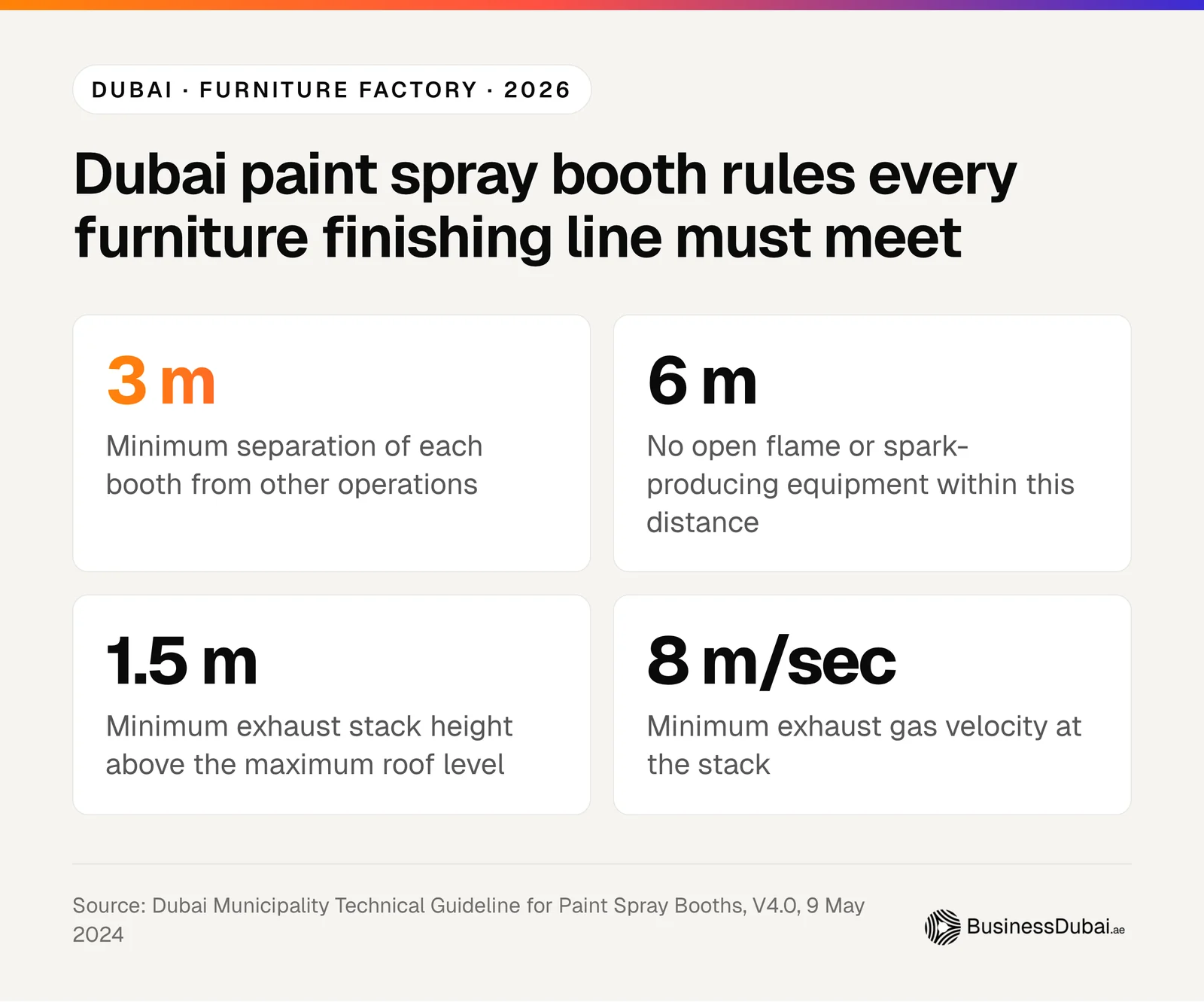
The 6 metre ignition rule is the one that reshapes layouts: a spray booth beside the machine line fails it unless a non-combustible partition separates them.
Lacquers, thinners and solvents
Dubai Municipality's Technical Guideline for Safe Use of Industrial Organic Solvents (GU43, issued 9 May 2024) also applies where solvents are used, and names paints and lacquers among the uses [12]. Plan solvent storage and ventilation alongside the booth.
What does Civil Defence need to approve before a furniture factory opens?
A Dubai furniture factory needs Civil Defence approval of its premises before production, under the UAE Fire and Life Safety Code. Dubai Development Authority restated in May 2026 that "compliance with the UAE Fire and Life Safety Code of Practice is mandatory". Approval runs in stages, drawings then inspection, and your fire consultant sets the systems from the current code.
Civil Defence approves the building for the process you describe, not for a generic warehouse. The staged process (drawing approval, then inspection of the built premises, running alongside the utility and municipal approvals) is set out in our manufacturing company setup guide, so it is not repeated here.
For a woodworking plant, three things drive the fire design: fine wood dust from saws, routers and sanders; flammable finishes and solvents in the spray area and its store; and stacks of timber, boards, foam and packed furniture. Your fire consultant designs detection, suppression, compartments and storage from the current edition of the code, and Civil Defence checks that design against the process you declared. A DDA circular of 19 May 2026 confirms that "compliance with the UAE Fire and Life Safety Code of Practice is mandatory" for work in its zones [13].
Real Talk: Do not take fire figures from blog posts. Online guides quote sprinkler thresholds and duct velocities for woodworking plants that we could not confirm in any official edition of the code we could read. Give your fire consultant the real layout, booth position, finish volumes and storage plan, and let the design come from the current code and Civil Defence's review.
Product fire performance is a separate question. No UAE fire test for hotel furniture or mattresses is stated in this guide as law: the hotel or project specification sets what the furniture must pass, and our furniture trading guide explains how standards and fire ratings work on imported pieces.
How do you import timber, boards and CITES-listed species into Dubai?
Raw timber entering Dubai needs a phytosanitary certificate from the exporting country and a heat treatment certificate or declaration. MOCCAE inspects it at the entry point and charges AED 200 per release request. CITES-listed species also need a CITES import certificate at AED 300, valid one year for a single shipment. Customs duty is 5% of CIF.
The Ministry of Climate Change and Environment (MOCCAE) releases agricultural products at the port, and its service covers raw timber. The service page says "inspection to these consignments will be done upon their arrival at the entry point" and lists, for wood, a "Heat Treatment Certificate (For woods)", or the same statement in the additional declaration of the phytosanitary certificate [14]. The phytosanitary certificate itself must come from the competent authority of the exporting country. The federal fee is AED 200 per release request [14]. The page's English is a machine translation, so read it alongside the Arabic version or ask MOCCAE where the wording matters.
Whether plywood, MDF and veneer need the same inspection is unclear from the published wording, so ask MOCCAE before the first shipment.
CITES-listed timber
Some timbers are listed under the Convention on International Trade in Endangered Species (CITES). For those, MOCCAE issues an import certificate at AED 300 [15]. The certificate is "issued for a single shipment", its validity is "one year from the date of issuance", and each certificate covers "a maximum four species only" [15]. For species in Appendix II or III, you also need the CITES export or re-export certificate from the exporting country, and MOCCAE's page refers to Federal Law No. 11 of 2002 on the regulation of international trade in endangered species [15]. Check each species' current status with MOCCAE or your supplier before you place the order: this guide does not name species, because listings change.
Pallets and packaging
For exports, the destination country sets the heat-treatment rules for wooden pallets and crates; for imports, confirm the UAE requirement with MOCCAE. No official UAE source confirming a packaging rule was found, so none is stated here.
The five checks on a timber shipment, in the order they usually arise, are shown below [14][15][7].
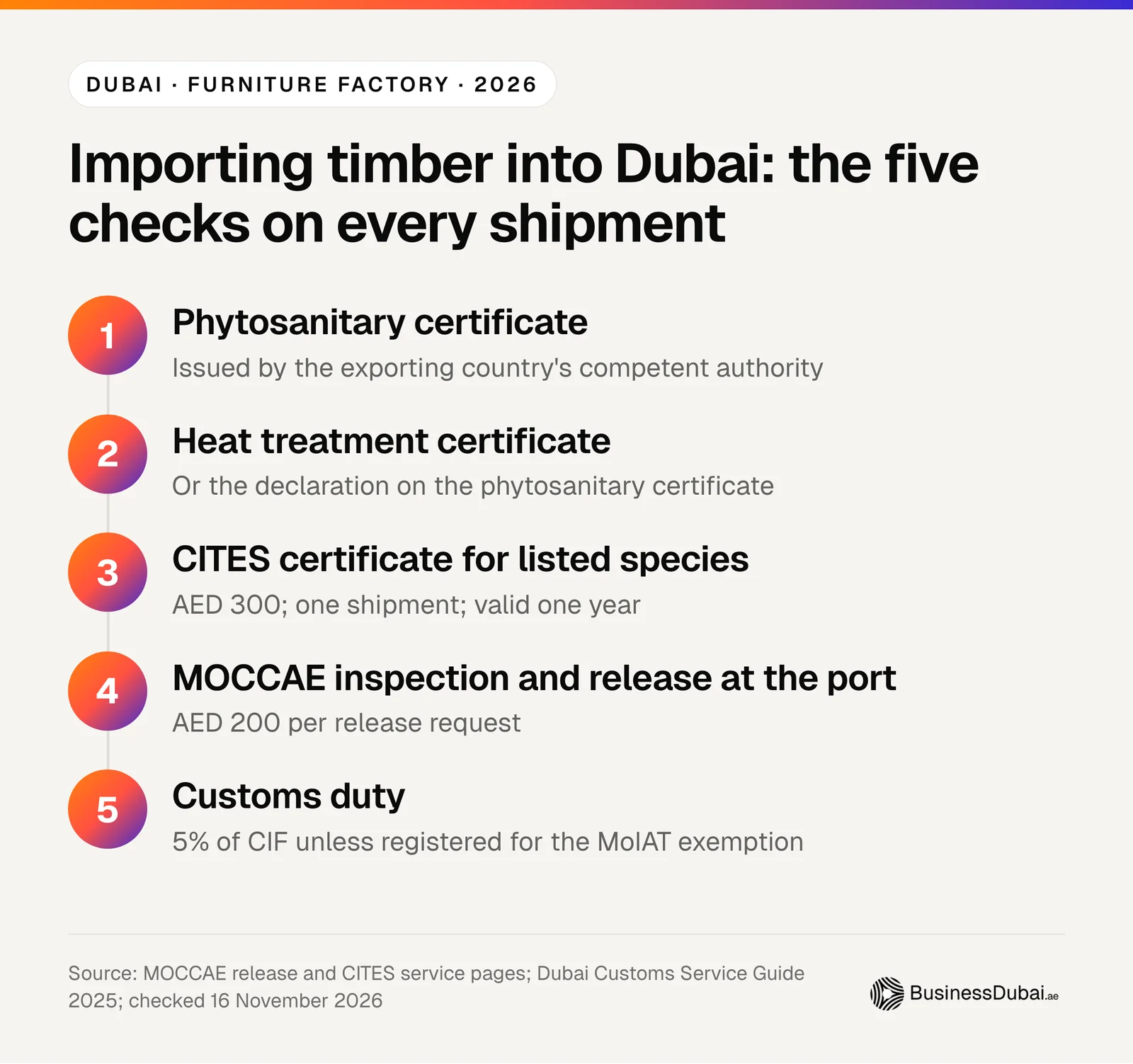
Duty is the last line on that list and often the largest. Dubai Customs charges "5% of the value CIF (Cost Freight Insurance) value except for alcohol and cigarettes/tobacco" [7]. A licensed factory can remove that line on registered inputs, which is the next section. For customs registration itself, see our Dubai customs registration guide.
How do the MoIAT industrial licence and duty-free inputs work for a furniture factory?
MoIAT's Industrial Production Licence needs at least 10 employees, AED 250,000 capital and a local industrial licence, with an AED 0 application fee and AED 100 inspection. Once licensed, the factory registers each input HS code at AED 100 per code and claims exemption from the 5% customs duty shipment by shipment.
The federal licence is what makes a furniture plant a factory for customs purposes. MoIAT's service page lists the requirements as the memorandum of association, "Total of no fewer than 10 employees.", "Total capital of no less than AED 250,000." and "Industrial license from a local licensing department." [3]. The application fee is AED 0, the inspection fee AED 100, and MoIAT's FAQ gives the time as "Within 15 business days" [3]. Renewal is AED 500, with a fine of AED 100 per month for late renewal up to AED 1,000 [16].
The 10-employee and AED 250,000 figures are MoIAT's federal criteria for this licence. They are not a DET condition for the local trade licence, though some online guides present them as one. A small carpentry workshop under 1622007 with fewer than 10 staff does not meet them, so it cannot register inputs for the duty exemption.
Step 1: register each input HS code
Registration covers "raw materials, machinery, equipment", as well as semi-finished goods and packaging, provided the factory holds a valid Industrial Production Licence [4]. The fee is AED 100 per HS code plus an AED 100 inspection, and the service time is "3 Working Days" [4]. For a furniture plant, that means boards (plywood, MDF, particle board), sawn timber, hardware, foam, fabric, lacquers, and each machine.
Step 2: request the exemption on each shipment
When a registered input arrives, the factory requests the exemption online at AED 100 per HS code. MoIAT describes it as "Instant service", the customs officer checks the application, and "If approved, the quantity will be deducted from the factory’s balance." [6]. The balance is the registered quantity, so register realistic annual volumes.
Step 3: the fast track when orders grow
If a hotel contract doubles your board consumption, the fast track helps. MoIAT offers an instant exemption where the increase "does not exceed 30% of the previously registered quantity", at AED 50 for the quantity increase and AED 50 per HS code for the exemption [17].
Quick Math: A shipment of boards and hardware worth AED 300,000 CIF that enters the local market pays 5% customs duty, which is AED 15,000 [7]. With the MoIAT exemption, the cost is AED 100 per HS code: a shipment covering three registered codes (say, MDF, plywood and hinges) costs AED 300 to exempt [6]. That is a saving of AED 14,700 on one shipment.
Common Mistake: Registering inputs before the Industrial Production Licence is issued. The registration service applies only where "the industrial facility holds a valid industrial production license" [4], so the order is fixed: local industrial licence, environmental and Civil Defence approvals, MoIAT licence, then HS code registration. Ship your first container of boards before the registration is approved, and you pay the 5% on it.
Free zone factories and the exemption
The exemption matters most when goods enter the UAE local market. Ask the zone and Dubai Customs how duty applies to your flow of goods before you plan around it.
What labour and housing rules apply to a furniture factory workforce?
A UAE furniture factory with 50 or more workers earning AED 1,500 or less a month must house them under Ministerial Resolution No. 44 of 2022, as the UAE government portal states. Emiratisation targets apply once a company reaches 50 employees. Confirm the current thresholds and your quota with the Ministry of Human Resources and Emiratisation.
The UAE government portal states that "50 or more workers earning a wage of AED 1,500 or less per month must provide accommodation" [18]. A furniture plant with large machine and assembly teams can reach that threshold faster than a design-led joinery. Budget accommodation from a licensed provider into the cost of each hire.
Emiratisation is the second people rule. Companies at 50 employees and above carry Emiratisation targets; confirm your quota with MoHRE and read our Emiratisation 2026 guide for the current position. Visa processing, renewals and the labour paperwork for a growing workforce are the kind of work our post-setup services team takes off the founder's desk.
Which product rules apply to furniture, mattresses, upholstery and finishes?
MoIAT's regulated-products sheet has no row named furniture or mattresses, but it lists paints and varnishes (Cabinet Resolution No. 6 of 2016) and textiles. Cabinet Resolution No. 54 of 2019 on textile products names "furniture products, curtains, carpets, mattresses", so upholstery fabric, cushions and mattress covers may fall inside the scheme.
MoIAT's regulated-products sheet lists paints and varnishes under Cabinet Resolution No. 6 of 2016, with a test report from an accredited laboratory and an electronic declaration of conformity among the requirements, and it lists textiles [19]. It has no line for furniture or mattresses.
The textile scheme and upholstered products
Cabinet Resolution No. 54 of 2019 regarding the UAE Scheme for the Control of Textile Products is the rule to read closely. Article 2(1)(c) brings into scope "Ready-to-use textiles intended for internal use, including furniture products, curtains, carpets, mattresses and their accessories." [20]. The Resolution defines textile products as products "made exclusively from textile fibers", and also covers products with textiles in their composition of "not less than 80%" of weight [20].
That wording cuts both ways for a furniture maker. Curtains, cushions, upholstery fabric and mattress covers look squarely inside it. A finished sofa with a timber frame and foam, or a spring mattress, may or may not be, depending on how the "exclusively" and 80% by weight tests apply. Confirm with MoIAT or an ECAS conformity assessment body before you label or sell. Where the scheme applies, the product is registered in ECAS, tested by an approved body, and its label carries "a code for the production batch" among other details [20]. The garment factory guide explains the labelling steps in more detail.
No UAE limit on formaldehyde emission from boards was found in an official source, so this guide gives none; follow the project specification and your board supplier's test reports.
How does a furniture factory win hotel, fit-out and government contracts?
A Dubai furniture factory wins hotel work through the fit-out contractor or as a turnkey FF&E supplier, which may need DET code 4610011 added. Government work starts with the free federal supplier register (30 working days) and, for many buyers, an In-Country Value (ICV) certificate, which MoIAT says gives advantages in tender awards.
Hotel demand is real: Dubai's hotel inventory reached 154,264 rooms across 827 establishments by the end of December 2025 [1]. Most of it is bought through the designer's specification and the fit-out contractor's package, so a pre-qualification file matters as much as price. Our interior fit-out company guide covers the contractor side, and the interior design business guide covers the specifier side.
ICV certification
MoIAT describes the National In-Country Value (ICV) Program as an initiative "aimed at generating economic benefits through redirecting government procurement expenditures and those of leading national companies to the UAE economy", and says "Certified suppliers will gain advantages during the award of tenders and contracts based on their ICV score." [21]. Confirm the formula, tender weighting and certificate validity with an ICV certifying body; this guide does not state them.
The federal supplier register
The Ministry of Finance register for federal suppliers is free. Its page states "No Fees", a service time of "30 working days", and documents of "Trade license, VAT registration certificate and passport copy of company owner identified in the trade license" for both domestic and free zone suppliers [22]. You need VAT registration before you can apply, so sequence it early.
Pro Tip: Build the pre-qualification pack once and reuse it. Keep current copies of the industrial licence, the Category B environmental clearance, the Civil Defence certificate, the MoIAT Industrial Production Licence, the VAT certificate and any test reports in one folder. The federal register asks for the trade licence, VAT certificate and owner's passport and takes 30 working days [22]; a contractor's pre-qualification usually asks for more. A factory that answers in a day looks like a supplier, not a start-up.
Can Dubai-made furniture be exported as UAE origin, including to India under CEPA?
UAE-made furniture can be exported with UAE origin once MoIAT issues a Value-Added Certificate, which needs a national component of at least 40% of production cost and costs AED 1,000 plus AED 100 inspection. Under the India-UAE CEPA, furniture (Chapter 94) must meet "CTH + VA 40%" on an FOB basis.
MoIAT's Value-Added Certificate applies the Arab Rules of Origin: "The national component must represent at least 40% of the total production cost." [23]. The fee is AED 1,000 plus an AED 100 inspection, with a service time of 5 working days [23].
The India-UAE CEPA rule for furniture
India's rules of origin under the CEPA set a product-specific rule for each chapter [24]. For Chapter 94 (furniture, bedding, mattresses, cushions and similar stuffed furnishings), the rule is "CTH + VA 40%". For Chapter 44 ("Wood and articles of wood; wood charcoal."), it is "CTSH + VA 40%" [24]. CTH means a change of tariff heading: the finished product must fall under a different four-digit heading from its non-originating inputs. VA means value addition, and "The percentages are on an FOB basis."; where ex-works price is the basis, the threshold is "5 percentage points lower" [24].
Imported plywood or MDF (Chapter 44) made into a wardrobe (Chapter 94) changes heading, so the 40% value addition is the real test. It differs from MoIAT's 40%: CEPA measures FOB price, the Value-Added Certificate production cost. Model both. If your plant assembles imported furniture parts rather than making them, the parts and the finished piece may share a heading, so check the classification with a customs adviser before you rely on CTH.
How is a furniture factory taxed in the UAE?
A mainland furniture factory pays corporate tax at 0% on taxable income up to AED 375,000 and 9% above. A free zone factory can pay 0% as a Qualifying Free Zone Person, because manufacturing is a Qualifying Activity, but sales to households are excluded. VAT is 5% on local sales; exports are zero-rated.
Ministerial Decision No. 229 of 2025 lists manufacturing of goods or materials as a Qualifying Activity and defines it as including "the production, improvement or assembly of products and materials from raw materials or components" [25]. The same Decision lists "Any transactions with natural persons" as an Excluded Activity, with exceptions that do not include manufacturing [25]. A free zone factory selling to hotels, contractors, retailers and export buyers can therefore qualify; its sales to households do not count as qualifying income.
| Position | Corporate tax | VAT | What decides it |
|---|---|---|---|
| Mainland factory | 0% to AED 375,000, 9% above [26] | 5% on UAE sales, exports zero-rated [27] | Ordinary rules |
| Mainland factory with revenue at or under AED 3,000,000 | Small Business Relief may apply for tax periods ending on or before 31 December 2029 [28] | As above | Election and revenue test |
| Free zone factory selling to businesses and exporters | 0% on qualifying income as a QFZP [25] | As above | Meeting every QFZP condition |
| Free zone factory with household sales | Household sales are non-qualifying | As above | De minimis: lower of 5% of revenue or AED 5,000,000 [25] |
The de minimis limit and what happens if you breach it
Non-qualifying revenue is tolerated if it does not exceed "5% (five percent) of the total Revenue" or AED 5,000,000, "whichever is lower" [25]. A free zone factory that runs a showroom selling to the public can breach that quickly. A company that fails a QFZP condition is taxed at the ordinary rates, 0% to AED 375,000 and 9% above, from the start of that tax period, and cannot be a QFZP for the following four periods [26]. Our Qualifying Free Zone Person guide explains the conditions, the Small Business Relief guide covers the AED 3,000,000 relief, and the VAT registration guide covers returns and zero-rating.
Quick Math: A mainland furniture factory with AED 1,200,000 of taxable profit pays nothing on the first AED 375,000 and 9% on the remaining AED 825,000 [26]. Nine per cent of AED 825,000 is AED 74,250. A free zone factory with the same profit, selling only to hotels, contractors and exporters and meeting every QFZP condition, can pay 0% [25]. That AED 74,250 a year is the value of keeping household sales out of the free zone company.
What does a furniture factory cost to set up in Dubai in 2026?
A Dubai furniture factory starts with BusinessDubai.ae's mainland package at AED 18,200 without a visa or AED 26,900 with one visa, about AED 15,000 on renewal. The MoIAT licence costs AED 100 in inspection, inputs AED 100 per HS code, and the factory unit, machines, spray booth and studies are quoted separately.
The table separates published fees from the lines that only a landlord, supplier or consultant can price. Package figures are BusinessDubai.ae's 2026 standard prices [29]; government fees are from each authority's service page.
| Cost item | Amount (AED) | Notes |
|---|---|---|
| Dubai mainland company, no visa | 18,200 | BusinessDubai.ae package, year one; company formation only [29] |
| Dubai mainland company, one visa | 26,900 | BusinessDubai.ae package, year one [29] |
| Ajman Free Zone package | 5,555 / 13,931 / 17,971 | Licence only / one visa / two visas [29] |
| RAKEZ package | 6,010 / 12,810 / 18,810 | Licence only / one visa / two visas [29] |
| MoIAT Industrial Production Licence | 0 application, 100 inspection | Needs 10 employees and AED 250,000 capital [3] |
| HS code registration for exemption | 100 per HS code, plus 100 inspection | 3 working days [4] |
| Customs exemption per shipment | 100 per HS code | Instant service [6] |
| Fast-track quantity increase | 50, plus 50 per HS code | Up to 30% above registered quantity [17] |
| Value-Added Certificate | 1,000 plus 100 inspection | 5 working days [23] |
| MOCCAE timber release | 200 per release request | Raw timber consignments [14] |
| CITES import certificate | 300 per certificate | One shipment, up to four species [15] |
| Federal supplier register | 0 | "No Fees" [22] |
| Factory unit | Zone or landlord quote | Industrial premises with a permitted land use |
| Machines (saws, CNC, edge banders, presses) | Supplier quote | Not estimated here |
| Spray booth and dust extraction | Contractor quote | Must meet the DM spray booth guideline [11] |
| Environmental study (EIA Summary Report) | Consultant quote | Category B submission [5] |
| Fire design and Civil Defence approvals | Consultant quote | Staged approval |
| Year two: mainland renewal | About 15,000 | BusinessDubai.ae renewal figure [29] |
| Year two: MoIAT licence renewal | 500 | Plus AED 100 inspection if needed [16] |
The building, machines, extraction and finishing line are where the capital goes: get written quotes for each before you sign a lease. For a quote that prices the company alongside your factory plan, get a free setup quote→
Real Talk: Budget the 5% duty into year one even if you plan to claim the exemption. The MoIAT licence needs 10 employees on payroll and an inspected factory [3], so your first board and machine shipments almost always land before the licence exists. Those shipments pay 5% of CIF [7]. Plan the machine order around the licence date if the numbers justify the wait.
In what order should you set up a furniture factory?
Set up a Dubai furniture factory in this order: choose the Industrial activity codes and location, secure premises with a confirmed land use, obtain the trade licence, file Category B environmental clearance with DECCA, get Civil Defence approval, hire to 10 staff, apply for MoIAT's licence, then register input HS codes (3 working days).
| Step | What happens | Published time or fee |
|---|---|---|
| 1 | Choose Industrial codes (3100xxx, 1622001, 1622005) and, if needed, 4610011 | DET or zone list [2] |
| 2 | Pick the zone or mainland area and check the plot's land use | Al Quoz plots: check the CCI plan [9] |
| 3 | Company formation and trade licence | BusinessDubai.ae package from AED 18,200 [29] |
| 4 | Design the layout: dust extraction, spray booth, finish store | DM spray booth guideline [11] |
| 5 | Environmental clearance, Category B | 5 working days on a complete file [5] |
| 6 | Civil Defence drawing approval and inspection | Staged |
| 7 | Hire to at least 10 employees and capitalise to AED 250,000 | MoIAT criteria [3] |
| 8 | MoIAT Industrial Production Licence | AED 100 inspection; "Within 15 business days" [3] |
| 9 | Register each input HS code | AED 100 per code; 3 working days [4] |
| 10 | Supplier register, VAT, ICV, Value-Added Certificate | 30 working days for the register [22] |
Steps 4 to 6 overlap, because the environmental and fire designs share one layout. Our mainland company setup team handles step 3 and the DET side; for the free zone route, our free zone company setup team prices Ajman Free Zone and RAKEZ against each other.
Which setup fits your furniture business?
The right furniture setup depends on the product and the buyer. A villa joiner can stay on carpentry 1622007; hotel FF&E, kitchen and mattress makers need Industrial codes and Category B clearance; an office furniture assembler supplying government needs the MoIAT licence, the federal supplier register and an ICV certificate. The table maps five common profiles.
| Profile | Activity codes | Location | What decides success |
|---|---|---|---|
| Bespoke joinery for villas | 1622007 Carpentry, or 1622001 and 1622005 if growing | Dubai mainland industrial unit | Category C clearance; duty at 5% priced in |
| Hotel FF&E manufacturer | 3100001, 1622001, 1622005, possibly 4610011 | Dubai mainland or JAFZA | Category B clearance, Civil Defence, MoIAT exemption, pre-qualification pack |
| Kitchen cabinet maker | 3100002 with 3100001 | Dubai mainland | Spray booth design and duty-free boards and hardware |
| Mattress plant | 3100009 or 3100010 | Ajman Free Zone, RAKEZ or mainland | Textile scheme scope confirmed with MoIAT; household sales and QFZP |
| Office furniture assembler supplying government | 3100007 | Mainland or a free zone listing the activity | MoIAT licence, supplier register, ICV score, origin of assembled parts |
Get the Industrial code right at the start, and the later approvals follow from it. To map your own profile to a code, location and budget, talk to a setup expert→
Real Client Stories
These are composite examples built from the situations furniture factory founders most often face in Dubai. Names and details are illustrative, and the only figures used are published government fees and BusinessDubai.ae's package prices.
The joinery that outgrew its carpentry licence (Dubai mainland)
Two partners opened a Dubai mainland joinery on carpentry code 1622007, building wardrobes and kitchens for villas with six craftsmen. A fit-out contractor then asked them to price loose furniture for a hotel, and its pre-qualification form asked for an industrial licence and environmental clearance. Their licence was Professional, their clearance was Category C, and six staff could not meet MoIAT's 10-employee test. They added 3100001 and 1622001, filed a Category B application and hired to ten. Lesson: choose the code for the buyer you want in year two, not the workshop you have in year one.
The mattress plant that checked the textile scheme first (Ajman Free Zone)
A founder planning a foam mattress line chose Ajman Free Zone, which lists mattress manufacturing, on the AED 13,931 one-visa package. Before ordering covers, she read Cabinet Resolution No. 54 of 2019, which names "mattresses and their accessories", and asked an ECAS conformity body whether her finished mattresses fell inside the scheme. She also kept household sales out of the free zone company, selling to hotels and retailers so her income stayed qualifying. Lesson: settle product conformity and the household-sales question before the first production run, not after.
The office furniture assembler chasing government tenders (RAKEZ)
An office furniture business took a RAKEZ package at AED 12,810 with one visa, planning to assemble imported desk frames and panels for government buyers. It registered on the federal supplier register, which is free and takes 30 working days, and applied for an ICV certificate. When an Indian distributor asked about CEPA origin, the founder learned that assembling imported parts may not change the tariff heading, and that the 40% value addition is measured on FOB price. Lesson: check classification and value addition before promising origin.
Start your furniture factory the right way
A Dubai furniture factory is decided by three early choices. The activity code: Industrial 3100xxx or 1622001 for a factory, not the Professional carpentry code. The premises: an industrial plot whose land use accepts dust, finishes and machines, with the spray booth and extraction designed before the environmental application. And the MoIAT licence: 10 employees and AED 250,000 capital, which is what turns a 5% duty on every board into an AED 100 registration per HS code.
BusinessDubai.ae has set up companies since 2013 with itemised pricing and no hidden fees. We will price a mainland company setup against a free zone company setup in Ajman Free Zone or RAKEZ on the things that actually differ for a factory, and our post-setup services team handles visas, renewals and the MoIAT paperwork once you are trading. Get a free consultation→
If you will import and sell finished furniture rather than make it, our furniture trading company guide is the better starting point.
Frequently Asked Questions
What licence do I need to start a furniture factory in Dubai?
A Dubai furniture factory needs an Industrial licence carrying a furniture manufacturing code such as 3100001 Home Furniture Manufacturing, issued by DET on the mainland or by a free zone that lists the activity. It then needs environmental clearance, Civil Defence approval and, for duty-free inputs, MoIAT's Industrial Production Licence.
What is the DET activity code for a furniture factory?
The main DET codes are 3100001 Home Furniture, 3100002 Kitchen Cabinets & Fixtures, 3100004 Schools, Hospitals & Parks Furniture, 3100007 Office Furniture and 3100008 Shop Fixtures, all Industrial. Wooden doors and windows use 1622001 and decor woodwork 1622005.
Is there a joinery or millwork activity code in Dubai?
No code named joinery, millwork or veneer appears in the Dubai DET register as of 2026. Joinery work is licensed under codes such as 1622001 Wooden Doors & Windows, 1622005 Wooden Decor Products, 3100xxx furniture codes or, for small workshops, 1622007 Carpentry.
Which code covers mattress manufacturing in Dubai?
DET lists 3100009 Sponge Mattresses Manufacturing and 3100010 Spring Mattresses Manufacturing, both Industrial and both in environmental Category B. A mattress maker should also confirm with MoIAT whether its products fall under the textile control scheme.
Can I upholster furniture under a manufacturing licence?
Upholstery has its own Professional code, 9524003 Furniture Upholstery, and refurbishing has 9524004. A factory that upholsters the furniture it makes usually works under its 3100xxx code; a business that only re-covers others' furniture uses 9524003. Confirm the combination with DET.
Do I need 10 employees and AED 250,000 to open a furniture factory in Dubai?
Not for the local trade licence. The 10 employees and AED 250,000 capital are MoIAT's federal criteria for the Industrial Production Licence, which is what unlocks duty-free imports of raw materials, machinery and equipment. A factory can trade without it but pays customs duty on inputs.
How long does the MoIAT Industrial Production Licence take?
MoIAT's FAQ answers "Within 15 business days", and its service card shows an AED 0 application fee and AED 100 inspection fee. The factory must already hold a local industrial licence and meet the 10-employee and AED 250,000 capital criteria.
Can a furniture factory import timber and machines duty-free?
Yes, once it holds MoIAT's Industrial Production Licence. It registers each input HS code at AED 100 per code (3 working days), then requests exemption on each shipment at AED 100 per HS code, and the quantity is deducted from its registered balance.
What customs duty applies to imported plywood, MDF and timber?
Dubai Customs charges 5% of the CIF value on most goods, including timber and boards, as of its 2025 service guide. A licensed factory can avoid it on registered inputs through the MoIAT customs exemption.
Do I need environmental clearance for a furniture factory in Dubai?
Yes. Dubai's environmental clearance guidance says no facility may start the activity before obtaining the environmental licence. Furniture, mattress, plywood, door and window codes are Category B, reviewed in 5 working days on an EIA Summary Report.
Who issues environmental permits for industrial projects in Dubai now?
The Dubai Environment and Climate Change Authority (DECCA). Dubai Municipality announced on 20 August 2026 that environmental permits for industrial projects were among seven services transferred to DECCA. Confirm the current portal with DECCA before applying.
Does a carpentry workshop need environmental clearance?
Yes. Carpentry 1622007 and sawmilling 1610008 are listed as Category C light industrial activities, with a review time of 3 working days on an EIA checklist. Only a licence based purely on an administrative office is exempt, and clearance is still needed before industrial work starts.
What are the spray booth rules in Dubai?
Dubai Municipality's spray booth guideline (V4.0, 9 May 2024) requires each booth to be at least 3 metres from other operations, no open flame or sparks within 6 metres unless partitioned, an exhaust stack at least 1.5 metres above roof level, exhaust velocity of at least 8 m/sec, and no recirculation of exhaust air.
Do I need Civil Defence approval for a furniture factory?
Yes. Civil Defence approves the premises in stages, drawings then inspection, under the UAE Fire and Life Safety Code. A woodworking plant's dust, finishes and timber stacks drive the fire design, which your fire consultant sets from the current code.
Do I need a phytosanitary certificate to import timber into the UAE?
Yes, for raw timber. MOCCAE's release service lists a phytosanitary certificate from the exporting country and a heat treatment certificate for wood, or the same statement in the certificate's additional declaration. MOCCAE inspects at the entry point and charges AED 200 per release request.
Do I need a CITES permit to import certain timbers?
Yes, for species listed under CITES. MOCCAE issues a CITES import certificate at AED 300, valid one year from issue, for a single shipment and up to four species. Appendix II and III species also need the exporting country's CITES export or re-export certificate.
Does UAE law require heat-treated wooden pallets?
This guide does not state a UAE rule on wooden packaging because no official UAE source confirming one was found. Destination countries set packaging rules for exports; confirm the import rule for wooden packaging with MOCCAE before you ship.
Can a free zone company manufacture furniture and sell in Dubai?
A free zone factory can manufacture if its zone lists the activity, such as JAFZA, Ajman Free Zone or RAKEZ. Selling to Dubai mainland customers normally needs a distributor or a mainland presence, and sales to households are non-qualifying income for the 0% free zone tax rate.
Can I open a furniture workshop in Al Quoz?
Possibly, but check the plot first. Dubai Municipality's Al Quoz Creative Zone manual (May 2023) re-plans plots into cultural and creative industry land uses, and it does not settle whether a given plot accepts a woodworking plant. Confirm the permitted use before signing the lease.
Is a free zone furniture factory taxed at 0%?
It can be. Manufacturing is a Qualifying Activity under Ministerial Decision No. 229 of 2025, so a Qualifying Free Zone Person can pay 0% on sales to businesses and exporters. Sales to households are excluded, and non-qualifying revenue above the lower of 5% of revenue or AED 5,000,000 costs the 0% rate.
What VAT applies to furniture made in Dubai?
VAT is 5% on sales in the UAE, and exports outside the GCC are zero-rated. Registration is mandatory once taxable supplies pass AED 375,000.
Do I need a certificate to supply furniture to hotels in Dubai?
No single UAE certificate is required for hotel furniture. The hotel or project specification sets the fire, durability and finish tests, and the fit-out contractor's pre-qualification usually asks for an industrial licence, environmental clearance and test reports. Upholstered items may also fall under the textile scheme.
Do I need an ICV certificate to sell furniture to the government?
MoIAT says ICV-certified suppliers "will gain advantages during the award of tenders and contracts based on their ICV score". Federal buyers also require registration on the Ministry of Finance supplier register, which is free and takes 30 working days.
What is the CEPA rule of origin for furniture exported to India?
Under the India-UAE CEPA, Chapter 94 furniture, bedding and mattresses must meet "CTH + VA 40%", meaning a change of tariff heading plus 40% value addition on an FOB basis. Chapter 44 wood articles must meet "CTSH + VA 40%".
What does the MoIAT Value-Added Certificate cost?
The MoIAT Value-Added Certificate costs AED 1,000 plus AED 100 inspection and takes 5 working days. It requires a national component of at least 40% of total production cost under the Arab Rules of Origin.
References
[1] Dubai Media Office. "Dubai's tourism industry achieves third successive record-breaking year", 9 February 2026: 19.59 million international overnight visitors in 2025 and hotel inventory of 154,264 rooms across 827 establishments at end-December 2025. mediaoffice.ae
[2] Dubai Department of Economy and Tourism (DET). Business activity list as recorded in a public copy of the register: furniture, mattress, wood, carpentry, upholstery and turnkey contracting codes with licence types and official descriptions; records last updated 24 October 2023. visaindubai.ae
[3] Ministry of Industry and Advanced Technology (MoIAT). Issue Industrial Production License: at least 10 employees, AED 250,000 capital, local industrial licence, AED 0 application and AED 100 inspection fees, and the "Within 15 business days" FAQ answer; checked 16 November 2026. moiat.gov.ae
[4] Ministry of Industry and Advanced Technology (MoIAT). Request Registration of Industrial Input for Customs Duty Exemption: items covered, AED 100 per HS code plus AED 100 inspection, 3 working days and the licence precondition; checked 16 November 2026. moiat.gov.ae
[5] Dubai Municipality. Guidance on the Environmental Clearance (EC) Requirements for Development, Infrastructure and Industrial Projects in the Emirate of Dubai, Version 17, 24 April 2024: the licence-before-activity rule, Category B and C lists, review times, documents, the administrative office note and the Category B form. dmpmedia.dm.gov.ae (PDF)
[6] Ministry of Industry and Advanced Technology (MoIAT). Request Customs Duty Exemption for Industrial Inputs: AED 100 per HS code, instant service and deduction from the factory balance; checked 16 November 2026. moiat.gov.ae
[7] Dubai Customs. Dubai Customs Service Guide 2025: customs duty of 5% of CIF value. dubaicustoms.gov.ae (PDF)
[8] Meydan Free Zone. Assembly of self-standing furniture activity page: the activity covers assembly, and manufacturing and retail of new furniture are not permitted under it; checked 16 November 2026. meydanfz.ae
[9] Dubai Municipality. Al Quoz Creative Zone Plot Development Guideline Manual, May 2023: re-planning of Al Quoz plots into CCI land-use categories. dmpmedia.dm.gov.ae (PDF)
[10] Dubai Municipality. "20 services restructured", 20 August 2026: transfer of seven services, including environmental permits for industrial projects, to the Dubai Environment and Climate Change Authority. dm.gov.ae
[11] Dubai Municipality. Technical Guideline for Paint Spray Booths, DM-HSD-GU42-PSB2, Version 4.0, issued 9 May 2024: scope, overspray control by application rate, stack height, exhaust velocity, separation, ignition sources and recirculation. dmpmedia.dm.gov.ae (PDF)
[12] Dubai Municipality. Technical Guideline for Safe Use of Industrial Organic Solvents, DM-HSD-GU43-SUOS2, Version 4.0, issued 9 May 2024: scope and uses including paints and lacquers. dmpmedia.dm.gov.ae (PDF)
[13] Dubai Development Authority. Circular 667, 19 May 2026: compliance with the UAE Fire and Life Safety Code of Practice is mandatory in its zones. dda.gov.ae (PDF)
[14] Ministry of Climate Change and Environment (MOCCAE). Release of agricultural products consignment: raw timber inspection at the entry point, phytosanitary and heat treatment documents, and the AED 200 federal fee; checked 16 November 2026. moccae.gov.ae
[15] Ministry of Climate Change and Environment (MOCCAE). Import of CITES-listed species: AED 300 import certificate, single shipment, one-year validity, four species per certificate, exporting-country certificates for Appendix II and III, and Law No. 11 of 2002; checked 16 November 2026. moccae.gov.ae
[16] Ministry of Industry and Advanced Technology (MoIAT). Renew Industrial Production License: AED 500 renewal, AED 100 inspection, 3 working days, and late renewal fines of AED 100 per month up to AED 1,000; checked 16 November 2026. moiat.gov.ae
[17] Ministry of Industry and Advanced Technology (MoIAT). Fast Track Customs Exemption Request: instant exemption up to 30% above the registered quantity, AED 50 quantity increase and AED 50 per HS code; checked 16 November 2026. moiat.gov.ae
[18] UAE Government portal (u.ae). Labour accommodation: Ministerial Resolution No. 44 of 2022 and the duty to house 50 or more workers earning AED 1,500 or less a month. u.ae
[19] Ministry of Industry and Advanced Technology (MoIAT). Regulated products sheet: paints and varnishes under Cabinet Resolution No. 6 of 2016, textiles and other regulated categories, with no furniture or mattress row. moiat.gov.ae
[20] UAE Cabinet. Cabinet Resolution No. (54) of 2019 Regarding the UAE Scheme for the Control of Textile Products: scope including furniture products and mattresses, the textile product definition, the 80% by weight rule and labelling. Read from a copy of the UAE Legislation portal page. uaelegislation.gov.ae and copy read
[21] Ministry of Industry and Advanced Technology (MoIAT). National In-Country Value (ICV) Program: programme description and tender advantages for certified suppliers. moiat.gov.ae
[22] UAE Ministry of Finance. Supplier registration in the federal supplier register: documents, 30 working days and no fees. mof.gov.ae
[23] Ministry of Industry and Advanced Technology (MoIAT). Issue Value-Added Certificate: Arab Rules of Origin, 40% national component of production cost, AED 1,000 plus AED 100 inspection and 5 working days; checked 16 November 2026. moiat.gov.ae
[24] Government of India. Customs Tariff (Determination of Origin of Goods under the Comprehensive Economic Partnership Agreement between India and the United Arab Emirates) Rules, 2022, Annexure-B: product-specific rules for Chapters 44 and 94, and the definitions of CTH, CTSH and VA. Read from a mirror of the Gazette PDF. taxguru.in
[25] UAE Ministry of Finance. Ministerial Decision No. 229 of 2025 Regarding Qualifying Activities and Excluded Activities: manufacturing as a Qualifying Activity, transactions with natural persons as an Excluded Activity, and the de minimis test. mof.gov.ae
[26] UAE Ministry of Finance. Corporate tax under Federal Decree-Law No. 47 of 2022: rates of 0% up to AED 375,000 and 9% above, and the consequences of failing a QFZP condition. mof.gov.ae
[27] Federal Tax Authority. VAT under Federal Decree-Law No. 8 of 2017: the 5% standard rate, the AED 375,000 mandatory registration threshold and zero-rating of exports. tax.gov.ae
[28] UAE Ministry of Finance. Ministerial Decision No. 73 of 2023 on Small Business Relief, as amended by Ministerial Decision No. 131 of 2026: the AED 3,000,000 revenue threshold and tax periods ending on or before 31 December 2029. mof.gov.ae
[29] BusinessDubai.ae. Internal pricing data: 2026 standard package prices for the Dubai mainland, Ajman Free Zone and RAKEZ by visa count, the mainland renewal figure, and the activity registers used for zone comparisons, as of November 2026. businessdubai.ae