

A PPE trading company in Dubai can hold a valid trade licence and still break the law on the day its first container lands. Cabinet Resolution No. 3 of 2016, the UAE system for the control of personal protection, safety and occupational health equipment, bars any product it covers from the market until that product holds a conformity certificate under the Emirates Conformity Assessment System (ECAS), and it counts storing and displaying a product as placing it on the market [1]. The Ministry of Industry and Advanced Technology (MoIAT) charges AED 600, AED 620 and AED 500 to process a certificate, before any laboratory testing [2].
Medical masks, gloves and gowns sit under a second resolution, Cabinet Resolution No. 83 of 2020 [3], and products used as medical devices also need a marketing authorisation from the Emirates Drug Establishment (EDE) [4]. Demand is fixed by law too: a UAE employer must provide personal protective equipment at no cost to the worker [5], so a PPE trader sells to buyers that are required to buy.
Since 2013, BusinessDubai.ae has set up trading companies on the Dubai mainland and in free zones across the UAE. This guide covers the activity codes for a PPE trading licence in Dubai, ECAS and its standards, medical PPE and EDE, fire and rescue equipment, who buys PPE, contractor and government supply, mainland versus free zone, customs, tax and cost. It is general guidance, not legal or tax advice.
What does a PPE trading company in Dubai need before it can sell?
A Dubai PPE trader licenses on DET activity 4773907, Occupational Hygiene & Safety Requisites Trading, but the licence is not the gate. Under Cabinet Resolution No. 3 of 2016, industrial PPE cannot be sold, displayed or stored for sale without a MoIAT ECAS certificate (AED 600, 620 and 500, plus lab tests). Medical PPE adds Resolution 83 of 2020 and EDE.
The Dubai Department of Economy and Tourism (DET) or the free zone issues the licence [6], MoIAT certifies each product under either resolution [1][2], and EDE authorises medical devices, applied for only by an EDE-licensed medical warehouse or marketing office [4]. The order matters more than the amounts: no certificate without a licence, distribution rights and current test reports, and no sale, display or storage for sale without the certificate.
Why is a trade licence not enough to sell PPE in the UAE?
A trade licence is not enough because Cabinet Resolution No. 3 of 2016 regulates each product, not the company. Article 10(9) bars any in-scope product from the UAE market without an ECAS conformity certificate, and the resolution treats an importer or trader as a supplier that carries the cost when a product fails inspection [1].
Who is a supplier, and what is placing on the market
Article 1 defines the supplier as the manufacturer or supplier and any person whose activity affects the product's characteristics, including their commercial or legal representative [1]. An importer, or a trader that resells helmets bought locally, is therefore a supplier with the factory's duties. The same article defines placing on the market as selling, leasing, circulating, storing, displaying, marketing or promoting the product to the consumer, paid or free [1]. Uncertified safety boots in your warehouse, a sample on a trade show stand and a product page on your website are all on the market.
What the supplier must do, and what happens when stock fails
Under Article 4, the supplier must trade through a licensed company or sole establishment, supply instructions with the product (in Arabic and English, under Article 5), make sure the product meets the annex standards and cooperate with inspectors, including by producing test reports [1]. Article 6 requires every in-scope product to be registered under ECAS, and treats a product carrying the Emirates Quality Mark, or another mark the authority recognises, as conforming.
Under Article 7, a non-conforming product is withdrawn from the market and its certificate cancelled at the supplier's cost. If the source cannot be traced, the seller the sample was taken from is held responsible [1]. Buying from a local wholesaler does not move that risk unless you can trace the goods and their certificate.
What it does not cover, and which number to use
Article 2(2) excludes products made for the armed forces, security forces, civil defence or nuclear plant staff, products for protection in abnormal atmospheric conditions, and products for use on marine vessels or agricultural aircraft [1]. Industrial PPE sold to contractors, factories, oilfields and workshops sits squarely inside the resolution. Some certification body pages call it Cabinet Decree No. 34 of 2016, but MoIAT's own PDF and its regulated-products sheet give Cabinet Resolution No. 3 of 2016 [1][7]. Use No. 3 of 2016 in contracts and tender responses.
Common Mistake: Ordering a container of helmets and safety boots, then applying for the certificate when it lands. Because the resolution treats storing and displaying as placing on the market, uncertified stock cannot legally be sold, shown or held for sale while the file is built [1]. If the manufacturer's test reports are three years old or more, or test to the wrong standard, new testing starts from zero [7]. Get the certificate first, and make it a condition of payment.
Which DET activity codes cover a safety equipment and PPE trading licence?
The core DET code for a PPE trading licence in Dubai is 4773907, Occupational Hygiene & Safety Requisites Trading, a Commercial activity. Related codes cover face masks and gloves (4771114), protective garments (4771108), uniforms (4771109), shoes (4771919) and fire fighting and safety equipment (4773916). None carries an external approval in the DET register.
DET describes 4773907 as reselling protective kit for workers in hospitals and clinics, factories, oilfields, civil construction sites and workshops, "including masks, gloves, helmets and anti-radiation eyeglasses and uniforms" [6]. It is the one code that names the core PPE range. The table maps it and its neighbours to the products they suit.
| Code | DET activity | Licence type | Use it for |
|---|---|---|---|
| 4773907 | Occupational Hygiene & Safety Requisites Trading | Commercial | The core PPE code: masks, gloves, helmets, protective eyewear and uniforms for workers |
| 4771114 | Face Masks & Gloves Trading | Commercial | Masks and respirators against particles and viruses, and gloves for health care professionals |
| 4771108 | Protective Garments & Vests Trading | Commercial | Fire resistant wear, protective vests and body cooling vests |
| 4771109 | Uniforms Trading | Commercial | Uniform contracts, with hats, helmets, gloves and shoes as requisites |
| 4771919 | Shoe Trading | Commercial | A safety footwear range or brand agency |
| 4773916 | Fire Fighting & Safety Equipment Trading | Commercial | Safety equipment sold alongside extinguishers, hoses, sprinklers and pumps |
| 4772005, 4773940 | Medical, Surgical Articles & Requisites Trading; Medical, Surgical Equipment & Instruments Trading | Commercial | Medical lines, alongside EDE requirements |
DET has no separate safety helmet or safety footwear code: helmets are named under 4773907 and appear as uniform requisites under 4771109, and safety boots fit 4773907 or 4771919 [6]. None of these codes is flagged with an external approval in the register, because the approval sits at product level, with MoIAT and, for medical devices, EDE. Free zone pages that quote codes such as 4773.83 or 4771.81 are using the zone's own activity codes, not DET codes.
Common Mistake: Reading a free zone activity page's line that no third-party approval is required as the whole answer. That line is about issuing the licence, and on that narrow point it may be accurate. It says nothing about the product, and Cabinet Resolution No. 3 of 2016 still bars uncertified PPE from sale, display and storage for sale [1].
Pro Tip: Write the product list before you choose the codes. List every line for the first two years and map each to a row in the table. A trader selling fire resistant coveralls, uniforms and safety boots alongside general PPE may need 4773907, 4771108, 4771109 and 4771919 on one licence [6]. If you also sell workwear fabric by the metre, our textile trading company guide covers the cloth side.
How do you get an ECAS certificate for industrial PPE, step by step?
An ECAS certificate for industrial PPE takes five steps: a licence carrying 4773907, distributor rights from the manufacturer, ISO 17025 test reports under three years old, an application on MoIAT's portal with AED 600, 620 and 500 in fees, and the certificate in hand before any sale, display or storage for sale.
The five steps, with MoIAT's published fees and the certificate's validity, are shown below [1][7].
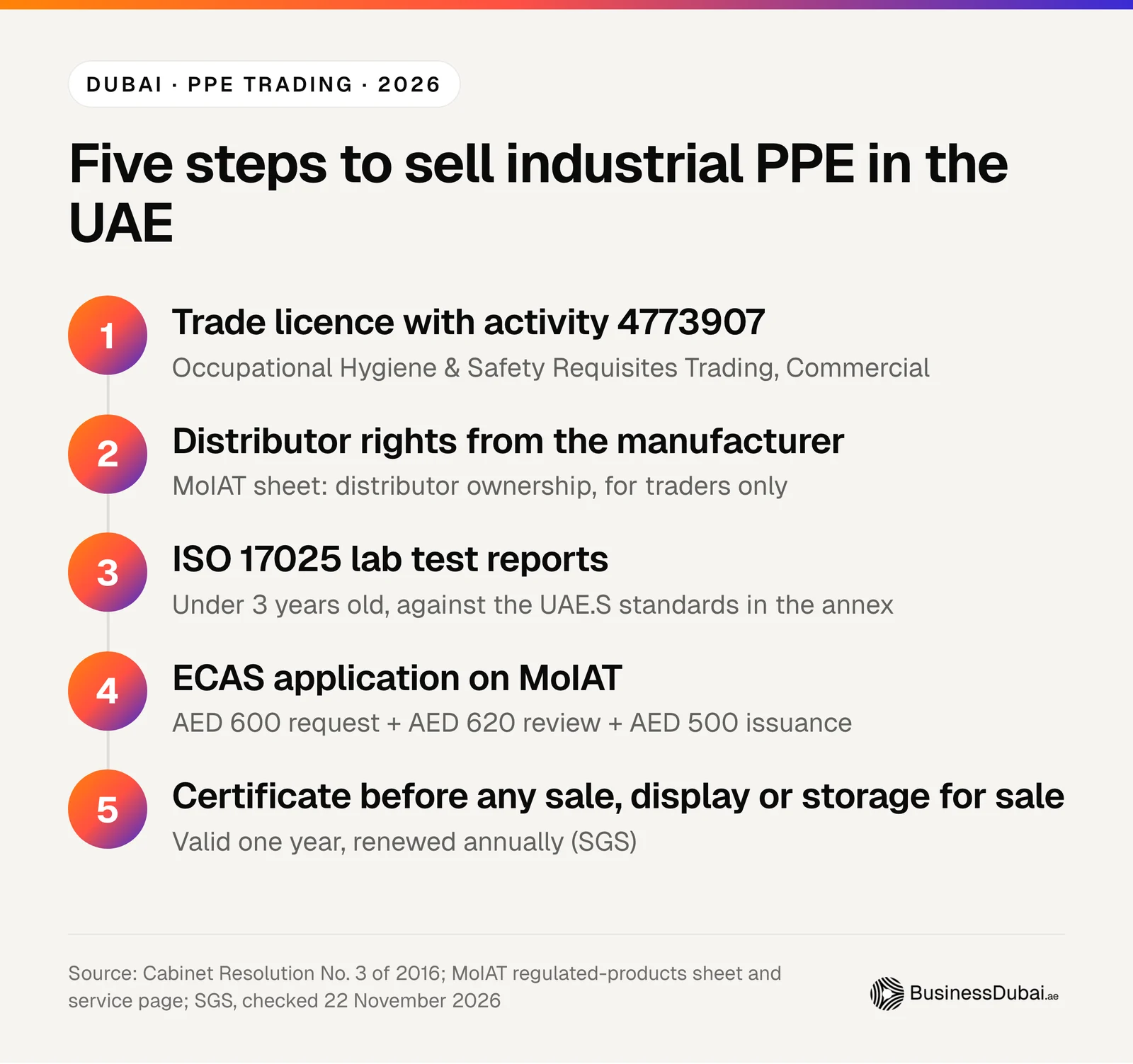
Article 4 requires the supplier to trade through a licensed company [1], so the licence comes first. A trader then has to show "Distributor ownership (for Traders only)" [7], which in practice means a distribution agreement or letter of authorisation from the factory. SGS, a certification body, notes that "Exporters, distributors, traders and manufacturers of the product can apply" [8], but a trader applies on the strength of the manufacturer's evidence. Article 10(9) closes the sequence: no product may be placed on the market without its ECAS certificate [1].
The documents MoIAT asks for
The PPE row of MoIAT's regulated-products sheet is short, and every line has a practical consequence [7]. The left column is MoIAT's wording.
| MoIAT requirement for personal protective equipment | What it means for a trader |
|---|---|
| Valid Industry/Trade License (For Companies within UAE) | Your DET or free zone licence, carrying the PPE activity |
| ISO 17025 Accredited Laboratory Test Reports, as per the requirement in the applicable standard/s | A report from an accredited laboratory against the annex standard for that product |
| Validity of Test report should be less than 3 Year | A manufacturer's report three years old or more needs retesting |
| Distributor ownership (for Traders only) | Evidence that the manufacturer authorises you to distribute the product |
| Label of the Product | The label as it will appear on goods sold in the UAE |
| Registration on MoIAT website | An account on MoIAT's e-services platform |
| Apply for ECAS service | The application itself, with documents uploaded and fees paid |
Article 5 adds one more: instructions in Arabic and English [1], which are cheaper printed at the factory than relabelled in Dubai.
What MoIAT charges, and how long it takes
MoIAT's service page lists four fee lines [2]. Submitting a request to register products costs AED 600, the technical review of documents costs AED 620 for each conformity certificate, and issuing the certificate costs AED 500. If MoIAT carries out a technical assessment of the establishment, it charges AED 2,500 per assessor per working day, plus the assessor's travel, transport and accommodation. A basic certificate with no assessment comes to AED 1,720 in MoIAT fees, before the laboratory is paid.
MoIAT gives the service time as "One and a half Working Days" [2], for a complete file. Testing comes first, because the reports are part of the upload, so the laboratory and the manufacturer set the real timeline.
Quick Math: A starter range of ten industrial PPE products, filed as ten separate requests and certificates, costs 10 × AED 1,720 = AED 17,200 in MoIAT fees before any testing [2]. SGS reports that ECAS certificates are renewed annually [8], so put renewals in the year-two budget and ask MoIAT what each renewal costs. Ask too whether related models can share a certificate: if they can, the fee line shrinks.
How long the certificate lasts
SGS, writing on 13 June 2024, says ECAS "Certificates are valid for one year and subject to annual renewal", while "An EQM certificate is valid for three years" [8]. SGS ties the Emirates Quality Mark (EQM) to an effective quality management system, and Article 6 treats a product carrying it as conforming [1]. For a trader, ECAS is the route that depends on the product file, with an annual renewal that is easy to miss. Our post-setup services team keeps licence and visa renewals on one calendar, and your certificate expiry dates belong on the same one.
Pro Tip: Get the distributor ownership letter before anything else. Only the manufacturer can give it, it is listed for traders specifically [7], and without it the file cannot go in. Ask for it, with the manufacturer's ISO 17025 test reports and their dates, before you sign a supply agreement. A manufacturer that cannot produce both quickly is showing you how every annual renewal will go.
Which standards must helmets, safety footwear, hi-vis and gloves meet in the UAE?
PPE sold in the UAE must meet the UAE.S standards listed in the annex to Cabinet Resolution No. 3 of 2016: 111 standards, including ISO 3873 for industrial helmets, ISO 20345 for safety footwear, ISO 20471 for high-visibility clothing and ISO 13999 for cut-resistant gloves. Each test report must show compliance with the standard for that product.
The table maps the products a PPE trader most often stocks to the annex [1], so you can check a test report against the right number before you order.
| Product | Annex standards (UAE.S) | Notes |
|---|---|---|
| Industrial safety helmets | ISO 3873 | Required on all Dubai construction and demolition sites [9] |
| Safety, protective and occupational footwear | ISO 20345, ISO 20346, ISO 20347 | Safety, protective and occupational grades respectively |
| High-visibility clothing | ISO 20471 | Site, road and logistics work |
| Protective clothing, general | ISO 13688 | General requirements |
| Welding clothing | ISO 11611 | Welding and allied processes |
| Heat and flame protective clothing | ISO 11612 | Oil and gas, foundry and hot work |
| Fall protection | ISO 16024, ISO 10333-4, ISO 14567, ISO 22846-1, ISO 22159 | Anchors, lanyards and related equipment |
| Respiratory protective devices | ISO 16900 series, ISO 16972, ISO 17420-3 | Industrial respirators |
| Cut-resistant gloves | ISO 13999 | Cut and stab protection |
| Hearing protectors | ISO 4869 | Earmuffs and earplugs |
| Electrical insulating gloves | GSO IEC 60903 | Live electrical work |
Three standards European buyers expect were not found among the 111 rows when the annex was read for this guide: EN 388 for general work gloves, ISO 374-1 for chemical-protection gloves and EN 166 for industrial safety glasses [1]. EN 166 and ISO 374-2 appear instead in the annex to Cabinet Resolution No. 83 of 2020, for face shields, goggles and protective gloves [3]. That does not make general work gloves and safety glasses unregulated. Confirm with MoIAT or a notified body how your gloves and eyewear are treated before you promise a contractor a delivery date.
Real Talk: The standard number on the test report decides the file, not the product name or the brochure. A helmet sold as meeting a European standard still needs a report showing it meets the annex standard, from an ISO 17025 laboratory, dated within three years [7]. Article 6 does treat products with the Emirates Quality Mark, or another mark the authority recognises, as conforming [1], but do not assume a foreign mark is recognised. Ask MoIAT in writing and keep the answer in the product file.
How are medical masks, gloves and gowns regulated differently from industrial PPE?
Medical and health PPE sits under Cabinet Resolution No. 83 of 2020, the UAE system for personal health protection products, which also routes through MoIAT's ECAS. Where the product is used as a medical device, the Emirates Drug Establishment adds a marketing authorisation: AED 100 to apply, AED 5,000 per device, 45 working days, valid five years.
Cabinet Resolution No. 83 of 2020 was issued on 17 December 2020 [3]. Its annex covers medical face masks (EN 14683 or ASTM F2100), filtering half masks (EN 149), protective gloves (ISO 374-2), medical gloves (EN 455 parts 1 and 4), protective clothing (EN 14126), personal eye protection including face shields and goggles (EN 166), surgical drapes and gowns (EN 13795 part 1) and clean air suits (EN 13795 part 2).
MoIAT's regulated-products sheet gives the system its own row, "Health protective equipment", asking for a valid licence, a test report from an accredited laboratory, an "Electronic Declaration of Conformity", a "User Manual of the products" and a "Quality Procedure Plan of the products" [7]. When the system was announced, MoIAT said that "it will not be allowed to offer, trade or market any registered products without obtaining the UAE conformity certificate (ECAS) from MoIAT", in a statement dated 27 December 2020 [10].
The second layer: EDE for medical devices
A product used as a medical device also needs an EDE marketing authorisation [4]. EDE lists an application fee of AED 100, a registration fee of AED 5,000 per medical device and a service time of 45 working days, and the certificate is valid for five years from the committee's approval. The condition that matters is who may apply: "The marketing office or medical warehouse must be licensed by the Emirates Drug Establishment and have a valid license" [4].
A trading company holding 4773907 is not, on that alone, an EDE-licensed medical warehouse. If you plan to sell medical gloves or surgical masks to clinics and hospitals, plan the warehouse licence, the medical activity codes (4772005 or 4773940) and the EDE file together [6]. Our medical equipment trading guide covers EDE registration, the warehouse licence and device classes in depth.
The two regimes side by side, with the published fees for each, are set out below [1][3][4].
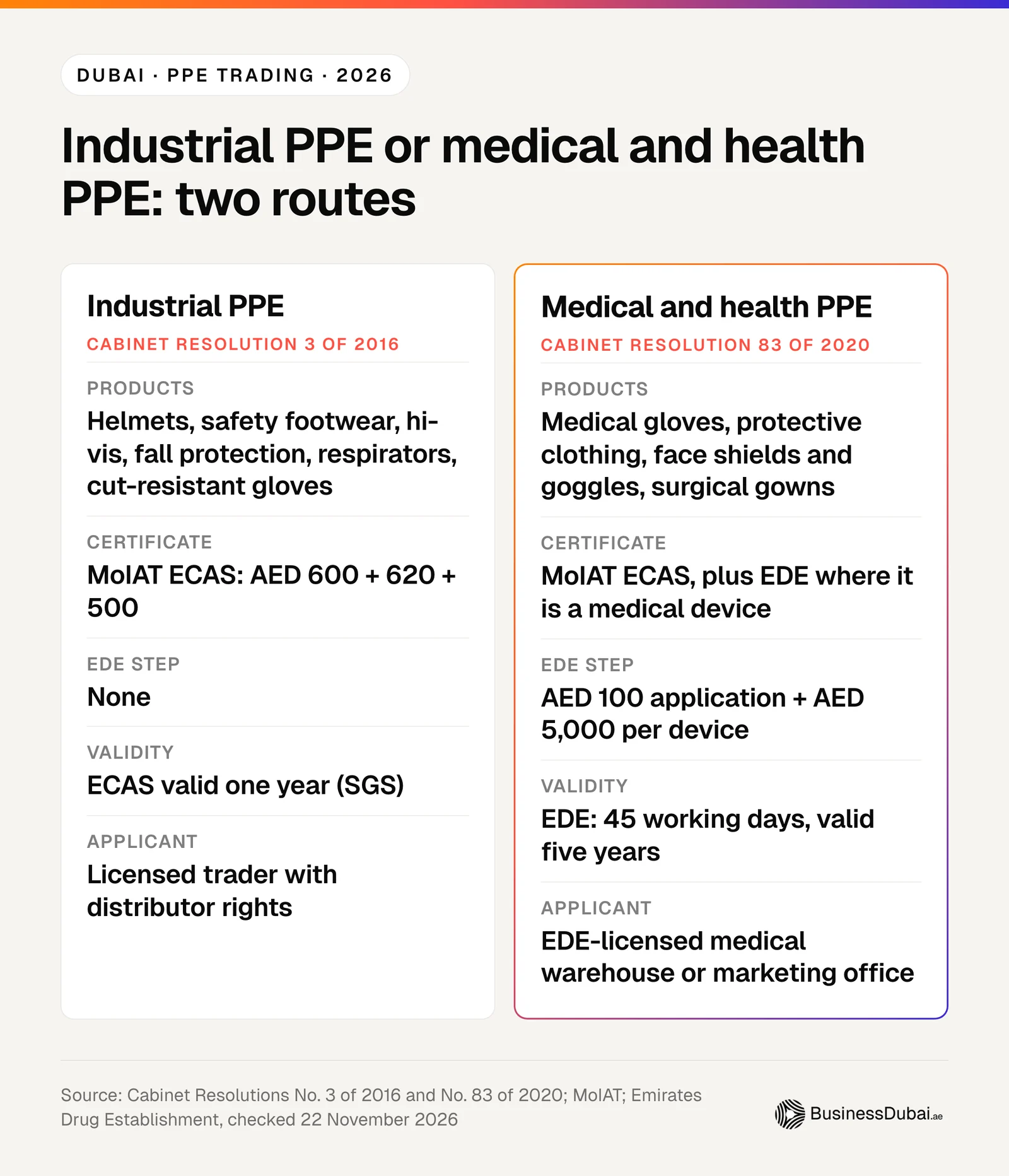
A glove marketed to factories and one marketed to clinics may fall under different rules, so confirm each product's route with MoIAT and EDE before you price it.
Does firefighting and rescue PPE need Civil Defence approval in Dubai?
Firefighting equipment such as extinguishers needs a Dubai Civil Defence product listing, but no published rule reviewed for this guide requires a Civil Defence listing for PPE. Cabinet Resolution No. 3 of 2016 excludes products made for civil defence personnel, so confirm the position with Dubai Civil Defence before stocking firefighter suits or breathing apparatus.
The annex to Cabinet Resolution No. 3 of 2016 lists standards for firefighter clothing and gloves, including ISO 11613, ISO 15384 and ISO 15383, yet Article 2(2) excludes products made for civil defence personnel [1]. Firefighter PPE made for a civil defence order may therefore sit outside the resolution, while the same product sold to a private industrial fire team may sit inside it. No guidance found for this article settles that reading. Lifejackets and immersion suits also have annex rows (ISO 12402 and ISO 15027), but products for marine vessels are excluded by the same article [1].
DET puts both trades under one activity, 4773916 Fire Fighting & Safety Equipment Trading, covering accident prevention equipment alongside extinguishers, hoses, sprinklers and pumps [6]. The products are what differ: firefighting equipment such as extinguishers, alarm panels and sprinkler heads must be listed by Dubai Civil Defence before it is sold or installed in Dubai, and our fire safety company setup guide explains that listing.
Real Talk: If you plan to sell firefighter suits or self-contained breathing apparatus, ask Dubai Civil Defence and MoIAT the same written question before you order: which approval, if any, does this product need to be sold to this buyer in Dubai? A written answer costs nothing next to a container that cannot be sold.
Who has to buy PPE in the UAE, and why does that shape a PPE trader's sales?
UAE employers must buy PPE: MoHRE Administrative Decision No. 28 of 2022 makes the employer provide adequate PPE at no cost to the worker, and Dubai's Safety Guide for Construction Works makes every contractor provide it at its own expense. A PPE trader's customer is therefore a business with a legal duty to buy.
The federal duty on employers
Administrative Decision No. 28 of 2022 of the Ministry of Human Resources and Emiratisation (MoHRE), issued on 6 April 2022, puts the cost on the employer. Article 5 reads: "The employer is responsible to provide, at no cost to the worker, adequate personal protective equipment appropriate for the conditions of the assigned task." [5] The same article requires the equipment to suit the task and protect effectively.
The UAE government portal states the duty in current terms: "Employers are required to provide appropriate safety gear and suitable clothing to protect workers from injuries and occupational hazards." [11] Workers must use the protective equipment and clothing provided. The portal now cites Administrative Decision No. 19 of 2023 as the current instrument; its text could not be read for this guide, so check it with MoHRE.
Two more federal rules shape demand. The portal states that "Every industrial establishment, and all establishments operating in the construction sector employing 100 workers or more, must appoint an Occupational Health and Safety Officer (HSO)" [11], the obvious first contact for a PPE supplier at a large site or plant. And outdoor work under direct sun is not allowed between 12.30 pm and 3 pm (12:30 to 15:00) from 15 June to 15 September each year [11].
Dubai's construction safety rules
Dubai Decree No. 19 of 2025 concerning safety in construction works, issued on 7 April 2025, gives the Safety Code legal force. Article 3 states: "The Safety Code applies to all zones across the Emirate, including Special Development Zones and free zones, such as the Dubai International Financial Centre." [12] Article 4 adds that "All Contractors and engineering consultancy firms must comply with all the safety rules" in the code [12].
Administrative Resolution No. 112 of 2026, issued on 11 June 2026, approved the Safety Guide for Construction Works [13]. The guide states: "Every contractor, at his expense, shall provide his employees with all necessary personal protective equipment appropriate to their work nature", and requires PPE "approved by the concerned parties" [9]. On site, that means [9]:
- Helmets on all construction and demolition sites, with no worker, visitor or supervisor allowed in without one.
- Safety shoes with a steel toe cap and steel sole for every construction or demolition employee, rubber boots in wet and muddy conditions, and non-conductive footwear near live current.
- A safety harness and shock-absorbing lanyard for anyone working 2 m or more above a lower level.
Dubai Municipality issued 10,776 building permits in the first quarter of 2026, up 12% on the first quarter of 2025 [14]. Every project behind those permits runs under the Safety Code. Our construction company setup guide explains how the contractors on them are licensed.
The four numbers that define the PPE buyer in the UAE are set out below [5][11][9][14].
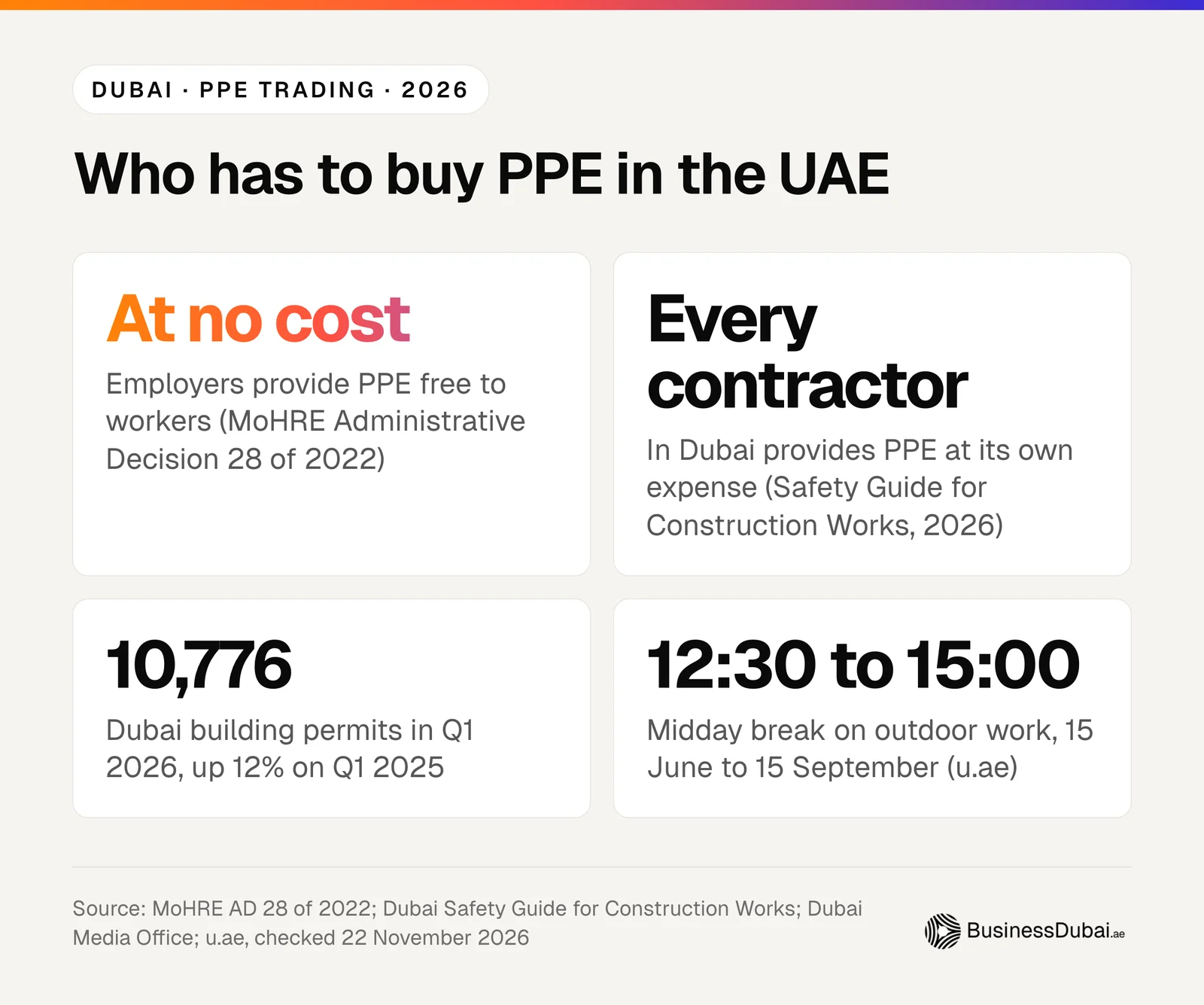
Real Talk: This is an inference from the rules, not a published finding. Because the employer or contractor pays, a PPE trader sells to a purchasing department, not to the worker who wears the kit. That buyer compares quotes, works to a project budget and has to show an inspector that its PPE is approved by the concerned parties [9]. Price matters, but a complete, current compliance file for every product is what lets the buyer say yes.
How do you supply PPE to contractors and government buyers in the UAE?
Supplying UAE federal government buyers starts with the Ministry of Finance's federal supplier register, which charges no fees and lists a 30 working day service time. An In-Country Value (ICV) certificate then gives an advantage in tender awards, and contractors can be expected to ask for each product's ECAS certificate before they buy.
The Ministry of Finance runs the federal supplier register on its Digital Procurement Platform, where suppliers register to take part in federal tenders [15]. The service page lists "No Fees" and a service completion duration of "30 working days". It separates domestic suppliers, located in the UAE and not in a free zone, from free zone suppliers, "Companies registered in any free zone entity within the UAE" [15]. Both upload a trade licence, a VAT registration certificate and the owner's passport copy, so VAT registration comes first. SMEs in the national SME programme also get "a 10% bonus to the final score" during evaluation [15].
For its National In-Country Value (ICV) programme, MoIAT states: "Certified suppliers will gain advantages during the award of tenders and contracts based on their ICV score." [16] For a PPE supplier bidding on government work, the ICV certificate is worth budgeting for. Our building materials trading guide covers ECAS and government project supply for construction products in more depth.
Private contractors run their own vendor registration. Because Dubai's Safety Guide requires PPE approved by the concerned parties [9], and Cabinet Resolution No. 3 of 2016 bars uncertified PPE from the market [1], a contractor's procurement team can reasonably be expected to ask for each product's ECAS certificate before it issues a purchase order. That is an inference from the rules, not a published procurement standard, but the certificate answers both questions at once.
Pro Tip: Build one compliance pack per product and send it with every quotation: the ECAS certificate and its expiry date, the ISO 17025 test report, the manufacturer's distribution authorisation, the bilingual instructions and the product label [1][7]. A complete pack answers a safety officer's questions in one email, and it doubles as your renewal checklist each year.
Should a PPE trading company be on the Dubai mainland or in a free zone?
A Dubai mainland licence suits a PPE trader selling directly to UAE contractors, at AED 18,200 in year one without a visa or AED 26,900 with one on BusinessDubai.ae's package. Dubai free zones start at AED 12,500 licence only at Meydan Free Zone or Dubai South, but onshore sales need a route the zone permits.
The choice decides who you can invoice directly, where stock can sit and how profit is taxed. Our mainland company setup page itemises the DET route, and our free zone company setup page compares the zones, including the year-two renewal a headline price leaves out.
The table compares the routes on BusinessDubai.ae's standard 2026 package prices, which cover company formation only [21].
| Factor | Dubai mainland (DET) | Dubai free zone: Meydan Free Zone, Dubai South, IFZA | Non-Dubai free zone: Ajman Free Zone, RAKEZ, SPC Free Zone |
|---|---|---|---|
| Licence only | AED 18,200 in year one | Meydan and Dubai South AED 12,500; IFZA AED 12,900 (partner price) | Ajman AED 5,555; RAKEZ AED 6,010; SPC AED 5,765 |
| With one visa | AED 26,900 | Meydan and Dubai South AED 21,850; IFZA AED 22,200 | Ajman AED 13,931; RAKEZ AED 12,810; SPC AED 15,055 |
| Selling to UAE contractors | Direct | Confirm with the zone how onshore sales are made | Confirm with the zone how onshore sales are made |
| Federal supplier register | Domestic supplier | Free zone supplier | Free zone supplier |
| Route to 0% corporate tax | None: ordinary rates or Small Business Relief | Only as a Qualifying Free Zone Person; distribution needs a Designated Zone | Same conditions; confirm Designated Zone status |
| Year-two renewal | About AED 15,000 | Ask for the standard renewal price | Ask for the standard renewal price |
The mainland is the simpler base when buyers are Dubai contractors, factories and government entities, because it invoices them directly. A free zone suits an importer holding stock for re-export or selling to other traders. How a free zone company sells onshore, often through a mainland distributor or the zone's permitted route, is a question to put to the zone in writing before you choose it.
BusinessDubai.ae has no JAFZA package. If a warehouse beside Jebel Ali Port is central to your plan, our JAFZA free zone guide explains how the zone works so you can price it with JAFZA directly.
If the business does not need a Dubai address, the northern emirates cost less. Ajman Free Zone is AED 13,931 with one visa, and our business setup in Ajman page shows what that package includes. SPC Free Zone in Sharjah is AED 15,055 with one visa, and our business setup in Sharjah page compares it with the other Sharjah zones. RAKEZ in Ras Al Khaimah is AED 12,810 with one visa [21].
Quick Math: With one visa, BusinessDubai.ae's Dubai mainland package is AED 26,900 and Meydan Free Zone or Dubai South is AED 21,850 [21], a gap of AED 5,050. If most of your buyers are Dubai contractors, the free zone company then needs an onshore route, such as a mainland distributor that takes a margin on every order. For a contractor-facing PPE distributor, the AED 5,050 usually buys the simpler business.
What customs duty applies to imported PPE, and does CEPA help?
Imported PPE pays Dubai customs duty of 5% of the CIF value, according to the Dubai Customs Service Guide 2025, which names no PPE-specific import permit. The ECAS certificate is a separate MoIAT requirement. Under the India-UAE CEPA rules of origin, footwear and headgear qualify as originating under a CTH plus 40% value-added rule.
The Dubai Customs Service Guide 2025 gives the duty rate as "5% of the value CIF (Cost Freight Insurance) value except for alcohol and cigarettes/tobacco" [17]. The guide names no PPE-specific permit and does not mention ECAS, so do not read a cleared shipment as a certified one: the certificate is a separate requirement under Cabinet Resolution No. 3 of 2016 [1]. Importing in the company's name needs a customs client code, and our Dubai Customs registration guide covers that step.
For footwear and helmets made in India, the India-UAE Comprehensive Economic Partnership Agreement (CEPA) sets product-specific rules of origin. As published in India's Gazette, Chapter 64, "Footwear, gaiters and the like; parts of such articles", and Chapter 65, "Headgear and parts thereof", both carry the rule "CTH + VA 40%" [18]. CTH means a change of tariff heading from the inputs, and VA means value addition, here 40% on an FOB basis. Confirm the HS code, and whether the UAE grants a preferential rate on that tariff line, with a customs broker before you price on it.
Can a PPE trading company pay 0% corporate tax, and how is VAT charged?
A PPE trading company usually pays ordinary UAE corporate tax: 0% on taxable income up to AED 375,000 and 9% above, or nothing under Small Business Relief while revenue stays at or under AED 3,000,000. A free zone distributor reaches 0% only on sales to resellers through a Designated Zone, not on sales to contractors.
The Designated Zone distribution test
Ministerial Decision No. 229 of 2025 lists the Qualifying Activities on which a Qualifying Free Zone Person can earn 0% [19]. The one that fits a PPE distributor is distribution of goods in or from a Designated Zone, and it is narrow. The activity must be conducted in or from a Designated Zone, the goods must enter the UAE through that zone, and they must be supplied to "A customer who resells, processes or alters such goods or materials, or parts thereof for the purposes of sale or resale", or to "A public benefit entity" [19].
PPE is bought to be used. A contractor issuing helmets, a factory buying gloves for its line and a government department equipping its staff all consume the goods, so on the text of the decision, sales to them are non-qualifying. A distributor selling to other traders and retailers through a Designated Zone can fit the route. Our Qualifying Free Zone Person guide covers the full set of conditions.
De minimis, and what failing it costs
Non-qualifying revenue is allowed only within de minimis: the condition is met where it "does not exceed 5% (five percent) of the total Revenue of the Qualifying Free Zone Person in that Tax Period or AED 5,000,000 (five million dirhams), whichever is lower" [19]. A company that fails a condition ceases to be a Qualifying Free Zone Person from the beginning of that tax period and for the following four tax periods [19]. It is then taxed as an ordinary taxable person from the start of the period: 0% on taxable income up to AED 375,000 and 9% above.
Quick Math: A free zone PPE distributor with AED 8,000,000 of revenue, of which AED 600,000 comes from direct sales to contractors, has non-qualifying revenue of 7.5% of revenue. The de minimis limit is the lower of 5% of revenue (AED 400,000) and AED 5,000,000, so AED 400,000 [19]. At AED 600,000 the company fails the test, loses Qualifying Free Zone Person status for that period and the next four, and pays ordinary rates on its taxable income.
Mainland rates and Small Business Relief
A mainland PPE trader pays ordinary corporate tax: 0% on taxable income up to AED 375,000 and 9% above. A resident person with revenue at or under AED 3,000,000 can elect Small Business Relief for tax periods ending on or before 31 December 2029, under Ministerial Decision No. 73 of 2023 as amended by Ministerial Decision No. 131 of 2026, and a Qualifying Free Zone Person cannot claim it [20]. Our Small Business Relief guide explains the election.
Quick Math: A mainland PPE distributor with AED 1,200,000 of taxable profit pays 0% on the first AED 375,000 and 9% on the remaining AED 825,000, so AED 74,250 in corporate tax. If its revenue is above AED 3,000,000, Small Business Relief is not available and that figure is the bill.
The table sets out the tax positions for the customer mixes a PPE trader actually has [19][20].
| Position | What the rule says | Fit for a PPE trader |
|---|---|---|
| Mainland, ordinary rates | 0% up to AED 375,000 of taxable income, 9% above | The default for a mainland distributor |
| Small Business Relief | Revenue at or under AED 3,000,000; tax periods ending on or before 31 December 2029 | Useful in the first years; not for a Qualifying Free Zone Person |
| Free zone, selling to contractors, factories or government users | The buyer uses the PPE rather than reselling it | Non-qualifying revenue that counts against de minimis |
| Free zone, selling to resellers through a Designated Zone | Imported through the zone and sold to a customer who resells, processes or alters for sale | Can be a Qualifying Activity, subject to every other condition |
| Failing a condition | Ordinary rates from the start of the period; status lost for the next four periods | The cost of claiming 0% on a customer mix that does not fit |
VAT on PPE
PPE sales are charged VAT at the standard rate of 5%. Registration is mandatory above AED 375,000 of taxable supplies and voluntary from AED 187,500, and the federal supplier register asks for the VAT registration certificate [15]. Our VAT registration and compliance guide covers registration and returns.
If you want your customer mix tested against these routes before you choose a zone, model your tax position→
How much does it cost to set up a PPE trading company in Dubai?
A Dubai mainland PPE trading company costs AED 18,200 in year one without a visa, or AED 26,900 with one, on BusinessDubai.ae's package, and about AED 15,000 on renewal. Each ECAS certificate adds AED 1,720 in MoIAT fees before laboratory testing, and EDE adds AED 5,100 per medical device where it applies.
The table itemises a first year, with the source of each line: BusinessDubai.ae's 2026 package prices [21], MoIAT's conformity fees [2] and EDE's medical device fees [4].
| Cost item | Amount (AED) | Notes |
|---|---|---|
| Dubai mainland licence, no visa | 18,200 | BusinessDubai.ae package, first year; company formation only |
| Dubai mainland licence, one visa | 26,900 | BusinessDubai.ae package, first year |
| Meydan Free Zone or Dubai South | 12,500 / 21,850 / 28,400 | Licence only / one visa / two visas |
| IFZA | 12,900 / 22,200 | Licence only / one visa; partner price |
| Ajman Free Zone (non-Dubai) | 5,555 / 13,931 / 17,971 | Licence only / one visa / two visas |
| RAKEZ (non-Dubai) | 6,010 / 12,810 / 18,810 | Licence only / one visa / two visas |
| SPC Free Zone, Sharjah (non-Dubai) | 5,765 / 15,055 / 19,505 | Licence only / one visa / two visas |
| JAFZA | No BusinessDubai.ae package | Price directly with the zone |
| ECAS: request to register products | 600 | MoIAT, per request |
| ECAS: technical review of documents | 620 | MoIAT, per conformity certificate |
| ECAS: issuance of certificate | 500 | MoIAT; valid one year, renewed annually [8] |
| ECAS: technical assessment of the establishment | 2,500 per assessor per working day | Only if MoIAT carries one out; travel and accommodation extra |
| Laboratory test reports | Laboratory quote | ISO 17025 accredited; less than three years old |
| EDE application (medical devices only) | 100 | Per application |
| EDE registration of a medical device | 5,000 per device | 45 working days; valid five years |
| EDE-licensed medical warehouse | EDE licence and landlord quote | Needed before you can apply to EDE |
| Warehouse lease | Landlord quote | Not included in any package |
| Dubai Customs client code | Confirm with Dubai Customs | Needed to import in the company's name |
| Year two, mainland renewal | About 15,000 | BusinessDubai.ae package, before ECAS renewals |
| Year two, free zone renewal | Ask the zone | The standard renewal price, not a launch price |
For a broad range, annual ECAS certificates and their testing, plus the warehouse, can outweigh the package price. Price the range, not just the company.
For a quote that prices the licence, the approvals your range needs and the warehouse together, get an itemised setup quote→
In what order should you set up a PPE trading company in Dubai?
Set up a PPE trading company in this order: fix the product list and the activity codes, secure distributor rights and current test reports, license the company, register with MoIAT and obtain each ECAS certificate, add EDE authorisation for medical devices, then import, store and sell. Stock bought before its certificate is stock you cannot legally sell.
- Write the product list, split into industrial, medical and firefighting lines, because each has its own approval route.
- Choose the codes and jurisdiction: 4773907 and related codes [6], mainland or free zone by buyer.
- Secure distributor rights and test reports, checking each report's standard and date against the annex [7].
- License the company: mainland from AED 18,200 without a visa, or a Dubai free zone from AED 12,500 licence only [21].
- Apply for ECAS: AED 600, 620 and 500 per certificate [2].
- Add EDE for medical devices, through an EDE-licensed warehouse: AED 100 plus AED 5,000 per device and 45 working days [4].
- Register with Dubai Customs and import once the certificates are issued; duty is 5% of CIF value [17].
- Register as a supplier: VAT, then the federal supplier register (no fees, 30 working days) and an ICV certificate for government work [15][16].
- Diary the renewals: ECAS annually [8], EDE every five years [4] and the licence every year.
Steps 3 and 4 can run in parallel, and so can the MoIAT and EDE files once the company is licensed. Steps 5 and 6 decide when you can trade.
Which setup fits your PPE trading business?
The right setup for a PPE trading business depends on the buyer. A construction PPE distributor selling to Dubai contractors fits the mainland, a medical gloves and masks importer needs an EDE-licensed warehouse on top, and a brand agent selling to resellers can consider a Designated Zone. The table maps five common profiles.
| Profile | Main buyers | Structure | Activity codes | Approvals before sale | Tax note |
|---|---|---|---|---|---|
| Construction PPE distributor | Dubai contractors | Dubai mainland | 4773907, 4771919 | ECAS per product (ISO 3873, ISO 20345, ISO 20471) | Ordinary rates or Small Business Relief |
| Oil and gas safety supplier | Operators, contractors, government entities | Dubai mainland, with the supplier register and ICV | 4773907, 4771108 | ECAS, including ISO 11612 clothing | Ordinary rates; ICV score matters in tenders |
| Medical gloves and masks importer | Clinics, hospitals, pharmacies | Mainland, with an EDE-licensed medical warehouse | 4771114, plus 4772005 or 4773940 | ECAS under Resolution No. 83 of 2020 and EDE authorisation per device | Ordinary rates or Small Business Relief |
| Workwear and uniform supplier | Corporate buyers, hotels, contractors | Mainland, or free zone if most buyers resell | 4771109, 4771108 | ECAS where the garment is PPE (ISO 20471, ISO 11611) | Free zone 0% only on sales to resellers |
| Safety footwear brand agent | Distributors and retailers | Designated Zone free zone if buyers resell; mainland if selling to contractors | 4771919, 4773907 | ECAS (ISO 20345 to 20347); CEPA Chapter 64 rule if made in India | Distribution route possible if buyers resell |
Most PPE traders mix profiles, and the mix of buyers decides the structure: the more revenue comes from end users who wear the PPE, the stronger the case for the mainland. If your group also trades oil products rather than only supplying the sites, our oil and gas trading company guide covers that business.
Real Client Stories
These are composite examples built from the situations PPE and safety equipment traders most often face in Dubai. Names and details are illustrative, and the only figures used are published government fees and BusinessDubai.ae's package prices.
The helmet order that landed before its certificate (Dubai mainland)
A construction PPE distributor, licensed on the Dubai mainland with one visa on BusinessDubai.ae's AED 26,900 package, ordered helmets, safety boots and hi-vis vests from an overseas factory. When the goods arrived, the ECAS files were not ready: the helmet test report was more than three years old and the factory had not issued a distributor ownership letter. Because storing stock for sale counts as placing it on the market, the cartons could not be offered to waiting contractors. New tests were ordered and three certificate files went in at AED 1,720 each in MoIAT fees.
Lesson: get the test reports, the distributor letter and the certificate before you pay for stock.
The glove importer who needed a medical warehouse (Dubai free zone)
A founder planning to import examination gloves and surgical masks for clinics, as products used as medical devices, set up at Meydan Free Zone on the AED 12,500 licence-only package, expecting to register them with EDE itself. EDE's service page settled it: the applicant must be an EDE-licensed medical warehouse or marketing office. The plan changed to an EDE-licensed warehouse with medical activity codes, with AED 100 per application and AED 5,000 per device budgeted over 45 working days, and the founder asked the zone in writing how onshore sales to clinics would be made.
Lesson: for medical PPE, decide who holds the EDE licence before you choose the jurisdiction.
The distributor whose customers changed (Designated Zone)
A PPE distributor in a Designated Zone imported gloves and coveralls through the zone and sold them to retailers and resellers, a customer mix that fits the distribution route in Ministerial Decision No. 229 of 2025. Then a large contractor asked to buy direct. Every contractor sale was non-qualifying, because the contractor used the PPE rather than reselling it, and the company's adviser warned that non-qualifying revenue above 5% of total revenue would fail de minimis and cost the 0% rate for that period and the next four. From then on, contractor sales were tracked monthly against the limit.
Lesson: tag every customer as reseller or end user from the first invoice.
Start your PPE trading company the right way
For a PPE trader, the licence is the easy part. Three decisions decide the business: whether each product holds its ECAS certificate before it is stored, shown or sold; whether any line is a medical device that needs EDE and an EDE-licensed warehouse; and whether your buyers resell or use the PPE, which decides whether a free zone 0% rate is realistic at all. Get those right at the start and they cost a few thousand dirhams in fees. Get them wrong and they cost a container.
BusinessDubai.ae has completed 700+ company registrations across the UAE, with itemised pricing and no hidden fees. We will price a mainland company setup against a free zone company setup on the points that actually differ for a PPE trader: direct invoicing to contractors, the onshore sales route, the warehouse and the tax position. After setup, our post-setup services team handles the visa and licence renewals, so your certificate dates are the only calendar you watch yourself.
For an all-in plan built around your product list and your buyers, talk to a setup expert→
Frequently Asked Questions
What licence do I need to start a PPE trading company in Dubai?
A commercial trade licence from DET or a free zone, carrying activity 4773907 Occupational Hygiene & Safety Requisites Trading or the zone's equivalent. Each product also needs a MoIAT ECAS certificate under Cabinet Resolution No. 3 of 2016 before it can be sold.
What is the DET activity code for safety equipment trading in Dubai?
The core DET code is 4773907, Occupational Hygiene & Safety Requisites Trading, a Commercial activity naming masks, gloves, helmets, anti-radiation eyeglasses and uniforms. Related codes are 4771114 (face masks and gloves), 4771108 (protective garments), 4771109 (uniforms), 4771919 (shoes) and 4773916 (fire fighting and safety equipment).
Can one licence cover helmets, safety boots and gloves?
Yes. 4773907 alone names helmets, gloves and masks, and the same licence can add 4771919 Shoe Trading and 4771108 or 4771109 for garments and uniforms. Each product still needs its own MoIAT conformity file.
Can I sell fire extinguishers and PPE on the same licence?
Yes. DET activity 4773916, Fire Fighting & Safety Equipment Trading, covers safety equipment together with extinguishers, hoses, sprinklers and pumps. The approval routes differ: firefighting equipment must be listed by Dubai Civil Defence, while industrial PPE needs a MoIAT ECAS certificate.
Can a foreigner own 100% of a PPE trading company in Dubai?
Yes. BusinessDubai.ae's Dubai mainland and free zone packages are offered with 100% foreign ownership for commercial trading activities such as PPE trading, as of 2026. Confirm the activity on the DET list at application.
Is an ECAS certificate mandatory for PPE in the UAE?
Yes. Article 10(9) of Cabinet Resolution No. 3 of 2016 bars any product within its scope from the market without an ECAS conformity certificate. Placing on the market includes selling, storing, displaying and promoting, whether paid or free.
Who applies for the ECAS certificate, the importer or the manufacturer?
Either can. SGS lists exporters, distributors, traders and manufacturers as eligible applicants, and MoIAT's sheet asks traders for distributor ownership, meaning evidence that the manufacturer authorises them to distribute the product.
What documents do I need for an ECAS application for PPE?
A valid trade licence, ISO 17025 laboratory test reports less than three years old, distributor ownership for traders, the product label, MoIAT website registration and the ECAS application with fees. Article 5 also requires Arabic and English instructions.
How much does an ECAS certificate cost for PPE?
MoIAT charges AED 600 for the registration request, AED 620 for the technical review of each certificate and AED 500 for issuance, so AED 1,720 for a basic certificate as of 2026. A technical assessment, where MoIAT conducts one, costs AED 2,500 per assessor per working day. Laboratory testing is extra.
How long is an ECAS certificate valid, and how long does it take?
An ECAS certificate is valid for one year and renewed annually, according to SGS, while an Emirates Quality Mark certificate lasts three years. MoIAT gives its service time as one and a half working days for a complete file, after laboratory testing is finished.
Can I store imported PPE in my warehouse before the ECAS certificate is issued?
No, not for sale. Cabinet Resolution No. 3 of 2016 counts storing a product as placing it on the market, alongside selling, displaying and promoting, so uncertified stock held for sale breaches Article 10(9). Time shipments so the certificate is issued first.
What happens if non-compliant PPE is found in my stock?
Under Article 7 of Cabinet Resolution No. 3 of 2016, a non-conforming product is withdrawn and its certificate cancelled at the supplier's cost. If the source cannot be traced, the seller the sample came from is held responsible, so keep purchase records and certificates for every batch.
Which standards must safety helmets and safety footwear meet in the UAE?
The annex to Cabinet Resolution No. 3 of 2016 lists UAE.S ISO 3873 for industrial helmets and ISO 20345, 20346 and 20347 for safety, protective and occupational footwear. Dubai's construction safety guide also requires steel toe cap and steel sole safety shoes on site.
Do work gloves and safety glasses need an ECAS certificate?
Confirm with MoIAT or a notified body. EN 388 work gloves, ISO 374-1 chemical gloves and EN 166 safety glasses were not found among the 111 annex standards of Resolution No. 3 of 2016, although ISO 13999 cut-resistant gloves are listed. EN 166 and ISO 374-2 appear in Resolution No. 83 of 2020.
Do medical gloves and surgical masks need EDE registration?
Products used as medical devices need an Emirates Drug Establishment marketing authorisation: AED 100 to apply, AED 5,000 per device, 45 working days, valid five years. The applicant must be an EDE-licensed medical warehouse or marketing office, and the products also fall under Cabinet Resolution No. 83 of 2020.
Do filtering half masks need a certificate in the UAE?
Filtering half masks appear against EN 149 in the annex to Cabinet Resolution No. 83 of 2020, which routes through MoIAT's ECAS. Industrial respiratory protective devices also have standards under Resolution No. 3 of 2016, so confirm with MoIAT which resolution covers your model.
Do firefighter suits and breathing apparatus need Civil Defence approval in Dubai?
No published rule reviewed for this guide settles it either way. Cabinet Resolution No. 3 of 2016 excludes products made for civil defence personnel, while its annex lists firefighter clothing standards. Ask Dubai Civil Defence and MoIAT in writing before stocking them.
Who must pay for PPE in the UAE, the employer or the worker?
The employer. MoHRE Administrative Decision No. 28 of 2022, Article 5, makes the employer provide adequate PPE at no cost to the worker, and u.ae states that employers must provide appropriate safety gear and suitable clothing.
Does Dubai Municipality require specific PPE on construction sites?
Yes. The Safety Guide for Construction Works, approved by Administrative Resolution No. 112 of 2026, requires every contractor to provide PPE at its own expense, approved by the concerned parties, including helmets on all sites and a harness with a shock-absorbing lanyard at 2 m or more.
How do I register as a supplier to UAE federal government entities?
Through the Ministry of Finance's federal supplier register on its Digital Procurement Platform: no fees, 30 working days, with a trade licence, VAT registration certificate and owner's passport copy. An ICV certificate then gives an advantage in tender awards.
Can a free zone PPE company sell directly to contractors on the mainland?
Confirm it with your free zone before you set up. How onshore sales are made, often through a mainland distributor or a route the zone permits, depends on the zone. A Dubai mainland company invoices UAE contractors directly.
Can a free zone PPE distributor pay 0% corporate tax?
Only on qualifying income. Under Ministerial Decision No. 229 of 2025, Designated Zone distribution qualifies only for sales to a customer who resells, processes or alters the goods for sale, or to a public benefit entity. Sales to contractors, factories or government users count against the de minimis limit of the lower of 5% of revenue or AED 5,000,000.
Is VAT charged on PPE in the UAE?
Yes, PPE sales are charged VAT at the standard 5% rate. Registration is mandatory above AED 375,000 of taxable supplies and voluntary from AED 187,500. Medical products have their own VAT rules, covered in BusinessDubai.ae's medical equipment trading guide.
What customs duty applies to imported PPE in Dubai?
Dubai Customs charges 5% of the CIF value on most goods, according to its Service Guide 2025, which names no PPE-specific permit. The ECAS certificate is a separate MoIAT requirement. Indian-made footwear and headgear carry a CTH plus 40% value-added CEPA origin rule.
Does BusinessDubai.ae offer a JAFZA package for a PPE trading company?
No. BusinessDubai.ae has no JAFZA package. Its Dubai options are Meydan Free Zone and Dubai South (AED 12,500 licence only, AED 21,850 with one visa), IFZA (AED 12,900 and AED 22,200) and the Dubai mainland from AED 18,200.
References
[1] Ministry of Industry and Advanced Technology (MoIAT). Cabinet Resolution No. 3 of 2016 on the UAE system for the control of personal protection, safety and occupational health equipment, tools and materials, issued 14 January 2016 (scanned Arabic PDF, read from page images and paraphrased, not quoted): Article 1 definitions of supplier and placing on the market, Article 2(2) exclusions, Articles 4 to 7 on supplier duties, ECAS registration and market surveillance, Article 10(9), and the annex of 111 UAE.S standards. moiat.gov.ae (PDF)
[2] Ministry of Industry and Advanced Technology (MoIAT). Issue Conformity Certificates for Regulated Products: fees of AED 600 (registration request), AED 620 (technical review per certificate) and AED 500 (issuance), the AED 2,500 per assessor per working day technical assessment fee and the assessor's expenses, requirements and service time; page last updated 16 November 2026, checked 22 November 2026. moiat.gov.ae
[3] Ministry of Industry and Advanced Technology (MoIAT). Cabinet Resolution No. 83 of 2020 on the UAE system for personal health protection products, issued 17 December 2020, and its annex of products and standards (read from page images). moiat.gov.ae (PDF)
[4] Emirates Drug Establishment (EDE). Issuance of Marketing Authorization for a Medical Device: AED 100 application and AED 5,000 registration fees, 45 working days, five-year validity and the licensed medical warehouse or marketing office condition; checked 22 November 2026. ede.gov.ae
[5] Ministry of Human Resources and Emiratisation (MoHRE). Administrative Decision No. 28 of 2022 concerning occupational health and safety and labour accommodation, issued 6 April 2022: Article 5 on employer obligations for personal protective equipment. MoHRE text read from the Gulf Labour Markets and Migration (GLMM) database mirror. gulfmigration.grc.net (PDF)
[6] Dubai Department of Economy and Tourism (DET). Business activity list as recorded in the Invest Dubai register: activity names, seven-digit codes, licence type and descriptions for 4773907, 4771114, 4771108, 4771109, 4771919, 4773916, 4772005 and 4773940, from BusinessDubai.ae's normalised copy of the DET list generated 22 August 2026. app.invest.dubai.ae
[7] Ministry of Industry and Advanced Technology (MoIAT). Regulated products requirements sheet (ECAS list): the personal protective equipment row under Cabinet Resolution No. 3 of 2016 and the health protective equipment row under Cabinet Resolution No. 83 of 2020. qc.moiat.gov.ae (PDF)
[8] SGS, certification body. UAE product conformity, understanding ECAS and EQM certification, 13 June 2024: who can apply, ECAS validity of one year with annual renewal and EQM validity of three years. sgs.com
[9] Dubai Municipality. Safety Guide for Construction Works (Code of Construction Safety Practice), 2026: the contractor's duty to provide PPE at its expense, PPE approved by the concerned parties, and the head, foot and fall protection sections. dmpmedia.dm.gov.ae (PDF)
[10] Ministry of Industry and Advanced Technology (MoIAT). News release on the national system for health protective equipment, with the statement dated 27 December 2020 as printed on the page. moiat.gov.ae
[11] UAE Government portal (u.ae). Health and safety at the workplace: employer and worker obligations, the mid-day break from 15 June to 15 September, the occupational health and safety officer threshold and the reference to Administrative Decision No. 19 of 2023; checked 22 November 2026. u.ae
[12] Government of Dubai, Supreme Legislation Committee. Decree No. 19 of 2025 concerning safety in construction works in the Emirate of Dubai, issued 7 April 2025: Article 3 on scope, including free zones, and Article 4 on the binding force of the Safety Code. dlp.dubai.gov.ae
[13] Dubai Municipality. Administrative Resolution No. 112 of 2026 approving the Safety Guide for Construction Works in the Emirate of Dubai, issued 11 June 2026. dlp.dubai.gov.ae (PDF)
[14] Dubai Media Office. Dubai records strong performance in the construction sector, 25 March 2026: 10,776 building permits in Q1 2026, up 12% on Q1 2025. mediaoffice.ae
[15] UAE Ministry of Finance. Register Suppliers in the Federal Supplier Register: supplier categories, required documents, SME benefits, 30 working days and no fees; checked 22 November 2026. mof.gov.ae
[16] Ministry of Industry and Advanced Technology (MoIAT). National In-Country Value (ICV) Program: the purpose of the programme and the tender advantage for certified suppliers. moiat.gov.ae
[17] Dubai Customs. Dubai Customs Service Guide, version 9 (2025): customs duty of 5% of CIF value. dubaicustoms.gov.ae (PDF)
[18] Government of India. Customs Tariff (Determination of Origin of Goods under the Comprehensive Economic Partnership Agreement between India and the United Arab Emirates) Rules, 2022, Annexures: product-specific rules for Chapters 64 and 65 and the definitions of CTH and VA. Read from a mirror of the Gazette PDF. taxguru.in
[19] UAE Ministry of Finance. Ministerial Decision No. 229 of 2025 Regarding Qualifying Activities and Excluded Activities, issued 28 August 2025: Article 2 on distribution in or from a Designated Zone, Article 3 on de minimis and Article 5 on conditions and loss of status. mof.gov.ae
[20] UAE Ministry of Finance. Ministerial Decision No. 131 of 2026 amending Ministerial Decision No. 73 of 2023 on Small Business Relief: the AED 3,000,000 revenue threshold and tax periods ending on or before 31 December 2029. mof.gov.ae
[21] BusinessDubai.ae. Internal pricing data: 2026 standard package prices for the Dubai mainland (AED 18,200 without a visa, AED 26,900 with one, about AED 15,000 on renewal), Meydan Free Zone, Dubai South, IFZA (partner price), Ajman Free Zone, RAKEZ and SPC Free Zone, with 100% foreign ownership on those packages and the corporate tax and VAT figures that accompany them. businessdubai.ae