

A sanitary ware and tiles trader in Dubai can lose the margin on a container before it clears. The register of GCC-wide anti-dumping measures kept by Saudi Arabia's General Authority for Foreign Trade lists duties of 70.2% to 106% on Indian ceramic tiles and 23.5% to 76% on Chinese ones [1]. Taps, mixers, showers and WCs face a different gate: the Ministry of Industry and Advanced Technology (MoIAT) lists water fixtures as a regulated product under Cabinet Resolution No. 43 of 2014 [2].
Get the duty wrong and the stock is priced at a loss. Get the certificate wrong and it cannot be sold. Get the licence wrong and you cannot trade at all, because Ceramic & Chinaware Trading, the activity that sounds right, covers household tableware.
Since 2013, BusinessDubai.ae has set up trading companies on the Dubai mainland and across the UAE's free zones. This guide covers the activity codes and their traps, the MoIAT water-fixture certificate, the Dubai Building Code flow rates and slip values project buyers check, the GCC anti-dumping duties, sourcing under the UAE-India CEPA, tax and cost. It is general information, not legal or tax advice: confirm duty and tax positions with your clearing agent and a tax adviser.
What does a sanitary ware and tiles trading company in Dubai need?
A Dubai sanitary ware and tiles trader needs DET codes 4752004 and 4752011, not 4759009, which is tableware. Taps, mixers, showers and WCs need a MoIAT water-fixture conformity certificate under Cabinet Resolution No. 43 of 2014 before sale. Project buyers check Dubai Building Code flow rates and slip data, and Chinese and Indian ceramics carry GCC anti-dumping duties.
Those four requirements come from four different authorities, and each decides something different.
| Gate | Who sets it | What it decides | Applies to |
|---|---|---|---|
| Activity code | Dubai Department of Economy and Tourism (DET) [3] | Whether your licence lets you sell the product | Every product line |
| Water-fixture conformity certificate | MoIAT, under Cabinet Resolution No. 43 of 2014 [2] | Whether a tap, shower, WC or urinal may be sold in the UAE | Water fixtures; not tiles |
| Dubai Building Code limits | Dubai Municipality [4] | Whether a fixture or floor tile can go into a Dubai building | Project supply |
| GCC anti-dumping duty | GCC measures, as listed by GAFT [1] | What a Chinese or Indian ceramic container costs landed | Ceramic tiles and ceramic sanitary ware |
Tiles do not appear on MoIAT's regulated-products sheet [2], and the anti-dumping measures cover ceramic articles only [1]. A bathroom showroom and a tile importer therefore face different gates.
What does this guide add to the building materials trading guide?
This guide covers the rules that apply only to sanitary ware and tiles: the MoIAT water-fixture certificate, Dubai Building Code flow rates, floor-tile slip resistance, GCC anti-dumping duties and CEPA origin rules. Licensing basics, ECAS in general, Dubai Central Laboratory approval types, yards, VAT and the Designated Zone tax tests sit in the building materials guide.
Our building materials trading company guide covers the full activity group, the federal conformity scheme, Dubai Central Laboratory routes, Al Sa'fat VOC rules, yards and Civil Defence storage, government supply, VAT and the reverse charge, and the Designated Zone tax tests. This article picks up where a bathroom or tile range differs from a general materials yard.
Which DET activity codes cover sanitary ware and tiles, and where are the traps?
Dubai's Department of Economy and Tourism (DET) licenses sanitary ware and tile trading under 4752004 Sanitary Ware Trading and 4752011 Tiles & Flooring Materials Trading. Add 4752009 for crude marble and stone, 4752020 for pipes and fittings and 4752012 for water heaters. Code 4759009 Ceramic & Chinaware Trading covers household tableware, not tiles or WCs.
The table quotes DET's own descriptions, as recorded in the Invest Dubai register [3]. The description, not the name, decides what you may sell.
| Code | Activity name | What DET's description says | Use it for |
|---|---|---|---|
| 4752004 | Sanitary Ware Trading | "reselling of sanitarywares, washbasins, bathtubs, lavatories taps, spigots, bathroom and kitchen articles (except furniture)" | WCs, basins, baths, taps |
| 4752011 | Tiles & Flooring Materials Trading | "reselling different kinds of tiles, mosaic, ceramic, cement and interlock tiles, marble tiles, granite and basalt tiles", plus other flooring | Ceramic, porcelain and stone tiles, flooring |
| 4752009 | Marble & Natural Stones Trading | Crude stone only, "except cutting in blocks or slabs for transport purposes" | Blocks and slabs as shipped |
| 4752020 | Pipes & Fittings Trading | Pipes and hoses, including "joints, knobs, spigots, taps, valves and others" | Plumbing supplies |
| 4752012 | Water Heaters Trading | "household water heaters operated by electricity and solar energy" | Water heaters |
| 4759016 | Domestic Kitchen & Fixture Trading | Household kitchens "tailored to the size of the kitchen and customers' specifications" | Fitted kitchens |
| 4759009 | Ceramic & Chinaware Trading | "household utensils and art works made of ceramic or chinaware" | Tableware only |
The register records no external approval for any of these at the licensing stage [3]. That describes the licence, not the product, which is why a tap still needs a certificate.
Taps sit in two codes
4752004 includes "lavatories taps, spigots" and 4752020 includes "spigots, taps, valves and others" [3]. A showroom selling mixers with basins fits 4752004; a plumbing supplier selling valves and taps to contractors fits 4752020. A business doing both should list both and let DET confirm the set at initial approval.
The marble trap: crude stone or cut to size
DET limits 4752009 to firms trading stone "as crude before any conversional processes except cutting in blocks or slabs for transport purposes" [3]. Finished marble tiles already sit in 4752011. Cutting slabs into vanity tops or worktops is processing: DET lists 2396004 Marble Cutting, Grinding & Polishing separately, in its "Block and building stones industry" group [3]. Ask DET before you offer cut-to-size.
Vanity units and water heaters
4752004 excludes furniture, "(except furniture)" [3], so ask DET whether vanity cabinets need a furniture activity; our furniture trading company guide lists those codes. Water heaters are regulated in their own right: MoIAT's sheet lists "Water Heater" and, for a trader, requires "Distributor ownership issued by the Brand Owner (for Traders/Suppliers only)" [2].
Installation is contracting, not trading
A trading licence sells the product; it does not let you fit it. DET's 4322002 Plumbing & Sanitary Contracting covers "fixing water pipes at home and sanitary installation such as washbasins, bathtubs, lavatories" [3], in the contracting group. No DET activity named for tile fixing could be confirmed for this guide, so ask DET before you hire a tiling crew. Our construction company setup, MEP contracting company setup and interior fit-out company setup guides cover that side.
Common Mistake: Licensing a bathroom showroom on 4759009 Ceramic & Chinaware Trading because the name says ceramic, or offering supply-and-fix on a trading licence. DET's description of 4759009 covers "household utensils and art works made of ceramic or chinaware" [3], not a single tile or WC, and fixing basins is 4322002, a contracting activity. Both are fixed the expensive way: a licence amendment before you can trade, or a second licence for the installers.
Do taps, showers and WCs need a MoIAT certificate before you sell them?
Yes. MoIAT's regulated-products sheet lists Water Fixture Products under Cabinet Resolution No. 43 of 2014, so taps, mixers, showers, WCs and urinals need a UAE conformity certificate before sale. The file needs an accredited laboratory test report, Green Label compliance, the factory's ISO 9001 certificate and product data, and MoIAT's published fees start at AED 1,720.
The sheet's water-fixture row asks for the documents below [2].
| Document | What MoIAT's sheet says | Who can produce it |
|---|---|---|
| Trade licence | "Valid UAE Industry/Trade License." | You |
| Laboratory test report | "Test Report from accredited and recognized laboratory" | The factory, or a laboratory you commission |
| Green Label | "Fulfill the requirements of the Green Label" | The product's design and test results |
| Factory quality certificate | "Valid QMS ISO 9001 Certificate of the manufacturing facility" | The factory only |
| Product data | Photos, technical drawing or specification datasheet | The factory |
Two documents can only come from the factory. A trader buying through an agent abroad has to obtain the ISO 9001 certificate and test report through that chain, and that is where a file can stall.
Which products the scheme covers
MoIAT's sheet names the class, not the items. A scheme document from RACS, a notified body, revised in June 2018, names the "UAE Green Labeling Scheme for Water Fixtures 43, 2014" and lists "Shower taps and shower mixers", "Taps for public toilets", "Taps for private toilets", dual and single flush toilets, "Urinal with stream system", "Kitchen Faucets", "Bathing (Washing) Faucets" and "Ablutions Spraying Faucets", the shattaf spray [5]. It names its clients as "Manufacturers, Traders, importers" and others [5]. It is one certifier's 2018 document, so confirm the current scope with your certification body.
What the certificate costs and how long it lasts
MoIAT lists AED 600 to register products in the UAE Conformity Assessment System, AED 620 for the technical review of documents for each conformity certificate and AED 500 for issuance, plus AED 2,500 per working day per technical assessor if it assesses the establishment [6]. A certificate without an assessment costs AED 1,720 in MoIAT fees, before laboratory and certification body charges. RACS's document states "Validity of certificate is one year" and that the "COC should be renewed 2 months prior expiry" [5].
What this guide could not confirm
The text of Cabinet Resolution No. 43 of 2014 was not available for this guide. It therefore does not state the Green Label's rating tiers, the date the requirement took effect, or whether the importer or the manufacturer must hold the certificate. Ask your certification body those three questions in writing before the first order.
Pro Tip: Ask the factory for the certification file with the pro forma invoice, not after the deposit. The test report and the ISO 9001 certificate of the manufacturing facility come only from the factory [2], and without them the application cannot start. Then diary each renewal at month ten: on RACS's scheme a certificate lasts one year and is renewed two months before expiry [5].
Common Mistake: Relying on an activity page that says no third-party approval is required for a sanitary ware business. That can be true of the licence: DET's register records no approval authority for 4752004 [3]. It is not true of the product. Water fixtures sit on MoIAT's regulated-products sheet [2], so a container of mixers without a conformity certificate is stock you cannot lawfully sell.
What flow rates does the Dubai Building Code set for taps, showers and WCs?
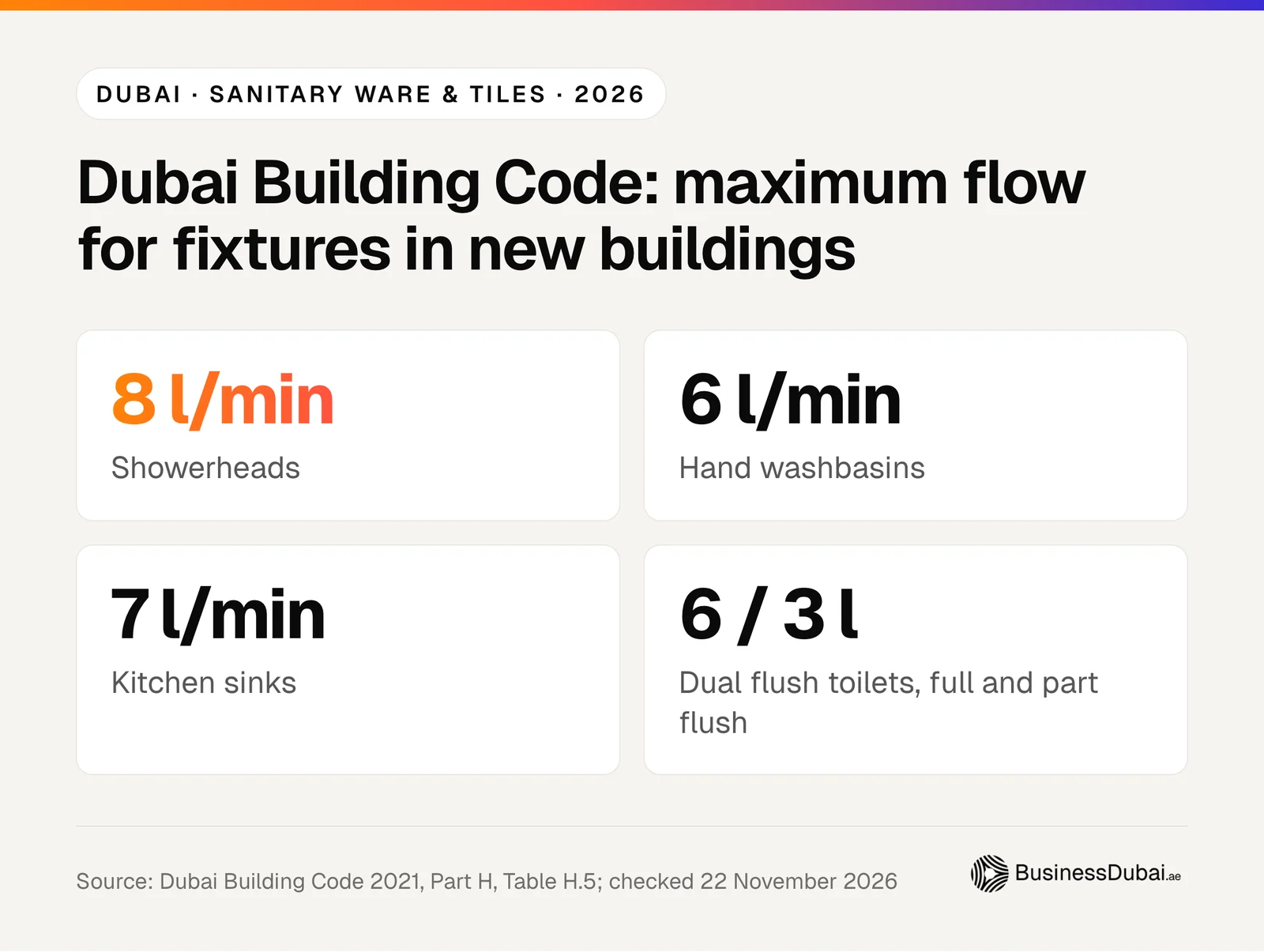
The Dubai Building Code 2021 caps showerheads at 8 litres a minute, hand washbasins at 6 and kitchen sinks at 7, and requires dual flush toilets at 6 litres full flush and 3 litres part flush. Urinals are capped at 2.4 litres in non-public facilities and 1 litre per flush, or waterless, in public facilities.
Clause H.5.2.2 requires "fixtures with a flow rate less than or equal to the flow rates shown in Table H.5", "dual flush toilets" and "automatic (proximity detection) or push-button faucets in all public facilities" [4]. Villas carry the same four limits in Part K, Table K.58 [4]. Al Sa'fat's second edition, January 2023, applies them at clause 601.01: "For all new buildings, the requirements stated in Dubai Building Code, Part H, H.5.2.2" [7].
| Fixture | Maximum flow (Table H.5) | Ask the factory for |
|---|---|---|
| Showerheads | 8 l/min | Rated flow, with the test pressure |
| Hand washbasins | 6 l/min | Rated flow of the mixer or aerator |
| Kitchen sinks | 7 l/min | Rated flow of the sink mixer |
| Dual flush toilets | 6 l full flush, 3 l part flush | Flush volumes of pan and cistern as a set |
| Urinals, non-public | 2.4 l | Flush volume |
| Urinals, public facilities | 1 l per flush, or waterless | Flush volume, or a waterless model |
A schedule inside this table passes the code's elemental route. A building that exceeds it must prove compliance by the performance method in H.5.2.1, a water-use calculation against a reference building [4], which is extra work the designer will avoid by choosing your compliant model.
The four limits a project buyer checks first are set out below [4].
These are building limits, not a shop ban
Table H.5 tells a designer what may be specified in a new building. It does not stop a showroom selling a higher-flow rain shower to a homeowner, though that shower still needs its MoIAT certificate and Green Label compliance [2], and the code decides what you can sell into a project. The one exception is narrow: "Faucets installed for specialized application may be exempted from meeting the flow rates, subject to Authority approval." [4] The table as read for this guide gives no test pressure, so ask each factory to state the pressure behind its rated flow.
Real Talk: Run two ranges and label them. A project range in which every showerhead, basin mixer and sink mixer is rated at or under 8, 6 and 7 litres a minute and every WC is dual flush at 6 and 3 litres [4], and a retail range for homeowners. Mixing them on one price list is how a high-flow mixer lands on a project submittal, gets rejected and hands the replacement order to a competitor.
What slip resistance do floor tiles need in Dubai?
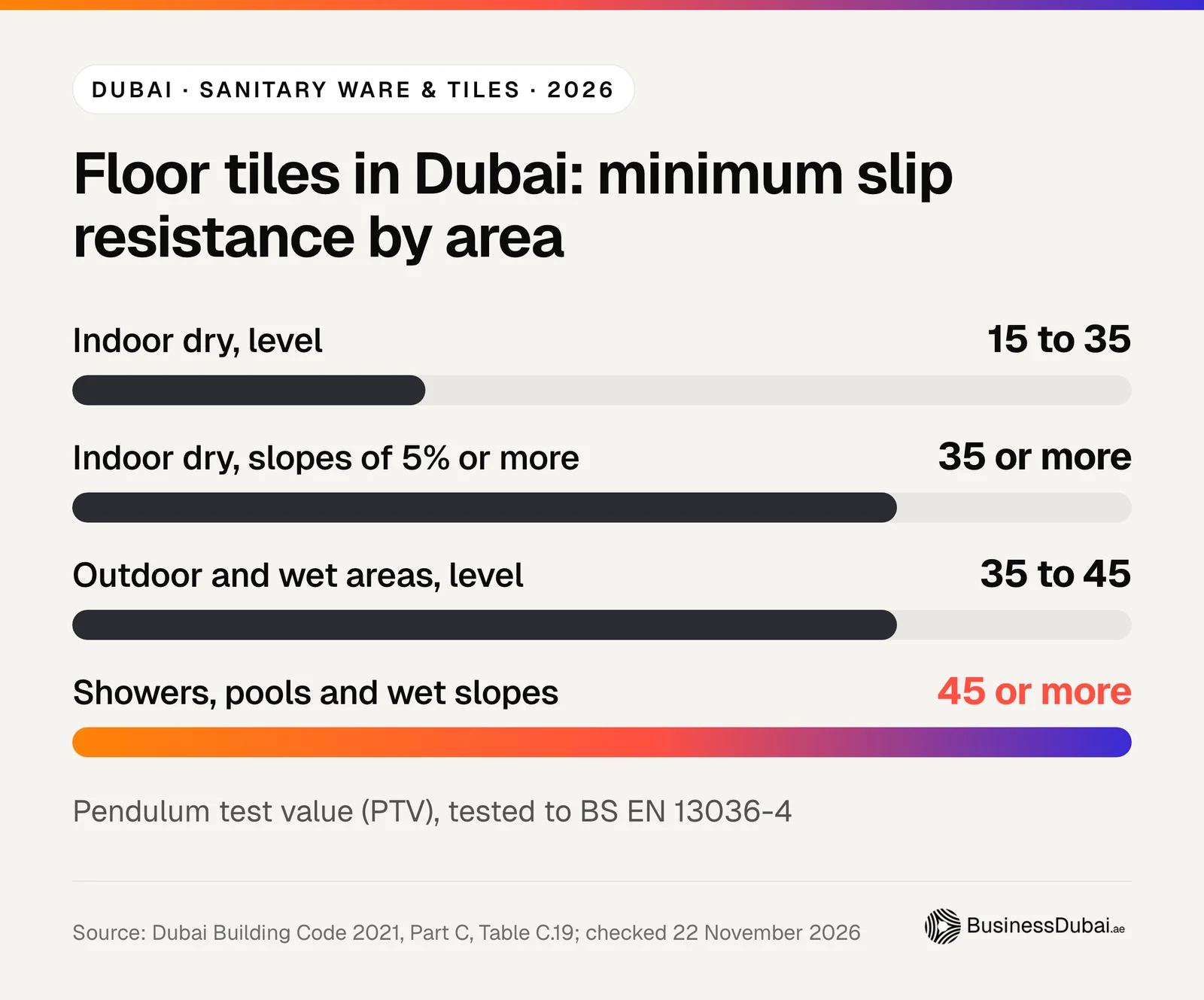
The Dubai Building Code sets floor slip resistance as a pendulum test value (PTV) under BS EN 13036-4: between 15 and 35 for level indoor dry floors, between 35 and 45 for level outdoor and wet areas, and 45 or more for showers, swimming pools, street paving and wet slopes of 5% or more. Suppliers must give PTV data.
Clause C.7.2.1.2 states: "Levels of slip resistance for accessible surfaces, as determined by pendulum testing (see BS EN 13036-4) shall conform to Table C.19." [4]
| Area | Floor slope | Pendulum test value (PTV) |
|---|---|---|
| Indoor, dry areas | Level, or slopes under 5% | Between 15 and 35 |
| Indoor, dry areas | Slopes of 5% or more | 35 or more |
| Outdoor and wet areas | Level, or slopes under 5% | Between 35 and 45 |
| Outdoor and wet areas | Slopes of 5% or more | 45 or more |
| Street paving, swimming pools and showers | Not split by slope | 45 or more |
Two sentences under the table name the trader directly: "The product provider shall provide technical slip resistance parameters in PTV units." and "If the data are not provided, the material should be tested in a laboratory before it is accepted." [4] The code adds that "PTVs shall take account of both shod and barefoot users", and that "Tiles presenting rounded edges and excessive joints should not be used in accessible routes" [4].
The minimum value for each area is the number to check on a datasheet before you quote [4].
Pro Tip: Hold a pendulum test report to BS EN 13036-4, in PTV units, for every floor tile you offer for bathrooms, pool decks or outdoor areas, with barefoot and shod results [4]. A datasheet that gives slip resistance in another unit, such as a ramp-test class, does not give the parameter Table C.19 names, and a polished tile quoted for a shower floor without data goes to a laboratory before it is accepted, at your cost in time.
Do tiles need a federal certificate or Dubai Central Laboratory certification?
Tiles do not appear on MoIAT's regulated-products sheet [2], and no UAE federal technical regulation for ceramic tiles was found for this guide. Dubai Municipality's Dubai Central Laboratory Department has announced a newly issued scheme for "Issuing Certificate of Conformity and Conformity Mark for Ceramic Tiles as per ISO 13006: 2018" [8].
It runs through the laboratory's factory assessment route: an ISO 9001 audit of the factory, testing of samples drawn during the audit, then surveillance audits [9]. The certificate is a factory's, not a trader's. Dubai Municipality's pages do not say whether it is mandatory for tiles. Its factory assessment table marks other products, such as "Solar water heating system as per BS EN 12976-1", as a "Mandatory requirement under Circular (183) 2011", and gives tiles no such entry [9]. Treat the tile scheme as a factory certification a specification may ask for, and check your project specification. For Dubai Central Laboratory approvals in general, see the building materials trading guide.
Do Chinese and Indian tiles and sanitary ware carry anti-dumping duty in the GCC?
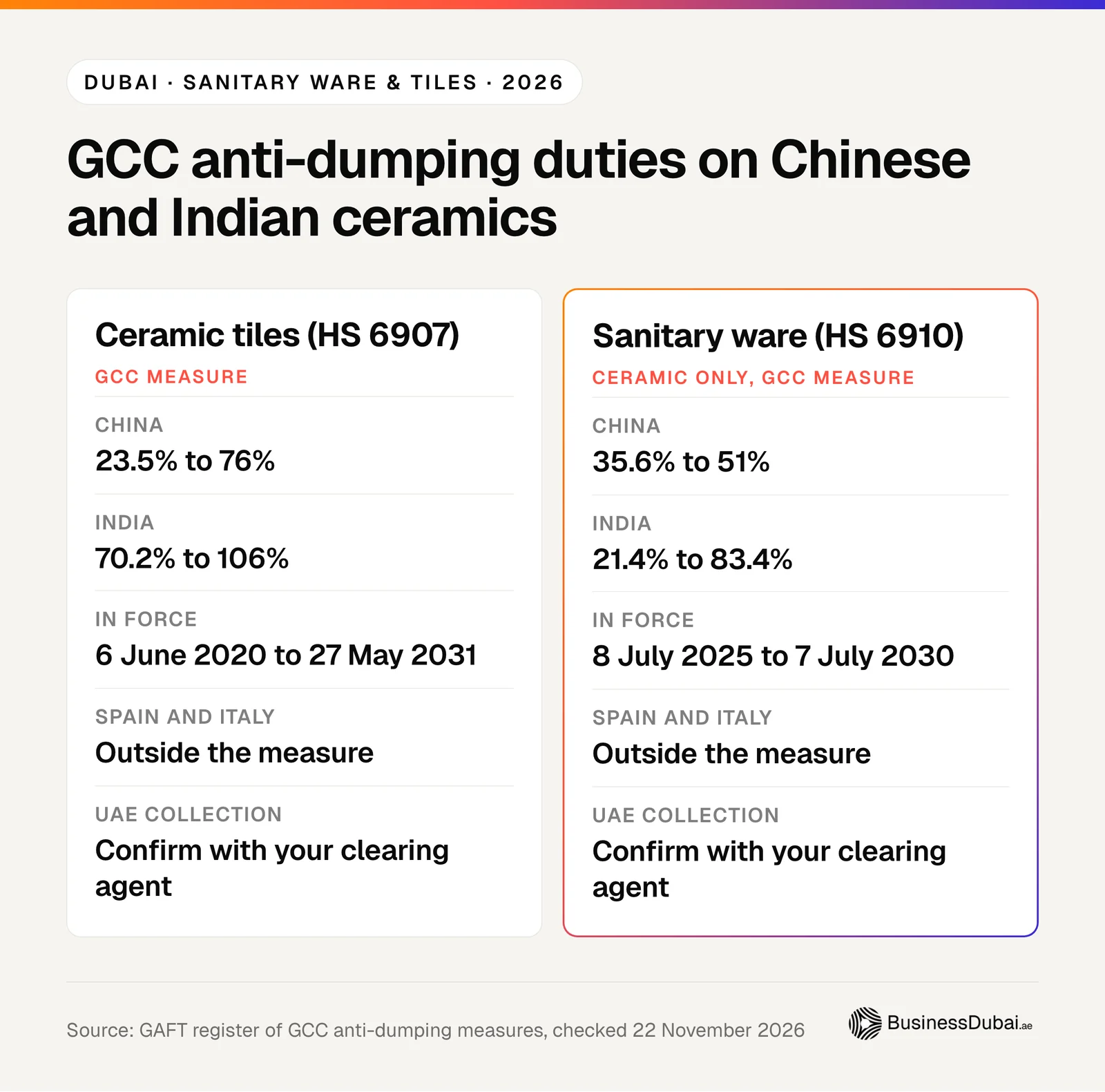
Yes, at GCC level. The register of GCC-wide measures kept by Saudi Arabia's General Authority for Foreign Trade (GAFT) lists duties on ceramic tiles of 23.5% to 76% from China and 70.2% to 106% from India, and on ceramic sanitary ware of 35.6% to 51% from China and 21.4% to 83.4% from India.
Both entries carry the scope "On all GCC imports" [1]. The tile measure covers HS "6907 except what is classified under 69073000". The sanitary ware measure covers HS 69101000 and 69109000: "Ceramic Sinks-Wash Basins, Wash Basin Pedestals, Baths, Bidets, Water Closet Pans, Flushing Cisterns, Urinals and Similar Sanitary Fixtures" [1]. Global Trade Alert records that the 2018 tile investigation also covered Spain and "was terminated without the imposition of duties on imports from Spain", and that the duty on China and India "was extended for a new period in April 2026" [10].
| Measure | HS codes | China | India | Imposed | Expires | Scope |
|---|---|---|---|---|---|---|
| Ceramic tiles | 6907, except 69073000 | 23.5% to 76% | 70.2% to 106% | 6 June 2020 | 27 May 2031 | On all GCC imports |
| Ceramic sanitary ware | 69101000, 69109000 | 35.6% to 51% | 21.4% to 83.4% | 8 July 2025 | 7 July 2030 | On all GCC imports |
Neither measure names Spain or Italy. Each country's figure is a range, so the rate that matters is your factory's.
The two measures side by side, as GAFT lists them on 22 November 2026 [1]:
What the measures do not cover
Taps and mixers, acrylic or steel baths and shower enclosures are not in these two measures [1]. A container holding a Chinese ceramic basin and a Chinese mixer faces the measure on the basin only. Ask your clearing agent to confirm each line's HS code, including whether a tile falls under the 69073000 exclusion.
Is the UAE collecting these duties at entry?
This guide could not answer that from a UAE source. GAFT is a Saudi government register summarising measures published in the GCC's official gazettes, and it gives the scope as all GCC imports [1]. No notice from the UAE Ministry of Economy and Tourism, the Federal Customs Authority or Dubai Customs on how, and from when, the UAE collects these duties at entry was found or could be read. Do not assume either way. Ask your clearing agent or Dubai Customs, in writing, before you price a Chinese or Indian ceramic container.
Real Talk: Ask your supplier whether the GCC decision names its factory and which rate it carries, get the answer in writing with the HS code, and give both to your clearing agent. A supplier that cannot say is a supplier whose landed cost you cannot calculate, and on Indian tiles the range runs from 70.2% to 106% [1].
Quick Math: A container of Indian ceramic tiles valued at AED 100,000 CIF pays AED 5,000 at the 5% customs rate in the Dubai Customs guide [11]. If the GCC anti-dumping duty is collected at the lowest Indian rate of 70.2% on the same value, add AED 70,200; at the highest rate of 106%, add AED 106,000 [1]. The GAFT register gives the rates only as percentages, so confirm the base with your clearing agent. The gap between those two cases is AED 35,800 on one container.
Should you source tiles and sanitary ware from India, China, Spain or Italy?
Country of origin now drives the landed cost of ceramics. Chinese and Indian ceramic tiles and sanitary ware are named in GCC anti-dumping measures; Spain's tile investigation ended without duty, and Italy is named in neither measure. Indian goods may qualify for UAE-India CEPA treatment, but CEPA does not remove anti-dumping duty.
Why CEPA does not shield Indian tiles
Article 7.2 of the UAE-India Comprehensive Economic Partnership Agreement says "the Parties retain their rights and obligations under Article VI of the GATT 1994, the Anti-Dumping Agreement, and the SCM Agreement" [12]. Its definition of customs duty also excludes any "anti-dumping or countervailing duty that is applied consistently with the provisions of Article VI of the GATT 1994" [12]. Whatever CEPA does to the ordinary duty, it leaves the GCC measure in place. This guide did not read the UAE's CEPA tariff schedule, so it states no CEPA duty rate; your clearing agent can confirm it for your HS code.
The CEPA origin rule for ceramics
Annex 3B sets the rule for Chapter 69, "Ceramic products", as "CTSH + VA 40%" [12]: a change of tariff subheading plus 40% value added, and "The percentages are on an FOB basis." [12] A tile pressed in India from imported materials needs that value added to qualify. The certificate of origin is limited too: "A Certificate of Origin shall be valid for twelve (12) months from the date of issue in the exporting Party", and it is "valid for only one import" [12].
The four origins compare as follows on the points that move landed cost [1][10][11][12].
| Origin | GCC anti-dumping position | Customs and origin notes | Check before ordering |
|---|---|---|---|
| India | Tiles 70.2% to 106%; sanitary ware 21.4% to 83.4% | CEPA possible: CTSH + VA 40%; certificate valid 12 months, one import | The factory's rate; a certificate per shipment; the CEPA rate for your HS code |
| China | Tiles 23.5% to 76%; sanitary ware 35.6% to 51% | 5% of CIF customs duty | The factory's rate and whether the UAE collects it |
| Spain | Tile investigation terminated without duty; not named for sanitary ware | 5% of CIF customs duty | Proof the goods were made in Spain |
| Italy | Not named in either measure | 5% of CIF customs duty | Where the goods were made: a brand's nationality is not the origin |
The table is a sourcing filter, not a price list: it shows which containers carry a duty question before the price conversation starts. Our import from China to Dubai guide covers the China route, and our Dubai Customs registration guide covers the client code you need before the first container clears.
Pro Tip: Order the CEPA certificate of origin with every shipment, not once per supplier. It is valid for 12 months and "for only one import" [12], so the March certificate does not cover the April container. Put it on the supplier's document checklist with the invoice and packing list, and hold the balance payment until it arrives.
Common Mistake: Assuming CEPA makes Indian tiles duty-free. CEPA can change the ordinary customs duty on qualifying goods, but Article 7.2 keeps anti-dumping rights intact [12], and the GCC measure on Indian ceramic tiles runs from 70.2% to 106% [1]. If that duty is collected, a price list built on the CEPA preference alone can be wrong by more than the value of the goods.
Should a sanitary ware and tiles business run a showroom or supply projects?
A Dubai bathroom or tile showroom sells mostly to individuals, so it carries consumer-law duties such as Arabic invoices and repair or replacement obligations, and its sales to natural persons are excluded from free zone 0% tax. Project supply sells to contractors and developers against a specification, where certificates, flow rates and PTV data win the order.
A showroom's risk sits with the customer. Our furniture trading company guide covers the consumer-law rules for showroom retail in full, including the dated Arabic invoice, warranty and spare-parts duties and the void no-returns clause, and the same law applies to a bathroom showroom.
A project supplier's risk sits in the submittal. A consultant can ask for the MoIAT certificate for each fixture [2], datasheets inside Table H.5, PTV results for every wet-area tile [4] and, where specified, a Dubai Central Laboratory tile certificate [8]. Keep one PDF per product line with the certificate or PTV report, the datasheet, the factory's ISO 9001 certificate and the certificate of origin.
For government work, the federal supplier register lists "No Fees" and "30 working days" [13], and MoIAT says "Certified suppliers will gain advantages during the award of tenders and contracts based on their ICV score." [14] The building materials trading guide covers ICV and Dubai Municipality's supplier database.
Should a sanitary ware and tiles trader set up on the mainland or in a free zone?
A showroom selling to the public in Dubai is a mainland business: BusinessDubai.ae's Dubai mainland package costs AED 18,200 in year one without a visa and AED 26,900 with one. A free zone company suits import, B2B and re-export, from AED 12,500 licence only at Meydan Free Zone or Dubai South.
Our mainland company setup page itemises the DET route for a Dubai showroom, and our free zone company setup page compares the zones for an import and B2B business, including the renewal a headline price leaves out. The table uses BusinessDubai.ae's standard 2026 package prices.
| Factor | Dubai mainland (DET) | Dubai free zone (Meydan Free Zone, Dubai South, IFZA) |
|---|---|---|
| Licence, no visa | AED 18,200 | AED 12,500 at Meydan or Dubai South; AED 12,900 at IFZA (partner price) |
| Licence with one visa | AED 26,900 | AED 21,850 at Meydan or Dubai South; AED 22,200 at IFZA |
| Showroom for the public in Dubai | Yes | No |
| Sell to Dubai contractors | Directly | Through a mainland route or distributor |
| Import, hold stock, re-export | Yes, through customs clearance | Yes; the natural fit |
| Year-two renewal | About AED 15,000 | Roughly 80% of year one |
Packages are company formation only: showroom and warehouse leases are separate. For free zone routes onto the mainland and the Designated Zones that suit a stockholding yard, see the building materials trading guide.
Outside Dubai, Ajman Free Zone is AED 5,555 licence only, AED 13,931 with one visa and AED 17,971 with two; RAKEZ is AED 6,010, AED 12,810 and AED 18,810; SPC Free Zone in Sharjah is AED 5,765, AED 15,055 and AED 19,505. These are not Dubai prices; our business setup in Ajman and business setup in Sharjah pages show what each buys. BusinessDubai.ae has no JAFZA package; our JAFZA free zone setup guide covers that zone.
Quick Math: With one visa, Ajman Free Zone costs AED 13,931 against AED 26,900 for BusinessDubai.ae's Dubai mainland package, a saving of AED 12,969. That saving buys a company that cannot open a showroom on a Dubai street. For a tile importer selling to Dubai contractors through a mainland distributor it may be the right trade; for a bathroom showroom it is money saved on the wrong licence.
How is a sanitary ware and tiles trader taxed?
A Dubai mainland sanitary ware or tile trader pays corporate tax at 0% on taxable income up to AED 375,000 and 9% above, or can elect Small Business Relief while revenue stays at or under AED 3,000,000, for tax periods ending on or before 31 December 2029. Local sales carry 5% VAT.
The rates come from Federal Decree-Law No. 47 of 2022 [15], and the relief from Ministerial Decision No. 73 of 2023 as amended by Ministerial Decision No. 131 of 2026 [16]; our Small Business Relief guide explains the election.
A free zone trader's 0% is narrow. Under Ministerial Decision No. 229 of 2025 the distributor's route is "Distribution of goods or materials in or from a Designated Zone", with conditions on how goods enter and who buys them, and "Any transactions with natural persons" are an Excluded Activity [17]. A showroom selling basins to homeowners is selling to natural persons. A company that fails a condition is taxed at ordinary rates from the start of that period and loses Qualifying Free Zone Person status for the following four periods [15]. Our Qualifying Free Zone Person guide and the building materials guide work through the tests.
VAT is 5% on local sales, with mandatory registration above AED 375,000 of taxable supplies and voluntary registration from AED 187,500 [18]; our VAT registration and compliance guide covers returns.
Real Talk: For most sanitary ware and tile traders the honest plan is ordinary rates, with Small Business Relief while revenue stays at or under AED 3,000,000 [16]. Showroom customers are individuals, and contractors' position under the resale test is unresolved, so the free zone 0% route rarely fits. Consider it only for a Designated Zone business selling to dealers who resell, with written advice.
What does it cost to start a sanitary ware and tiles trading company in Dubai?
A Dubai sanitary ware and tiles trading company costs AED 18,200 in year one on BusinessDubai.ae's mainland package without a visa, or AED 26,900 with one. Each MoIAT water-fixture certificate adds at least AED 1,720 in published fees before laboratory testing. Showroom leases, stock, customs duty and any anti-dumping duty come on top.
The table uses BusinessDubai.ae's standard package prices [19], MoIAT's published fees [6], the Dubai Customs duty rate [11] and the GCC measures listed by GAFT [1].
| Cost item | Amount (AED) | Notes |
|---|---|---|
| Dubai mainland package, no visa | 18,200 | First year; company formation only |
| Dubai mainland package, one visa | 26,900 | First year; company formation only |
| Meydan Free Zone or Dubai South: licence only, one visa, two visas | 12,500; 21,850; 28,400 | Import and B2B; no Dubai showroom |
| IFZA: licence only, one visa | 12,900; 22,200 | Partner price; IFZA publishes no prices |
| Ajman Free Zone, RAKEZ, SPC Free Zone (non-Dubai) | See the section above | Cheaper, but not Dubai prices |
| JAFZA | No BusinessDubai.ae package | Ask the zone directly |
| MoIAT product registration | 600 | Registering products in the UAE Conformity Assessment System |
| MoIAT technical review | 620 per certificate | Review of documents |
| MoIAT certificate issuance | 500 per certificate | Issued by the Ministry |
| MoIAT technical assessment | 2,500 per working day per assessor | Only if MoIAT assesses the establishment |
| Laboratory test reports and PTV tests | Laboratory quote | Ask the factory for existing reports first |
| Dubai Central Laboratory tile certification | Quoted by Dubai Municipality | Factory scheme; only where specified |
| Showroom or warehouse lease and fit-out | Landlord and contractor quotes | Not in any package |
| Customs duty | 5% of CIF value | CEPA may change it for qualifying Indian goods |
| GCC anti-dumping duty, if collected | Tiles: China 23.5% to 76%, India 70.2% to 106%. Sanitary ware: China 35.6% to 51%, India 21.4% to 83.4% | Confirm collection and your factory's rate |
| Year two, Dubai mainland renewal | About 15,000 | BusinessDubai.ae package |
| Year two, free zone renewal | About 80% of year one | Ask for the standard renewal price |
The licence is the line you can price today. The duty question on Chinese and Indian ceramics can swing the business case, and it needs a written answer before the first order.
Quick Math: One water-fixture certificate costs AED 600 to register, AED 620 for the technical review and AED 500 for issuance, a total of AED 1,720 [6]. If MoIAT also assesses the establishment for one working day with one assessor, add AED 2,500, for AED 4,220. Laboratory and certification body charges come on top, so ask the factory which reports it already holds.
For a quote that prices the licence, the certificates your range needs and the duty position of your sources together, get an itemised setup quote→
In what order should you set up a sanitary ware and tiles trading company?
Set up in this order: fix the product list and its countries of origin, choose mainland or free zone, map the DET codes, get initial approval, sign the showroom or warehouse, issue the licence, register with Dubai Customs, certify water fixtures with MoIAT, collect flow and PTV data, confirm anti-dumping exposure, then register for VAT.
- Product list and origin. List every line and the country it is made in; origin decides the duty question.
- Mainland or free zone. A public showroom goes on the Dubai mainland; import and B2B can sit in a free zone.
- Activity codes. Map lines to 4752004, 4752011 and the other codes above; avoid 4759009.
- Initial approval. Reserve the trade name and get DET's or the zone's approval on your real product list.
- Premises and licence. Sign the lease in the company's name and issue the licence.
- Dubai Customs client code. Register so containers clear in the company's name.
- MoIAT certificates. Certify your best-selling taps, showers and WCs first and diary renewals.
- Project data. Collect flow rates, PTV reports and any Dubai Central Laboratory certificates.
- Duty and VAT. Get your clearing agent's written duty answer for each Chinese or Indian ceramic HS code, then register for VAT.
Steps 7 to 9 run on factories' and authorities' timelines, so start them while the licence is issued. From year two, licence, certificate and visa renewals, VAT returns and the corporate tax return fall due within months of each other, and our post-setup services team keeps that calendar so a certificate does not lapse with stock on the shelf.
Which setup fits your sanitary ware or tile business?
The right setup depends on who buys and where the goods are made. A bathroom showroom selling to the public needs a Dubai mainland licence and MoIAT certificates; a tile importer supplying contractors needs PTV data and a duty answer; an Indian brand distributor needs CEPA paperwork and an anti-dumping check. The table maps five common profiles.
| Profile | Base | Codes | What decides the business |
|---|---|---|---|
| Bathroom showroom on a main road such as Sheikh Zayed Road | Dubai mainland | 4752004, 4752011 | MoIAT certificates; consumer law; a labelled retail range outside Table H.5 |
| Tile importer supplying contractors | Mainland, or free zone with a mainland route | 4752011, 4752009 for slabs | PTV reports; a written duty answer on Chinese or Indian origin |
| Indian tile brand distributor | Free zone or mainland | 4752011 | The factory's rate within 70.2% to 106%; a CEPA certificate per shipment |
| Italian and Spanish premium tile agent | Dubai mainland showroom or studio | 4752011 | Proof of Italian or Spanish manufacture; PTV data; DCL certificate where specified |
| Tap and mixer brand distributor | Free zone or mainland | 4752004, 4752020 | MoIAT certificates; Table H.5 flow rates for project lines; outside the ceramic measures |
All five usually sit on ordinary corporate tax rates or Small Business Relief. If your business straddles two rows, the buyer and the country of manufacture decide which wins. Check which setup fits your range→
Real Client Stories
These are composite examples built from the situations sanitary ware and tile traders most often face in Dubai. Names and details are illustrative, and the only figures used are published government fees and duties and BusinessDubai.ae's package prices.
The showroom licensed for tableware (Dubai mainland)
A couple opening a bathroom showroom chose BusinessDubai.ae's Dubai mainland package at AED 26,900 with one visa and asked for Ceramic & Chinaware Trading, because their whole range was ceramic. DET's description of that code covers household utensils and art works, so the application was redrafted with 4752004 Sanitary Ware Trading and 4752011 Tiles & Flooring Materials Trading before the licence was issued. Their first container then included shower mixers with no conformity file, and the factory took weeks to send its ISO 9001 certificate and test report. Lesson: choose codes by their descriptions, and collect the MoIAT file before the order ships.
The Indian tile importer who priced at 5% (Dubai South)
A trader set up at Dubai South on the AED 21,850 one-visa package to import Indian porcelain for contractors, and built his price list on 5% customs duty and an expected CEPA preference. Before the first order, his clearing agent pointed him to the GCC measure on Indian ceramic tiles, listed at 70.2% to 106%, and asked which rate his factory carried. The factory could not say. He held the price list, obtained written answers on the rate and on collection, and reworked his margin before quoting a single contractor. Lesson: CEPA does not remove anti-dumping duty, so confirm the duty position before you price.
The pool deck tile with no PTV result (Dubai mainland)
A mainland supplier on the AED 18,200 package without a visa won a hotel order for Spanish porcelain on the pool deck and in the shower areas. The consultant asked for slip resistance in PTV units under Dubai Building Code Table C.19, where swimming pools and showers need 45 or more. The datasheet gave only a ramp-test class, so the tiles went for a pendulum test before approval, and the order slipped while the result came back. Spanish origin had kept the container clear of the GCC tile measure; the missing data cost the time instead. Lesson: hold PTV results for every wet-area tile before you quote.
Start your sanitary ware and tiles trading company the right way
For a sanitary ware and tiles trader, the licence is the simple part. Three things decide the business: whether every tap, shower and WC carries its MoIAT certificate before it goes on sale, whether your project range sits inside the Dubai Building Code's flow rates and slip values, and whether you know, in writing, the duty position on every Chinese or Indian ceramic container before you price it.
BusinessDubai.ae sets up trading companies with itemised pricing and no hidden fees. We will price a mainland company setup for a Dubai showroom against a free zone company setup for an import and B2B business, and our post-setup services team keeps licence, visa and certificate renewals on one calendar. Talk to a setup expert→
Frequently Asked Questions
What activity code do I need for sanitary ware trading in Dubai?
Sanitary ware trading in Dubai uses DET activity 4752004 Sanitary Ware Trading, covering washbasins, bathtubs, lavatories, taps and bathroom articles except furniture. Tiles need 4752011 Tiles & Flooring Materials Trading alongside it. Free zones number activities differently, so quote your licensing authority's code.
Can I use Ceramic & Chinaware Trading for a tile or sanitary ware business?
No. DET activity 4759009 Ceramic & Chinaware Trading covers household utensils and art works made of ceramic or chinaware. It does not cover tiles, basins or WCs, so a business licensed on it needs an amendment before selling a bathroom range.
Do taps and mixers go under sanitary ware or pipes and fittings?
Taps appear in both 4752004 Sanitary Ware Trading and 4752020 Pipes & Fittings Trading. A showroom selling mixers with basins fits 4752004; a plumbing supplier selling valves and taps to contractors fits 4752020. A business doing both should list both.
Can a tile trading licence sell marble slabs and cut-to-size countertops?
A tile licence covers finished marble tiles. Slabs sold as shipped need 4752009 Marble & Natural Stones Trading, which excludes processing beyond cutting for transport. Cutting stone to size falls under a separate activity, 2396004 Marble Cutting, Grinding & Polishing.
Can a sanitary ware trading company install what it sells in Dubai?
No. A trading licence lets you sell fixtures, not fit them. Installing washbasins, bathtubs and lavatories is DET activity 4322002 Plumbing & Sanitary Contracting, so supply-and-fix needs a contracting activity or a separate contracting company.
Can I sell water heaters with a sanitary ware licence in Dubai?
Water heaters have their own DET activity, 4752012 Water Heaters Trading. They are also on MoIAT's regulated-products sheet, and a trader's file must include distributor ownership issued by the brand owner. Dubai Municipality marks solar water heating systems as a mandatory certification under Circular 183 of 2011.
Do I need a MoIAT certificate to sell taps and showers in the UAE?
Yes. MoIAT's regulated-products sheet lists Water Fixture Products under Cabinet Resolution No. 43 of 2014, so taps, mixers, showers, WCs and urinals need a UAE conformity certificate before sale. The file needs an accredited laboratory test report, Green Label compliance, the factory's ISO 9001 certificate and product data.
What is the Green Label for water fixtures in the UAE?
The Green Label is the water-efficiency requirement of the UAE water-fixture scheme under Cabinet Resolution No. 43 of 2014, and MoIAT's sheet requires products to fulfil it. This guide did not read the resolution's text, so ask your certification body for the label's rating tiers.
Which bathroom products are covered by the UAE water-fixture scheme?
A 2018 scheme document from RACS, a notified body, lists shower taps and mixers, toilet taps, single and dual flush toilets, urinals, kitchen faucets, washing faucets and ablution spray faucets. MoIAT's sheet names only the class, Water Fixture Products, so confirm each product with your certification body.
How much does a MoIAT water-fixture certificate cost in 2026?
MoIAT lists AED 600 to register products, AED 620 for the technical review of each certificate and AED 500 for issuance, a total of AED 1,720. If MoIAT assesses the establishment, add AED 2,500 per working day per assessor. Laboratory testing is extra, and RACS's 2018 scheme gives a one-year validity.
Do ceramic tiles need a MoIAT conformity certificate?
Ceramic tiles do not appear on MoIAT's regulated-products sheet, and no UAE federal technical regulation for ceramic tiles was found for this guide. Water fixtures and water heaters are on the sheet. Dubai Municipality runs a separate tile certification scheme for factories.
Is Dubai Central Laboratory certification mandatory for ceramic tiles?
Dubai Municipality's pages do not say. Its Dubai Central Laboratory has a newly issued scheme certifying ceramic tiles to ISO 13006:2018, issued to factories after an ISO 9001 audit and sample testing. Check whether your project specification asks for it.
What is the maximum shower flow rate allowed in Dubai buildings?
The Dubai Building Code 2021 caps showerheads at 8 litres a minute in Table H.5, hand washbasins at 6 and kitchen sinks at 7. It also requires dual flush toilets at 6 litres full and 3 litres part flush. Al Sa'fat applies these limits to all new buildings.
Can I still sell high-flow rain showers in a Dubai showroom?
The Dubai Building Code does not stop it: its flow limits are design rules for new buildings, not a ban on retail sales. The shower still needs its MoIAT water-fixture certificate and Green Label compliance, and it cannot be specified into a new building under the code's elemental route, so keep a labelled project range within 8 litres a minute.
What slip resistance do bathroom and shower floor tiles need in Dubai?
Under Dubai Building Code Table C.19, showers and swimming pools need a pendulum test value of 45 or more, and level wet areas need between 35 and 45. Testing follows BS EN 13036-4, and the product provider must give slip data in PTV units.
Is there anti-dumping duty on ceramic tiles from China and India in the GCC?
Yes. The GAFT register lists a GCC measure on ceramic tiles under HS 6907 at 23.5% to 76% from China and 70.2% to 106% from India, running to 27 May 2031. How and from when the UAE collects it was not confirmed from a UAE source, so ask your clearing agent.
Is there anti-dumping duty on toilets and washbasins from China and India?
Yes. The GAFT register lists a GCC measure on ceramic sinks, wash basins, baths, bidets, WC pans, cisterns and urinals under HS 69101000 and 69109000, from 8 July 2025 to 7 July 2030, at 35.6% to 51% from China and 21.4% to 83.4% from India.
Does CEPA make Indian tiles duty-free in the UAE?
Not for anti-dumping duty. Article 7.2 of the UAE-India CEPA keeps each party's anti-dumping rights, and the agreement's customs duty definition excludes anti-dumping duty. This guide does not state a CEPA rate for tiles, so confirm the ordinary duty with your clearing agent.
Are Spanish and Italian tiles subject to GCC anti-dumping duty?
Not under the current measures. Global Trade Alert records that the investigation into Spanish tiles ended without duty, and Italy is named in neither measure. Ordinary customs duty of 5% of CIF value still applies, and origin depends on where the tile was made, not the brand.
Do anti-dumping duties apply to taps, mixers and acrylic baths?
Not under these two measures, which cover ceramic tiles under HS 6907 and ceramic sanitary ware under HS 6910. Taps, mixers, acrylic or steel baths and shower enclosures are outside them. Confirm each line's HS code with your clearing agent.
What customs duty applies to tiles imported into Dubai?
Dubai Customs' 2025 service guide gives the customs duty rate as 5% of CIF value, except for alcohol and tobacco. Chinese and Indian ceramic tiles may also face GCC anti-dumping duty, and qualifying Indian goods may get a CEPA preference on the ordinary duty.
How long is a UAE-India CEPA certificate of origin valid?
A UAE-India CEPA certificate of origin is valid for 12 months from issue and for only one import. Ceramic products must also meet the Chapter 69 origin rule, CTSH + VA 40%, so every shipment needs its own certificate.
Can a free zone company open a tile showroom in Dubai?
No. A showroom selling to the public in Dubai is a mainland business and needs a Dubai mainland licence. A free zone company suits importing, B2B supply and re-export, and reaches mainland buyers through a mainland route or distributor.
How much does a sanitary ware trading licence cost in Dubai in 2026?
BusinessDubai.ae's Dubai mainland package costs AED 18,200 in year one without a visa and AED 26,900 with one, renewing at about AED 15,000. Meydan Free Zone and Dubai South start at AED 12,500 licence only. BusinessDubai.ae has no JAFZA package, and leases are separate.
Can a free zone tile trader get 0% corporate tax?
Only through a narrow route. Ministerial Decision No. 229 of 2025 allows distribution in or from a Designated Zone to buyers who resell, and transactions with natural persons are excluded. Most showrooms and contractor suppliers pay 0% up to AED 375,000 and 9% above, or use Small Business Relief.
Is VAT charged on tiles and sanitary ware in the UAE?
Yes. Tiles and sanitary ware sold locally carry 5% VAT, and registration is mandatory once taxable supplies pass AED 375,000 a year, with voluntary registration from AED 187,500.
References
[1] Saudi General Authority for Foreign Trade (GAFT). Follow-up Trade Remedies Investigations, "Imposed Anti-Dumping Measures" under the GCC common law: ceramic tiles (HS 6907 except 69073000) and ceramic sanitary fixtures (HS 69101000, 69109000), rates for China and India, dates of imposition and expiry, and the scope "On all GCC imports". Checked 22 November 2026. gaft.gov.sa
[2] Ministry of Industry and Advanced Technology (MoIAT). Regulated products sheet: the Water Fixture Products row under Cabinet Resolution No. 43 of 2014 with its required documents, and the Water Heater row with its trader requirement; no ceramic tile entry. moiat.gov.ae
[3] Dubai Department of Economy and Tourism (DET). Business activity list as recorded in the Invest Dubai register: activity names, seven-digit codes, descriptions and approval fields for 4752004, 4752011, 4752009, 4752020, 4752012, 4759016, 4759009, 4322002 and 2396004. app.invest.dubai.ae
[4] Dubai Municipality. Dubai Building Code, 2021 edition: Part C clauses C.7.2.1.2 and C.7.2.1.3 with Table C.19 on slip resistance, Part H clauses H.5.2.1 and H.5.2.2 with Table H.5 maximum flow rates, and Part K Table K.58 for villas. dmpmedia.dm.gov.ae
[5] RACS, notified body. Product Certification Scheme for Mechanical-Water Fixtures, RACS/SOP/54 Revision 02, 5 June 2018: scope of products, the mandatory scheme named, required documents and certificate validity. One certifier's document, used for scope and validity only. racs-me.com
[6] Ministry of Industry and Advanced Technology (MoIAT). Issue Conformity Certificates for Regulated Products, service fees: AED 600 registration, AED 620 technical review per certificate, AED 500 issuance and AED 2,500 per working day per technical assessor. moiat.gov.ae
[7] Dubai Municipality. Al Sa'fat, Dubai Green Building System, 2nd edition, January 2023: clause 601.01 Water Efficient Fittings, referring to Dubai Building Code H.5.2.2 and K.10.2.2.2. dmpmedia.dm.gov.ae
[8] Dubai Municipality, Dubai Central Laboratory Department. Product certification page: the newly issued ceramic tile scheme to ISO 13006:2018 and the statement on local certification regulations. dm.gov.ae
[9] Dubai Municipality, Dubai Central Laboratory Department. Factory Assessment Scheme page: the ISO 9001 audit, sample testing and surveillance route, and the table of schemes with their mandatory circulars, including solar water heating systems. dm.gov.ae
[10] Global Trade Alert. GCC definitive anti-dumping duty on imports of certain ceramic tiles from China and India, termination of investigation on imports from Spain: 2018 initiation, 2020 imposition, March 2025 sunset review and April 2026 extension. globaltradealert.org
[11] Dubai Customs. Dubai Customs Services Guide 2025: customs duty of 5% of CIF value, except alcohol and tobacco. dubaicustoms.gov.ae
[12] UAE Ministry of Economy and Tourism. Comprehensive Economic Partnership Agreement between the UAE and India, final text: the customs duty definition, Article 7.2 on anti-dumping, the certificate of origin validity rules and Annex 3B product-specific rules for Chapter 69. moet.gov.ae
[13] UAE Ministry of Finance. Register suppliers in the federal supplier register: service fees and completion time. mof.gov.ae
[14] Ministry of Industry and Advanced Technology (MoIAT). National In-Country Value programme: the ICV certificate and its use in tenders. moiat.gov.ae
[15] Federal Tax Authority. Federal Decree-Law No. 47 of 2022 on the Taxation of Corporations and Businesses: the 0% and 9% rates, the AED 375,000 threshold and the consequences of failing Qualifying Free Zone Person conditions. tax.gov.ae
[16] UAE Ministry of Finance. Ministerial Decision No. 73 of 2023 on Small Business Relief, as amended by Ministerial Decision No. 131 of 2026: the AED 3,000,000 revenue threshold and tax periods ending on or before 31 December 2029. mof.gov.ae
[17] UAE Ministry of Finance. Ministerial Decision No. 229 of 2025 Regarding Qualifying Activities and Excluded Activities: distribution of goods or materials in or from a Designated Zone, and transactions with natural persons as an Excluded Activity. mof.gov.ae
[18] Federal Tax Authority. VAT registration: the 5% standard rate, the AED 375,000 mandatory and AED 187,500 voluntary registration thresholds. tax.gov.ae
[19] BusinessDubai.ae. Internal pricing data: 2026 standard company formation package prices by visa count for the Dubai mainland, Meydan Free Zone, Dubai South, IFZA (partner price), Ajman Free Zone, RAKEZ and SPC Free Zone, the mainland renewal figure and the free zone renewal rule of thumb. businessdubai.ae