

A bakery business in Dubai is licensed by what it bakes and who it sells to, and bread brings rules that a café or a cake shop never meets. Bread is one of nine essential consumer products whose price cannot be raised without the Ministry of Economy's prior approval [1], and under Cabinet Resolution No. 14 of 2026 a retailer that raises it anyway faces a written warning, then fines that climb to AED 50,000 to 75,000 with a 30-day closure [2]. Since October 2026, bread also has national sodium caps: 444 mg per 100 g for leavened bread in the first phase, falling to 370 mg by the end of 2030 [3].
The licence decision comes first. A traditional bread bakery, a cake shop, a resale counter and a production bakery each sit on a different activity code and licence class [4], and Dubai Municipality sets a different minimum food area for each [5]. Sign a lease on the wrong unit and the shop can be too small for the activity your menu needs.
Since 2013, BusinessDubai.ae has helped founders set up companies across the UAE. This guide covers the code for each bakery model, Dubai Municipality's requirements, home baking, bread price control, the new salt, sugar and fat limits, ovens and gas, mainland or free zone, tax, costs and the order of steps. It is general information, not legal or tax advice: confirm your case with the relevant authority before you commit money.
What licence does a bakery need in Dubai?
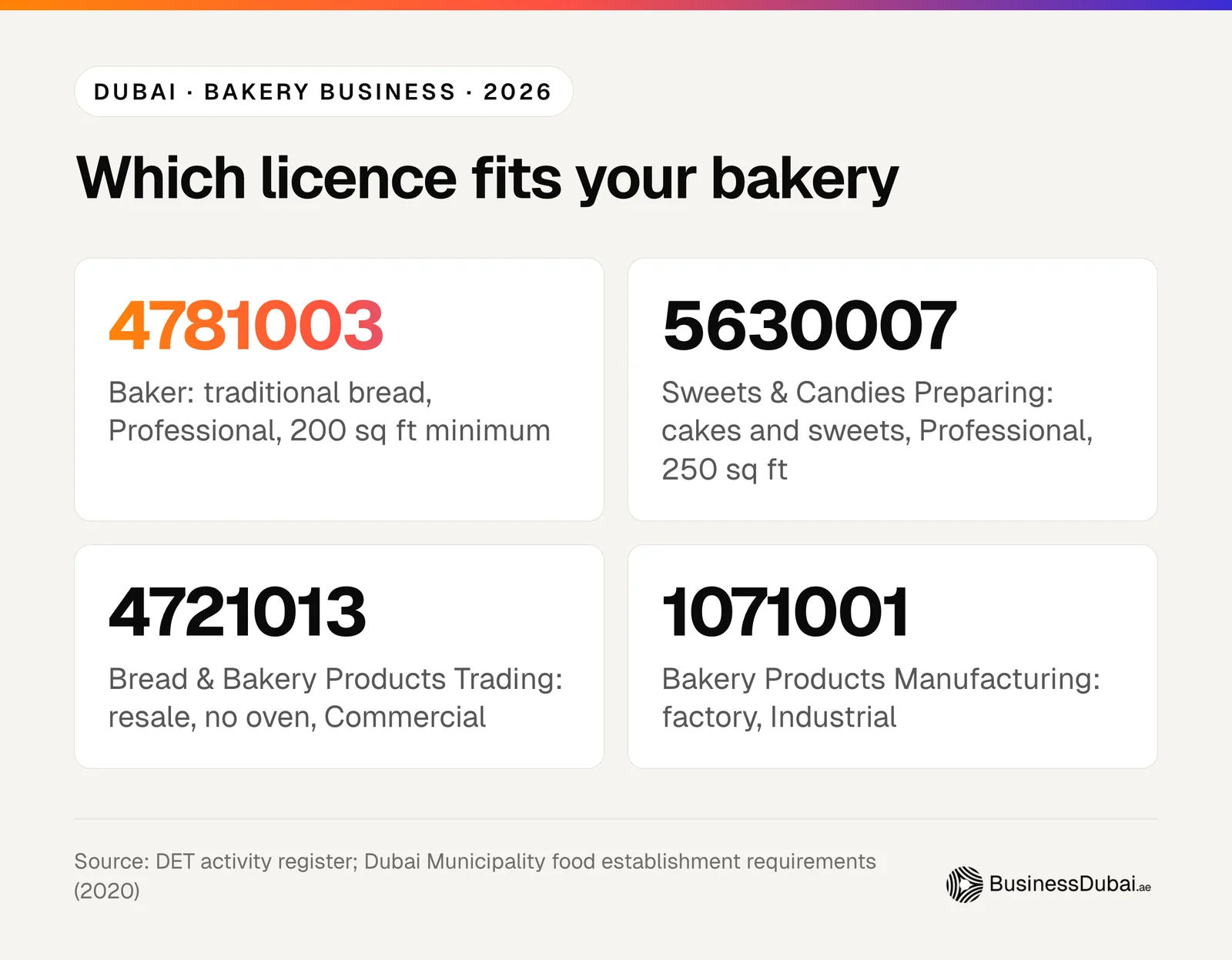
A Dubai bakery is licensed by what it does: traditional bread on Baker (4781003), cakes and sweets on 5630007, resale on 4721013 and a production bakery on Industrial 1071001. Dubai Municipality sets a minimum food area and pre-approves the premises. Bread is price-controlled, and new MoHAP caps limit sodium in packaged bread from 2026.
Think of a bakery licence as three layers. The trade licence and activity code come from the Dubai Department of Economy and Tourism (DET) on the mainland, or from a free zone authority [4]. The food establishment approval comes from Dubai Municipality's Food Safety Department [5]. The product rules are federal: the Ministry of Economy controls the price of bread [1] and the Ministry of Health and Prevention (MoHAP) caps its sodium, sugar and fat [3]. Few food businesses in the UAE sell a product whose price and salt content are both set by federal rules.
Which bakery are you opening, and which activity code fits it?
Each bakery model maps to a different Dubai Department of Economy and Tourism (DET) code: Baker (4781003) for traditional bread, Pastry Preparing (5621004) or Sweets & Candies Preparing (5630007) for pastries and cakes, Bread & Bakery Products Trading (4721013) for resale with no oven, and Bakery Products Manufacturing (1071001) for a production bakery.
The table maps the common bakery models to the DET register [4] and to the minimum food area in Dubai Municipality's activity requirements table, April 2020 edition [5].
| Bakery model | DET activity and code | Licence class | DM minimum food area (2020 table) | What the code covers |
|---|---|---|---|---|
| Arabic or traditional bread bakery | Baker, 4781003 | Professional | 200 sq ft; not an instant licence | Traditional bread in traditional ovens; the Arabic text names tannour ovens |
| Pastry shop | Pastry Preparing, 5621004 | Professional | Not listed in the 2020 table; ask DM | Pastries for immediate consumption, or sold uncooked to bake later |
| Cake, dessert and sweets shop | Sweets & Candies Preparing, 5630007 | Professional | 250 sq ft | Oriental and European sweets, cakes and candies for immediate consumption |
| Local sweets counter | Local Sweets Preparing, 5621007 | Professional | 250 sq ft | Local sweets for immediate consumption |
| Seating, snacks and drinks | Cafeteria, 5610003 | Professional | 200 sq ft (250 with shawarma) | Snacks, juices and beverages |
| Bread and bakery resale, no oven | Bread & Bakery Products Trading, 4721013 | Commercial | Depends on process; instant licence | "Includes the reselling of fresh, frozen or dry bakery products" |
| Packed pastry and sweets resale | Pastry Trading, 4721015 | Commercial | Depends on process; instant licence | Packed pastries and sweets from approved suppliers |
| Production bakery | Bakery Products Manufacturing, 1071001 | Industrial | Set by process, equipment, output and staff | Bread, rolls, pastry, cakes, biscuits and more, made at scale |
| Laminated pastry production | Pastry & Sweets Manufacturing, 1071002 | Industrial | Set by process | Flaky pastry from flour, sugar, milk, butter and eggs |
Read the licence class column first: baking for immediate consumption is Professional, resale is Commercial, a factory is Industrial. The register flags none of these codes as needing an outside approval at licensing, but Dubai Municipality's Food Safety Department pre-approves every one before the bakery trades [4][5]. A production bakery on 1071001 runs the longer factory chain in our food processing factory guide.
The bakery-café that bakes on site
The DET register has no single code for a modern bakery-café that bakes croissants and cakes on site and serves coffee. That business is a combination: a preparing code for what is baked (Pastry Preparing, Sweets & Candies Preparing, or both) plus a food-service code for drinks and seating, such as Cafeteria or a coffee activity from our coffee shop setup guide. The combination is settled at licensing, so confirm it with DET and Dubai Municipality before you sign a lease.
Ask Dubai Municipality which minimum food area applies to the combination, because the 2020 table lists a minimum per activity, not per combination [5]. If the menu grows into hot dishes cooked from raw, the business starts to look like a restaurant: our food kiosk versus restaurant licence guide explains where that line falls, and the restaurant setup guide covers the full route.
Free zone codes are not DET codes
Free zones keep their own activity lists, and many use dotted codes such as 4721.05. Those are zone codes: they do not appear in the DET register and do not license a shop on the Dubai mainland.
The four codes most bakery founders choose between, with their licence class and Dubai Municipality's minimum area, are summarised below [4][5].
Common Mistake: Signing a lease before the code mix and the minimum area are settled. A cake shop on Sweets & Candies Preparing needs at least 250 sq ft of food area in Dubai Municipality's 2020 table, 50 sq ft more than a bread-only Baker, and the table's own header warns that equipment, storage, output and processes can push the figure higher [5]. A founder who signs for the unit first and asks about codes second can find the shop cannot hold the activity the menu needs. Settle the codes, put the unit to Dubai Municipality, then sign.
What does Dubai Municipality require before a bakery opens?
Dubai Municipality's Food Safety Department pre-approves every bakery premises, with building licensing, planning, drainage and Civil Defence where they apply. The bakery needs the minimum food area for its activity, at least one full-time certified Person in Charge, formally trained food handlers, and shelf-life approval before labelling any pre-packed high-risk or perishable product.
The minimum food area
Dubai Municipality's "Food Establishment Requirements Based on Activity" table, last updated April 2020, is the latest edition among the sources behind this guide. It describes Baker (Bread only) as a licence to bake bread in a traditional oven and sets the minimums in the code table above [5]. Its column header notes that additional area might be required based on equipment, storage, quantity produced and processes, and for Bakery Products Manufacturing the space is set by process, equipment, output and the number of food handlers [5]. Confirm the current minimum with Dubai Municipality before you commit to a unit.
The Person in Charge
The Dubai Food Code is direct: "All food establishments shall employ at least one (1) full time, on-site Person in Charge (PIC) certified in food safety." [6] Bakeries are named in its scope. Where high-risk, ready-to-eat or raw foods are prepared, a certified PIC has to be present during all shifts, so a bakery running a night bake and a day counter may need more than one. The certificate is valid for five years. If the PIC leaves, you have up to 30 days to designate a new one, who should be certified within 45 days [6].
Food handler training and FoodWatch
The Food Code states: "All food handlers must be formally trained on food safety." It adds: "Formal food safety training should be obtained from a trainer approved by the Department." [6] For a bakery that means the bakers, the pastry staff, the counter team and whoever packs and delivers. Dubai Municipality's permit services also assume the business is registered on FoodWatch, its food safety platform [7], so register the bakery and its suppliers early.
Pro Tip: Ask Dubai Municipality which of the other approvers apply to your unit before you order equipment. The 2020 table names building licensing, planning, drainage and Civil Defence as possible pre-approvers alongside the Food Safety Department [5], and a bakery with deck ovens, a gas line and a wash-up area can touch all four. Getting that list in writing turns four separate surprises into one plan and tells your fit-out contractor which drawings to produce.
Packaged bread, labels and shelf life
A bakery that bags bread or boxes cakes for other shops takes on an extra duty. The Food Code says: "Food manufacturers, and establishments such as bakeries, catering companies and departmental stores that prepare and distribute pre-packaged high risk or perishable foods should validate the shelf-life and obtain shelf life approval from the Food Control Department prior to the label approval process." [6] Shelf life comes first, then the label.
Label content is covered in our UAE food labelling requirements guide. On dates, UAE.S 150-1 exempts same-day bakery products from the mandatory expiry date, so fresh loaves for cafés and longer-life packs for supermarkets follow two dating rules, as our food factory guide explains. Bags and boxes are food-contact materials, covered in our packaging factory guide.
Non-halal ingredients
A line that uses a non-halal ingredient changes the rules. The Food Code states: "Non-Halal products shall not be imported, exported, processed or sold without obtaining a prior permit from the Food Control Department." [6] Non-halal food products must also be "cooked on/in designated ovens" [6]. Whether you need a halal certificate for what you sell is a separate question, covered in our halal certification guide.
Can you bake from home in Dubai?
Home baking for sale in Dubai has one route with a published government source: the Intelaq home-based licence, open only to businesses 100% owned by UAE or GCC nationals, and food preparation under it needs a designated kitchen outside the home with its own outside entrance. For other residents, we found no published Dubai home-baking route.
The rules below come from Dubai's 2020 expansion of Intelaq to food and Dubai Municipality's permit document of the same year, the latest published terms in the sources behind this guide. Confirm current fees and conditions with DET and Dubai SME before you apply.
Intelaq for UAE and GCC nationals
Dubai's Media Office set out the eligibility plainly: "Intelaq licences are given to home-based projects in Dubai that are 100% owned by nationals of UAE or other GCC countries." [8] In August 2020, Dubai SME extended Intelaq to food, adding seven food preparation activities (candies and confectionery; pies and pastries; desserts and traditional sweets; juice; and selling snacks, sandwiches and ice cream) and 19 food trading activities, including bread and bakery products [8].
The kitchen condition matters most: "For food preparation activity under the Intelaq licence a designated kitchen outside the home with an entrance from outside is mandatory." [8] Staff from Dubai SME, Dubai Economy and Dubai Municipality may enter to inspect, and for food trading the residence may serve only as a management office, with no storage or repackaging at home [8]. Food activities are allowed for five years with yearly renewal, and then: "At the end of the fifth year the licence must be converted into a commercial licence." [8]
The Dubai Municipality permit for licensed home businesses
Dubai Municipality lists a permit called "Trader (Licensed Home Businesses)" for "Owners of licensed home-based business in Dubai that prepare sweets, light, traditional foods." [7] The requirements include registering as a trader on FoodWatch, listing the food items there, a valid home business licence and an inspection report from Dubai Municipality. The 2020 document sets the fee at AED 200, issued in 1 working day and valid for 1 year, applied for by email [7]. It is the only Dubai Municipality food fee published in the sources behind this guide, so check the current fee with Dubai Municipality.
If you are not a UAE or GCC national
We found no published Dubai route for other residents to sell home-baked food. Our e-Trader licence guide says food is generally not allowed on that licence. The practical route is a licensed kitchen: rent a shared commercial kitchen or a small unit, licence the company under the matching code, and sell from there, online and through delivery apps. Our cloud kitchen guide covers shared kitchens, and the food delivery platform guide covers the platform side.
Common Mistake: Believing either of two claims that circulate online: that home baking is simply illegal in Dubai, or that any resident can sell cakes from home on a cheap online licence. The published sources support neither. Intelaq exists for UAE and GCC nationals, with a kitchen outside the home and a five-year limit for food activities [8], while our e-Trader guide says food is generally excluded from that licence. Check your nationality and your kitchen against the published conditions before you take a single order.
Is bread price-controlled in the UAE?
Yes. Bread is one of nine essential consumer products, with related subcategories, whose prices cannot be raised without the Ministry of Economy's prior approval under Cabinet Resolution No. 120 of 2022. Cabinet Resolution No. 14 of 2026 sets the penalties: a written warning first, then fines rising to AED 50,000 to 75,000 with a 30-day closure.
The Ministry of Economy described the list when it launched its national price-monitoring platform on 20 February 2025: "nine essential consumer products-including cooking oil, eggs, dairy products, rice, sugar, poultry, legumes, bread, and wheat-along with related subcategories, whose prices cannot be increased without prior approval from the Ministry" [1]. The Ministry tied the platform to "Cabinet Resolution No. 120 of 2022 on consumer goods pricing rules and controls" [1].
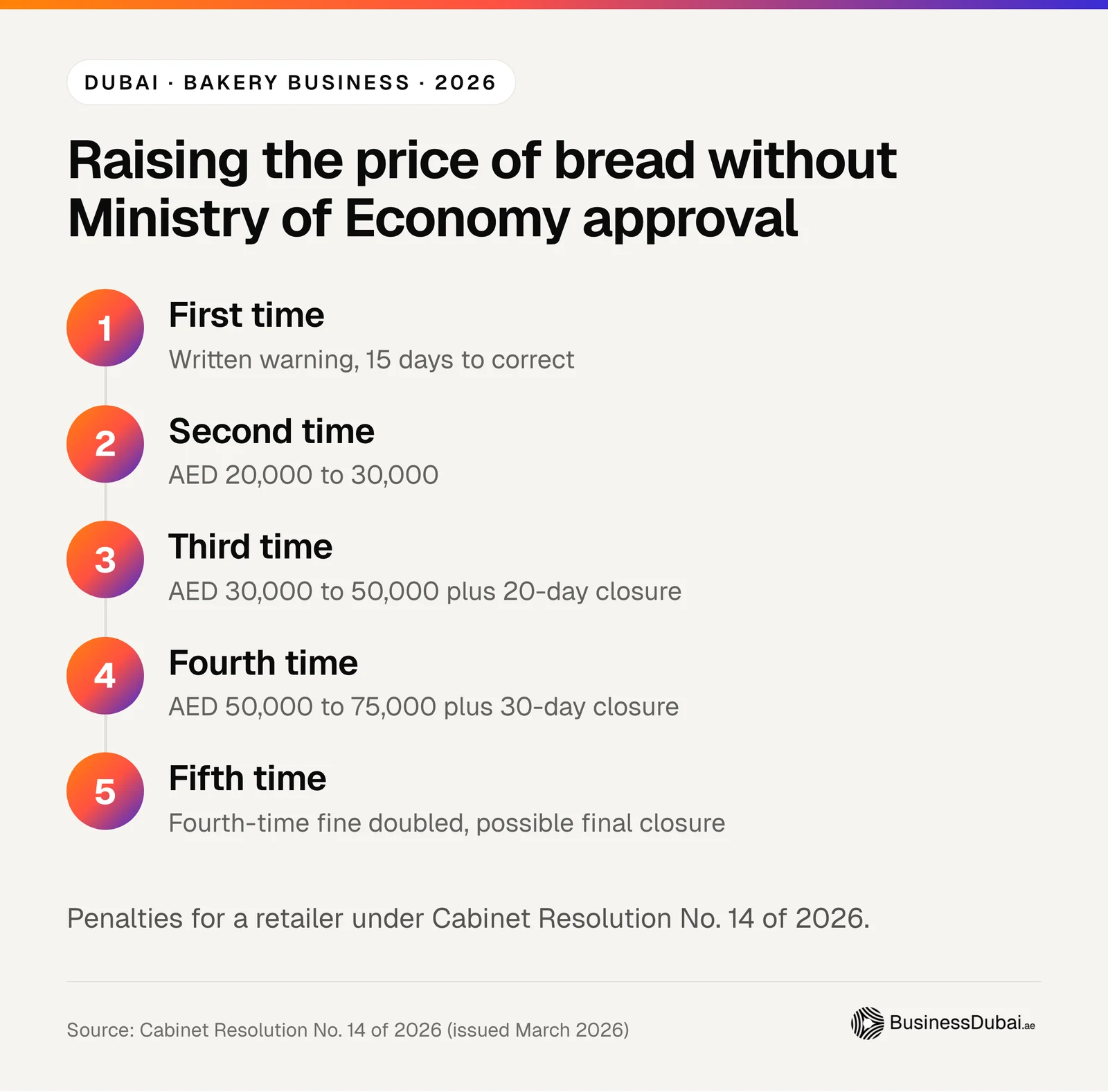
Cabinet Resolution No. 14 of 2026, issued in March 2026 and published in Arabic by Dubai Municipality, sets the penalties under Resolution No. 120. Two rows matter most to a bakery: a retailer raising a basic good's price without the Ministry's prior approval, and a retailer charging more than the approved price [2].
| Occurrence | Raising a basic good's price without prior approval | Charging above the price the Ministry approved |
|---|---|---|
| First | Written warning, 15 days to correct | Written warning |
| Second | AED 20,000 to 30,000 | AED 10,000 to 20,000 |
| Third | AED 30,000 to 50,000 plus 20 days' temporary closure | AED 20,000 to 35,000 plus 20 days' closure |
| Fourth | AED 50,000 to 75,000 plus 30 days' closure | AED 35,000 to 50,000 plus 30 days' closure |
| Fifth and later | Fourth-time fine doubled; final closure possible | Fourth-time fine doubled; final closure possible |
From the fifth repeat, the resolution doubles the fourth-time fine and allows the Ministry or the competent authority to order final closure [2]. On the first ladder, that puts a fifth offence at AED 100,000 to 150,000. A business that disagrees with a penalty can file a grievance within 30 days of being notified [2].
The escalation from a warning to a 30-day shutdown is shown below [2].
Which bakery products count as bread?
The Ministry's list names bread "along with related subcategories" [1], and the sources behind this guide do not say whether cakes, croissants, buns or other lines fall inside them. Before you reprice anything bread-like, ask the Ministry of Economy in writing. A bakery selling bread over its own counter is selling at retail, so treat the retailer rows above as yours.
Real Talk: A rise in flour, butter or rent does not, by itself, entitle you to raise the price of bread. The Ministry's wording is that the nine goods' prices cannot be increased without its prior approval [1], so a cost increase is a reason to apply, not a reason to reprice. Build the business plan on the assumption that your bread price is sticky, and put the margin into lines you have confirmed with the Ministry sit outside the controlled list. The first offence costs a warning; the second costs AED 20,000 to 30,000 [2].
What are the new salt, sugar and fat limits for bread?
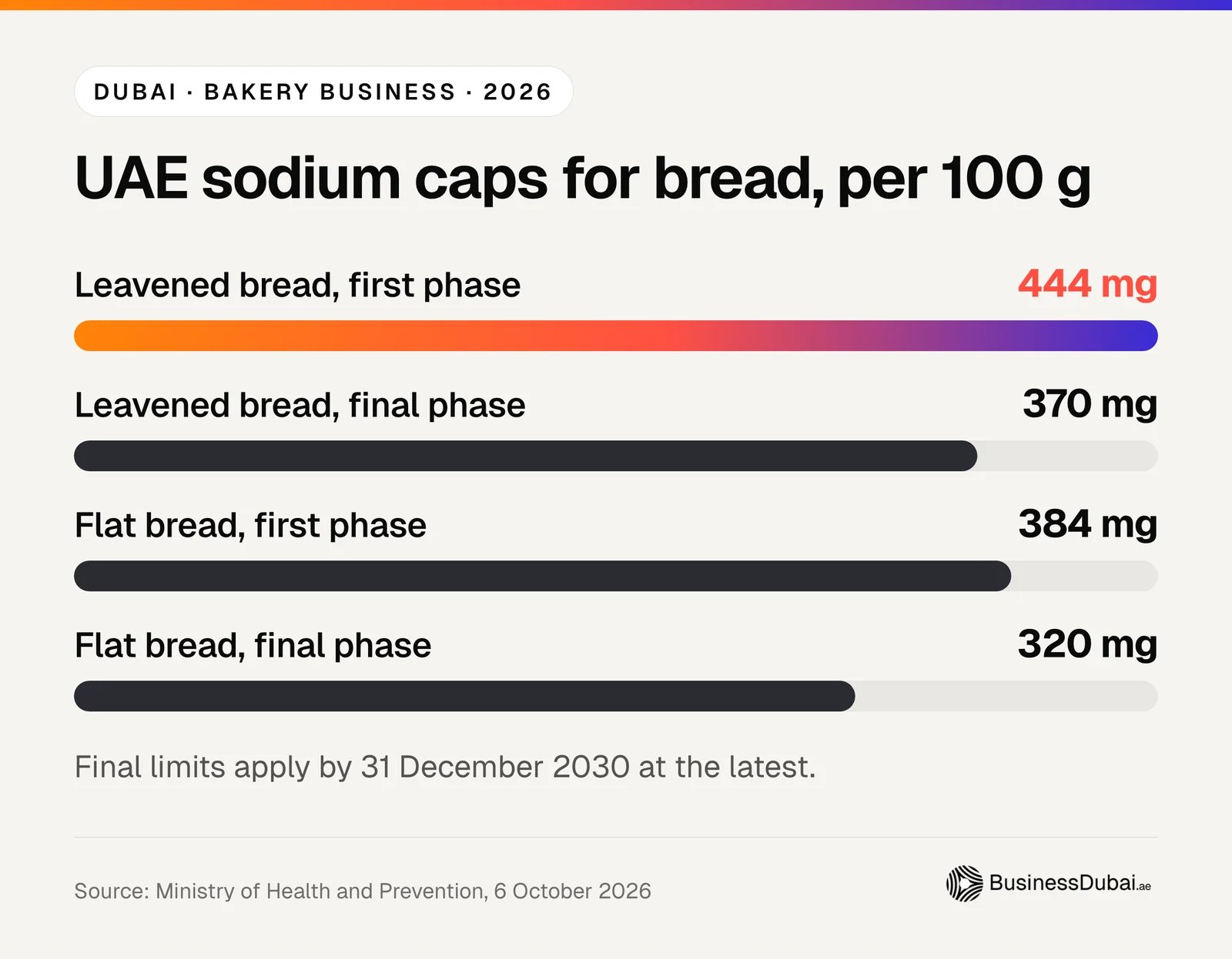
A national resolution that MoHAP began implementing in October 2026 caps leavened bread at 444 mg sodium, 6 g total sugars and 8.4 g total fat per 100 g in the first phase, and flat bread at 384 mg sodium, 6 g sugars and 8.4 g fat. Final limits apply by 31 December 2030.
The Ministry of Health and Prevention (MoHAP) announced on 6 October 2026 that it had started implementing a resolution setting caps on sodium, sugar and fat in selected food products, with bread in the first group [3]. The table shows the bread limits per 100 g [3].
| Bread type, per 100 g | Phase | Sodium | Total sugars | Total fat |
|---|---|---|---|---|
| Leavened bread | First phase | 444 mg | 6 g | 8.4 g |
| Leavened bread | Final phase, by 31 December 2030 | 370 mg | 5 g | 7 g |
| Flat bread | First phase | 384 mg | 6 g | 8.4 g |
| Flat bread | Final phase, by 31 December 2030 | 320 mg | 5 g | 7 g |
For first-group products, which include bread, establishments must meet the first-phase limits within nine months of the resolution taking effect, then keep reducing to reach the final limits by 31 December 2030 at the latest [3]. Both final sodium figures sit about 17% below the first-phase figures: 74 mg less for leavened bread and 64 mg less for flat bread.
The sodium path for each bread type is set out below [3].
Who the limits apply to
MoHAP's release defines the scope: "The resolution applies to packaged foods, whether locally manufactured or imported, that fall within its categories, and to food establishments operating in the UAE handling these products, including free zones companies." [3] Handling covers every stage from production and preparation to packaging, storage, display and sale. Products made or imported for direct export are outside the resolution unless they are traded inside the UAE.
Whether bread baked and sold unpackaged over the counter is covered is not stated in the published release. A bakery that bags bread for supermarkets, hotels or other shops is plainly in scope. A counter bakery should ask MoHAP before assuming it is outside, and reformulating anyway is the safer plan when the same dough ends up in both a bag and a basket.
Penalties, existing stock and the exception
The penalties depend on how serious and how frequent the breach is. They include a warning, an administrative fine of AED 5,000 to 500,000, closure of the establishment for up to six months (renewable), or cancellation of its licence or approval [3]. Stock made or imported before the resolution takes effect may stay on sale for up to one year from that date or until it expires, whichever comes first [3].
Pro Tip: Reformulate in steps rather than in one jump. Get an accredited laboratory reading of sodium, sugars and fat per 100 g for every bread you bag today, cut salt gradually batch by batch toward the first-phase figure, and retest. If a product would need a cut of more than 20%, the resolution lets you apply to MoHAP for an exception within 30 days of it taking effect, with technical data, registered label data and accredited test results, provided you commit to a cut of at least 20% within the first phase [3].
The exception is narrow. It does not exempt the product from the limits and does not move the 31 December 2030 deadline [3].
Trans fat and partially hydrogenated oils
Laminated doughs and many cakes depend on margarines and shortenings, so the trans fat rule matters. GCC technical regulation GSO 2483/2015, approved on 5 November 2015, caps trans fat at 2% of total fat in vegetable oils and soft spreadable margarines, and states that "the trans fat content for all other foods is 5% of the total fat content including ingredients sold to restaurants" [9].
The National Healthy Nutrition Strategy 2031, approved by the Cabinet, goes further with "a full ban on partially hydrogenated oils" [10]. No deadline for the ban appears in the sources behind this guide, so ask your fat and margarine suppliers for written PHO-free specifications now.
Is flour fortification mandatory?
No. The Food Fortification Initiative lists UAE wheat flour fortification as voluntary and notes that "Qatar and the United Arab Emirates fortify more than half of their industrially milled wheat flour even though it is not mandatory" [11]. Fortified flour is the mill's choice, not a bakery duty, so do not describe it as a legal requirement on a label or menu.
What do ovens and gas mean for a Dubai bakery?
Gas is the fit-out question to settle before any oven is ordered. Dubai Municipality's LPG cylinder guideline (DM-HSD-GU53, version 5.0, issued 30 April 2024) puts bulk storage and manifold or piping systems under Dubai Civil Defence and allows cylinder storage only with a valid approval from the concerned Dubai authorities.
The guideline covers every establishment that stores, uses or supplies LPG cylinders in Dubai, and points to Dubai Civil Defense for "bulk storage, manifold/piping systems, residential use" [12]. On storage it says: "Storage of LPG cylinders is only allowed to establishments/facilities having valid approval/permit from concerned Dubai government authorities" [12]. It also states: "Commercial establishments such as supermarkets and groceries; and residential areas are not allowed to store LPG filled cylinders." [12]
Dubai Municipality's kitchen safety guideline, DM-HSD-GU46 version 3 of 9 May 2024, adds a fitting rule for kitchens fed from an LPG tank or a battery of cylinders through a manifold: in addition to the appliance taps, "install a gas shut off valve in the kitchen to shut off the gas supply to all the appliances in an emergency" [13].
In practice: ask the landlord in writing whether the unit has a central gas supply and what it is approved for, use a Civil Defence-approved contractor for any gas installation, and confirm the position before you order gas deck ovens or a gas-fired tannour. Electric ovens avoid the question but load the unit's power supply, which the landlord should also confirm. This matters most for a traditional bread bakery on the Baker code, whose Arabic description refers to tannour ovens [4].
Common Mistake: Ordering gas deck ovens or a gas tannour before confirming the unit's gas supply. If the building has no approved supply for your unit, cylinder storage needs an approval from the concerned Dubai authorities [12], and a manifold or piping system falls under Dubai Civil Defence. Equipment bought on the assumption of gas can then sit idle while the supply is approved, or be swapped for electric models at your cost. A written answer from the landlord costs nothing; get it before the purchase order.
Should a bakery set up on the mainland or in a free zone?
A retail bakery that sells to the public in Dubai needs a Dubai mainland licence; BusinessDubai.ae's mainland package is AED 18,200 in year one without a visa and AED 26,900 with one. A free zone fits a central bakery selling to businesses, from AED 12,500 at Meydan Free Zone or Dubai South, licence only.
The customer mostly makes the decision. A shop selling bread and cakes over the counter in Dubai is a mainland business. A central bakery selling only to cafés, hotels and supermarkets has a choice, and corporate tax points the same way: sales to individual consumers are non-qualifying income for a Qualifying Free Zone Person [14]. The table compares the two routes for a bakery.
| Factor | Free zone | Mainland |
|---|---|---|
| Selling over the counter to the public in Dubai | Not the route for a Dubai retail shop | Yes, with the matching DET code |
| Supplying cafés, hotels and supermarkets | Suits a central bakery selling business to business | Yes |
| Company formation with one visa | AED 21,850 (Meydan Free Zone, Dubai South); IFZA AED 22,200 | AED 26,900 |
| Year-two renewal | About 80% of year one; ask the zone for its standard renewal price | About AED 15,000 |
| Corporate tax on consumer sales | Non-qualifying income for a Qualifying Free Zone Person | 0% up to AED 375,000 of taxable income, 9% above |
| Sodium, sugar and fat caps | Apply, including to free zone companies | Apply |
The route changes your cost, your visa quota and who you may sell to. Our mainland company setup page itemises the Dubai licence a retail bakery needs, and our free zone company setup page compares the zones a central bakery can use, including the year-two renewal the headline price leaves out.
Where to base a central bakery
A central bakery that never sells to the public in Dubai can look beyond Dubai's own zones. The table lists BusinessDubai.ae's standard packages, which cover company formation only; rent, fit-out, ovens and food approvals are separate in every case.
| Base | Licence only (AED) | One visa (AED) | Two visas (AED) | Emirate |
|---|---|---|---|---|
| Dubai mainland | 18,200 | 26,900 | Quote on request | Dubai |
| Meydan Free Zone | 12,500 | 21,850 | 28,400 | Dubai |
| Dubai South | 12,500 | 21,850 | 28,400 | Dubai |
| IFZA (partner price) | 12,900 | 22,200 | Not quoted | Dubai |
| Ajman Free Zone | 5,555 | 13,931 | 17,971 | Ajman |
| RAKEZ | 6,010 | 12,810 | 18,810 | Ras Al Khaimah |
| SPC Free Zone | 5,765 | 15,055 | 19,505 | Sharjah |
Check with the zone that it licenses bakery production and has units that can take ovens before you choose on price. BusinessDubai.ae has no JAFZA or Dubai Industrial City package, so a founder set on those locations should approach the zone directly.
If the bakery supplies the northern emirates or does not need a Dubai address, Sharjah and Ajman are cheaper. Our business setup in Sharjah page covers SPC Free Zone, and our business setup in Ajman page shows what the Ajman Free Zone package includes. Food approvals there run through those emirates' own municipalities, so confirm the food rules before you sign.
Quick Math: A central bakery needing two visas pays AED 28,400 for company formation at Meydan Free Zone or Dubai South, against AED 17,971 at Ajman Free Zone. The difference is AED 10,429 in year one. That is real money, but it is company formation only: delivery distance to your customers, rent and the cost of a second set of municipal food approvals can outweigh it, so price the full year, not the licence.
How is a bakery taxed in the UAE?
A mainland bakery pays UAE corporate tax at 0% on taxable income up to AED 375,000 and 9% above it, and can elect Small Business Relief if revenue is at or under AED 3,000,000, for tax periods ending by 31 December 2029. Bread, cakes and other food are standard-rated for VAT at 5%.
Corporate tax runs under Federal Decree-Law No. 47 of 2022 [15]. Small Business Relief, under Ministerial Decision No. 73 of 2023 as amended by Ministerial Decision No. 131 of 2026, lets a business with revenue at or under AED 3,000,000 be treated as having no taxable income for tax periods ending on or before 31 December 2029 [15]. The revenue test applies to the period and each earlier period. Our Small Business Relief guide explains the conditions and the election.
Quick Math: A mainland bakery with AED 900,000 of taxable profit pays nothing on the first AED 375,000. The remaining AED 525,000 is taxed at 9%, which is AED 47,250 for the year [15], an effective rate of about 5.3% on the full AED 900,000.
Quick Math: A home-grown bakery with AED 2,400,000 of revenue is under the AED 3,000,000 Small Business Relief threshold. If revenue in that period and every earlier period stayed at or under the threshold, it can elect the relief for tax periods ending by 31 December 2029 and be treated as having no taxable income [15]. Once revenue passes AED 3,000,000, ordinary rates apply.
Why a free zone rarely helps a retail bakery's tax
A Qualifying Free Zone Person pays 0% only on qualifying income. Sales to individual consumers are non-qualifying, and if non-qualifying income goes over the de minimis limit (the lower of 5% of revenue or AED 5,000,000), the company is taxed at the ordinary rates for that period and cannot return to the regime for the next four periods [14]. This mostly matters to a central bakery choosing between business and consumer customers. Our Qualifying Free Zone Person guide sets out the full test.
VAT on bread and cakes
Food is standard-rated for VAT at 5% in the UAE [16]. Registration is mandatory once taxable supplies pass AED 375,000 a year and voluntary from AED 187,500 [16], so set the till system up for VAT from opening. Our VAT registration and compliance guide covers returns and penalties.
What does it cost to open a bakery in Dubai?
The one published, fixed cost in opening a Dubai bakery is company formation: BusinessDubai.ae's Dubai mainland package is AED 18,200 in year one without a visa, AED 26,900 with one visa and about AED 15,000 on renewal. Dubai Municipality approvals, fit-out, ovens, rent and Person in Charge certification are priced separately by quote.
The table itemises what a bakery pays for, with the figures that are published and the lines that need a quote [7][17].
| Cost item | Amount (AED) | Notes |
|---|---|---|
| Dubai mainland company formation, no visa | 18,200 | Year one, BusinessDubai.ae standard package; company formation only |
| Dubai mainland company formation, one visa | 26,900 | Year one, includes one visa |
| Mainland renewal, year two | About 15,000 | Standard package renewal |
| Dubai Municipality food establishment approvals | Dubai Municipality quote | No current fee for these appears in the sources behind this guide |
| Dubai Municipality Trader (Licensed Home Businesses) permit | 200 | Licensed home businesses only; 2020 document |
| Shop or unit rent | Landlord quote | Check the food area meets the code's minimum first |
| Fit-out | Contractor quote | Only after Dubai Municipality has seen the unit |
| Ovens, mixers, proofers, display | Supplier quote | Confirm gas or electric before ordering |
| Gas installation and shut-off valve | Civil Defence-approved contractor quote | Only if the unit uses gas |
| Person in Charge certification | Training provider quote | At least one full-time certified PIC |
| Food handler training | Approved trainer quote | Every food handler |
| Shelf-life validation and sodium testing | Accredited laboratory quote | Packaged lines only |
Only the company formation lines are fixed. Everything else depends on your unit, menu and suppliers, which is why this guide gives no all-in total.
Real Talk: All-in bakery budgets quoted online come with wide ranges, and none comes from a government fee schedule. The lines that move them most, rent, fit-out and ovens, depend on your unit and menu, not on the licence. Build your own: Dubai Municipality's view of the unit, the landlord's rent, two fit-out quotes and two oven quotes, plus the AED 18,200 or AED 26,900 formation figure. That gives you a budget you can defend to a partner or a bank.
After opening come licence and visa renewals, PIC replacement deadlines, VAT returns and the corporate tax return. Our post-setup services team runs that calendar so none of it lands on a busy baking week. For a quote built around your bakery model, unit and visa count, get an itemised bakery setup quote→
In what order should you set up a bakery in Dubai?
The safe order for a Dubai bakery is codes first, unit second, money third: settle the DET code mix and the Dubai Municipality minimum area, put the unit to Dubai Municipality before committing to fit-out, then fit out, install ovens and gas with Civil Defence sign-off, certify a Person in Charge, train staff and open.
- Write down what you will bake and who will buy it. That decides the code mix.
- Confirm the codes with DET and the minimum food area with Dubai Municipality [4][5], asking about the combination for a bakery-café.
- Choose mainland or free zone and form the company.
- Find a unit that meets the minimum area and ask the landlord about gas, agreeing terms subject to the approvals if you can.
- Submit the unit for Dubai Municipality pre-approval, with building licensing, planning, drainage and Civil Defence where they apply [5].
- Fit out and install equipment, with gas work by a Civil Defence-approved contractor and a kitchen shut-off valve where LPG comes through a manifold [13].
- Certify a Person in Charge, train every food handler and register on FoodWatch [6][7].
- For packaged lines, validate shelf life before label approval and test bagged bread against the caps [3][6].
- Check the Ministry of Economy list before setting bread prices, and apply before any later increase [1].
None of the sources behind this guide publishes a timeline for the Dubai Municipality steps, so plan the lease around the approvals, not the other way round. Step 5 sets the pace, because fit-out cannot sensibly start until it is done.
Which route fits your bakery?
The right Dubai bakery route depends on what you bake and who buys it: a bread or cake shop selling to the public goes mainland on a Professional code such as 4781003 or 5630007, a central bakery supplying businesses can use a free zone or the Industrial code 1071001, and an Emirati home baker can start on Intelaq.
The table matches six common bakery founders to a licence, a jurisdiction and the rules that will bite first [3][4][5][8][17].
| Profile | Activity and code | Jurisdiction | Rules that bite first | Start with |
|---|---|---|---|---|
| Arabic bread bakery | Baker, 4781003 | Dubai mainland | 200 sq ft minimum; bread price control; oven gas | Mainland, AED 26,900 with one visa |
| Cake and dessert shop | Sweets & Candies Preparing, 5630007 | Dubai mainland | 250 sq ft minimum; shelf-life approval for packed cakes | Mainland, AED 18,200 without a visa |
| French-style bakery-café | A combination settled at licensing, such as Pastry Preparing plus a food-service code | Dubai mainland | Codes and area confirmed before the lease; PHO-free fats | Mainland package |
| Central bakery supplying cafés and supermarkets | Bakery Products Manufacturing, 1071001 | Free zone or mainland industrial unit | Sodium caps on packaged bread; shelf-life and label approval | Free zone from AED 12,500 licence only |
| Emirati home baker | Intelaq home-based licence | Dubai, home-based | Kitchen with an outside entrance; DM permit of AED 200; conversion after five years | Confirm current terms with DET |
| Expat baker selling online | The matching code in a licensed kitchen | Dubai mainland | No published home route; e-Trader generally excludes food | Mainland package and a licensed kitchen |
Two profiles change as the business grows: an Intelaq home baker converts to a commercial licence after five years [8], and a bakery-café that starts bagging bread for other outlets takes on shelf-life approval and the sodium caps. If you are not sure which row you are in, check which bakery route fits you→
Real Client Stories
These are composite examples built from the situations bakery founders most often face in Dubai. Names and details are illustrative, and the only figures used are published government fees and limits and BusinessDubai.ae's package prices.
The bakery-café that signed before it chose its codes
A pastry chef planned a Dubai bakery-café selling croissants, cakes and coffee, and signed the lease on a small unit before settling her activity codes. At licensing, the combination she needed became clear: pastries baked on site, cakes and a drinks counter. Sweets & Candies Preparing alone carries a 250 sq ft minimum food area in Dubai Municipality's 2020 table, and her food area could not hold the full combination. She opened with a reduced menu and moved cake production elsewhere. Her company formation, AED 26,900 with one visa on BusinessDubai.ae's mainland package, was the simplest part. Lesson: settle the code mix and the minimum area before you sign a lease.
The Emirati home baker who needed a second door
An Emirati founder baking traditional sweets and pastries at home applied for an Intelaq licence, which Dubai reserves for home businesses 100% owned by UAE or GCC nationals. She expected to use her family kitchen. The published conditions say food preparation under Intelaq needs a designated kitchen outside the home with an entrance from outside, so she fitted out a separate room with its own outside door before starting. To supply orders as a licensed home business, she then applied for Dubai Municipality's Trader (Licensed Home Businesses) permit: AED 200, one working day and valid for a year in the 2020 schedule. Lesson: read the kitchen condition before you plan the menu.
The khubz bakery that repriced without asking
An Arabic bread bakery in a residential neighbourhood saw its flour and rent costs rise and added a small amount to the price of khubz at the counter. An inspection followed. Bread is one of the nine goods whose prices cannot be increased without the Ministry of Economy's prior approval, and under Cabinet Resolution No. 14 of 2026 a first offence by a retailer brings a written warning with 15 days to correct. The bakery restored the old price within the window. A second offence would have meant a fine of AED 20,000 to 30,000. Lesson: apply to the Ministry before repricing bread, not after.
Start your bakery the right way
A Dubai bakery stands or falls on three early decisions. The first is the code, which decides your licence class and minimum food area. The second is the product rules: if you sell bread, its price is controlled and its salt is capped, so plan margins and recipes around both from day one. The third is the unit: a shop too small for its codes, or without an approved gas supply for the ovens you ordered, costs more to fix than to choose correctly.
BusinessDubai.ae has completed 700+ company registrations across the UAE, with itemised pricing and no hidden fees. We will price a mainland company setup for a bakery serving the public against a free zone company setup for a central bakery, on the points that differ for bread: who you can sell to, how the revenue is taxed and what renews in year two. Once you are trading, our post-setup services team keeps the visa, renewal and tax calendar running while you bake. Talk to a bakery setup expert→
If your plan is closer to a factory than a shop, start with our food processing factory guide instead.
Frequently Asked Questions
How much does it cost to open a bakery in Dubai?
Company formation for a Dubai mainland bakery costs AED 18,200 in year one without a visa and AED 26,900 with one visa on BusinessDubai.ae's 2026 standard package, and about AED 15,000 on renewal. Rent, fit-out, ovens, Dubai Municipality approvals and staff certification are separate and priced by quote for your unit and menu.
What licence do I need to open a bakery in Dubai?
A Dubai bakery needs a trade licence carrying the activity code that matches what it makes and sells, plus Dubai Municipality food approval of the premises. A bread bakery uses Baker (4781003), a cake shop Sweets & Candies Preparing (5630007), a resale counter Bread & Bakery Products Trading (4721013) and a production bakery Bakery Products Manufacturing (1071001).
What is the difference between a bakery and a cake shop licence in Dubai?
A traditional bread bakery uses Baker (4781003), with a 200 sq ft minimum food area in Dubai Municipality's 2020 table, while a cake and dessert shop uses Sweets & Candies Preparing (5630007), with a 250 sq ft minimum. Both are Professional licences.
Can I sell bread in Dubai without an oven?
Yes. Bread & Bakery Products Trading (4721013) is a Commercial licence for reselling fresh, frozen or dry bakery products, listed by Dubai Municipality in 2020 as an instant licence with the area depending on the process. The premises still need Dubai Municipality pre-approval.
What is the minimum shop size for a bakery in Dubai?
Dubai Municipality's 2020 activity table sets a minimum food area of 200 sq ft for Baker (bread only) and 250 sq ft for Sweets & Candies Preparing. Additional area may be required for equipment, storage and output. Confirm the current figure with Dubai Municipality, because the table dates from April 2020.
Does a Dubai bakery need a Person in Charge?
Yes. The Dubai Food Code requires every food establishment, bakeries included, to employ at least one full-time, on-site Person in Charge certified in food safety. The certificate lasts five years, and if the PIC leaves you have 30 days to designate a replacement, who should be certified within 45 days.
Do bakery staff need food safety training in Dubai?
Yes. The Dubai Food Code states that all food handlers must be formally trained on food safety, by a trainer the department approves. That covers bakers, pastry and counter staff, not only the head baker.
Can I start a home bakery in Dubai?
Only UAE and GCC nationals have a published route. Dubai's Intelaq licence covers home-based businesses 100% owned by UAE or GCC nationals, and food preparation under it needs a designated kitchen outside the home with an entrance from outside. Confirm current Intelaq fees and terms with DET before applying.
Can an expat get a home baking licence in Dubai?
We found no published Dubai route for a non-GCC resident to sell home-baked food, because Intelaq is limited to UAE and GCC nationals. The practical route is a trade licence with the matching code and a licensed kitchen, shared or your own.
Can I sell homemade cakes on Instagram or with an e-Trader licence in Dubai?
Instagram is a sales channel, not a licence, and our e-Trader licence guide says food is generally not allowed on e-Trader, with any exception decided case by case by DET. The cakes still have to come from a licensed kitchen under the matching code, or from an Intelaq kitchen if you are a UAE or GCC national.
What is the Dubai Municipality permit for licensed home businesses?
It is the Trader (Licensed Home Businesses) permit, for owners of licensed home-based businesses in Dubai that prepare sweets, light or traditional foods. In Dubai Municipality's 2020 document it costs AED 200, is issued in one working day and is valid for one year. FoodWatch registration and an inspection report are required.
What happens to an Intelaq food licence after five years?
Food activities under Intelaq are allowed for five years, provided the licence is renewed every year. At the end of the fifth year, the Intelaq licence must be converted into a commercial licence, according to Dubai's 2020 announcement. Plan the move to a licensed commercial kitchen before year five.
Can a bakery in the UAE raise the price of bread?
Only with the Ministry of Economy's prior approval. Bread is one of nine essential consumer products, with related subcategories, whose prices cannot be increased without it under Cabinet Resolution No. 120 of 2022. The others are cooking oil, eggs, dairy products, rice, sugar, poultry, legumes and wheat.
What is the fine for raising bread prices without approval in the UAE?
Under Cabinet Resolution No. 14 of 2026, a retailer that raises a basic good's price without approval gets a written warning with 15 days to correct, then a fine of AED 20,000 to 30,000, then AED 30,000 to 50,000 with a 20-day closure, then AED 50,000 to 75,000 with a 30-day closure. From the fifth time the fine doubles and final closure is possible.
Are cakes and croissants covered by UAE bread price control?
It is not clear. The Ministry of Economy's list covers bread "along with related subcategories", and the published sources do not say which bakery products those include. Ask the Ministry in writing before you reprice cakes, croissants or any bread-like product.
What are the UAE salt limits for bread?
From the MoHAP resolution announced in October 2026, leavened bread may contain at most 444 mg of sodium per 100 g in the first phase and 370 mg in the final phase. Flat bread is capped at 384 mg, then 320 mg. Sugars and fat are capped too, at 6 g and 8.4 g, then 5 g and 7 g.
Do the new sodium limits apply to fresh bread sold over the counter?
The published MoHAP release says the resolution applies to packaged foods within its categories and to the food establishments handling them, including free zone companies. It does not say whether unpackaged bread baked and sold over the counter is covered. Bagged bread sold through shops is plainly in scope; ask MoHAP about counter bread.
When do bakeries have to meet the new UAE sodium limits?
Bread is in the first group, so bakeries must meet the first-phase limits within nine months of the resolution taking effect and the final limits by 31 December 2030 at the latest. Existing stock may stay on sale for up to one year from the effective date or until it expires, whichever is sooner.
What is the penalty for breaking the UAE sodium, sugar and fat limits?
Penalties under the MoHAP resolution include a warning, a fine of AED 5,000 to 500,000, closure of the establishment for up to six months (renewable), or cancellation of its licence or approval. The penalty depends on how serious the breach is and how often it recurs.
Are trans fats banned in UAE bakery products?
Trans fat is capped: GSO 2483/2015 limits it to 2% of total fat in vegetable oils and soft spreadable margarines and 5% in all other foods. The National Healthy Nutrition Strategy 2031 adds a full ban on partially hydrogenated oils, with no published deadline, so ask suppliers for PHO-free specifications.
Is flour fortification mandatory in the UAE?
No. The Food Fortification Initiative lists wheat flour fortification in the UAE as voluntary, while noting that the UAE fortifies more than half of its industrially milled wheat flour. A bakery is not required to use fortified flour.
Can a Dubai bakery use LPG gas cylinders?
Only with approval. Dubai Municipality's LPG guideline (version 5.0, April 2024) allows cylinder storage only with a valid approval from the concerned Dubai authorities and puts manifold or piping systems under Dubai Civil Defence. Check the unit's gas supply before ordering gas ovens.
What corporate tax does a bakery pay in the UAE?
A mainland bakery pays 0% on taxable income up to AED 375,000 and 9% above it, so AED 900,000 of taxable profit means AED 47,250 of tax. A bakery with revenue at or under AED 3,000,000 can elect Small Business Relief for tax periods ending by 31 December 2029.
Is VAT charged on bread and cakes in the UAE?
Yes. Food is standard-rated for VAT at 5% in the UAE. A bakery must register for VAT once taxable supplies pass AED 375,000 a year and may register voluntarily from AED 187,500.
Does a bakery need halal certification in Dubai?
A halal certificate depends on the products you sell and the claims you make, which our halal certification guide covers. Separately, the Dubai Food Code requires a prior permit from the Food Control Department to process or sell any non-halal product, and non-halal food must be cooked in designated ovens.
Does packaged bread need an expiry date in Dubai?
Same-day bakery products are exempt from the mandatory expiry date under UAE.S 150-1, but longer-life packed products need dates. Under the Dubai Food Code, bakeries that distribute pre-packaged high-risk or perishable foods must validate shelf life and obtain shelf-life approval before label approval.
References
[1] Ministry of Economy. "Ministry of Economy launches national platform for monitoring prices of essential commodities to enhance government oversight of markets and real-time price tracking" (20 February 2025): the nine essential consumer products, including bread, whose prices cannot be increased without prior approval from the Ministry, and Cabinet Resolution No. 120 of 2022 on consumer goods pricing rules and controls. moet.gov.ae
[2] UAE Cabinet. Cabinet Resolution No. 14 of 2026 on violations and administrative penalties under Cabinet Resolution No. 120 of 2022 (Arabic text, issued March 2026, published by Dubai Municipality): the penalty table for retailers raising a basic consumer good's price without prior approval and for charging above the approved price, Article 3(3) on the fifth repeat and Article 4(2) on grievances. Cabinet Resolution No. 14 of 2026 (Arabic PDF)
[3] Ministry of Health and Prevention. "MoHAP starts implementing a resolution setting caps on levels of sodium, sugar and fats in selected food products" (press release, October 2026), with Khaleej Times, "UAE sets new sodium, sugar and fat limits; violators face fines up to Dh500,000" (6 October 2026): bread limits per 100 g, phases, scope, penalties, existing stock and the exception route. zawya.com and khaleejtimes.com
[4] Dubai Department of Economy and Tourism. Business activity list as recorded in the Invest Dubai register: codes, names, descriptions and licence classes for Baker (4781003), Pastry Preparing (5621004), Sweets & Candies Preparing (5630007), Local Sweets Preparing (5621007), Cafeteria (5610003), Bread & Bakery Products Trading (4721013), Pastry Trading (4721015), Bakery Products Manufacturing (1071001) and Pastry & Sweets Manufacturing (1071002). Invest Dubai business activity search
[5] Dubai Municipality, Food Safety Department. "Food Establishment Requirements Based on Activity" (last update April 2020): minimum food areas, instant licence status and pre-approving authorities by activity code. Dubai Municipality requirements table
[6] Dubai Municipality, Food Safety Department. Food Code (2013 edition, as published by Dubai Municipality): Section 3.1.1 on the Person in Charge, Section 3.1.3 on shelf-life approval for bakeries, Section 6 on food handler training, and Sections 8.7.1 and 8.7.3 on non-halal food. Dubai Municipality Food Code
[7] Dubai Municipality, Food Safety Department. Food Related Permits and Approvals Services (2020): item 12, Trader (Licensed Home Businesses), with its requirements, fee of AED 200, one working day and one-year validity, and FoodWatch registration across permit services. Dubai Municipality permits document
[8] Government of Dubai Media Office. "Dubai SME adds foodstuff to 'Intelaq' licence and allows issuance of Establishment Cards" (17 August 2020): eligibility, the seven food preparation and 19 food trading activities, the outside-entrance kitchen rule, inspections, the five-year limit and conversion, and the establishment card. mediaoffice.ae
[9] GCC Standardization Organization. GSO 2483/2015, Trans Fatty Acids, technical regulation approved 5 November 2015: maximum trans fat of 2% of total fat in vegetable oils and soft spreadable margarines and 5% in all other foods. GSO 2483/2015 text
[10] Khaleej Times. "UAE bans trans fats: How it forces industry to tackle processed foods" (9 April 2026): the full ban on partially hydrogenated oils in the National Healthy Nutrition Strategy 2031. khaleejtimes.com
[11] Food Fortification Initiative. Middle East region profile: the UAE's voluntary legislative status for wheat flour fortification. ffinetwork.org
[12] Dubai Municipality, Health and Safety Department. Technical Guidelines for Liquefied Petroleum Gas Cylinders, DM-HSD-GU53, version 5.0 (issued 30 April 2024): scope, the Dubai Civil Defense remit and cylinder storage rules. Dubai Municipality LPG guideline
[13] Dubai Municipality, Health and Safety Department. Technical Guidelines for Occupational Health and Safety in Kitchens and Food Preparation Areas, DM-HSD-GU46, version 3 (issued 9 May 2024): the kitchen gas shut-off valve where LPG is supplied from a tank or a battery of cylinders through a manifold. Dubai Municipality technical guidelines list
[14] Ministry of Finance. Ministerial Decision No. 229 of 2025 on Qualifying Activities and Excluded Activities, read with Federal Decree-Law No. 47 of 2022, Article 18(2): transactions with natural persons as non-qualifying income, the de minimis limit (lower of 5% of revenue or AED 5,000,000) and loss of status for the following four periods. mof.gov.ae
[15] Federal Tax Authority and Ministry of Finance. Corporate tax under Federal Decree-Law No. 47 of 2022 (0% to AED 375,000, 9% above) and Small Business Relief for revenue at or under AED 3,000,000 for tax periods ending on or before 31 December 2029 (Ministerial Decision No. 73 of 2023 as amended by Ministerial Decision No. 131 of 2026). tax.gov.ae
[16] Federal Tax Authority. VAT under Federal Decree-Law No. 8 of 2017: the 5% standard rate on food and the registration thresholds of AED 375,000 and AED 187,500. tax.gov.ae
[17] BusinessDubai.ae. 2026 standard package pricing: Dubai mainland company formation at AED 18,200 in year one without a visa, AED 26,900 with one visa and about AED 15,000 on renewal; Meydan Free Zone and Dubai South at AED 12,500, 21,850 and 28,400; IFZA partner prices of AED 12,900 and 22,200; Ajman Free Zone at AED 5,555, 13,931 and 17,971; RAKEZ at AED 6,010, 12,810 and 18,810; SPC Free Zone at AED 5,765, 15,055 and 19,505 (licence only, one visa, two visas); company formation only. businessdubai.ae