

Halal certification in the UAE fails far more often on paper than on the product. In the examples table of its open-data presentation, Dubai Municipality's Food Trade Control Section lists 26 items, weighing 23,528 kg, recorded under the contravention "Halal Certificate only copy submitted" [1]. The importer had a certificate. It was a copy, and the port wanted the original.
The other number that surprises traders runs the other way. The Ministry of Industry and Advanced Technology (MoIAT) cut the fee for a licence to use the UAE Halal National Mark from AED 18,000 to AED 2,000 as of 1 January 2023 [2], yet older guides still quote the higher figure, and many still name a regulator that no longer exists.
Since 2013, BusinessDubai.ae has set up food trading, import and processing companies on the Dubai mainland and in the free zones, so this guide is written for the trader who has to get a container released. It covers which products legally need a halal certificate under the Dubai Municipality Food Code, which certifiers MoIAT recognises, how a foreign certificate is checked at the port and why it fails, the National Mark, real costs, and how halal ties into your trade licence and importer registration. It is general information, not legal advice: confirm your position with Dubai Municipality and MoIAT.
Is halal certification mandatory in the UAE?
Halal certification is mandatory in the UAE in two situations: for any product sold, stored or marketed with a halal claim, under Cabinet Decree No. 10 of 2014, and in Dubai for raw meat, poultry, processed meat and foods with animal-origin ingredients such as gelatin, under the Dubai Municipality Food Code. The Halal National Mark itself is optional.
The federal rule: Cabinet Decree No. 10 of 2014
The federal law is Cabinet Decree No. 10 of 2014 on the UAE Regulations for Control on Halal Products [3]. Article 9(4) is the core: "No products marked as consistent with the provisions of Islamic Shari'a or as Halal shall be launched unless they comply with the provisions hereof" [3]. "Launch" covers "Selling, leasing, handling, storing, displaying, marketing, promoting, or serving the product to the consumer" [3], so a warehouse or a website is inside the rule. The decree's "supplier" includes "any legal or commercial agent in charge of importing products" [3]. MoIAT requires them "from Halal Certification Bodies registered by the ministry" [4].
The Dubai rule: Food Code section 7.3
Dubai adds a product list. Raw meat and poultry consignments need halal slaughtering certificates, and "Halal Slaughtering Certificates are valid only if they are issued at the country of origin by an Islamic Society approved by the Government of UAE" [5]. Halal certificates are also required for processed meat and for foods containing meat, poultry or "ingredients of animal origin", with gelatin as the example and seafood excepted [5]. The federal test is triggered by the claim; the Dubai test by the ingredient.
Who regulates now: MoIAT, not ESMA
The 2014 decree names the Emirates Authority for Standardization and Metrology (ESMA) as its "Authority" [3]. ESMA was merged into MoIAT, and "all authorities, responsibilities and duties" passed to the new ministry [19], which was established in July 2020 [4], and Federal Decree-Law No. 20 of 2020 on standardization and metrology followed in September 2020 [6]. UAE.S 993:2022 calls MoIAT "the authority in charge of standardization activities in the Country" [7]. At the border, Dubai Municipality's Food Trade Control Section reads your certificate, with units at Jebel Ali port, Jebel Ali free zone, the airports and Hatta border [1]. Other emirates run their own food control, so the port detail here is Dubai's.
Based on our experience: The ESMA error is the quickest way to spot a stale source. If a supplier's compliance pack names ESMA as the current regulator, check its other claims against MoIAT's register; the fees in it usually date from the same era, including the old AED 18,000 mark fee.
Which products legally need a halal certificate to be imported into Dubai?
In Dubai, a halal certificate is legally required for raw meat and poultry (a halal slaughtering certificate from the country of origin), all processed meat, and foods containing meat, poultry or animal-origin ingredients such as gelatin, with seafood excepted. Other foods need one only if the pack, menu or marketing claims halal.
The table sorts a typical catalogue into the positions the rules create, using Food Code section 7.3 [5], the 2014 decree [3] and Dubai Municipality's import document list [1].
| Product category | Halal certificate at import into Dubai | Rule | What to send |
|---|---|---|---|
| Raw meat and poultry | Legally needed, every consignment | Food Code 7.3(b); UAE.S 993:2022 clause 5-1 | Original halal slaughtering certificate from the country of origin |
| Processed meat: sausages, burgers, nuggets, canned meat | Legally needed | Food Code 7.3(c)(i) | Original halal certificate |
| Foods with gelatin or other animal-origin ingredients: gummies, marshmallows, capsules | Legally needed | Food Code 7.3(c)(ii) | Original halal certificate |
| Cheese and dairy made with animal rennet or enzymes | Ask before shipping | The decree's certificate definition names rennet; Food Code 7.3 does not | Confirm with Dubai Municipality |
| Fish and seafood | Not needed for halal | Excepted in Food Code 7.3(c)(ii) | Health certificate; farmed fish need a pork-free diet certificate |
| Fresh produce, rice, pulses, spices, plant-based foods | Only if you claim halal | Decree Article 9(4) | Health certificate and packing list |
| Any product sold as halal, including supplements and cosmetics | Needed for the claim | Decree Article 9(4) | Certificate from a MoIAT-registered body covering the product |
| Pork and other non-halal food | Needs a permit instead | Food Code 8.7.1(a) | Prior permit and a "Non-Halal" label in Arabic and English |
The rennet row is the grey area: the decree's definition of a halal certificate covers "rennet, and animal gelatin, fat oils and derivatives thereof" [3], but the Food Code list does not mention rennet by name. Ask before the order ships, not at the port.
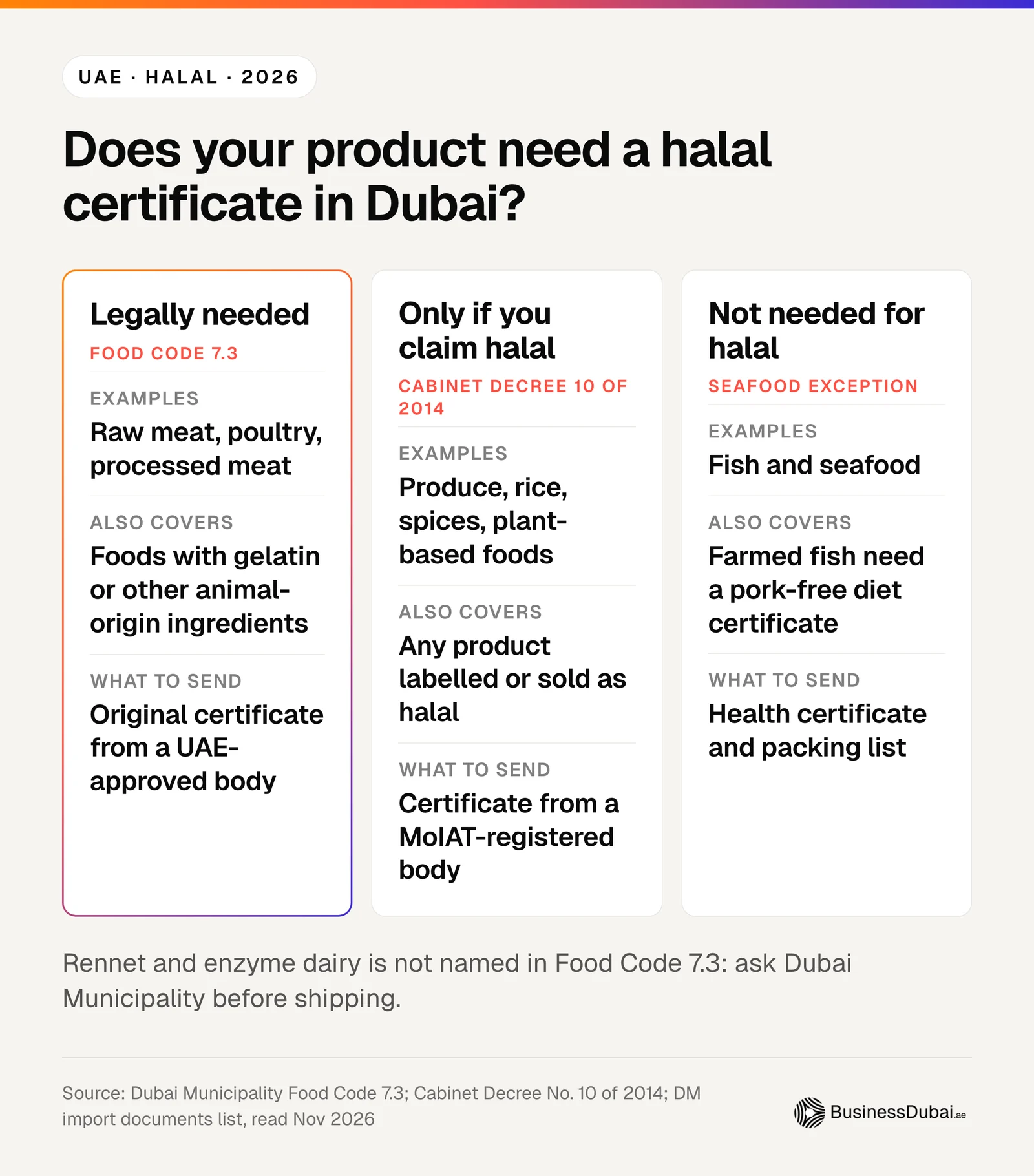
The three positions are summarised in the graphic below.
Common Mistake: Classifying a product by what it looks like rather than by its ingredient list. A fruit gummy, a cream dessert or a soft-gel supplement can all carry animal gelatin, and under Food Code 7.3(c)(ii) that puts the product on the halal certificate list [5]. Get the full ingredient specification, including the source of every gelatin and emulsifier, before you register the item.
For the business side of food importing, our food trading company setup guide covers licensing, FIRS and cold chain.
Is the UAE Halal National Mark mandatory, and how is it different from a halal certificate?
The UAE Halal National Mark is optional, according to MoIAT, and it is not a halal certificate. A certificate comes from a MoIAT-registered certification body and is required for any halal claim. The mark is a separate MoIAT licence to print the national logo, costing AED 2,000 for three years since 1 January 2023, down from AED 18,000.
| Item | Who issues it | Mandatory? | What it proves |
|---|---|---|---|
| Halal certificate | A certification body registered by MoIAT | Yes, for the Food Code list and any halal claim | The product, site or ingredient conforms to the halal standards |
| Halal National Mark licence | MoIAT | No, optional | MoIAT has licensed the national logo for that product or system |
| Halal claim on the label | The brand owner | Optional to make; once made it must comply | Nothing on its own; the certificate has to support it |
MoIAT's wording is the one to rely on: "While the Halal National Mark is optional, qualified local and global products, as well as distinguished services or production systems that wish to emphasize their compliance with the provisions of Islamic Sharia are required to obtain the certification" [4]. The sources do not all agree: a European Commission note from December 2015 told EU exporters that halal products "shall be certified by a body accredited by ESMA" and would bear the mark [3]. That was the plan then. The current regulator calls the mark optional, and a buyer who insists on it is setting a commercial condition, not a legal one. The decree accepts foreign halal marks only within mutual recognition agreements [3]; our guide to food labelling requirements in the UAE covers Arabic labels, claims and FIRS label approval.
What the National Mark costs
MoIAT cut "licensing to use the national Halal mark from AED 18,000 to AED 2,000", and scope expansion from AED 2,500 to AED 250, as of 1 January 2023 [2]. Its current service page lists AED 2,000 for "a three-year license certificate", a conformity certificate fee of AED 670 and the technical assessment at AED 2,500 per day [8]. The fee table is hard to read line by line, so treat AED 2,000 as confirmed by both sources and confirm the assessment days in writing. You need a valid UAE industry or trade licence (or a declaration for factories abroad), an accredited lab test report and a field visit; the service time is 6 working days, and the assessor's travel is on you [8]. The fee cut and its terms are summarised below.
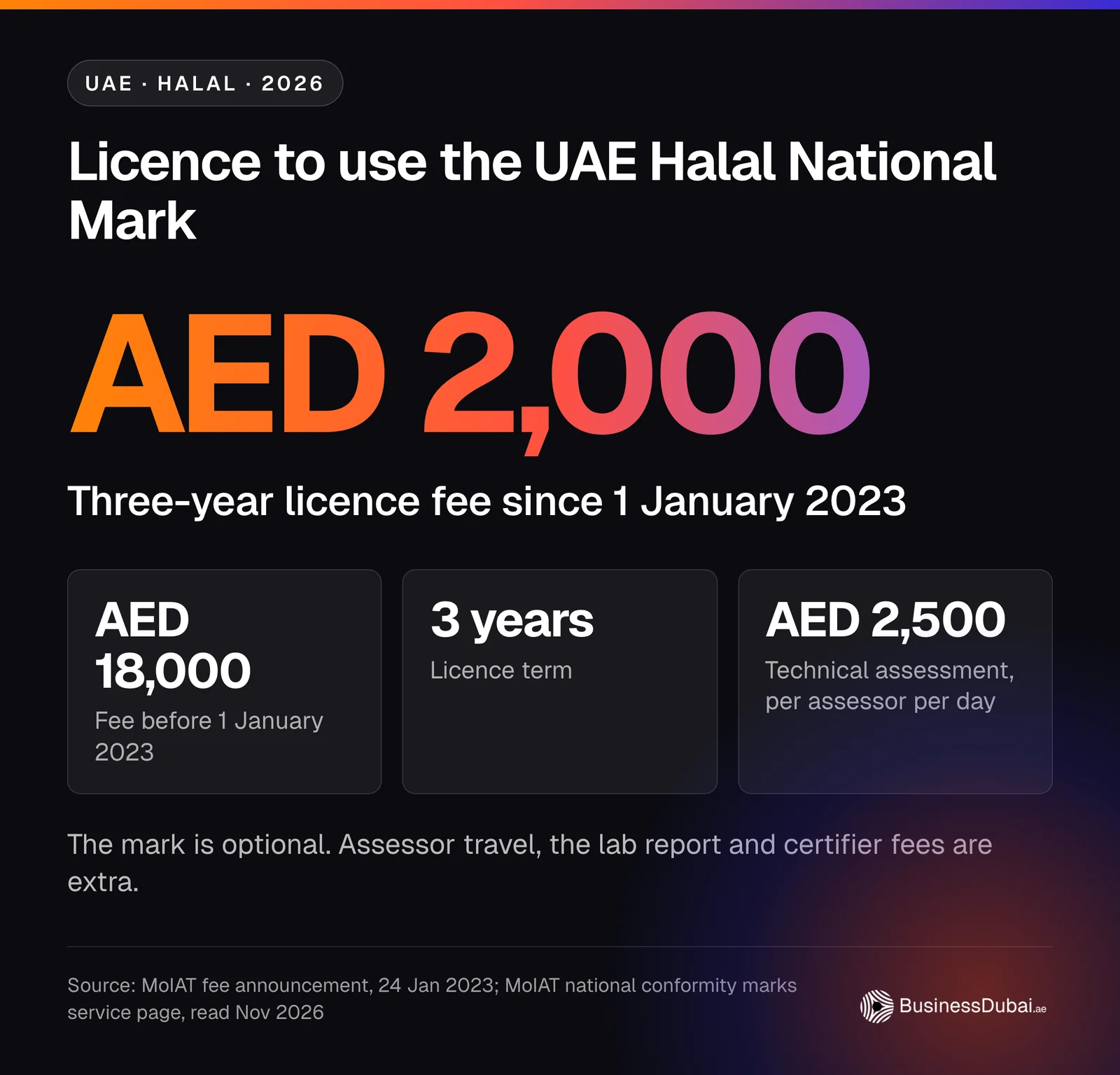
Quick Math: At AED 2,000 for three years, the licence costs about AED 667 a year, against AED 6,000 a year at the old fee [2]. A two-day assessment by one assessor at AED 2,500 a day adds AED 5,000 [8]. The official MoIAT side for one product scope is roughly AED 7,000 in year one, before travel, the lab report and the certifier's own fees.
Real Talk: For a trader importing finished goods, the National Mark rarely holds a container; the supplier's certificate does. MoIAT pitches the mark as helping "ensure the smooth movement of halal food products from abroad to the UAE's markets and from the UAE to global markets" [4], which suits a UAE producer exporting. Spend the first AED 7,000 on getting supplier certificates right.
How much does halal certification cost in the UAE in 2026?
Halal certification in the UAE has few published official fees: AED 2,000 for a three-year National Mark licence and AED 2,500 per assessor day for MoIAT's assessment. Certification body audits, certificates and lab tests are quoted privately. A Dubai food trading licence costs from AED 18,200 on the mainland or AED 12,500 in a free zone.
The table separates official fees from quotes. Official fees are MoIAT's [2][8], duty and VAT come from Dubai Customs and the Federal Tax Authority [9][10], and package prices are BusinessDubai.ae's 2026 standard prices [20].
| Cost item | Amount (AED) | Notes |
|---|---|---|
| Halal National Mark licence (optional) | 2,000 | Official MoIAT fee since 1 January 2023; three years |
| MoIAT technical assessment | 2,500 per assessor per day | Official, as listed; travel and residence on top |
| MoIAT conformity certificate | 670 | Official, as listed |
| National Mark scope expansion | 250 | Official, January 2023 announcement |
| Certification body application, audit and certificate | Quote | No official schedule; audit time drives the price |
| Accredited laboratory test report | Quote | Needed for the National Mark |
| Supplier's halal certificate per shipment | Usually in the supplier's price | Agree who pays in the purchase order |
| Dubai Municipality registration and financial deposit | Confirmed at application | Required before importing |
| Dubai mainland licence: no visa / one visa / two visas | 18,200 / 26,900 / 30,900 | BusinessDubai.ae package, year one |
| Meydan Free Zone or Dubai South: no visa / one / two | 12,500 / 21,850 / 28,400 | BusinessDubai.ae package, year one |
| IFZA: no visa / one / two | 12,900 / 22,200 / 25,400 | Partner price; IFZA publishes none |
| Ajman: no visa / one / two | 4,888 / 11,600 / 17,000 | Cheaper non-Dubai alternative |
| Customs duty | 5% of CIF value | On goods entering the mainland |
| Import VAT | 5% of CIF plus duty | Generally recoverable once VAT-registered |
| Year two: mainland licence renewal | About 15,000 | Visas and rent separate |
| Year two: free zone renewal | Ask the zone | Ask for the standard, not launch, price |
| Year two: certification surveillance | Quote | Set by the certification body |
Real Talk: Halal cost ranges published by consultants and directories differ from one another by a factor of four or more, and none cites a fee schedule. A Dubai Municipality halal fee table circulates in search results, but we could not open an official copy, so we do not print it. Ask every certifier for a written quote itemising application, audit days, certificate, surveillance, travel, VAT and whether the National Mark fee is included.
For an itemised quote that puts your licence, FIRS registration and halal paperwork in one plan, get a free consultation→
Who can issue a halal certificate the UAE accepts?
Only a halal certification body registered by MoIAT can issue a certificate the UAE accepts. MoIAT's public register lists at least 90 bodies in the UAE and abroad, each with its fields, accreditor, expiry date and status. UAE-based examples include TUV SUD Middle East, SGS Gulf, GulfTIC Certification and Prime Certification and Inspection.
The register can be filtered by country and by status, Active, Expired or Suspended, and each entry shows fields (Food Products, Cosmetics Products, Slaughter Houses), a detailed field list, the accreditor and issue and expiry dates [11]. Accreditors named include the GCC Accreditation Center (GAC), EIAC and ENAS [11]. In November 2026 the UAE-based entries were TUV SUD Middle East, RACS Quality Certificates Issuing Services (two entries), Prime Certification And Inspection, GulfTIC Certification, International Halal Certification, Pioneers of Quality Systems & Certifications Dubai Branch and SGS Gulf Limited [11].
Foreign bodies are registered too, such as the Halal Food Authority (UK), FAMBRAS Halal (Brazil) and the American Halal Foundation (US) [11]. The register is the test, not the reputation.
For meat there is a second list. MoIAT's "Approved Halal Slaughter Houses" list, issue 096-2026, gives each facility's country, certifying body, scope and approval expiry [12]. A sample row: Brazil, FAMBRAS Halal, BRF S.A. SIF 18, poultry, approval expiring 6 November 2029 [12].
A certifier pays MoIAT AED 1,000 per domain and AED 1,000 for the registration certificate, needs accreditation from a body the ministry accepts, and is registered in 10 working days [13]. EIAC lists halal bodies separately, for example GulfTIC Certification under HBN-CB-077 [14]. A Dubai business that wants to certify licenses DET activity 7120033, Halal Quality & Conformity Certification Services [20]: a certifier's licence, not a trader's.
How do you check that a supplier's halal certificate will be accepted before you pay?
Check a supplier's halal certificate against MoIAT's register before the purchase order: the issuing body must be listed as Active, its fields must cover your product, its registration must outlast the shipment, and for meat the slaughterhouse must appear on MoIAT's approved list with the right species and a valid approval date.
Six desk checks, using MoIAT's two lists [11][12], the US Department of Agriculture's summary of UAE certificate content [15] and Dubai Municipality's port rules [1]:
| Check | Where to look | It fails when |
|---|---|---|
| Issuing body registered and Active | MoIAT register, status filter | Body missing, Expired or Suspended |
| Fields cover your product | "Fields Details", for example "E: Biscuits" or "L: Dietary supplements" | A slaughterhouse-only body certifies confectionery |
| Registration outlives the shipment | Expiry date (TUV SUD Middle East shows 05/01/2027) | Registration lapses before arrival |
| Slaughterhouse approved (meat) | Approved Halal Slaughter Houses, issue 096-2026 | Plant not listed, wrong species, approval expired |
| Certificate matches the consignment | Slaughterhouse, dates, importer name, port of loading | Any field differs from the health certificate or packing list |
| You will hold the original | Your shipping instructions | Only a scan reaches the port |
The USDA's 2025 export certificate report for the UAE is blunt: "Only halal certificates issued by UAE-approved halal certifiers are accepted" [15]. It lists the required fields, from slaughterhouse address and date of slaughter to importer name [15].
Pro Tip: Ask for a draft of the halal certificate before loading and lay it next to the packing list SKU by SKU. Every product should appear, and the importer name must match your trade licence exactly; a one-letter difference is cheaper to fix at origin than at Jebel Ali.
Common Mistake: Treating a supplier's certificate as covering everything the factory makes. A certificate covers the products and sites printed on it, and a certifier's registration covers only the fields MoIAT lists for it [11]. When the supplier adds a flavour or a second plant, get an updated certificate before you order.
What documents does a food shipment need at a Dubai port?
A food consignment entering Dubai needs an original health certificate from an authorised government body in the country of origin, a packing list, and, for meat, poultry and their products, an original halal certificate. Farmed fish and seafood need a pork-free diet certificate, and organic or GMO-free claims need their own certificates.
Dubai Municipality's list of documents from the country of origin is short, and every item on it is checked [1].
| Document | Issued by | Original at the port? | Needed for |
|---|---|---|---|
| Health certificate | An authorised government entity in the country of origin | Yes | Every food consignment |
| Halal certificate | A UAE-approved halal certification body | Yes; a copy is a recorded contravention | Meat, poultry and their products, and the Food Code 7.3 list |
| Packing list | The exporter | Supporting document | Every consignment |
| Pork-free diet certificate | The competent authority in the country of origin | Yes | Farmed fish and seafood |
| Organic or GMO-free certificate | The authorised body | Yes | Only if claimed |
Dubai Municipality is explicit: "The original certificate must be submitted to the inspector at the entry port during the inspection of the consignment" [1]. The Arabic label is mandatory [1]. Its units handle about 12,600 sea, 12,000 air and 6,000 land consignments a month on average [1]. The customer journey runs in two phases, before import and after arrival, as the graphic shows.
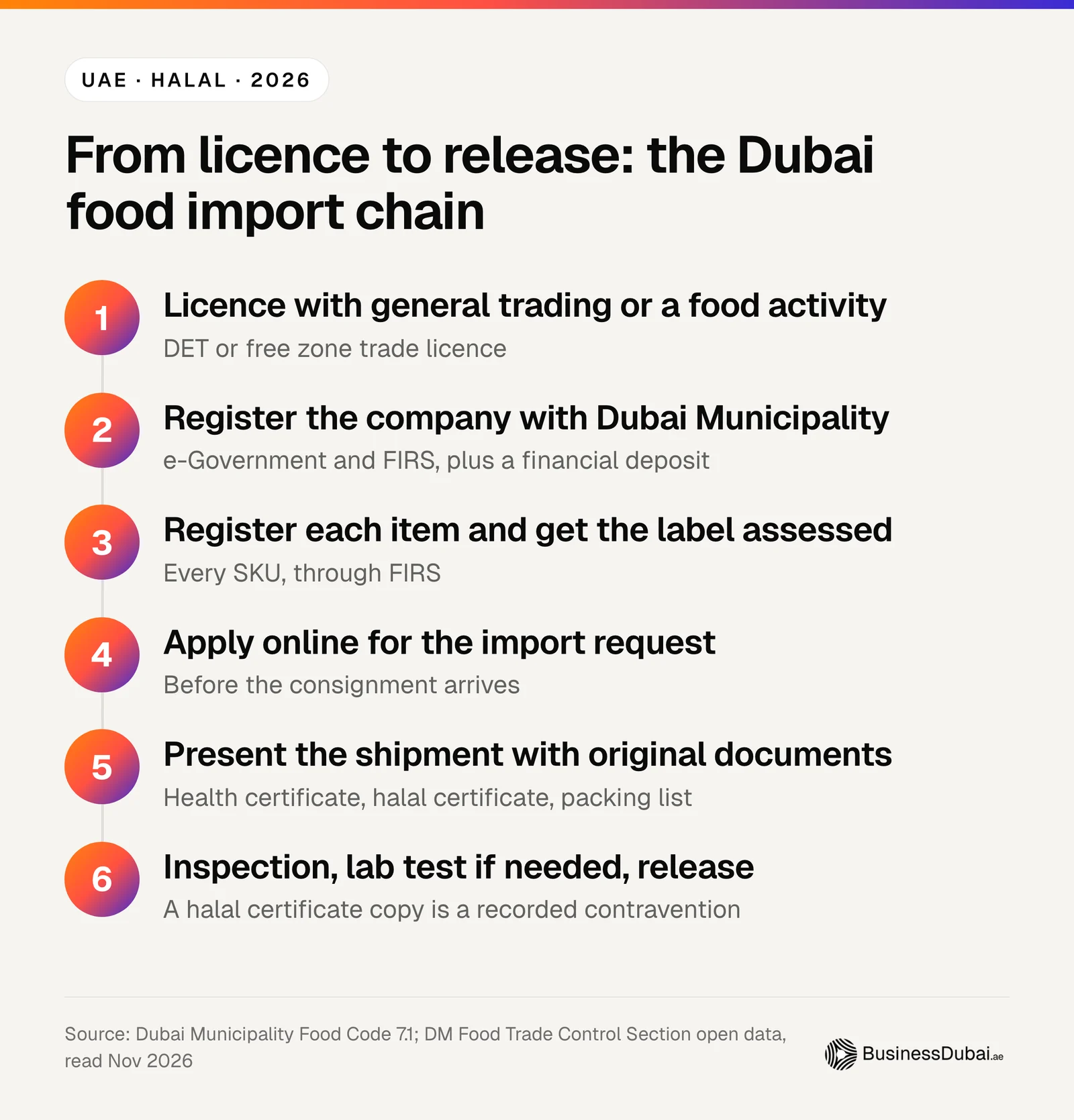
Before import: company registration with a financial deposit, item registration and label assessment, and an online import request. After arrival: original documents, inspection, a lab test where needed, and release [1].
Why do halal certificates fail at the port, and what happens next?
Halal certificates fail at a Dubai port for five recurring reasons: a copy instead of the original, an issuer not registered by MoIAT, a scope that misses the product or plant, an expired certificate, and details that do not match the shipment. A failed consignment can be held, returned or destroyed at the importer's cost.
Dubai Municipality's contraventions examples table, in a presentation whose statistics run to 2020, includes these lines [1].
| Contravention recorded by Dubai Municipality | Items | Total weight (kg) |
|---|---|---|
| Health Certificate not submitted | 101 | 209,197 |
| Health Certificate copy only submitted | 71 | 303,205 |
| Arabic Label Is Not Declared | 53 | 21,623 |
| Halal Certificate only copy submitted | 26 | 23,528 |
| Health certificate does not comply with regulation | 10 | 52,508 |
Certificate contraventions fell from 754 in 2019 to 338 in 2020 [1]. Copies are a courier problem, not a halal problem. The other four reasons come from the rules. A certificate from an unregistered body is not accepted [15]; a body outside its fields, or a plant outside its approved scope, fails the same test [11][12]; and an expired certificate must "not be advertised or remain in use upon the expiration, cessation or termination thereof" [3].
When a product breaches the decree, the authority can order it recalled "to recondition said product, return the same to the country of origin, or destroy it", and "the Body in breach shall incur all costs arising out of the same" [3]. It can also withdraw the halal certificate [3]. We could not read an official copy of the current fine table, so we quote no fine.
Common Mistake: Sending the original halal certificate with the shipping documents and a copy to the clearing agent, who then presents the copy. The port wants the original [1]. Courier the original health and halal certificates together, track them, and book inspection only once they are in your agent's hands. A waiting reefer costs plug-in and storage.
Which trade licence activity does a halal food importer need in Dubai?
A halal food importer in Dubai needs a trade licence carrying general trading or a specific food activity, such as DET 4721004 Fresh, Chilled & Frozen Meat Trading or 4721037 Snack Food Trading. Dubai Municipality then requires registration in its e-Government system and FIRS, label approval and registration of every item before the first import.
Dubai Municipality says food reaches the UAE "through any distributing company based in UAE" or "By obtaining a trade license in UAE with having general trading or any food activity" [1]. The table maps halal-sensitive catalogues to Dubai Department of Economy and Tourism (DET) activities [20].
| DET code | Activity | Fits |
|---|---|---|
| 4721004 | Fresh, Chilled & Frozen Meat Trading | Meat importers; the description names beef and mutton |
| 4721002 | Dairy Products Trading | Milk, cheese and butter, including rennet cheeses |
| 4721037 | Snack Food Trading | Confectionery and snacks, where gelatin is common |
| 4690018 | General Trading | A mixed catalogue |
| 1010101 / 1010901 | Slaughtering & Meat Preparing / Poultry Slaughtering & Processing | UAE producers, industrial licence |
Food Code section 7.1 then requires registration in Dubai Municipality's e-Government system and the Food Import and Re-export System (FIRS) before importing or exporting, label approval through FIRS, and individual registration of every item [5]. Your Dubai Customs code runs alongside; see our Dubai Customs registration guide.
Common Mistake: Licensing a frozen poultry business under 4721004 without asking. The DET description names beef and mutton, not poultry, and the register has no separate poultry trading code [20]. Confirm with DET whether 4721004 covers your poultry lines or whether General Trading 4690018 fits better before the licence is issued, because amending an activity later costs a fee and a delay.
Free zone or mainland: which suits a halal food importer?
A halal food importer selling to Dubai supermarkets and restaurants can use either route: the Dubai mainland from AED 26,900 with one visa, or Meydan Free Zone or Dubai South from AED 21,850 with one visa. The halal rules do not change with the licence, and Dubai Municipality inspects food at Jebel Ali free zone too.
Prices are BusinessDubai.ae's 2026 standard packages [20]; the jurisdiction changes who you sell to and when duty falls due, not the certificate.
| Factor | Free zone (Meydan Free Zone, Dubai South, IFZA) | Dubai mainland (DET) |
|---|---|---|
| Licence only, year one | AED 12,500 (Meydan, Dubai South); AED 12,900 (IFZA, partner price) | AED 18,200 |
| One visa / two visas | AED 21,850 / 28,400 (Meydan, Dubai South); AED 22,200 / 25,400 (IFZA) | AED 26,900 / 30,900 |
| Year-two renewal | Ask the zone | About AED 15,000 |
| Selling to UAE retailers and restaurants | Through a mainland distributor or onshore routes | Direct |
| Halal certificate and FIRS rules | Same Food Code rules | Same Food Code rules |
| Customs duty on stock | When goods enter the mainland | At import |
| Corporate tax | 0% only on qualifying income | 0% to AED 375,000, 9% above |
On one visa the mainland costs AED 5,050 more than Meydan Free Zone in year one, usually less than adding market access later if your buyers are Dubai retailers. Where your stock sits and who buys it decides the route: our free zone company setup page compares the zones on the one-visa basis, and our mainland company setup page itemises the DET route, including the renewal the headline price leaves out.
For a port-side operation, our Dubai South free zone setup guide and JAFZA free zone setup guide cover licensing and warehousing; BusinessDubai.ae has no JAFZA package. Frozen stock also needs a compliant cold store, covered in our cold storage warehouse guide. If you need no Dubai address and one visa is enough, Ajman is the cheapest complete package at AED 4,888 licence-only or AED 11,600 with one visa; our business setup in Ajman page shows what that buys. Ajman runs its own food control, so the Dubai port procedure does not transfer automatically.
Re-export from a free zone
Some guides say food re-exported from a free zone never meets UAE halal inspection. Dubai Municipality's material does not support that as a blanket rule: its Food Trade Control Section lists "Inspecting and releasing all imported food shipments for re export purpose" among its responsibilities [1], and the Food Code requires every re-exported item to be registered in FIRS [5]. Which documents are checked on a load that never enters the local market is not stated in the sources we read, so confirm it in writing before relying on an exemption.
How are customs duty, VAT and corporate tax handled for a food importer?
A Dubai food importer pays 5% customs duty on the CIF value of goods entering the mainland and 5% import VAT on the CIF value plus duty, generally recoverable once VAT-registered. Corporate tax is 0% on taxable income up to AED 375,000 and 9% above, with 0% free zone treatment only on qualifying income.
Dubai Customs charges 5% of the CIF value (cost, insurance and freight) as its standard rate, with exceptions for alcohol and tobacco [9]. VAT is 5% [10]; registration is mandatory once taxable supplies pass AED 375,000 a year, and exports with proper evidence are zero-rated [16]. We price food sales at 5% unless the Federal Tax Authority confirms otherwise for a product line.
Quick Math: A reefer of frozen poultry with a CIF value of AED 100,000 pays AED 5,000 in customs duty at 5% [9]. Import VAT is 5% of AED 105,000, which is AED 5,250. Landed cost before clearing, plug-in and storage: AED 110,250. If you are VAT-registered, the AED 5,250 is generally recoverable; the AED 5,000 duty is a cost.
Corporate tax is "levied on corporations having an income above AED 375,000" at 9 per cent, with 0% below [17]. A free zone company pays 0% only as a Qualifying Free Zone Person on qualifying income. The Ministry of Finance lists "distribution in or from a designated zone that meets the relevant conditions" as a qualifying activity and income from transactions with natural persons as excluded, subject to exceptions [18]. Non-qualifying revenue must stay below "the lower of either 5% of their total revenue or AED5,000,000", or the company loses the regime for "a minimum period of five (5) years" [18]. Our Qualifying Free Zone Person guide and Designated Zone VAT guide cover the conditions. Have the position modelled before you choose the zone. Model your position→
What changes for a UAE producer, slaughterhouse, restaurant or supermarket?
A UAE food producer must hold halal certificates for its final products and raw materials from a MoIAT-registered body, unless the supplier already holds them, and a slaughterhouse must also meet UAE.S 993:2022. Restaurants and supermarkets in Dubai that sell non-halal food need a Dubai Municipality prior permit and complete physical separation.
Producers and slaughterhouses
The decree covers any facility "authorized to handle foods and Halal products in any stage of the supply chain" [3]. Our food processing factory guide covers the industrial licence. UAE.S 993:2022, Animal Slaughtering Requirements according to Islamic Rules, was approved under Cabinet Resolution No. 104 of 2022, published in the Official Gazette on 30/11/2022 with a commitment date of 02/12/2023, and replaced Gulf Technical Regulation No. 993/2015 [7]. Its clause 5-1 says "Each shipment of slaughtered animals or their products must be accompanied by a (Halal) certificate" [7].
Restaurants, supermarkets and cold stores
Food Code 8.7.1(a) is direct: "Non-Halal products shall not be imported, exported, processed or sold without obtaining a prior permit from the Food Control Department" [5]. Non-halal food must be labelled in Arabic and English, kept apart in transport, storage and display, held in designated refrigerators, sold only to permit holders, and given "A complete physical separation" where displayed or sold [5]. Our restaurant business setup guide and supermarket business setup guide cover the outlet licences.
Cosmetics
A halal claim on a cosmetic falls under the decree, and MoIAT lists UAE.S 2055-4 for cosmetics and personal care among its halal standards [4]; our cosmetics manufacturing guide covers the factory side.
What do food traders get wrong about halal certification in the UAE?
The costliest halal mistakes in the UAE are sending a copy of the certificate instead of the original, buying from a supplier whose certifier is not on MoIAT's register, assuming one certificate covers every product the supplier makes, shipping on an expired certificate, and treating the National Mark as compulsory or as a substitute for certification.
Each comes from the rules, the Dubai Municipality contravention data [1] or the pattern we see on food files [20].
| Mistake | What it costs | Fix |
|---|---|---|
| Copy of the halal certificate at the port | A recorded contravention and a held consignment | Courier originals; book inspection once they arrive |
| Certifier not registered for the field | The certificate is not accepted | Check register, status and fields before the order |
| Expired certificate or registration | It cannot remain in use | Keep a supplier register with every expiry |
| Assuming all seafood needs nothing | Farmed fish held without a pork-free diet certificate | Ask for it with the health certificate |
Real Talk: Most halal problems at the port start with a purchase order that never mentioned halal. Write the requirements into the order: the issuing body, the products it must list, originals to your agent before arrival, and who pays if a consignment is held. A supplier who refuses is telling you something.
What has to be renewed and checked every year?
A halal food trader in Dubai renews its trade licence every year, about AED 15,000 on a BusinessDubai.ae mainland package, re-checks each supplier's certifier and slaughterhouse approvals before every order, registers new items in FIRS, and renews the National Mark licence every three years if it holds one. VAT returns and the corporate tax return run alongside.
The halal calendar has no single date. Certificates expire on their own dates, certifier registrations carry their own expiry (TUV SUD Middle East's runs from 06/01/2021 to 05/01/2027) [11], slaughterhouse approvals have theirs [12], and every new SKU needs FIRS registration first [5]. Our post-setup services team runs the licence, visa, VAT and corporate tax calendar for food trading companies, so a renewal does not land in the week a reefer arrives.
Pro Tip: Keep a one-page register per supplier: certifier, its MoIAT status and expiry, certificate number and expiry, products covered, and for meat the slaughterhouse and its approval expiry [11][12]. Review it before every purchase order.
Real Client Stories
These are composite examples built from the situations food importers most often face in Dubai. Names and details are illustrative, and the only figures used are published government fees, Dubai Municipality data and BusinessDubai.ae's package prices.
The gummy importer whose certifier covered the wrong field
Sara set up a confectionery trading company in Meydan Free Zone at AED 21,850 with one visa, to import gelatin gummies from a European factory. The factory's halal certificate came from a body that was on MoIAT's register, so she assumed she was covered. Before the first order, she checked the body's field list and found it was registered for slaughterhouses and meat, not confectionery. The factory had a second certifier for its sweets line, but that body was not on the register at all. She moved her order to a range certified by a registered body with the right field. "The logo was fine. The scope was the problem."
The poultry trader who sent a scan
Omar licensed a Dubai mainland meat trading company at AED 26,900 with one visa and imported frozen poultry from a plant on MoIAT's approved slaughterhouse list. His supplier emailed scans of the health and halal certificates and sent the originals with the shipping documents, which went to the wrong office. His agent presented the scans. The consignment was held, the same contravention Dubai Municipality records as "Halal Certificate only copy submitted", until the originals were found and couriered across. He now books inspection only once the originals are in his agent's hands. "I paid storage on a reefer for a piece of paper."
The sauce maker who budgeted for the old fee
Leila runs a small sauce and marinade producer in Dubai and wanted the UAE Halal National Mark on her export range. An old article told her the licence cost AED 18,000, so she had shelved it. When we checked MoIAT's current terms, the licence was AED 2,000 for three years, with the technical assessment charged per assessor day and the lab report on top. Her chicken marinade used a stock with animal-origin ingredients, which needed a certified input before anything else could happen. She fixed the supplier certificate first and applied for the mark after. "The fee was a ninth of what I feared. The ingredient was the work."
Start your halal food trading business the right way
For a halal food trader, the licence is the easy part. Three things decide whether containers clear: knowing which products are on the Dubai Food Code list and which need a certificate only because you claim halal, checking every supplier's certifier, field and slaughterhouse against MoIAT's registers before you pay, and getting original certificates to the port. The National Mark is optional, and at AED 2,000 for three years it is no longer the expensive part.
BusinessDubai.ae has completed 700+ company registrations across the UAE, including food trading and import companies, with itemised pricing and no hidden fees. We will price a mainland company setup under the right DET food activity against a free zone company setup for an import or distribution company, and our post-setup services team keeps your licence, visas, VAT and corporate tax filings current once you are trading.
Tell us what you import, from where, and who buys it, and we will build an all-in plan from licence to first release. Talk to a setup expert→
Frequently Asked Questions
Is halal certification compulsory for all food sold in the UAE?
No. It is compulsory for any product sold or marketed as halal under Cabinet Decree No. 10 of 2014, and in Dubai for meat, poultry, processed meat and foods with animal-origin ingredients such as gelatin. Fresh produce and plant-based foods need one only if labelled halal.
Do I need a halal certificate to import chicken into Dubai?
Yes. Poultry consignments need an original halal slaughtering certificate issued in the country of origin by a UAE-approved body, and the slaughterhouse should be on MoIAT's approved list for poultry.
Do sweets or gummies containing gelatin need a halal certificate in Dubai?
Yes. The Dubai Food Code requires halal certificates for foods with ingredients of animal origin and names gelatin as the example. The certifier must be MoIAT-registered for confectionery.
Does imported seafood need a halal certificate in Dubai?
No. Seafood is excepted from the Food Code's halal list. Farmed fish and seafood do need a pork-free diet certificate alongside the health certificate.
Do fresh fruit, rice and spices need halal certification for the UAE?
Not by law. They are not on the Dubai Food Code halal list. If the pack or marketing says halal, a certificate from a MoIAT-registered body must back the claim.
Can I put a halal logo on my product without certification?
No. Cabinet Decree No. 10 of 2014 bars selling, storing or marketing any product marked halal unless it complies. An unsupported claim is a breach, and the product can be recalled.
Is the UAE Halal National Mark compulsory?
No. MoIAT describes the mark as optional. Certification by a MoIAT-registered body is what is compulsory for halal claims and for the Dubai Food Code product list.
How much does the UAE Halal National Mark licence cost in 2026?
AED 2,000 for a three-year licence, down from AED 18,000 since 1 January 2023. MoIAT lists the technical assessment at AED 2,500 per assessor per day, plus the assessor's travel.
Is ESMA still the halal regulator in the UAE?
No. ESMA was merged into the Ministry of Industry and Advanced Technology (MoIAT), established in July 2020. MoIAT registers certifiers, lists approved slaughterhouses and issues the Halal National Mark.
Where can I find the list of halal certification bodies approved by the UAE?
On MoIAT's "Registered Halal Certification Bodies" register. Filter by country and status (Active, Expired or Suspended); each entry shows fields, accreditor and expiry date.
Does the UAE accept foreign halal certificates?
Yes, if the issuing body is registered by MoIAT for that product field. The register includes bodies in the UK, Brazil, Canada, the US and many other countries; an unregistered body's certificate is not accepted.
Can a halal certificate be sent as a scanned copy?
No. Dubai Municipality requires originals at inspection and records "Halal Certificate only copy submitted" as a contravention, with 26 items weighing 23,528 kg in its published examples table.
What happens if my halal certificate is rejected at a Dubai port?
The consignment is held until the problem is fixed. If it cannot be, the authority can order it reconditioned, returned to origin or destroyed, at the cost of the party in breach under Cabinet Decree No. 10 of 2014.
Does the slaughterhouse need approval as well as the certifier?
Yes, for meat and poultry. MoIAT's Approved Halal Slaughter Houses list, issue 096-2026, shows each plant's certifier, scope and approval expiry. Check plant, species and date before ordering.
Does cheese made with rennet need a halal certificate in the UAE?
Possibly. The federal decree's definition of a halal certificate names rennet, but the Dubai Food Code list does not. Ask Dubai Municipality before the first shipment.
How much does halal certification cost for a food trader in the UAE?
The only official fees are MoIAT's: AED 2,000 for the three-year National Mark licence, AED 2,500 per assessor day and AED 250 for scope expansion. Certifier audits are quoted privately, and most importers rely on the supplier's certificate.
How long does it take to get halal certified in the UAE?
There is no official timeline for a private audit; it depends on sites, products and audit days. MoIAT lists 6 working days to issue a National Mark licence and 10 working days to register a certifier.
How long is a halal certificate valid in the UAE?
For the period its issuing body prints on it; the decree bans using it after expiry. The Halal National Mark licence runs three years, and a certifier's MoIAT registration has its own expiry.
Does a free zone food trading company need halal certification?
Yes, on the same terms as a mainland company. The Food Code applies to the product, not the licence, and Dubai Municipality inspects food at its Jebel Ali free zone unit too.
Is halal certification needed for food re-exported from a Dubai free zone?
Dubai Municipality still inspects and releases re-export consignments, and re-exported items must be registered in FIRS. Which documents are checked on a re-export-only load is not stated in the sources we read, so confirm it in writing.
What licence do I need to import halal food into Dubai?
A trade licence with general trading or a food activity, such as DET 4721004 or 4721037. A BusinessDubai.ae mainland package starts from AED 18,200 without a visa, and a Meydan Free Zone or Dubai South package from AED 12,500.
Do I need to register with Dubai Municipality before importing food?
Yes. Food Code section 7.1 requires registration in Dubai Municipality's e-Government system and FIRS before importing or exporting, with every item registered and its label approved.
Does a restaurant in Dubai need halal certification?
The Food Code sections we read do not require a restaurant certificate; halal control sits on the meat and ingredients bought. Serving non-halal food needs a prior permit and complete separation.
Can I sell pork or other non-halal food in Dubai?
Only with a prior permit from Dubai Municipality's Food Control Department. Products must be labelled non-halal in Arabic and English, kept apart and sold only to permit holders.
Does a halal certification body need its own licence in the UAE?
Yes. It needs a commercial licence and accreditation, then MoIAT registration at AED 1,000 per domain plus AED 1,000 for the certificate. In Dubai the DET activity is 7120033.
References
[1] Dubai Municipality, Food Safety Department, Food Trade Control Section. Open-data presentation (statistics to 2020): port units, monthly consignment volumes, documents required from the country of origin, the import customer journey, re-export release and the contraventions examples table. Copy hosted by the Government of Poland. gov.pl
[2] Ministry of Industry and Advanced Technology (MoIAT). "MoIAT reduces fees for 14 services", 24 January 2023: National Halal Mark licence cut from AED 18,000 to AED 2,000 and scope expansion from AED 2,500 to AED 250, as of 1 January 2023. moiat.gov.ae
[3] European Commission, DG Trade. Note to the Trade Policy Committee, 11 December 2015, enclosing the translated Cabinet Decree No. 10 of 2014 on UAE Regulations for Control on Halal Products: definitions, Articles 3, 7 and 9, and the 2015 implementation note. parlament.gv.at
[4] Ministry of Industry and Advanced Technology (MoIAT). UAE Halal programme page: certificate rule under Cabinet Decree 10/2014, the Halal National Mark described as optional, establishment date of the ministry and the list of halal standards including UAE.S 2055-4. moiat.gov.ae
[5] Dubai Municipality. Food Code (2013, English edition): section 7.1 registration in the e-Government system and FIRS, section 7.3 health and halal certificates at the port, and section 8.7 non-halal food. dmpmedia.dm.gov.ae
[6] Ministry of Industry and Advanced Technology (MoIAT). News, 1 June 2021: Federal Decree-Law No. 20 of 2020 on standardization and metrology. moiat.gov.ae
[7] Ministry of Industry and Advanced Technology (MoIAT). UAE.S 993:2022 Animal Slaughtering Requirements according to Islamic Rules: Official Gazette and commitment dates, Cabinet Resolution No. 104 of 2022, replacement of GSO 993/2015 and clause 5-1. Copy hosted by the Government of Poland. gov.pl
[8] Ministry of Industry and Advanced Technology (MoIAT). Service page, Issue a Licence to Use National Marks for Conformity: procedure, requirements, fees (three-year licence certificate, conformity certificate, technical assessment per day) and 6 working days service time, read November 2026. moiat.gov.ae
[9] Dubai Customs. Dubai Customs Services Guide 2025: customs duty of 5% of CIF value and its exceptions. dubaicustoms.gov.ae
[10] Federal Tax Authority. VAT in the UAE: the 5% standard rate. tax.gov.ae
[11] Ministry of Industry and Advanced Technology (MoIAT). Registered Halal Certification Bodies register: countries, fields, accreditation bodies, issue and expiry dates and status, read November 2026. moiat.gov.ae
[12] Ministry of Industry and Advanced Technology (MoIAT). Approved Halal Slaughter Houses list, issue 096-2026: country, certifying body, facility, scope and approval expiry. moiat.gov.ae
[13] Ministry of Industry and Advanced Technology (MoIAT). Service page, Issue a Halal Certification Body Certificate: requirements, fees of AED 1,000 per domain and AED 1,000 per registration certificate, and 10 working days. moiat.gov.ae
[14] Emirates International Accreditation Centre (EIAC). Accredited bodies directory, Halal Bodies category, read November 2026. eiac.gov.ae
[15] US Department of Agriculture, Foreign Agricultural Service. FAIRS Export Certificate Report, United Arab Emirates, TC2025-0009, 21 November 2025: halal certificate acceptance rule and required certificate content. apeda.gov.in
[16] Federal Tax Authority. Executive Regulation of Federal Decree-Law No. 8 of 2017 on VAT (unofficial translation): mandatory registration threshold of AED 375,000 and zero-rating of exports. tax.gov.ae
[17] UAE Government portal (u.ae). Corporate tax: 0% up to AED 375,000 and 9% above. u.ae
[18] UAE Ministry of Finance. "Ministry of Finance Announces New Decisions Relating to Corporate Tax for Free Zones", 7 June 2023: qualifying and excluded activities, de minimis threshold and the five-year consequence of failing it. mof.gov.ae
[19] Ministry of Industry and Advanced Technology (MoIAT). About the Ministry: ESMA, the Office of the Minister of State for Advanced Technology and the industrial sector of the Ministry of Energy and Infrastructure merged into MoIAT. moiat.gov.ae
[20] BusinessDubai.ae. Internal data from food trading and import company registrations since 2013, including 2026 standard package prices for the Dubai mainland, free zones and Ajman, and the DET activity register as exported in July 2026. businessdubai.ae