

A meat and poultry trading company in Dubai lives or dies on the paperwork that travels with each container. Dubai Municipality's Food Code requires a halal slaughtering certificate with every consignment of raw meat and poultry, and says those certificates are "valid only if they are issued at the country of origin by an Islamic Society approved by the Government of UAE" [1]. The market is large and built on imports: the US Department of Agriculture (USDA) forecasts UAE chicken meat imports of 410,000 MT in 2026, against domestic production of 75,000 MT [2].
What most founders search for as a "meat trading license Dubai" is really a set of gates run by different authorities: the activity code, Dubai Municipality's food approvals, the certificates on each consignment, duty that changes with the product's state and, for poultry, federal price control. Poultry prices cannot be raised without the Ministry of Economy's approval [3], and a supplier that does it a fourth time faces AED 50,000 to 75,000 and 30 days' closure [4]. Get one gate wrong and the cost is a licence amendment, a held container or a closure order.
Since 2013, BusinessDubai.ae has set up trading companies on the Dubai mainland and across the UAE's free zones. This guide covers the activity codes, port documents, the cold chain, duty by product, poultry price control, corporate tax and VAT, and an itemised cost on a stated visa basis. It is general information, not legal or tax advice: confirm each position with the authority concerned, your clearing agent and a tax adviser.
What does a meat or poultry trading company in Dubai need in 2026?
A Dubai meat or poultry trader licenses on DET codes such as 4721004 or 4721011, registers every product in Dubai Municipality's FIRS, and imports each consignment with a health certificate and a UAE-approved halal slaughtering certificate. Fresh or chilled red meat pays 0% duty, frozen meat and all poultry 5%, and poultry prices need Ministry approval to rise.
Each requirement belongs to a different authority and repeats on its own cycle. The table sets out the six gates, using the Department of Economy and Tourism (DET) register [5], Dubai Municipality's Food Code and activity table [1][6], Dubai Customs' tariff master [7] and the Ministry of Economy's pricing policy [3].
| Gate | Authority | When it repeats |
|---|---|---|
| Activity code and trade licence | DET on the mainland, or the free zone authority | Every renewal, and on any change of activity |
| Food establishment approval | Dubai Municipality, Food Safety Department | When premises or activities change |
| Importer and product registration | Dubai Municipality, Food Import and Re-export System (FIRS) | Once per product and pack size |
| Health and halal slaughter certificates | Origin authorities and UAE-approved Islamic bodies, to federal animal-health conditions | Every consignment |
| Customs duty (0% or 5%) and VAT (5%) | Dubai Customs and the Federal Tax Authority | Every declaration |
| Poultry price changes | Ministry of Economy | Every proposed increase |
The licence is the cheapest gate to get right and the only one you pass once.
Is Dubai a good base for a meat and poultry trading company?
Dubai is the UAE's main food gateway: Dubai Municipality reported 5.2 million tons of food imported into the emirate in the first half of 2024, across 268,084 shipments. For chicken, USDA forecasts 2026 UAE imports of 410,000 MT against domestic production of 75,000 MT, so importers supply most of the market, mainly from Brazil.
USDA's hotel, restaurant and institutional report records that "In the first half of 2024, Dubai Municipality reported that 5.2 million tons of food were imported into the emirate of Dubai alone across 268,084 shipments" and that "Dubai Municipality also reported that 90 percent of all food and beverage imports destined for the UAE pass through Dubai" [8].
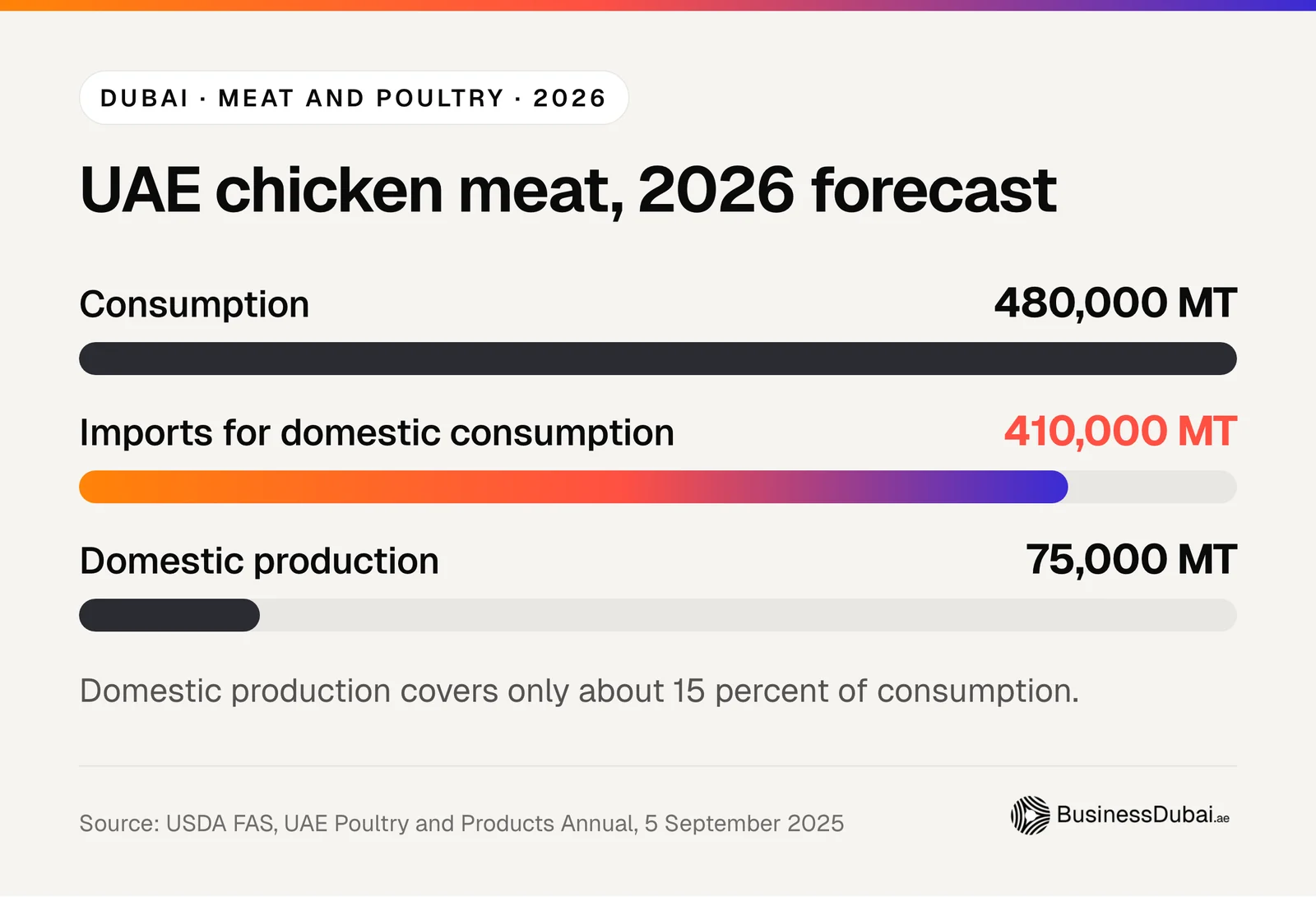
For chicken, UAE domestic production "presently fills only about 15 percent of chicken meat consumption and relies on the international market, primarily Brazil, to supply the remaining 85 percent" [2]. USDA estimated imports for domestic consumption at 400,000 MT in 2025 and forecasts 410,000 MT in 2026, and "Post forecasts chicken meat consumption to reach 480,000 MT in 2026" [2]. Domestic production is forecast at 75,000 MT in 2026 [2].
The three 2026 chicken figures that size the market are set out below [2].
Those import figures understate the trade. USDA's footnote says: "This figure excludes transshipments and re-exports. If transshipments and re-exports were included, total imports would be approximately 25-30 percent higher." [2] UAE consumption and the re-export flow are two markets that need different setups, covered in the free zone section.
Who you compete with, and when Dubai is the wrong base
Brazil wins on pack size as well as price: USDA reports that "Local importers state that supersacks put U.S. poultry at a disadvantage compared to smaller packaging sizes available from Brazil" [2]. Brazilian producers also have plants inside the UAE, with Brazil Foods opening a factory at KIZAD and JBS acquiring two UAE plants in 2022 [2], so a new frozen chicken importer competes with suppliers that already hold local stock.
If your buyers or your cold store partner sit in Abu Dhabi, an address near KIZAD may suit you better than Dubai, and our business setup in Abu Dhabi page compares that emirate's options.
Which licence does a meat or poultry trader need: meat, poultry, livestock or retail?
A Dubai importer or wholesaler of beef and mutton licenses on DET 4721004 Fresh & Chilled & Frozen Meat Trading, a frozen chicken trader on 4721011 Frozen Poultry Trading, a live-animal dealer on 4620201 Livestock Trading, and a butcher selling to consumers on 4781008 Meat Seller. Slaughtering, cutting and freezing need separate industrial codes.
The DET register, read on 22 August 2026, carries five codes that matter to a meat or poultry trader [5]. None carries an external approval flag in the register itself; the food approval comes from Dubai Municipality.
| DET code | Official activity name | What DET's description covers |
|---|---|---|
| 4721004 | Fresh & Chilled & Frozen Meat Trading | Reselling beef and mutton, fresh, chilled or frozen |
| 4721011 | Frozen Poultry Trading | "Includes reselling frozen poultry such as chicken, pigeons, ducks, provided that no conversion process has been made." |
| 4721040 | Poultry Trading | Reselling poultry, and also slaughtering, cleaning and preparing it for consumption |
| 4620201 | Livestock Trading | Reselling live camels, cows, horses, goats and sheep |
| 4781008 | Meat Seller | Small market shops selling meat and chicken to consumers, with cutting and preparing |
DET's English text for 4721004 reads as if a converting process were required, which looks like a missing word: DMCC's description of the same code ends "provided that no freezing or any converting process have been executed" [9]. If you plan any cutting or freezing, ask DET to confirm in writing what 4721004 allows.
A trader importing both frozen beef and frozen chicken needs both 4721004 and 4721011. A trader selling chilled chicken should ask DET which code covers it, because 4721011 is worded for frozen poultry only and 4721040's description includes slaughtering.
What Dubai Municipality's activity table says
Dubai Municipality's "Food Establishment Requirements Based on Activity" table, last updated April 2020, lists the Food Safety Department as the pre-approving authority for these codes, plus departments such as building licensing, planning, drainage and Civil Defence where they apply [6].
| Code | Dubai Municipality description (April 2020 table) | Minimum food area |
|---|---|---|
| 4721004 | Trading commercially packed fresh, chilled and frozen meat; the establishment "must have sufficient facilities to store foods when necessary" | Depends on process |
| 4721011 | Trading frozen poultry meat such as chicken, ducks and turkey | Depends on process |
| 4781008 | A professional licence for selling, cutting and packing meat | 250 sq ft |
More area may be needed for equipment and processes [6]. The edition is from 2020 and does not list 4721040 or 4620201, so confirm requirements with Dubai Municipality before you sign a lease.
The same activities in free zone registers
Free zones keep their own activity lists, and the numbers do not always match DET's [9].
| Register | Meat trading | Poultry trading |
|---|---|---|
| DMCC | 4721004 | Covered by 4721004, whose DMCC text includes "birds and poultry meat" |
| IFZA | 4721004, flagged for Department of Food Control approval | 4721011, same flag |
| JAFZA | 512206 | No poultry trading line found in the extract; confirm with JAFZA |
| DAFZ | 4630-006 | 4630-007, which includes eggs |
| Meydan Free Zone | 4721.70; 4630.05 for wholesale | 4721.74 Frozen Poultry Trading |
Dubai South, Ajman Free Zone and RAKEZ lists were not checked for this guide. Before you choose any free zone, confirm in writing that its current list carries a meat or poultry trading activity that matches your products.
Common Mistake: Cutting, portioning or freezing meat on a trading code. 4721011's description ends "provided that no conversion process has been made" [5], and breaking down carcasses, mincing or freezing chilled stock is conversion. DET gives Slaughtering & Meat Preparing (1010101), Poultry Slaughtering & Processing (1010901) and Meat Freezing (1010103) their own industrial codes [5]. Ask DET or the zone in writing before the first cut, because adding an activity later is a licence amendment. Our food processing factory guide covers the industrial route.
Pro Tip: Write your product list before you apply: species, cut, state and pack size. That one list decides your activity codes, your duty (chilled red meat 0%, frozen and poultry 5%), your price-control exposure (poultry only) and your FIRS registrations (each pack size counts).
What does each meat or poultry consignment need at a Dubai port?
Each meat or poultry consignment into Dubai needs a health certificate from the origin authority, a halal slaughtering certificate issued in the country of origin by a UAE-approved Islamic body, and products already registered in Dubai Municipality's FIRS. Federal animal-health conditions, such as avian influenza freedom for poultry, come from MOCCAE and differ by origin.
The Food Code says: "All imported food products and food contact materials are inspected by the Food Control Department at the port of entry." Officers take samples for laboratory analysis when necessary [1]. For a meat trader, three documents decide whether the container is released.
The health certificate
At the port of entry:
"importers of food must submit the Health Certificates for each consignment of food that clearly state: i the quantities and description of imported food items; ii that the imported products are produced or manufactured according to the requirements of Dubai Municipality in an establishment that is licensed and supervised by the competent food authority at the country of origin." [1]
The certificate comes from the exporting country's government, not the supplier. USDA's 2025 certificate report names the authority requesting it as "Food control sections at municipalities based on guidelines from Ministry of Climate Change and Environment" [10].
The halal slaughtering certificate
Raw meat and poultry need a second certificate:
"Consignments of raw meat and poultry shall be accompanied with Halal Slaughtering Certificates. Halal Slaughtering Certificates are valid only if they are issued at the country of origin by an Islamic Society approved by the Government of UAE." [1]
Processed meat needs halal certificates too [1]. USDA puts the rule plainly: "Only halal certificates issued by UAE-approved halal certifiers are accepted." [10] Its required fields include the slaughterhouse, the date of slaughter, production and expiration dates, the importer name and the health certificate number [10].
The Ministry of Industry and Advanced Technology (MoIAT) keeps a register of approved halal certification bodies and a separate list of approved halal slaughterhouses, and both should be checked before you pay a supplier [11][12]. Our halal certification guide walks through both lists and why certificates fail at the port.
Real Talk: A halal certificate is only as good as the body that signed it. The Food Code accepts certificates issued "by an Islamic Society approved by the Government of UAE" [1], so a respected certifier that is not on the UAE's list still fails at the port. Check the body and the plant on MoIAT's lists before you sign [11][12], and write the requirement into the contract so a rejected consignment is the supplier's cost.
FIRS registration for every product
The Food Code requires FIRS registration and label approval before importing: "All imported or re-exported food items should be individually registered in the FIRS System." [1] A frozen chicken import business with whole birds, leg quarters and fillets in two pack sizes each registers six products. Our food trading company guide explains importer registration, and our spices and dry foods trading guide covers pack sizes.
Federal animal-health conditions
Animal-health conditions are set federally by the Ministry of Climate Change and Environment (MOCCAE). MOCCAE's website could not be reached when this guide was researched, so this guide states no MOCCAE conditions, fees or country restrictions for meat: confirm them for your origin with MOCCAE and Dubai Municipality's Food Control Department before you sign a supply contract.
The UK's notes for certificate 1513, poultry meat to the UAE, revised on 9 March 2026, show what such conditions look like. They allow the avian influenza clause where the country is "free from infection with high pathogenic avian influenza viruses (HPAI) for a minimum period of (28) days prior to export", or where the relevant zone is free for the same period [13]. They also set a minimum of three months after stamping out for Newcastle disease, cover salmonella freedom based on national testing, and require assurance that the birds were not slaughtered for disease control [13]. And they note: "Exporters are responsible for ascertaining whether an import permit is a compulsory requirement in the importing country" [13]. Because these conditions depend on how long an origin has been disease-free, an origin that qualifies one month may not qualify the next, so confirm the position with MOCCAE before each new origin or season.
What cold chain does Dubai Municipality enforce for meat and poultry?
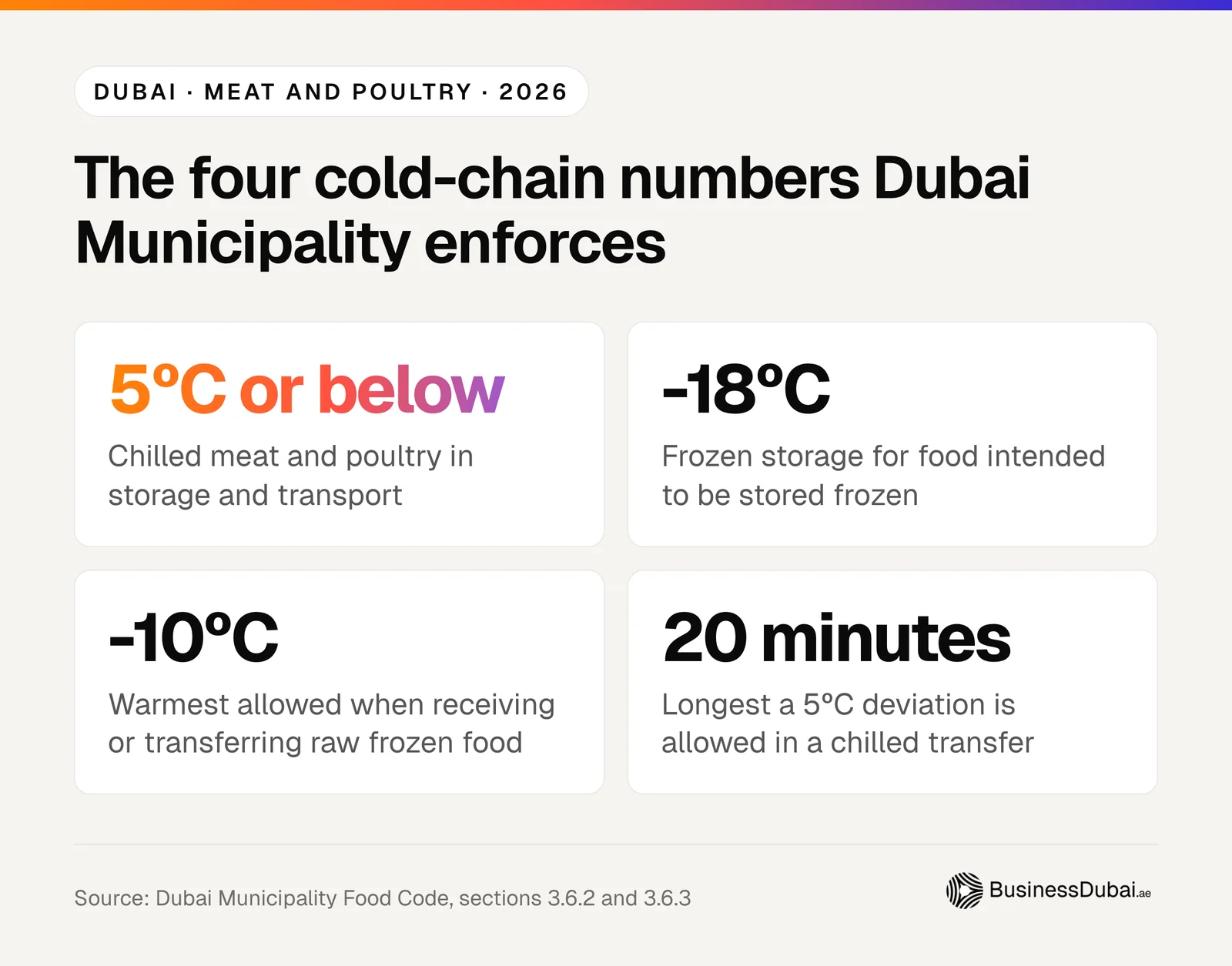
Dubai Municipality's Food Code requires chilled meat and poultry to be kept at or below 5ºC and frozen product at -18ºC. Raw frozen food must not exceed -10ºC while it is received or transferred, and a chilled transfer may deviate by up to 5ºC for no more than 20 minutes.
Section 3.6.2 of the Food Code requires perishable food to be transported and stored in equipment that holds it "at or below 5ºC if cold" and "frozen at -18ºC if they are intended to be stored frozen" [1]. Section 3.6.3 covers receiving and transfer: "While receiving and transferring raw frozen foods, the temperature of the food shall not exceed -10ºC." And: "A deviation of not more than 5ºC is allowed for not more than 20 minutes during the transfer of chilled foods." [1]
The four numbers a meat and poultry trader works to every day are set out below [1].
The Code also puts the burden of proof on the business: "Equipment units must have accurate and reliable monitoring devices" and "Products and records should be checked at the time of receiving and nonconforming products should not be accepted." [1] The reefer container, the cold store and the delivery truck each need a working thermometer, a record and a person who reads it.
Pro Tip: Ask for a temperature data logger in every reefer container and read it before you sign the receiving note. Frozen meat warmer than -10ºC on arrival fails the Food Code's receiving limit [1]. A probe reading at the door, logged with the time and container number, plus the logger download, is your evidence to reject a load or claim against the carrier.
Shelf life, storage and non-halal stock
The Food Code requires imported food to "comply with the UAE standards, especially those pertaining to labelling, shelf life, and the relevant requirements of this Code and associated guidelines" [1]. Shelf life and date marking follow the UAE's expiry-date standard, UAE.S 150-1, which our food processing factory guide explains. Check the current edition for each product before you agree a route, because chilled meat has far less life than frozen.
A trading licence does not come with storage. Dubai Municipality's description of 4721004 requires "sufficient facilities to store foods when necessary" [6], met with your own approved premises or space in a third-party cold store. Our cold storage warehouse guide covers what a cold store needs to be approved.
Non-halal meat adds two rules: "Non-Halal products shall not be imported, exported, processed or sold without obtaining a prior permit from the Food Control Department" and "Refrigerated and frozen Non-Halal food shall be stored in designated refrigerators or freezers." [1] A shared cold store therefore needs designated units for non-halal stock, not a separate shelf.
How much customs duty does imported meat and poultry pay in Dubai?
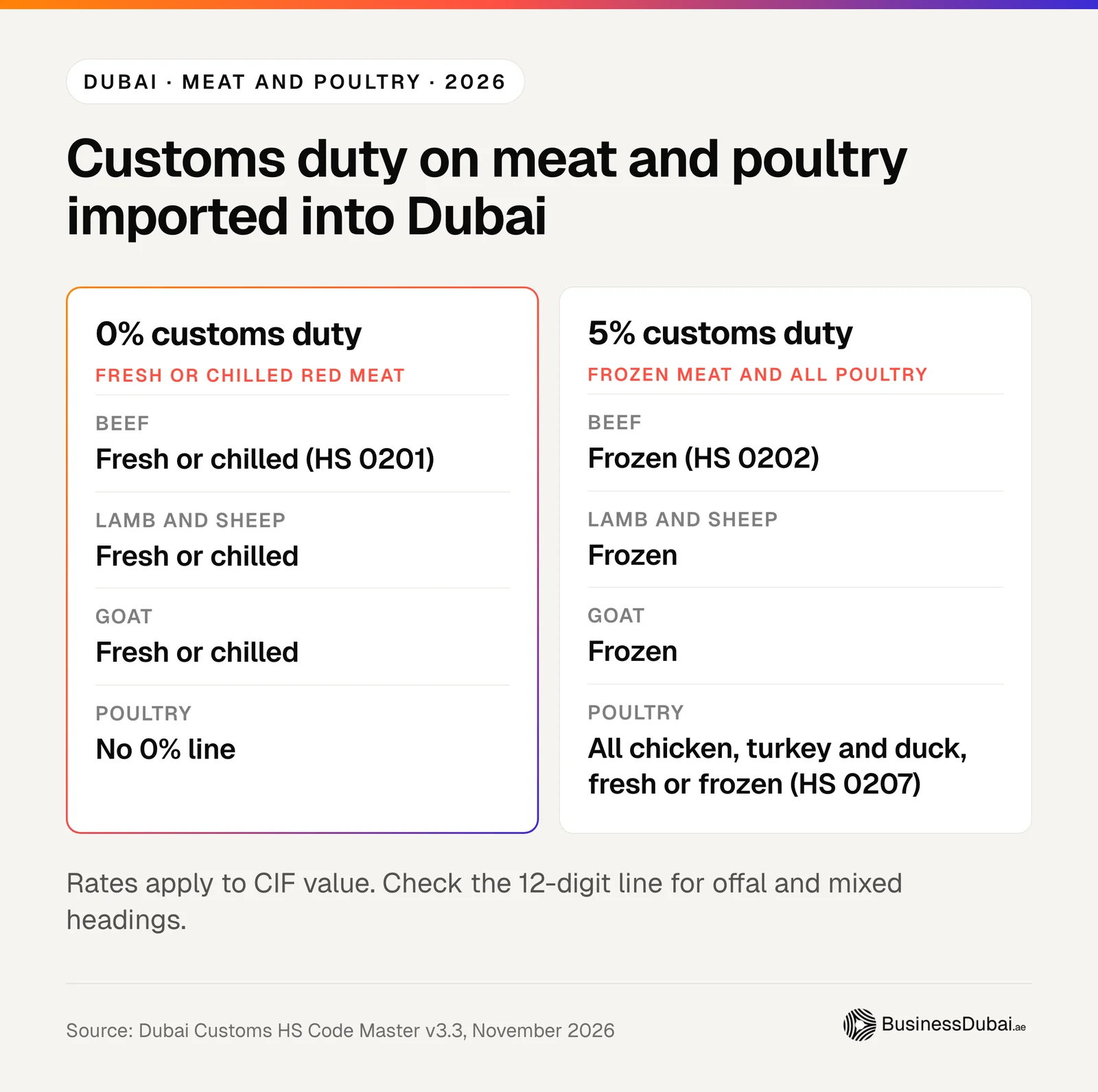
Dubai Customs charges 0% duty on fresh or chilled beef, lamb, sheep and goat meat, and 5% of CIF value on frozen beef, lamb, sheep and goat and on every chicken, turkey and duck line, fresh or frozen, according to its HS Code Master v3.3 of November 2026. VAT at 5% applies on top.
Dubai Customs states the general rule as "5% of the value CIF (Cost Freight Insurance) value except for alcohol and cigarettes/tobacco" [14]. Its HS Code Master v3.3 then sets the rate per tariff line, and chapter 02, meat and edible offal, splits on red meat versus poultry and chilled versus frozen [7].
The split that decides most meat business cases is shown below [7].
The table lists the chapter 02 lines a meat trader is most likely to use [7].
| HS heading | Product | Duty |
|---|---|---|
| 0201 | Beef, fresh or chilled: carcasses, bone-in cuts, boneless | 0% |
| 0202 | Beef, frozen: carcasses, bone-in cuts, boneless and minced | 5% |
| 0204 10, 0204 21 to 0204 23 | Lamb and sheep meat, fresh or chilled | 0% |
| 0204 30, 0204 41 to 0204 43 | Lamb and sheep meat, frozen | 5% |
| 0204 50 | Goat meat | 0% on the fresh or chilled lines, 5% on the frozen lines |
| 0206 10 to 0206 29 | Edible offal of cattle, fresh, chilled or frozen | 5% |
| 0207 | Chicken, turkey, duck, goose and guinea fowl, fresh, chilled or frozen | 5% on every line |
| 0208 60 | Camel meat, fresh or chilled | 0% |
Two lines catch traders out. Every poultry line in 0207 carries 5%, including chilled chicken, so 0% is a red meat rate only. And cattle offal is 5% even when chilled. Buffalo is a bovine animal in the tariff, so frozen Indian buffalo meat falls under 0202 at 5%; confirm the 12-digit code with your clearing agent before you price a contract [7].
Quick Math: A frozen chicken container with a CIF value of AED 500,000 pays 5% duty, AED 25,000, before VAT [7][14]. A chilled lamb shipment of the same CIF value pays no duty at all. Over five such shipments a year the gap is AED 125,000, which is why the product mix decides the business case far more than the licence price does.
Real Talk: The 0% rate on chilled red meat is real money, but it is not free. Chilled product must stay at or below 5ºC the whole way [1] and carries far less shelf life than frozen, so a slow sea route or a long port hold can use up the margin the duty saved. Price chilled against the route, the clearance time and how fast your buyers turn stock.
The UAE's trade agreements, including its Comprehensive Economic Partnership Agreements (CEPAs), can lower duty on goods of qualifying origin. This guide does not state CEPA rates for meat: check your origin's agreement and the certificate of origin it requires. VAT at 5% applies to meat and poultry on import and sale [18]. Our Dubai Customs registration guide explains the client code an importer needs and how import VAT is accounted for.
Can a poultry trader in the UAE raise prices freely?
No. Poultry is one of nine essential consumer products under Cabinet Resolution No. 120 of 2022 whose prices cannot be increased without prior approval from the Ministry of Economy. Cabinet Resolution No. 14 of 2026 fines a supplier AED 20,000 to 30,000 for a second unapproved rise and up to AED 75,000 with closure for a fourth.
The Ministry of Economy said in February 2025 that its pricing policy "designates nine essential consumer products" (cooking oil, eggs, dairy products, rice, sugar, poultry, legumes, bread and wheat), with related subcategories, "whose prices cannot be increased without prior approval from the Ministry" [3]. Its price-tracking platform covers cooperatives, hypermarkets and retail chains that "collectively represent over 90 per cent of domestic trade in essential consumer goods across the seven emirates" [3], so a poultry price rise shows up on a monitored shelf.
Red meat is not on the list: all other goods "remain subject to supply and demand dynamics, as well as market mechanisms" [3]. A trader in both runs two pricing regimes, free for beef and lamb and prior approval for chicken, which the Ministry's website handles through a "Request for Price Increase" service [3].
The supplier penalties under Cabinet Resolution No. 14 of 2026
Cabinet Resolution No. 14 of 2026, issued in March 2026 in Arabic, has separate penalty rows for suppliers and retailers. The table paraphrases the two supplier rows that matter to a poultry importer or distributor [4].
| Repeat | Supplier raises a basic good's price without prior approval | Supplier charges above the approved price |
|---|---|---|
| First time | Written warning, with 15 days to correct | Written warning |
| Second time | AED 20,000 to 30,000 | AED 10,000 to 20,000 |
| Third time | AED 30,000 to 50,000 plus 20 days' temporary closure | AED 20,000 to 35,000 plus 20 days' temporary closure |
| Fourth time | AED 50,000 to 75,000 plus 30 days' temporary closure | AED 35,000 to 50,000 plus 30 days' temporary closure |
| Fifth time and after | The fourth-time fine doubles, and final closure is possible | The fourth-time fine doubles, and final closure is possible |
A poultry importer selling to supermarkets will usually sit in the supplier position, but the resolution's definitions decide, so confirm with the Ministry how it classifies you. The same regime covers bread, and our bakery business guide sets out the retailer rows.
Common Mistake: Passing a freight or insurance jump straight into the next poultry invoice. USDA recorded a sharp rise in insurance costs for Red Sea shipments in July 2025 [2], and the instinct is to reprice the next container. For poultry, that is the first row of the penalty table [4]. File the Ministry's price-increase request with the cost evidence first, and write buyer contracts on terms that allow for the approval step.
Mainland or free zone: which suits a meat or poultry trader in Dubai?
A meat or poultry trader selling to Dubai supermarkets, butchers and caterers usually fits a Dubai mainland licence, at AED 18,200 without a visa or AED 26,900 with one on BusinessDubai.ae's 2026 prices. A re-exporter holding stock near Jebel Ali fits JAFZA, a VAT Designated Zone, for which BusinessDubai.ae has no package.
Mainland or free zone changes who you can invoice, where your stock sits and how the company is taxed. Our mainland company setup page itemises the Dubai mainland route, and our free zone company setup page compares the zones, including the year-two renewal a headline price leaves out. The table uses BusinessDubai.ae's 2026 package prices, which are company formation only [19], and the Designated Zone list in Cabinet Decision No. 59 of 2017 [15].
| Factor | Dubai mainland | Meydan Free Zone or Dubai South | JAFZA | Ajman Free Zone (non-Dubai) |
|---|---|---|---|---|
| Package, licence only | AED 18,200 | AED 12,500 | No BusinessDubai.ae package | AED 5,555 |
| Package with one visa | AED 26,900 | AED 21,850 | No BusinessDubai.ae package | AED 13,931 |
| Year-two renewal | About AED 15,000 | Roughly 80% of year one; ask for the standard renewal price | Quote from JAFZA | Roughly 80% of year one |
| Selling to UAE buyers | Direct to any buyer | Through a mainland distributor, branch or permit | Same as Meydan | Same as Meydan |
| VAT Designated Zone | Not applicable | Meydan is not; confirm Dubai South in writing | Yes | Yes |
The mainland is simpler when buyers are local. A Designated Zone suits bulk stock, re-export and sales to processors and wholesalers. A trader doing both can run a JAFZA company that imports and holds stock and a mainland company that buys from it and sells locally.
JAFZA, Ajman and RAKEZ
JAFZA sits beside Jebel Ali Port and is a Designated Zone [15]. BusinessDubai.ae has no JAFZA package, so take JAFZA's own quote; our JAFZA free zone setup guide covers its entity types. JAFZA lists 512206 for meat, but no poultry trading line was found in the register extract used here [9], so confirm a poultry activity with JAFZA first.
Ajman Free Zone is also a Designated Zone [15], at AED 13,931 with one visa [19], but stock and buyers in Dubai mean a reefer road leg. Our business setup in Ajman page shows what its packages include, and our Ajman Free Zone setup guide covers the zone. RAKEZ in Ras Al Khaimah costs AED 6,010 licence only, AED 12,810 with one visa and AED 18,810 with two [19]; confirm its activity list and Designated Zone position first.
Real Talk: The cheapest licence is rarely the cheapest meat business. A meat trader's real costs are the cold store, the reefer trucks, the duty and the stock. Choose the jurisdiction for where your buyers are and where your stock will sit, then the package: a zone that saves a few thousand dirhams on the licence and adds a daily reefer run from another emirate is not saving money.
How is a meat or poultry trading company taxed in the UAE?
A Dubai mainland meat or poultry trader pays corporate tax at 0% on taxable profit up to AED 375,000 and 9% above, can claim Small Business Relief with revenue up to AED 3,000,000 for periods ending by 31 December 2029, and charges 5% VAT on food. A free zone 0% rate needs a qualifying activity.
Small Business Relief treats a company with revenue at or under AED 3,000,000 as having no taxable income for periods ending on or before 31 December 2029, under Ministerial Decision No. 73 of 2023 as amended by Ministerial Decision No. 131 of 2026 [17]. Meat trading turns over a lot of stock on thin margins, so revenue can pass that line while profit is small. Our Small Business Relief guide explains the election.
Quick Math: A Dubai mainland meat trader with taxable profit of AED 1,000,000 pays 0% on the first AED 375,000 and 9% on the remaining AED 625,000: AED 56,250 of corporate tax [17]. Below AED 3,000,000 of revenue, the same trader could elect Small Business Relief instead, so revenue, not profit, is the number to watch.
VAT is 5% on meat and poultry, with registration mandatory once taxable supplies pass AED 375,000 a year and voluntary from AED 187,500 [18].
Is meat a Qualifying Commodity for the 0% free zone rate?
A free zone Qualifying Free Zone Person (QFZP) can pay 0% on qualifying income, and one qualifying activity is trading Qualifying Commodities, defined in Ministerial Decision No. 229 of 2025 [16]:
"Qualifying Commodities: Means the following commodities provided a Quoted Price for such commodities exists: 1. Metals, minerals, industrial chemicals, energy and agriculture commodities and Associated By-products, excluding products packaged for retail sale and any other products specified in a decision issued by the Minister."
Whether frozen chicken, beef or lamb counts is an open question that this guide does not answer. It turns on whether a recognised Quoted Price exists for the product, and the exclusion of "products packaged for retail sale" [16] removes consumer packs sold to supermarkets in any case. A trader whose distribution, warehousing, logistics or inventory revenue is 51% or more of its revenue is also excluded [16]. Take tax advice on your own product list before relying on this route.
The Designated Zone distribution route
Article 2(1)(l) of the same Decision makes distribution in or from a Designated Zone a qualifying activity where the goods enter the UAE through the zone and go to "A customer who resells, processes or alters such goods or materials, or parts thereof for the purposes of sale or resale", or to a public benefit entity [16]. A JAFZA or Ajman Free Zone importer selling frozen meat to wholesalers, processors and caterers that resell or process it can fit. Meydan Free Zone and IFZA are not Designated Zones [15], so the route is closed there.
Neither route covers consumers: the Decision lists "Any transactions with natural persons" among Excluded Activities, with exceptions that do not include trading or distribution [16]. The table sets out each route and the business it fits [15][16][17].
| Route | Conditions | Fits |
|---|---|---|
| Mainland, ordinary rates | 0% to AED 375,000, 9% above | Any mainland trader |
| Small Business Relief | Revenue at or under AED 3,000,000; periods ending by 31 December 2029 | A small or new trader, by election |
| QFZP, Qualifying Commodities | Quoted Price exists; not packaged for retail sale; distribution revenue under 51% | Open question for meat and poultry; take advice |
| QFZP, Designated Zone distribution | Imported through the zone; sold to a customer who resells, processes or alters | JAFZA or Ajman Free Zone importer selling to wholesalers, processors, caterers |
| Free zone sales to consumers | Excluded Activity | Not a 0% route |
Common Mistake: Assuming a free zone licence means 0% tax. A QFZP has no AED 375,000 band and no Small Business Relief, and if its non-qualifying revenue exceeds the de minimis limit, the lower of 5% of revenue or AED 5,000,000, it is taxed at the ordinary rates from the start of that period and stays out of the regime for the next four [16]. A sideline in consumer sales can cost the 0% rate on everything. Our Qualifying Free Zone Person guide explains the tests.
What does it cost to set up a meat or poultry trading company in Dubai?
A Dubai meat or poultry trading company costs AED 21,850 with one visa at Meydan Free Zone or Dubai South, or AED 26,900 with one visa on the Dubai mainland, on BusinessDubai.ae's 2026 package prices. Those packages are company formation only: cold storage, reefer transport, Dubai Municipality approvals and duty are separate.
The table itemises the setup lines on a stated visa basis, then the operating lines no package includes. Package figures are BusinessDubai.ae's 2026 standard prices [19], duty is from Dubai Customs [7][14] and VAT from the Federal Tax Authority [18]; where a figure depends on your premises or routes, the table names who quotes it.
| Cost item | Amount (AED) | Notes |
|---|---|---|
| Dubai mainland company formation, no visa | 18,200 | Year one; company formation only |
| Dubai mainland company formation, one visa | 26,900 | Year one; company formation only |
| Meydan Free Zone or Dubai South: licence only, one visa, two visas | 12,500 / 21,850 / 28,400 | Confirm the zone lists your activity first |
| Ajman Free Zone (non-Dubai): licence only, one visa, two visas | 5,555 / 13,931 / 17,971 | A VAT Designated Zone |
| RAKEZ (non-Dubai): licence only, one visa, two visas | 6,010 / 12,810 / 18,810 | Confirm the activity list |
| JAFZA | No BusinessDubai.ae package | Take JAFZA's own quote |
| Dubai Municipality food approval, importer and FIRS product registration | DM quote | Per premises and per product; each pack size counts |
| Cold store: own approved premises or third-party space | Landlord quote | -18ºC frozen, 5ºC or below chilled; separate non-halal units |
| Reefer transport, port to store and store to buyers | Carrier quote | Ask for data loggers |
| Customs duty | 0% or 5% of CIF value, by HS line | 0% fresh or chilled red meat; 5% frozen red meat and all poultry |
| VAT on imports and sales | 5% | Mandatory registration above AED 375,000 |
| Year-two renewal | About 15,000 on the mainland; roughly 80% of year one in a free zone | Ask for the standard renewal price |
The licence is the smallest number in that table once the business trades. A single frozen chicken container at AED 500,000 CIF carries AED 25,000 of duty [7], more than a free zone package with one visa.
Pro Tip: Before you sign a cold store contract, ask the operator for its Dubai Municipality approval, the temperature records for the room your stock will use and, if you need them, its designated units for non-halal stock. Your food approval depends on where the food is stored, so a store that cannot show its own approval is a risk to your licence as well as your stock.
For an itemised quote across the mainland and the zones that list your activity, get an itemised setup quote→
In what order should you set up a meat or poultry trading company in Dubai?
Set up a Dubai meat or poultry trading company in this order: fix the product list and HS lines, choose mainland or free zone, license the right activity codes, secure approved cold storage and Dubai Municipality approval, register as an importer and register each product in FIRS, then contract suppliers whose certifiers and plants are UAE-approved.
Each step depends on the one before it: a wrong code means an amendment, and a supplier contract signed before products are registered means a container waiting at the port.
- Fix the product list. Species, cut, state, pack sizes and HS lines.
- Choose the jurisdiction. Mainland for local buyers; a Designated Zone such as JAFZA or Ajman Free Zone for bulk stock and re-export.
- Confirm the activity in writing. 4721004 and 4721011 as needed on the mainland [5], or the zone's own code [9].
- Form the company. Trade name, licence, establishment card and visas.
- Secure storage and the food approval. Approved premises, or a contract with an approved third-party cold store [6].
- Register in FIRS. Importer registration, then every product and pack size, with labels approved [1].
- Register with Dubai Customs and for VAT. A customs client code before the first declaration, and VAT registration once supplies pass AED 375,000 [18].
- Contract suppliers. UAE-approved halal certifier, plant on MoIAT's list, and the origin's current MOCCAE conditions [1][11][12].
- Set up pricing. For poultry, the Ministry's approval before any increase [3].
If you would like the codes, approvals and cold store questions answered for your product list before you commit, talk to a setup expert→
Which setup fits your meat or poultry business?
The table maps six common business models to the code, duty, base and the one rule each most needs to watch [5][7][9][15].
| Profile | Activity code | Customs duty | Typical base | Watch |
|---|---|---|---|---|
| Frozen chicken importer from Brazil | 4721011 | 5% of CIF | Mainland, or JAFZA for stock | Price control; MOCCAE conditions for the origin |
| Chilled lamb importer from Australia or Africa | 4721004 | 0% | Mainland | Shelf life on the route; the origin's trade agreement |
| Indian buffalo-meat trader | 4721004 | 5% as frozen bovine meat | Mainland or a Designated Zone | Certifier and plant on MoIAT's lists |
| Poultry distributor to supermarkets | 4721011; ask DET about chilled | 5% | Mainland | Supplier penalties under Cabinet Resolution No. 14 of 2026 |
| Butcher shop | 4781008 Meat Seller | Paid by the importer you buy from | Mainland shop, 250 sq ft minimum (2020 table) | Cutting is in scope, unlike on trading codes |
| Re-exporter through Jebel Ali | JAFZA 512206 | Due when goods enter the UAE market | JAFZA; no BusinessDubai.ae package | Designated Zone route; confirm a poultry activity |
What has to be renewed and checked every year?
A Dubai meat or poultry trader renews its trade licence every year, about AED 15,000 on the mainland, keeps Dubai Municipality approvals and FIRS registrations current, re-checks each supplier's halal certifier and slaughterhouse approval dates, and files corporate tax and VAT returns. Poultry price approvals are needed whenever costs move.
The licence and visas renew on fixed dates, but supplier approvals expire on their own calendars: MoIAT's register shows each halal certification body's expiry date and status, and its slaughterhouse list shows each plant's approval expiry [11][12]. A plant approved when you signed may not be approved when your next order loads.
Year two is when compliance stops being the founder's job and becomes someone's job. Our post-setup services team runs the licence and visa renewals, the corporate tax and VAT calendar and the PRO work, so filing dates do not collide with a container arriving.
Pro Tip: Keep a supplier register with one row per plant: the halal certification body and its MoIAT expiry date, the plant's slaughterhouse approval expiry, the origin's current animal-health position and the last health certificate number. Check it before each purchase order; it replaces the most expensive phone call in this business, the one from the port.
Real Client Stories
These are composite examples built from the situations meat and poultry traders most often face in Dubai. Names and details are illustrative, and the only figures used are published duty rates, fines and BusinessDubai.ae's package prices.
The frozen chicken importer who planned a price rise
A Dubai mainland company licensed under 4721011 imported frozen Brazilian chicken for supermarkets, paying 5% duty on every container. When freight and insurance costs jumped, the owner drafted a letter telling his buyers that prices would rise from the next delivery. His accountant stopped it. Poultry is one of the nine essential goods whose prices need prior Ministry of Economy approval, and a supplier that raises one without approval faces a written warning and then AED 20,000 to 30,000 for a second offence. He filed a price-increase request with his cost evidence and held his price until the decision.
Lesson: for poultry, a cost rise is a request to the Ministry first and a new price second.
The buffalo-meat trader whose certifier was not on the list
An importer of frozen Indian buffalo meat set up on the Dubai mainland under 4721004 and ordered a first container from a plant offering a lower price. The plant's halal certificate came from a certifier that the UAE had not approved. Dubai Municipality's Food Code accepts halal slaughtering certificates only from an Islamic Society approved by the Government of UAE, so the certificate could not support the consignment. The trader had to re-source from a plant whose certifier and slaughterhouse were both on MoIAT's lists, and paid 5% duty, as frozen bovine meat, on the replacement as well.
Lesson: check the certifier and the plant against the UAE's lists before the purchase order, not after the ship sails.
The chilled lamb importer who chased the 0% rate
A trader supplying lamb to hotels and restaurants chose chilled over frozen because fresh or chilled lamb and sheep meat pays 0% duty in Dubai, against 5% on frozen. The first shipments came on a slow sea route with a transshipment, and the cartons arrived with much of their shelf life already used, because the UAE's expiry-date standard sets that life and the clock starts long before the container docks. Hotel buyers refused short-dated stock, and some cartons had to be sold at a discount. The trader moved the slower routes to frozen at 5% and kept chilled for the fastest.
Lesson: the duty saving on chilled meat is only real if the route leaves the buyer enough shelf life.
Start your meat or poultry trading company the right way
For a meat or poultry trader, the licence is the easy part. The decisions that matter are the product mix, which sets your codes, your duty and whether your prices are controlled; the supplier list, because a certificate from the wrong body stops a container; and where your stock sits, which decides your cold store, your buyers and your tax route. All three are cheap to get right before the first order and expensive to fix after it.
BusinessDubai.ae works with itemised pricing and no hidden fees. We will price a free zone company setup against a mainland company setup on what differs for a meat business: who you can invoice, where stock is held, Designated Zone status and visa count. After setup, our post-setup services team keeps renewals and the tax calendar on time. Get a free consultation→
If rice or grain is in your range too, our rice and grains trading guide covers the Qualifying Commodities route in detail.
Frequently Asked Questions
What licence do I need to import frozen chicken into Dubai?
A frozen chicken importer on the Dubai mainland needs a commercial licence carrying DET activity 4721011 Frozen Poultry Trading, as of 2026. Dubai Municipality pre-approves the premises, and every product must be registered in FIRS before the first consignment.
Which DET code covers fresh, chilled and frozen beef and mutton?
DET activity 4721004 Fresh & Chilled & Frozen Meat Trading covers reselling beef and mutton, fresh, chilled or frozen. Frozen poultry needs 4721011 as well, so a trader in both needs both codes.
Do I need Dubai Municipality approval for a meat trading licence?
Yes. Dubai Municipality's activity table, last updated April 2020, lists its Food Safety Department as the pre-approving authority for 4721004, 4721011 and 4781008. Confirm the current requirement with Dubai Municipality.
Can I cut, portion or freeze meat under a trading licence?
No. Trading codes are for resale without conversion, and DET gives Slaughtering & Meat Preparing (1010101), Poultry Slaughtering & Processing (1010901) and Meat Freezing (1010103) their own industrial codes. A retail butcher licensed as Meat Seller (4781008) may cut meat for its customers.
Do I need a MOCCAE permit to import meat into Dubai?
Confirm it with MOCCAE and Dubai Municipality before you contract, because MOCCAE's website could not be reached for this guide. The Food Code's port requirements are a health certificate, a halal slaughtering certificate and FIRS registration, and MOCCAE sets the animal-health conditions those certificates must meet.
What documents does a frozen meat consignment need in Dubai?
A frozen meat consignment needs a health certificate from the origin's government authority, a halal slaughtering certificate issued in the origin country by a UAE-approved Islamic body, and FIRS registration for every product before arrival. Your clearing agent adds the commercial documents.
Who can issue a halal slaughtering certificate that Dubai accepts?
Only an Islamic body approved by the UAE government, issuing it in the country of origin. Check the body on MoIAT's register of halal certification bodies and the plant on MoIAT's approved slaughterhouse list before you order.
What does a halal certificate for imported meat have to show?
USDA's 2025 report on UAE certificates lists fields including the slaughterhouse name and address, date of slaughter, production and expiration dates, the meat cutting establishment, the importer name and the health certificate number. It should match the health certificate and packing list exactly.
Is poultry from countries with bird flu banned in the UAE?
This guide states no current country ban, because no official 2026 list could be confirmed. Certificates for poultry meat to the UAE carry avian influenza conditions, such as 28 days of freedom before export in the UK's 2026 certificate notes, so confirm your origin's position with MOCCAE.
What temperature must frozen and chilled meat be kept at in Dubai?
Under Dubai Municipality's Food Code, frozen meat is held at -18ºC and chilled meat and poultry at or below 5ºC. Raw frozen food must not be warmer than -10ºC when received or transferred.
How long can chilled chicken be sold in the UAE?
Chilled chicken's maximum shelf life is set by the UAE's mandatory expiry-date standard, UAE.S 150-1, not by the supplier. Check the current edition for each product before agreeing a route, because chilled poultry carries far less life than frozen.
Can halal and non-halal meat share a cold store in Dubai?
They can share a building but not a unit. The Food Code requires non-halal chilled and frozen food in designated refrigerators or freezers, and non-halal products need a prior permit from the Food Control Department.
Is frozen chicken subject to customs duty in Dubai?
Yes. Every chicken, turkey and duck line in HS heading 0207 carries 5% duty on CIF value in Dubai Customs' HS Code Master v3.3, fresh or frozen. A container worth AED 500,000 CIF pays AED 25,000.
Is chilled beef or lamb duty-free in Dubai?
Yes. Fresh or chilled beef and lamb carry 0% duty in Dubai Customs' 2026 master, while frozen beef and lamb carry 5%. Cattle offal is 5% even when chilled.
Is VAT charged on meat and poultry in the UAE?
Yes. Meat and poultry carry 5% VAT on imports and sales, and VAT registration is mandatory once taxable supplies pass AED 375,000 a year.
Can I raise chicken prices when my costs go up in the UAE?
Not without prior approval. Poultry is one of nine essential products whose prices cannot be increased without prior approval from the Ministry of Economy, so file a price-increase request first.
What is the fine for a supplier raising poultry prices without approval?
Under Cabinet Resolution No. 14 of 2026, a supplier gets a written warning, then AED 20,000 to 30,000, then AED 30,000 to 50,000 with 20 days' closure, then AED 50,000 to 75,000 with 30 days' closure. From the fifth time the fourth-time fine doubles and final closure is possible.
Are beef and lamb prices controlled in the UAE?
No. Beef, lamb, mutton and buffalo are not among the Ministry of Economy's nine essential products, so their prices follow supply and demand. Poultry is on the list.
Is a free zone or the mainland better for a meat trading company in Dubai?
The mainland usually suits a trader selling to Dubai supermarkets, butchers and caterers, from AED 18,200 without a visa or AED 26,900 with one on BusinessDubai.ae's 2026 prices. A Designated Zone such as JAFZA suits a re-exporter holding stock near Jebel Ali.
Does BusinessDubai.ae offer a JAFZA package for meat traders?
No. Take JAFZA's own quote and compare it with the mainland, Meydan Free Zone, Dubai South and Ajman Free Zone packages. JAFZA lists 512206 for meat, and a poultry importer should confirm a poultry activity first.
Can a free zone meat trader pay 0% corporate tax?
Possibly. A Designated Zone importer, such as one in JAFZA or Ajman Free Zone, selling to customers who resell or process can fit the distribution route, but sales to consumers are excluded and there is no AED 375,000 band.
Is meat a Qualifying Commodity for the free zone 0% rate?
That is an open question for a tax adviser. Ministerial Decision No. 229 of 2025 requires a Quoted Price and excludes products packaged for retail sale, so retail packs of chicken or mince fall outside the route either way.
How much corporate tax does a mainland meat trader pay in the UAE?
A mainland meat trader pays 0% on taxable profit up to AED 375,000 and 9% above, so AED 1,000,000 of taxable profit costs AED 56,250. Revenue at or under AED 3,000,000 can qualify for Small Business Relief for periods ending by 31 December 2029.
Do I need my own cold store to trade meat in Dubai?
Not necessarily. Dubai Municipality requires a 4721004 trader to have sufficient facilities to store food when necessary, which can be your own approved premises or space in an approved third-party cold store.
How much does it cost to start a meat trading company in Dubai?
A Dubai meat trading company costs AED 21,850 with one visa at Meydan Free Zone or Dubai South, or AED 26,900 with one visa on the mainland, on BusinessDubai.ae's 2026 prices. Cold storage, reefer transport, Dubai Municipality approvals and duty are separate.
What is the minimum shop size for a butcher in Dubai?
Dubai Municipality's activity table lists 250 sq ft as the minimum food area for Meat Seller (4781008), more if equipment and processes need it. The table is dated April 2020, so confirm before signing a lease.
References
[1] Dubai Municipality, Food Safety Department. Food Code (2013 edition, as published by Dubai Municipality): Section 3.6.2 on storage and transport temperatures, Section 3.6.3 on receiving and transfer, Section 7.1 on FIRS registration, Section 7.2 on UAE standards for imported food, Section 7.3 on health certificates and halal slaughtering certificates at the port, and Section 8.7 on non-halal food. Dubai Municipality Food Code
[2] United States Department of Agriculture, Foreign Agricultural Service. Poultry and Products Annual, United Arab Emirates, Report TC2025-0007, 5 September 2025: UAE chicken meat production, consumption and import estimates and forecasts for 2025 and 2026, the 15 percent self-sufficiency figure, the transshipment footnote, Brazil's pack-size advantage, Brazilian plants in the UAE and Red Sea insurance costs. apps.fas.usda.gov
[3] Ministry of Economy. "Ministry of Economy launches national platform for monitoring prices of essential commodities to enhance government oversight of markets and real-time price tracking" (20 February 2025): the nine essential consumer products, including poultry, whose prices cannot be increased without prior approval from the Ministry, Cabinet Resolution No. 120 of 2022, the monitoring platform and the Request for Price Increase service. moet.gov.ae
[4] UAE Cabinet. Cabinet Resolution No. 14 of 2026 on violations and administrative penalties under Cabinet Resolution No. 120 of 2022 (Arabic text, issued March 2026, published by Dubai Municipality): the penalty rows for a supplier raising a basic good's price without prior approval and charging above the approved price, and the fifth-repeat rule. Cabinet Resolution No. 14 of 2026 (Arabic PDF)
[5] Dubai Department of Economy and Tourism. Business activity list as recorded in the Invest Dubai register, read 22 August 2026: codes, names and descriptions for 4721004 Fresh & Chilled & Frozen Meat Trading, 4721011 Frozen Poultry Trading, 4721040 Poultry Trading, 4620201 Livestock Trading, 4781008 Meat Seller, 1010101 Slaughtering & Meat Preparing, 1010901 Poultry Slaughtering & Processing and 1010103 Meat Freezing. Invest Dubai business activity search
[6] Dubai Municipality, Food Safety Department. "Food Establishment Requirements Based on Activity" (last update April 2020): descriptions, minimum food areas and pre-approving authorities for 4721004, 4721011 and 4781008. Dubai Municipality requirements table
[7] Dubai Customs. HS Code Master v3.3 (November 2026): duty rates for chapter 02, meat and edible meat offal, including headings 0201, 0202, 0204, 0206, 0207 and 0208. dubaicustoms.gov.ae
[8] United States Department of Agriculture, Foreign Agricultural Service. Food Service, Hotel Restaurant Institutional Annual, United Arab Emirates, Report TC2025-0013, 31 December 2025: Dubai Municipality's figures for food imported into Dubai in the first half of 2024 and the share of UAE food and beverage imports passing through Dubai. apps.fas.usda.gov
[9] Free zone activity registers for DMCC, IFZA, JAFZA, DAFZ and Meydan Free Zone, as normalized in BusinessDubai.ae's activity registers, 2026, with Meydan Free Zone's fresh, chilled and frozen meat trading activity page: meat, poultry, livestock and meat seller codes and their approval flags. meydanfz.ae
[10] United States Department of Agriculture, Foreign Agricultural Service. FAIRS Export Certificate Report, United Arab Emirates, TC2025-0009, 21 November 2025: the authorities requesting meat and poultry health and halal certificates, the halal certificate acceptance rule and the required halal certificate fields. apeda.gov.in
[11] Ministry of Industry and Advanced Technology (MoIAT). Registered Halal Certification Bodies register: countries, fields, accreditation bodies, issue and expiry dates and status. moiat.gov.ae
[12] Ministry of Industry and Advanced Technology (MoIAT). Approved Halal Slaughter Houses list: country, certifying body, facility, scope and approval expiry. moiat.gov.ae
[13] UK Animal and Plant Health Agency. Notes for guidance 1513NFG, export of poultry meat and poultry meat products to the United Arab Emirates, certificate 1513EHC (revised 9 March 2026): import permit responsibility, halal certification, avian influenza, Newcastle disease and salmonella conditions, and slaughter and feeding requirements. assets.publishing.service.gov.uk
[14] Dubai Customs. Dubai Customs Service Guide 2025, version 9: customs duty of 5% of CIF value, except alcohol and tobacco. dubaicustoms.gov.ae
[15] Federal Tax Authority. Cabinet Decision No. 59 of 2017 on Designated Zones, as amended, with the annex naming JAFZA and Ajman Free Zone; Meydan Free Zone and IFZA are not listed. tax.gov.ae
[16] UAE Ministry of Finance. Ministerial Decision No. 229 of 2025 Regarding Qualifying Activities and Excluded Activities, issued 28 August 2025: the definition of Qualifying Commodities, the 51% condition on trading, Article 2(1)(l) on distribution in or from a Designated Zone, Article 2(2)(a) on transactions with natural persons, the de minimis requirements and loss of status. mof.gov.ae
[17] Federal Tax Authority and Ministry of Finance. Corporate tax under Federal Decree-Law No. 47 of 2022 (0% to AED 375,000, 9% above) and Small Business Relief for revenue at or under AED 3,000,000 for tax periods ending on or before 31 December 2029 (Ministerial Decision No. 73 of 2023 as amended by Ministerial Decision No. 131 of 2026). tax.gov.ae
[18] Federal Tax Authority. VAT under Federal Decree-Law No. 8 of 2017: the 5% standard rate on food and the registration thresholds of AED 375,000 and AED 187,500. tax.gov.ae
[19] BusinessDubai.ae. 2026 standard package pricing: Dubai mainland company formation at AED 18,200 in year one without a visa, AED 26,900 with one visa and about AED 15,000 on renewal; Meydan Free Zone and Dubai South at AED 12,500, 21,850 and 28,400; Ajman Free Zone at AED 5,555, 13,931 and 17,971; RAKEZ at AED 6,010, 12,810 and 18,810 (licence only, one visa, two visas); no JAFZA package; company formation only, with the free zone renewal rule of thumb. businessdubai.ae