


Dubai's Department of Economic Development counted 514 companies in the emirate's spice trade, and the first three, established in 1963, were still operating when it published the count [1]. A spices trading licence in Dubai today is a Commercial licence on a code such as 4721030 Spices Trading [2]. That licence is the easy part of the business.
The money is made or lost on three things the licence does not show. Cardamom and dates pay no customs duty while cumin, pepper and almonds pay 5% [3]. Every food item has to be registered with Dubai Municipality before it is imported [4]. And a trader who repacks, grinds or roasts is doing a job the trading code does not describe [2]. Get one wrong and the cost arrives as a container held at the port, a margin priced on the wrong duty or a licence amendment.
Since 2013, BusinessDubai.ae has set up trading companies on the Dubai mainland and across the UAE's free zones. This guide covers the activity codes for spices, nuts, dried fruit and dates, trading versus repacking, the FIRS import route and laboratory testing, mycotoxin limits, labelling for bulk sacks and consumer packs, customs duty by product, the India-UAE CEPA, saffron, corporate tax and VAT, and an itemised cost. It is general information, not legal or tax advice: confirm licence, duty and tax positions with the authority concerned, your clearing agent and a tax adviser.
What does a spices and dry foods trading company in Dubai need?
A Dubai spice or dry fruit trader licenses on Commercial codes such as 4721030 Spices Trading or 4721039 Nuts Trading, registers each product in Dubai Municipality's FIRS, and pays 5% customs duty on most spices and nuts but 0% on cardamom, dates, raisins and dried figs. Repacking, grinding and roasting need separate Professional codes.
Each of those requirements comes from a different authority: the Dubai Department of Economy and Tourism (DET) or the free zone for the code [2], Dubai Municipality for registration, inspection and labels [4], Dubai Customs for duty [3], and the Ministry of Finance and Federal Tax Authority for tax. The licence is the first gate and the cheapest to get right; the others repeat with every product and every container.
Why do spice and dry fruit traders build their business in Dubai?
Dubai's Department of Economic Development counted 514 companies in the emirate's spice trade, with Indians leading the investor nationalities, and India's government names the UAE among the top 10 destinations for Indian spice exports, which reached USD 4.45 billion in 2024-25. Deira's spice souk adds a retail and re-export market on the doorstep.
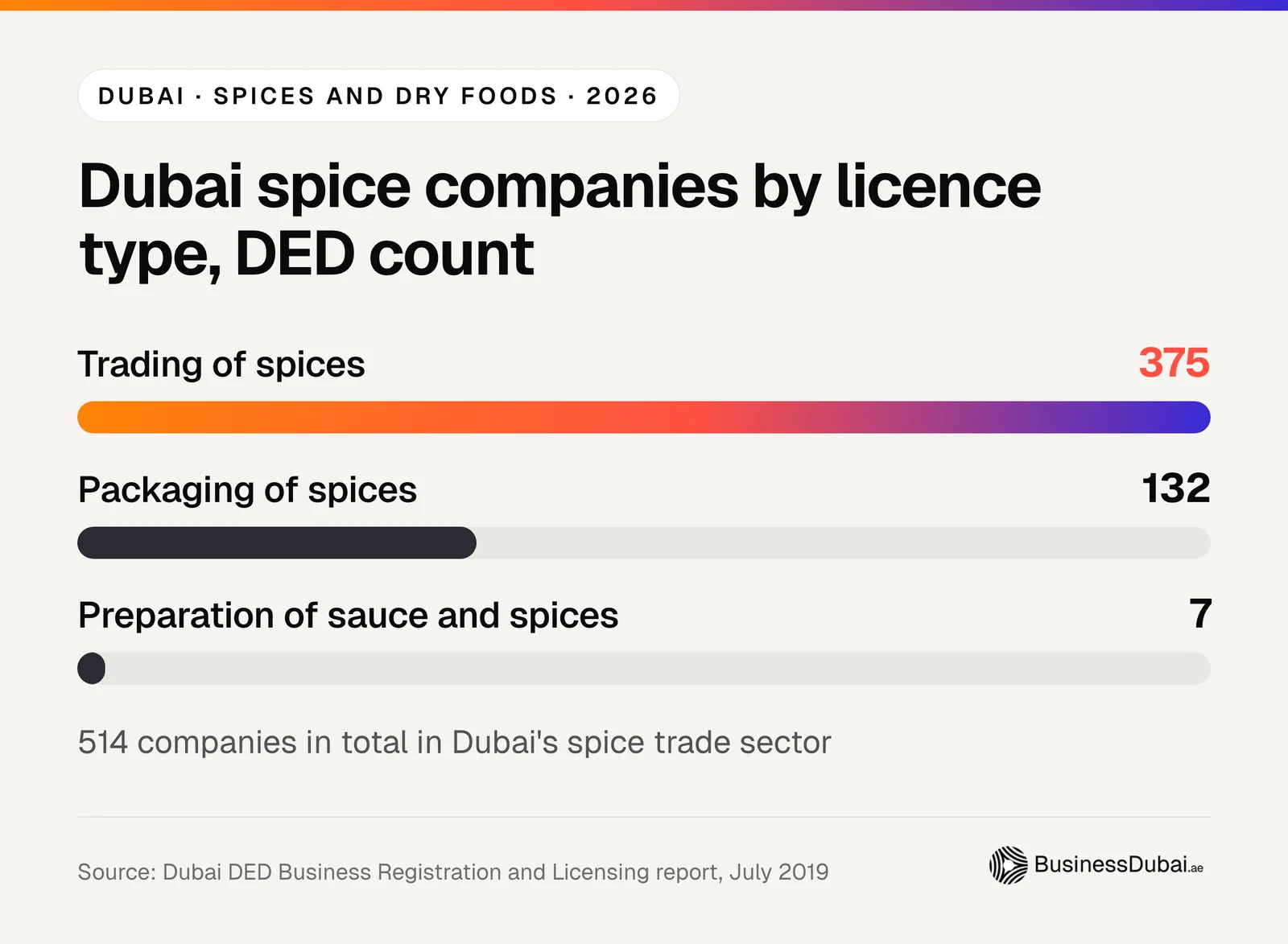
DED's Business Registration and Licensing sector reported in 2019 that "514 companies operate in the spice trade sector in Dubai": 375 licences for "Trading of spices", 132 for "Packaging of spices" and seven for "Preparation of sauce and spices" [1]. Indians led the investor nationalities, followed by Kuwaitis and Pakistanis [1]. BusinessDubai.ae found no newer published count, so treat it as a 2019 snapshot, and note the split between trading and packaging: it is the split the licence section below turns on.
India is the supply side. The Press Information Bureau reported on 1 May 2025 that India's spice exports reached USD 4.45 billion in 2024-25, and that the top 10 destinations, "China, USA, UAE, Bangladesh, Thailand, Malaysia, UK, Saudi Arabia, Indonesia, and Germany", accounted for over 60% of export earnings [5]. The UAE is named among them, listed after China and the USA.
Khaleej Times reported on 30 August 2022 that the Deira spice souk had an "estimated 200-plus shops" and that traders re-export saffron from Dubai to Europe, the Middle East and Asia [6]. Those are trader estimates as reported, not official figures.
Dubai is the wrong base for an exporter whose goods ship from origin to a third country and never land in the UAE: the company adds a licence without adding a market.
Which licence does a spice, nut or dried fruit trader need: trading, repacking, grinding or processing?
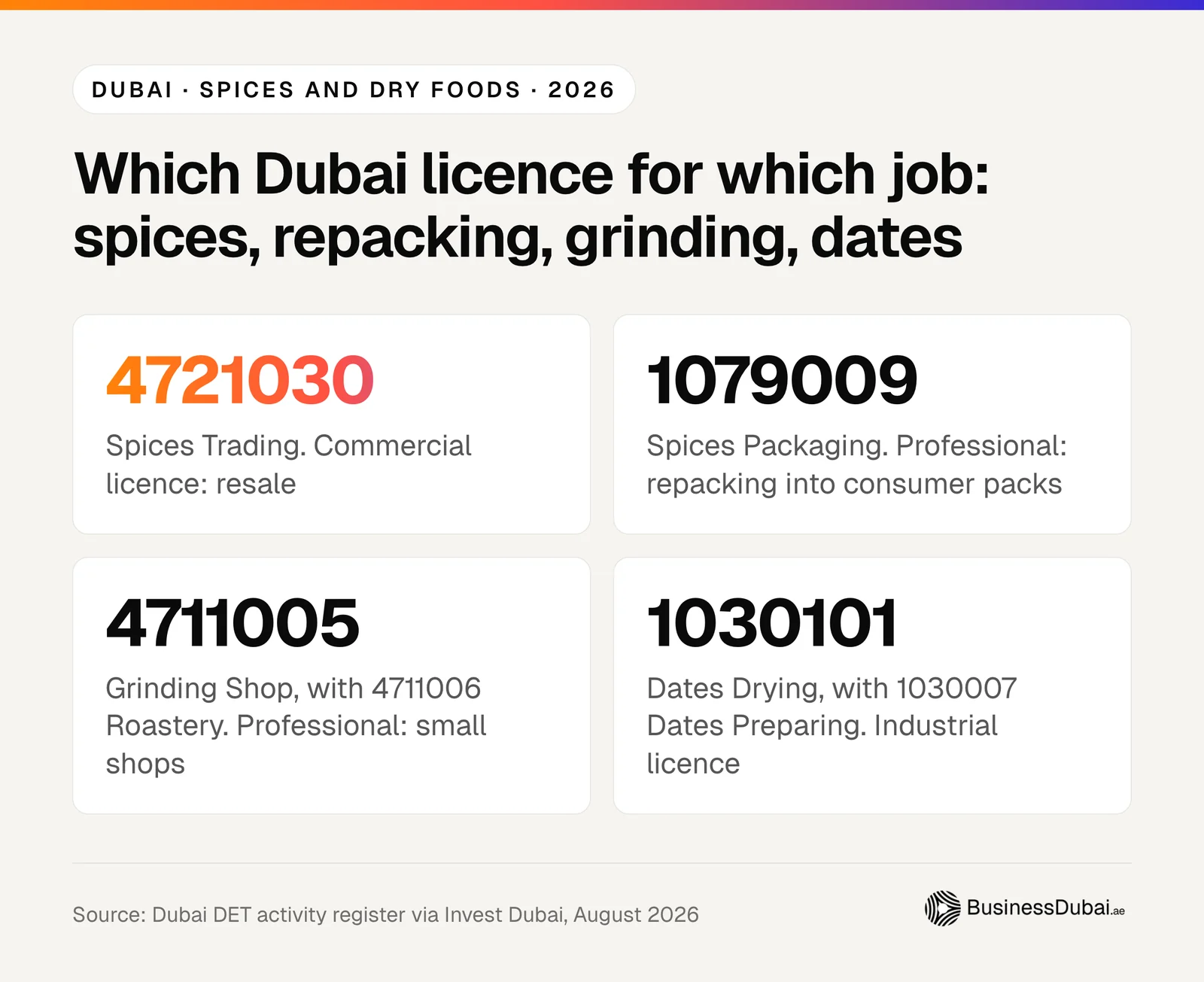
A Dubai spice or nut trader needs a Commercial trading code such as 4721030 Spices Trading, 4721039 Nuts Trading, 4721020 Dried Vegetables & Fruit Trading or 4721022 Dates Trading. Repacking spices into consumer packs sits on 1079009 Spices Packaging, a Professional code, and date drying and preparing sit on Industrial codes 1030101 and 1030007.
The DET register describes each activity in a sentence, and the sentence, not the name, decides what the licence covers [2]. Codes and descriptions are from the Invest Dubai register generated in August 2026; licence types are from BusinessDubai.ae's copy of the DET register, last updated in October 2023 [2].
| Code | Activity | Licence type | What it covers |
|---|---|---|---|
| 4721030 | Spices Trading | Commercial | "Includes reselling of dried, packed or preserved spices, whether as raw or after having been roasted, ground, blended or packed." |
| 4721039 | Nuts Trading | Commercial | Reselling nuts, raw or already roasted, salted or packed |
| 4721020 | Dried Vegetables & Fruit Trading | Commercial | Reselling dried fruit and vegetables, such as figs and apricots |
| 4721022 | Dates Trading | Commercial | "Includes reselling of all kinds of dates whether soft, semi crunchy or crunchy." |
| 4721041 | Natural Herbs Trading | Commercial | Reselling dried herbs, without processing |
| 1079009 | Spices Packaging | Professional | Re-packaging dried and powdered spices into sealed consumer packs |
| 1079007 | Nuts Roasting & Packaging | Professional | Roasting, salting and packing nuts |
| 1079006 | Herbs Packaging | Professional | Packaging herbs; the only description that names saffron |
| 4711005 | Grinding Shop | Professional | Small shops grinding spices for others or into consumer packs |
| 4711006 | Roastery | Professional | Small shops roasting nuts, coffee or spices into small packs |
| 1030101 | Dates Drying & Packaging | Industrial | Drying dates |
| 1030007 | Dates Preparing & Packaging | Industrial | Cleaning, drying and stuffing dates, then packing |
| 1030005 | Dry Fruit & Vegetables Packaging | Industrial | Drying fruit and vegetables with dryers |
| 1104906 | Sauces, Spreads & Condiments Preparation | Industrial | Preparing and packing spice mixes |
None of these codes carries an external approval flag in the DET register [2]. That describes the licence stage only; the food rules below apply whatever the code.
Four codes decide most spice businesses, and the licence class changes with the job, not with the product [2].
What the trading code covers, and what it does not say
Code 4721030 covers reselling spices "after having been roasted, ground, blended or packed" [2]. Read next to the separate codes for repacking, grinding and roasting, that describes reselling a product someone else has processed. The register does not say whether a 4721030 or 4721039 holder may itself repack, grind or roast, so confirm your code mix with DET before you buy a filling machine. Our food processing factory guide covers 1079009 at scale and the open question of whether the federal Industrial Production Licence applies to a packing activity.
Common Mistake: Repacking on a trading code because a setup page said a spices trading licence lets you repackage. DET gives re-packaging spices into sealed consumer packs its own Professional code, 1079009 Spices Packaging, and gives grinding and roasting their own shop codes [2]. A trader who buys 25 kg sacks of cumin and fills 100 g pouches is doing the job 1079009 describes. Ask DET in writing before the first pouch, because adding an activity later means a licence amendment.
Saffron and dates
There is no saffron code in the DET register. The nearest are 4721030 for resale and 1079006 Herbs Packaging, the only description that names saffron [2]. Dates have their own trading code, 4721022, and date processing sits on Industrial codes 1030101 and 1030007 [2]. Count your activities before choosing a package: BusinessDubai.ae's Meydan Free Zone, IFZA and Dubai South packages include three, SPC Free Zone five, and Ajman Free Zone and RAKEZ ten [26].
Should a spice or nut trader set up on the Dubai mainland or in a free zone?
A spice or nut trader selling to UAE supermarkets, wholesalers, restaurants and Deira souk shops usually fits a Dubai mainland licence, AED 18,200 without a visa or AED 26,900 with one on BusinessDubai.ae's 2026 prices. A re-exporter or bulk importer fits a free zone, from AED 12,500 licence-only at Meydan Free Zone.
The deciding questions are who pays you and where the goods sit. A mainland company can invoice any UAE buyer directly, including a supermarket chain or a shop in the Deira souk, which sits on the Dubai mainland. A free zone company selling into the mainland needs a mainland distributor or a mainland licence of its own; in return it gets zone storage, re-export and, for some businesses, a route to 0% corporate tax.
Our mainland company setup page itemises the DET route, including the year-two renewal, and our free zone company setup page compares the zones on price, activities and visa quota. The comparison uses BusinessDubai.ae's 2026 package prices [26], each zone's activity list [7] and the Designated Zone list [8].
| Factor | Dubai free zone | Dubai mainland (DET) |
|---|---|---|
| Licence, no visa | Meydan Free Zone or Dubai South AED 12,500; IFZA AED 12,900 (partner price) | AED 18,200 |
| Licence with one visa | Meydan Free Zone or Dubai South AED 21,850; IFZA AED 22,200 (partner price) | AED 26,900 |
| Selling to Dubai supermarkets, wholesalers and souk shops | Through a mainland distributor or a mainland licence | Direct |
| VAT Designated Zone for goods held in the zone | JAFZA and Ajman Free Zone; not Meydan Free Zone or IFZA | Not applicable |
| Route to 0% corporate tax | Qualifying activities, with conditions | None: ordinary rates or Small Business Relief |
| Year-two renewal | Roughly 80% of year one | About AED 15,000 |
The mainland is the simpler answer when your customers are UAE shops and supermarkets. A trader doing both can run a free zone stockholding company and a mainland company that buys from it.
Which free zones list spice, nut and dried fruit codes, and which flag an approval?
DMCC, IFZA, DWTC, Meydan Free Zone, JAFZA and Ajman Free Zone all list spice and nut trading codes, but approval flags differ. IFZA marks 4721030 Spices Trading for the Department of Food Control and DWTC marks its spice, nut, date and dried fruit codes for Dubai Municipality, while DMCC's 2026 list shows no flag.
The table compares the codes in each zone's own list, as compiled in BusinessDubai.ae's activity registers in August 2026 [7], with Designated Zone status [8] and BusinessDubai.ae's one-visa package price [26].
| Zone | Spice code | Nuts | Dried fruit | Dates | Approval flag in the list | VAT Designated Zone | One visa (AED) |
|---|---|---|---|---|---|---|---|
| DMCC | 4721030 | 4721039 | 4721020 | Not in the list | None | No | Quoted on request |
| IFZA | 4721030 | 4721039 | 4721020 | 4721022 | Department of Food Control | No | 22,200 (partner price) |
| DWTC | 5122-14 | 5122-21 | 5122-29 | 5121-05 | Dubai Municipality; "Outside UAE" variants carry none | Confirm with the zone | Quoted on request |
| Meydan Free Zone | 4721.86 | 4721.92 | 4721.83 | 4721.84 | None | No | 21,850 |
| JAFZA | 512214 | 512221 | 512229 | 512105 | None | Yes | Quoted by the zone |
| Ajman Free Zone (non-Dubai) | 4630122 | 4721039 | 4630132 | 4630119 | None | Yes | 13,931 |
Two details are worth reading closely. Ajman Free Zone's spice code is 4630122 Wholesale of Spice and Pepper Trading, worded for import and export, and it also lists 1079009 Spices Packaging [7]. JAFZA files Spices Packaging under 154907 as an Industrial activity, where DET treats 1079009 as Professional [7][2]: the same job can sit in a different licence class depending on where you license it.
Our guides to JAFZA, DMCC, Meydan Free Zone and Ajman Free Zone cover each zone. If a Dubai address is not essential, our business setup in Ajman page shows what Ajman Free Zone's AED 5,555 licence-only and AED 13,931 one-visa packages include, and SPC Free Zone, from AED 5,765 licence-only, is on our business setup in Sharjah page.
Common Mistake: Trusting a page that says nut trading needs "no third-party approval", or paying for a "Dubai Dry Fruit Import Export License". IFZA's own list flags its spice, nut, date and dried fruit codes for the Department of Food Control, and DWTC's flags Dubai Municipality [7]. DET has no licence by that name: the licence carries activity codes, and the food approvals run through FIRS whatever the code says [4]. Ask your zone in writing which approval its code carries before you pay.
How do spices, nuts and dried fruit clear into Dubai?
Spices, nuts, dried fruit and dates clear into Dubai through Dubai Municipality's Food Import and Re-export System (FIRS). The importer registers, every food item is registered individually, each consignment arrives with a health certificate from the origin country, and Food Control officers inspect at the port and take samples for laboratory analysis when necessary.
The Food Code is plain: "All imported or re-exported food items should be individually registered in the FIRS System." [4] At the port, "Authorised officers verify the document and collect samples for laboratory analysis when necessary", and "importers of food must submit the Health Certificates for each consignment" [4], issued by the origin country's food authority.
USDA's November 2025 report on UAE import rules says a product registering for the first time is tested at Dubai Municipality's Central Laboratory, based on safety risk and import frequency, and "It may take up to five working days to receive test results depending on the type of test." [9] It warns that "In the event an ingredient or additive is detected but not included on the label, the food item will be rejected." [9] And pack sizes are separate products: "Different packaging of the same food item (for example, one 100-gram package and one 200-gram package) are considered different food items and must be registered separately." [9]
Our Dubai customs registration guide covers the importer code, and our food trading company guide general food import practice. Plain spices, nuts and dried fruit do not need halal certificates: the Food Code requires them for processed meat and foods containing meat, poultry or animal-origin ingredients [4], and our halal certification guide covers the exceptions.
Pro Tip: Register every product, in every pack size, in FIRS before the first container sails. Dubai Municipality lists one working day for item registration and five working days for registration with label assessment [10], and a first-time item may then wait up to five working days for laboratory results [9]. A container that lands before its products are registered waits at the port while you catch up, and a 500 g and a 1 kg pack of the same cumin are two registrations, not one.
Do spices and nuts need a MoCCAE import permit or a phytosanitary certificate?
BusinessDubai.ae found no Ministry of Climate Change and Environment (MoCCAE) permit service for dried spices, nuts, dried fruit or dates imported as food. MoCCAE's import permit covers seeds and tubers, seedlings, plants, palm seedlings and honey bees. Confirm with MoCCAE, and with your supplier, whether a phytosanitary certificate will be asked for.
MoCCAE's import permit page covers an agricultural consignment of "seeds & tubers, seedlings & plants & palm seedlings, and honey bees", and its release service covers cut flowers, fresh fruit and vegetables, raw timber and fodder of plant origin [11]. Neither names dried spices, nuts, dried fruit or dates sold as food. For food, the Food Code's port document is the health certificate [4].
That is a finding, not a ruling, and a buyer or clearing agent may still ask for a phytosanitary certificate. Keep seeds for sowing and spice seeds for food on different descriptions and HS lines, because planting material is MoCCAE's business, and ask MoCCAE in writing what your product needs.
Common Mistake: Following a page that says the Ministry of Health and Prevention (MOHAP) governs spice import permits. No such permit service appears in the official sources this guide used. For food entering Dubai, the documented route is Dubai Municipality: FIRS registration, a health certificate per consignment and port inspection [4]. Build the import file around that route rather than paying an agent for a permit nobody asked for.
What aflatoxin and ochratoxin limits apply to nuts, dried fruit and spices in the UAE?
The UAE's contaminant limits sit in GSO 193:2021, Contaminants and toxins in food and feed, the current Gulf Technical Regulation, approved on 1 July 2021. Its published August 2019 draft set total aflatoxin at 10 micrograms per kilogram for ready-to-eat almonds, hazelnuts and pistachios and for spices such as pepper and turmeric.
The GCC Standardization Organization's store lists GSO 193:2021 as the "Current Edition" and the older aflatoxin standard, GSO 841:1997, as "Historical" [12], and USDA lists UAE.S GSO 193:2021 among UAE standards [9]. The adopted text is sold by GSO and BusinessDubai.ae could not read it. The readable text is the August 2019 draft, which states that it cancels and replaces GSO 841:1997 [13]. Its figures below are draft numbers, so have your laboratory test against the adopted values.
| Product | Contaminant | Draft maximum level (µg/kg) | Applies to |
|---|---|---|---|
| Almonds, hazelnuts, pistachios, shelled Brazil nuts | Total aflatoxins | 10 | Ready-to-eat |
| Almonds, hazelnuts, pistachios, shelled Brazil nuts | Total aflatoxins | 15 | Intended for further processing |
| Dried figs | Total aflatoxins | 10 | Ready-to-eat |
| Spices: capsicum, pepper, nutmeg, ginger, turmeric and mixes | Total aflatoxins | 10 | Whole commodity |
| Dried vine fruit: raisins, currants, sultanas | Ochratoxin A | 10 | Whole commodity |
| Spices: pepper, nutmeg, ginger, turmeric, capsicum and mixes | Ochratoxin A | 15 | Whole commodity |
The draft treats a lot as for further processing only if it will undergo a treatment proven to reduce aflatoxins, such as shelling, blanching followed by colour sorting, or sorting by specific gravity and colour [13]. A trader selling to a sorter may buy to the higher level; one selling packs to shops buys to the lower. Saffron, cumin, coriander and cardamom are not named in the draft's spice rows, so ask your laboratory which limit it applies. Pesticide residues are a separate test: USDA reports that UAE.S MRL 1/2024, published in December 2024, added an annex referencing Codex limits first, then EU, then US, which it describes in connection with rice [9]. Ask which reference your laboratory applies.
Real Talk: Aflatoxin is the contaminant that decides whether a nut or spice lot is worth buying. The moulds that produce it grow in warm, damp conditions, so a lot can deteriorate between harvest, drying, storage and shipment. Make a pre-shipment certificate of analysis from an accredited laboratory, testing aflatoxins and ochratoxin A against the GSO 193:2021 limits on a properly drawn sample, a condition of the contract and of payment.
Does the UAE ban ethylene oxide in spices?
BusinessDubai.ae found no published UAE numeric limit for ethylene oxide in spices, and no official ban text. When Indian spice products were withdrawn abroad in April 2024, Dubai Municipality told Khaleej Times that its routine testing of food "did not reveal anything that should be a cause of concern", adding that it was aware of the recalls abroad and that routine protocols would be followed.
Khaleej Times reported on 29 April 2024 that Hong Kong and Singapore had banned four spice products from popular Indian brands over ethylene oxide, and quoted Dubai Municipality: "The regular, routine testing that we perform on all food items in the country did not reveal anything that should be a cause of concern" [14]. It added: "However, we are fully aware of the global notification and recalls and routine protocols will be followed." [14]
That statement is not a limit. Buy from exporters who do not fumigate with ethylene oxide, and where a buyer or a re-export market asks, have the laboratory report ethylene oxide, including its breakdown product 2-chloroethanol, on the certificate of analysis.
Irradiated spices
GSO 9/2013 requires an irradiated food to carry a written statement of the treatment close to the food name and the international food irradiation symbol, and a single-ingredient product made from irradiated raw material to say so in its ingredient list [15]. Ask your supplier in writing whether any lot was irradiated before you print labels.
What labelling rules apply to bulk sacks versus consumer packs?
Dubai Municipality does not require label assessment for bulk seeds, pulses, nuts, grains, oils and honey, or for non-retail goods for manufacturing, according to its December 2023 guide. Consumer packs need label assessment against UAE.S 9:2019 with Arabic mandatory, and products carrying claims, and locally produced items, always need it.
The guide's exempt list also covers fresh produce and food additives, while products with claims, such as high protein, and locally produced items always need assessment [10]. Mandatory label information follows UAE.S 9:2019, and "The mandatory language is Arabic and English is optional." [10] Spices and dried fruit are not named in the bulk line, so a bulk spice importer selling sacks to a repacker should ask Dubai Municipality whether the for-manufacturing exemption fits. Registration is never exempt: every item is still registered in FIRS [4].
| Point | Bulk sacks to traders or packers | Consumer packs for shops |
|---|---|---|
| FIRS registration | Each item | Each item and each pack size |
| Label assessment | Not needed for bulk nuts, seeds, pulses, grains or non-retail goods; confirm for spices | Needed |
| Label content | As agreed with the buyer | UAE.S 9:2019 fields, Arabic mandatory |
| Licence | Trading code | Trading code, plus 1079009 or 1079007 if you pack |
| 0% commodity tax route | Not excluded by the retail wording | Excluded as "packaged for retail sale" |
GSO 9/2013 lets some products show the production or harvest year instead of an expiry date, including dried vegetables, medicinal plants and herbs such as anise, chamomile, clove and saffron, loose tea, dry cereals and dried legumes, and it does not allow dates to be added by sticker [15]. It lists "Peanuts, soybeans and their products." and "Walnuts and their products." among the allergens a label must declare [15]. Dubai Municipality now cites UAE.S 9:2019 [10], so confirm both clauses in the current edition before you design packs. Our food labelling requirements guide covers date formats and Arabic stickers.
Pro Tip: Upload the label artwork for assessment exactly as it will print: barcode, net weight, ingredient spelling and origin. Dubai Municipality's own guide warns that "Unclear image and incomplete information will always be reason of rejection." [10] A clear artwork file with every mandatory field visible is the cheapest way to save a five-day assessment from a second round.
What customs duty applies to spices, nuts, dried fruit and dates in Dubai?
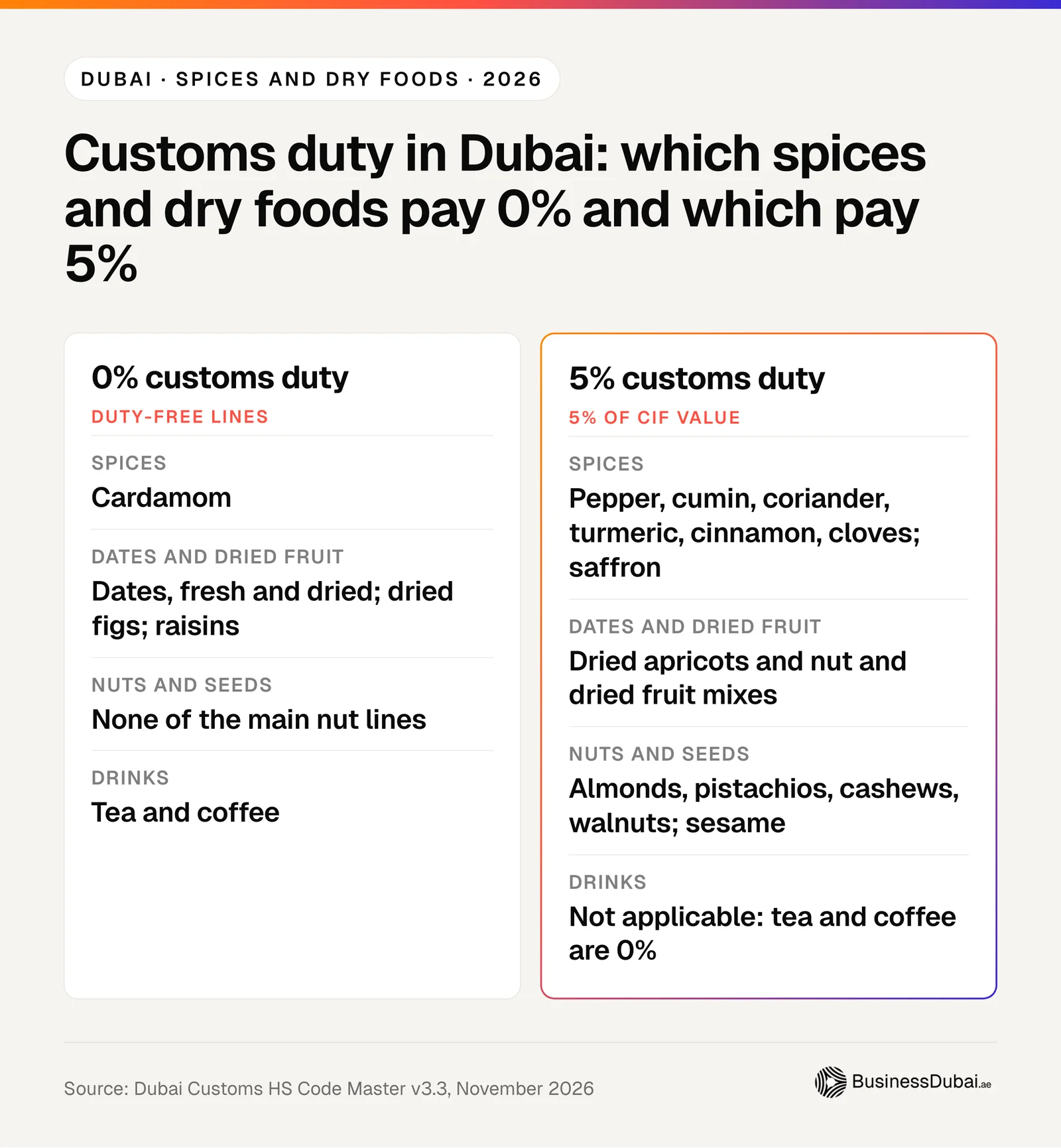
Dubai Customs charges 5% of CIF value on most spices and nuts, including pepper, cumin, coriander, turmeric, saffron, almonds, pistachios and cashews, but 0% on cardamom, dates, dried figs, raisins, tea and coffee, according to its HS Code Master v3.3, dated 16 November 2026. Dried apricots, nut and dried fruit mixes and sesame pay 5%.
Dubai Customs states the general rule as "5% of the value CIF (Cost Freight Insurance) value except for alcohol and cigarettes/tobacco" [16]. Food has many exceptions, and this trade sits on both sides of the rule. The rates below are read line by line from the HS Code Master v3.3 [3].
| Product | HS lines | Duty |
|---|---|---|
| Cardamom | 0908 31, 0908 32 | 0% |
| Dates, fresh and dried, including pressed and stuffed | 0804 10 | 0% |
| Dried figs | 0804 20 20 | 0% |
| Raisins | 0806 20 | 0% |
| Tea and coffee | 0901, 0902 | 0% |
| Pepper, whole and ground | 0904 11, 0904 12 | 5% |
| Cinnamon, cloves, nutmeg and mace | 0906, 0907, 0908 | 5% |
| Coriander, cumin, anise and fennel seeds | 0909 | 5% |
| Ginger, saffron, turmeric, fenugreek, thyme, curry and spice mixtures | 0910, saffron at 0910 20 | 5% |
| Almonds, hazelnuts, walnuts, pistachios, pine nuts and other nuts | 0802 | 5% |
| Cashews, in shell and shelled | 0801 31, 0801 32 | 5% |
| Dried apricots, dried cherries and mixtures of nuts and dried fruit | 0813 | 5% |
| Sesame seeds | 1207 40 | 5% |
None of the main nut lines is at 0%, and cardamom is the only spice that is. USDA also notes that repacked or partly offloaded shipments moving on to another GCC state may face a further 5% duty at their destination [9].
Quick Math: A container of cumin with a CIF value of AED 400,000 pays AED 20,000 in customs duty at 5% [3][16]. The same CIF value of cardamom pays nothing, because cardamom lines 0908 31 and 0908 32 carry 0% [3]. Duty on a mixed container is worked line by line, so a trader pricing cumin and cardamom at one average rate either overcharges the cardamom buyer or loses up to AED 20,000 of margin on the cumin.
What does the India-UAE CEPA change for spice and nut imports?
The India-UAE CEPA, in force since 1 May 2022, can remove the 5% duty on qualifying Indian goods, but only with an Indian certificate of origin and direct shipment. Spices must meet a change of tariff subheading plus 40% value added, nuts must be wholly obtained, and cardamom, dates, raisins and figs already pay 0%.
Dubai Customs Policy No. 54 of 2022 requires that "The products should be shipped directly from the territory of one Party to the territory of the other Party", with transit allowed only under customs control, and that Indian goods be "accompanied with a certification of origin issued by the competent authorities in the Republic of India" [17]. Goods listed in Category (H) of Annex 2B are excluded from the agreement altogether [17].
The rules of origin decide whether a spice or nut counts as Indian in the first place [18].
| Chapter or line | Description in the rules | Rule of origin | Dubai duty without CEPA |
|---|---|---|---|
| Ex Chapter 8 | "Edible fruit and nuts; peel of citrus fruits or melons." | "WO" (wholly obtained) | 5% on nuts and dried apricots; 0% on dates, figs and raisins |
| 080132 | "Shelled (Cashew kernel)" | "CTSH" | 5% |
| Chapter 9 | "Coffee, tea, maté and spices." | "CTSH + VA 40%" | 5% on most spices; 0% on cardamom, tea and coffee |
| Chapter 12 | Oil seeds and miscellaneous grains, seeds and fruit | "WO" | 5% on sesame |
CTSH means a change to the subheading from any other subheading, and for value added "The percentages are on an FOB basis." [18] The Indian rules list the Spices Board as an issuing authority for certificates of origin for "Spices and Cashewnuts" [18].
We could not read the UAE's Annex 2B rows for chapters 8, 9 and 12, so this guide cannot say which spice or nut lines the UAE eliminated, phased or excluded: check your line in the schedule before you price on a CEPA rate. The most CEPA can save on a 5% line is that 5%. One inference, our reading rather than a ruling: grinding pepper or blending a masala in Dubai may move a product to a new subheading, but Chapter 9 also asks for 40% value added, so the operation alone does not make Indian spices UAE-origin.
Common Mistake: Spending weeks on CEPA paperwork for goods that already pay 0%. Cardamom, dates, raisins and dried figs carry no customs duty in Dubai [3], so a certificate of origin saves nothing on them. Some pages claim CEPA removed duty on most Indian spice lines; BusinessDubai.ae found no source for that. Check your HS line in the UAE schedule first.
How do you trade saffron from Dubai?
Dubai has no saffron activity code: a saffron trader licenses on 4721030 Spices Trading for resale, adds 1079006 Herbs Packaging if it packs, and pays 5% customs duty under HS 0910 20. Buy against an ISO 3632 laboratory certificate, because Dubai has a recorded history of saffron adulterated with dyed corn.
Saffron sits in HS 0910 20 at 5% duty [3], is licensed on 4721030 for resale and 1079006 for packing [2], and may show a production or harvest year instead of an expiry date under GSO 9/2013 [15]. ISO 3632-1:2025 is the current ISO edition of the saffron specification, while GSO lists its Gulf adoption, GSO ISO 3632-1:1997, as "Historical" [19]. BusinessDubai.ae found no UAE standard adopting ISO 3632, so write the edition and the laboratory into the purchase contract.
Fraud is why that matters. The National reported on 5 July 2011 that Dubai Police arrested four men in two operations, and that "The first gang was found to be mixing real, imported saffron with corn grains that were dyed red"; that gang was arrested in Deira [20]. Gulf News published an explainer on 2 February 2022 on corn silk threads sold as saffron [21]. Traders told Khaleej Times in 2022 that "90% of saffron available in the souq comes from Iran" [6]. If your saffron or pistachios are of Iranian origin, ask your bank before the first payment how it treats such goods, because that decides whether the trade can be financed.
Pro Tip: Buy saffron lot by lot against an ISO 3632 test report from an independent laboratory, and match the lot number on the report to the lot number on the tin. Saffron is light and valuable, so a few grams of corn silk or dyed fibre in a kilo changes the margin, while the duty and registration cost per kilo stay the same whether the saffron is real or not. Keep the reports on file for re-export buyers.
Can a spice or nut trader pay 0% corporate tax in a UAE free zone?
A free zone spice or nut trader may reach 0% corporate tax as a Qualifying Free Zone Person through Trading of Qualifying Commodities or Designated Zone distribution under Ministerial Decision No. 229 of 2025. Whether any spice or nut has a Quoted Price is untested, and products packaged for retail sale are excluded from the commodities route.
Article 1 of the Decision defines the category [22]:
"Qualifying Commodities: Means the following commodities provided a Quoted Price for such commodities exists: 1. Metals, minerals, industrial chemicals, energy and agriculture commodities and Associated By-products, excluding products packaged for retail sale and any other products specified in a decision issued by the Minister."
A Quoted Price is the "Price of the Qualifying Commodity or a Related Commodity specified by a Recognised Commodity Exchange Market or a recognised price reporting agency specified by a decision issued by the Minister." [22] A Related Commodity is "Any commodity that is listed in the same chapter in the Common Schedule for Classification and Coding of Goods as a Qualifying Commodity that has a Quoted Price." [22] Ministerial Decision No. 230 of 2025 lists 13 recognised price reporting agencies, and Expana is one of them [23].
Expana's own pages, read on 24 November 2026, describe "161 industry-leading nut price series", including "64 proprietary Expana Benchmark Prices", and "11 leading cumin price series" [24]. Its December 2025 benchmark specifications cover black pepper, including Indian pepper, nuts, raisins, sultanas and dried apricots; cumin, cardamom and turmeric sit outside its spices benchmark, and we found none for dates, saffron or sesame [24].
Four questions are open, and this guide does not answer them: whether an Expana price counts as a Quoted Price for a spice or nut; whether cumin or dates can borrow the price of pepper or almonds as a Related Commodity in the same chapter, a reading our rice and grains trading guide treats as arguable, not settled; whether Indian exchange prices count; and what "packaged for retail sale" covers by pack size. The route also closes to a company earning 51% or more of its revenue from distribution, warehousing, logistics or inventory management [22].
The second route: Designated Zone distribution
Article 2(1)(l) makes distribution in or from a Designated Zone a qualifying activity where the goods enter the UAE through the zone and go to a customer who resells, processes or alters them [22]. It has no Quoted Price test, but it does not cover sales to consumers. JAFZA and Ajman Free Zone are Designated Zones; Meydan Free Zone and IFZA are not [8]. Non-qualifying revenue must stay within the lower of 5% of revenue or AED 5,000,000, and a company that fails a condition pays ordinary rates, 0% to AED 375,000 and 9% above, from the start of that period and is barred for the following four [22][26].
| Tax route | What the rule says | Fit for a spice, nut or dried fruit trader |
|---|---|---|
| Ordinary rates | 0% up to AED 375,000 of taxable income, 9% above | The default for mainland traders and retail packers |
| Small Business Relief | Revenue at or under AED 3,000,000; periods ending on or before 31 December 2029 | A small trader's early years; not for a Qualifying Free Zone Person |
| Trading of Qualifying Commodities | A Quoted Price exists; not retail-packed; distribution and warehousing revenue under 51% | Untested for spices and nuts; take advice first |
| Designated Zone distribution | Imported through a Designated Zone; sold to a customer who resells, processes or alters | JAFZA or Ajman Free Zone importers selling bulk to repackers and wholesalers |
Quick Math: A mainland spice trader with AED 800,000 of taxable profit pays nothing on the first AED 375,000 and 9% on the remaining AED 425,000, which is AED 38,250 [25]. If its revenue is AED 3,000,000 or less, it can instead elect Small Business Relief for periods ending on or before 31 December 2029 [25]. A free zone company that claims qualifying status and fails pays the same ordinary AED 38,250 from the start of that period, and loses the status for four more.
Real Talk: For a business that packs spices for UAE supermarket shelves, plan on ordinary rates or Small Business Relief and treat 0% as upside that has to be proven. The commodities route turns on two untested readings for this trade: whether a spice or nut has a Quoted Price, and where "packaged for retail sale" begins. A wrong claim costs the status for five tax periods.
VAT on spice and dry fruit sales
Sales of spices, nuts, dried fruit and dates in the UAE are standard-rated for VAT at 5%, because the UAE has no zero rate for basic food; exports are zero-rated when the export conditions are met, and registration is mandatory above AED 375,000 of taxable supplies [8]. Our guides to VAT registration, the Qualifying Free Zone Person conditions and Small Business Relief cover each in full. To test your model against both routes before you choose a zone, model your tax position→
What does a spice or dry fruit trading company cost in its first year?
A Dubai spice trading company costs AED 12,500 licence-only or AED 21,850 with one visa at Meydan Free Zone or Dubai South, and AED 18,200 without a visa or AED 26,900 with one on the Dubai mainland, on BusinessDubai.ae's 2026 package prices. Product registration, laboratory tests, warehousing and duty are separate.
The packages are company formation only. The lines that scale with the business are priced by the authority, laboratory or landlord concerned, and the table says so rather than guessing [26].
| Cost item | Amount (AED) | Notes |
|---|---|---|
| Meydan Free Zone or Dubai South | 12,500, 21,850 or 28,400 | Licence only, one visa or two visas; three activities |
| IFZA | 12,900 or 22,200 | Licence only or one visa; partner prices, as IFZA publishes none |
| Dubai mainland (DET) | 18,200 or 26,900 | No visa or one visa; sells directly to UAE shops |
| Ajman Free Zone (non-Dubai) | 5,555, 13,931 or 17,971 | Licence only, one visa or two visas; a Designated Zone |
| RAKEZ (non-Dubai) | 6,010, 12,810 or 18,810 | Licence only, one visa or two visas |
| SPC Free Zone, Sharjah (non-Dubai) | 5,765, 15,055 or 19,505 | Licence only, one visa or two visas |
| DMCC, DWTC or JAFZA | Quoted by the zone | No BusinessDubai.ae package price |
| FIRS registration and label assessment | Dubai Municipality quote | Per item and per pack size |
| Laboratory tests | Laboratory quote | Aflatoxins, ochratoxin A, pesticides and, where asked, ethylene oxide |
| Warehouse | Landlord quote | Not in any package |
| Customs duty | 0% or 5% of CIF value | By HS line |
| Year two, free zone renewal | Roughly 80% of year one | Ask for the standard renewal price, not the launch price |
| Year two, mainland renewal | About 15,000 | BusinessDubai.ae mainland package |
The licence lines differ by a few thousand dirhams, once; stock, duty, testing and storage scale with every container. If you will hold nuts or dates through a Dubai summer, our cold storage warehouse guide covers what a temperature-controlled food store involves. Year two adds a calendar of licence and visa renewals, new FIRS registrations and tax returns, and our post-setup services team runs it so a renewal does not land in the middle of a container season.
Real Talk: IFZA and Meydan Free Zone now require a shareholder applying for an investor visa to show capital of at least AED 75,000 in a bank account, in the UAE or in the home country [26]. Next to the value of one container of pistachios or saffron it is a small sum, but no package price shows it, so have it in place before you apply.
For a quote that prices the licence, the visas and the zone that fits your product range, get an itemised setup quote→
What are the steps to open a spices trading company in Dubai?
Opening a Dubai spice trading company runs in seven steps: list every product and process, choose mainland or free zone, license with the right codes, register with Dubai Customs, register as a food importer and register each product in FIRS, line up laboratory testing and labels, then ship. Dubai Municipality lists five working days for label assessment.
- List every product and process. Resell only, or also repack, grind, roast or dry; this list decides the codes [2].
- Choose mainland or a free zone. Mainland for UAE shops and supermarkets; a Designated Zone such as JAFZA or Ajman Free Zone to hold stock for re-export [8].
- License with the right codes, and confirm the mix with DET or the zone [2][7].
- Register with Dubai Customs for an importer code.
- Register as a food importer and register each product in FIRS, each pack size separately: one working day for registration, five with label assessment [10].
- Line up testing and labels. Agree the pre-shipment certificate of analysis, and expect a first-registration test with results in up to five working days [9].
- Ship with a health certificate per consignment, plus an Indian certificate of origin if you claim CEPA [4][17].
Steps 4 to 6 can run in parallel once the licence is issued, so ask suppliers for label artwork and test reports while the licence is still in progress.
Which setup fits your spice, nut or dried fruit business?
The right setup depends on what you do between buying and selling: resell, repack, roast or process. An Indian exporter, an Iranian saffron trader, an Afghan dried fruit importer, a supermarket repacker, a nut roastery and a dates exporter each need different codes, a different base and a different first compliance task.
The table maps six common profiles to codes, base and the point most likely to cause trouble [2][7][3].
| Profile | Codes | Likely base | Watch first |
|---|---|---|---|
| Indian spice exporter opening a Dubai arm | 4721030; 4721039 for nuts | Mainland for UAE shops; JAFZA or Ajman Free Zone for re-export | FIRS before shipping; CEPA only on 5% lines |
| Iranian saffron and pistachio trader | 4721030, 4721039; 1079006 to pack saffron | By customer | ISO 3632 reports, pistachio aflatoxin, bank view of Iranian-origin goods |
| Afghan dried fruit importer | 4721020, 4721039 | Free zone for bulk, mainland for shops | Raisins 0%, dried apricots 5%; consumer-pack labels |
| Repacker supplying supermarkets | Trading codes plus 1079009 or 1079007 | Mainland | Every pack size registered; outside the commodities route |
| Nut roastery shop | 4711006 Roastery | Mainland shop | Scale beyond a shop is a factory question |
| Dates exporter | 4721022; 1030101 or 1030007 to dry or stuff | JAFZA or Ajman Free Zone | 0% duty; Industrial licence to process |
If your profile sits between two rows, ask whether you change the product or only move it: changing it adds a Professional or Industrial code; moving it does not.
Real Client Stories
These are composite examples built from the situations spice, nut and dried fruit traders most often face in Dubai. Names and details are illustrative, and the only figures used are published duty rates and BusinessDubai.ae's package prices.
The cardamom exporter who found the duty was already zero (IFZA)
A Kerala cardamom exporter opened a Dubai distribution arm in IFZA, at a partner package price of AED 22,200 with one visa, selling to Dubai wholesalers through a mainland distributor. He had planned his first year around CEPA certificates of origin. Then his clearing agent pointed out that Dubai Customs already charges 0% on cardamom under HS 0908 31 and 0908 32, so the certificate saved nothing on his main line. What held his first container was FIRS: his 50 g, 100 g and 1 kg packs were three separate items, each needing registration before clearance. Lesson: check the duty line before chasing a preference, and register every pack size before you ship.
The dried fruit importer whose sacks and packs were treated differently (Meydan Free Zone)
An Afghan importer of raisins, dried apricots and almonds set up in Meydan Free Zone at BusinessDubai.ae's package price of AED 21,850 with one visa, selling bulk to mainland wholesalers. His almond sacks needed no Dubai Municipality label assessment, because bulk nuts are exempt. When a wholesaler asked for 250 g retail packs of raisins and apricots, each pack needed registration, label assessment and an Arabic label before it could reach a shelf. He also found that raisins pay 0% customs duty while dried apricots pay 5%, which changed his pricing. Lesson: treat the sack and the shelf pack as two products, with two sets of paperwork.
The trader who started packing cumin on a trading licence (Dubai mainland)
A spice trader on the Dubai mainland, licensed on 4721030 Spices Trading at BusinessDubai.ae's package price of AED 26,900 with one visa, began buying 25 kg sacks of cumin and filling 100 g packs for local supermarkets. Nobody had checked that the DET register gives re-packaging spices into sealed consumer packs its own Professional code, 1079009. When a supermarket buyer asked for the licence before listing the packs, the activity was not on it, and the licence had to be amended before the first order shipped. Each pack size also needed its own registration and label assessment. Lesson: list every process, not just every product, when you choose your codes.
Start your spices and dry foods trading company the right way
For a spice, nut or dried fruit trader, the licence is the cheap decision. The ones that decide the business are whether your codes match what you do to the product, whether every product and pack size is registered before the container sails, whether your supplier tests to the GSO 193:2021 limits, and which of your lines pay 0% and which pay 5%. The 0% corporate tax routes are worth examining for bulk traders in a Designated Zone, and worth treating as unproven for anyone packing for retail shelves.
BusinessDubai.ae has set up trading companies on the Dubai mainland and in the UAE's free zones since 2013, with itemised pricing and no hidden fees. We will price a mainland company setup against a free zone company setup on the points that differ for a spice trader: whether you sell to UAE shops directly, whether you hold stock for re-export and whether a packing code belongs on the licence. Our post-setup services team then handles renewals, visas and the filing calendar.
Founders from India and Pakistan can also read our setup guides for Indian entrepreneurs and Pakistanis, and coffee traders our coffee trading business guide.
Frequently Asked Questions
What licence do I need to trade spices in Dubai?
A Dubai spice trader needs a Commercial licence carrying 4721030 Spices Trading from the Department of Economy and Tourism, or the free zone equivalent, such as 4721.86 at Meydan Free Zone or 512214 at JAFZA. Add 4721039 for nuts, 4721020 for dried fruit and 4721022 for dates.
Is there a separate activity code for saffron in Dubai?
No. The DET register has no saffron code as of 2026. A saffron trader uses 4721030 Spices Trading for resale, and 1079006 Herbs Packaging, the only description that names saffron, if it packs. Confirm the combination with DET.
Can I trade nuts, dried fruit and dates on one licence?
Yes. A nuts trading licence and a dry fruits trading business can sit on one licence if it carries every code: 4721039, 4721020 and 4721022 alongside 4721030 for spices. Check the activity allowance first, because Meydan Free Zone and IFZA packages include three activities and Ajman Free Zone ten.
Can I repack spices into small packs on a spices trading licence?
Not safely. The DET register gives re-packaging spices into sealed consumer packs its own Professional code, 1079009 Spices Packaging, and does not say whether a 4721030 holder may repack. Ask DET in writing and add 1079009 if you will fill retail packs.
What licence do I need to grind or roast spices or nuts in Dubai?
A small shop that grinds spices fits 4711005 Grinding Shop, and one that roasts nuts, coffee or spices into small consumer packs fits 4711006 Roastery, both Professional. Roasting, salting and packing nuts in sealed packs has its own Professional code, 1079007 Nuts Roasting & Packaging.
Do I need Dubai Municipality approval to trade spices in a free zone?
It depends on the zone. IFZA's list flags its spice, nut, date and dried fruit codes for the Department of Food Control and DWTC's flags Dubai Municipality, while DMCC's and Meydan Free Zone's show none. Every food importer still registers in FIRS.
What is FIRS and why does it matter for spice and dry fruit importers?
FIRS is Dubai Municipality's Food Import and Re-export System. The Food Code requires every imported or re-exported food item to be registered in it individually, and USDA reports that different pack sizes count as different items. An unregistered product cannot clear.
Does Dubai Municipality test every spice shipment?
Not every shipment. The Food Code says officers collect samples for laboratory analysis when necessary. USDA reports that products registering for the first time are tested at Dubai Municipality's laboratory based on risk and import frequency, with results in up to five working days.
Do I need a MoCCAE permit or phytosanitary certificate to import spices or nuts?
BusinessDubai.ae found no MoCCAE permit service for dried spices, nuts, dried fruit or dates imported as food; its import permit covers seeds and tubers, seedlings, plants, palm seedlings and honey bees. Ask MoCCAE and your supplier in writing whether a phytosanitary certificate will be needed.
Do bulk nuts need label approval in Dubai?
No. Dubai Municipality's December 2023 guide lists bulk seeds, pulses, nuts, grains, oils and honey among items that do not need label assessment. Each item is still registered in FIRS, and retail packs of the same nuts do need assessment.
Do spices need halal certification in the UAE?
Plain spices, nuts and dried fruit do not normally need a halal certificate to enter Dubai. The Food Code requires halal certificates for processed meat and for foods containing meat, poultry or ingredients of animal origin, so a spice mix with an animal-derived ingredient changes the answer.
What aflatoxin limit applies to pistachios, almonds and spices in the UAE?
The UAE applies GSO 193:2021, whose adopted text is sold by GSO. Its published 2019 draft set total aflatoxins at 10 micrograms per kilogram for ready-to-eat almonds, hazelnuts and pistachios, 15 for nuts intended for further processing, and 10 for spices such as pepper and turmeric. Test against the adopted values.
Does the UAE ban ethylene oxide in spices?
BusinessDubai.ae found no published UAE numeric limit or ban text for ethylene oxide in spices as of 2026. In April 2024 Dubai Municipality said its routine testing had revealed nothing of concern and that it was following the global recalls.
Can spices and saffron show a harvest year instead of an expiry date?
Under GSO 9/2013, dried vegetables, medicinal plants and herbs such as anise, clove and saffron, loose tea and dry cereals may show the production or harvest year instead of an expiry date. Dubai Municipality now cites UAE.S 9:2019, so confirm the clause in the current edition.
Do nut products need an allergen warning on UAE labels?
Yes for peanuts and walnuts, which GSO 9/2013 lists among the allergens a label must declare. Check the allergen list in the current UAE.S 9:2019 edition before printing packs that contain other nuts.
What is the customs duty on spices and nuts in Dubai?
Most spices and nuts pay 5% of CIF value in Dubai, including pepper, cumin, turmeric, saffron, almonds, pistachios and cashews, according to Dubai Customs' HS Code Master v3.3 of November 2026. Cardamom is the exception among spices, at 0%, and no main nut line is at 0%.
Is customs duty zero on dates, raisins and cardamom?
Yes. Dubai Customs' HS Code Master v3.3 shows 0% on dates, fresh and dried, on raisins, dried figs and cardamom, and on tea and coffee. Dried apricots and other dried fruit under heading 0813 pay 5%.
Does CEPA remove duty on Indian spices imported into Dubai?
The India-UAE CEPA can remove the 5% duty on an Indian spice line if that line is in the UAE's elimination schedule, the goods ship directly and they carry an Indian certificate of origin. Spices must meet a change of subheading plus 40% value added.
Does grinding or blending Indian spices in Dubai make them UAE-origin?
Not on its own, in our reading. Chapter 9 of the CEPA rules requires a change of tariff subheading plus 40% value added, so even where grinding or blending moves a spice to a new subheading, the value added test must also be met.
How do I avoid buying fake saffron in Dubai?
Buy each lot against an independent ISO 3632 test report and match the lot numbers. ISO 3632-1:2025 is the current edition. Dubai Police arrested traders in Deira in 2011 for mixing imported saffron with dyed corn grains, and Gulf News warned in 2022 about corn silk sold as saffron.
Are spices and nuts Qualifying Commodities for UAE corporate tax?
That is untested. Ministerial Decision No. 229 of 2025 requires a Quoted Price from a recognised exchange or price reporting agency and excludes products packaged for retail sale. Expana, a recognised agency, publishes benchmarks for pepper, nuts and raisins, but no ruling confirms that this qualifies them. Designated Zone distribution from JAFZA or Ajman Free Zone is the other route to examine.
Is VAT charged on spices and dry fruits in the UAE?
Yes. Spices, nuts, dried fruit and dates sold in the UAE are standard-rated for VAT at 5%, because the UAE has no zero rate for basic food. Exports are zero-rated when the conditions are met.
How much does it cost to start a spices trading company in Dubai?
On BusinessDubai.ae's 2026 prices, AED 12,500 licence-only or AED 21,850 with one visa at Meydan Free Zone or Dubai South, and AED 18,200 without a visa or AED 26,900 with one on the mainland. Registration, testing, storage and duty are extra.
Can a free zone spice company sell to Dubai supermarkets and Deira shops?
Not directly, as a rule. A free zone company sells into the Dubai mainland through a mainland distributor or a mainland licence of its own, so a trader whose main customers are UAE supermarkets and souk shops is usually better served by a mainland licence.
Do I need a warehouse to trade spices or dry fruits in Dubai?
Not if you sell back-to-back or use a third-party store, but stock held in Dubai must sit somewhere that meets Dubai Municipality's food rules. No BusinessDubai.ae package includes a warehouse, so price the space with the landlord before you sign.
References
[1] Dubai Department of Economic Development, Business Registration and Licensing sector. Report on the spice trade sector, as published in a DED press release, July 2019: 514 companies, 375 licences for trading of spices, 132 for packaging of spices and seven for preparation of sauce and spices, the first three companies established in 1963 and the investor nationalities. zawya.com
[2] Dubai Department of Economy and Tourism (DET). Business activity register: 4721030, 4721039, 4721020, 4721022, 4721041, 1079009, 1079007, 1079006, 4711005, 4711006, 1030101, 1030007, 1030005 and 1104906, with names, descriptions and approval flags from the Invest Dubai register generated 22 August 2026, and licence types from BusinessDubai.ae's copy of the DET register, records last updated October 2023. app.invest.dubai.ae
[3] Dubai Customs. HS Code Master v3.3, spreadsheet dated 16 November 2026: duty rates for HS 0801, 0802, 0804, 0806, 0813, 0901 to 0910 and 1207, including cardamom, dates, dried figs and raisins at 0% and pepper, cumin, saffron, nuts and sesame at 5%. dubaicustoms.gov.ae
[4] Dubai Municipality. Food Code 2013, section 7: importer registration in FIRS, individual registration of every imported or re-exported food item, port inspection and sampling, health certificates for each consignment, and halal certificate requirements. dmpmedia.dm.gov.ae
[5] Press Information Bureau, Government of India. Trading Aromas, 1 May 2025: India's spice exports of USD 4.45 billion in 2024-25 and the top 10 destinations accounting for over 60% of export earnings. static.pib.gov.in
[6] Khaleej Times. The rise of the red gold: how Dubai emerged as a global hub for saffron, 30 August 2022: trader estimates of the Deira spice souk's size and history, saffron re-exports and the share of souk saffron from Iran. khaleejtimes.com
[7] Free zone activity lists for DMCC (2026 list), IFZA, DWTC, Meydan Free Zone, JAFZA, Ajman Free Zone and RAKEZ, as compiled in BusinessDubai.ae's activity registers on 22 August 2026: spice, nut, dried fruit, date and packaging codes and each zone's approval flags. dmcc.ae, jafza.ae and afz.gov.ae
[8] Federal Tax Authority. VAT under Federal Decree-Law No. 8 of 2017, including the 5% standard rate on food, export zero-rating and registration thresholds, and Cabinet Decision No. 59 of 2017 on Designated Zones, as amended, naming JAFZA and Ajman Free Zone. tax.gov.ae
[9] United States Department of Agriculture, Foreign Agricultural Service. Food and Agricultural Import Regulations and Standards Country Report, United Arab Emirates, TC2025-0008, 21 November 2025: first-registration laboratory testing, rejection for undeclared ingredients, separate registration of pack sizes, test result timing, the UAE standards list including UAE.S GSO 193:2021 and UAE.S MRL 1/2024, and GCC duty on repacked shipments. agriexchange.apeda.gov.in
[10] Dubai Municipality. How to apply for Food Label Assessment on the IRS system, December 2023: processing times, the UAE.S 9:2019 reference, Arabic as the mandatory language, rejection reasons, and the lists of items that do and do not need label assessment. dm.gov.ae
[11] UAE Ministry of Climate Change and Environment (MoCCAE). Import permit service for agricultural consignments, and release service for agricultural products, describing the scope of each. moccae.gov.ae and moccae.gov.ae
[12] GCC Standardization Organization (GSO). Store listings for GSO 193:2021, Contaminants and toxins in food and feed (Current Edition, approved 1 July 2021), and GSO 841:1997 on aflatoxins (Historical). gso.org.sa and gso.org.sa
[13] GCC Standardization Organization (GSO), Technical Committee No. TC05. Draft Technical Regulation, Contaminants and toxins in food and feed, August 2019: the statement that it cancels and replaces GSO 841:1997, draft aflatoxin and ochratoxin A maximum levels for nuts, dried fruit and spices, and the ready-to-eat and further-processing definitions. bcglobal.bryantchristie.com
[14] Khaleej Times. Dubai Municipality to look into claims of some Indian spice brands containing adulterants, 29 April 2024: Dubai Municipality's statement on routine testing and the Hong Kong and Singapore actions. khaleejtimes.com
[15] GCC Standardization Organization (GSO). GSO 9/2013, Labeling of prepackaged food stuffs: clause 5.2.5 allergens, clause 5.7.4 production or harvest year marking, the rule against date stickers, and clause 5.8 on irradiated foods. servicio.mapama.gob.es
[16] Dubai Customs. Dubai Customs Service Guide 2025, version 9: customs duty of 5% of CIF value, except alcohol and tobacco. dubaicustoms.gov.ae
[17] Dubai Customs. Customs Policy No. 54 of 2022 on the conditions and regulations of implementation of the UAE-India CEPA: Category (H) exclusion, direct shipment and the Indian certificate of origin. dubaicustoms.gov.ae
[18] UAE Ministry of Economy and Tourism and Government of India. UAE-India CEPA, in force from 1 May 2022, and the Indian rules of origin published in the Gazette of India Extraordinary, May 2022 (F. No. 15020/4/2021-ICD(CBEC)): product-specific rules for chapters 8, 9 and 12 and line 080132, the definitions of WO, CTSH and VA, and the issuing authorities including the Spices Board. moet.gov.ae and moet.gov.ae
[19] GCC Standardization Organization store listing for GSO ISO 3632-1:1997, Saffron, Part 1: Specification (Historical), and the International Organization for Standardization's page for ISO 3632-1:2025. gso.org.sa and iso.org
[20] The National. Traders in fake saffron arrested, 5 July 2011: Dubai Police arrests in Deira over saffron mixed with dyed corn grains. thenationalnews.com
[21] Gulf News. Are you sure you've bought saffron or zafran? They could be corn silk threads, last updated 2 February 2022. gulfnews.com
[22] UAE Ministry of Finance. Ministerial Decision No. 229 of 2025 Regarding Qualifying Activities and Excluded Activities: Article 1 definitions of Qualifying Commodities, Quoted Price, Related Commodity and Recognised Commodities Exchange Market; Article 2(1)(l) and 2(3)(c); the de minimis rule; and loss of status. mof.gov.ae
[23] UAE Ministry of Finance. Ministerial Decision No. 230 of 2025 on Recognised Price Reporting Agencies: the 13 named agencies, including Expana. mof.gov.ae
[24] Expana. Nut prices, cumin prices and herbs and spices market pages, read 24 November 2026, and the Spices and the Nuts, Dried Fruit and Seeds benchmark price specifications, last updated December 2025. expanamarkets.com, expanamarkets.com, expanamarkets.com and expanamarkets.com
[25] UAE Ministry of Finance. Corporate tax under Federal Decree-Law No. 47 of 2022 (0% to AED 375,000, 9% above), and Ministerial Decision No. 73 of 2023 on Small Business Relief as amended by Ministerial Decision No. 131 of 2026: the AED 3,000,000 revenue threshold and tax periods ending on or before 31 December 2029. mof.gov.ae
[26] BusinessDubai.ae. Internal pricing data: 2026 package prices by visa count for the Dubai mainland, Meydan Free Zone, Dubai South, IFZA (partner price), Ajman Free Zone, RAKEZ and SPC Free Zone, package activity counts, the investor visa capital rule at IFZA and Meydan Free Zone, the renewal rule of thumb and the corporate tax figures that accompany those prices. businessdubai.ae