

The UAE imported USD 1.162 billion of wood and wood products in 2023, according to UN Comtrade data reported by the UAE, and sawn wood, fibreboard and plywood made up more than two thirds of it [1]. Licensing a timber trading company in Dubai for that market is the simple part: the Dubai Department of Economy and Tourism (DET) has one activity called Timber Trading, code 4752001 [2]. The difficult parts sit at product level, and they are where a timber business loses money.
DET's English description of that code speaks of timber "prior to cutting into boards", which leaves plywood and MDF importers with a question to settle before they license [2]. Rosewoods, African padauk and African mahogany are listed under CITES and need export paperwork at origin [3]. Raw timber needs a release from the Ministry of Climate Change and Environment (MOCCAE) at the port [4]. And from 30 December 2026, the EU buyers of a Dubai re-exporter must hold the geolocation of every plot where the wood was grown [5].
Since 2013, BusinessDubai.ae has set up trading companies on the Dubai mainland and across the UAE's free zones. This guide covers activity codes and the panel gap, mainland versus free zone with itemised prices, clearance and duty, CITES-listed timbers, Dubai Building Code demands, the EU deforestation rules, yards, tax, and the setup that fits six common timber businesses. It is general information, not legal or tax advice: confirm your case with the authority or a qualified adviser.
What does a timber trading company in Dubai actually need?
A timber trading company in Dubai licenses on DET activity 4752001 Timber Trading or a free zone timber or wood wholesale code. The harder work is product by product: panels and the code, CITES papers for listed hardwoods, MOCCAE release for raw timber, 5% duty, Dubai Building Code demands from buyers and EU deforestation data for re-exports.
For timber the licence is one check of eight. The others follow every container: whether panels fit the code, the MOCCAE release, CITES documents, 5% duty, project buyers' certification demands, EU deforestation data and Civil Defence approval of the yard [2][3][4][5][6][7]. So decide products first, buyers second and licence third.
Why is Dubai a base for timber and wood trading?
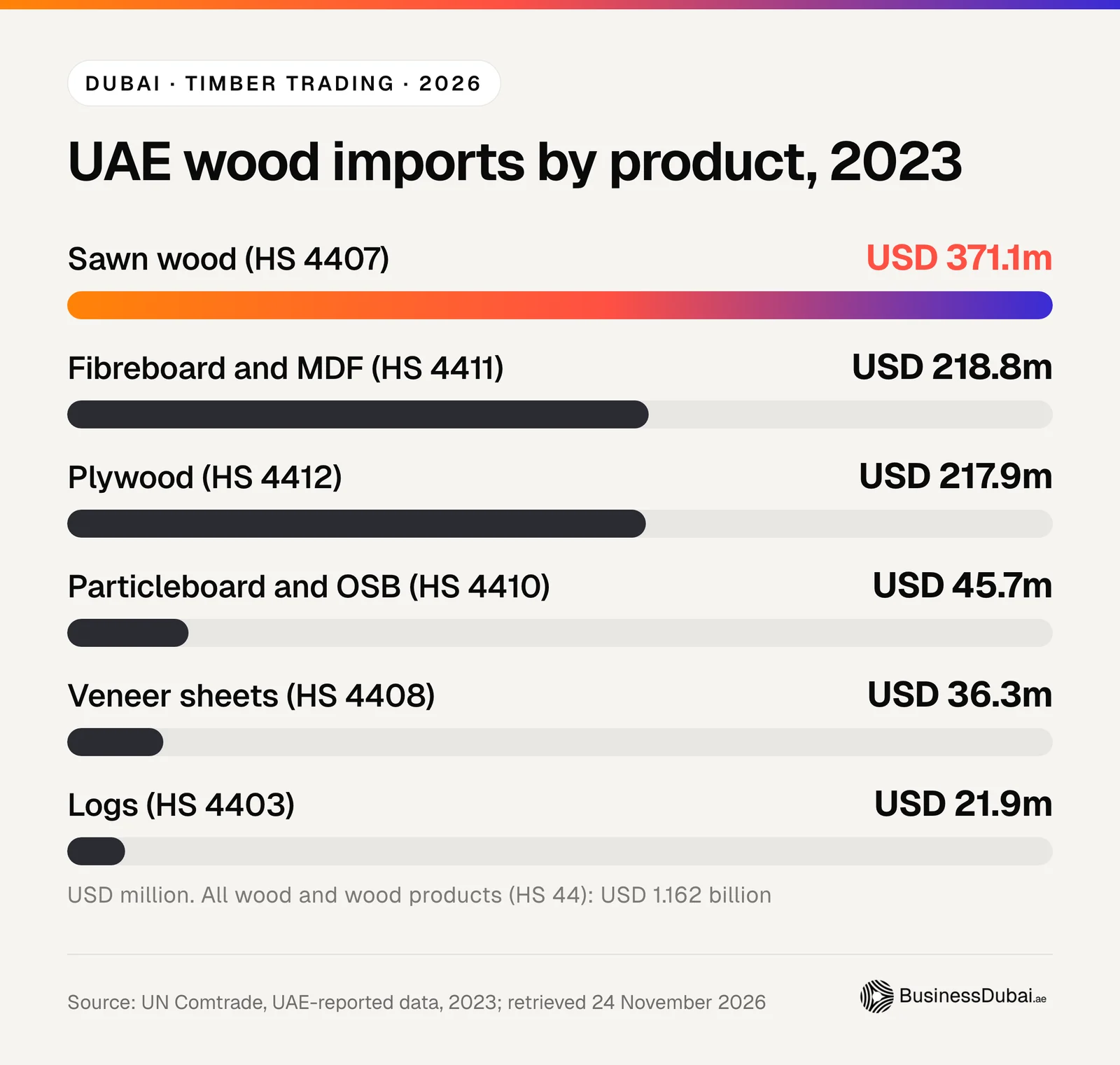
The UAE imported USD 1.162 billion of wood and wood products (HS chapter 44) in 2023, after USD 1.171 billion in 2022 and USD 1.014 billion in 2021, on UN Comtrade data reported by the UAE. Sawn wood led at USD 371.1 million, followed by fibreboard including MDF at USD 218.8 million and plywood at USD 217.9 million.
The six headings a timber trader licenses for, as Comtrade reports them for 2023 [1]:
| Product (HS heading) | Imports 2023 (USD million) | Weight (tonnes) |
|---|---|---|
| Sawn wood, thicker than 6 mm (4407) | 371.1 | 668,443 |
| Fibreboard including MDF (4411) | 218.8 | 596,741 |
| Plywood and veneered panels (4412) | 217.9 | 409,395 |
| Particleboard and OSB (4410) | 45.7 | 80,381 |
| Veneer sheets, 6 mm or less (4408) | 36.3 | 7,770 |
| Logs (4403) | 21.9 | Not reported |
Two readings matter. Panels (MDF, plywood and particleboard) came to USD 482.4 million in 2023, more than sawn wood, yet the DET register has no trading code that names them. And logs were only USD 21.9 million: most timber traders here distribute processed wood, not round logs [1].
The import mix by product is shown below [1].
Re-exports of chapter 44 goods were USD 198.5 million in 2023 [1], the trade exposed to the EU deforestation rules covered later. Comtrade had no 2024 figure in November 2026, so 2023 is the latest full year.
Dubai is not the cheapest place to hold timber. A yard selling mainly to Sharjah factories, or a business needing a large plot for cutting, may do better in a northern emirate, and our business setup in Sharjah page compares those options. Dubai's case rests on its buyers, the contractors, fit-out firms and joinery shops, and on Jebel Ali for re-export.
Which activity code does a timber trader need in Dubai?
A Dubai mainland timber trader needs DET activity 4752001 Timber Trading (old code 514328), in DET's building materials trading group, with no external approval flagged. DET also lists 4752016 Wooden Products Trading for finished items such as doors and windows. No DET trading code names plywood, MDF, particleboard, veneer, logs or pallets.
DET's English description of 4752001 reads in full: "Includes reselling timber prior to cutting into boards, bars or blocks to use in construction or in industry." [2] The Arabic description is wider: it covers reselling timber in its original state or after cutting into boards, strips or blocks ready for construction or industrial use. 4752016 covers finished goods such as doors, windows, staircase fences and false ceilings [2].
The table maps the timber codes in DET's register and in eight free zone lists, as compiled in BusinessDubai.ae's register files on 22 August 2026 [2][8]. A code is valid only in the register that issues it.
| Register | Code | Activity name |
|---|---|---|
| DET (Dubai mainland) | 4752001 | Timber Trading |
| DET | 4752016 | Wooden Products Trading (finished doors, windows, ceilings) |
| DET | 1610001, 1610008 | Plywood Manufacturing; Sawmilling & Planning Of Wood (manufacturing, not trading) |
| Meydan Free Zone | 4752.29, 4663.01, 4663.02 | Timber Trading; Wholesale Of Wood In The Rough; Wholesale Of Products Of Primary Processing Of Wood |
| IFZA and DMCC | 4752001 | Timber Trading |
| JAFZA | 514328, plus 201000, 201001, 201003 | Timber Trading, plus sawmilling, plywood industries and wood drying |
| DAFZ | 4663-001, 4663-002 | Timber Trading; Wood products trading |
| Ajman Free Zone | 4663001 | Timber trade - Import & Export |
| RAKEZ | 514328, 4663001 | Timber Trading; Timber trade - Wholesale |
| SPC Free Zone (Sharjah) | 4752.29, 4651.28, 4663.01, 4663.02 | Timber Trading; Wholesale of Wood Products Trading; rough wood; primary processed wood |
Hamriyah Free Zone and SAIF Zone lists were not checked for this guide, so ask either zone for its current list.
The panel gap: plywood, MDF and particleboard
The only DET activity that names panels is a manufacturing one, 1610001 Plywood Manufacturing: "Includes the manufacture of cross-wood boards, plywood boards, pressed granular wood boards, wood paste boards(MDF), or other types of wood boards." [2]
A panel importer on the mainland has two possible readings. The Arabic text of 4752001, which includes cut boards, may stretch to plywood and MDF, or a general building materials trading code may fit better; our building materials trading guide sets those codes out. Neither reading is confirmed. Ask DET in writing, naming the products and their HS headings (4410 particleboard, 4411 MDF, 4412 plywood), which code covers them, and keep the answer on file. In a free zone, the wholesale codes for primary processed wood sound closer to panels [8], but get the same written confirmation from the zone.
Cutting, planing and drying are separate activities
Sawmilling & Planning Of Wood (1610008) and Wood Drying & Processing (1610006) are manufacturing activities in DET's register [2], and JAFZA carries 201000 and 201003 for the same work [8]. A yard that saws, planes or kiln-dries needs the matching activity and a workshop's premises and fire requirements. Our furniture manufacturing guide covers that side.
Common Mistake: Licensing on 4752001 and assuming it covers MDF and plywood because both are "wood". DET's English description stops at timber "prior to cutting into boards", and no DET trading code names panels [2]. Fixing the activity after trading starts means a licence amendment while stock is already on the water. One written question to DET before licensing, with your HS headings attached, avoids it.
Should a timber trader choose the Dubai mainland or a free zone?
A timber trader selling to Dubai contractors, fit-out firms and joinery shops usually fits the Dubai mainland, at AED 18,200 without a visa or AED 26,900 with one on BusinessDubai.ae's packages. A re-exporter holding stock fits a Designated Zone such as JAFZA or Ajman Free Zone. Meydan Free Zone starts at AED 12,500 licence only.
The deciding questions are who pays you and where the wood sits. A Dubai free zone company selling to mainland buyers needs a mainland route, such as a branch or a mainland distributor. A mainland company has no such limit, but no route to the 0% free zone rate either. Our free zone company setup page compares the zones on those points, and our mainland company setup page itemises the DET route, including the renewal the headline price leaves out.
The comparison uses BusinessDubai.ae's 2026 package prices [23] and the Designated Zone annex to Cabinet Decision No. 59 of 2017 [9].
| Factor | Dubai mainland (DET) | Dubai desk zone (Meydan, Dubai South, IFZA) | Designated Zone (JAFZA, Ajman Free Zone) |
|---|---|---|---|
| Licence only | AED 18,200 | AED 12,500 (Meydan, Dubai South); AED 12,900 (IFZA) | AED 5,555 at Ajman Free Zone (non-Dubai); JAFZA quotes directly |
| Licence with one visa | AED 26,900 | AED 21,850; AED 22,200 at IFZA | AED 13,931 at Ajman Free Zone |
| Selling to Dubai contractors | Direct | Through a mainland route | Through a mainland route |
| Designated Zone | Not applicable | Meydan and IFZA are not | Both are on the annex |
| Route to 0% corporate tax | None | Qualifying Commodities only, uncertain for timber | Designated Zone distribution, plus the commodities question |
| Year-two renewal | About AED 15,000 | Roughly 80% of year one | Roughly 80% at Ajman; JAFZA quotes directly |
The mainland is simpler for local supply, and a Designated Zone is stronger for holding stock and re-exporting. A trader doing both can run a Designated Zone stockholding company and a mainland company that buys from it.
Real Talk: IFZA and Meydan Free Zone now require a shareholder applying for an investor visa to show capital of at least AED 75,000 in a bank account, in the UAE or in the home country [23]. No package price shows it, so have it in place before you apply.
Common Mistake: Believing a mainland timber trader needs a UAE national partner holding 51%. That rule was removed for most commercial activities by Federal Decree-Law No. 26 of 2020 and Federal Decree-Law No. 32 of 2021. Pages that still quote it push founders into a free zone they did not need, and away from the Dubai contractors who are their buyers.
Which free zone suits a timber trader?
JAFZA suits a timber importer or re-exporter that needs land and port access, and it is a VAT Designated Zone, but BusinessDubai.ae has no JAFZA package. Meydan Free Zone and IFZA are the cheapest Dubai desks, at AED 21,850 and AED 22,200 with one visa. Ajman Free Zone, also a Designated Zone, costs AED 13,931 with one visa.
The table uses BusinessDubai.ae's 2026 package prices where we have one [23] and the Cabinet Decision annex where checked [9]; each zone's timber codes are in the activity code table above.
| Zone | Emirate | BusinessDubai.ae package, AED (licence / 1 visa / 2 visas) | Designated Zone | Best fit |
|---|---|---|---|---|
| Meydan Free Zone | Dubai | 12,500 / 21,850 / 28,400 | No | Trading desk using third-party storage |
| Dubai South | Dubai | 12,500 / 21,850 / 28,400 | Confirm in writing | Trading desk; confirm the timber code |
| IFZA | Dubai | 12,900 / 22,200 (partner prices; IFZA publishes none) | No | Low-cost Dubai desk |
| JAFZA | Dubai | No package; the zone quotes directly | Yes | Stockholding importer, re-exporter or processor |
| DMCC, DAFZ | Dubai | Not priced here | DMCC is not on the annex; confirm DAFZ | Trading office |
| Ajman Free Zone | Ajman | 5,555 / 13,931 / 17,971 | Yes | Lower-cost stockholding and re-export outside Dubai |
| RAKEZ | Ras Al Khaimah | 6,010 / 12,810 / 18,810 | Confirm with the zone | Low-cost trader outside Dubai |
| SPC Free Zone | Sharjah | 5,765 / 15,055 / 19,505 | Confirm with the zone | Low-cost desk with four wood codes |
| Hamriyah, SAIF Zone | Sharjah | No package | Confirm with the zone | Ask the zone directly |
BusinessDubai.ae has no JAFZA, Hamriyah, SAIF Zone or Dubai Industrial City package, so those zones quote their licence, land and warehouse costs directly. Our JAFZA free zone setup guide covers its facilities, and our Hamriyah Free Zone guide covers that Sharjah zone. Ajman Free Zone is the lower-cost Designated Zone, covered in our Ajman Free Zone guide, and if an Ajman base works for your buyers, our business setup in Ajman page shows what each Ajman package includes.
Quick Math: A timber desk with the founder and one sales manager on visas costs AED 28,400 at Meydan Free Zone and AED 17,971 at Ajman Free Zone on BusinessDubai.ae's 2026 packages [23], a gap of AED 10,429 in year one. Ajman is not Dubai, and a Dubai contractor buying from either still needs a proper mainland route. Choose on where the stock sits and who buys it, then compare price.
How does a timber shipment clear customs and MOCCAE in Dubai?
A raw timber shipment into Dubai needs a phytosanitary certificate from the exporting country and a heat treatment certificate or declaration, then a MOCCAE release at AED 200 per request. Listed species also need CITES documents, and Dubai Customs charges 5% of the CIF value. Whether panels need the MOCCAE release is not settled by the published wording.
What MOCCAE's release covers
MOCCAE's release service covers, in its machine-translated English text, "raw timber (timber that is not subject to the following manufacturing processes: coking, multi-mode, With a thickness of less than 6 mm)" [4]. For raw wood consignments it asks for a "Heat Treatment Certificate (For woods), Or to be mentioned in the additional declaration clause in the phytosanitary certificate" [4].
The wording suggests that plywood, MDF and veneer thinner than 6 mm may sit outside "raw timber", but that is a reading of a machine translation, not a ruling. Our furniture manufacturing guide covers the AED 200 release fee and the inspection in full.
Pro Tip: Before the first panel shipment, send MOCCAE a written question naming the product (for example 18 mm MDF under HS 4411, or 9 mm plywood under HS 4412), the origin and your supplier's documents, and ask whether the AED 200 release and the heat treatment certificate apply. Keep the reply with your import file.
CITES documents at the border
For listed species, MOCCAE issues a CITES import certificate at AED 300, "issued for a single shipment", valid for one year and covering "a maximum four species only", under Federal Law No. 11 of 2002 [10]. For processed plant products, the same page says: "Only CITES Export or Re-export Certificates issued by the exporting country are required" [10]. Which of your products MOCCAE treats as processed is a question to put to MOCCAE with your species list.
Duty, tariff lines and product standards
Dubai Customs' 2025 service guide sets the general rate at "5% of the value CIF (Cost Freight Insurance) value except for alcohol and cigarettes/tobacco" [6]. The UAE tariff amendment list published by JETRO in December 2024 shows chapter 44 lines for logs, sawn wood and plywood at 5%, and wood charcoal at 0% [11]. No GCC anti-dumping duty on wood products appeared in the sources read for this guide, and MoIAT's regulated-products sheet has no wood, plywood or MDF row, so no conformity certificate route was found for panels [12]. Confirm all three with your clearing agent for your exact tariff line and origin before you price a contract.
You also need a Dubai Customs client code before the first shipment: our Dubai Customs registration guide covers the steps, and our bonded warehouse guide explains when holding stock under customs control helps with duty. This guide states no UAE rule on ISPM 15 marks for wooden pallets and crates, because no official UAE source confirming one was found; ask MOCCAE.
The fees are small, and the cost table below collects them. A missing document is not small: the consignment waits at the port while port and storage charges keep running.
Which timbers are CITES-listed, and what does that mean for a trader?
Under the CITES Appendices valid from 5 March 2026, Brazilian rosewood (Dalbergia nigra) is in Appendix I, and all other rosewoods, including Indian shisham, are in Appendix II with plywood covered. African padauk, afrormosia, African mahogany, doussie, Spanish cedar and big-leaf mahogany are also Appendix II. Teak is not listed.
An Appendix II listing does not ban trade: the exporting country must issue a CITES document, and the listing's annotation says which parts are controlled. The table uses the Appendices valid from 5 March 2026 as published in the Netherlands Treaty Series, Tractatenblad 2026 No. 100 [3]; the CITES website blocked our requests, so check each species against the live Appendices before you order.
| Timber (scientific name) | Trade names | Appendix | Parts controlled (annotation) |
|---|---|---|---|
| Dalbergia nigra | Brazilian rosewood | I | All specimens; no annotation |
| Dalbergia spp. | Rosewoods, including Indian shisham (Dalbergia sissoo) | II | #15: all parts and derivatives, including veneer and plywood, with exclusions such as finished products up to 10 kg |
| Guibourtia demeusei, pellegriniana, tessmannii | Bubinga, kevazingo | II | #15 |
| Pterocarpus spp. (African populations only) | African padauk | II | #17: logs, sawn wood, veneer sheets, plywood and transformed wood |
| Pterocarpus santalinus | Red sanders | II | #7: logs, woodchips, powder and extracts |
| Pericopsis elata | Afrormosia | II | #17 |
| Afzelia spp. (African populations only) | Doussie | II | #17 |
| Khaya spp. (African populations only) | African mahogany | II | #17 |
| Dipteryx spp. | Cumaru | II | #17 |
| Cedrela spp. (Neotropical populations) | Spanish cedar | II | #6: logs, sawn wood, veneer sheets and plywood |
| Swietenia macrophylla (Neotropical populations) | Big-leaf mahogany | II | #6 |
| Swietenia mahagoni | Caribbean mahogany | II | #5: logs, sawn wood and veneer sheets |
| Gonystylus spp. | Ramin | II | #4: all parts and derivatives, with exceptions |
| Aquilaria spp., Gyrinops spp. | Agarwood (oud) | II | #14: all parts and derivatives, with exceptions |
| Diospyros spp. (Madagascar populations only) | Madagascar ebony | II | #5 |
| Paubrasilia echinata | Pernambuco | II | #10, zero quota for wild-harvested commercial trade |
| Quercus mongolica, Pinus koraiensis, Fraxinus mandshurica | Mongolian oak, Korean pine, Manchurian ash | III (listed by the Russian Federation) | #5: logs, sawn wood and veneer sheets |
| Tectona grandis | Teak | Not listed | None |
The rosewood annotation #15 excludes, among other things, "finished products to a maximum weight of wood of the listed species of up to 10 kg per shipment" [3]. The Appendices' interpretation note applies the 10 kg to the wood of each annotated Dalbergia or Guibourtia species in each item, not to the shipment's total weight [3], and only finished products qualify. Veneer and plywood are listed parts and derivatives, so rosewood-faced plywood needs the documents.
CoP20, held in Samarkand in late 2025, changed only one timber entry. Pernambuco's annotation #10 now adds: "Zero quota for wild-harvested specimens (source code W) traded for commercial purposes." [3][13] The Netherlands Enterprise Agency (RVO) notes: "Most CoP20 species amendments will enter into force on the 5th of March 2026." [13]
The four groups a general timber trader meets most often are summarised below [3].
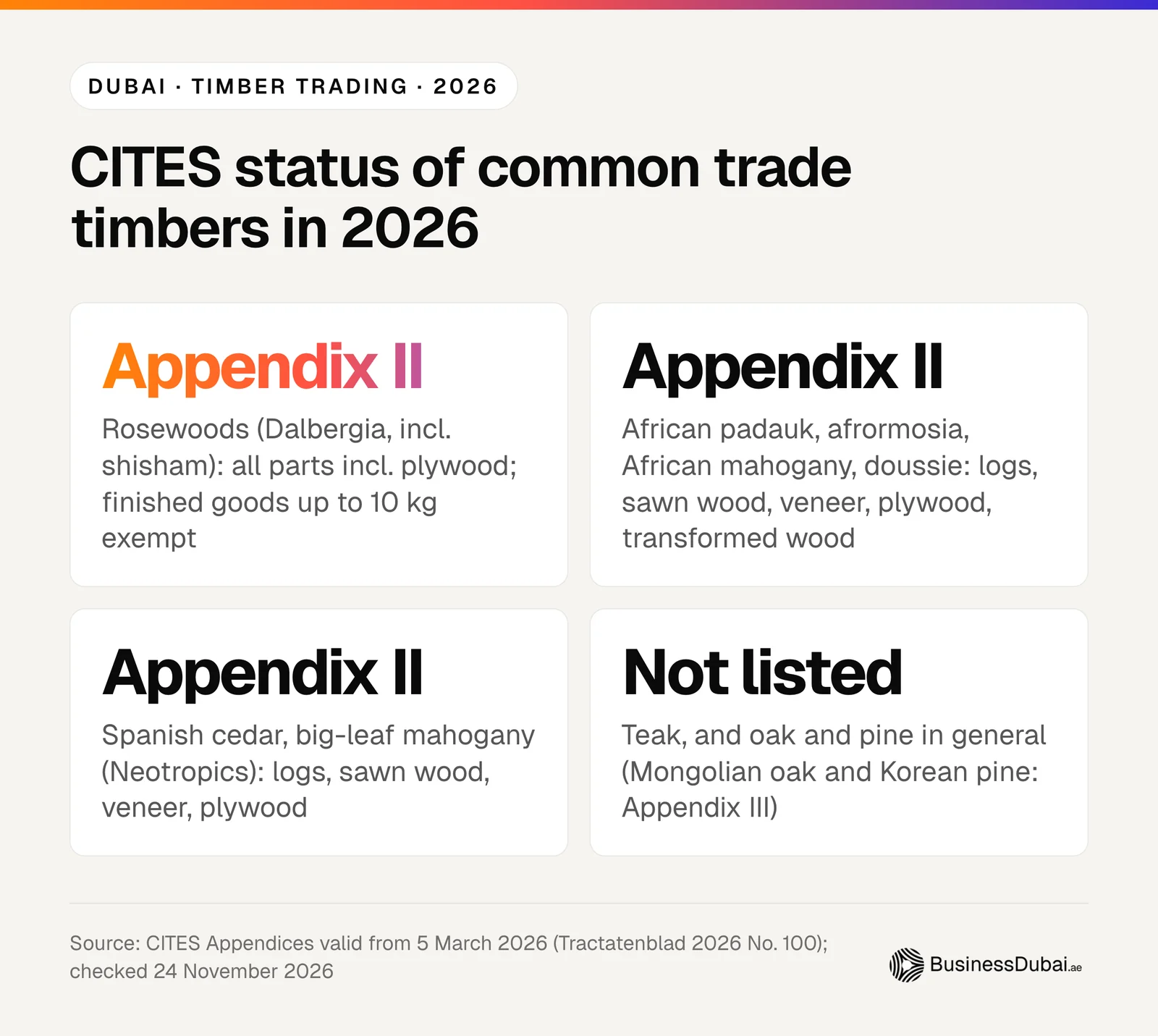
Teak is not in the Appendices we read, and neither are oaks and pines in general, but the table's Appendix III row shows that even they have exceptions [3]. Lignum vitae, palo santo and the rosewood oil tree are also listed in Appendix II, though left out of the table. Listings change at each Conference of the Parties, so check every species before each order.
Real Talk: A CITES check is only as good as the species name on the paperwork. Trade names such as rosewood, mahogany or padauk cover several genera, some listed and some not, and an invoice that says "hardwood" tells MOCCAE nothing. Ask every supplier for the full scientific name on the pro forma, the invoice and the phytosanitary certificate, and match it against the Appendices before you pay. From 30 December 2026 your EU buyers will want the same names anyway [5].
Common Mistake: Taking CITES advice from setup pages that call teak CITES-listed or send importers to a local environment agency for the permit. Teak is not in the Appendices valid from 5 March 2026 [3], the UAE import certificate is a MOCCAE service at AED 300 [10], and the export certificate comes from the exporting country's CITES authority.
What do Dubai building projects demand of timber, plywood and MDF?
Dubai Building Code 2021 requires at least 25% by volume of the timber and timber-based products permanently installed in a building to come from a certified or accredited source approved by Dubai Municipality, and limits added urea-formaldehyde in interior composite timber. Al Sa'fat makes both mandatory for new buildings and optional for private villas.
The two clauses sit in Part B of the Dubai Building Code 2021, the edition read for this guide; check the current revision before quoting a clause to a client. Clause B.10.6.5, headed "Composite timber products", reads: "For composite timber products used in the interior of the building, the percentage of added urea-formaldehyde resins shall be within the limit prescribed by the Authority." [7] Clause B.10.6.6 reads: "Based on volume, at least 25% of timber and timber-based products used during construction, and permanently installed in the building, shall be from a certified/ accredited source, approved by the Authority." [7]
Dubai Municipality's green building system, Al Sa'fat (second edition, January 2023), requires all new buildings to follow both clauses through its requirements 701.02 and 701.08, which are optional for private villas [14]. It defines composite wood products as "Products such as plywood, panel substrates, door cores, particleboard and medium density fiberboard." [14] That definition is the panel trader's whole range.
The numeric formaldehyde limit "prescribed by the Authority" was not in the texts read for this guide, so this guide names no E1, E0 or other grade as a Dubai rule.
The obligations sit on the building and its contractors, not on the trader. Our inference, not a rule, is that they flow down the supply chain: a contractor with a 25% certified-timber target and an interior formaldehyde limit will ask its plywood and MDF supplier for certification and formaldehyde data. Our building materials trading guide covers Dubai Municipality's product approvals, and our construction company setup guide covers the contractor's side.
Pro Tip: Keep the chain-of-custody certificate, the supplier's certificate number and any formaldehyde test report for each batch, filed against the bill of lading and invoice. A contractor proving 25% certified timber by volume [7] needs volumes per delivery, and a batch you cannot document is one it cannot count. Confirm with Dubai Municipality which certification schemes it approves before you advertise a product as compliant.
What do the EU deforestation rules mean for a Dubai timber re-exporter?
The EU Deforestation Regulation applies to large and medium EU operators from 30 December 2026, and to micro and small ones from 30 June 2027, except for timber products already covered by the EU Timber Regulation, which follow the December 2026 date. A Dubai re-exporter's EU buyer needs species names, country of production and every harvest plot's geolocation.
The rules are in Regulation (EU) 2023/1115 as amended by Regulation (EU) 2025/2650, read in the EUR-Lex consolidated text of 18 September 2026 [5][15]. Article 38 reads: "Articles 3 to 13, Articles 16 to 24 and Articles 26, 31 and 32 shall apply from 30 December 2026." [5] Micro and small operators established by 31 December 2024 apply them from 30 June 2027, except for products covered by the old EU Timber Regulation, for which 30 December 2026 applies [5][16].
Which wood products are in scope, and what the buyer must hold
Annex I covers the wood headings a Dubai trader handles, including ex 4403 (logs), 4407 (sawn wood), 4408 (veneer), 4410 (particleboard and OSB), 4411 (fibreboard) and 4412: "Plywood, veneered panels and similar laminated wood (not including used products and second-hand products)" [5]. Under Article 3, such products may enter the EU market only if they are deforestation-free (for wood, harvested without forest degradation after 31 December 2020), legally produced and covered by a due diligence statement [5].
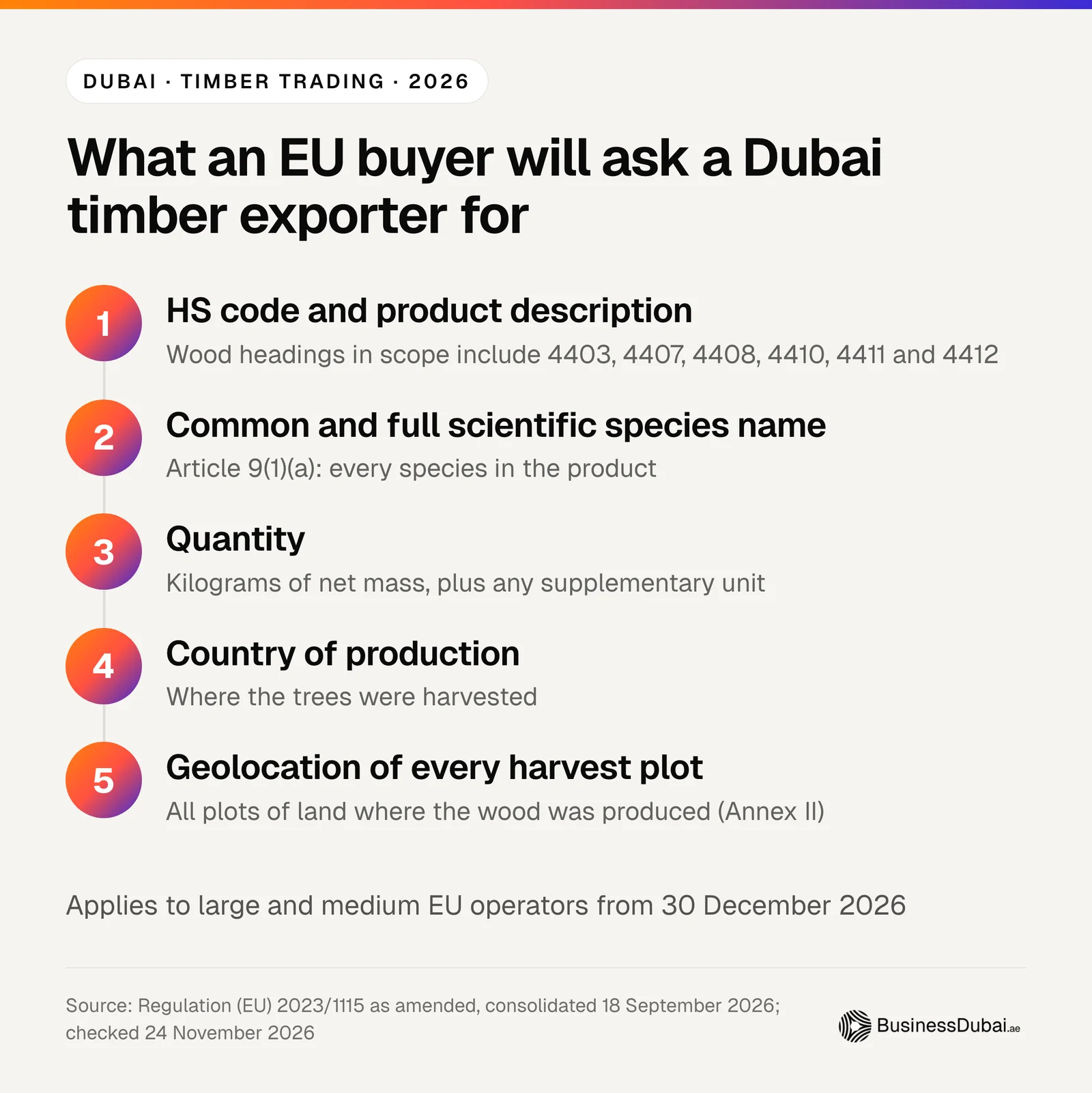
The operator's records must include "the common name of the species and their full scientific name" (Article 9(1)(a)), and the due diligence statement must give the HS code, a description, the quantity in kilograms of net mass and the "Country of production and the geolocation of all plots of land where the relevant commodities were produced." [5] The data an EU buyer will ask a Dubai exporter for is set out below [5].
Where a Dubai company sits
The Regulation defines an operator as a person who places relevant products on the EU market or exports them [5]. A UAE company without an EU presence is normally not that operator; its EU importer is. But the importer cannot file without the data, so a Dubai re-exporter must obtain plot-level origin data from its own suppliers.
Processing in Dubai does not help. On our reading of the Regulation, which defines "produced" as grown or harvested on plots of land [5], the country of production is where the trees were harvested, not where the wood was sawn or pressed into panels. Take EU counsel's view before you sign an EU supply contract.
Real Talk: Stock that mixes sawn timber from several origins in one stack will be very hard to sell into the EU after 30 December 2026, because the buyer needs the plots behind every board. If the EU matters to you, keep EU-bound stock separate from the day it lands, buy it only from suppliers who contract to deliver geolocation and species data, and price that handling into the EU order.
Where can a timber trader keep a yard or warehouse, and what does Civil Defence require?
A timber trader's warehouse or yard in Dubai needs Civil Defence approval under the UAE Fire and Life Safety Code. The 2011 edition, the only text this guide could read, treats wood as ordinary warehouse goods and sets no specific rule on timber stack sizes or outdoor yards. Dubai Industrial City offers open yards, though BusinessDubai.ae has no package there.
The 2011 edition of the UAE Fire and Life Safety Code of Practice defines a warehouse as space for storing goods including "paper, wood, metal and other materials which are classified as non-hazardous material" [17]. A later edition exists and is the one Civil Defence applies, so this guide gives no compartment sizes, stack heights, aisle widths or hydrant thresholds. Instead:
- Approve the premises. Get Civil Defence approval of the warehouse or yard before stock moves in.
- Use an approved professional. Appoint a Civil Defence-approved fire consultant or contractor to design detection, suppression and storage layout from the current code.
- Declare any processing. Cutting, planing or drying on site changes the activity, which can change both the licence and the fire classification.
For location, Dubai Industrial City advertises open yards "for storing construction materials, equipment, and vehicles" [18]. BusinessDubai.ae has no Dubai Industrial City package, so the zone quotes directly. JAFZA leases land and warehouses beside Jebel Ali Port, and a desk zone company can use a third-party warehouse. Get the landlord's written confirmation that timber storage is permitted before you sign.
Common Mistake: Designing a yard around stacking heights and aisle widths quoted on setup websites, such as a 4 metre stack and 2 metre aisles. No such figure for timber appears in the Fire and Life Safety Code text read for this guide [17], and Civil Defence approves the design your consultant submits from the current edition. Ask the consultant for the code clause behind every dimension.
Can a free zone timber trader pay 0% corporate tax?
A free zone timber trader reaches 0% only as a Qualifying Free Zone Person with qualifying income. Two routes might apply: Trading of Qualifying Commodities, where it is unclear whether timber counts, and distribution from a Designated Zone such as JAFZA or Ajman Free Zone to customers who resell or process. Mainland traders pay ordinary rates.
Route one: Trading of Qualifying Commodities
Ministerial Decision No. 229 of 2025 defines the category this way [19]:
"Qualifying Commodities: Means the following commodities provided a Quoted Price for such commodities exists: 1. Metals, minerals, industrial chemicals, energy and agriculture commodities and Associated By-products, excluding products packaged for retail sale and any other products specified in a decision issued by the Minister."
The same article defines a Quoted Price as the "Price of the Qualifying Commodity or a Related Commodity specified by a Recognised Commodity Exchange Market or a recognised price reporting agency specified by a decision issued by the Minister." [19] A Related Commodity is "Any commodity that is listed in the same chapter in the Common Schedule for Classification and Coding of Goods as a Qualifying Commodity that has a Quoted Price." [19] A Recognised Commodities Exchange Market begins "Any commodities exchange market established in the State that is licensed and regulated by the relevant Competent Authority", then extends to foreign exchanges and any the Minister names [19].
Ministerial Decision No. 230 of 2025 lists Fastmarkets among the recognised price reporting agencies [20]. Fastmarkets' own pages offer "Access 2,000+ wood product prices", "more than 1,600 wood and lumber prices", and timber prices for "sawlogs, pulpwood, wood chips, biomass, stumpage and delivered wood fiber" [21], mostly North American and European softwood and panels. Three questions stay open, and this guide draws no conclusion on them:
- Is timber among the "agriculture commodities"? The definition does not name wood, timber or lumber [19].
- Is there a Quoted Price for what you sell? Whether a Fastmarkets assessment of North American lumber or panels prices the hardwood, plywood or MDF a Dubai trader sells, directly or as a Related Commodity in chapter 44, has not been ruled on.
- Does a stockholding yard pass the 51% test? Article 2(3)(c) excludes a Qualifying Free Zone Person whose "Revenue from distribution, warehousing, logistics or inventory management functions constitutes 51% (fifty one percent) or more of their Revenue for the relevant Tax Period." [19]
Our rice and grains trading guide works through the same definitions for a commodity with a clearer exchange price.
Route two: distribution in or from a Designated Zone
Article 2(1)(l) makes "Distribution of goods or materials in or from a Designated Zone" a qualifying activity where the goods are imported through the zone and supplied to "A customer who resells, processes or alters such goods or materials, or parts thereof for the purposes of sale or resale" or to a public benefit entity [19]. It has no Quoted Price test and no 51% condition.
Selling to joinery shops and furniture factories, which process the wood into products for sale, fits that wording better than selling to end users; a contractor installing timber in a client's building is a harder case. The route needs a Designated Zone: JAFZA and Ajman Free Zone are on the annex, Meydan Free Zone and IFZA are not [9].
Quick Math: Non-qualifying revenue must stay within the lower of 5% of total revenue or AED 5,000,000 [19]. A free zone timber trader with AED 20,000,000 of revenue has a cap of AED 1,000,000, because 5% of its revenue is lower than AED 5,000,000. If more than AED 1,000,000 comes from sales that do not qualify, such as direct sales to homeowners, the company fails the condition for that period.
Real Talk: A company that fails a condition is taxed at ordinary rates, 0% up to AED 375,000 and 9% above, from the start of that tax period, and cannot return for the following four periods [19][23]. For a timber trader, plan on ordinary rates or Small Business Relief and treat 0% as upside to be proven in writing first.
If you want your trading model tested against both routes before you choose a zone, model your tax position→
How is a mainland timber trader taxed, and how does VAT work?
A Dubai mainland timber trader pays corporate tax at 0% on taxable income up to AED 375,000 and 9% above, or can elect Small Business Relief while revenue stays at or under AED 3,000,000, for tax periods ending on or before 31 December 2029. VAT at 5% applies to local timber, plywood and MDF sales once the company is registered.
Small Business Relief runs to tax periods ending on or before 31 December 2029 under Ministerial Decision No. 73 of 2023 as amended by Ministerial Decision No. 131 of 2026 [22], and a Qualifying Free Zone Person cannot also claim it. The table sets the routes side by side [19][22][23].
| Tax route | What the rule says | Fit for a timber trader |
|---|---|---|
| Ordinary rates | 0% up to AED 375,000 of taxable income, 9% above | Mainland traders and any free zone company that does not qualify |
| Small Business Relief | Revenue at or under AED 3,000,000; periods ending on or before 31 December 2029 | A small yard or distributor in its early years |
| Trading of Qualifying Commodities, Article 2(1)(c) | Quoted Price exists; not retail-packed; distribution, warehousing, logistics or inventory revenue under 51% | Unresolved for timber; needs written advice |
| Designated Zone distribution, Article 2(1)(l) | Imported through a Designated Zone; sold to a customer who resells, processes or alters | JAFZA or Ajman Free Zone traders selling to joinery shops, factories and re-export buyers |
| Failing a condition | Ordinary rates from the start of that period; barred for the next four | The cost of a claim that does not fit |
Quick Math: A Dubai mainland timber trader with AED 1,000,000 of taxable profit pays nothing on the first AED 375,000 and 9% on the remaining AED 625,000, which is AED 56,250 of corporate tax [23]. With revenue of AED 3,000,000 or less, Small Business Relief would take that to nil for periods ending by 31 December 2029 [22], so check revenue before profit.
VAT is charged at 5% on local sales of timber, plywood and MDF, with mandatory registration above AED 375,000 of taxable supplies a year and voluntary registration from AED 187,500 [9][23]; exports can be zero-rated when the evidence rules are met [9]. Our VAT registration and compliance guide, Qualifying Free Zone Person guide and Small Business Relief guide cover each regime in full.
How much does it cost to start a timber trading company in Dubai?
A Dubai timber trading company costs AED 12,500 licence only or AED 21,850 with one visa at Meydan Free Zone or Dubai South on BusinessDubai.ae's 2026 packages, and AED 18,200 without a visa or AED 26,900 with one on the Dubai mainland. Each shipment then adds AED 200 per MOCCAE release, AED 300 per CITES certificate and 5% duty.
The table itemises the setup lines on a stated visa basis, then the per-shipment and premises lines outside every package. Package figures are BusinessDubai.ae's 2026 prices [23]; government fees are from MOCCAE and Dubai Customs [4][10][6].
| Cost item | Amount (AED) | Notes |
|---|---|---|
| Dubai mainland (DET), no visa / one visa | 18,200 / 26,900 | First year; invoices Dubai contractors directly |
| Meydan Free Zone or Dubai South (licence / 1 visa / 2 visas) | 12,500 / 21,850 / 28,400 | The second visa adds AED 6,550 |
| IFZA (licence / 1 visa) | 12,900 / 22,200 | Partner prices; IFZA publishes none |
| Ajman Free Zone, non-Dubai (licence / 1 visa / 2 visas) | 5,555 / 13,931 / 17,971 | A VAT Designated Zone |
| RAKEZ, non-Dubai (licence / 1 visa / 2 visas) | 6,010 / 12,810 / 18,810 | Ras Al Khaimah |
| SPC Free Zone, Sharjah, non-Dubai (licence / 1 visa / 2 visas) | 5,765 / 15,055 / 19,505 | Four wood codes |
| JAFZA, Hamriyah, SAIF Zone, Dubai Industrial City | Zone quote | No BusinessDubai.ae package |
| MOCCAE release, raw timber | 200 per release request | Ask in writing whether panels need it |
| CITES import certificate | 300 per certificate | One shipment, up to four species |
| Customs duty | 5% of the CIF value | Charcoal 0% [11] |
| Yard or warehouse | Landlord quote | Not in any package |
| Civil Defence approval and fire systems | Consultant quote | Not in any package |
| Year two, mainland renewal | About 15,000 | BusinessDubai.ae mainland package |
| Year two, free zone renewal | Roughly 80% of year one | Ask for the standard renewal price, not the launch price |
Packages are company formation only. Yards, warehouses, racking and Civil Defence approvals are separate, and so is the stock, where most starting capital goes. The licence lines differ by a few thousand dirhams, once; duty and premises costs scale with every container.
Quick Math: On a consignment of sawn timber with a CIF value of AED 200,000, duty at 5% is AED 10,000 [6], plus AED 200 for the MOCCAE release [4]. That one duty bill is more than half a year-one mainland licence at AED 18,200 [23]. Ten such consignments a year mean AED 100,000 in duty, which is why the duty position belongs at the centre of the business plan.
For an itemised quote that prices the licence, the visas and the zone that fits your stock, get an itemised setup quote→
In what order should you set up a timber trading company in Dubai?
Setting up a timber trading company in Dubai runs in nine steps: list products by HS heading, confirm the activity code in writing, choose the base, obtain initial approval, secure a Civil Defence-approved yard or warehouse, issue the licence, register with Dubai Customs, set up supplier documents, then register for tax and open the bank account.
- List the products by HS heading. Sawn wood 4407, veneer 4408, particleboard 4410, MDF 4411, plywood 4412, with the species of each.
- Confirm the activity in writing. Ask DET or the zone whether your code covers every product, especially panels.
- Choose the base. Mainland for local supply, a Designated Zone for stock and re-export, a desk zone for back-to-back trading.
- Trade name and initial approval. From DET or the zone.
- Premises and Civil Defence. Lease the yard or warehouse and start Civil Defence approval with an approved consultant.
- Licence issue. Against the approved activities and premises.
- Dubai Customs client code. Before the first shipment is booked.
- Supplier documents. Write phytosanitary and heat treatment documents, CITES certificates and, for EU-bound stock, geolocation data into every purchase contract.
- Tax and banking. Register for corporate tax on time (late registration carries an AED 10,000 penalty [23]), register for VAT at AED 375,000 of taxable supplies, and open the operating account.
Start steps 7 to 9 as soon as the licence is issued. Year two brings the licence and visa renewals, VAT returns and the corporate tax return, and our post-setup services team runs that calendar so a filing does not land in the week a vessel arrives.
Which setup fits your timber business?
The right setup depends on product and buyer. A sawn softwood importer for Dubai construction fits the mainland, a plywood and MDF distributor fits the mainland once DET confirms the code, a tropical hardwood trader needs CITES discipline in any base, and an EU-facing re-exporter needs geolocation data before it needs a zone.
The table maps six common timber businesses to a base, a licence and the rules that bite [2][3][5]; the tax routes are in the tax sections above.
| Business model | Base | Licence codes | Rules that bite |
|---|---|---|---|
| Sawn softwood importer for construction | Dubai mainland | 4752001 | MOCCAE release and heat treatment per shipment; buyers' 25% certified timber target |
| Plywood and MDF distributor | Dubai mainland, or a Designated Zone with a mainland route | 4752001 or a building materials code, once DET confirms | The MOCCAE question on panels; formaldehyde and certification data |
| Tropical hardwood trader | Any base; JAFZA or Ajman Free Zone if holding stock | 4752001, or the zone's timber code | CITES export certificate at origin; MOCCAE import certificate at AED 300 |
| Re-exporter to Africa and Asia | JAFZA or Ajman Free Zone | 514328 at JAFZA; 4663001 at Ajman Free Zone | CITES documents; each destination's packaging rules |
| EU-facing re-exporter | A Designated Zone, EU stock kept separate | As above | Species names, country of production, plot geolocation from 30 December 2026 |
| Timber yard with a cutting service | Mainland industrial premises or JAFZA | 4752001 plus 1610008, or JAFZA 514328 plus 201000 | Civil Defence approval covering machinery and dust |
If your business straddles two rows, the product form and the buyer decide which one wins. Check which setup fits your timber trade→
Real Client Stories
These are composite examples built from the situations timber and panel traders most often face in Dubai. Names and details are illustrative, and the only figures used are published government fees and BusinessDubai.ae's package prices.
The plywood importer who assumed the timber code covered MDF (Dubai mainland)
Karim licensed a Dubai mainland company on DET activity 4752001 Timber Trading, using BusinessDubai.ae's AED 18,200 no-visa package, to import MDF and plywood for joinery shops. He had read timber as covering every wood product. His clearing agent pointed out that DET's English description stops at timber prior to cutting into boards, and that no DET trading code names panels. He wrote to DET with his HS headings, 4411 and 4412, and amended the licence on its answer before the first container sailed. Lesson: put your HS headings to DET in writing before you choose the activity.
The hardwood trader whose padauk had no export certificate (Ajman Free Zone)
Ayo set up in Ajman Free Zone, a Designated Zone, on BusinessDubai.ae's AED 13,931 one-visa package to import African hardwoods for joinery factories. His first order of African padauk sawn wood came from a new supplier who described it as legal and certified. African Pterocarpus is in CITES Appendix II, and annotation #17 covers sawn wood, so the shipment needed the exporting country's CITES export certificate. The supplier had none, and the consignment waited at the port while both sides worked out whether it could be put right. Lesson: make the CITES export certificate, checked against the scientific name, a condition of payment.
The re-exporter whose EU buyer asked for plot geolocation (Meydan Free Zone)
Leena ran a Meydan Free Zone trading company on BusinessDubai.ae's AED 28,400 two-visa package, buying sawn hardwood and plywood from mills in three countries and selling part of it to a Dutch distributor. In autumn 2026 the distributor sent a questionnaire for deliveries after 30 December 2026: full scientific species names, country of production and the geolocation of every plot the wood came from. Two of her mills could supply plot data; the third bought logs from traders and could not. She moved her EU orders to the two mills. Lesson: ask suppliers for plot-level origin data before your buyer asks you.
Start your timber trading company the right way
For a timber trader the licence is the quick part. Three decisions made before the first container decide whether the business works: an activity code that matches what you will actually sell, confirmed in writing when the range includes plywood or MDF; a base that matches where the stock sits and who buys it; and supplier contracts that deliver scientific species names, CITES certificates and, for EU buyers, plot geolocation. If you will sell finished furniture rather than wood, our furniture trading company guide covers that trade.
BusinessDubai.ae has completed 700+ company registrations across the UAE, with itemised pricing and no hidden fees. We will price a free zone company setup against a mainland company setup on the points that differ for a timber trader: who you can invoice, where the yard can sit and whether a 0% claim would survive a review. After launch, our post-setup services team handles the renewals, visas and filings that follow. Talk to a setup expert→
Frequently Asked Questions
What licence do I need to start a timber trading company in Dubai?
A Dubai mainland timber trader needs a DET licence with activity 4752001 Timber Trading, in DET's building materials trading group, with no external approval flagged. Free zones use their own codes, such as Meydan Free Zone's 4663.02 or Ajman Free Zone's 4663001.
Does the Dubai timber trading code cover plywood and MDF?
Not clearly. No DET trading activity names plywood, MDF, particleboard or veneer, and the only DET code mentioning MDF is 1610001 Plywood Manufacturing. Ask DET in writing whether 4752001 or a building materials code covers your panels before you license.
Which free zones list a timber trading activity?
Meydan Free Zone (4752.29, 4663.01, 4663.02), IFZA and DMCC (4752001), JAFZA (514328), DAFZ (4663-001, 4663-002), Ajman Free Zone (4663001), RAKEZ (514328, 4663001) and SPC Free Zone (four wood codes), on each zone's list as compiled on 22 August 2026.
Can I cut timber to size under a trading licence in Dubai?
Not on the trading code alone. Cutting, planing and drying are manufacturing activities in DET's register, such as 1610008 Sawmilling & Planning Of Wood and 1610006 Wood Drying & Processing. Add the matching activity and expect a workshop's premises and Civil Defence requirements.
Can a foreigner own 100% of a timber trading company on the Dubai mainland?
Yes. Since the Commercial Companies Law amendments of 2020 and 2021, most commercial activities, trading included, can be 100% foreign-owned on the Dubai mainland, with no 51% local partner. Free zone companies are 100% foreign-owned as well.
How much does it cost to set up a timber trading company in Dubai?
On BusinessDubai.ae's 2026 packages, a Dubai mainland timber trading company costs AED 18,200 without a visa and AED 26,900 with one, renewing at about AED 15,000. Meydan Free Zone and Dubai South cost AED 12,500 licence only and AED 21,850 with one visa. Yards and Civil Defence approvals are extra.
What is the cheapest package for a timber trader with one visa?
Among the packages in this guide, RAKEZ is lowest at AED 12,810 with one visa, then Ajman Free Zone at AED 13,931 and SPC Free Zone at AED 15,055, none of them in Dubai. The cheapest Dubai one-visa package is Meydan Free Zone or Dubai South at AED 21,850.
Does BusinessDubai.ae have a JAFZA package for timber traders?
No. BusinessDubai.ae has no JAFZA, Hamriyah, SAIF Zone or Dubai Industrial City package, so those zones quote licence, land and warehouse costs directly. JAFZA lists Timber Trading under 514328 and is a VAT Designated Zone.
What documents does raw timber need to clear in the UAE?
Raw timber needs a phytosanitary certificate from the exporting country, a heat treatment certificate or a declaration in the phytosanitary certificate, the bill of lading and the invoice or packing list, then MOCCAE's release at AED 200 per request. Listed species also need CITES documents.
Do plywood and MDF need the MOCCAE agricultural release?
The published wording does not settle it. MOCCAE's machine-translated English describes raw timber as timber not subject to manufacturing processes and mentions a thickness of less than 6 mm, which suggests panels may sit outside. Ask MOCCAE in writing before the first panel shipment.
What customs duty applies to timber, plywood and MDF in Dubai?
Dubai Customs charges the general rate of 5% of the CIF value. The UAE tariff amendment list published by JETRO in December 2024 shows logs, sawn wood and plywood at 5% and wood charcoal at 0%. Confirm your exact tariff line with your clearing agent.
Is there an anti-dumping duty on plywood or MDF in the GCC?
No GCC anti-dumping duty on wood products appeared in the sources read for this guide, as of November 2026. Measures change, so confirm the position for your product and origin with your clearing agent before pricing a contract.
Do wooden pallets need ISPM 15 marking to enter the UAE?
This guide states no UAE rule on ISPM 15 marks, because no official UAE source confirming one was found. Ask MOCCAE for the current requirement on wooden packaging, and check each destination's rules for anything you re-export.
Is teak CITES-listed?
No. Teak (Tectona grandis) is not in the CITES Appendices valid from 5 March 2026. Oaks and pines in general are not listed either, except Mongolian oak and Korean pine, placed in Appendix III by the Russian Federation for logs, sawn wood and veneer.
Does CITES cover rosewood plywood and furniture?
Yes for plywood, usually not for small finished items. Dalbergia rosewoods, including Indian shisham, are in Appendix II under annotation #15, covering all parts and derivatives but exempting finished products with up to 10 kg of the listed wood per shipment. Brazilian rosewood is in Appendix I.
What did CITES CoP20 change for timber traders?
CoP20, held in Samarkand in late 2025, changed one timber entry: pernambuco (Paubrasilia echinata) now carries a zero quota for wild-harvested specimens traded commercially. Most CoP20 amendments entered into force on 5 March 2026.
How much is a CITES import certificate in the UAE?
MOCCAE charges AED 300 for a CITES import certificate, issued for a single shipment, valid one year and covering up to four species. MOCCAE's page says processed plant products need only the exporting country's CITES export or re-export certificate.
Is there a Dubai formaldehyde limit for MDF and plywood?
Dubai Building Code 2021 requires added urea-formaldehyde in interior composite timber to be within the limit prescribed by Dubai Municipality, but the numeric limit was not in the texts read for this guide. Do not treat E1 or E0 as the Dubai rule without written confirmation.
Do I need FSC or PEFC certification to trade timber in Dubai?
Not for the licence. But Dubai Building Code 2021 requires at least 25% by volume of the timber permanently installed in a new building to come from a certified or accredited source approved by Dubai Municipality, so certified stock helps project sales. Confirm which schemes Dubai Municipality approves.
When do the EU deforestation rules apply to timber?
Regulation (EU) 2023/1115, as amended, applies to large and medium operators from 30 December 2026. Micro and small operators follow on 30 June 2027, except for products already covered by the EU Timber Regulation, for which 30 December 2026 applies.
Does a Dubai company have to file an EU due diligence statement?
Normally not: the EU operator is the company placing the timber on the EU market, usually the importer. Its statement needs species names, country of production and plot geolocation, so a Dubai seller must get that data from its own suppliers. Take EU legal advice.
Does cutting timber in Dubai change its origin under the EU rules?
On our reading, no. The Regulation defines produced as grown or harvested on plots of land, so the country of production is where the trees were harvested, not where the wood was cut. Confirm with EU counsel.
Does a timber warehouse or yard in Dubai need Civil Defence approval?
Yes. A timber warehouse or yard needs Civil Defence approval of its fire design under the UAE Fire and Life Safety Code, usually through a Civil Defence-approved consultant or contractor. Cutting or planing on site can change the licence and fire classification, so declare it.
Can a free zone timber trader get 0% corporate tax?
Possibly, but not by default. The routes are Trading of Qualifying Commodities, where it is unclear whether timber counts, and distribution from a Designated Zone such as JAFZA or Ajman Free Zone to customers who resell or process. Non-qualifying revenue must stay within the lower of 5% of revenue or AED 5,000,000.
Is timber a Qualifying Commodity under Ministerial Decision No. 229 of 2025?
The Decision does not say. It covers metals, minerals, industrial chemicals, energy and agriculture commodities with a Quoted Price, without naming timber. Fastmarkets, a recognised agency, publishes wood prices, but whether they price the timber you sell is open. Take written tax advice.
Is VAT charged on timber sales in the UAE?
Yes. Local sales of timber, plywood and MDF carry VAT at 5%, and registration is mandatory once taxable supplies pass AED 375,000 a year. Exports can be zero-rated when the export evidence rules are met.
References
[1] United Nations. UN Comtrade database, UAE-reported trade in HS chapter 44 (wood and articles of wood): imports for 2021, 2022 and 2023, 2023 imports by heading 4403, 4407, 4408, 4410, 4411 and 4412 with net weight, and 2023 re-exports, pulled through the public preview API on 24 November 2026. comtradeapi.un.org
[2] Dubai Department of Economy and Tourism (DET). Business activity list as recorded in the Invest Dubai register, generated 22 August 2026: 4752001 Timber Trading (old code 514328), 4752016 Wooden Products Trading, 1610001 Plywood Manufacturing, 1610008 Sawmilling & Planning Of Wood and 1610006 Wood Drying & Processing, with English and Arabic descriptions and approval flags. app.invest.dubai.ae
[3] Netherlands Treaty Series (Tractatenblad) 2026 No. 100, published 7 September 2026: consolidated English text of CITES Appendices I, II and III valid from 5 March 2026, including the annotations #2 to #17, the interpretation of "10 kg per shipment" and the CoP20 amendments adopted at Samarkand. zoek.officielebekendmakingen.nl
[4] Ministry of Climate Change and Environment (MOCCAE). Release of imported agricultural products consignment: the raw timber scope wording, the phytosanitary and heat treatment documents for raw wood consignments and the AED 200 federal fee; page read 16 November 2026. moccae.gov.ae
[5] European Union. Regulation (EU) 2023/1115 on deforestation-free products, consolidated text of 18 September 2026: Article 2 definitions of operator, deforestation-free and produced, Article 3, Article 9(1), Article 38 dates of application, Annex I wood headings and Annex II due diligence statement contents. eur-lex.europa.eu
[6] Dubai Customs. Dubai Customs Service Guide 2025 (version 9): the general customs duty rate of 5% of the CIF value. dubaicustoms.gov.ae
[7] Dubai Municipality. Dubai Building Code, 2021 edition, Part B: clause B.10.6.5 on composite timber products and clause B.10.6.6 on certified or accredited timber. dmpmedia.dm.gov.ae
[8] Free zone and emirate activity lists for Meydan Free Zone, IFZA, DMCC, JAFZA, DAFZ, Ajman Free Zone, RAKEZ and SPC Free Zone, each zone's own list as compiled in BusinessDubai.ae's register files on 22 August 2026, with Meydan Free Zone's timber trading activity page. meydanfz.ae
[9] Federal Tax Authority. VAT under Federal Decree-Law No. 8 of 2017, including the 5% standard rate, registration thresholds and export zero-rating, and Cabinet Decision No. 59 of 2017 on Designated Zones, as amended, with the annex naming JAFZA and Ajman Free Zone. tax.gov.ae
[10] Ministry of Climate Change and Environment (MOCCAE). Import of a species listed in CITES Appendices: AED 300 import certificate, single shipment, one-year validity, a maximum of four species, exporting-country certificates for processed plant products, and Federal Law No. 11 of 2002; page read 16 November 2026. moccae.gov.ae
[11] Japan External Trade Organization (JETRO). UAE customs duty rate amendment list, 13 December 2024: chapter 44 lines for logs, sawn wood and plywood at 5% and wood charcoal at 0%. jetro.go.jp
[12] Ministry of Industry and Advanced Technology (MoIAT). Regulated products sheet for conformity assessment, checked for wood, plywood, MDF and wood-based panel rows. moiat.gov.ae
[13] Netherlands Enterprise Agency (RVO). Overview of amended CITES Appendices and annotations after CoP20 (version 1.0), and the companion note on CoP20 species changes and their entry into force on 5 March 2026. english.rvo.nl
[14] Dubai Municipality. Al Sa'fat, Dubai Green Building System, second edition, January 2023: requirements 701.02 (certified or accredited timber) and 701.08 (composite wood products), the optional status for private villas, and the definition of composite wood products. dm.gov.ae
[15] European Union. Regulation (EU) 2025/2650 of 19 December 2025 amending Regulation (EU) 2023/1115, including the new dates of application. eur-lex.europa.eu
[16] European Commission, Directorate-General for Environment. EU Deforestation Regulation page: dates of application for large and medium operators and for micro and small enterprises, including those already covered by the EU Timber Regulation; read 24 November 2026. environment.ec.europa.eu
[17] UAE Ministry of Interior, General Command of Civil Defence. UAE Fire and Life Safety Code of Practice, 2011 edition (unofficial copy read), Chapter 13A definition of a warehouse; a later edition is in force and is published by Civil Defence. dcd.gov.ae
[18] Dubai Industrial City. Open yards offering: open yards for storing construction materials, equipment and vehicles; read 24 November 2026. dubaiindustrialcity.ae
[19] UAE Ministry of Finance. Ministerial Decision No. 229 of 2025 Regarding Qualifying Activities and Excluded Activities, issued 28 August 2025: Article 1 definitions of Qualifying Commodities, Quoted Price, Related Commodity and Recognised Commodities Exchange Market; Article 2(1)(l) and 2(3)(c); Article 3 de minimis. mof.gov.ae
[20] UAE Ministry of Finance. Ministerial Decision No. 230 of 2025 on Recognised Price Reporting Agencies, issued 29 August 2025, naming Fastmarkets among the recognised agencies. mof.gov.ae
[21] Fastmarkets. Wood products, lumber prices and timber price pages, read 24 November 2026: the number of wood product and lumber prices covered and the timber products assessed. fastmarkets.com, lumber prices and timber
[22] UAE Ministry of Finance. Ministerial Decision No. 73 of 2023 on Small Business Relief, as amended by Ministerial Decision No. 131 of 2026: the AED 3,000,000 revenue threshold and tax periods ending on or before 31 December 2029. mof.gov.ae
[23] BusinessDubai.ae. Internal pricing data: 2026 package prices for the Dubai mainland, Meydan Free Zone, Dubai South, IFZA (partner prices), Ajman Free Zone, RAKEZ and SPC Free Zone by visa count, the investor visa capital rule at IFZA and Meydan Free Zone, the free zone renewal rule of thumb, and the corporate tax, VAT and penalty figures that accompany those prices. businessdubai.ae